Questions

[3 Mark Question Answer]

🎯

Test yourself on this topic

20 questions · timed · auto-graded

Question 13 Marks
It takes 0.2 s for a pendulum bob to move from the mean position to one end. What is the time period of the pendulum?
Answer
As we know,
Time period = 4 × (time a pendulum bob takes to move from mean position to one end).
Given, Time a pendulum bob takes to move from mean position to one end = 0.2 s
Substituting the value in the equation above we get,
Time taken to complete one oscillation (T) -
= 4 × 0.2 s
= 0.8 s
Hence, time period of the pendulum = 0.8 s
View full question & answer
Question 23 Marks
How do you measure the time period of a given pendulum? Why do you note the time for more than one oscillation?
Answer
Measurement of time period of a simple pendulum:
(i) To measure the time period of a simple pendulum, the bob is slightly displaced from its mean position and is then released. This gives a to and fro motion about the mean position to the pendulum.
(ii) The time 't' for 20 complete oscillations is measured with the help of a stopwatch.
(iii) Time period 'T' can be found by dividing 't' by 20.
To find the time period, the time for the number of oscillations more than 1 is noted because the least count of stopwatch is either 1 s or 0.5 s. It cannot record the time period in fractions such as 1.2 or 1.4 and so on.
View full question & answer
Question 33 Marks
The time periods of two simple pendulums at a place are in the ratio 2:1. What will be the corresponding ratio of their lengths?
Answer
Let $T_1$ and $T_2$ be the time periods of the two pendulums of lengths $I_1$ and $I_2$, respectively.
Then, we know that the time period is directly proportional to the square root of the length of the pendulum.
$
\therefore \frac{T_1}{T_2}=\sqrt{\frac{l_1}{l_2}}
$
or , $\frac{l_1}{l_2}=\left(\frac{T_1}{T_2}\right)^2$
or, $\frac{l_1}{l_2}=\left(\frac{2}{1}\right)^2=4: 1$
View full question & answer
Question 43 Marks
A pendulum completes 2 oscillations in 5 s . What is its time period? If $g =9.8 m s ^{-2}$, find its length.
Answer
Time period $=$ Total time/total no. of oscillations
$ =(5 / 2) s$
$=2.5 s $
Let 'l' be the length. Then,
$T=2 \pi \sqrt{\frac{l}{ g }}$
or, $2.5=2(3.14) \sqrt{\frac{l}{9.8}}$
or, $0.398=\sqrt{\frac{l}{9.8}}$
or , $l=(0.398)^2(9.8)$
or, $I =1.55 m$
View full question & answer
Question 53 Marks
Find the length of a second's pendulum at a place where $g = 10 m s^{-2}$ (Take $\pi = 3.14$)
Answer
Given, $g =10 m / s ^2$ and time period $( T )=2 s$ Let 'l' be the length of the seconds' pendulum.
We know that $T =2 \pi \sqrt{\frac{l}{ g }}$
$ \Rightarrow 2=2 \pi \sqrt{\frac{l}{10}}$
$\Rightarrow \frac{l}{10}=\frac{1}{\pi^2}$
$\Rightarrow l=\frac{10}{(3.14)^2}$
$\Rightarrow I=1.0142 m $
View full question & answer
Question 63 Marks
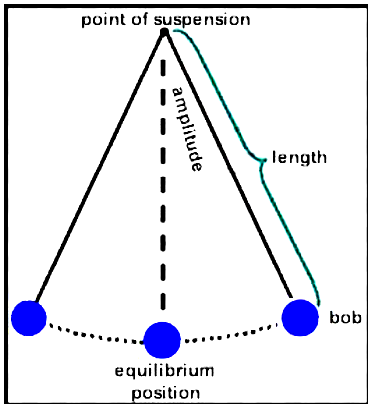
Draw a neat diagram of a simple pendulum. Show on it the effective length of the pendulum and its one oscillation .
Answer
Simple Pendulum :
View full question & answer
Question 73 Marks
State how does the time period of a simple pendulum depend on (a) length of pendulum, (b) mass of bob, (c) amplitude of oscillation and (d) acceleration due to gravity.
Answer
(a) The time period of oscillations is directly proportional to the square root of the length of the pendulum.
(b) The time period of oscillations of simple pendulum does not depend on the mass of the bob.
(c) The time period of oscillations of simple pendulum does not depend on the amplitude of oscillations.
(d) The time period of oscillations of simple pendulum is inversely proportional to the square root of acceleration due to gravity.
View full question & answer
Question 83 Marks
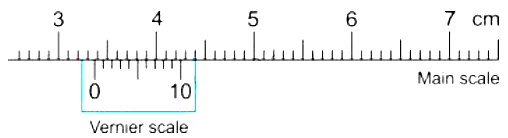
While measuring the length of a rod with a vernier callipers, below shows the position of its scales. What is the length of the rod?
Answer
L.C. of vernier callipers = 0.01 cm
In the shown scale,
Main scale reading = 3.3 mm
$6^{th}$ vernier division coincides with an m.s.d.
Therefore, vernier scale reading = 6 × 0.01 cm = 0.06 cm
Total reading = m.s.r. + v.s.r.
= 3.3 + 0.06
= 3.36 cm
View full question & answer
Question 103 Marks
A microscope is provided with a main scale graduated with 20 divisions in 1 cm and a vernier scale with 50 division on it of length same as of 49 divisions of main scale. Find the least count of the microscope.
Answer
Given :
50 × vernier scale division (vsd) = 49 × main scale division (msd)
∴ 1 vsd = $\frac{49}{50}$msd = 0.98 msd
∴ least count = 1msd - 1 vsd
∴ least count = 1 msd - 0.98 msd = 0.02 msd....(1)
∴ 1 msd = $\frac{1}{20}$ cm = 0.05 cm
⇒ least count = 0.02 × 0.05 cm = 0.001 cm
Thus, the least count of the microscope is 0.001 cm.
View full question & answer
Question 113 Marks
What is backlash error? Why is it caused? How is it avoided?
Answer
Backlash error: If by reversing the direction of rotation of the thimble, the tip of the screw does not start moving in the opposite direction immediately but remains stationary for a part of rotation; it is called backlash error.
Reason: It happens due to wear and tear of the screw threads.
To avoid the backlash error, while taking the measurements the screw should be rotated in one direction only. If the direction of rotation of the screw needs to be changed, then it should be stopped for a while and then rotated in the reverse direction.
View full question & answer
Question 123 Marks
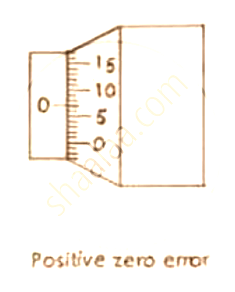
A screw gauge has a least count 0.001 cm and zero error +0.007 cm. Draw a neat diagram to represent it.
Answer
Diagram of a screw gauge with L.C. 0.001 cm and zero error +0.007 cm.
View full question & answer
Question 133 Marks
What do you mean by zero error of a screw gauge? How is it accounted for?
Answer
Due to mechanical errors, sometimes when the anvil and spindle end are brought in contact, the zero mark of the circular scale does not coincide with the base line of main scale. It is either above or below the base line of the main scale, in which case the screw gauge is said to have a zero error. It can be both positive and negative.
It is accounted by subtracting the zero error (with sign) from the observed reading in order to get the correct reading.
Correct reading = Observed reading - zero error (with sign)
View full question & answer
Question 143 Marks
Name the two scales of a vernier callipers and explain how it is used to measure length correct up to 0.01 cm.
Answer
Two scales of vernier calipers are
(a) Main scale
(b) Vernier scale
The main scale is graduated to read up to 1 mm and on vernier scale, the length of 10 divisions is equal to the length of 9 divisions on the main scale.
Value of 1 division on the main scale = 1 mm
Total no. of divisions on the vernier scale = 10
Thus, L.C. = 1 mm /10 = 0.1 mm = 0.01 cm.
Hence, a vernier callipers can measure length correct up to 0.01 cm.
View full question & answer
Question 153 Marks
Explain the meaning of the derived unit with the help of one example?
Answer
The units of quantities other than those measured in fundamental units can be obtained in terms of the fundamental units, and thus the units so obtained are called derived units.
Example:
Speed = Distance/time
Hence, the unit of speed = fundamental unit of distance/fundamental unit of time Or, the unit of speed = metre/second or $ms^{-1}$.
As the unit of speed is derived from the fundamental units of distance and time, it is a derived unit.
View full question & answer
Question 163 Marks
It takes time $8$ min for light to reach from the sun to the earth surface . If speed of light is taken to be $3 \times 10^8 m / s ^{-1}$, find the distance from the sun to the earth in km .
Answer
Given,
Speed of light $=3 \times 10^8 m / s$
Time taken to reach the earth $=8 min =480 s$
We know,
$ \text { Distance }=\text { speed } \times \text { Time }$
$=3 \times 10^8 \times 480$
$=1440 \times 10^8 m =1440 \times \frac{10^8}{10^3} km =1440 \times 10^5 km$
$=1.44 \times 10^8 km $
View full question & answer
Question 173 Marks
Name the three systems of units and state the various fundamentals units in them.
Answer
Three systems of unit and their fundamental units:
  1. C.G.S. system (or French system): In this system, the unit of length is centimeter (cm), unit of mass is gramme (g) and unit of time is second (s).
  2. F.P.S. system (or British system): In this system, the unit of length is foot (ft), unit of mass is pound (lb) and unit of time is second (s).
  3. M.K.S. system (or metric system): In this system, the unit of length is metre (m), unit of mass is kilogramme (kg) and unit of time is second (s).
View full question & answer
Question 183 Marks
Name the three convenient units used to measure length ranging from very short to very long value. How are they related to the S.I unit?
Answer
Three convenient units of length and their relation with the S.I. unit of length:
(1) 1 Angstrom $(\mathring A) = 10^{-10} m$
(2) 1 kilometre $(km) = 10^3 m$
(3) 1 light year $(ly) = 9.46 \times 10^{15} m$
View full question & answer
Question 193 Marks
The wavelength of light of a particular colour is $5800 \mathring A.$
Express it in metre.
Answer
As we know, $1 m=10^{10}$
Given, Wavelength of light $=5800 \mathring A$
Substituting the value of wavelength in the relation above, we get,
$10^{10} \mathring A = 1 m$
$1 \mathring A = 10^{-10} m$
$\therefore 5800 \mathring A = 5800 \times 10^{-10} m$
$\therefore 5800 \mathring A = 5.8 \times 10^{-7} m$
Hence, wavelength of $5800 \mathring A$ in m $= 5.8 \times 10 ^{-7}m.$
View full question & answer
Question 203 Marks
The wavelength of light of a particular colour is 5800 Å.
Express it in nanometre.
Answer
As we know, 1 nm = 10 Å
Given, Wavelength of light of particular colour = 5800 Å
Substituting the value of wavelength in the relation above, we get,
10 Å = 1 nm
1 Å = $\frac{1}{10}$ nm
∴ 5800 Å = $\frac{1}{10}$× 5800 nm
∴ 5800 Å = 580 nm
Hence, wavelength of 5800 Å in nm = 580 nm.
View full question & answer
[3 Mark Question Answer] - PHYSICS STD 9 Questions - Vidyadip