Questions

[3 Mark Question Answer]

🎯

Test yourself on this topic

25 questions · timed · auto-graded

Question 13 Marks
Explain the following : Two holes are made in a completely filled sealed tin can to take out oil from it .
Answer
There is no air inside a completely filled and sealed can. When a single hole is made to drain out the oil from the can, some of the oil will come out and due to that the volume of air above the oil will increase and hence the pressure of air will decrease. But if two holes are made on the top cover of the can, air outside the can will enter it through one hole and exert atmospheric pressure on the oil from inside along with the pressure due to oil column, and it will come out of the can from the other hole.
View full question & answer
Question 23 Marks
QUESIION Assuming the density of air to be $1.295 kg m ^{-3}$, find the fall in barometric height in mm of Hg at a height of 107 m above the sea level. Take density of mercury $=13.6 \times 10^3 kg m ^{-3}$.
Answer
Let $h =107 m$ be the height above sea level
$ \therefore P_h-P_{\text {sea }}=\rho_{\text {air }} g h$
$\therefore \rho_m g h_f-\rho_m g h_i=\rho_{\text {air }} g h$
$\therefore \rho_m g \Delta h=\rho_{\text {air }} g h$
$\therefore \Delta h=\frac{\rho_{\text {air }} h}{\rho_m}=\frac{1.295 \times 107}{13.6 \times 10^3}$
$\therefore \Delta h=0.010 m \text { of Hg }$
$\therefore \Delta h =10 mm \text { of Hg } $
View full question & answer
Question 33 Marks
 At sea level, the atmospheric pressure is $1.04 \times 10^5$ Pa. Assuming $g =10 m s ^{-2}$ and density of air to be uniform and equal to 1.3 $kg m ^{-3}$, find the height of the atmosphere.
Answer
Atmospheric pressure, $P =1.04 \times 10^5 Pa$

Acceleration due to gravity, $g =10 ms ^{-2}$ Density,$\rho=1.3 kgm ^{-3}$

Let $h$ be the height of the atmosphere.
$ P = h \rho g$
$\therefore h =\frac{P}{\rho g}=\frac{1.04 \times 10^5}{1.3 \times 10}=8000 m $
View full question & answer
Question 43 Marks
At sea level, the atmospheric pressure is 76 cm of Hg. If air pressure falls by 10 mm of Hg per 120m of ascent, what is the height of a hill where the barometer reads 70 cm Hg. State the assumption made by you.
Answer
Atmospheric pressure , P = 76 cm Hg
Rate at which pressure falls = 10 mm of Hg per 120 m of ascent = 1 cm of Hg per 120 m of ascent
Let h be the height of the hill.
Pressure at hill , P' = 70 cm Hg
Total fall in pressure = P - P' = (76 - 70) cm Hg = 6 cm Hg
Now , fall in pressure is 1 cm Hg for every 120 m increase in height
Thus , if the fall in pressure is 6 cm Hg , increase in height shall be (6 × 120)m = 720 m
∴ Height of the hill = 720 m
View full question & answer
Question 53 Marks
What is an altimeter? State its principle. How is its scale calibrated?
Answer
An altimeter is a device used in aircraft to measure its altitude. Principle: Atmospheric pressure decreases with the increase in height above the sea level; therefore, a barometer measuring the atmospheric pressure can be used to determine the altitude of a place above the sea level. The scale of altimeter is graduated with height increasing towards left because the atmospheric pressure decreases with increase of height above the sea level.
View full question & answer
Question 63 Marks
At a given place, a mercury barometer records a pressure of $0.70$ m of Hg. What would be the height of water column if mercury in barometer is replaced by water? Take density of mercury to be $= 13.6 \times 10^3 kg m^{-3}.$
Answer
Relative Density of $Hg =1.36=13.6 \times 10^3 kgm ^{-3}$

Acceleration due to gravity, $g =9.8 ms ^{-2}$

Height of mercury column $=0.70 m$
$\therefore$ Pressure, $P = h \rho g$
or, $P=(0.7)\left(1.36 \times 10^3\right)(9.8)$ pascal
or, $P =93.3 \times 10^3 Pa$

Let $h$ be the height of water column

Then , $P = h$ (density of water) $g$
or, $93.3 \times 10^3= h \times 10^3 \times 9.8$\
or, $h =9.52 m$
View full question & answer
Question 73 Marks
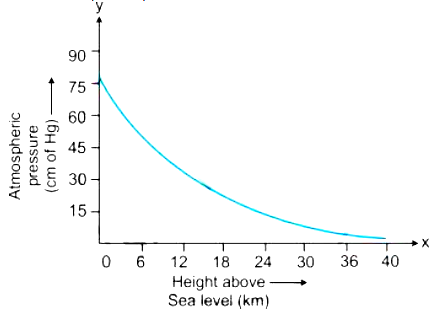
How does the atmospheric pressure change with altitude? Draw an approximate graph to show this variation.
Answer
The atmospheric pressure decreases with an increase in the altitude.
View full question & answer
Question 83 Marks
Mention two demerits of a simple barometer and state how they are removed in a Fortin barometer .
Answer
In a simple barometer, there is no protection for the glass tube but in Fortin's barometer, this defect has been removed by enclosing the glass tube in a brass case. In a simple barometer, a scale cannot be fixed with the tube (or it cannot be marked on the tube) to measure the atmospheric pressure but Fortin's barometer is provided with a vernier calipers to measure the accurate reading.
View full question & answer
Question 93 Marks
How will you show that there is vacuum above the surface of mercury in a barometer? What name is given to this vacuum?
Answer
The space above mercury is a vacuum. This empty space is called 'Torricellian vacuum'. This can be shown by tilting the tube till the mercury fills the tube completely. Again when the mercury column becomes stationary, the empty space is created above the mercury column. If somehow air enters into the empty space or a drop of water gets into the tube, it will immediately vaporize and the air will exert pressure on mercury column due to which the barometric height will decrease.
View full question & answer
Question 103 Marks
Illustrate with the help of a labelled diagram of a simple barometer that the atmospheric pressure at a place is 76 cm of Hg.
View full question & answer
Question 113 Marks
What should be the ratio of area of cross section of the master cylinder and wheel cylinder of a hydraulic brake so that a force of 15 N can be obtained at each of its brake shoe by exerting a force of 0.5 N on the pedal ?
Answer
Let the ratio of area of cross - section of the master cylinder and wheel cylinder be $A_1: A_2$
Force on pedal, $F _1=0.5 N$
Force on break shoe, $F _2=15 N$
By the principle of hydraulic machine,
Pressure on narrow piston $=$ pressure on wider piston
or, $\frac{F_1}{A_1}=\frac{F_2}{A_2}$
or, $\frac{F_1}{F_2}=\frac{A_1}{A_2}$
or , $\frac{A_1}{A_2}=\frac{0.5}{15}$
or,$\frac{A_1}{A_2}=\frac{1}{30}$
Thus, the required ratio is $1: 30$
View full question & answer
Question 123 Marks
In a hydraulic machine, a force of $2 N$ is applied on the piston of area of cross section $10 cm^2$. What force is obtained on its piston of area of cross section $100 cm^2$ ?
Answer
Force on narrow piston , $F_1 = 2N$
Area of cross - section of narrow piston , $A_1 = 10 cm^2$​​​​​​​
Let Force on wider piston be $F_2$​​​​​​​
Area of cross - section of wider piston , $A_2 = 100 cm^2​​​​​​​$
By the principle of hydraulic machine ,
Pressure on narrow piston = pressure on wider piston
or, $\text { or, } \frac{ F _1}{ A _1}=\frac{ F _2}{ A _2}$
$\frac{2}{10}=\frac{ F _2}{100}$
$\text { or, } F _2=20 N $
View full question & answer
Question 133 Marks
How does the pressure exerted by thrust depend on the area of surface on which it acts? Explain with a suitable example.
Answer
Pressure exerted by thrust is inversely proportional to area of surface on which it acts. Thus, larger the area on which the thrust acts, lesser is the pressure exerted by it. Example: If we stand on loose sand, our feet sink into the sand, but if we lie on that sand, our body does not sink into the sand. In both the cases, the thrust exerted on the sand is equal (equal to the weight of the body). However, when we lie on sand, the thrust acts on a large area and when we stand, the same thrust acts on a small area.
View full question & answer
Question 143 Marks
The pressure of water on the ground floor is $40,000 Pa$ and on the first floor is $10,000 Pa$. Find the height of the first floor. (Take density of water $=1000 kg m ^{-3}, g=10 m s ^{-2}$ )
Answer
Pressure of water on ground floor $= 40,000$ pascal
Pressure of water on first floor $= 10,000$ pascal
Density of water , $\rho = 1000 kg m^{-3}$
Acceleration due to gravity , $g = 10 ms^{-2}$
Let h be the height of the first floor.
Difference in water pressure between ground and first floor = hρg
or , $(40,000 - 10,000) = h (1000) (10)$
or , $h = 3 m$
View full question & answer
Question 153 Marks
The area of base of a cylindrical vessel is $300 cm^2$. Water (density= $1000 kg m ^{-3}$ ) is poured into it up to a depth of 6 cm . Calculate : (a) the pressure and (b) the thrust of water on the base. $\left( g =10 m s ^{-2}\right.$.
Answer
Given Area of base of vessel, $a=300 cm^2=300 \times 10^{-4} m^2$
Density of water, $\rho=1000 kg m ^{-3}$
Depth, $h =6 cm=0.06 m$
Acceleration due to gravity, $g=10 ms^{-2}$ (a) Pressure $= h \rho g =0.06 \times 1000 \times 10=600$ pascal
(b) Thrust, $T =$ pressure $\times$ area $=600 \times 300 \times 10^{-4}=18 N$
View full question & answer
Question 163 Marks
 A vessel contains water up to a height of 1.5 m . Taking the density of water $10^3 kg m ^{-3}$, acceleration due to gravity $9.8 m s { }^{-2}$ and area of base of vessel $100 cm^2$, calculate: (a) the pressure and (b) the thrust at the base of vessel.
Answer
Given height, $h =1.5 m$
Density of water, $\rho=10^3 kgm ^{-3}$
Acceleration due to gravity, $g =9.8 m / s ^2$
Area of base of the vessel , $a =100 cm ^2=100 \times 10^{-4} m ^2$
(a) Pressure, $P = h \rho g$
or, $P =1.5 \times 10^3 \times 9.8$
or, $P =1.47 \times 10^4 Nm ^{-2}$
(b) Thrust $=$ Pressure $\times$ area
or , thrust $=1.47 \times 10^4 \times 100 \times 10^{-4} N$
or, thrust $=147 N$
View full question & answer
Question 173 Marks
A block of iron of mass 7.5 kg and of dimensions $12 cm \times 8 cm \times 10 cm$ is kept on a table top on its base of side $12 cm \times 8 cm$. Calculate :
  1. Thrust and
  2. Pressure exerted on the table top
Take $1 kgf = 10 N.$
Answer
$1 kgf = 10 N \therefore g = 10 m s^{-2} 1)$ Thrust is
$F = mg = 7.5 kg \times 10 = 75 N 2)$ Pressure is force per area .
$\therefore P =\frac{ F }{ A _{\text {base }}}=\frac{75}{12 \times 10^{-2} \times 8 \times 10^{-2}}$
$\therefore P = 7812.5 Pa$
View full question & answer
Question 183 Marks
State the laws of liquid pressure.
Answer
Laws of liquid pressure:
(i) Pressure at a point inside the liquid increases with the depth from its free surface.
(ii) In a stationary liquid, pressure is same at all points on a horizontal plane.
(iii) Pressure is same in all directions about a point in the liquid.
(iv) Pressure at same depth is different in different liquids. It increases with the increase in the density of liquid.
(v) A liquid seeks its own level.
View full question & answer
Question 193 Marks
Explain why a gas bubble released at the bottom of a lake grows in size as it rises to the surface of the lake.
Answer
The reason is that when the bubble is at the bottom of the lake, total pressure exerted on it is the atmospheric pressure plus the pressure due to water column. As the gas bubble rises, due to decrease in depth the pressure due to water column decreases. By Boyle's law, PV = constant, so the volume of bubble increases due to decrease in pressure, i.e., the bubble grows in size.
View full question & answer
Question 203 Marks
 A hammer exerts a force of 1.5 N on each of the two nails A and B . The area of cross section of tip of nail A is $2 mm^2$ while that of nail B is $6 mm^2$. Calculate pressure on each nail in pascal.
Answer
Force exerted, $F =1.5 N$
Area of cross - section of tip of nail A, $a_1=2 mm ^2=2 \times 10^{-6} m ^2$
Area of cross - section of tip of nail B, $a_1=6 mm ^2=6 \times 10^{-6} m ^2$
Pressure on nail $A =\frac{ F }{ a _1}=\frac{1.5}{2 \times 10^{-6}}=7.5 \times 10^5$ pascal
Pressure on nail $B =\frac{ F }{ a _2}=\frac{1.5}{6 \times 10^{-6}}=2.5 \times 10^5$ pascal
View full question & answer
Question 213 Marks
What force is applied on a piston of area of cross section $2 cm^2$ to obtain a force 150 N on the piston of area of cross section 12 $cm ^2$ in a hydraulic machine?
Answer
In a hydraulic machine
Pressure on narrow piston = Pressure on wider piston
$\therefore P _1= P _2$
$\therefore \frac{F_1}{A_1}=\frac{F_2}{A_2}$
$\therefore \frac{F_1}{2 \times 10^{-4}}=\frac{150}{12 \times 10^{-4}}$
$\therefore F_1=\frac{150}{12 \times 10^{-4}} \times 2 \times 10^{-4}$
$\therefore F_1=\frac{150}{12} \times 2=25 N $
View full question & answer
Question 223 Marks
Describe a simple experiment to demonstrate that a liquid enclosed in a vessel exerts pressure in all directions.
Answer
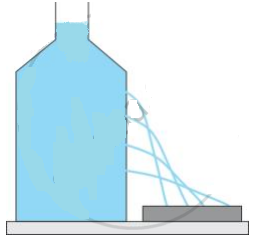
Take a can or large plastic bottle filled with water. Place it on a horizontal surface. Make a series of holes in the wall of the vessel anywhere below the free surface of the liquid. The water spurts out through each hole. This shows that the liquid exerts pressure at each point on the wall of the bottle

Image

Liquid exerts pressure at all points in all directions
View full question & answer
Question 233 Marks
A force of 50 kgf is applied to the smaller piston of a hydraulic machine. Neglecting friction, find the force exerted on the large piston, if the diameters of the pistons are 5 cm and 25 cm respectively.
Answer
Ratio of diameter of smaller piston to bigger piston $=5: 25$
$\therefore$ Ratio of area of smaller piston to bigger piston $=25: 625$
Force applied on smaller piston, $F _1=50 kgf$
Let $F_2$ be the force on the bigger piston .
By the principle of hydraulic machine,
Pressure on narrow piston $=$ pressure on wider piston
or , $\frac{F_1}{A_1}=\frac{F_2}{A_2}$
or , $\frac{F_1}{F_2}=\frac{A_1}{A_2}$
or , $\frac{50}{F_2}=\frac{25}{625}$
or, $F_2=50 \times \frac{625}{25}=1250 kgf$
View full question & answer
Question 243 Marks
(i) The diameter of neck and bottom of a bottle are 2 cm and 10 cm, respectively. The bottle is completely filled with oil. If the cork in the neck is pressed in with a force of 1.2 kgf, what force is exerted on the bottom of the bottle? (ii) Name the law/principle you have used to find the force in part (a).
Answer
(i) Diameter of the neck of the bottle, $d _1=2 cm$
Diameter of the bottom of the bottle, $d _2=10 cm$
Force on the cork in the neck, $F_1=1.2 kgf$
Force on the bottom be $F _2$
By the principle of hydraulic machine,
Pressure on neck $=$ pressure on bottom or,
$\frac{F_1}{A_1}=\frac{F_2}{A_2}$
or,$\frac{1.2}{\pi\left(d_1 / 2\right)^2}=\frac{F_2}{\pi\left(d_2 / 2\right)^2}$
or, $F_2=\frac{1.2}{(2)^2} \times(10)^2=30 kgf$
(ii) Pascal's law has been used to find the force.
View full question & answer
Question 253 Marks
The areas of pistons in a hydraulic machine are $5 cm^2$ and $625 cm^2$. What force on the smaller piston will support a load of 1250 N on the larger piston? State any assumption which you make in your calculation.
Answer
Area of small piston $A_1=5 cm ^2$
Area of wider piston, $A_2=625 cm ^2$
Force on small piston be $F_1$
Force on wider piston or load, $F _2=1250 N$
By the principle of hydraulic machine,
Pressure on narrow piston $=$ pressure on wider piston
or, $\frac{F_1}{A_1}=\frac{F_2}{A_2}$
or , $\frac{F_1}{5}=\frac{1250}{625}$
or, $F_1=\frac{1250}{625} \times 5$
or $F_1=10 N$
Assumption: No friction or leakage of liquid happens .
View full question & answer
[3 Mark Question Answer] - PHYSICS STD 9 Questions - Vidyadip