Question 14 Marks
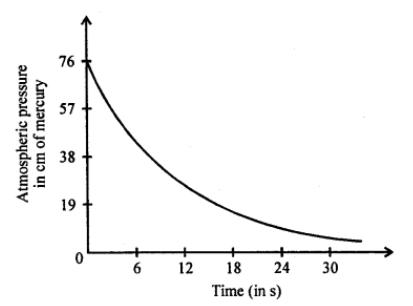
State briefly, how and why the atmospheric pressure of a place varies with the altitude. Draw an approximate graph to illustrate this variation.
Answer
View full question & answer→1. We know atmospheric pressure = height of air column $x$ density of air $x$ acceleration due to gravity; $P = h \rho g$ So, as we go up i.e. at higher altitudes, height of air column and hence atmospheric pressure decreases.
2. Also with the increase in altitude, density of air decreases and hence atmospheric pressure decreases.
If we take average density of air as $1.29 kgm ^{-3}$ and the density of mercury as 13 $600 kgm ^{-3}$
we can find the height
Column which will exert as much pressure as*' is exerted by 1 cm or ( 0.01 m ) column of mercury as
Height of air column $x$ density of air = height of mercury column $x$ density of mercury height of air column $\times 1.29 kg / m ^3$
$
=0.01 m \times 13600 kg / m^3
$
$
\therefore \quad \text { Height of air column }=\frac{136}{1.29} m= 1 0 5 m \text { (approx). }
$
Thus, 105 m of air column, on the average, will exert as much pressure as 1 cm column of mercury. Further, 1 cm of mercury column exerts pressure $=105 m$ of air column 76 cm of mercury column exerts pressure $=105 \times 76 m=7980 m= 8$ km (approx).
Thus, $8 ~ k m$ of air column will exert as much pressure as 76 cm of mercury column. However, it does not mean that atmosphere extends to only 8 km . As it is pointed out earlier, the density of atmosphere also changes with height. Thus, a fall of one cm in pressure does not mean that we have covered a vertical height of 105 m . On higher altitudes the vertical height of air is far in excess of 105 m , because of low density of air. A graph showing fall in pressure with height is shown in the figure.
2. Also with the increase in altitude, density of air decreases and hence atmospheric pressure decreases.
If we take average density of air as $1.29 kgm ^{-3}$ and the density of mercury as 13 $600 kgm ^{-3}$
we can find the height
Column which will exert as much pressure as*' is exerted by 1 cm or ( 0.01 m ) column of mercury as
Height of air column $x$ density of air = height of mercury column $x$ density of mercury height of air column $\times 1.29 kg / m ^3$
$
=0.01 m \times 13600 kg / m^3
$
$
\therefore \quad \text { Height of air column }=\frac{136}{1.29} m= 1 0 5 m \text { (approx). }
$
Thus, 105 m of air column, on the average, will exert as much pressure as 1 cm column of mercury. Further, 1 cm of mercury column exerts pressure $=105 m$ of air column 76 cm of mercury column exerts pressure $=105 \times 76 m=7980 m= 8$ km (approx).
Thus, $8 ~ k m$ of air column will exert as much pressure as 76 cm of mercury column. However, it does not mean that atmosphere extends to only 8 km . As it is pointed out earlier, the density of atmosphere also changes with height. Thus, a fall of one cm in pressure does not mean that we have covered a vertical height of 105 m . On higher altitudes the vertical height of air is far in excess of 105 m , because of low density of air. A graph showing fall in pressure with height is shown in the figure.