Questions

[5 Mark Question Answer]

🎯

Test yourself on this topic

5 questions · timed · auto-graded

Question 15 Marks
Explain with an example, the propagation of sound in a medium.
Answer
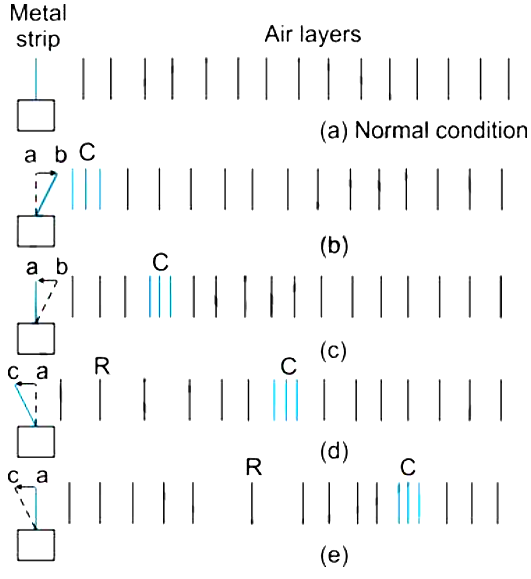
Take a vertical metal strip with its lower end fixed and upper end being free to vibrate as shown in fig (a).

As the strip is moved to right from a to b as shown in Fig (b), the air in that layer is compressed (compression is formed at C). The particles of this layer compress the layer next to it, which then compresses the next layer and so on. Thus, the disturbance moves forward in form of compression without the particles themselves being displaced from their mean positions.

As the metal strip returns from b to a as shown in Fig (c) after pushing the particles in front, the compression C moves forward and particles of air near the strip return to their normal positions.

When the strip moves from a to c as shown in Fig (d), it pushes back the layer of air near it towards left and thus produces a low pressure space on its right side i.e. layers of air get rarefied. This region is called rarefaction (rarefaction is formed at R).

When the strip returns from C to its mean position A in Fig (e), the rarefaction R travels forward and air near the strip return to their normal positions.

Thus, one complete to and fro motion of the strip forms one compression and one rarefaction, which together form one wave. This wave through which sound travels in air is called longitudinal wave.
View full question & answer
Question 25 Marks
Describe in brief, with the aid of a lebelled diagram, an experiment to demonstrate that a material medium is necessary for propagation of sound.
Answer
Experiment to demonstrate that a material medium is necessary for the propagation of sound: An electric bell is suspended inside an airtight glass bell jar. The bell jar is connected to a vacuum pump as shown in figure. As the circuit of electric bell is completed by pressing the key, the hammer of the electric bell begins to strike the gong repeatedly due to which sound is heard.
Keeping the key pressed, air is gradually withdrawn from jar by starting the vacuum pump. It is noticed that the loudness of sound goes on decreasing as the air is taken out from the bell jar and finally no sound is heard when all the air from the jar has been drawn out. The hammer of the electric bell is still seen striking the gong repeatedly which means that sound is still produced but it is not heard.
When the jar is filled with air, the vibrations produced by the gong are carried by the air to the walls of jar which in turn set the air outside the jar in vibration and sound is heard by us but in absence of air, sound produced by bell could not travel to the wall of the jar and thus no sound is heard. It proves that material medium is necessary for the propagation of sound waves.
View full question & answer
Question 35 Marks
Describe a simple experiment which demonstrates that the sound produced by a tuning fork is due to vibrations of its arms.
Answer
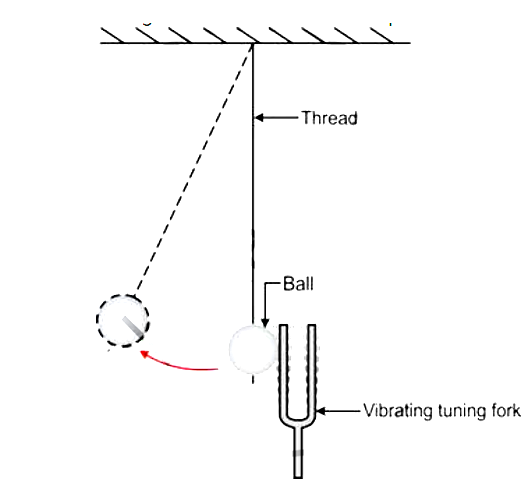
Experiment: A tuning fork is taken and its one arm is struck on a rubber pad and it is brought near a tennis ball suspended by a thread as shown in figure.

It is noticed that as the arm of the vibrating fork is brought close to the ball, it jumps back and forth and sound of the vibrating tuning fork is heard. When its arm stop vibrating, the ball becomes stationary and no sound is heard.
View full question & answer
Question 45 Marks
Describe an experiment to show that in wave motion, only energy is transferred, but particles of medium do not move.
Answer
Experiment to show that in a wave motion, only energy is transferred, but particles of the medium do not move:
If we drop a piece of stone in the still water of pond, we hear a sound of stone striking the water surface. Actually a disturbance is produced in water at the point where the stone strikes it. This disturbance spreads in all directions radially outwards in form of circular waves on the surface of water.
If we place a piece of cork on water surface at some distance away from the point where the stone strikes it, we notice that cork does not move ahead, but it vibrates up and down, while the wave moves ahead. The reason is that particles of water (or medium) start vibrating up and down at the point where the stone strikes. These particles then transfer their energy to the neighboring particles and they themselves come back to their mean positions. Thus only energy is transferred but the particles of the medium do not move.
View full question & answer
Question 55 Marks
Explain meaning of the terms compression and rarefaction in relation to a longitudinal wave.
Answer
A longitudinal wave propagates by means of compressions and rarefactions.
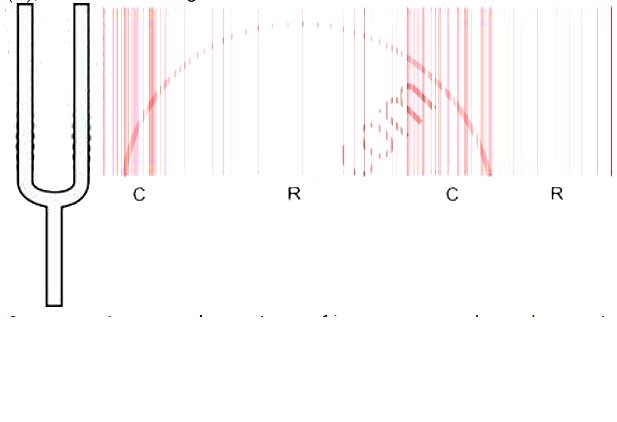
When a vibrating object moves forward, it pushes and compresses the air in front of it creating a region of high pressure. This region is called a compression (C), as shown in Fig. This compression starts to move away from the vibrating object. When the vibrating object moves backwards, it creates a region of low pressure called rarefaction (R), as shown in Figure .
Compressions are the regions of high density where the particles of the medium come very close to each other and rarefactions are the regions of low density where the particles of the medium move away from each other.
View full question & answer