Questions

[5 Mark Question Answer]

🎯

Test yourself on this topic

4 questions · timed · auto-graded

Question 14 Marks
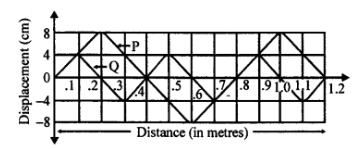
From diagram given below calculate
1. velocity of $P$ and $Q$
2. frequency of $P$, when frequency of $Q$ is 512 Hz .
Assume that both wave are travelling in same medium.
Image
Answer
For Q :
Wavelength $(\lambda)=$ Distance between two consecutive crests
$
=0.5-0.1=0.4 m
$
Frequency $(f)=512 Hz$
Velocity $(v)=\lambda f$
$
=0.4 \times 512=204.8 ms^{-1}
$
Since both waves are travelling in same medium and velocity of
P and Q is same i.e., $204.8 ms^{-1}$.
For $P$ :
Wavelength $=\lambda^{\prime}=1.0-0.2=0.8 m$
Velocity $=\nu=204.8 ms^{-1}$
Frequency of wave $P =f^{\prime}=$ ?
$
\begin{array}{l}
v=\lambda^{\prime} f^{\prime} \\
f=\frac{v}{\lambda^{\prime}}=\frac{204.8}{0.8}=256 Hz
\end{array}
$
View full question & answer
Question 24 Marks
State four differences between the sound wave and the light wave.
Answer
Differences between the sound wave and light wave:
Light waves:
1. They are produced from the electrons in an excited state.
2. They travel at a very high speed of $3 \times 108 ms-1$ in air.
3. They can travel through vacuum.
4. Their velocity does not change with the change in temperature, humidity, etc.
5 . They can produce the sensation of vision.
Sound waves:
1. They are produced due to vibrations of various objects in a material medium.
2. They travel in air at a very low speed of $332 ms-1$ at $20^{\circ} C$.
3. They cannot travel through vacuum and always require some material medium for propagation.
4. Their velocity changes with the change in velocity, humidity, etc.
5. They can produce the sensation of hearing.
View full question & answer
Question 34 Marks
Define the terms :
1.wavelength
2.amplitude
3.frequency.
Answer
(i) Wavlength: The linear distance between the two consecutive particles of a vibratingmedium in the same phase is called its wavelength. It is denoted by Greek letter lambda ( $\lambda$ ).
OR
The distance travelled by the wave in one time period of vibration of the particles of medium is called its wavelength.
OR
In a longitudinal wave, distance between the two consecutive compressions or rare fractions is called wavelength.
(ii) Amplitude : The maximum displacement of a vibrating particles about its mean position is called amplitude.
(iii) Frequency : It is denoted by letter (f). The number of complete vibrations executed by a vibrating particle of a medium about its mean position in one second is called its frequency.
OR
It may be defined as the number of waves passing through one particular point in one second.
View full question & answer
Question 44 Marks
Describe an experiment to prove that material medium is necessary for the propagation of sound.
Answer
A material medium is necessary for the propagation of sound. It can be proved with the help of following experiment :
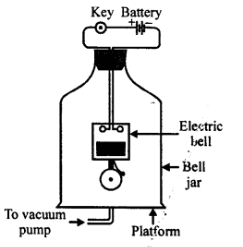
An electric circuit consisting of a cell, a switch and an electric bell is arranged inside a bell-jar, which stands on the platform of an evacuating pump.
The switch of the bell is pressed to close the electric circuit. Sound is heard when there is airwithin the bell-jar. Air is now gradually pumped out of the bell-jar. The intensity of sound goes on decreasing, and no sound is heard when the air is completely removed from the bell-jar. It is because, the air which acts as a medium for the propagation of sound energy is removed.
Image
From above experiment, it is clear that sound can not be heard in the absence of air i.e. a material medium is necessary for the propagation of sound.

View full question & answer
[5 Mark Question Answer] - PHYSICS STD 9 Questions - Vidyadip