Questions

[2 Mark Question Answer]

🎯

Test yourself on this topic

44 questions · timed · auto-graded

Question 12 Marks
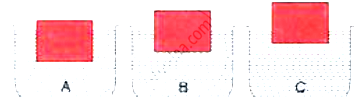
Figure shows the same block of wood floating in three different liquids $A, B$ and $C$ of densities $\rho_1, \rho_2$ and $\rho_3$ respectively. Which of the liquid has the highest density? Give a reason for your answer.
Answer
The upthrust on the body by each liquid is the same and equal to the weight of the body. However, upthrust = Volume submerged $\times \rho_{ L } \times g$, For the liquid $C_{\text {, }}$ since the volume submerged is least so the density $\rho_3$ must be maximum.
View full question & answer
Question 22 Marks
Explain why an iron nail floats on mercury, but it sinks in water. Hint : Density of iron is less than that of mercury, but more than that of water.
Answer
Density of iron is less than the density of mercury; hence, an iron nail floats in mercury and density of iron is more than the density of water; hence, an iron nail sinks in water.
View full question & answer
Question 32 Marks
How does the density $\rho_5$ of a substance determine whether a solid piece of that substance will float or sink in a given liquid $PL ^2$
Answer
The body will float if its density is less than or equal to the density of the liquid $\rho _s\leq \rho _L.$ The body will sink if its density is greater than the density of the liquid $\rho _s> \rho _L.$
View full question & answer
Question 42 Marks
Explain the following :
A ship submerges more as it sails from sea water to river water.
Answer
Density of river water is less than the density of sea water. Hence, according to the law of floatation, to balance the weight of the ship, a great volume of water is required to be displaced in river water having a comparitively lower density.
View full question & answer
Question 52 Marks
Explain the following :
A balloon filled with hydrogen rises to a certain height and then stops rising further.
Answer
The reason is that the density of air decreases with altitude. Therefore, as the balloon gradually goes up, the weight of the displaced air (i.e. uphrust) decreases. It keeps on rising as long as the upthrust exceeds its weight. When upthrust becomes equal to its weight, it stops rising.
View full question & answer
Question 62 Marks
Explain the following :
As a ship in harbour is being unloaded, it slowly rises higher in water.
Answer
As a ship in harbor is unloaded, its weight decreases. As a result, it displaces less water, and the ship's hull rises in water till the weight of the water displaced balances the weight of the unloaded ship.
View full question & answer
Question 72 Marks
Explain the following : Toy balloons filled with hydrogen rise to the ceiling, but if they are filled with carbon dioxide, then they sink to the floor.
Answer
Density of hydrogen is much less than the density of carbon dioxide. When a balloon is filled with hydrogen, the weight of the air displaced by an inflated balloon (i.e. upthrust) becomes more than the weight of a gas filled balloon, and hence, it rises. In case of a balloon filled with carbon dioxide, weight of the balloon becomes more than the upthrust of the air, and hence, it sinks to the floor.
View full question & answer
Question 82 Marks
Explain the following :&
An egg sinks in fresh water, but floats in a strong salt solution.
Answer
Density of a strong salt solution is more than the density of fresh water. Hence, the salt solution exerts a greater upthrust on the egg which balances the weight of the egg, so the egg floats in a strong salt solution but sinks in fresh water.
View full question & answer
Question 92 Marks
Explain the following :&
Icebergs floating in sea are dangerous for ships.
Answer
Icebergs are dangerous for ships as they may collide with them. Icebergs being lighter than water, float on water with a major part of their surfaces laying under the water surface and only a small part lies outside water. Thus, it becomes difficult for the driver of the ship to estimate the size of the iceberg.
View full question & answer
Question 102 Marks
A piece of ice floating in a glass of water melts, but the level of water in the glass does not change. Give reasons. Hint: Ice contracts on melting.
Answer
When a floating piece of ice melts into water, it contracts by the volume equal to the volume of ice pieces above the water surface while floating on it. Hence, the level of water does not change when ice floating on it melts.
View full question & answer
Question 112 Marks
A loaded cargo ship sails from sea water to river water. State and Explain your observations.
Answer
water.
Density of river water is less than the density of sea water. Hence, according to the law of floatation, to balance the weight of the ship, a greater volume of water is required to be displaced in river water of lower density.
View full question & answer
Question 122 Marks
A body is held inside water contained in a vessel by tying it with a thread to the base of the vessel. Name the three forces that keep the body in equilibrium, and state the direction in which each force acts.
Answer
Forces acting on the body are listed below: (i) Weight of the body vertically downwards. (ii) Upthrust of water on body vertically upwards. (iii) Tension in thread vertically downwards.
View full question & answer
Question 132 Marks
State the principle of floatation.
Answer
“When a solid is floating in a fluid, the weight of whole solid acting vertically downward at its "Centre of Gravity", is equal to the weight of the fluid displaced by the "Immersed" part of solid acting upward, at its "centre of Buoyancy" or at the centre of the "Bulk of liquid" displaced.” OR “The weight of a floating body is equal to the weight of the liquid displaced by its "Submerged" part.”
View full question & answer
Question 142 Marks
A man first swims in sea water and then in river water. (i) Compare the weights of sea water and river water displaced by him. (ii) Where does he find it easier to swim and why?
Answer

(i) 1:1; The weight of the water displaced by the man in sea and river will be same and will be equal to his own weight.

(ii) He finds it easier to swim in the sea because the density of sea water is more than the density of river water. So his weight is balanced in sea water with a part of his body submerged in the water.

View full question & answer
Question 152 Marks
Why is the floating ice less submerged in brine than in water?
Answer
Density of brine is more than the density of water. Hence, the upthrust exerted by brine is more than the upthrust exerted by water on ice. Therefore, floating ice is less submerged in brine.
View full question & answer
Question 162 Marks
Two identical pieces, one of ice (density = 900kg per meter cube) and other wood (density = 300kg per meter cube) float on water.
  1. Which of the two will have more volume submerged inside water
  2. Which of two will experience more upthrust due to water.
Answer
  1. Ice will be more submerged inside water. Ice has a greater density than wood, although the volume of both is the same. So to support a greater amount of weight, ice needs to displace more water, and to displace more water, it has to be submerged more as compared to wood.
  2. As ice displaces more water, it will experience more upthrust.
View full question & answer
Question 172 Marks
A balloon filled with helium gas floats in a big closed jar which is connected to an evacuating pump. What will be your observation, if air from the jar is pumped out? Explain your answer.
Answer

Observation : The balloon will sink.

Explanation : As air is pumped out from jar, the density of air in jar decreases, so the upthrust on balloon decreases. As weight of balloon exceeds the upthrust on it, it sinks.

View full question & answer
Question 182 Marks
A piece of stone of mass $113 \ g$ sinks to the bottom in water contained in a measuring cylinder and water level in cylinder rises from $30 \ ml$ to $40 \ ml$. Calculate $R.D$. of stone.
Answer
Mass of stone $=113 g$
Rise in water level $=(40-30) ml =10 ml$
This rise is equal to the space occupied (volume) by the stone .
$\therefore$ volume of stone $=10 cm^{-3}$
Density of stone in C.G.S. =$\frac{\text { Mass }}{\text { Volume }}=\frac{113}{10}=11.3g cm^{-3}$
$R.D. = 11.3$
View full question & answer
Question 192 Marks
Calculate the mass of air in a room of dimensions $4.5 m \times 3.5 m \times 2.5 m$ if the density of air at N.T.P. is $1.3 kgm ^{-3}$.
Answer
Volume of air = $4.5 \times 3.5 \times 2.5 m ^3$
Density pf air at$ NTP = 1.3 kgm^3$​​​​​​​
Mass of air = Density × volume
Or Mass = (1.3) × (4.5 × 3.5 × 2.5) = 51.19 kg
View full question & answer
Question 202 Marks
How are the (i) Mass, (ii) Volume and (iii) Density of a metallic piece affected, if at all, with an increase in temperature?
Answer
(i) Mass of a metallic body remains unchanged with increase in temperature. (ii) Volume of metallic body increases with an increase in temperature. (iii) Density (= Mass/volume) of a metallic body decreases with an increase in temperature.
View full question & answer
Question 212 Marks
Calculate the mass of a body whose volume is $2 m^3$ and relative density is $0.52 .$
Answer
R.D. of silver $=0.52$ Volume $=2 m^3$ Density of body in S.I. $=0.52 \times 10^3 kgm ^3 $
$\therefore$ Mass $=$ Density $\times$ volume $=\left(0.52 \times 10^3\right) \times 2=$ 1040 kg
View full question & answer
Question 222 Marks
The relative density of silver is $10.8$. Find its density.
Answer
R.D. of silver $=10.8$ Density of silver in C.G.S. $=10.8 gcm ^{-3}$ Density in S.I. $=10.8 \times 10^3 kgm ^3$
View full question & answer
Question 232 Marks
The density of iron is $7.8 x 10^3 kg m^{-3}$​​​​​​​. What is its relative density?
Answer
Density of iron $=7.8 \times 10^3 kgm ^{-3}$

Density of iron in C.G.S $=7.8 gcm ^{-3}$
R.D. = Density of C.G.S. (without unit) $=7.8$
View full question & answer
Question 242 Marks
The relative density of mercury is $13.6$. State its density in
(i) $C.G.S.$ unit and
(ii) S.I. unit.
Answer
R.D. of mercury $=13.6$ (i) Density in C.G.S. $=13.6 gcm ^{-3}$ (ii) Density in S.I. $=13.6 \times 10^3 kgm ^{-3}$
View full question & answer
Question 252 Marks
The density of copper is $8.83 g cm ^{-3}$. Express it in $kg m ^{-3}$.
Answer
Density of copper in C.G.S. $=8.83 gcm ^{-3}$
Density of copper in S.I. $=\frac{8.83}{1000 \times 100^{-6}}=8830 kgm ^{-3}$
View full question & answer
Question 262 Marks
 A body weighs $W_1 g f$ in air and when immersed in a liquid it weighs $W_2 g f$, while it weights $W_3 g f$ on immersing it in water. Find:
(i) volume of the body (ii) upthrust due to liquid (iii) relative density of the solid and (iv) relative density of the liquid.
Answer
(i) Volume of the body $=W_1-W_3 cm ^3$
(ii) Upthrust due to liquid $=$ loss in weight when immersed in liquid $= W _1- W _2 gf$
(iii)
Weight of a body in air $= W _1 gf$

Weight of that body in liquid $= W _2 gf$

Weight of that body in water $= W _3 gf$
$
\text { RD of solid }=\frac{\text { Weight of solid in air }}{\text { Weight in air - Weight in water }}
$
$
=\frac{W_1}{W_1-W_3}
$
(iv)
Weight of a body in air $=W_1 g f$

Weight of that body in liquid $= W _2 gf$

Weight of that body in water $=W_3 g f$
RD of Liquid $=\frac{W_1-W_2}{W_1-W_3}$
View full question & answer
Question 272 Marks
A body weighs W gf in air and $W_1$​​​​​​​ gf when it is completely immersed in water. Find: (i) Volume of the body, (ii) Upthrust on the body and (iii) Relative density of the material of the body.
Answer
(i) Volume of the body $=\left( W - W _1\right) cm ^3$ (ii) Upthrust on the body $=\left( W - W _1\right) gf$ (iii) R.D. of the material of body $=$$\frac{ W }{ W - W _1}$
View full question & answer
Question 282 Marks
A body weighs 20 gf in air and 18.0 gf in water. Calculate the relative density of the material of the body.
Answer
Weight of body in air, $W_1=20 gf$
Weight of body when completely immersed in water $W_2=18 gf$
R.D. of body $=\frac{W_1}{W_1-W_2} \times$
R.D. of water R.D. of body $=\frac{20}{20-18} \times 1$
R.D. of body $=10$
View full question & answer
Question 292 Marks
A block of wood is floating on water with its dimensions $50 cm x 50 cm x 50 cm$ inside water. Calculate the buoyant force acting on the block. Take$ g = 9.8 N kg^{-1}.$
Answer
Volume of block of wood $=50 cm \times 50 cm \times 50 cm=125000 cm^3=0.125 m^3$ Given, $g =9.8 m / s ^2$ Buoyant force $= V \rho g =0.125$ $\times 1000 \times 9.8 N=1225 N$
View full question & answer
Question 302 Marks
A piece of brass weighs 175 gf in air and 150 gf when fully submerged in water. The density of water is $1.0 g cm ^{-3}$.
(i) What is the volume of the brass piece? (ii) Why does the brass piece weigh less in water?
Answer
 Weight of piece of brass in air $=175 gf$ Weight of piece of brass when fully immersed in water $=150 gf$ Density of water $=1 g$ $cm ^{-3}$ (i) Volume of brass piece $=$ Loss in weight $=175-150=25 cm^3$ (ii) The brass piece weighs less in water due to upthrust.
View full question & answer
Question 312 Marks
Why is a force needed to keep a block of wood inside water?
Answer
Upthrust due to water on block when fully submerged is more than its weight. Density of water is more than the density of cork; hence, upthrust due to water on the block of cork when fully submerged in water is more than its weight.
View full question & answer
Question 322 Marks
State the Archimedes' principle.
Answer
Archimedes' principle states that when a body is immersed partially or completely in a liquid, it experiences an upthrust, which is equal to the weight of liquid displaced by it.
View full question & answer
Question 332 Marks
It is easier to lift a heavy stone under water than in air. Explain.
Answer
It is easier to lift a heavy stone under water than in air because in water, it experiences an upward buoyant force which balances the actual weight of the stone acting downwards. Thus, due to upthrust there is an apparent loss in the weight of the heavy stone, which makes it lighter in water, and hence easy to lift.
View full question & answer
Question 342 Marks
A body of density ρ is immersed in a liquid of density $ρ_L$. State the condition when the body will (i) float and (ii) sink in the liquid.
Answer
(i) The body will float if $\rho<$ or $=\rho_{ L }$. (ii) The body will sink if $\rho>\rho_{ L }$.
View full question & answer
Question 352 Marks
How does the density of material of a body determine whether it will float or sink in water?
Answer
The bodies of average density greater than that of the liquid sink in it. While the bodies of average density equal to or smaller than that of liquid float on it.
View full question & answer
Question 362 Marks
A sphere of iron and another of wood, both of same radius are placed on the surface of water. State which of the two will sink? Give a reason for your answer.
Answer
Sphere of iron will sink. Density of iron is more than the density of water, so the weight of iron sphere will be more than the upthrust due to water in it; thus, it causes the iron sphere to sink. Density of wood is less than the density of water, so the weight of sphere of wood shall be less than the upthrust due to water in it. So, the sphere of wood will float with a volume submerged inside water which is balanced by the upthrust due to water.
View full question & answer
Question 372 Marks
A sphere of iron and another sphere of wood of the same radius are held under water. Compare the upthrust on the two spheres.
[Hint: Both have equal volume inside the water].
Answer
Since the spheres have the same radius, both will have an equal volume inside water, and hence, the upthrust acted by water on both the spheres will be the same. Hence, the required ratio of upthrust acting on two spheres is 1:1.
View full question & answer
Question 382 Marks
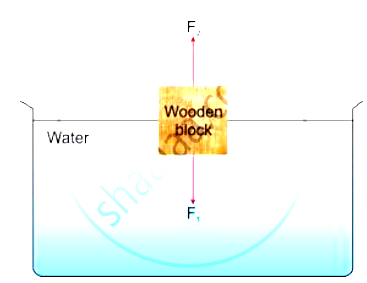
A body held completely immersed inside a liquid experiences two forces: (i) $F_1$, the force due to gravity and (ii) $F_2$, the buoyant force. Draw a diagram showing the direction of these forces acting on the body and state the condition when the body will float or sink.
Answer

If $F 1<F 2$ or $F 1=F 2$, the body will float.
If F1 > F2, the body will sink.
 
View full question & answer
Question 392 Marks
A body of volume V and density ρ is kept completely immersed in a liquid of density $\rho _L$. If g is the acceleration due to gravity, then write expressions for the following: (i) The weight of the body, (ii) The upthrust on the body, (iii) The apparent weight of the body in liquid, (iv) The loss in weight of the body.
Answer
(i) Weight of the body $= V \rho g$
(ii) Upthrust on the body $=\vee \rho_{ L } g$
(iii) Apparent weight of the body in liquid $= V \left(\rho-\rho_{ L }\right) g$
(iv) Loss in weight of the body $= V \rho_{ L } g$
View full question & answer
Question 402 Marks
A small block of wood is completely immersed in (i) water, (ii) glycerine and then released. In each case, What do you observe? Explain the difference in your observation in the two cases.
Answer
Observation: Volume of a block of wood immersed in glycerine is smaller as compared to the volume of block immersed in water.
Explanation: Density of glycerine is more than that of water. Hence, glycerine exerts more upthrust on the block of wood than water, causing it to float in glycerine with a smaller volume.
View full question & answer
Question 412 Marks
A body experiences an upthrust $F_1$ in river water and $F_2$ in sea water when dipped up to the same level. Which is more, $F _1$ or $F _2$ ? Give reason.
Answer
$F_2 > F_1$​​​​​​​; Sea water is denser than river water; therefore, the upthrust due to sea water will be greater than that due to river water at the same level. This shall make the body to appear lighter in the sea water.
View full question & answer
Question 422 Marks
A bunch of feathers and a stone of the same mass are released simultaneously in air. Which will fall faster and why? How will your observation be different if they are released simultaneously in vacuum?
Answer
When a bunch of feathers and a stone of the same mass are released simultaneously in air, the feathers will fall after the stone falls due to air friction. In vacuum, as there is no air friction, the acceleration due to gravity of both bodies will be the same, and therefore, the feathers and the stone will fall at the same time.
View full question & answer
Question 432 Marks
A body dipped into a liquid experiences an upthrust. State two factors on which upthrust on the body depends.
Answer
Upthrust on a body depends on the following factors:
(i) Volume of the body submerged in the liquid or fluid.
(ii) Density of liquid or fluid in which the body is submerged.
View full question & answer
Question 442 Marks
A metal solid cylinder tied to a thread is hanging from the hook of a spring balance. The cylinder is gradually immersed into the water contained in a jar. What changes do you expect in the readings of the spring balance? Explain your answer.
Answer
The readings in the spring balance decreases.
As the cylinder is immersed in the jar of water, an upward force acts on it, which is in opposition to the weight component of the cylinder. Hence the cylinder appears to be lighter.
View full question & answer
[2 Mark Question Answer] - PHYSICS STD 9 Questions - Vidyadip