Questions

[3 Mark Question Answer]

🎯

Test yourself on this topic

19 questions · timed · auto-graded

Question 13 Marks
A piece of wood of uniform cross section and height 15 cm floats vertically with its height 10 cm in water and 12 cm in spirit. Find the densities of wood and spirit.
Answer
Let densities of water, wood and spirit are $\rho_{,} \rho_{ W }$ and $\rho_{ s }$ respectively.
Let $A$ be the area of the wooden block.
Total volume of the wooden block is, $V =15 A$
1. Mass of wood = Mass of water displaced by the wood
$ V \rho_{ w } g = A \times 10 \times \rho \times g$
$\rho_{ w }=\frac{A \times 10 \times \rho \times g }{15 \times A \times g }=0.67 g / cm ^3 $
2. Mass of the wood = Mass of then spirit displaced
$ V \rho_w g=A \times 12 \times \rho_s \times g$
$\rho_s=0.83 g / cm ^3 $
View full question & answer
Question 23 Marks
QUESIION If the density of ice is $0.9 g cm ^{-3}$, then what portion of an iceberg will remain below the surface of water in sea? (Density of sea water $\left.=1.1 g cm ^{-3}\right)$
Answer
Density of ice $\left(\rho_1\right)=0.9 gcm ^{-3}$
Density of sea water $\left(\rho_{ s }\right)=1.1 gcm ^{-3}$
Let the total volume of the iceberg be $V$ and the volume of immersed portion be $v$.
According to the law of floatation,
$
\frac{ v }{ V }=\frac{\rho_1}{\rho_s}
$
or,$\frac{ v }{ V }=\frac{0.9}{1.1}=\frac{9}{11}$
or, $v=\frac{9}{11} V$
Thus, ice floats with $\frac{9}{11}$ th part of its volume above the surface sea water.
View full question & answer
Question 33 Marks
QUESIION A piece of wax floats on brine. What fraction of its volume is immersed? Density of wax $=0.95 g cm ^{-3}$, Density of brine $=1.1 g cm ^{-3}$.
Answer
Density of wax $\left(\rho_{ w }\right)=0.95 gcm ^{-3}$
Density of brine $\left(\rho_{ B }\right)=1.1 gcm ^{-3}$
Let the total volume of piece of wax be $V$ and the volume of immersed portion be $v$.
According to the law of floatation,
$\frac{ v }{ V }=\frac{\rho_{ w }}{\rho_{ B }}$
or,$\frac{ v }{ V }=\frac{0.95}{1.1}=0.86$
or,$v=0.86 V$
Thus, wax floats with 0.86 th part of its volume above the surface brine.
View full question & answer
Question 43 Marks
A rubber ball floats on water with its $1/3^{rd} $volume outside water. What is the density of rubber?
Answer
Let the volume of the ball be $V$.

Volume of ball above the surface of water $=\frac{1}{3} V$
$\therefore$ Volume of ball immersed in water $= V -\frac{1}{3} V =\frac{2}{3} V$

By the principle of floatation on,
$\frac{\text { Volume of rubber ball immersed }}{\text { Total volume of rubber ball }}=\frac{\text { Density of rubber }}{\text { Density of water }}$
or,$\frac{2}{3}=\frac{\text { Density of rubber }}{1000}$
or, Density of rubber ball $=1000 \times \frac{2}{3}=666.7 kgm ^3 \approx 667 kgm ^3$
View full question & answer
Question 53 Marks
An iron nail sinks in the water while an iron ship floats on water. Explain the reason.
Answer
An iron nail sinks in water because density of iron is more than the density of water, so the weight of the nail is more than the upthrust of water on it.
On the other hand, ships are also made of iron, but they do not sink. This is because the ship is hollow and the empty space in it contains air, which makes its average density less than that of water. Therefore, even with a small portion of ship submerged in water, the weight of water displaced by the submerged part of ship becomes equal to the total weight of ship and it floats.
View full question & answer
Question 63 Marks
A block of wood is so loaded that it just floats in water at room temperature. What change will occur in the state of floatation, if (a) Some salt is added to water, (b) Water is heated? Give reasons.
Answer
(a) It will float with some part outside water. Reason : On adding some salt to water, the density of water increases, so upthrust on a block of wood increases, and hence, the block rises up till the weight of salty water displaced by the submerged part of block becomes equal to the weight of the block. (b) The block will sink. Reason: On heating, the density of water decreases, so upthrust on the block decreases and the weight of block exceeds upthrust due to which it sinks.
View full question & answer
Question 73 Marks
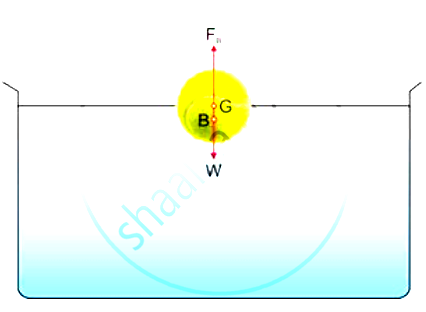
What is the centre of buoyancy? State its position for a floating body with respect to the centre of gravity of the body.
Answer
Centre of buoyancy: It is the point through which the resultant of the buoyancy forces on a submerged body act; it coincides with the centre of gravity of the displaced liquid, if the body is completely immersed.
For a floating body with its part submerged in the liquid, the centre of buoyancy is at the centre of gravity of the submerged part of the body and it lies vertically below the centre of gravity of the entire body.
View full question & answer
Question 83 Marks
Draw a diagram to show the forces acting on a body floating in water with its some part submerged. Name the forces and show their points of application. How is the weight of water displaced by the floating body related to the weight of the body itself?
Answer

The forces acting are as listed below:
(i) Weight of the body acting downwards.
(ii) Upthrust due to water acting upwards.
Weight of water displaced by the floating body = Weight of the body
View full question & answer
Question 93 Marks
A body of mass 70 kg , when completely immersed in water, displaces $20,000 cm^3$ of water. Find: (i) The weight of body in water and (ii) The relative density of material of the body.
Answer
Weight of body $=70 kg$
Volume of water displaced by body $=20,000 cm ^3=0.02 m ^3$
(i) Mass of solid immersed in water = mass of water displaced
Mass of solid immersed in water $=$ Density of water $\times$ Volume of water displaced
Mass of solid immersed in water $=1000 \times 0.02=20 kg$
Weight of the body, $W=m g$
Weight of the body in water $=(70 \times 9.8)-(20 \times 9.8)=50 kgf$(ii) R.D. of solid = Density in C.G.S. (without unit)
Density in C.G.S. $=\frac{\text { mass }}{\text { volume }}=\frac{70 \times 1000}{20,000}=3.5 gcm ^3$
R.D. $=3.5$
View full question & answer
Question 103 Marks
A piece of iron weighs 44.5 gf in air. If the density of iron is $8.9 \times 10^3$​​​​​​​, find the weight of iron piece when immersed in water.
Answer
Density of iron $=8.9 \times 10^3=8900$
Density of water $=1000$
Weight of iron when immersed in water is given by
$ \text { Weight of iron in water }=\text { Weight of iron in air } \times\left(1-\frac{\text { density of water }}{\text { density of iron }}\right)$
$=44.5 gf \times\left(1-\frac{1000}{8900}\right)$
$=39.5 kgf $
View full question & answer
Question 113 Marks
A jeweller claims that he makes ornaments of pure gold that has a relative density of 19.3. He sells a bangle weighing 25.25 gf to a person. The clever customer weighs the bangle when immersed in water and finds that it weighs 23.075 gf in water. With the help of suitable calculations, find out whether the ornament is made of pure gold or not. [Hint : calculate R.D. of material of bangle which comes out to be 11.6].
Answer
R.D. of pure gold $=19.3$
Weight of bangle in air, $W_1=25.25 gf$
Weight of bangle when completely immersed in water $W_2=23.075 gf$
R.D. of bangle $=\frac{W_1}{W_1-W_2} \times$
R.D. of water R.D. of bangle $=\frac{25.25}{25.25-23.075} \times 1$
R.D. of bangle $=11.6$ The bangle is not made of pure gold as its density is not 19.3 .
View full question & answer
Question 123 Marks
A solid weighs 1.5 kgf in air and 0.9 kgf in a liquid of density $1.2 \times 10^3 kg m ^{-3}$. Calculate R. D. of solid.
Answer
Weight of body in air, $W_1=1.5 kgf$
Weight of body when completely immersed in liquid $W_2=0.9 kgf$
Density of liquid $=1.2 \times 10^3 kgm ^{-3}$
R.D. of liquid $=1.2$
R.D. of body $=\frac{W_1}{W_1-W_2} \times$ R.D. of liquid
R.D. of body $=\frac{1.5}{1.5-0.9} \times 1.2$
R.D. of body $=\frac{1.5}{0.6} \times 1.2$
R.D. of body $=3$
View full question & answer
Question 133 Marks
A solid weighs 120 gf in air and and 105 gf when it is completely immersed in water. Calculate the relative density of solid.
Answer
Weight of solid in air, $W_1=120 gf$
Weight of solid when completely immersed in water $W _2=105 gf$
R.D. of solid $=\frac{W_1}{W_1-W_2} \times$
R.D. of water R.D. of solid $=\frac{120}{120-105} \times 1$
R.D. of solid $=8$
View full question & answer
Question 143 Marks
The mass of a block made of certain material is 13.5 kg and its volume is $15 \times 10^{-3} m^3$.
(a) Calculate upthrust on the block if it is held fully immersed in water.
(b) Will the block float or sink in water when released? Give a reason for your answer.
(c) What will be the upthrust on block while floating?
Take density of water $=1000 kg m ^{-3}$.
Answer
Mass of a block $=13.5 kg$ Weight of the block $=13.5 kgf$ Volume $=15 \times 10^{-3} m^{-3}$
Density of water $=1000 kgm ^{-3}( a )$
Upthrust $=$ Volume of block $\times$ density of water $\times g =15 \times 10^{-3} \times 1000 \times g =15 kgf ( b )$
The block will float since the upthrust on it is more than its weight ( $=13.5 kgf$ )
when fully immersed in water. (c) While floating , upthrust $=13.5 kgf$ (weight of the body)
View full question & answer
Question 153 Marks
A solid of density $5000 kg m^{-3}$​​​​​​​ weighs $0.5$ kgf in air. It is completely immersed in water of density $1000 kg m^{-3}.$ Calculate the apparent weight of the solid in water.
Answer
Density of solid $=5000 kg m ^{-3}$
Weight of solid $=0.5 kgf$
Density of water $=1000 kg m ^{-3}$
Here, Upthrust $=$ Volume of the solid $\times$ density of water $\times g$
$ =\frac{\frac{0.5}{g}}{5000} \times 1000 \times g$
$=\frac{0.5}{5000 \times g } \times 1000 \times g =0.1 kgf $
Apparent weight $=$ True weight - Upthrsut
$=0.5-0.1=0.4\ kgf$
View full question & answer
Question 163 Marks
 You are provided with a hollow iron ball A of volume $15 cm^3$ and mass 12 g and a solid iron ball B of mass 12 g . Both are placed on the surface of water contained in a large tub.
a. Find upthrust on each ball.
b. Which ball will sink? Give a reason for your answer (Density of iron $=8.0 g cm ^{-3}$ )
Answer
(a) Volume of hollow iron ball $A =15 cm ^3$

Mass of hollow iron ball $A =12 g$

Mass of solid iron ball $B =12 g$
Density of iron $=8.0 g cm ^{-3}$

Upthrust due to liquid $=$ volume of the solid $x$ density of fluid $x$ acceleration due to gravity ... [Equation 1]

Volume $=\frac{\text { Mass }}{\text { density }}$
...[Equation 2]

Substituting the values in equation 2 , to find volume of solid iron ball B,
Volume of solid iron ball $B=\frac{12}{8}=1.5 cm ^2$\

Substituting the values in equation 1 to get upthrust on hollow ball $A$

Upthrust on hollow ball $A =15 \times 1 \times g =15 gf$

Hence, Upthrust on hollow ball $A=15 gf$

Substituting the values in equation 1 to get upthrust on solid iron ball $B$

Upthrust on solid iron ball $B=1.5 \times 1 \times g =1.5 gf$

Hence, Upthrust on solid iron ball B $=1.5 gf$

(b) Solid iron ball B will sink.

Ball B experiences an upthrust of $1.5 gf$ in water that is less than it's weight of $12 gf$. Hence ball B will sink. Ball A experiences an upthrust of $15 gf$ that is greater than it's weight of $12 gf$. Hence it will float with its that much part submerged for which upthrust becomes equal to its weight of $12 gf$.
View full question & answer
Question 173 Marks
A body weighs 450 gf in air and 310 gf when completely immersed in water. Find
(i) The volume of the body,
(ii) The loss in weight of the body, and
(iii) The upthrust on the body.
State the assumption made in part (i).
Answer
Weight of body in air $=450 gf$
Weight of body in water $=310 gf$
(i) Volume of the body $=$ Loss in weight $\times$ density of water
$ =(450-310) \times 1 \quad\left[\text { Assumption : density of water }=1 g cm ^{-3}\right]$
$=140 cm ^3 $
$ \text { (ii) Loss in weigh }$
$=(450-310) gf$
$=140 gf $
(iii) Upthrust on body $=$ loss in weight $=140 gf$
View full question & answer
Question 183 Marks
A body of volume $100 cm^3$ weighs 5 kgf in air. It is completely immersed in a liquid of density $1.8 \times 10^3 kg m ^{-3}$. Find:
(i) The upthrust due to liquid and
(ii) The weight of the body in liquid.
Answer
Volume of body $= V =100 cm ^3=100 \times 10^{-6}=10^{-4} m ^3$
Weight in air $W=5 kgf$"
Density of liquid $d =1.8 \times 10^3 kg / m ^3$
(i) Upthrust due to liquid $=$ Volume of the solid submerged $\times$ density $0$
$ =10^{-4} \times 1.8 \times 10^3 \times g$
$=0.18 gN$
$=0.18 kgf $
(ii) Weight of body in liquid = Weight of body in air - upthrust
$ =5 kgf -0.18 kgf$
$=4.82 kgf $
View full question & answer
Question 193 Marks
 A body of mass 3.5 kg displaces $1000 cm^3$ of water when fully immersed inside it. Calculate: (i) the volume of body, (ii) the upthrust on body and (iii) the apparent weight of body in water.
Answer
Mass of body $=3.5 kg$ Weight of the body $=3.5 kgf$
Volume of water displaced when body is fully immersed $=1000$ $cm ^3$
(i) Volume of body when fully immersed in liquid = Volume of water displaced
$\therefore$
Volume of body $=1000 cm^3$ or $0.001 m^3$
(ii) Upthrust on body = Volume of body $\times$ Density of water $\times g =0.001 \times 1000 \times g =1 kgf$
(iii) Apparent weight $=$ True weight - Upthrust $=(3.5-1)=2.5 kgf$
View full question & answer
[3 Mark Question Answer] - PHYSICS STD 9 Questions - Vidyadip