MCQ 11 Mark
Tick the correct answer in the following : Area of a sector of angle $p($in degrees$)$ of a circle with radius $R$ is,
- A
$\frac{\text{p}}{180}\times2\pi\text{R}$
- B
$\frac{\text{p}}{180}\times2\pi\text{R}^2$
- C
$\frac{\text{p}}{360}\times2\pi\text{R}$
- ✓
$\frac{\text{p}}{720}\times2\pi\text{R}^2$
AnswerCorrect option: D. $\frac{\text{p}}{720}\times2\pi\text{R}^2$
$\frac{\text{p}}{360^\circ}\times\pi\text{R}^2$
$=\frac{\text{p}}{720}\times2\pi\text{R}^2$
View full question & answer→MCQ 21 Mark
Tick the correct answer in the following and justify your choice : If the perimeter and thearea of a circle are numerically equal, then the radius of the circle is :
- ✓
$2$ units
- B
$\pi\text{ units}$
- C
$4$ units
- D
$7$ units
AnswerCorrect option: A. $2$ units
Circumference of circle $=$ Area of circle
$\Rightarrow\ 2\pi\text{r}-\pi\text{r}^2$
$\Rightarrow\ \text{r}=2\text{ units}$
View full question & answer→Question 31 Mark
If $\pi$is taken as$\frac{22}{7}$, calculate the distance (in metres) covered by a wheel of diameter 35 cm, in one revolution.
AnswerRequired distance = Perimeter = 2$\pi\text{r}$
$ = 2\times\frac{22}{7}\times\frac{35}{2}\text{cm} = 110\text{cm} = 1.1\text{m}.$
View full question & answer→Question 41 Mark
If the diameter of a semicircular protractor is 14cm, then find its perimeter.
AnswerPerimeter of semicircle $=\pi\text{r}+2\text{r}$$=\frac{22}{7}\times7+2\times7=22+14=36\text{cm}$
View full question & answer→Question 51 Mark
Find the perimeter of Figure 3, where AED$$ is a semi-circle and ABCD is a rectangle.
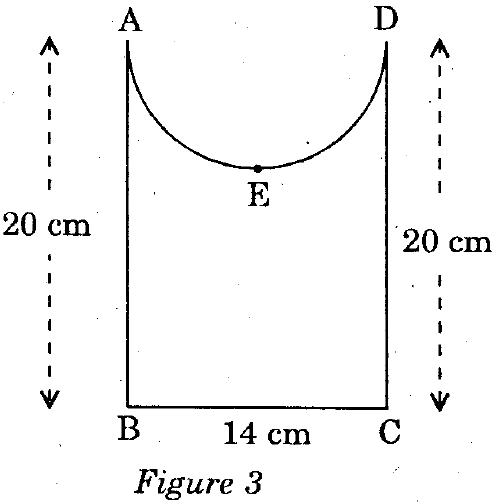
AnswerPerimeter of the given figure = AB + BC + CD + Circumference of semicirclePerimeter of the given figure = 20 + 14 + 20 + 22 = 76cm.
Hence, the perimeter of the given figure is 76cm.
View full question & answer→Question 61 Mark
Volume and surface area of a solid hemisphere are numerically equal. What is the diameter of hemisphere?
Answer$\frac{2}{3} \pi\text{r}^{3} = 3\pi\text{r}^{2}\Rightarrow \text{r} = \frac{9}{2} \text{units}$
$\therefore \text{d} = 9 \text{ units}$
View full question & answer→Question 71 Mark
In Fig. 4, O is the centre of a circle. The area of sector OAPB is $\frac{5}{18}$ of the area of the circle. Find x.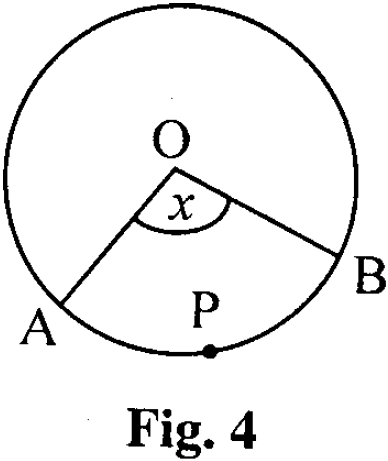
AnswerLet x = central angle and r = radius of the circle.
Area of sector = $\frac{5}{18}\text{th}$ of area of circle
$\frac{\pi\text{r}^2\text{x}}{360}=\frac{5}{18}\big(\pi\text{r}^2\big)$
$\frac{\text{x}}{360}=\frac{5}{18}$
$\text{x}=\frac{5}{18}\times360=100^\circ$
View full question & answer→Question 81 Mark
In fig. is a sector of circle of radius 10.5cm. Find the perimeter of the sector. $\Big(\text{Take}\ \pi=\frac{22}{7}\Big)$ 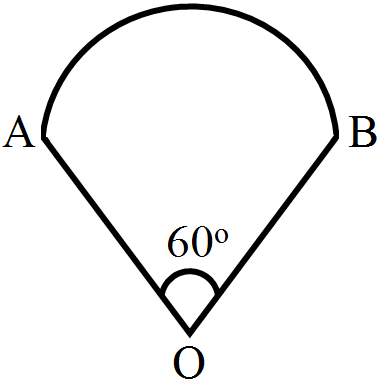
AnswerPerimeter $= 2\text{r}+\frac{\pi\text{r}\theta}{180^\circ}$
$= 2 \times 10.5+\frac{22}{7}\times10.5\times\frac{60^\circ}{180^\circ}$
$= 21 + 11= 32 \text{cm}$
View full question & answer→Question 91 Mark
In fig. is a sector of circle of radius 10.5cm. Find the perimeter of the sector. $\Big(\text{Take}\ \pi=\frac{22}{7}\Big)$ 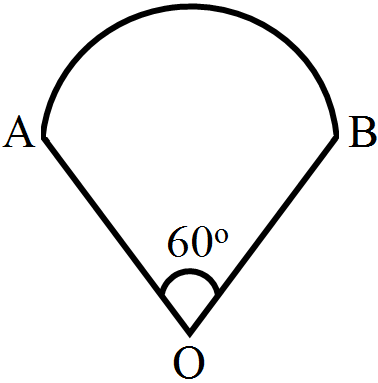
AnswerPerimeter $= 2\text{r}+\frac{\pi\text{r}\theta}{180^\circ}$
$= 2 \times 10.5+\frac{22}{7}\times10.5\times\frac{60^\circ}{180^\circ}$
$= 21 + 11= 32 \text{cm}$
View full question & answer→MCQ 101 Mark
Each side of an equilateral triangle is $6\sqrt3\text{ cm}.$ The altitude of the triangle is :
- A
$8\ cm$
- ✓
$9\ cm$
- C
$3\sqrt3\text{ cm}$
- D
$6\ cm.$
AnswerCorrect option: B. $9\ cm$
As, area of an equilateral triangle $=\frac{\sqrt3}{4}\times(\text{side})^2$
$\Rightarrow\frac{1}{2}\times\text{Base}\times\text{Height}=\frac{\sqrt3}{4}\times(6\sqrt3)^2$
$\Rightarrow\frac{1}{2}\times6\sqrt3\times\text{Height}=\frac{\sqrt3}{4}\times36\times3$
$\Rightarrow3\sqrt3\times\text{Height}=27\sqrt3$
$\Rightarrow\text{Height}=\frac{27\sqrt3}{3\sqrt3}$
$\therefore\ \text{Height}=9\text{ cm}$
View full question & answer→MCQ 111 Mark
On increasing the length of a rectangle by $20\%$ and decreasing its breadth by $20\%,$ what is the change in its area?
- A
$20\%$ increase
- B
$20\%$ decrease
- C
- ✓
$4\%$ dcrease.
AnswerCorrect option: D. $4\%$ dcrease.
Let :
Length $= x$
breadth $= y$
Area $= xy$
Now,
New length $= x + 20%x =\text{x}+\frac{1}{5}\text{x}=\frac{6}{5}\text{x}$
New breadth $= y - 20%y =\text{y}-\frac{1}{5}\text{y}=\frac{4}{5}\text{y}$
New area $=\frac{6}{5}\text{x}\times\frac{4}{5}\text{y}=\frac{24}{25}\text{xy}$
Difference in the areas $=\text{xy}-\frac{24}{25}\text{xy}=\frac{1}{25}\text{xy}$
Difference in percentage $=\bigg[\bigg(\frac{\frac{1}{25}\text{xy}}{\text{xy}}\bigg)\times100\bigg]\%=4\%$
View full question & answer→Question 121 Mark
Explain the underlying principle and working of an electric generator by drawing a labelled diagram. What is the function of brushes?
Answer
Principle : The electric generator is based on the principle of electromagnetic induction. When a coil is rotated with respect to a magnetic field, the number of magnetic field lines through the coil changes. Due to this a current is induced in the coil whose direction can be found by Fleming’s right hand rule.
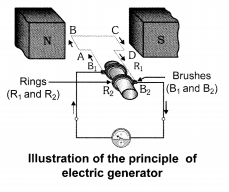
Working : When the armature coil ABCD rotates in a magnetic field produced by the permanent magnets, it cuts through the magnetic lines of force. Due to the rotation of armature coil, the associated magnetic field changes and an induced electromagnetic force is produced in it. The direction of this induced electromotive force or current can be determined by using Fleming’s right hand rule.
In first half cycle the current flows in one direction by brush $B_1$ and in second it flows in opposite direction by brush $B_2$. This process continues. So the current produced is alternating in nature.
Functions of Brushes : Brushes in contact with rings provide the current for external use. View full question & answer→MCQ 131 Mark
The area of a rhombus is $480\ cm^2$ and the length of one of its diagonals is $20\ cm$. The length of each side of the rhombus is:
- A
$24\ cm$
- B
$30\ cm$
- ✓
$ 26\ cm$
- D
$28\ cm$
AnswerCorrect option: C. $ 26\ cm$
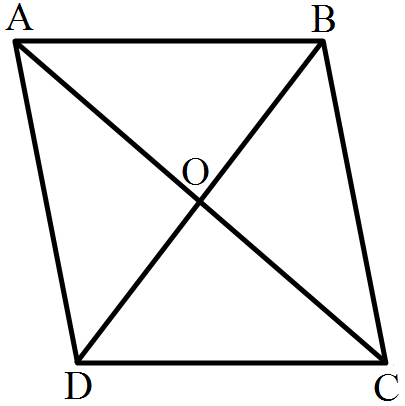
We have,$BD = 20\ cm$
$\Rightarrow\text{BO}=\frac{\text{BD}}{2}=\frac{20}{2}=10\text{cm}$
As, area of the rhombus $ABCD = 480\ cm^2$
$\Rightarrow\frac{1}{2}\times\text{AC}\times\text{BD}=480$
$\Rightarrow\frac{1}{2}\times\text{AC}\times20=480$
$\Rightarrow\text{AC}\times10=480$
$\Rightarrow\text{AC}=\frac{480}{10}$
$\Rightarrow\text{AC}=48\text{cm}$
$\Rightarrow\text{AO}=\frac{\text{AC}}{2}=\frac{48}{2}=24\text{cm}$
Now, in $\triangle\text{AOB},$
Using Pythagoras theorem,
$\text{AB}^2=\text{AO}^2+\text{BO}^2$
$=24^2+10^2$
$=576+100$
$\Rightarrow\text{AB}^2=676$
$\Rightarrow\text{AB}=\sqrt{676}$
$\therefore\text{AB}=26\text{cm}$
View full question & answer→MCQ 141 Mark
Area of the largest circle that can be inscribed in a semicircle of radius $'r\ ’$ units is :
- A
$\sqrt{2\text{r}}^2\text{ sq.units}$
- B
$\frac{\text{r}^2}{2}\text{ sq.units}$
- ✓
$\Big(\frac{\pi}{4}\Big)\text{r}^2\text{ sq.units}$
- D
$\frac{\text{r}^2}{\sqrt{2}}\text{ sq.units}$
AnswerCorrect option: C. $\Big(\frac{\pi}{4}\Big)\text{r}^2\text{ sq.units}$
Here, Diameter of circle $=$ Radius of semicircle $= r$
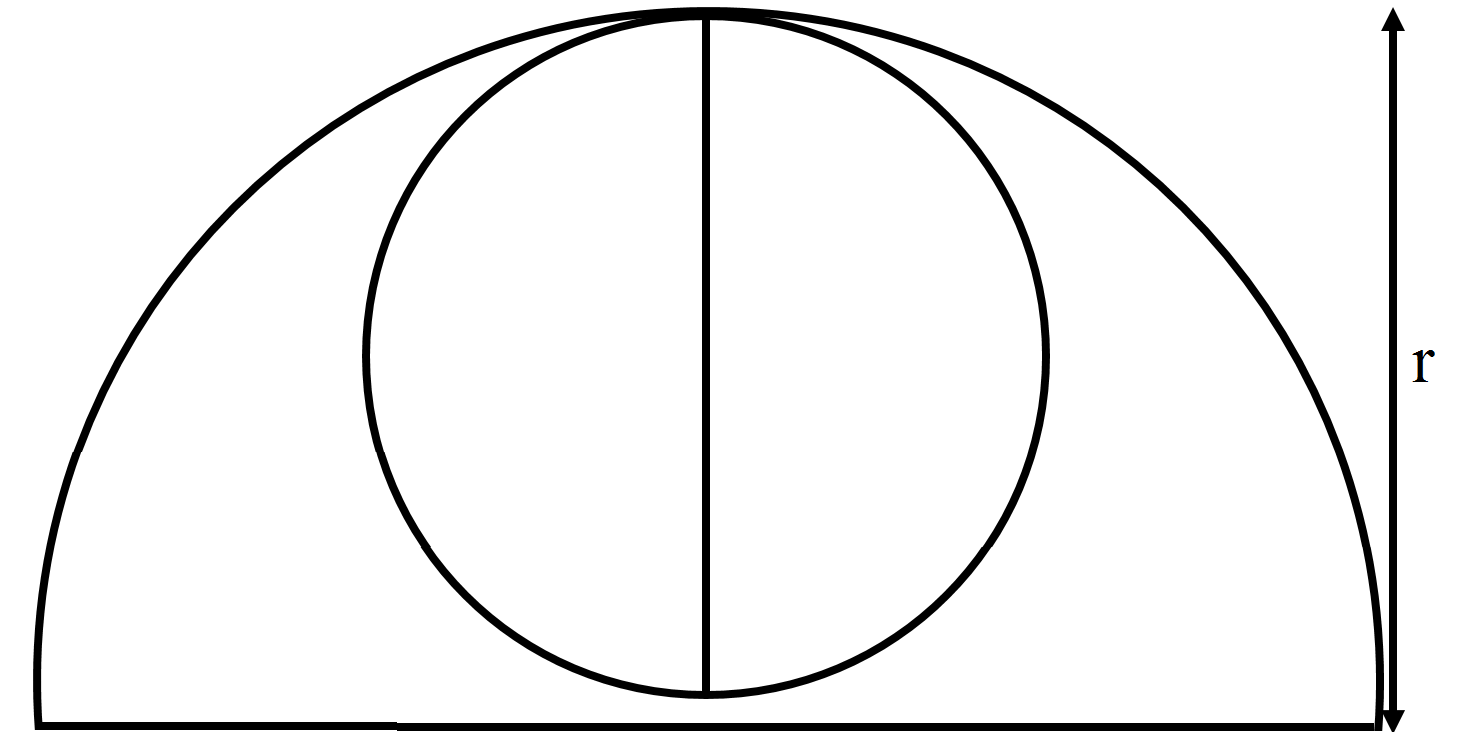
$\therefore$ Radius of the circle $=\frac{\text{r}}{2}$
$\therefore$ Area of the circle $=\pi\Big(\frac{\text{r}}{2}\Big)^2=\frac{\pi\text{r}^2}{4}$
$\therefore \Big(\frac{\pi}{4}\Big)\text{r}^2\text{ sq.units}$ View full question & answer→MCQ 151 Mark
The side of an equilateral triangle is equal to the radius of a circle whose area is $154\ cm2$. The area of the triangle is :
AnswerCorrect option: B. $\frac{49\sqrt3}{4}\text{ cm}^2$
Area of a circle $=\pi\text{r}^2$
$\Rightarrow154=\pi\text{r}^2$
$\Rightarrow\text{r}=\sqrt{\frac{154\times7}{22}}$
$=\sqrt{7\times7}$
$=7\text{ cm}$
The radius of the circle is equal to the side of the equilateral triangle.
$\therefore r = a($Here, a is the side of the equilateral triangle.$)$
$a = 7\ cm$
$\therefore$ Area of the equilateral triangle $=\frac{\sqrt3}{4}\text{a}^2$
$=\frac{\sqrt3}{4}\times7\times7$
$=\frac{49\sqrt3}{4}\text{ cm}^2$
View full question & answer→Question 161 Mark
If the numerical value of the area of a circle is equal to the numerical value of its circumference, find its radius.
Answer$\because$ Numerical value of area of circle = Numerical value of circumference
$\therefore$ $\pi\text{r}^2=2\pi\text{r}$
or r = 2 units
View full question & answer→Question 171 Mark
Find the area of an equilateral triangle having each side of length 10cm. $\big[\text{Take}\sqrt3=1.732\big]$
AnswerArea of equilateral triangle $=\frac{\sqrt3}{4}\times\text{side}^2$
$=\frac{\sqrt3}{4}\times10^2$
$=\frac{\sqrt3}{4}\times100$
$=1.732\times25$
$=43.3\text{cm}^2$
View full question & answer→MCQ 181 Mark
The area of an equilateral triangle is $4\sqrt3\text{ cm}^2.$ Its perimeter is :
- A
$9\text{ cm}$
- ✓
$12\text{ cm}$
- C
$12\sqrt3\text{ cm}$
- D
$6\sqrt3\text{ cm}$
AnswerCorrect option: B. $12\text{ cm}$
Area of an equilateral triangle $=\frac{\sqrt3}{4}\text{a}^2 \ ($where a is the length of the side$)$
Thus, we have :
$4\sqrt3=\frac{\sqrt3}{4}\text{a}^2$
$\Rightarrow\text{a}^2=16$
$\Rightarrow\text{a}=4\text{ cm}$
Perimeter of the equilateral triangle $= 3a = 3 \times 4 = 12\ cm.$
View full question & answer→Question 191 Mark
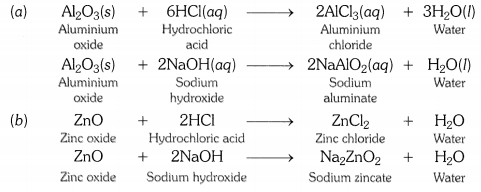
What are amphoteric oxides? Give two examples of amphoteric oxides?
Answer
Those metal oxides which show basic as well as acidic behaviour are known as amphoteric oxides. In other words, metal oxides that react wtih both acids and bases to form salt and water are called amphoteric oxides. Aluminium oxide and zinc oxide are amphoteric in nature.
View full question & answer→MCQ 201 Mark
The length of the diagonal of a square is $10\sqrt2\ \text{cm}.$ Its area is:
- A
$200\ \text{cm}^2$
- ✓
$100\ \text{cm}^2$
- C
$150\ \text{cm}^2$
- D
$100\sqrt2\ \text{cm}^2$
AnswerCorrect option: B. $100\ \text{cm}^2$
A diagonal of a square forms the hypotenuse of a right$-$angled triangle with base and height equal to side $a.$
$\text { Diagonal }^2=a^2+a^2$
$\text { Diagonal }^2=2 a^2$
$\Rightarrow a=\frac{1}{\sqrt{2}} \text { Diagonal }$
$=\frac{1}{\sqrt{2}} \times 10 \sqrt{2}$
$=10 \ cm$
$\therefore$ Area of the square $a^2=10 \times 10=100 \ cm^2$.
View full question & answer→Question 211 Mark
What would be electron dot structure of sulphur which is made up of eight atoms of sulphur.
MCQ 221 Mark
The height of an equilateral triangle is $3\sqrt3\text{ cm}.$ Its area is :
- A
$6\sqrt3\text{ cm}^2$
- B
$27\text{ cm}^2$
- ✓
$9\sqrt3\text{ cm}^2$
- D
$27\sqrt3\text{ cm}^2.$
AnswerCorrect option: C. $9\sqrt3\text{ cm}^2$
Let the side of the equilateral triangle be $x.$
As, area of the equilateral triangle $=\frac{\sqrt3}{4}\times(\text{side})^2$
$\Rightarrow\frac{1}{2}\times\text{Base}\times\text{height}=\frac{\sqrt3}{4}\times\text{x}^2$
$\Rightarrow\frac{1}{2}\times\text{x}\times3\sqrt3=\frac{\text{x}^2\sqrt3}{4}$
$\Rightarrow\frac{3\text{x}\sqrt3}{2}=\frac{\text{x}^2\sqrt3}{4}$
$\Rightarrow\frac{3\sqrt3}{2}=\frac{\text{x}\sqrt3}{4}$
$\Rightarrow\text{x}=\frac{3\sqrt3\times4}{2\sqrt3}$
$\Rightarrow\text{x}=6\text{ cm}$
Now, the area of the triangle $=\frac{\sqrt3}{4}\times6^2$
$=\frac{\sqrt3}{4}\times36$
$=9\sqrt3\text{ cm}^2$
View full question & answer→Question 231 Mark
Compounds such as alcohol and glucose also contain hydrogen but are not categorised as acids. Describe an activity to prove it.
AnswerThough compounds like alcohol and glucose contain hydrogen but they do not ionise in the solution to produce $H^+$ ions on passing current through them.
(i) Take solutions of alcohols and glucose.
(ii) Fix two nails on a cork, and place the cork in 100 mL beaker.
(iii) Connect the nails to the two terminals of a 6 volt battery through a bulb and a switch, as shown in the given Figure.
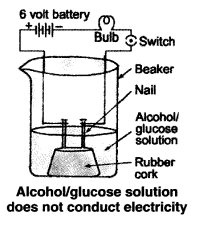
(iv) Now pour alcohol in the beaker and switch on the current.
(v) The bulb does not glow.
(vi) Repeat the experiment with glucose. The bulb does not glow in this case also.
(vii) This means no ions or H+ ions are present in the solution.
This shows that alcohols and glucose are not acids. View full question & answer→Question 241 Mark
What would be the electron dot structure of carbon dioxide which has the formula $CO _2$
?
View full question & answer→MCQ 251 Mark
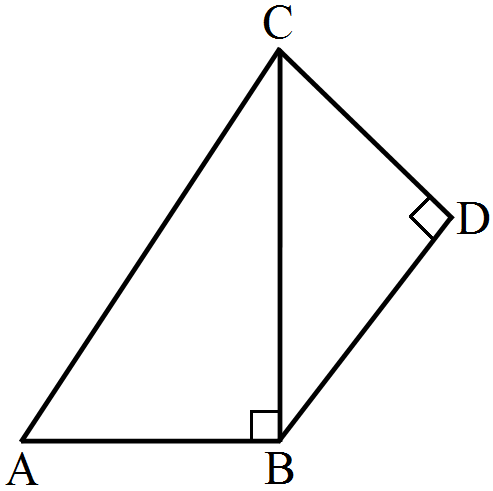
In the given figure $\text{ABCD}$ is a quadrilateral in which $\angle\text{ABC}=90^\circ, AC = 17\ cm, BC = 15\ cm, BD = 12\ cm$ and $CD = 9\ cm.$ The area of quad. $\text{ABCD}$ is:
- A
$102\ cm^2$
- ✓
$114\ cm^2$
- C
$95\ cm^2$
- D
$57\ cm^2.$
AnswerCorrect option: B. $114\ cm^2$
$\text { In } \triangle ABC, \angle ABC=90^{\circ}$
$\Rightarrow AC^2=BC^2+AB^2$
$\Rightarrow 17^2=15^2+AB^2$
$\Rightarrow 289=225+AB^2$
$\Rightarrow AB^2=64$
$\Rightarrow AB=8 \ cm$
$\text { Area of quad. } ABCD=\text { Area of } \triangle ABC+\text { Area of } \triangle BCD$
$=\frac{1}{2} \times BC \times AB+\frac{1}{2} \times BD \times CD$
$=\frac{1}{2} \times 15 \times 8+\frac{1}{2} \times 12 \times 9$
$=60+54$
$=114 \ cm^2$
View full question & answer→Question 261 Mark
Write the formula for the area of a sector of angle $\theta$ (in degrees) of a circle of radius r.
AnswerArea of a sector of a circle whose radius = r
and angle at centre $=\theta,$ Will be $\pi\text{r}^2\times\frac{\theta}{360^\circ}$
View full question & answer→MCQ 271 Mark
The length of a rectangular hall is $5\ m$ more than its breadth. If the area of the hall is $750\ m^2$, then its length is:
- A
$15m$
- B
$20m$
- C
$25m$
- ✓
$30m.$
AnswerCorrect option: D. $30m.$
Let the length of the rectangle be $\times m$.
$\therefore$ Breadth of the rectangle $=(x-5) m$
Area $=x(x-5)=x^2-5 x$
$\Rightarrow x^2-5 x=750$
$\Rightarrow x^2-5 x-750=0$
$\Rightarrow x^2-30 x+25 x-750=0$
$\Rightarrow x(x-30)+25(x-30)=0$
$\Rightarrow(x+25)(x-30)=0$
$\Rightarrow x+25=0 $ and $ x-30=0$
$\Rightarrow x=-25 $ and $ x=30$
Length cannot be negative.
$\therefore$ Length $x =30 m$.
View full question & answer→MCQ 281 Mark
Each side of an equilateral triangle is $8\ cm.$ Its area is :
- A
$24\text{ cm}^2$
- B
$24\sqrt3\text{ cm}^2$
- ✓
$16\sqrt3\text{ cm}^2$
- D
$8\sqrt3\text{ cm}^2.$
AnswerCorrect option: C. $16\sqrt3\text{ cm}^2$
Let the side of the equilateral triangle be a.
Given; $a = 8\ cm$
Now,
Area of the equilateral triangle $=\frac{\sqrt3}{4}\text{a}^2=\frac{\sqrt3}{4}\times8\times8$
$=16\sqrt3\text{ cm}^2$
View full question & answer→MCQ 291 Mark
The length of a rectangular field is $23\ m$ more than its breadth. If the perimeter of the field is $206\ m$, then its area is:
- A
$2420m^2$
- ✓
$2520m^2$
- C
$2480m^2$
- D
$2620m^2$
AnswerCorrect option: B. $2520m^2$
Let the breadth of the field be $x m.$
$\therefore$ Length $= (x + 23)m$
Now,
Perimeter $= 2($Length $+$ Breadth$) = 2(x + x + 23) = (4x + 46)m$
Thus, we have:
$4x + 46 = 206$
$\Rightarrow 4x = 206 - 46 = 160$
$\Rightarrow\text{x}=\frac{160}{4}=40$
$\therefore$ Breadth $= x = 40m$
Length $= x + 23 = 40 + 23 = 63m$
Area $=$ Length $\times$ Breadth $ = 63 \times 40 = 2520m^2.$
View full question & answer→MCQ 301 Mark
The cost of carpeting a room $15\ m$ long with a carpet $75\ cm$ wide, at $₹ 7$0 per metre, is $₹ 8400$. The width of the room is:
AnswerWe have,
Width of the carpet $= 75\ cm = 0, 75m$ and length of the room $= 15m$
Length of the carpet $=\frac{\text{cost}\ \text{of}\ \text{carpeting}}{\text{Rate}\ \text{of}\ \text{carpeting}}=\frac{8400}{70}=120\text{m}$
Now, area of the carpet required for carpeting $=120 \times 0.75 m^2$
$\Rightarrow$ area of the floor $=120 \times 0.75 m^2$
$\Rightarrow 15\ \times$ breadth $= 120 \times 0.75$
$\Rightarrow\text{breadth}=\frac{120\times0.75}{15}$
So, breadth $= 6m.$
View full question & answer→MCQ 311 Mark
The angle described by the minute hand in $5$ minutes is:
- ✓
$30^{\circ}$
- B
$60^{\circ}$
- C
$360^{\circ}$
- D
$90^{\circ}$
AnswerCorrect option: A. $30^{\circ}$
$\because$ Angle described by the minute hand in $60$ minutes $=360^{\circ}$
$\therefore$ Angle described by the minute hand in $5$ minutes $=\frac{360^\circ}{60}\times5=30^\circ$
View full question & answer→MCQ 321 Mark
The parallel sides of a trapezium are $9.7\ cm$ and $6.3\ cm, $ and the distance between then is $6.5\ cm.$ The area of the trapezium is:
- A
$104\ cm^2$
- B
$78\ cm^2$
- ✓
$52\ cm^2$
- D
$65\ cm^2.$
AnswerCorrect option: C. $52\ cm^2$
Given that the parallel sides are $9.7\ cm$ and $6.3\ cm$ and the distance between them $=$ height $= 6.5\ cm.$
Area of trapezium $=\frac{\text{Sum}\ \text{of}\ \text{parallel}\ \text{sides}}{2}\times\text{height}$
Area of trapezium $=\frac{9.7+6.3}{2}\times6.5$
$=\frac{16}{2}\times6.5$
$=8\times6.5$
$=52\ \text{cm}^2$
View full question & answer→MCQ 331 Mark
The lengths of the sides of a triangular field are $20\ m, 21\ m$ and $29\ m$. The cost of cultivating the field at $₹ 9 \text{ per m}^2$ is:
- A
$₹ 2610$
- B
$₹ 3780$
- ✓
$₹ 1890$
- D
$₹ 1800.$
AnswerCorrect option: C. $₹ 1890$
As, the sides of the triangle are $ 20\ m, 21\ m$ and $29\ m$
So, the semi $-$ perimeter $=\frac{20+21+29}{2}=35\text{m}$
Now, the area of the triangular field
$=\sqrt{35(35-20)(35-21)(35-29)}$
$=\sqrt{35\times15\times14\times6}$
$=\sqrt{7\times5\times5\times3\times7\times2\times2\times3}$
$=2\times3\times5\times7$
$=210\text{m}^2$
$\therefore$ The cost of cultivating the field $= 210 \times 9 = ₹ 1890.$
View full question & answer→Question 341 Mark
Find the area of a parallelogram with base equal to 25cm and the corresponding height measuring 16.8cm.
AnswerArea of the $\|^{g m}=$ (base height) sq.
unit $=(25 \times 16.8) cm ^2=420 cm^2$.
View full question & answer→MCQ 351 Mark
The area of the circle that can be inscribed in a square of side $10 \ cm$ is :
- A
$25\pi\text{ sq.cm}$
- B
$20\pi\text{ sq.cm}$
- C
$25\text{ sq.cm}$
- ✓
$10\pi\text{ sq.cm}$
AnswerCorrect option: D. $10\pi\text{ sq.cm}$
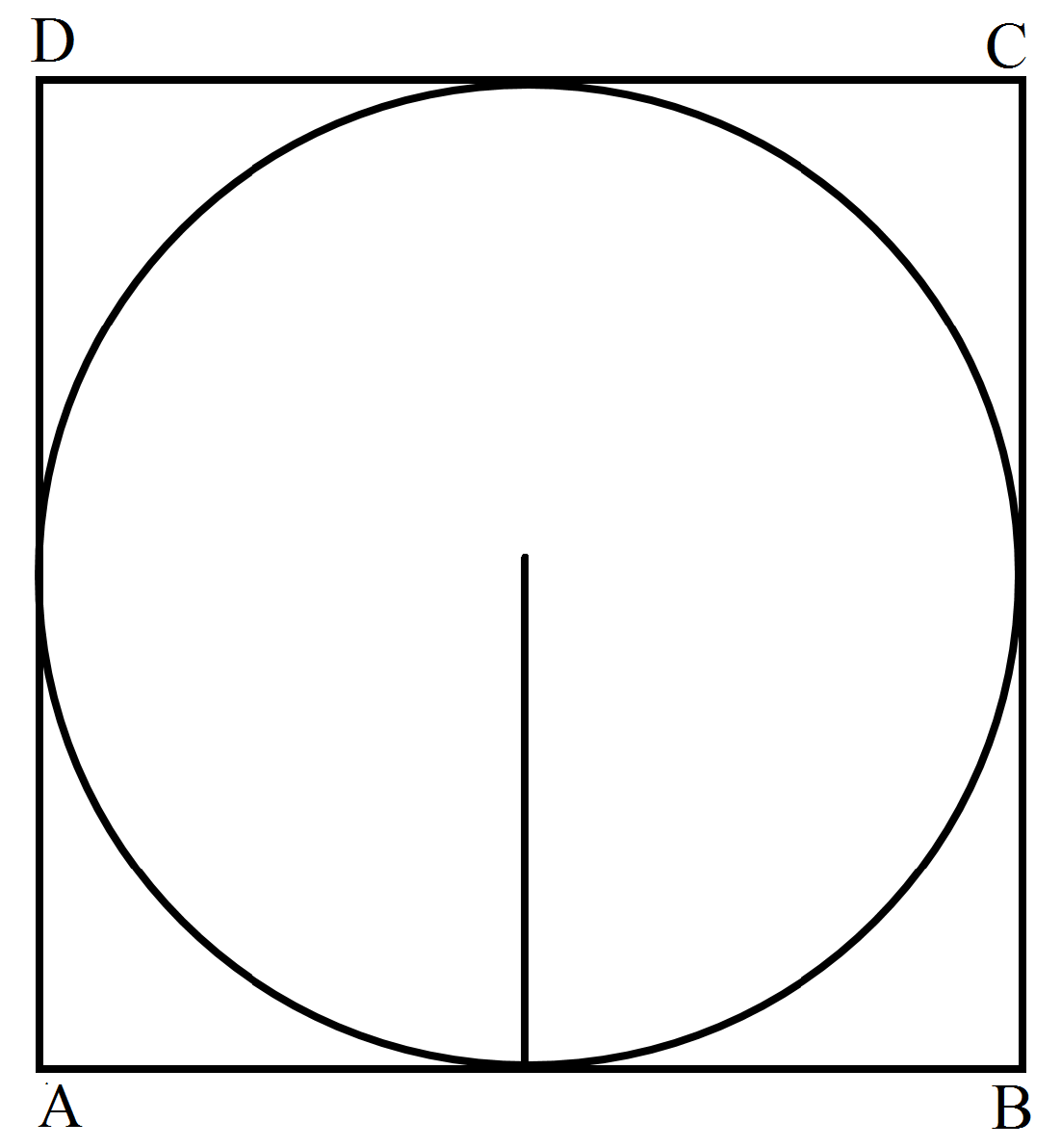
Since if a circle inscribed a square, then the radius of the circle is half of the side of the square.
$\therefore$ Radius$=\frac{10}{2}=5\text{ cm}$
$\therefore$ Area of the circle $=\pi\text{r}^2=\pi(5)^2$
$=25\pi\text{ sq.cm}$ View full question & answer→MCQ 361 Mark
The area of a square field is $0.5$ hectare. The length of its diagonal is:
- A
$150\text{m}$
- B
$100\sqrt2\text{m}$
- ✓
$100\text{m}$
- D
$50\sqrt2\text{m}$
AnswerCorrect option: C. $100\text{m}$
Disclaimer : The length cannot be in hectare so we used is as area of the square.
Area of the square field $= 0.5 \times 10000 = 5000\ m^2$
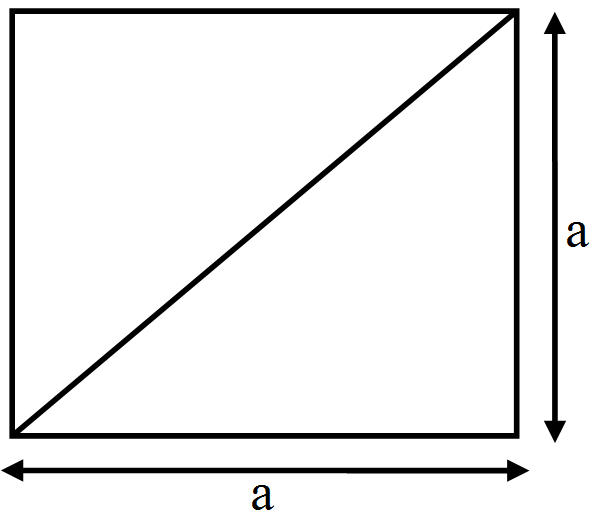
The diagonal divides the square into the isoscale right $-$ angled triangles.
Using Pythagoras theorem, we have:
Diagonal ${ }^2=a^2+a^2=2 a^2$
Area of a square $=a^2$
$\therefore\ \text{Diagonal}=\sqrt{2\times\text{area}}$
$=\sqrt{2\times5000}$
$=\sqrt{10000}=100\text{m}.$ View full question & answer→MCQ 371 Mark
The length of a rectangle is thrice its breadth and the length of its diagonal is $8\sqrt{10}\text{ cm}.$ The perimeter of the rectangle is :
- A
$15\sqrt{10}\text{ cm}$
- B
$16\sqrt{10}\text{ cm}$
- C
$24\sqrt{10}\text{ cm}$
- ✓
$64\text{ cm}.$
AnswerCorrect option: D. $64\text{ cm}.$
Let the breadth of the rectangle be $x \ cm.$
Length of the rectangle $= 3x \ cm$
We know :
$\text{Diagonal}=\sqrt{(\text{Length})^2+(\text{Breadth})^2}$
$\Rightarrow8\sqrt{10}=\sqrt{\text{x}^2+(3\text{x})^2}$
$\Rightarrow8\sqrt{10}=\sqrt{\text{x}^2+9\text{x}^2}$
$\Rightarrow8\sqrt{10}=\text{x}\sqrt{10}$
$\Rightarrow\text{x}=8$
Now,
Breadth of the rectangle $= x = 8\ cm$
Length of the rectangle $= 3x = 24\ cm$
Perimeter of the rectangle $= 2($Length $+$ Breadth$)$
$= 2(8 + 24) = 64\ cm.$
View full question & answer→Question 381 Mark
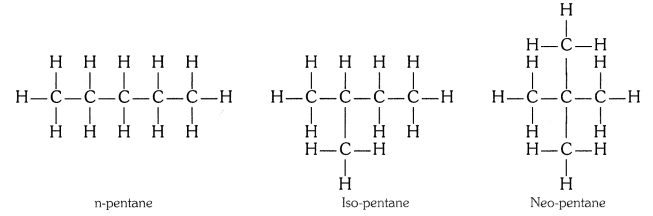
How many structural isomers can you draw for pentane?
Answer
Three, these are n-pentane, iso-pentane and neo-pentane.
View full question & answer→MCQ 391 Mark
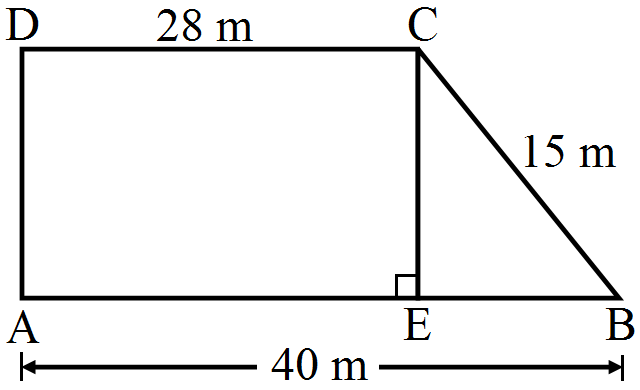
In the given figure $\text{ABCD}$ is a trapizium in which $Ab = 40m, BC = 15m, CD = 28m, AD = 9m$ and $\text{CE}\bot\text{AB}.$ Area of trap. $\text{ABCD}$ is:
- ✓
$306m^2$
- B
$316m^2$
- C
$296m^2$
- D
$284m^2.$
AnswerCorrect option: A. $306m^2$
Since $CD = AE = 28m,$
$EB = AB - AE = 40m - 28m = 12m$
In right $\triangle\text{BEC},$
$C E^2=B C^2-E B^2$
$\Rightarrow C E^2=15^2-12^2$
$\Rightarrow C E^2=225-144$
$\Rightarrow C E^2=81$
$\Rightarrow C E=9 m$
Area of trap. $\text{ABCD} =\frac{\text{DC}+\text{AB}}{2}\times\text{CE}$
$=\frac{28+40}{2}\times9$
$=\frac{68}{2}\times9$
$=34\times9$
$=306\text{m}^2$
View full question & answer→Question 401 Mark
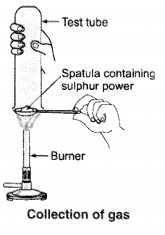
Pratyush took sulphur powder on a spatula and heated it. He collected the gas evolved by inverting a test tube over it, as shown in the figure.
(a) What will be the action of gas on
(i) dry litmus paper?
(ii) moist litmus paper?
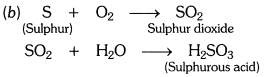
(b) Write a balanced chemical equation for the reaction taking place.
Answer(i) Dry litmus paper – no action.
(ii) Moist litmus paper – becomes red.
View full question & answer→Question 411 Mark
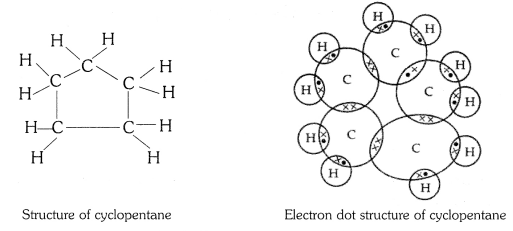
What will be the formula and electron dot structure of cyclopentane?
AnswerThe molecular formula of cyclopentane is $C _5 H _{10}$ The electron dot structure of cyclopentane is given on the next page.
View full question & answer→MCQ 421 Mark
The side of a square is equal to the side of an equilateral triangle. The ratio of their areas is:
- A
$4 : 3$
- B
$2:\sqrt3$
- ✓
$4:\sqrt3$
- D
AnswerCorrect option: C. $4:\sqrt3$
Let:
Length of the side of the square $=$ Length of the side of the equilateral triangle $=$ a unit
Now,
Area of the square $= a \times a = a^2 \text{unit}^2$
Area of the equilateral triangle $=\frac{\sqrt3}{4}\text{a}^2\text{unit}^2$
Ratio of areas $=\frac{\text{Area}\ \text{of}\ \text{the}\ \text{square}}{\text{Area}\ \text{of}\ \text{the}\ \text{equilateral}\ \text{triangle}}$
$=\frac{\text{a}^2}{\frac{\sqrt3}{4}\text{a}^2}$
$=\frac{4}{\sqrt3}$
View full question & answer→Question 431 Mark
If a square is inscribed in a circle, what is the ratio of the areas of the circle and the square?
AnswerWe have the following situation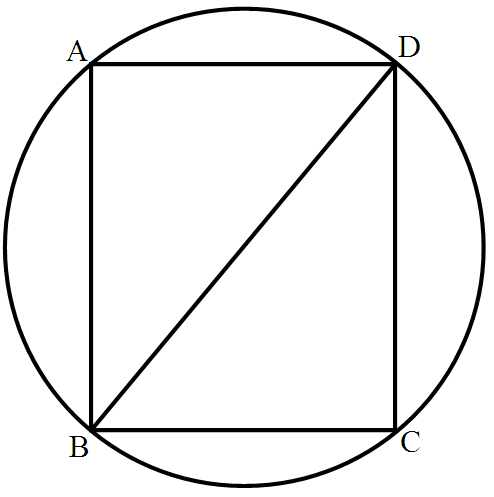
Let BD be the diameter and diagonal of the circle and the square respectively. We know that area of the circle $=\pi\text{r}^2$ Area of the square = side$^2 $As we know that diagonal of the square is the diameter of the square. Diagonal = 2r Side of the square $=\frac{\text{diagonal}}{\sqrt{2}}\ \dots(1)$ Substituting Diagonal = 2r in equation (1) we get, Side of the square $=\frac{2\text{r}}{\sqrt{2}}$ Now we will find the ratio of the areas of circle and square. $\frac{\text{Area of circle}}{\text{Area of square}}=\frac{\pi\text{r}^2}{\Big(\frac{2\text{r}}{\sqrt{2}}\Big)^2}$ Now we will simplify the above equation as below, $\frac{\text{Area of circle}}{\text{Area of square}}=\frac{\pi\text{r}^2}{\frac{4\text{r}^2}{2}}$ $\frac{\text{Area of circle}}{\text{Area of square}}=\pi\text{r}^2\times{\frac{2}{4\text{r}^2}}$ Hence, $\frac{\text{Area of circle}}{\text{Area of square}}=\frac{\pi}{2}$ Therefore, ratio of areas of circle and square is $\pi:2.$ View full question & answer→MCQ 441 Mark
The length of a rectangular field is $12\ m$ and the length of its diagonal is $15\ m$. The area of the field is:
- ✓
$108\text{m}^2$
- B
$180\text{m}^2$
- C
$30\sqrt3\text{m}^2$
- D
$12\sqrt{15}\text{m}^2$
AnswerCorrect option: A. $108\text{m}^2$
Length of the rectangular field $12m$
Diagonal $= 15m$
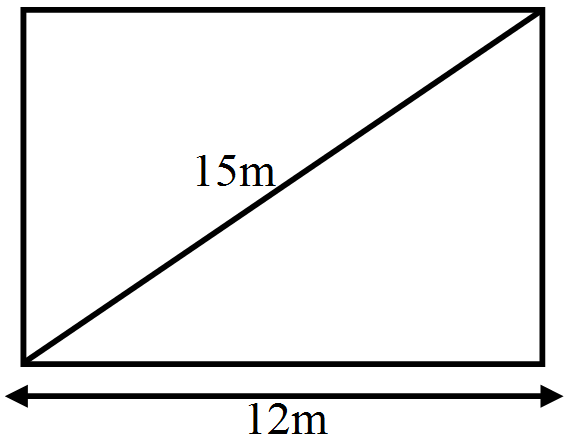
$\text{Diagonal}^2=\text{Length}^2+\text{Breadth}^2$
$\text{Breadth}=\sqrt{\text{Diagonal}^2-\text{Length}^2}$
$=\sqrt{15^2-12^2}$
$=\sqrt{225-144}$
$=9\text{m}$
$\therefore$ Area of the field $=$ Length $\times$ Breadth $= 12 \times 9 = 108m^2.$ View full question & answer→MCQ 451 Mark
The base and height of a triangle are in the ratio $3 : 4$ and its area is $216\ cm^2$. The height of the triangle is:
- A
$18\ cm$
- ✓
$24\ cm$
- C
$21\ cm$
- D
$28\ cm.$
AnswerCorrect option: B. $24\ cm$
Let the base of the triangle be $3x$ and its height be $4x.$
As, the area of the triangle $= 216\ cm^2$
$\Rightarrow\frac{1}{2}\times\text{Base}\times\text{Height}=216$
$\Rightarrow\frac{1}{2}\times3\text{x}\times4\text{x}=216$
$\Rightarrow6\text{x}^2=216$
$\Rightarrow\text{x}^2=\frac{216}{6}$
$\Rightarrow\text{x}^2=36$
$\Rightarrow\text{x}=\sqrt{36}$
$\Rightarrow\text{x}=6\ \text{cm}$
So, the height of the triangle $= 4 \times 6 = 24\ cm.$
View full question & answer→MCQ 461 Mark
The sides of a triangle are in the ratio $12 : 14 : 25$ and its perimeter is $25.5\ cm$. The largest side of the triangle is :
- A
$7\ cm$
- B
$14\ cm$
- ✓
$12.5\ cm$
- D
$18\ cm.$
AnswerCorrect option: C. $12.5\ cm$
The sides of a triangle are in the ratio $12 : 14 : 25.$
Let the common multiple be $x \ cm.$
$\Rightarrow $ The sides of the triangle are $12x, 14x$ and $25x$
Now,
Perimeter $= 12x + 14x + 25x$
$\Rightarrow 25 .5 = 51x$
$\Rightarrow x = 0.5$
$\Rightarrow $ The sides of the triangle are $12 \times 0.5 = 6\ cm, 14 \times 0.5 = 7\ cm$ and $25 \times 0.5 = 12.5\ cm$
$\Rightarrow $ The largest side of the triangle is $12.5\ cm.$
View full question & answer→MCQ 471 Mark
The area of a square field is $6050m^2$. The length of its diagonal is:
- A
$135m$
- B
$120m$
- C
$112m$
- ✓
$110m$
AnswerCorrect option: D. $110m$
Let the diagonal of the square field be $d m$.
In case of a square field, $d^2=2 a^2$, where $a$ is the side of the square field.
Now,
Area of a square field $=a^2$
$d^2=2 a^2$
$\Rightarrow d^2=2 \times \text { Area of the square field }$
$\Rightarrow d=\sqrt{2 \times \text { Area of the square field }}$
$\therefore d=\sqrt{2 \times 6050}$
$=\sqrt{12100}$
$=110$
View full question & answer→MCQ 481 Mark
A rectangular ground $80m \times 50m$ has a path $1\ m$ wide outside around it. The area of the path is:
AnswerLength of the ground including the path $= 80 + 2 = 82m$
Breadth of the ground including the path $= 50 + 2 = 52m$
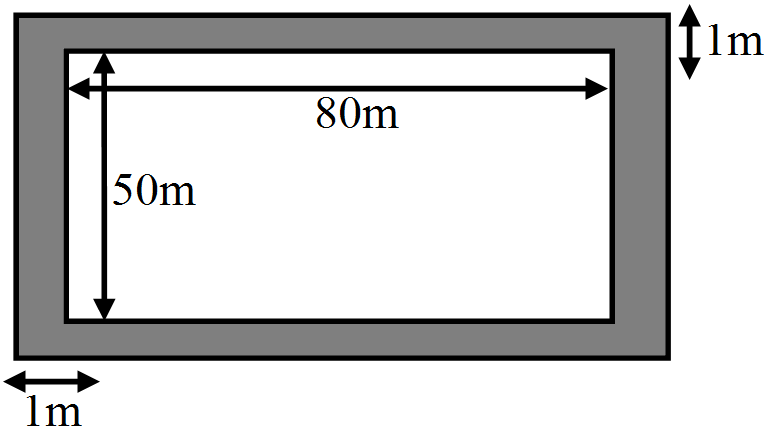
Total area $($including the path$)\ =$ Length $\times$ Breadth $=82 \times 52=4264 m^2$
Area of the field $=80 \times 50=4000 m^2$
Area of the path $=4264-4000=264 m^2$. View full question & answer→Question 491 Mark
State Fleming’s left hand rule.
AnswerFleming’s left hand rule : Stretch the first finger, the middle finger and the thumb of your left hand mutually perpendicular to each other in such a way that the first finger represents the direction of the magnetic field, the middle finger represents the direction of the current in the conductor, then the thumb will represent the direction of motion of the conductor.
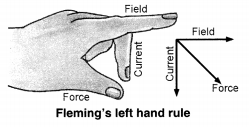
View full question & answer→