Questions

5 Marks Questions

Take a timed test

11 questions · self-marked practice — reveal the answer and mark yourself.

Question 15 Marks
The sum of the third and the seventh terms of an AP is 6 and their product is 8. Find the sum of the first sixteen terms of the AP.
Answer
Let the first term and the common difference of the AP be a and d respectively.
According to the question,
Third term + seventh term = 6
$ \Rightarrow $ [a + (3 - 1)d] + [a + (7 - 1)d] = 6 = a + (n - 1)d
$ \Rightarrow $ (a + 2d) + (a + 6d) = 6 $ \Rightarrow $ 2a + 8d = 6
$ \Rightarrow $ a + 4d = 3 ..... (1)
Dividing throughout by 2 &
(third term) (seventh term) = 8
$ \Rightarrow $ (a + 2d) (a + 6d) = 8
$ \Rightarrow $ (a + 4d - 2d) (a + 4d + 2d) = 8
$ \Rightarrow $ (3 - 2d) (3 + 2d) = 8
$ \Rightarrow $ $9 - 4d^2 = 8$
$ \Rightarrow 4{d^2} = 1 \Rightarrow {d^2} = \frac{1}{4} \Rightarrow d + \pm \frac{1}{2}$
Case I, when $d = \frac{1}{2}$
Then from (1), $a + 4\left( {\frac{1}{2}} \right) = 3$
$ \Rightarrow $ a + 2 = 3 $ \Rightarrow $ a = 3 - 2 $ \Rightarrow $ a = 1
$\therefore $ Sum of first sixteen terms of the $AP = S_{16}$
$ = \frac{{16}}{2}[2a + (16 - 1)d]$ $\because {S_n} = \frac{n}{2}[2a + (n - 1)d]$
= 8[2a + 15d]
$ = 8[2(1) + 15(\frac{1}{2})]$
$ = 8[12 + \frac{{15}}{2}]$
$ = 8[\frac{{19}}{2}]$
$ = 4 \times 19 = 76$
Case II. When $d = - \frac{1}{2}$
Then from (1),
$a + 4\left( { - \frac{1}{2}} \right) = 3$
$ \Rightarrow $ a - 2 = 3 $ \Rightarrow $ a = 3 + 2 $ \Rightarrow $ a = 5
$\therefore $ Sum of first sixteen terms of the $AP = S_{16}​​​​​​​$​​​​​​​
$ = \frac{{16}}{2}[2a + (16 - 1)d]$ $\because {S_n} = \frac{n}{2}[2a + (n - 1)d]$
$ = 8[2a + 15d] = 8\left[ {2(5) + 15\left( { - \frac{1}{2}} \right)} \right] = 8\left[ {10 - \frac{{15}}{2}} \right] = 8\left[ {\frac{5}{2}} \right] = 20$

View full question & answer
Question 25 Marks
In an $AP: a_n = 4, d = 2, S_n = -14$, find n and a.
Answer
Here, $a_n = 4$
$d = 2$
$S_n = -14$
We know that
$a_n = a + (n - 1)d$
$ \Rightarrow $ 4 = a + (n - 1)d
$ \Rightarrow $ 4 = a + 2n - 2
$ \Rightarrow $ 4 + 2 = a + 2n
$ \Rightarrow $ 6 = a + 2n
$ \Rightarrow $ a + 2n = 6 ...... (1)
Again, we know that
${S_n} = \frac{n}{2}\left[ {2a + (n - 1)d} \right]$
$ \Rightarrow - 14 = \frac{n}{2}\left[ {2a + (n - 1)2} \right]$
$ \Rightarrow $ -14 = n[a + (n - 1)]
$ \Rightarrow $ -14 = n (a + n - 1)
$ \Rightarrow $ -14 = n (6 - n - 1) .......From (1), (a + 2n = 6 $ \Rightarrow $ a + n = 6 - n)
$ \Rightarrow $ -14 = n(-n + 5)
$ \Rightarrow $ $-14 = -n^2 + 5n$
$ \Rightarrow $ $n^2 - 7n + 2n - 14 = 0$
$ \Rightarrow $ n(n - 7) + 2(n - 7) = 0
$ \Rightarrow $ (n - 7) (n + 2) = 0
$ \Rightarrow $ n - 7 = 0 or n + 2 = 0
$ \Rightarrow $ n = 7 or n = -2
$ \Rightarrow $ n = - 2 is in admissible as n, being the number of terms, is a natural number.
$\therefore $ n = 7
Putting n = 7 in equation (1), we get
a + 2(7) = 6
$ \Rightarrow $ a + 14 = 6
$ \Rightarrow $ a = 6 - 14
$ \Rightarrow $ a = -8
View full question & answer
Question 35 Marks
In an AP: $a_3=15, S_{10}=125$, find $d$ and $a_{10}$.
Answer
Here, $a_3=15$
$S_{10}=125$
We know that
$a_n = a + (n - 1)d$
$ \Rightarrow  a_3 = a + (3 - 1)d$
$ \Rightarrow  a_3 = a + 2d$
$ \Rightarrow  15 = a + 2d$
$ \Rightarrow  a + 2d = 15 ...... (1)$
Again, we know that
${S_n} = \frac{n}{2}\left[ {2a + (n - 1)d} \right]$
$ \Rightarrow {S_{10}} = \frac{{10}}{2}\left[ {2a + (10 - 1)d} \right]$
$ \Rightarrow  S_{10} = 5(2a + 9d)$
$ \Rightarrow  125 = 5(2a + 9d)$
$ \Rightarrow  25 = 2a + 9d$
$ \Rightarrow  2a + 9d = 25 ....... (2)$
Solving equation (1) and equation (2), we get
$a = 17$
$d = -1$
Now $an = a + (n - 1)d$
$ \Rightarrow  a_{10} = a + (10 - 1)d$
$ \Rightarrow  a_{10} = a + 9d$
$ \Rightarrow  a_{10} = 17 + 9(-1)$
$ \Rightarrow  a_{10} = 17 - 9$
$ \Rightarrow  a_{10} = 8$
View full question & answer
Question 45 Marks

200 logs are stacked in the following manner: 20 logs in the bottom row, 19 in the next row, 18 in the row next to it and so on (see Fig.). In how many rows are the 200 logs placed and how many logs are in the top row?

Answer
Self Learning
View full question & answer
Question 55 Marks
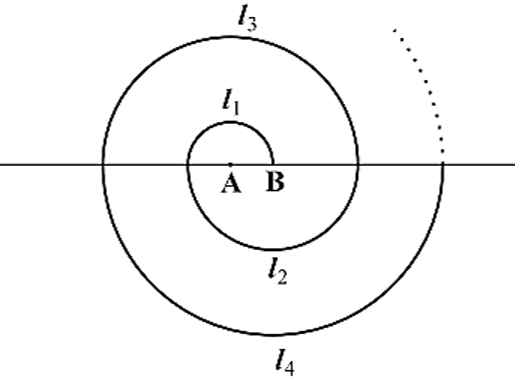
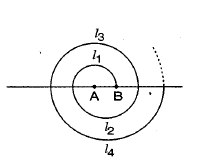
A spiral is made up of successive semicircles, with centres alternately at A and B, starting with centre at A, of radii 0.5 cm, 1.0 cm, 1.5 cm, 2.0 cm, ... as shown in Figure. What is the total length of such a spiral made up of thirteen consecutive semicircles? $(Take\; \pi = \frac { 22 } { 7 } )$
[Hint: Length of successive semicircles is$ l_1, l_2, l_3, l_4, ...$ with centres at A, B, A, B, ... respectively.]
Image
Answer
According to question we are given that a spiral is made up of successive semi-circles, with centres alternately at A and B, starting with centre at A, of radii 0.5 cm, 1.0 cm, 1.5 cm, 2.0 cm, ....as shown in Fig.
Let $l_1, l_2, l_3, l_4,..l_{13}$​​​​​​​ be the lengths (circumferences) of semi-circles of radii $r_1= 0.5 cm, r_2 =1.0 cm, r_3 = 1.5 cm, r_4 = 2.0 cm, r_5 = 2.5 cm,...$ respectively.

Now, Semi-perimeter of circle = $\pi\cdot r $
Therefore,
$l _ { 1 } = \pi r _ { 1 } = \pi \times 0.5 = \frac { \pi } { 2 } \mathrm { cm }$
$l _ { 2 } = \pi r _ { 2 } = \pi \times 1 = 2 \left( \frac { \pi } { 2 } \right) \mathrm { cm }$
$l _ { 3 } = \pi r _ { 3 } = \pi \times \frac { 3 } { 2 } = 3 \left( \frac { \pi } { 2 } \right) \mathrm { cm }$
$l _ { 4 } = \pi r _ { 4 } = \pi \times 2 = 4 \left( \frac { \pi } { 2 } \right) \mathrm { cm }$
and
$l _ { 13 } = \pi r _ { 13 } = \pi \times \frac { 13 } { 2 } \mathrm { cm } = 13 \left( \frac { \pi } { 2 } \right) \mathrm { cm }$
Therefore total length of the spiral $= l_1 + l_2 + l_3 +...+ l_{13}​​​​​​​$​​​​​​​
$\bf= \left\{ \frac { \pi } { 2 } + 2 \left( \frac { \pi } { 2 } \right) + 3 \left( \frac { \pi } { 2 } \right) + \dots + 13 \left( \frac { \pi } { 2 } \right) \right\} $
$\bf= \frac { \pi } { 2 } ( 1 + 2 + 3 + \cdots + 13 ) $
$\bf= \frac { \pi } { 2 } \times \frac { 13 } { 2 } ( 1 + 13 ) \quad \left[ \text { Using } S _ { n } = \frac { n } { 2 } ( a + l ) \right]$
$\bf= \frac { \pi } { 2 } \times \frac { 13 } { 2 } \times 14$ = $\bf\frac { 1 } { 2 } \times \frac { 22 } { 7 } \times 13 \times 7$ = $\bf {143 cm}$
which is required length of the spiral made up of thirteen consecutive semi-circles.
View full question & answer
Question 65 Marks
A sum of ₹ 700 is to be used to give seven cash prizes to students of a school for their overall academic performance. If, each prize is ₹ 20 less than its preceding term, find the value of each of the prizes.
Answer
It is given that the sum of seven cash prizes is equal to ₹ 700.
And, each prize is ₹ 20 less than its preceding term.
Let the value of first prize = ₹ a
Let the value of second prize =₹ (a−20)
Let the value of third prize = ₹ (a−40)
So, we have a sequence of the form:
a, a−20, a−40, ...................
It is an arithmetic progression because the difference between consecutive terms is constant.
First term = a, Common difference = d = (a − 20) − a= −20
n = 7 (Because there are total of seven prizes)
$S_7 = ₹ 700$ {given}
Applying formula, ${S_n} = \frac{n}{2}\left[ {2a + (n - 1)d} \right]$ to find sum of n terms of AP, we get
${S_7} = \frac{7}{2}\left[ {2a + (7 - 1)( - 20)} \right]\;\;$
$\Rightarrow 700 = \frac{7}{2}[2a - 120]$
$\Rightarrow 200 = 2a− 120$
$\Rightarrow 320 = 2a$
$\Rightarrow a =160$
Therefore, value of first prize = ₹ 160
Value of second prize = 160 - 20= ₹ 140
Value of third prize = 140 - 20= ₹ 120
Value of fourth prize = 120 - 20 = ₹ 100
Value of fifth prize = 100 - 20 = ₹ 80
Value of sixth prize = 80 - 20 = ₹ 60
Value of seventh prize = 60 - 20 = ₹ 40
View full question & answer
Question 75 Marks
Find the sum of the odd numbers between 0 and 50.
Answer
The odd numbers between 0 and 50 are 1, 3, 5, 7, ....., 49.
Here, $a_2 - a_4 = 3 - 1 = 2$
$a_3 - a_2 = 5 - 3 = 2$
$a_4 - a_3 = 7 - 5 = 2$
i.e. $a_{k+1} - a_k$​​​​​​​ is the same everytime.
So, the above list of numbers forms an AP.
Here, $a = 1$
$d = 2$
$l = 49$
Let the number of terms of the AP be n.
Then, l = a + (n - 1)d
$ \Rightarrow $ 49 = 1 + (n - 1)d
$ \Rightarrow $ (n - 1)2 = 48
$ \Rightarrow n - 1 = \frac{{48}}{2}$
$ \Rightarrow $ n - 1 = 24
$ \Rightarrow $ n = 24 + 1
$ \Rightarrow $ n = 25
Hence, the number of terms of the AP be 25.
$\therefore $ Sum of the odd numbers between 0 and $50 = S_{25}​​​​​​​$​​​​​​​
$ = \frac{{25}}{2}(a + l)$ ......$\because {S_n} = \frac{n}{2}(a + l)$
$ = \left( {\frac{{25}}{2}} \right)(1 + 49)$
$ = \left( {\frac{{25}}{2}} \right)(50)$
= (25) (25)
= 625
View full question & answer
Question 85 Marks
Show that $a_1, a_2, ........, a_n$, form an AP where $a_n = 9 - 5n.$
Answer
We have $a_n = 9 - 5n$
Put n = 1, 2, 3, 4,.... in succession, we get
$a_1 = 9 - 5(1) = 9 - 5 = 4$
$a_2 = 9 - 5(2) = 9 - 10 = - 1$
$a_3 = 9 - 5(3) = 9 - 15 = -6$
$a_4 = 9 - 5(4) = 9 - 20 = -11$
$\therefore $ $a_2 - a_1 = - 1 - 4 = - 5$
$a_3 - a_2 = -6 - (-1) = -6 + 1 = -5$
$a_4 - a_5 = -11 - (-6) = -11 + 6 = - 5$
$i.e. a_{k+1} - a_k$ is the same everytime
So, $a_1, a_2$​​​​​​​, ..., an, ...... form an AP
Here, $a = a_1 = 4$
$a = a_2 - a_1 = -5$
$\therefore $ Sum of the first 15 terms $= S_{15}​​​​​​​$​​​​​​​
$ = \frac{{15}}{2}\left[ {2a + (n - 1)d} \right]$ $\because {S_n} = \frac{n}{2}[2a + (n - 1)d]$
$ = \frac{{15}}{2}\left[ {2 \times a + (15 - 1)d} \right]$
$ = \frac{{15}}{2}\left[ {2a + 14d} \right]$
$= 15(a + 7d)$
$= (15) [4 + 7(-5)]$
$= (15) (4 - 35)$
$= (15) (-31)$
$= -465$
View full question & answer
Question 95 Marks
The sum of the 4th and 8th terms of an AP is 24 and the sum of the 6th and 10th term is 44. Find the first three terms of the AP.
Answer
Let the first term and the common difference of the AP be a and d respectively.
Then,
4th term = a + (4 - 1)d = a + 3d $\because {a_n} = a + (n - 1)d$
8th term = a + (8 - 1)d = a + 7d $\because {a_n} = a + (n - 1)d$
6th term = a + (6 - 1)d = a + 5d $\because {a_n} = a + (n - 1)d$
and 10th term = a + (10 - 1)d = a + 9d $\because {a_n} = a + (n - 1)d$
According to the question,
$4^{th} term + 8^{th} term = 24$
$ \Rightarrow $ (a + 3d) + (a + 7d) = 24
$ \Rightarrow $ 2a + 10d = 24
$ \Rightarrow $ a + 5d = 12 .......... (1) (Dividing throughout by 2)
6th term + 10th term = 24
$ \Rightarrow $ (a + 5d) + (a + 9d) = 44
$ \Rightarrow $ 2a + 14d = 44
$ \Rightarrow $ a + 7d = 22 .......... (2) (Dividing throughout by 2)
Solving (1) and (2), we get
a = -13
d = 15
So, First term = -13
Second term = -13 + 5 = -8
Third term = -8 + 5 = -3
Hence, the first three terms of the given AP are -13, -8 and -3.
View full question & answer
Question 105 Marks

Find the 20th term from the last term of the AP : 3, 8, 13, …., 253.

Answer

The given AP is 3, 8, 13, ..., 253
Here, a = 3
d = 8 - 3 = 5
l = 253
Let the number of terms of the AP be n.
Term, nth term = l
$ \Rightarrow $ 3 + (n - 1)5 = 253 $\because {a_n} = a + (n - 1)d$
$ \Rightarrow $ (n - 1)5 = 253 - 3
$ \Rightarrow $ (n - 1)5 = 250
$ \Rightarrow n - 1 = \frac{{250}}{5}$
$ \Rightarrow $ n - 1 = 50
$ \Rightarrow $ n = 50 + 1
$ \Rightarrow $ n = 51
So, there are 51 terms in the given AP.
Now, 20th term from the last term
= (51 - 20 + 1)th term from the beginning
= 32th term from the beginning
= 3 + (32 - 1)5 $\because {a_n} = a + (n - 1)d$
= 3 + 155
= 158
Hence, the 20th term from the last term of the given AP is 158.
Aliter. Let us write the given AP in the reverse order.
Then the AP becomes 253, 248, 243, ...., 3
Here, a = 253
d = 248 - 253 = -5
Therefore, required term
= 20th term of the AP
= 253 + (20 - 1) (-5) $\because {a_n} = a + (n - 1)d$
= 253 - 95
= 158
Hence, the 20th term from the last term of the given AP is 158.

View full question & answer
Question 115 Marks
Fill in the blanks in the following table, given that a is the first term, $d$ is the common difference and $a_n$ is the $n^{\text {th }}$ term of the AP:
  a d n $a_n$​​​​​​​
i 7 3 8 ...
ii -18 ... 10 0
iii ... -3 18 -5
iv -18.9 2.5 ... 3.6
v 3.5 0 105 ...
Answer
Given: a = 7, d = 3 and n = 8,
$a_n = ?$
We know that $a_n = a + (n – 1)d$
Thus, $a_8 = 7 + (8 – 1)3 = 7 + 21 = 28$
Given: $a = - 18, n = 10, a_n = 0, d = ?$
We know that $a_n = a + (n – 1)d$
Thus, $0 = - 18 + (10 – 1)d$
$0 = -18 + 9d$
$or, 9d = 18$
$d = 18/9 = 2$
Given: $d = - 3, n = 18, a_n = - 5, a = ?$
We know that $a_n = a + (n – 1)d$
$-5 = a + (18 - 1) (-3)$
$-5 = a - 51$
or a = -5 + 51 = 46
Given: $a = -18.9, d = 2.5, a_n = 3.6, n = ?$
We know that $a_n = a + (n – 1)d$
$3.6 = – 18.9 + (n – 1)2.5$
$or, 2.5(n – 1) = 3.6 + 18.9 = 22.5$
$n – 1 = 22.5/2.5 = 9$
$n = 9 + 1 = 10$
Given: $a = 3.5, d = 0, n = 105, a_n= ?$
We know $a_n = a + (n - 1)d$
$a_{105} = 3.5 + (105 - 1)0$
$a_{105} = 3.5 + 0$
$a_{105} = 3.5$
View full question & answer