Questions

5 Marks Questions

Take a timed test

23 questions · self-marked practice — reveal the answer and mark yourself.

Question 15 Marks
If $s_n$​​​​​​​ denotes the sum of first n terms n terms of an AP, prove that:
$S_{12} = 3(S_8 - S_4).$
Answer
$\because$ Sum of n terms of an AP,
$\text{S}_{\text{n}}=\frac{\text{n}}{2}\big[2\text{a}+\big(\text{n}-1\big)\text{d}\big ] ......(\text{i})$
$\therefore\text{S}_{\text{8}}=\frac{\text{8}}{2}\big[2\text{a}+\big(8-1\big)\text{d}\big]$
$\text{S}_{\text{8}}=4\big(2\text{a}+7\text{d}\big)=8\text{a}+28\text{d}$
$\text{S}_{4}=\frac{4}{2}\big[2\text{a}+\big(4-1\big)\text{d}\big]$
$\text{S}_{4}=2\big(2\text{a}+3\text{d}\big)=4\text{a}+6\text{d}$
$\text{S}_{8}-\text{S}_{4}=8\text{a}+28\text{d}-4\text{a}-6\text{d}$
$\text{Now}, \text{S}_{8}-\text{S}_{4}=4\text{a}+22\text{d }.....(\text{ii})$
$\text{and }\text{S}_{12}=\frac{12}{2}\big[2\text{a}+\big(12-1\big)\text{d}\big]$
$\text{S}_{12}=6\big(2\text{a}+11\text{d}\big)$ [from Eq. (ii)]
$\text{S}_{12}=3\big(4\text{a}+22\text{d}\big)$
$\text{S}_{12}=3\big(\text{S}_{8}-\text{S}_{4}\big)$ Hence proved.
View full question & answer
Question 25 Marks
Find the-
sum of those integers from 1 to 500 which are multiples of 2 as well as of 5.
Answer
Multiple of 2 as well as of 5 are multiples of 2 × 5 = 10. Multiples of 10 from (not between) 1 to 500 are 10, 20, 30, 40, ........., 500.
$\therefore$ $a = 10, d = 10, a_n = 500$
Now, $an = a + (n - 1)d = 500$
$\Rightarrow 10 + (n - 1)d = 500$
$\Rightarrow 1 + n - 1 = 50$
$\Rightarrow n = 50$
$\bigg[\because\text{S}_{\text{n}}=\frac{\text{n}}{2}\big[2\text{a}+\big(\text{n}-1\big)\text{d}\big]\bigg]$
$\text{So,}\text{ S}_{\text{50}}=\frac{\text{50}}{2}\big[2\times10+\big(50-1\big)10\big]$
$\Rightarrow\text{ S}_{\text{50}}=\frac{50\times10}{2}\big[2+49\big]$
$\Rightarrow\text{ S}_{\text{50}}=50\times5\times51$
$\Rightarrow\text{ S}_{\text{50}}=12750$
View full question & answer
Question 35 Marks
If $a_n=3-4 n$, show that $a_1, a_2, a_3, \ldots \ldots .$. from an AP. also find $S_{20}$.
Answer
Given that, $n^{th}$ term of the series is an = 3 - 4n
Put $n = 1, a_1 = 3 - 4(1) = 3 - 4 = -1$
Put $n = 2, a_2 = 3 - 4(2) = 3 - 8 = -5$
Put $n = 3, a_3 = 3 - 4(3) = 3 - 12 = -9$
Put $n = 4, a_4 = 4 - 4(4) = 3 - 16 = -13$
So, the series becomes -1, -5, -9, -13, .....
We see that,
$a_2- a_1 = -5 - (-1) = -5 + 1 = -4$
$a_3 - a_2 = -9 - (-5) = -9 + 5 = -4$
$a_4 - a_3 = -13 - (-9) = -13 + 9 = -4$
$i.e., a_2- a_1 = a_3 - a_2 = a_4 - a_3 = ....... = -4$
Since, the each successive term of the series has the same difference. So, it forms an AP.
We know that, sum of n terms of an AP,
$\text{S}_{\text{n}}=\frac{\text{n}}{2}\big[2\text{a}+\big(\text{n-1}\big)\text{d}\big]$
$\therefore$ Sum of 20 term of the AP,
$\text{S}_{\text{20}}=\frac{\text{20}}{2}\big[2\big(-1\big)+\big(20-1\big)\big(-4\big)\big]$
$S_{20} = 10[-2 + (19)(-4)]$
$S_{20} = 10(-2 - 76)$
$S_{20} = 10 \times -78$
$S_{20}= -780$
The required sum of 20 term i.e., $S_{20}​​​​​​​$​​​​​​​ is -780.
View full question & answer
Question 45 Marks
Jaspal Singh repays his total loan of Rs. 118000 by paying every month starting with the first instalment of Rs. 1000. If he increases the instalment by Rs. 100 every month, what amount will be paid by him in the $30^{\text {th }}$ instalment? What amount of loan does he still have to pay after the $30^{\text {th }}$ instalment?
Answer
Monthly instalment paid by Jaspal Singh are 1000, 1100, 1200, ...... 30 terms.
$a = -1000, d = 100, a_n = ?, n = 30$
$\Rightarrow a_n = a + (n - 1)d$
$\Rightarrow a_n= 1000 + (30 - 1)100$
$\Rightarrow a_n = 100[10 + 29]$
$\Rightarrow a_n = 3900$
So, the amount paid by him in $30^{th}$​​​​​​​ instalment = Rs. 3900.
Total amount of all 30 instalments paid $= 1000 + 1100 + 1200 + ...... + 3900$
Here, $a = 1000, d = 100, n = 30$
$\therefore\text{S}_{\text{n}}=\frac{\text{n}}{2}\big[2\text{a}+\big(\text{n}-1\big)\text{d}\big]$
$\Rightarrow\text{S}_{\text{30}}=\frac{30}{2}\big[2\times1000+\big(30-1\big)100\big]$
$\Rightarrow\text{S}_{30}=15\big[2000+2900\big]$
$\Rightarrow\text{S}_{30}=15\times4000$
$\Rightarrow\text{S}_{30}=\text{Rs.}73500$
So, the loan amount left lone instalment
= Rs. 118000 - Rs. 73500
= Rs. 44500
Hence, he has to pay Rs. 44500 after $30^{th}​​​​​​​$​​​​​​​ instalment.
View full question & answer
Question 55 Marks
Show that the sum of an AP whose first term is a, the second term b and the last term c, is equal to $\frac{\big(\text{a+c}\big)\big(\text{b + c - 2a}\big)}{2\big(\text{b - a}\big)}.$
Answer
Here, a($l^{st} $term) = a, d = (b - a), an = c
[ $\because$ $a_n = a + (n - 1)d]$
$\Rightarrow As a_n = c$
$\Rightarrow (n - 1)(b - a) = c - a$
$$$\Rightarrow\big(\text{n}-1\big)=\frac{\big(\text{c}-\text{a}\big)}{\text{b}-{\text{a}}}$
$\Rightarrow\text{n}=\frac{\text{c}-\text{a}}{\text{b}-{\text{a}}}+1$
$\Rightarrow\text{n}=\frac{\text{c}-\text{a}+\text{b}-\text{a}}{\text{b}-{\text{a}}}$
$\Rightarrow\text{n}=\frac{\big(\text{b}+\text{C}-2\text{a}\big)}{\text{b}-\text{c}}......(\text{i})$
$\text{Now }\text{S}_{\text{n}}=\frac{\text{n}}{2}\big[2\text{a}+\big(\text{n-1}\big)\text{d}\big]$
$\Rightarrow\text{S}_\text{n}=\frac{\big(\text{b}+\text{C}-2\text{a}\big)}{2\big(\text{b}-\text{c}\big)}\bigg[2\text{a}+\left\{\frac{\text{b}+\text{c}-2\text{a}}{\text{b}-\text{c}}+1\right\}\big(\text{b}-\text{a}\big)\bigg]\big[\text{Using(i)}\big]$
$\Rightarrow\text{S}_\text{n}=\frac{\big(\text{b}+\text{C}-2\text{a}\big)}{2\big(\text{b}-\text{c}\big)}\bigg[2\text{a}+\left\{\frac{\text{b}+\text{c}-2\text{a}-\text{b}+\text{a}}{\big(\text{b}-\text{c}\big)}+1\right\}\times\big(\text{b}-\text{a}\big)\bigg]$
$\Rightarrow\text{S}_\text{n}=\frac{\big(\text{b}+\text{C}-2\text{a}\big)}{2\big(\text{b}-\text{c}\big)}\big[2\text{a}+\text{c}-\text{a}\big]$
$\Rightarrow\text{S}_\text{n}=\frac{\big(\text{b}+\text{C}-2\text{a}\big)}{2\big(\text{b}-\text{c}\big)}\big(\text{a}+\text{c}\big)$
Hence proved.
View full question & answer
Question 65 Marks
Find the sum:
$1 + (-2) + (-5) + (-8) + ........ + (-236)$
Answer
Here, first term (a) = 1 and common difference (d) = (-2) - 1 = -3 Sum of n terms of an
AP, $\text{S}_\text{n}=\frac{\text{n}}{2}\big[2\text{a}+\big(\text{n}-1\big)\text{d}\big]$
$\Rightarrow\text{S}_\text{n}=\frac{\text{n}}{2}\big[2\times1+\big(\text{n}-1\big)\times\big(-3\big)\big]$
$\Rightarrow\text{S}_\text{n}=\frac{\text{n}}{2}\big(2-3\text{n}+3\big)$
$\Rightarrow\text{S}_\text{n}=\frac{\text{n}}{2}\big(5-3\text{n}\big)........(\text{i})$
we know that, if the last term (l) of an AP is known, then l = a + (n - 1)
[$\because$ l = -236, given]
$\Rightarrow -236 = 1 + (n - 1)(-3)$
$\Rightarrow -237 = -(n - 1) \times 3$
$\Rightarrow n - 1 = 79$
$\Rightarrow n = 80$
Now, put the value of n in Eq. (i), we get
$\Rightarrow\text{S}_\text{n}=\frac{\text{80}}{2}\big[5-3\times80\big]$
$\Rightarrow S_n = 40(5 - 240)$
$\Rightarrow S_n = 40 \times (-235)$
$\Rightarrow S_n = -9400$
Hence, the required sum is -9400.Alternate method:
Given, a = 1, d = -3 and l = -236 Sum of n terms of an
AP, $\Rightarrow\text{S}_\text{n}=\frac{\text{n}}{2}\big[\text{a}+\text{l}\big]$ [ $\because$ n = 80] $\Rightarrow\text{S}_\text{n}=\frac{\text{80}}{2}\big[1+\big(-236\big)\big]$
$\Rightarrow\text{S}_\text{n}=40\times(-235)$
$\Rightarrow\text{S}_\text{n}=-9400$
View full question & answer
Question 75 Marks
Find the-
Sum of those integers between 1 and 500 which are multiples of 2 as well as of 5.
Answer
Integers which are multiples of 2 as well as 5 are multiples of 10, i.e., 10, 20, 30, ........, 490. [$\because$ Between 1 and 500]
$\therefore$ $a = 10, d = 10, a_n = 490$
[$\because$ an = a + (n - 1)d]
Now, $a_n = 490$
$\Rightarrow a + (n - 1)d = 490$
$\Rightarrow 10 + (n - 1)10 = 490$
$\Rightarrow1+\big(\text{n}-1\big)=\frac{490}{10}$
$\Rightarrow\text{n}=49$
$\because\text{S}_{\text{n}}=\frac{\text{n}}{2}\big[2\text{a}+\big(\text{n}-1\big)\text{d}\big]$
$\therefore\text{S}_{49}=\frac{49}{2}\big[2\times10+\big(49-1\big)10\big]$
$\text{S}_{49}=\frac{49}{2}\times10\big[2+48\big]$
$\text{S}_{49}=49\times5\times50$
$\therefore\text{S}_{49}=12250$
View full question & answer
Question 85 Marks
If sum of the $3^{\text {rd }}$ and the $8^{\text {th }}$ terms of an AP is 7 and the sum of the $7^{\text {th }}$ and the $14^{\text {th }}$ terms is -3 , find the $10^{\text {th }}$ term.
Answer
⇒ Let the first and common difference of an AP are a and b, respectively.
According to the question,
$a_3+ a_6 = 7$ and $a_7 + a_{14} = -3$
[$\because$ $a_n= a + (n - 1)d]$
$\Rightarrow a + (3 - 1)d + a + (8 - 1)d = 7$
and $a + (7 - 1)d + a + (14 - 1)d = -3$
$\Rightarrow a + 2d + a + 7d = 7$
and $a + 6d + a + 13d = -3$
$\Rightarrow 2a + 9d = 7 ......(i)$
$\Rightarrow 2a + 19d = -3 .......(ii)$
on subtracting Eq.(i) from Eq.(ii), we get
$\Rightarrow 10d = -10$
$\Rightarrow d = -1 [from Eq.(i)]$
$\Rightarrow 2a + 9(-1) = 7$
$\Rightarrow 2a - 9 = 7$
$\Rightarrow 2a = 16$
$\Rightarrow a = 8$
$\Rightarrow a_{10} = a + (10 - 1)d$
$\Rightarrow a_{10} = 8 + 9(-1)$
$\Rightarrow a_{10} = 8 - 9$
$\Rightarrow a_{10} = -1$
View full question & answer
Question 95 Marks
An AP consists of 37 terms. The sum of the three middle most terms is 225 and the sum of the last three is 429. Find the AP.
Answer
Consider an AP. whose first term and common difference are 'a' and 'd' respectively. Total terms = 37
$\text{The middle most term}=\frac{37+1}{2}=\frac{38}{2}=19^\text{th}\text{ term}$
So, the sum of the three middle most terms $= a_{18} + a_{19} + a_{20} = a + (18 - 1)d + a + (19 - 1)d + a + (20 - 1)d = 3a + 17d +18d + 19d$
$\Rightarrow 225 = 3a + 54d .........(i)$
$\Rightarrow a + 18d = 75$ The sum of the last three terms $= a_{37} + a_{36} + a_{35} = 429$
[Given] $= a + (37 - 1)d + a + (36 - 1)d + a + (35 - 1)d = 429$
$\Rightarrow 3a + 36d + 35d + 34d = 429$
$\Rightarrow 3a + 105d = 429$
$\Rightarrow a + 35d = 143 ........(ii)$
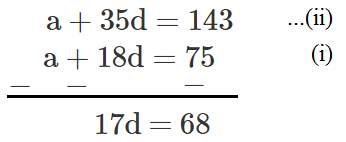
Now, subtracting (i) from (ii), we get

$\Rightarrow d = 4$
Now, a + 18d = 75[Using (i)]
$\Rightarrow a + 18 \times 4 = 75$
$\Rightarrow a = 75 - 72 = 3 a = 3$ and $d = -4$
Hence, the required AP is $a, a + d, a + 2d, a + 3d ...... = 3, 7, 11, 15.....$
View full question & answer
Question 105 Marks
Find the sum of all the 11 terms of an AP is 36 and that of the first 16 terms are -15 and -30 respectively.
Answer
Since, the total number of terms (n) = 11 [odd]
$\therefore\text{Middle most term}=\frac{\big(\text{n}-1\big)}{2}\text{th term}=\bigg(\frac{11+1}{2}\bigg)^\text{th}\text{term}=6\text{th}\text{ term}$
Given that, $a_6 = 30$
$\Rightarrow a + (6 - 1)d = 310$
$\Rightarrow a + 5d = 30$
sum of n terms of an AP,
$\text{S}_{\text{n}}=\frac{\text{n}}{2}\big[2\text{a}+\big(\text{n}-1\big)\text{d}\big]$
$\therefore\text{S}_{\text{11}}=\frac{\text{11}}{2}\big[2\text{a}+\big(11-1\big)\text{d}\big]$
$\text{S}_{11}=\frac{11}{2}\big(2\text{a}+10\text{d}\big)$
$\text{S}_{11}=11\big(\text{a}+5\text{d}\big)$ [from Eq. (i)]
$\text{S}_{11}=11\times30$
$\text{S}_{11}=330$
View full question & answer
Question 115 Marks
Find the sum of first 17 terms of an AP whose $4^{\text {th }}$ and $9^{\text {th }}$ term are -15 and -30 respectively.
Answer
Let the first term, common difference and the number of terms in an AP are a, d and n, respectively We know that, the nth term of an AP,
$\Rightarrow T_n = a + (n - 1)d .......(i) 4^{th}$​​​​​​​ term of an
AP, $T_4 = a + (4 - 1)d = -15$ [given]
$\Rightarrow a + 3d = -15 ......(ii)$ and $9^{th}$ term of an
$AP, T_9 = a + (9 - 1)d = -30$
$\Rightarrow a + 8d = -30$
Now, subtract Eq. (ii) from Eq. (iii), we get Put the value of d in Eq. (ii),
we get $a + 3(-3) = -15$
$\Rightarrow a - 9 = -15$
$\Rightarrow a = -15 + 9$
$\Rightarrow a = -6$ Sum of first n terms of an
AP, $\because \text{S}_{\text{n}}=\frac{\text{n}}{2}\big[2\text{a}+\big(\text{n}-1\big)\text{d}\big]$
$\therefore$ Sum of first 17 terms of an AP,
$\because \text{S}_{\text{17}}=\frac{\text{17}}{2}\big[2\times\big(-6\big)+\big(17-1\big)\big(-3\big)\big]$
$ \text{S}_{\text{17}}=\frac{\text{17}}{2}\big[-12+\big(16\big)\big(-3\big)\big]$
$ \text{S}_{\text{17}}=\frac{\text{17}}{2}\big(-12-48\big)$ $\text{S}_{\text{17}}=\frac{\text{17}}{2}\times\big(-60\big)$
$\text{S}_{\text{17}}=17\times\big(-30\big)$ $\text{S}_{\text{17}}=-510$
Hence, the required sum of first 17 term of an AP is -510.
View full question & answer
Question 125 Marks
Find the sum of the integers between 100 and 200 that are-
Not divisible by 9.
[Hint: These numbers will be: Total numbers – Total numbers divisible by 9]
Answer
Numbers between 100 and 200 = 101, 102, 103, ..... 199
Here, $a = 101, d = 1, a_n= 199$
$\Rightarrow a + (n - 1)d = 199$
$\Rightarrow 101 + (n - 1)(1) = 199$
$\Rightarrow (n - 1) = 199 - 101 = 98$
$\Rightarrow n = 99$
$\bigg[\because\text{S}_{\text{n}}=\frac{\text{n}}{2}\big[2\text{a}+\big(\text{n}-1\big)\text{d}\bigg]$
$\text{Now, }\text{S}_{\text{99}}=\frac{99}{2}\big[2\times101+\big(99-1\big)\big(1\big)\big]$
$\text{S}_{\text{99}}=\frac{99}{2}\big[202+98\big]$
$\text{S}_{\text{99}}=\frac{99}{2}\times300=99\times150$
$\text{S}_{\text{99}}=14850$
So, the sum of integers between 100 and 200 which are not divisible by 9 = 14850 - 1683 = 13167.
View full question & answer
Question 135 Marks
Find the $12^{th}$​​​​​​​ term from the end of the AP:
$–2, –4, –6,..., –100.$
Answer
Given AP $-2,-4,-6, \ldots \ldots . .,-100$
Here, first term $( a )=-2$, Common difference $( d )=-4-(-2)=-2$ and the last term $( l )=-100$. We know, that the $n^{\text {th }}$ term an of AP from the end is $a_n=1-(n-1) d$, where is the last term and $d$ is the common difference, $\therefore 12^{\text {th }}$ term from the end,
$a_{12} = -100 + (11)(2)$
$a_{12} = -100 + 22$
$a_{12} = -78$
Hence, the $12^{\text {th }}$ term from the end is -78 .
View full question & answer
Question 145 Marks
Yasmeen saves Rs. 32 during the first month, Rs. 36 in the second month and Rs. 40 in the third month. If she continues to save in this manner, in how many month will she save Rs. 2000?
Answer
Given that,
Yasmeen, during the first month, saves = Rs. 32
During the second month, saves = Rs. 36
During the third month, saves = Rs. 40
Let Yasmeen saves Rs. 2000 during the n months.
Here, we have arithmetic progression 32, 36, 40, ......
First term (a) = 32, common difference (d) = 36 - 32 = 4
and she saves total money, i.e., $s_n = Rs. 2000$
We know that, sum of first n term of an AP is,
$\text{S}_{\text{n}}=\frac{\text{n}}{2}\big[2\text{a}+\big(\text{n}-1\big)\text{d}\big]$
$\Rightarrow2000=\frac{\text{n}}{2}\big[2\times32+\big(\text{n}-1\big)\times4]$
$\Rightarrow 2000 = n(32 + 2n - 2)$
$\Rightarrow 2000 = n(30 + 2n)$
$\Rightarrow 1000 = n(15 + n)$
$\Rightarrow 1000 = 15n + n^2$
$\Rightarrow n^2 + 15n - 1000 = 0$
$\Rightarrow n^2 + 40n - 25n 1000 = 0$
$\Rightarrow n(n + 40) - 25(n + 40) = 0$
(n + 40)(n - 25) = 0 $\big[\because\text{n}\neq-40\big]$
$\therefore$ n = 25
Hence, in 25 months will she save Rs. 2000.
[Since, month cannot be negative]
View full question & answer
Question 155 Marks
The students of a school decided to beautify the school on the Annual Day by fixing colourful flags on the straight passage of the school. They have 27 flagsto be fixed at intervals of every 2m. The flags are stored at the position of the middle most flag. Ruchi was given the responsibility of placing the flags. Ruchi kept her books where the flags were stored. She could carry only one flag at a time. How much distance did she cover in completing this job and returning back to collect her books? What is the maximum distance she travelled carrying a flag?
Answer
Flags are to be fixed at intervals of 2 m .
Position odf middle most flag $=\frac{27+1}{2}$ th flag $=\frac{28}{2}$ th flag $=14^{\text {th }}$ flag.
This means that 13 flags are to be fixed before the middle most $14^{\text {th }}$ flag and 13 flags are to be fixed before the $14^{\text {th }}$ flag.
Distance between flags $=2 m$
Distance covered by placing a $\left.\right|^{\text {st }}$ flag $=2+2=4 m$
Distance covered to place $॥^{\text {nd }}$ flag $=4+4=8 m$
Distance covered to place $III ^{\text {rd }}$ flag $=6+6=12 m$
So, the total distance covered to place 13 flags on either side is given by-
$S_{13} = 4 + 8 + 12 + ...... 13$ terms
Here, a = 4, d = 4, n = 13 terms
$\therefore\text{S}_{\text{n}}=\frac{\text{n}}{2}\big[2\text{a}+\big(\text{n}-1\big)\text{d}\big]$
$\text{S}_{13}=\frac{13}{2}\big[2\big(4\big)+\big(13-1\big)\big(4\big)\big]$
$\text{S}_{13}=\frac{13}{2}\big[8+48\big]$
$\text{S}_{13}=\frac{13}{2}\times56$
$\text{S}_{13}=13\times28$
$\text{S}_{13}=364$
Distance covered by Ruchi for other side 13 flags = 364m
Hence, the total distance to place 27 flags and pickup her books = 364 × 2 = 728m
Maximum distance which she travelled carrying a flag = Distance = (13 × 2)m = 26m.
View full question & answer
Question 165 Marks
The sum of the first five terms of an AP and the sum of the first seven terms of the same AP is 167. If the sum of the first ten terms of this AP is 235, find the sum of its first twenty terms.
Answer
According to the question:
$\text{S}_{5}+\text{S}_{7}=167 \big[\text{Given}\big]$
$\Rightarrow\frac{5}{2}\big[2\text{a}+\big(5-1\big)\text{d}\big]+\frac{7}{2}\big[2\text{a}+\big(7-1\big)\text{d}\big]=167$
$\Rightarrow5\big[2\text{a}+4\text{d}\big]+7\big[2\text{a}+6\text{d}\big]=167\times2$
On multiplying both sides by $\frac{1}{2},$ we get
$\frac{1}{2}\big[10\text{a}+20\text{d}+14\text{a}+42\text{d}\big]=167$
$\Rightarrow\frac{1}{2}\big[24\text{a}+62\text{d}\big]=167$
$\Rightarrow\frac{1}{2}\times2\big[12\text{a}+31\text{d}\big]=167$
$\Rightarrow12\text{a}+31\text{d}=167......(\text{i})$
$\text{Also},\text{S}_{10}=235\big[\text{Given}\big]$
$\Rightarrow\frac{10}{2}\big[2\text{a}+\big(10-1\big)\text{d}\big]=235$
$\Rightarrow5\big[2\text{a}+9\text{d}\big]=235$
$\Rightarrow2\text{a}+9\text{d}=\frac{235}{5}$
$\Rightarrow2\text{a}+9\text{d}=47........(\text{ii})$
Multiplying (ii) by 6, we have
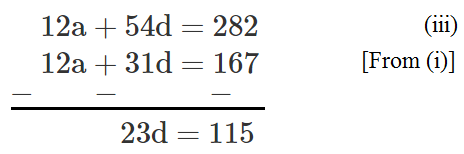
$\text{12}\text{a}+54\text{d}=282........(\text{iii})$
Now, subtracting (i) from (iii), we get

$\Rightarrow\text{d}=\frac{115}{23}$
$\Rightarrow\text{d}=5$
$\text{Now},2\text{a}+9\text{d}=47[\text{From}(\text{ii})\big]$
$\Rightarrow2\text{a}+9\times5=47$
$\Rightarrow2\text{a}+47-45$
$\Rightarrow2\text{a}=2$
$\Rightarrow\text{a}=1$
$\bigg[\because\text{S}_{\text{n}}=\frac{\text{n}}{2}\big[2\text{a}+\big(\text{n}-1\big)\text{d}\big]\bigg]$
$\therefore\text{S}_{\text{20}}=\frac{\text{20}}{2}\big[2\text{a}+\big(20-1\big)\text{d}\big]$
$\Rightarrow\text{S}_{20}=10\big[2\times\big(1\big)+19\big(5\big)\big]$
$\Rightarrow\text{S}_{20}=10\big[2+95\big]=10\times97$
$\Rightarrow\text{S}_{20}=970$
Hence, the sum of first twenty terms is 970.
View full question & answer
Question 175 Marks
Solve the quation:
$-4 + (-1) + 2 + ...... + x = 437$
Answer
Given list of numbers are in AP.
$[d = d_1 = d_2 = 3]$
$a = -4$ and $a_n= x$
$As a_n = x$
$\Rightarrow a + (n - 1)d = x$
$\Rightarrow -4 + (n - 1)(3) = x + 4$
$\Rightarrow\big(\text{n}-1\big)=\frac{\text{x}+4}{3}$
$\Rightarrow\text{n}=\frac{\text{x}+4}{3}+1$
$\Rightarrow\text{n}=\frac{\text{x}+4+3}{3}$
$\Rightarrow\text{n}=\frac{\text{x}+7}{3}......(\text{i})$
$\Rightarrow\text{S}_{\text{n}}=\frac{\text{n}}{2}\big[2\text{a}+\big(\text{n}-1\big)\text{d}\big]$
$\therefore\text{S}_{\text{n}}=\frac{\big(\text{x}+7\big)}{\big(2\times3\big)}\bigg[2\big(-4\big)+\frac{\big(\text{x}+4\big)3}{3}\bigg]\big[\text{Using(i)}\big]$
$\text{S}_{\text{n}}=\frac{\big(\text{x}+7\big)}{6}\big[-8+\text{x}+4\big]$
$\text{S}_{\text{n}}=\frac{\big(\text{x}+7\big)\big(\text{x}-4\big )}{6}$
$\text{S}_{\text{n}}=437$
$\Rightarrow x^2 + 3x - 28 - 2622 = 0$
$\Rightarrow x^2 + 3x - 2650 = 0$
$\Rightarrow x^2 + 53x - 50x - 2650 = 0$
$\Rightarrow x(x + 53) - 50(x + 53) = 0$
$\Rightarrow (x + 53)(x - 50) = 0$
$\Rightarrow x = -53 or x = 50$
Rejecting the negative value x = -53, we have x = -50.
So, x = 50 is the requried value as forward terms are positive.
View full question & answer
Question 185 Marks
Find the $20^{\text {th }}$ term of the AP whose $7^{\text {th }}$ term is 24 less than the $11^{\text {th }}$ term, first term being 12.
Answer
Let the first term, common difference and number of term of an AP are $a , d$ and n , resoectively, Given that, first term $(a)=12$ Now by condition,
$7^{th} term (T_7) = 11^{th} term (T_{11}) - 24$
[$\because$ $n^{th}$ term of an AP, $T_n = a + (n - 1)d]$
$\Rightarrow a + (7 - 1)d = a + (11 - 1)d - 24$
$\Rightarrow a + 6d = a + 10d - 24$
$\Rightarrow 24 = 4d$
$\Rightarrow d = 6$
$\therefore 20^{th}$ term of AP, $T_{20} = a + (20 - 1)d$
$20^{th}​​​​​​​$​​​​​​​ term of AP, $T_{20} = 12 + 19 \times 6 = 126$
Hence, the reduired $20^{th}​​​​​​​$​​​​​​​ term of an AP is 126.
View full question & answer
Question 195 Marks
Which term of the AP:
-2, -7, -12, ........ will be -77? Find the sum of this AP upto the term -77.
Answer
Given, AP -2, -7, -12, ......
Let the nth term of an AP is -77
Then, first term (a) = -2 and common difference $(d) = -7 - (-2) = 7 + 2 = -5$
$\therefore$ $n^{th}$ term of an AP, $T_n = a + (n - 1)d$
$\Rightarrow -77 = -2 + (n - 1)(-5)$
$\Rightarrow -75 = -(n - 1) \times 5$
$\Rightarrow (n - 1) = 15$
$\Rightarrow n = 16$
So, the $16^{th}$ term i.e., upto the term -77
$\text{S}_{\text{16}}=\frac{16}{2}\big[2\times\big(-2\big)+\big(\text{n}-1\big)\big(-5\big)\big]$
$\Rightarrow S_{16} = 8[-4 + (16 - 1)(-5)]$
$\Rightarrow S_{16}= 8(-4 - 75)$
$\Rightarrow S_{16}= 8 \times -79$
$\Rightarrow S_{16}= -632$
Hence, the sum of the AP upto the term -77 is -632.
View full question & answer
Question 205 Marks
Find the-
sum of those integers from 1 to 500 which are multiples of 2 or 5.
[Hint: These numbers will be: multiples of 2 + multiples of 5 – multiples of 2 as well as of 5 ]
Answer
Sum of integers which are multiples of 2 or 5 only (not of 10)
= Sum of integers which are multiples of 2 + Sum of integers which are multiples of 5 - Sum of integers which are multiples of 10
= (20+ 4 + 6 + ........ + 500) + (5 + 10 + 15 + 20 + ...... + 500) - (10 + 20 +30 + ...... + 500)
= S_1+ S_2+ S_3
For S_1= 2 + 4 + 60 + ...... + 500, we have
$a = 2, d = 2, a_n = 500$
$\Rightarrow a + (n - 1)d = 500$
$\Rightarrow 2 + (n - 1)2 = 500$
$\Rightarrow 2[1 + (n -1)] = 500$
$\Rightarrow 2n = 500$
$\Rightarrow n = 250$
$\therefore$ $S_1 = S_{250}$​​​​​​​
$\bigg[\because\text{ S}_{\text{n}}=\frac{\text{n}}{2}\big[2\text{a}+\big(\text{n}-1\big)\text{d}\bigg]$
$\Rightarrow\text{S}_{1}=\text{S}_{250}=\frac{250}{2}\big[2\times2+\big(250-1\big)\big(2\big)\big]$
$\Rightarrow S_1 = 125[4 + 249 \times 2]$
$\Rightarrow S_1 = 125[4 + 498]$
$\Rightarrow S_1= 125 \times 502$
$\Rightarrow S_1 = 62750$
For $S_2= 5 + 10 + 15 + 20 + ........ + 500$, we have
$a = 5, d = 5, a_n = 500$
$\therefore$ $a + (n - 1)d = 500$
$\Rightarrow 5 + (n - 1)5 = 500$
$\Rightarrow 5[1 + n - 1] = 500$
$\Rightarrow n = 100$
$\therefore$ $S_2 = S_{100}​​​​​​​$​​​​​​​
$\Rightarrow\text{S}_{2}=\text{S}_{100}=\frac{100}{2}\big[2\text{a}+\big(\text{n}-1\big)\text{d}]$
$\Rightarrow S_2 = 50[2(5) + (100 - 1)5]$
$\Rightarrow S_2 = 50[10 + 99 \times 5]$
$\Rightarrow S_2 = 50[10 + 495]$
$\Rightarrow S_2 = 50 \times 505$
$\Rightarrow S_2= 25250$
For $S_3 = 10 + 20 + 30 + ..... + 500,$ we have
$a = 10, d = 10, a_n = 500$
[ $\because$ $a_n = a + (n - 1)d]$
$\therefore$ $a + (n - 1)d = 500$
$\Rightarrow 10 + (n - 1)10 = 500$
$\Rightarrow 10[1 + n - 1] = 500$
$\Rightarrow\text{n}=\frac{500}{10}=50$
$\text{Now},\text{ S}_{3}=\text{S}_{50}=\frac{50}{2}\big[2\text{a}+\big(\text{n}-1\big)\text{d}]$
$S_3 = 25[2(10) + (50 - 1)10]$
$S_3 = 25[20 + 490]$
$S_3 = 25 \times 510$
$\Rightarrow S_3 = 12750$
Hence, the sum of the required integers $= S_1 + S_2 - S_3$
$= 62750 + 25250 - 12750$
$= 88000 - 12750 = 75250$
View full question & answer
Question 215 Marks
Find the sum of the integers between 100 and 200 that are-
Divisible by 9.
Answer
Numbers between 100 - 200 divisible by 9 are 108, 117, 125, ...... 198
Here, a = 108, d = 117 - 108 = 9 and $a_n = 198$
[$\because$ $a_n = a + (n - 1)d]$
$\Rightarrow a + (n - 1)d = 198$
$\Rightarrow 108 + (n - 1)9 = 198$
$\Rightarrow 9[12 + n - 1] = 198$
$\Rightarrow11+\text{n}=\frac{198}{9}$
$\Rightarrow\text{n}=22-11$
$\Rightarrow\text{n}=11$
$\text{Now},\text{S}_{\text{n}}=\frac{\text{n}}{2}\big[2\text{a}+\big(\text{n}-1\big)\text{d}\big]$
$\Rightarrow\text{S}_{11}=\frac{11}{2}\big[2\big(108\big)+\big(11-1\big)\big(9\big)\big]$
$\Rightarrow\text{S}_{11}=\frac{11}{2}\big[216+99-9\big]$
$\Rightarrow\text{S}_{11}=\frac{11}{2}\big[216+90\big]$
$\Rightarrow\text{S}_{11}=\frac{11}{2}\times306$
$\Rightarrow\text{S}_{11}=1683$
View full question & answer
Question 225 Marks
The eighth term of an AP is half its second term and the eleventh term exceeds one third of its fourth term by 1. Find the $15^{th}$​​​​​​​ term.
Answer
Consider the first term and common difference as a and d respectively.
$\text{a}_{8}=\frac{1}{2}\text{a}_{2}[\text{Given}]$
[$\because$ $a_n = a + (n - 1)d]$
$\Rightarrow\text{a}+(8-1)\text{d}=\frac{1}{2}\big[\text{a}+\big(2-1)\text{d}\big]$
$2(a + 7d) = a + d 2a + 14d - a - d = 0 a + 13d = 0 ........ (i)$
$\text{Now},\text{ a}_{11}=\frac{1}{3}\text{a}_{4}+1\big[\text{Given}\big]$
$\Rightarrow\text{a}+\big(11-1\big)\text{d}=\frac{1}{3}\big[\text{a}+\big(4-1)\text{d}\big]+1$
$\Rightarrow\big(\text{a}+10\text{d}\big)=\frac{1}{3}\big(\text{a}+3\text{d}\big)+1$
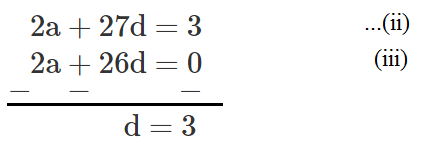
$3(a + 10d) = a + 3d + 3 3a + 30d - a - 3d = 3 2a + 27d = 3 ...... (ii)$ Multiplaying (i) by 2,
we have 2a + 26d = 0 ........ (iii)
Now, subtraction (iii) from (ii), we get

Now, a + 13d = 0 [From (i)]
$\Rightarrow a + 13 \times 3 = 0$
$\Rightarrow a = -39$
Now, we know that an
$= a + (n - 1)d$
$\Rightarrow a_{15} = -39 + (15 - 1)3$
$\Rightarrow a_{15} = 3$
View full question & answer
Question 235 Marks
The ratio of the $11^{\text {th }}$ term to the $18^{\text {th }}$ term of an AP is $2: 3$. Find the ratio of the $5^{\text {th }}$ term to the $21^{\text {st }}$ term, and also the ratio of the sum of the first five terms to the sum of the first 21 terms.
Answer
Consider an AP whose first term and common difference are a and d respectively.
$a_{11} : a_{18} = 2 : 3$ [Given]
[$\therefore$ $a_n= a + (n - 1)]$
$\Rightarrow\frac{\text{a}+10\text{d}}{\text{a}+17\text{d}}=\frac{2}{3}$
$\Rightarrow 3a + 30d = 2a + 34d$
$\Rightarrow 3a - 2a = 34d - 30d$
$\Rightarrow a = 4d$
To find:
$\frac{\text{a}_{5}}{\text{a}_{21}}=\frac{\text{a}+4\text{d}}{\text{a}+20\text{d}}=\frac{4\text{d}+4\text{d}}{4\text{d}+20\text{d}}=\frac{8\text{d}}{24\text{d}}=\frac{1}{3}$
$\therefore\text{a}_{5}:\text{a}_{21}=1:3$
$\text{Now,}\frac{\text{S}_{5}}{\text{S}_{21}}=\frac{\frac{5}{2}\big[2\text{a}+\big(5-1\big)\text{d}\big]}{\frac{21}{2}\big[2\text{a}+\big(21-1\big)\text{d}\big]}$
$\frac{\text{S}_{5}}{\text{S}_{21}}=\frac{5\big[2\big(4\text{d}\big)+4\text{d}\big]}{21\big[2\big(4\text{d}\big)+20\text{d}\big]}$
$\frac{\text{S}_{5}}{\text{S}_{21}}=\frac{5\big[8\text{d}+4\text{d}\big]}{21\big[8\text{d}+20\text{d}\big]}$
$\frac{\text{S}_{5}}{\text{S}_{21}}=\frac{5\times12\text{d}}{21\times28\text{d}}$
$\frac{\text{S}_{5}}{\text{S}_{21}}=\frac{5}{7\times7}$
$\frac{\text{S}_{5}}{\text{S}_{21}}=\frac{5}{49}$
$\frac{\text{S}_{5}}{\text{S}_{21}}=5:49$
$\therefore\text{S}_{5}:\text{S}_{21}=5:49$
View full question & answer