Questions

Assertion (A) & Reason (B) MCQ

Take a timed test

11 questions · 10 auto-graded MCQ + 1 self-marked written.

MCQ 11 Mark
Directions : In the following questions, a statement of assertion $(A)$ is followed by a statement of reason $(R).$ Mark the correct choice as:
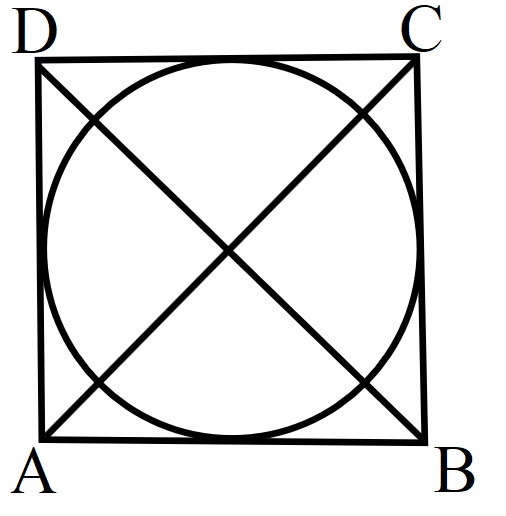
Assertion : In the given figure, all the sides of a quadrilateral $\text{ABCD}$ touch a circle with centre $O.$ Then, $\angle\text{AOB}+\angle\text{COD}=180^\circ$
Reason : The opposite sides of a quadrilateral circumscribing a circle does not subtend supplementary angles at the centre of the circle.
  • A
    Assertion and Reason both are correct statements and Reason is the correct explanation of Assertion.
  • B
    Assertion and Reason both are correct statements but Reason is not the correct explanation of Assertion.
  • Assertion is correct statement but Reason is wrong statement.
  • D
    Assertion is wrong statement but Reason is correct statement.
Answer
Correct option: C.
Assertion is correct statement but Reason is wrong statement.
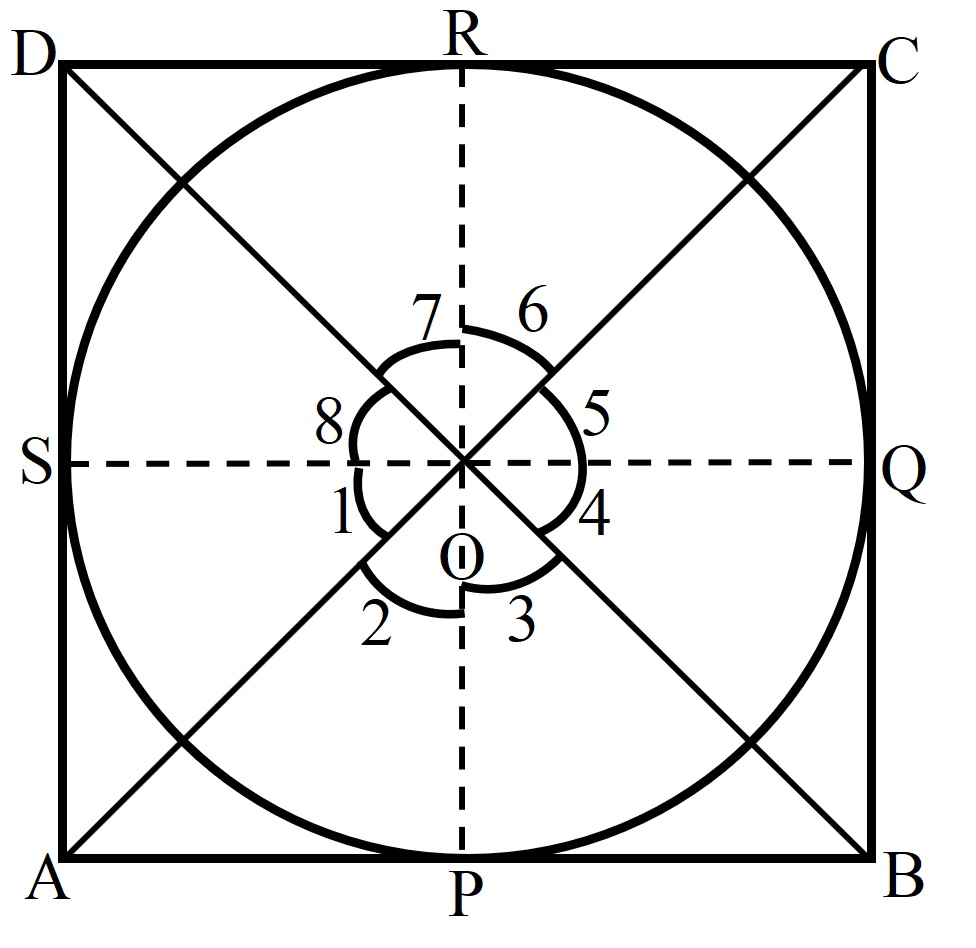
We have a circle with $R$ centre $O$.
A quadrilateral $\text{ABCD}$ is such that the sides $AB, BC, CD$ and $DA$ touch the circle at $P, Q, R$ and $S$ respectively.
Let us join $OP, OQ, QR$ and $OS.$
We know that two tangents drawn from an external point to a circle subtend equal angles at the centre.
$\therefore \angle1=\angle2,\angle3=\angle4$
$\angle5=\angle6$ and $\angle7=\angle8$
Also, the sum of all the angles around a point is $360^\circ$
$\therefore\angle1+ \angle2+ \angle3+ \angle4+ \angle5+ \angle6+ \angle7+\angle8 = 360^\circ$
$\Rightarrow 2[42+ 43+ 26+ 27] = 360^\circ $
$\Rightarrow(\angle2+\angle3) + (\angle6+\angle7) = 180^\circ$
Since, $\angle2 +\angle3 =\angle\text{AOB}, \angle6 + \angle7 = \angle\text{COD}$
$\angle\text{AOB} +\angle\text{COD} = 180^\circ $
$\therefore$ Assertion is correct and Reason is wrong.
View full question & answer
MCQ 21 Mark
Directions : In the following questions, a statement of assertion $(A)$ is followed by a statement of reason $(R).$ Mark the correct choice as:
Assertion : At a point $P$ of a circle with centre $O$ and radius $12\ cm,$ a tangent $PQ$ of length $16\ cm$ is drawn.Then $, OQ = 20\ cm.$
Reason : The tangent at any point of a circle is perpendicular to the radius through the point of contact.
  • Assertion and Reason both are correct statements and Reason is the correct explanation of Assertion.
  • B
    Assertion and Reason both are correct statements but Reason is not the correct explanation of Assertion.
  • C
    Assertion is correct statement but Reason is wrong statement.
  • D
    Assertion is wrong statement but Reason is correct statement.
Answer
Correct option: A.
Assertion and Reason both are correct statements and Reason is the correct explanation of Assertion.
In $\triangle\text{OPQ},$ we have, $\angle\text{OPQ}=90^\circ$
$\therefore\text{OQ}^2 =\text{OP}^2 +\text{PQ}^2 = (12)^2 + (16)^2$
$= (144 + 256) = 400$
$\Rightarrow\text{OQ}=\sqrt{400}\text{ cm}=20\text{ cm}$
Both Assertion and Reason are correct and Reason is the correct explanation of Assertion.
View full question & answer
MCQ 31 Mark
Directions : In the following questions, a statement of assertion $(A)$ is followed by a statement of reason $(R).$ Mark the correct choice as:
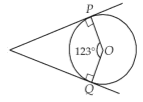
Assertion : If $\text{TP}$ and $\text{TQ}$ are the two tangents to a circle with centre $\text{O}$ so that $\angle\text{POQ} = 123^\circ$, then $\angle\text{PTQ} = 57^\circ$
Reason : The tangent at any point of a circle is perpendicular to the radius through the point of contact.
  • Assertion and Reason both are correct statements and Reason is the correct explanation of Assertion.
  • B
    Assertion and Reason both are correct statements but Reason is not the correct explanation of Assertion.
  • C
    Assertion is correct statement but Reason is wrong statement.
  • D
    Assertion is wrong statement but Reason is correct statement.
Answer
Correct option: A.
Assertion and Reason both are correct statements and Reason is the correct explanation of Assertion.
$\angle\text{OPT}=\angle\text{OQT}=90^\circ$
$\angle\text{OPT}+\angle\text{PTQ}+\angle{\text{OQT}}+\text{POQ}=360^\circ$
$\Rightarrow90^\circ+\angle\text{PTQ}+90^\circ+123^\circ=360^\circ$
$\Rightarrow\angle\text{PTQ}=360^\circ-303^\circ$
$\Rightarrow\angle\text{PTQ}=57^\circ$
Both Assertion and Reason are correct and Reason is the correct explanation of Assertion.
View full question & answer
MCQ 41 Mark
Directions : In the following questions, a statement of assertion $(A)$ is followed by a statement of reason $(R)$. Mark the correct choice as :
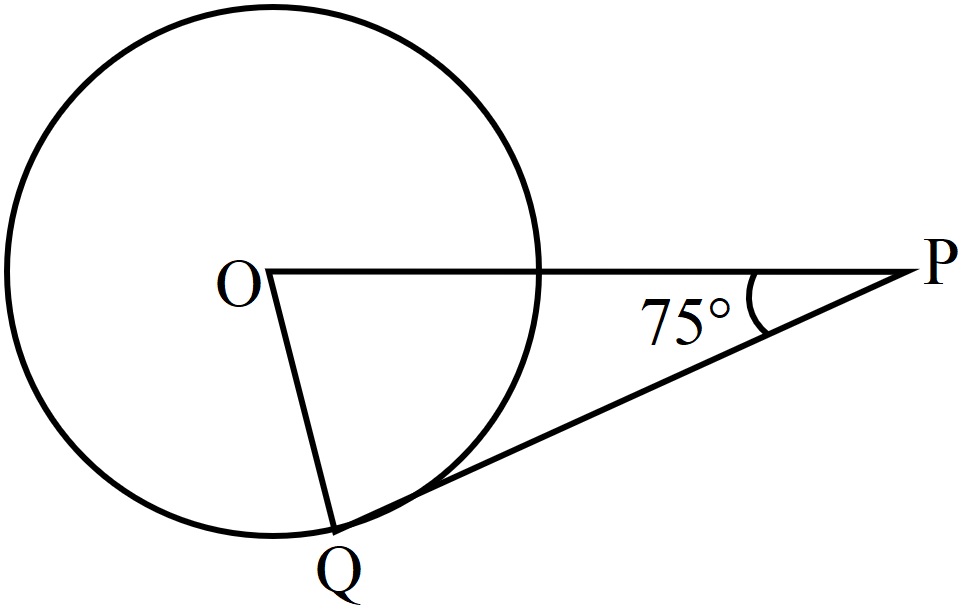
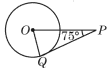
Assertion : In the given figure, if $PQ$ is a tangent to the circle with centre $O,$ then the value of $\angle\text{POQ}$ is $25^\circ$
Reason : If two tangents are drawn to a circle from an external point, then they subtend equal angles at the centre.
  • A
    Assertion and Reason both are correct statements and Reason is the correct explanation of Assertion.
  • B
    Assertion and Reason both are correct statements but Reason is not the correct explanation of Assertion.
  • C
    Assertion is correct statement but Reason is wrong statement.
  • Assertion is wrong statement but Reason is correct statement.
Answer
Correct option: D.
Assertion is wrong statement but Reason is correct statement.
In $\triangle\text{OQP},\text{PQ}\bot\text{OQ}$
$[ \because$ Tangent at any point of a circle is perpendicular to the radius through the point of contact$]$
$\therefore \angle\text{OQP}=90^\circ$
Now, in $\triangle\text{OQP}$
$\angle\text{OQP}+\angle\text{QPO}+\angle\text{POQ}=180^\circ\ [$By angle sum property$]$
$\Rightarrow90^\circ+75^\circ+\angle\text{POQ}=180^\circ$
$\Rightarrow\text{POQ}=180^\circ-165^\circ=15^\circ$
Assertion is wrong but Reason is correct.
View full question & answer
MCQ 51 Mark
Directions : In the following questions, a statement of assertion $(A)$ is followed by a statement of reason $(R).$ Mark the correct choice as:
Assertion : The secant of circle is perpendicular to the radius of the circle.
Reason : A line that intersects the given circle in two points is called a secant.
  • A
    Assertion and Reason both are correct statements and Reason is the correct explanation of Assertion.
  • B
    Assertion and Reason both are correct statements but Reason is not the correct explanation of Assertion.
  • C
    Assertion is correct statement but Reason is wrong statement.
  • Assertion is wrong statement but Reason is correct statement.
Answer
Correct option: D.
Assertion is wrong statement but Reason is correct statement.
Assertion is wrong, as secant of circle is not perpendicular to the radius of circle. Reason is correct.
View full question & answer
MCQ 61 Mark
Statement A (Assertion) : The length of tangents drawn from an external point to a circle are not always equal in length.
Statement $R$ (Reason) : The tangent is always perpendicular to the radius through the point of contact.
  • A
    Both assertion (A) and reason ( $R$ ) are true and reason $(R)$ is the correct explanation of assertion $(A)$.
  • B
    Both assertion (A) and reason ( $R$ ) are true and reason $(R)$ is not the correct explanation of assertion (A).
  • C
    Assertion $(A)$ is true but reason $(R)$ is false.
  • Assertion (A) is false but reason $(R)$ is true.
Answer
Correct option: D.
Assertion (A) is false but reason $(R)$ is true.
(d) : Assertion is wrong as length of tangents drawn from an external point to a circle are always equal. But reason is correct.
View full question & answer
MCQ 71 Mark
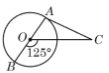
Statement $A ($Assertion$)$ : In the given figure, $\text{AOB}$ is a diameter of a circle with centre $O$ and $A C$ is a tangent to the circle at $A$. If $\angle B O C=125^{\circ}$, then $\angle A C O=35^{\circ}$.
Image
Statement $R ($Reason$)$ : $\angle A C O$
and $\angle B O C$ form a linear pair.
  • A
    Both assertion $(A)$ and reason $(R)$  are true and reason $(R)$ is the correct explanation of assertion $(A)$.
  • B
    Both assertion $(A)$ and reason $(R)$ are true and reason $(R)$ is not the correct explanation of assertion $(A).$
  • Assertion $(A)$ is true but reason $(R)$ is false.
  • D
    Assertion $(A)$ is false but reason $(R)$ is true.
Answer
Correct option: C.
Assertion $(A)$ is true but reason $(R)$ is false.
$\angle B O C=125^{\circ}$
$[$Given$]$
Since, $A C$ is a tangent to the circle at $A$
$\therefore \angle O A C=90^{\circ} \quad[\because$ Radius is perpendicular to the tangent at point of contact$]$
Now, $\angle A O C+\angle B O C=180^{\circ}$
$[$Linear pair$]$
$\Rightarrow \angle A O C=180^{\circ}-125^{\circ}=55^{\circ}$
$\text { In } \triangle A O C, \angle A O C+\angle A C O+\angle O A C=180^{\circ}$
$[$By angle sum property$]$
$\Rightarrow 55^{\circ}+\angle A C O+90^{\circ}=180^{\circ}$
$\Rightarrow \angle A C O=180^{\circ}-55^{\circ}-90^{\circ}=35^{\circ}$
$\therefore$ Assertion is true but reason is false.
View full question & answer
MCQ 81 Mark
Statement A (Assertion) : The secant of circle is perpendicular to the radius of the circle.
Statement R (Reason): A line that intersects the given circle in two points is called a secant.
  • A
    Both assertion (A) and reason ( $R$ ) are true and reason $(R)$ is the correct explanation of assertion $(A)$.
  • B
    Both assertion (A) and reason ( $R$ ) are true and reason $(R)$ is not the correct explanation of assertion (A).
  • C
    Assertion $(A)$ is true but reason $(R)$ is false.
  • Assertion (A) is false but reason $(R)$ is true.
Answer
Correct option: D.
Assertion (A) is false but reason $(R)$ is true.
(d) : Assertion is false, as secant of circle is not perpendicular to the radius of circle. Reason is true.
View full question & answer
MCQ 91 Mark
Statement $A ($Assertion$) :$ At a point $P$ of a circle with centre $O$ and radius $12 \ cm$, a tangent $PQ$ of length $16 \ cm$ is drawn. Then, $OQ=20 \ cm$.
Statement $R ($Reason$)$ : The tangent at any point of a circle is not perpendicular to the radius through the point of contact.
  • A
    Both assertion $(A)$ and reason $(R)$ are true and reason $(R)$ is the correct explanation of assertion $(A)$.
  • B
    Both assertion $(A)$ and reason $( R)$ are true and reason $(R)$ is not the correct explanation of assertion $(A).$
  • Assertion $(A)$ is true but reason $(R)$ is false.
  • D
    Assertion $(A)$ is false but reason $(R)$ is true.
Answer
Correct option: C.
Assertion $(A)$ is true but reason $(R)$ is false.
In $\triangle \text{OPQ}$, we have, $\angle \text{OPQ}=90^{\circ}$
$\therefore \ce{OQ^2=O P^2 + PQ^2}$
$=(12)^2+(16)^2$
$=(144+256)$
$=400$
$\Rightarrow \text{OQ}=\sqrt{400} \ cm $
$=20 \ cm$
Both assertion is true but reason is false.
View full question & answer
MCQ 101 Mark
Statement A (Assertion): If $T P$ and $T Q$ are the two tangents to a circle with centre $O$ so that $\angle P O Q=123^{\circ}$, then $\angle P T Q=57^{\circ}$.
Statement $R$ (Reason) : The tangent at any point of a circle is perpendicular to the radius through the point of contact.
  • A
    Both assertion (A) and reason ( $R$ ) are true and reason $(R)$ is the correct explanation of assertion $(A)$.
  • B
    Both assertion (A) and reason ( $R$ ) are true and reason $(R)$ is not the correct explanation of assertion (A).
  • C
    Assertion $(A)$ is true but reason $(R)$ is false.
  • D
    Assertion (A) is false but reason $(R)$ is true.
View full question & answer
MCQ 111 Mark
Statement $A\ ($Assertion$)$ : In the given figure, if $P Q$ is a tangent to the circle with centre $O,$ then the value of $\angle P O Q$ is $25^{\circ}$.
Image
Statement $R \ ($Reason$)$ : If two tangents are drawn to a circle from an external point, then they subtend equal angles at the centre.
  • A
    Both assertion $(A)$ and reason $(R)$ are true and reason $(R)$ is the correct explanation of assertion $(A)$.
  • B
    Both assertion $(A)$ and reason $(R)$ are true and reason $(R)$ is not the correct explanation of assertion $(A).$
  • C
    Assertion $(A)$ is true but reason $(R)$ is false.
  • Assertion $(A)$ is false but reason $(R)$ is true.
Answer
Correct option: D.
Assertion $(A)$ is false but reason $(R)$ is true.
In $\triangle O Q P, P Q \perp O Q$
$[\because$ Tangent at any point of a circle is perpendicular to the radius through the point of contact$]$
$\therefore \angle O Q P=90^{\circ}$
Now, in $\triangle O Q P$,
$\angle O Q P+\angle Q P O+\angle P O Q=180^{\circ} \ [$By angle sum property$]$
$\Rightarrow 90^{\circ}+75^{\circ}+\angle P O Q=180^{\circ}\ [$Using $(i)]$
$\Rightarrow \angle P O Q=180^{\circ}-165^{\circ}=15^{\circ}$
Assertion is wrong but reason is correct.
View full question & answer