Questions

True False[1 Marks ]

Take a timed test

10 questions · self-marked practice — reveal the answer and mark yourself.

Question 11 Mark
Write ‘True’ or ‘False’ and justify your answer.
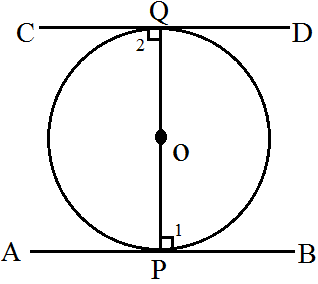
The angle between two tangents to a circle may be 0°.
Answer
True.
Consider the diameter POQ of a circle with centre O. The tangent at P and Q are drawn, as we know the radius and tangent at contact point are perpendicular so$\angle1=\angle2=90^\circ.$ These are alternate angles so the tangent APB || CQD i.e., angle between two tangent to circle may be zero. Hence, the given statment is true.
View full question & answer
Question 21 Mark
Write ‘True’ or ‘False’ and justify your answer.
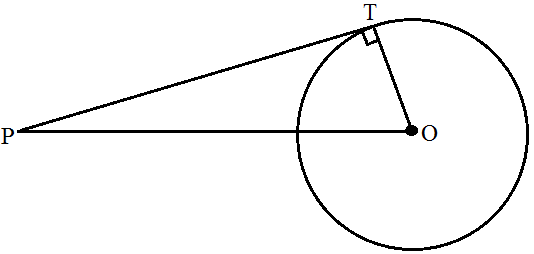
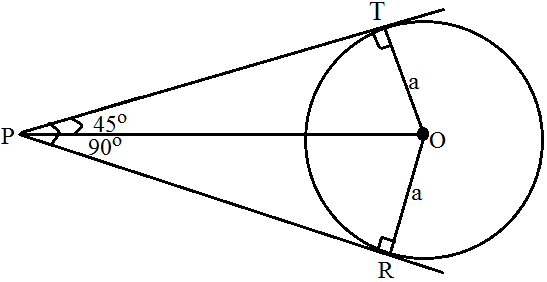
If angle between two tangents drawn from a point P to a circle of radius a and centre O is 90°, then $\text{OP}=\text{a}\sqrt{2}.$
Answer
True.
Consider a tangent PT from an external point P on a circle with radius 'a'. OT and PT are radius and tangent respectively at contact point T. $\therefore\ \angle\text{T}=90^\circ$ As $\triangle\text{OPT}\cong\triangle\text{OPR}$ [By SSS criterion of congruence] $\therefore\ \angle\text{OPT}=\angle\text{OPR}=\frac{90^\circ}{2}=45^\circ$ $\therefore$ In right angle $\triangle\text{OPT},$ $\sin45^\circ=\frac{\text{OT}}{\text{OP}}$ $\Rightarrow\ \frac{1}{\sqrt{2}}=\frac{\text{a}}{\text{OP}}$ $\Rightarrow\ \text{OP}=\sqrt{2}\text{a}.$ Hence, the given statment is true.
View full question & answer
Question 31 Mark
Write ‘True’ or ‘False’ and justify your answer.
The length of tangent from an external point P on a circle with centre O is always less than OP.
Answer
True.
PT and OT are the tangent and radius respectively at contact point T. So, $\angle\text{OTP}=90^\circ$ $\Rightarrow\ \triangle\text{OPT}$ is right angled triangle. Again, in $\triangle\text{OPT}$ $\because\ \angle\text{T}>\angle\text{O}$ $\therefore\ \text{OP}>\text{PT}$ [Side opposite to greater angle is larger] Hence, the given statement is true.
View full question & answer
Question 41 Mark
Write ‘True’ or ‘False’ and justify your answer.
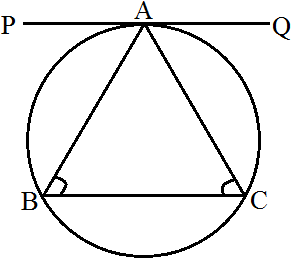
The tangent to the circumcircle of an isosceles triangle$\triangle\text{ABC}$ at A, in which AB = AC, is parallel to BC.
Answer
True.
A $\triangle\text{ABC},$ inscribed in a circle in which AB = AC. PAQ is tangent at A. AB is chord. $\therefore\ \angle\text{PAB}=\angle\text{C}\ \ ...(\text{i})$ $\because$ Angle $\angle\text{PAB}$ formed by chord (AB) with tangent is equal to the angle $\angle\text{C}$ formed by chord AC in alternat segment. In $\triangle\text{ABC},$ AB = AC [Given] $\therefore\ \angle\text{B}=\angle\text{C}$ $[\because$ Angles opposite to equal sides are equal$]$ ...(ii) From (i) and (ii), $\angle\text{B}=\angle\text{PAB}$ These are alternate interior angles. So, PAQ || BC Hence, the given statement is true.
View full question & answer
Question 51 Mark
Write ‘True’ or ‘False’ and justify your answer.
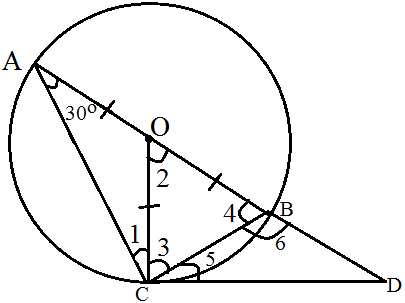
AB is a diameter of a circle and AC is its chord such that $\angle\text{BAC}=30^\circ.$ If the tangent at C intersects AB extended at D, then BC = BD.
Answer
True.

CD is a tangent at contact point C. AOB is diameter which meets tangent produced at D.
Chord AC makes $\angle\text{A}=30^\circ$ with diameter AB.
To prove BD = BC
Proof: In $\triangle\text{OAC},$
OA = OC = r [Radil of same circle]
$\angle1=\angle\text{A}$ $[\angle\text{s}$ opp. to equal sides are equal$]$
$\Rightarrow\ \angle1=30^\circ\ \ [\because\angle\text{A}=30^\circ]$
Exterior $\angle\text{BOC}=\angle2=\angle1+\angle\text{A}=(30^\circ+30^\circ)=60^\circ$
Now, in $\triangle\text{OCB},$
OC = OB [Radii of same circle]
$\therefore\ \angle3=\angle4$ [Angles opposite to equal sides are equal]
$\angle3+\angle4+\angle\text{COB}=180^\circ$
$\Rightarrow\ \angle3+\angle3+60^\circ=180^\circ$ [Angle sum property of triangle]
$\Rightarrow\ 2\angle3=180^\circ-60^\circ=120^\circ$
$\Rightarrow\ \angle3=60^\circ=\angle4$
$\angle6+\angle4=180^\circ$ [Linear pair axiom]
$\Rightarrow\ \angle6=180^\circ-\angle4$
$=180^\circ-60^\circ$
$\Rightarrow\ \angle6=120^\circ$
$\because$ Tangent CD and radius CO are at contact point C.
$\therefore\ \angle\text{OCD}=90^\circ$
$\Rightarrow\ \angle3+\angle5=90^\circ$
$\Rightarrow\ 60^\circ+\angle5=90^\circ$
$\Rightarrow\ \angle5=30^\circ$
Now, in $\triangle\text{BCD},$ we have
$\angle\text{D}+\angle5+\angle6=180^\circ$ [Angle sum property of a triangle]
$\Rightarrow\ \angle\text{D}=180^\circ-\angle5-\angle6$
$=180^\circ-30^\circ-120^\circ=180^\circ-150^\circ$
$\Rightarrow\ \angle\text{D}=30^\circ$
$\therefore\ \angle\text{D}=\angle5=30^\circ$
$\Rightarrow\text{BC}=\text{BD}$
[Sides opposite to equal $\angle\text{s}$ of a triangle are equal]
Hence, verifies the given statement true.
View full question & answer
Question 61 Mark
Write ‘True’ or ‘False’ and justify your answer.
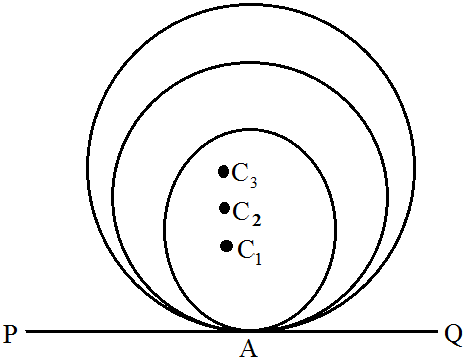
If a number of circles touch a given line segment PQ at a point A, then their centres lie on the perpendicular bisector of PQ.
Answer
False.

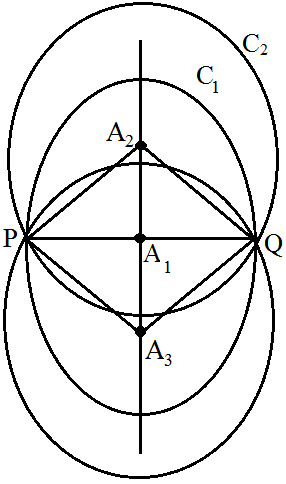
$C_1A$ and PAQ are redius and tangent at contact point A.
$\therefore\ \angle\text{C}_1\text{AP}=90^\circ\Rightarrow\text{C}_1\text{A}\perp\text{PQ}$
Similarly, $\angle\text{C}_2\text{AP}=90^\circ\Rightarrow\text{C}_2\text{A}\perp\text{PQ}$
$\angle\text{C}_3\text{AP}=90^\circ\Rightarrow\text{C}_3\text{A}\perp\text{PQ}$
We know that perpendicular on any point of a segment PQ may be only one.
So, point segment $C _1 A, C _2 A, C _3 A, C _4 A, \ldots$ will be on a line.
$\Rightarrow C_1 A, C_2 A, C_3 A, C_4 A$ will lie on a line, which is perpendicular on $P Q$ at $A$.
As A is not mid point of PQ . So, the perpendicular AB will not be perpendicular bisector of PQ . Hence, the given statment is false.
View full question & answer
Question 71 Mark
Write ‘True’ or ‘False’ and justify your answer.
If a number of circles pass through the end points P and Q of a line segment PQ, then their centres lie on the perpendicular bisector of PQ.
Answer
True.
Centre of any circle passing through the end points $P$ and $Q$ of a line segment are equidistant from $P$ and $Q$. \$itherefore $\$ A_1 P=$ $A _1 Q A_2 P= A _2 Q A _3 P = A _3 Q$ as we know that any point on perpendicular bisector of a segment is equidistant from the end point of the segment. Hence, $A _1, A_2, A_3$ points are the centres of circles passing through the end points P and Q of a segment $P Q$ or the centeres of circles lie on the perpendicular bisector of PQ .
View full question & answer
Question 81 Mark
Write ‘True’ or ‘False’ and justify your answer.
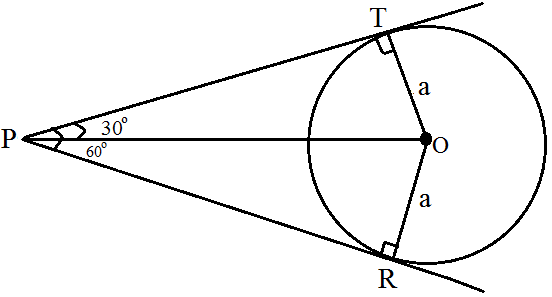
If angle between two tangents drawn from a point P to a circle of radius a and centre O is 60°, then $\text{OP}=\text{a}\sqrt{3}.$
Answer
False.
PT and OT are tangent and radius respectively at contact point T. $\therefore\ \angle\text{OTP}=90^\circ$ $\Rightarrow\ \triangle\text{OTP}$ is right angle $\triangle$ at T As $\triangle\text{OPT}\cong\triangle\text{OPR}$ [By SSS criterion of congruence] $\Rightarrow\ \angle\text{OPT}=\angle\text{OPR}=\frac{1}{2}\times60^\circ=30^\circ$ $\therefore$ In right angle $\triangle\text{OPT},$ $\sin30^\circ=\frac{\text{OT}}{\text{OP}}\Rightarrow\frac{1}{2}=\frac{\text{a}}{\text{OP}}\Rightarrow\text{OP}=2\text{a}$ Hence, the given statement is false.
View full question & answer
Question 91 Mark
Write ‘True’ or ‘False’ and justify your answer.
The length of tangent from an external point on a circle is always greater than the radius of the circle.
Answer
False.
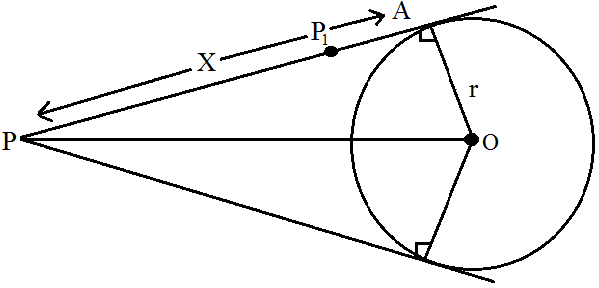
Consider any point P external to a circle away from O . Now, draw tangent PA on the circle. Clearly, $PA > r [\because P$ is external to circle and $P$ is at sufficient distance] Now, again consider any point $P_1$ on the tangent $A P$ very near to contact point $A$ of tangent $P A, P_1 A<A O$ So, it is clear that the length of the tangent $P A$ and $P_1 A$ are greater and smaller respectively than radius OA. Hence, the length of the tangent from an external point of a circle may or may not be greater than the radius of the circle. Hence, the given statment is false.
View full question & answer
Question 101 Mark
Write ‘True’ or ‘False’ and justify your answer.
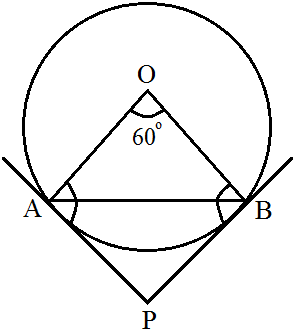
If a chord AB subtends an angle of 60° at the centre of a circle, then angle between the tangents at A and B is also 60°.
Answer
False.
Chord AB subtends $\angle60^\circ$ at O. $\therefore$ AP and OA are tangent and radius at A. $\therefore\ \angle\text{OAP}=90^\circ$ Similarly, $\angle\text{OBP}=90^\circ$ In quadrilateral $\text{OAPB},$ $\angle\text{O}+\angle\text{P}+\angle\text{OAP}+\angle\text{OBP}=360^\circ$ $\Rightarrow\ 60^\circ+\angle\text{P}+90^\circ+90^\circ=360^\circ$ $\Rightarrow\ \angle\text{P}=360^\circ-240^\circ$ $\Rightarrow\ \angle\text{P}=120^\circ$ Hence, the given statement is false.
View full question & answer