Questions

True False[1 Marks ]

Take a timed test

4 questions · self-marked practice — reveal the answer and mark yourself.

Question 11 Mark
Write True or False and give reasons for your answer in each of the following.
A pair of tangents can be constructed from a point P to a circle of radius 3.5cm situated at a distance of 3cm from the centre.
Answer
False.
Any tangent on a circle can be drawn only if the distance of point to draw tangent is equal to or more than radius of circle. Here, radius of circle is 3.5cm and point is at 3cm from centre which is inside the circle.
So, no tangent can be drawn if point is inside the circle.
View full question & answer
Question 21 Mark
Write True or False and give reasons for your answer in each of the following.
A pair of tangents can be constructed to a circle inclined at an angle of 170°.
Answer
True.
A pair of tangents can be constructed if the angle between the tangents is between zero and less than 180°. Because the sum of angles between tangents and radii on tangent are supplementary.
So, a pair of tangents can be constructed to circle inclined at an angle of 170°.
View full question & answer
Question 31 Mark
Write True or False and give reasons for your answer in each of the following.
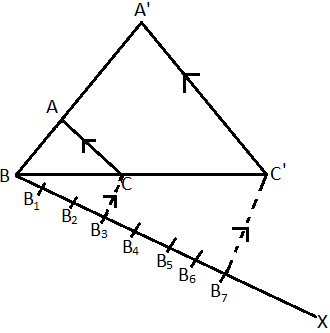
To construct a triangle similar to a given $\triangle ABC$ with its sides $\frac{7}{3}$ of the corresponding sides of $\triangle ABC$, draw a ray $B X$ making acute angle with $B C$ and $X$ lies on the opposite side of $A$ with respect to $B C$. The points $B_1, B_2, \ldots, B_7$ are located at equal distances on $B X, B_3$ is joined to $C$ and then a line segment $B_6 C^{\prime}$ is drawn parallel to $B_3 C$ where $C^{\prime}$ lies on BC produced. Finally, line segment $A ^{\prime} C ^{\prime}$ is drawn parallel to AC .
Answer
False.
Given ratio is $\frac{7}{3}>1$ so, the resulting triangle will be larger than given as $B _7 C ^{\prime} \| B _3 C ^{\prime}$ and BX is equally divided into 7 parts as $(7>3)$. Construction:
1. Draw given triangle with given specifications.
2. Draw an acute angle $C B X$.
3. Divide $B X$ into 7 equal parts and mark them $B_1, B_2, B_3 \ldots B_7$,
4. Produce $B C$ and $B A$ as shown in figure.
5. Join $B_3 C$.
6. Draw $B_7 C^{\prime} \| B_3 C, C^{\prime}$ is on $B C$ produced.
7. Draw $C^{\prime} A^{\prime} \| A C$. $A^{\prime}$ on $B A$ produced $\triangle A^{\prime} B C^{\prime}$ is required triangle i.e.,
$\frac{\triangle A^{\prime} BC^{\prime}}{\triangle ABC}=\frac{3}{7}$
Here, $B_7 C^{\prime}| | B_3 C$. But in Question $B_6 C^{\prime}| | B_3 C$, which is false.
View full question & answer
Question 41 Mark
Write True or False and give reasons for your answer in each of the following.
By geometrical construction, it is possible to divide a line segment in the ratio $\sqrt{3}:\frac{1}{\sqrt{3}}.$
Answer
True.
On multiplying or dividing a given ratio by a real number, the ratio remains same.
On multiplying the given ratio by $\sqrt{3}$ we get $\sqrt{3}.\sqrt{3}:\frac{1}{\sqrt{3}}.\sqrt{3}$ or 3 : 1
Hence, the given ratio $\sqrt{3}:\frac{1}{\sqrt{3}}.$ is possible to divide a line in ratio 3 : 1 in place of $\sqrt{3}:\frac{1}{\sqrt{3}}.$
View full question & answer