Questions

3 Marks Question

🎯

Test yourself on this topic

14 questions · timed · auto-graded

Question 13 Marks
Prove the following.
Find the angle of elevation of the sun when the shadow of a pole h metres high is $\sqrt{3}\text{h}$ metres long.
Answer
Let the angle of elevation of the sun is $\theta.$ Given, height of pole = h Now,in $\triangle\text{ABC},$
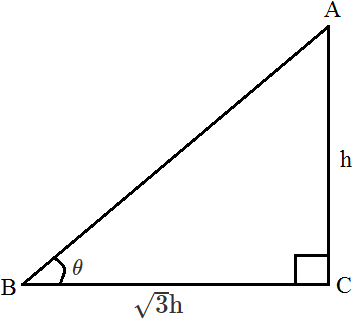
$\tan\theta=\frac{\text{AB}}{\text{BC}}=\frac{\text{h}}{\sqrt{3}\text{h}}$ $\Rightarrow\ \tan\theta=\frac{1}{\sqrt{3}}=\tan30^\circ\Rightarrow\theta=30^\circ$ Hence, the angle of elevation of the Sun is 30º.
View full question & answer
Question 23 Marks
Prove the following.
$(\sqrt{3}+1)(3-\cot30^\circ)=\tan^360^\circ-2\sin60^\circ$
Answer
RHS $=\tan^360^\circ-2\sin60^\circ=(\sqrt{3})^3-2\frac{\sqrt{3}}{2}=3\sqrt{3}-\sqrt{3}=2\sqrt{3}$
LHS $=(\sqrt{3}+1)(3-\cot30^\circ)=(\sqrt{3}+1)(3-\sqrt{3})$
$[\because\ \tan60^\circ=\sqrt{3}\sin60^\circ=\frac{\sqrt{3}}{2}\text{ and }=(\sqrt{3}+1)\sqrt{3}(\sqrt{3}-1)\cot30^\circ=\sqrt{3}]$
$=(\sqrt{3}(\sqrt{3})^2-1)=\sqrt{3}(3-1)=2\sqrt{3}$
$\therefore$ LHS = RHS
Hence proved
View full question & answer
Question 33 Marks
Prove the following.Simplify $(1+\tan^2\theta)(1-\sin\theta)(1+\sin\theta)$
Answer
$(1+\tan^2\theta)(1-\sin\theta)(1+\sin\theta)=(1+\tan^2\theta)(1-\sin^2\theta)$ $[\because(\text{a}-\text{b})(\text{a}+\text{b})=\text{a}^2-\text{b}^2]$
$=\sec^2\theta\cdot\cos^2\theta$
$[\because1+\tan^2\theta=\sec^2\theta\text{ and }\cos^2\theta+\sin^2\theta=1]$
$=\frac{1}{\cos^2\theta}\cdot\cos^2\theta=1\ \Big[\because\sec\theta=\frac{1}{\cos\theta}\Big]$
View full question & answer
Question 43 Marks
Prove the following.
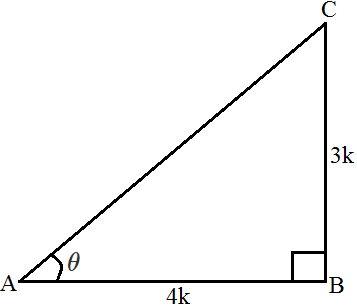
If $\tan\text{A}=\frac{3}{4},$ then $\sin\text{A}\cos\text{A}=\frac{12}{25}$
Answer

Given, $\tan\text{A}=\frac{3}{4}=\frac{\text{P}}{\text{B}}=\frac{\text{perpendicular}}{\text{Base}}$
Let $P = 3k$ and $B = 4k$
By pythagoras theorem,
$H^2 = P^2 + B^2 = (3k)^2 + (4k)^2$
$= 9k^2 + 16k^2 = 25k^2$
$\Rightarrow H = 5k$ [since, side cannot be negative]
$\therefore\ \sin\text{A}=\frac{\text{P}}{\text{H}}=\frac{3\text{k}}{5\text{k}}=\frac{3}{5}\text{ and }\cos\text{A}=\frac{\text{B}}{\text{H}}=\frac{4\text{k}}{5\text{k}}=\frac{4}{5}$
Now, $\sin\text{A}\cos\text{A}=\frac{3}{5}\cdot\frac{4}{5}=\frac{12}{25}$
Hence proved.
View full question & answer
Question 53 Marks
Prove the following.
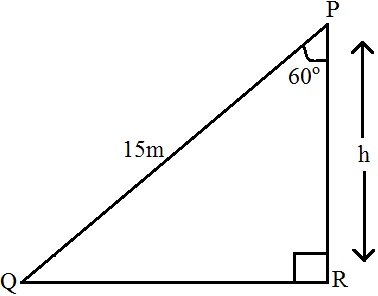
A ladder 15 metres long just reaches the top of a vertical wall. If the ladder makes an angle of 60° with the wall, find the height of the wall.
Answer
Given that, the height of the ladder = 15m Let the height of the vertical wall = h And the ladder makes an angle of elevation 60º with the wall i.e $\theta=60^\circ$
In $\triangle\text{QPR},\ \cos60^\circ=\frac{\text{PR}}{\text{PQ}}=\frac{\text{h}}{15}$ $\Rightarrow\ \frac{1}{2}=\frac{\text{h}}{15}$ $\Rightarrow\ \text{h}=\frac{15}{2}\text{m}.$ Hence, the required height of the well $\frac{15}{2}\text{m}.$
View full question & answer
Question 63 Marks
Prove the following.
If $\sqrt{3}\tan\theta=1,$ then find the value of $\sin^2\theta-\cos^2\theta$
Answer
Given that, $\sqrt{3}\tan\theta=1$
$\Rightarrow\ \tan\theta=\frac{1}{\sqrt{3}}=\tan30^\circ$
$\Rightarrow\ \theta=30^\circ$
Now, $\sin^2\theta-\cos^2\theta=\sin^230^\circ-\cos^230^\circ$
$=\Big(\frac{1}{2}\Big)^2-\Big(\frac{\sqrt{3}}{2}\Big)^2$
$=\frac{1}{4}-\frac{3}{4}=\frac{1-3}{4}=-\frac{2}{4}=-\frac{1}{2}$
View full question & answer
Question 73 Marks
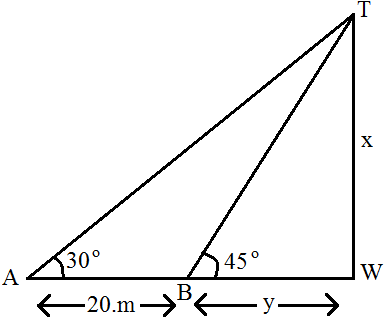
The angle of elevation of the top of a tower from certain point is 30°. If the observer moves 20 metres towards the tower, the angle of elevation of the top increases by 15°. Find the height of the tower.
Answer

Consider the height of the vertical tower (TW) = x m (let). Ist position of observer at A makes angle of elevation at the top of tower is 30º. Now, observer moves towards the tower at new position B such that AB = 20m. Let BW = y.
Now, angle of elevation of the top of tower is increased by 15º i.e., it becomes 30º + 15º = 45º.
In $\triangle\text{TWB},$ we have
$\tan45^\circ=\frac{\text{x}}{\text{y}}$
$\Rightarrow\ 1=\frac{\text{x}}{\text{y}}\Rightarrow\ \text{x}=\text{y}\ \ ...(\text{I})$
Now, $\triangle\text{TWA},$ we have
$\tan30^\circ=\frac{\text{x}}{20+\text{y}}$
$\Rightarrow\ \frac{1}{\sqrt{3}}=\frac{\text{x}}{20+\text{x}}\ \ [\text{From(I)}]$
$\Rightarrow\ \sqrt{3}\text{x}=20+\text{x}$
$\Rightarrow\ \sqrt{3}\text{x}-\text{x}=20$
$\Rightarrow\ \text{x}(\sqrt{3}-1)=20$
$\Rightarrow\ \text{x}=\frac{20}{(\sqrt{3}-1)}\times\frac{(\sqrt{3}-1)}{(\sqrt{3}+1)}$
$\Rightarrow\ \text{x}=\frac{20(\sqrt{3}+1)}{3-1}=\frac{20(\sqrt{3}+1)}{2}$
$\Rightarrow\ \text{x}=10(1.732+1)$
$\Rightarrow\ \text{x}=10\times2.732=27.32\text{m}$
Hence, the height of the tower is 27.32m.
View full question & answer
Question 83 Marks
If $\tan\theta+\sec\theta=\text{l},$ then prove that $\sec\theta=\frac{\text{l}^2+1}{2\text{l}}.$
Answer
Recall identity $\sec^2\theta-\tan^2\theta=1$ and now change $\sec\theta+\tan\theta\text{ to }\sec^2\theta-\tan^2\theta$by multiplying and dividing the given expression to $(\sec\theta-\tan\theta).$
$\sec\theta+\tan\theta=\text{l}\ \ [\text{Given}]\ (\text{I})$
$\Rightarrow\ (\sec\theta+\tan\theta)\frac{(\sec\theta-\tan\theta)}{\sec\theta-\tan\theta}=\text{l}$
$\Rightarrow\ \frac{\sec^2\theta-\tan^2\theta}{\sec\theta-\tan\theta}=\text{l}\ [\because1+\tan^2\theta=\sec^2\theta]$
$\Rightarrow\ \frac{1}{\sec\theta-\tan\theta}=\text{l}$
$\text{or}\ \sec\theta-\tan\theta=\frac{1}{\text{l}}\ \ (\text{II})$
Now, get $\sec\theta$ by eliminating $\tan\theta$ from (I) and (II).
It can be obtained by adding (I) and (II).
$\Rightarrow\ 2\sec\theta=\text{l}+\frac{1}{\text{l}}$
$\Rightarrow\ 2\sec\theta=\frac{\text{l}^2+1}{\text{l}}$
$\Rightarrow\ \sec\theta=\frac{\text{l}^2+1}{2\text{l}}$
Hence, proved.
View full question & answer
Question 93 Marks
Prove the following.
If $2\sin^2\theta-\cos^2\theta=2,$ then find the value of $\theta.$
Answer
Given, $2\sin^2\theta-\cos^2\theta=2$$\Rightarrow\ 2\sin^2\theta-(1-\sin^2\theta)=2\ [\because\sin^2\theta+\cos^2\theta=1]$
$\Rightarrow\ 2\sin^2\theta+\sin^2\theta-1=2$
$\Rightarrow\ 3\sin^2\theta=3$
$\Rightarrow\ \sin^2\theta=1\ [\because\sin90^\circ=1]$
$\Rightarrow\ \sin\theta=1=\sin90^\circ$
$\therefore\ \theta=90^\circ$
View full question & answer
Question 103 Marks
Prove the following.
$(\sin\alpha+\cos\alpha)(\tan\alpha+\cot\alpha)=\sec\alpha+\text{cosec}\alpha$
Answer
LHS $=(\sin\alpha+\cos\alpha)(\tan\alpha+\cot\alpha)$
$=(\sin\alpha+\cos\alpha)\bigg(\frac{\sin\alpha}{\cos\alpha}+\frac{\cos\alpha}{\sin\alpha}\bigg)$ $\bigg[\because\ \tan\theta=\frac{\sin\theta}{\cos\theta}\text{ and }\cot\theta=\frac{\cos\theta}{\sin\theta}\bigg]$
$=(\sin\alpha+\cos\alpha)\bigg(\frac{\sin^2\alpha+\cos^2\alpha}{\sin^\alpha\cdot\cos\alpha}\bigg)$
$=(\sin\alpha+\cos\alpha)\cdot\frac{1}{(\sin\alpha\cdot\cos\alpha)}$ $[\because\ \sin^2\theta+\cos^2\theta=1]$
$=\frac{1}{\cos\alpha}+\frac{1}{\sin\alpha}$ $\Big[\because\ \sec\theta=\frac{1}{\cos\theta}\text{ and cosec}\theta=\frac{1}{\sin\theta}\Big]$
$=\sec\alpha+\cos\alpha=$ RHS
View full question & answer
Question 113 Marks
Prove the following.
$\frac{\tan\text{A}}{1+\sec\text{A}}-\frac{\tan\text{A}}{1-\sec\text{A}}=2\text{cosecA}$
Answer
LHS $=\frac{\tan\text{A}}{1+\sec\text{A}}-\frac{\tan\text{A}}{1-\sec\text{A}}=\frac{\tan\text{A}(1-\sec\text{A}-1-\sec\text{A})}{(1+\sec\text{A})(1-\sec\text{A})}$
$=\frac{\tan\text{A}(-2\sec\text{A})}{(1-\sec^2\text{A})}=\frac{2\tan\text{A}\cdot\sec\text{A}}{(\sec^2\text{A}-1)}$ $[\because(\text{a}+\text{b})(\text{a}-\text{b})=\text{a}^2-\text{b}^2]$
$\frac{2\tan\text{A}\cdot\sec\text{A}}{\tan^2\text{A}}[\because\sec^2\text{A}-\tan^2\text{A}=1]$ $\bigg[\because\sec\theta=\frac{1}{\cos\theta}\text{ and }\tan\theta=\frac{\sin\theta}{\cos\theta}\bigg]$
$=\frac{2\sec\text{A}}{\tan\text{A}}=\frac{2}{\sin\text{A}}=2\text{cosecA}=$ RHS $\Big[\because\text{cosec}\theta=\frac{1}{\sin\theta}\Big]$
View full question & answer
Question 123 Marks
Given that $\sin\theta+2\cos\theta=1,$ then prove that $2\sin\theta-\cos\theta=2.$
Answer
$\sin\theta+2\cos\theta=1\ [\text{Given}]$
On squaring both sides, we get
$(\sin\theta)^2+(2\cos\theta)^2+2(\sin\theta)(2\cos\theta)=1$
$\Rightarrow\ \sin^2\theta+4\cos^2\theta+4\sin\theta\cos\theta=1$
$\Rightarrow\ 1-\cos^2\theta+4(1-\sin^2\theta)+4\sin\theta\cos\theta=1$
$\Rightarrow\ 1-\cos^2\theta+4-4\sin^2\theta+4\sin\theta\cos\theta=1$
$\Rightarrow\ -\cos^2\theta-4\sin^2\theta+4\sin\theta\cos\theta=-4$
$\Rightarrow\ \cos^2\theta+4\sin^2\theta-4\sin\theta\cos\theta=4$
$\Rightarrow\ (\cos\theta)^2+(2\sin\theta)^2-2(\cos\theta)(2\sin\theta)=4$
$\Rightarrow\ (2\sin\theta-\cos\theta)^2=2^2$
Taking square root both sides, we have
$2\sin\theta-\cos\theta=2$
Hence, proved.
View full question & answer
Question 133 Marks
Prove the following.
$1+\frac{\cot^2\alpha}{1+\text{cosec}\alpha}=\text{cosec}\alpha$
Answer
LHS $=1+\frac{\cot^2\alpha}{1+\text{cosec}\alpha}=1+\frac{\cos^2\alpha/\sin^2\alpha}{1+1/\sin\alpha}$ $\bigg[\because\ \cot\theta=\frac{\cos\theta}{\sin\theta}\text{ and cosec}\theta=\frac{1}{\sin\theta}\bigg]$
$=1+\frac{\cos^2\alpha}{\sin\alpha(1+\sin\alpha)}=\frac{\sin\alpha(1+\sin\alpha)+\cos^2\alpha}{\sin\alpha(1+\sin\alpha)}$
$=\frac{\sin\alpha+(\sin^2\alpha+\cos^2\alpha)}{\sin\alpha(1+\sin\alpha)}\ [\because\ \sin^2\theta+cos^2\theta=1]$
$=\frac{(\sin\alpha+1)}{\sin\alpha(\sin\alpha+1)}=\frac{1}{\sin\alpha}\ \Big[\because\ \text{cosec}\theta=\frac{1}{\sin\theta}\Big]$
$=\text{cosec}\alpha=$ RHS
View full question & answer
Question 143 Marks
Prove the following.
Show that $\frac{\cos^2(45^\circ+\theta)+\cos^2(45^\circ-\theta)}{\tan(60^\circ+\theta)\tan(30^\circ-\theta)}=1$
Answer
LHS $=\frac{\cos^2(45^\circ+\theta)+\cos^2(45^\circ-\theta)}{\tan(60^\circ+\theta)\cdot\tan(30^\circ-\theta)}$
$=\frac{\cos^2(45^\circ+\theta)+[\sin\{90^\circ-(45^\circ-\theta)\}]^2}{\tan(60^\circ+\theta)\cdot\cot\{90^\circ-(30^\circ-\theta)\}}$ $[\because\sin(90^\circ-\theta)=\cos\theta\text{ and }\cot(90^\circ-\theta)=\tan\theta]$
$=\frac{\cos^2(45^\circ+\theta)+\sin^2(45^\circ+\theta)}{\tan(60^\circ+\theta)\cdot\cot(60^\circ+\theta)}$ $[\because\sin^2\theta+\cos^2\theta=1]$
$=\frac{1}{\tan(60^\circ+\theta)\cdot\frac{1}{\tan(60^\circ+\theta)}}=1=$ RHS $[\because\cot\theta=1/\tan\theta]$
View full question & answer
3 Marks Question - Maths STD 10 Questions - Vidyadip