Questions

5 Marks Questions

Take a timed test

4 questions · self-marked practice — reveal the answer and mark yourself.

Question 15 Marks
Write all the other trigonometric ratios of $\angle$A in terms of sec A.
Answer
$\sin A$ can be expressed in terms of sec A as:
$\sin A=\sqrt{\sin ^{2} A}$
$sin A=\sqrt{( 1-\cos ^{2} A)}$
$\sin A=\sqrt{1-\frac{1}{\sec ^{2} A}}$
$\sin A=\sqrt{\frac{\sec ^{2} A-1}{\sec ^{2} A}}$
$\sin A=\frac{1}{\sec A} \sqrt{\sec ^{2} A-1}$
Now,
$\cos A$ can be expressed in terms of secA as:
$\cos A=\frac{1}{\sec A}$
tanA can be expressed in the form of sec A as:
As,$ 1 + tan^2A = sec^2A$
$\left.\Rightarrow \tan A=\pm \sqrt{( \sec ^{2} A-1}\right)$
since A is an acute angle, and tan A is positive when A is acute, So, tan A = $\sqrt{( \sec ^{2} A-1)}$
Now $\ cosec A$ can be expressed in the form of sec A as:
$\ cosec A=\frac{1}{\sin A}$
$\ cosec A=\frac{1}{\frac{\sec A}{\sqrt{1-\sec ^{2} A}}} $
$\ cosec A=\frac{\sqrt{1-\sec ^{2} A}}{\sec A} $Now, cot A can be expressed in terms of sec A as:
cot A $=\frac{1}{\tan A}$
as, $1 + tan^2A = sec^2A$
$\ cot A=\frac{1}{\sqrt{\sec ^{2} A-1}}$
View full question & answer
Question 25 Marks
If 3 cot A = 4, check whether $\frac { 1 - \tan ^ { 2 } A } { 1 + \tan ^ { 2 } A } = \cos ^ { 2 } A - \sin ^ { 2 } A$ or not.
Answer
Give that 3cot A = 4
Or cot $A = \frac{4}{3}$
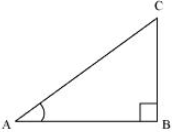
Consider a right angle triangle $\Delta ABC$ right angled at point B.

$\cot A = \frac{{Side\;adjacent\;to\;\angle A}}{{Side\;opposite\;to\;\angle A}}$
$\frac{{AB}}{{BC}} = \frac{4}{3}$
If AB is 4K, BC will be 3K. where K is a positive integer
Now in $\Delta ABC$
$(AC)^2 = (AB)^2 + (BC)^2$
$= (4K)^2 + (3K)^2$
$= 16 K^2 + 9K^2$
$= 25K^2$
$AC = 5K$
$\cos A = \frac{{Side\;adjacent\;to\;\angle A}}{{hypotenuse}} = \frac{{AB}}{{AC}}$
$ = \frac{{4K}}{{5K}} = \frac{4}{5}$
$\sin A = \frac{{Side\;opposite\;to\;\angle A}}{{hypotenuse}} = \frac{{BC}}{{AC}}$
$ = \frac{{3K}}{{5K}} = \frac{3}{5}$
$\tan A = \frac{{Side\;opposite\;to\;\angle A}}{{Side\;adjacent\;to\;angle\;A}} = \frac{{BC}}{{AB}}$
$ = \frac{{3K}}{{4K}} = \frac{3}{4}$
$\frac{{1 - {{\tan }^2}A}}{{1 + {{\tan }^2}A}} = \frac{{1 - {{\left( {\frac{3}{4}} \right)}^2}}}{{1 + {{\left( {\frac{3}{4}} \right)}^2}}} = \frac{{1 - \frac{9}{{16}}}}{{1 + \frac{9}{{16}}}}$
$ = \frac{{\frac{7}{{16}}}}{{\frac{{25}}{{16}}}} = \frac{7}{{25}}$
${\cos ^2}A - {\sin ^2}A = {\left( {\frac{4}{5}} \right)^2} - {\left( {\frac{3}{5}} \right)^2}$
$ = \frac{{16}}{{25}} - \frac{9}{{25}} = \frac{7}{{25}}$
Hence $\frac{{1 - {{\tan }^2}A}}{{1 + {{\tan }^2}A}} = {\cos ^2}A - {\sin ^2}A$
View full question & answer
Question 35 Marks
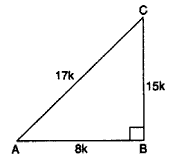
Given 15 cot A = 8 find sin A and sec A.
Answer
Let us draw a right triangle ABC.
15 cot A = 8 ...... Given
$\Rightarrow \cot A = \frac { 8 } { 15 } \Rightarrow \frac { A B } { B C } = \frac { 8 } { 15 }$
$\Rightarrow \frac { A B } { 8 } = \frac { B C } { 15 } = k ( 5 a y )$
where k is a positive number
$\Rightarrow A B = 8 k$
BC = 15k

By using the Pythagoras theorem, we have
$A C ^ { 2 } = A B ^ { 2 } + B C ^ { 2 }$
$\Rightarrow A C ^ { 2 } = ( 8 k ) ^ { 2 } + ( 15 k ) ^ { 2 } \Rightarrow A C ^ { 2 } = 64 k ^ { 2 } + 225 k ^ { 2 }$
$\Rightarrow A C = \sqrt { 289 k ^ { 2 } } \Rightarrow A C = 17 k$
Now, $\sin A = \frac { B C } { A C } = \frac { 15 k } { 17 k } = \frac { 15 } { 17 }$
and, $\sec A = \frac { A C } { A B } = \frac { 17 k } { 8 k } = \frac { 17 } { 8 }$
View full question & answer
Question 45 Marks
If $ \angle B $ and $\angle Q$ are acute angles such that sin B = sin Q, then prove that $ \angle B = \angle Q$.
Answer
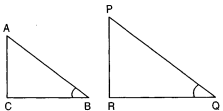
Consider two right triangles ABC and PQR in which $ \angle B{/tex} and $\angle Q$ are the right angles.
We have,

In $\triangle ABC$
$\sin B=\frac{AC}{AB}$
and, In $\triangle PQR$
$\sin Q=\frac{PR}{PQ}$
$ \because \quad \sin B = \sin Q$
$ \Rightarrow \quad \frac { A C } { A B } = \frac { P R } { P Q }$
$ \Rightarrow \quad \frac { A C } { P R } = \frac { A B } { P Q } = k$(say) ...... (i)
$ \Rightarrow $ AC = kPR and AB = kPQ .....(ii)
Using Pythagoras theorem in triangles ABC and PQR, we obtain
$AB^2 = AC^2 + BC^2$ and $PQ^2 = PR^2 + QR^2$​​​​​​​
$ \Rightarrow \quad B C = \sqrt { A B ^ { 2 } - A C ^ { 2 } } \text { and } Q R = \sqrt { P Q ^ { 2 } - P R ^ { 2 } }$
$ \Rightarrow \quad \frac { B C } { Q R } = \frac { \sqrt { A B ^ { 2 } - A C ^ { 2 } } } { \sqrt { P Q ^ { 2 } - P R ^ { 2 } } } = \frac { \sqrt { k ^ { 2 } P Q ^ { 2 } - k ^ { 2 } P R ^ { 2 } } } { \sqrt { P Q ^ { 2 } - P R ^ { 2 } } }$ [ using (ii) ]
$ \Rightarrow \quad \frac { B C } { Q R } = \frac { k \sqrt { P Q ^ { 2 } - P R ^ { 2 } } } { \sqrt { P Q ^ { 2 } - P R ^ { 2 } } } = k$...(iii)
From (i) and (iii), we get
$ \frac { A C } { P R } = \frac { A B } { P Q } = \frac { B C } { Q R }$
$ \Rightarrow \quad \Delta A C B - \Delta P R Q$ [By S.A.S similarity]
$ \therefore \quad \angle B = \angle Q$
Hence proved.
View full question & answer