MCQ 11 Mark
The pair of linear equations. $\frac{3\text{x}}{2}+\frac{5\text{y}}{3}=7$ and $9\text{x}+10\text{y}=14$ is :
- A
- ✓
- C
Consistent with one solution.
- D
Consistent with many solutions.
AnswerGiven,
$\frac{3\text{x}}{2}+\frac{5\text{y}}{3}=7\ \dots(1)$
$9\text{x}+10\text{y}=14\ \dots(2)$
$\text{a}_1=\frac{3}{2},\text{a}_2=9$
$\text{b}_1=\frac{5}{3},\text{b}_2=10$
$\text{c}_1=7,\text{c}_2=14$
$\therefore\frac{\text{a}_1}{\text{a}_2}=\frac{\frac32}{9}$
$=\frac3{18}=\frac16$
$\frac{\text{a}_1}{\text{a}_2}=\frac16$
$\therefore\frac{\text{b}_1}{\text{b}_2}=\frac{\frac53}{10}$
$=\frac5{30}=\frac16$
$\therefore\frac{\text{c}_1}{\text{c}_2}=\frac{7}{14}$
$=\frac12$
$\therefore\frac{\text{a}_1}{\text{a}_2}=\frac{\text{b}_1}{\text{b}_2}\neq\frac{\text{c}_1}{\text{c}_2}\ [$parallel lines $=$ inconsistent$]$
View full question & answer→MCQ 21 Mark
The pair of linear equations $y = 0$ and $y = -6$ has.
- A
- ✓
- C
Infinitely many solutions
- D
Only solution $(0, 0)$
AnswerThe pair of equation $y = 0$ and $y = -6$ has no solution.
We know that the line $y = c$ is a horizontal line.
Since, therefore both lines are parallel to each other.
View full question & answer→MCQ 31 Mark
The value of $\lambda$ for which $(\text{x}_2 + 4\text{x} + \lambda)$ is a perfect square, is :
AnswerThe given quadric equation is $\text{x}_2 + 4\text{x} + \lambda=0$
Then find the value of $k$.
Here, $a = 1, b = 4$ and, $\text{c}=\lambda$
As we know that $D=b^2-4 a c$
Putting the value of $a = 1, b = 4$ and, $\text{c}=\lambda$
$\lambda=(4)^2-4\times1\times\lambda$
$=16-4\lambda$
The given equation are perfect square, if $D = 0$
$14-4\lambda=0$
$4\lambda=16$
$\lambda=\frac{16}{4}$
$=4$
Therefore, the value of $\lambda=4$
View full question & answer→MCQ 41 Mark
The value of $k$ for which the system of linear equations $x + 2y = 3, 5x + ky + 7 = 0$ is inconsistent is :
- A
$-\frac{14}{3}$
- B
$\frac{2}{5}$
- C
$5$
- ✓
$10$
AnswerThe given system is
$x + 2y - 3 = 0 ...(i)$
$5x + ky + 7 = ...(ii)$
Here, $a_1=1, b_1=2, c_1=-3, a_2=5, b_2=k$, and $c_2=7$.
For the system, to be consistent, we must have
$\frac{\text{a}_1}{\text{a}_2}=\frac{\text{b}_1}{\text{b}_2}\neq\frac{\text{c}_1}{\text{c}_2}$
$\Rightarrow\frac{1}{\text{5}}=\frac{\text{2}}{\text{k}}\neq\frac{\text-{3}}{\text{7}}$
$\Rightarrow\text{k}=10$
Hence $, k = 10$
View full question & answer→MCQ 51 Mark
The value of $x$ for which $2x, (x + 10)$ and $(3x + 2)$ are the three consecutive terms of an $AP,$ is :
AnswerGiven $2x, x + 10, 3x + 2$ are the consecutive terms of an $AP$.
Therefore, the common difference will be same.
$\Rightarrow (x + 10) - 2x = (3x + 2) - (x + 10)$
$\Rightarrow x + 10 - 2x = 3x + 2 - x + 10$
$\Rightarrow 10 - x = 2x - 8$
$\Rightarrow 3x = 18$
$\Rightarrow x = 6$
Hence the correct answer is option $(a).$
View full question & answer→MCQ 61 Mark
The value of $k$ for which the system of equations $x + y - 4 = 0$ and $2x + ky = 3$ has no solution, is :
AnswerFor no solution;
$\frac{\text{a}_1}{\text{a}_2}=\frac{\text{b}_1}{\text{b}_2}\neq\frac{\text{c}_1}{\text{c}_2}$
$\therefore\frac12=\frac{1}{\text{k}}\neq\frac{-4}{-3}$
$\Rightarrow\text{k}=2$
View full question & answer→MCQ 71 Mark
If $2^\text{x+y} = 2^\text{x-y}=\sqrt{8}$ then the value of $y$ is :
- A
$\frac{1}{2}$
- ✓
$0$
- C
$\frac{3}{2}$
- D
Answer$2^\text{x+y} = 2^\text{x-y}={2}\frac{3}{2}$
$\Rightarrow \text{x+y}=\frac{3}{2}$ and
$x-y =\frac{3}{2}$
So adding above two equations.
We get and $x = y = 0$
View full question & answer→MCQ 81 Mark
The sum of the numerator and denominator of a fraction is $18$. If the denominator is increased by $2,$ the fraction reduces to $\frac{1}{3}$ The fraction is :
- ✓
$\frac{5}{13}$
- B
$\frac{-5}{13}$
- C
$\frac{7}{11}$
- D
$\frac{-7}{11}$
AnswerCorrect option: A. $\frac{5}{13}$
Let the fraction be $\frac{\text{x}}{\text{y}}$
According to question
$x + y = 18 ...(i)$
And $\frac{\text{x}}{\text{y+2}}=\frac{1}{3}$
$\Rightarrow 3x = y + 2$
$\Rightarrow 3x - y = 2 ...(ii)$
On solving eq. $(i)$ and eq. $(ii),$ we get
$x = 5, y = 13$
$\therefore$ The fraction is $\frac{5}{13}$
View full question & answer→MCQ 91 Mark
The number of solutions of two linear equations representing intersecting lines is /are :
AnswerThe number of solutions of two linear equations representing intersecting lines is $1$ because two linear equations representing intersecting lines has a unique solution.
View full question & answer→MCQ 101 Mark
If the system of equations has infinitely many solutions, then : $2x + 3y = 7(a + b)x + (2a - b)y = 21$
- A
$a = 1, b = 5$
- ✓
$a = 5, b = 1$
- C
$a = -1, b = 5$
- D
$a = 5, b = -1$
AnswerCorrect option: B. $a = 5, b = 1$
The given systems of equations are
$2x + 3y = 7$
$(a + b)x + (2a - b)y = 21$
For the equations to have infinite number of solutions, $\frac{\text{a}_1}{\text{a}_2}=\frac{\text{b}_1}{\text{b}_2}=\frac{\text{c}_1}{\text{c}_2}$
Here, $a_1=2, a_2=(a+b), b_1=3, b_2=(2 a-b), c_1=7, c_2=21$
$\frac{2}{\text{a}+\text{b}}=\frac{3}{2\text{a}-\text{b}}=\frac{7}{21}$
Let us take $\frac{\text{a}_1}{\text{a}_2}=\frac{\text{b}_1}{\text{b}_2}$
$\frac{2}{\text{a}+\text{b}}=\frac{3}{2\text{a}-\text{b}}$
By cross multiplication we get,
$2(2a - b) = 3(a + b)$
$4a - 2b = 3a + 3b$
$4a - 3a = 3b + 2b$
$a = 5b ......(i)$
Now take $\frac{\text{b}_1}{\text{b}_2}=\frac{\text{c}_1}{\text{c}_2}$
$\frac{3}{2\text{a}-\text{b}}=\frac{7}{21}$
$\frac{3}{2\text{a}-\text{b}}=\frac{1}{3}$
By cross multiplication we get,
$3 \times 3 = 1 \times 2a - b$
$9 = 2a - b .....(ii)$
Substitute $a = 5b$ in the above equation
$9 = 2 \times 5b - b$
$9 = 10b - b$
$9 = 9b$
$\frac{9}{9}=\text{b}$
$1 = b$
Substitute $b = 1$ in equation $(i)$ we get $a = 5b$
$a = 5 \times 1$
$a = 5$
Therefore $a = 5 $ and $b = 1$
Hence, the correct choice is $b$.
View full question & answer→MCQ 111 Mark
If the lines given by $3x + 2ky = 2$ and $2x + 5y + 1 = 0$ are parallel then the value of $k$ is :
- A
$\frac{-5}{4}$
- B
$\frac{2}{5}$
- C
$\frac{3}{2}$
- ✓
$\frac{15}{4}$
AnswerCorrect option: D. $\frac{15}{4}$
$3x + 2ky = 2$ and $2x + 5y + 1 = 0$
$3x + 2ky - 2 = 0$ and $2x + 5y + 1 = 0$
If the lines are parallel, it means the system has an infinite number of solutions.
We know that,
the system of linear equations $a_1 x+b_1 x+c_1=0, a_2 x+b_2 y+c_2=0$ has a unique solution if $\frac{\text{a}_1}{\text{a}_2}=\frac{\text{b}_1}{\text{b}_2}=\frac{\text{c}_1}{\text{c}_2}.$
So, $\frac{3}{2}=\frac{2\text{k}}{5}=\frac{-2}{1}$
$\Rightarrow\frac{3}{2}=\frac{2\text{k}}{5}$
$\Rightarrow\text{k}=\frac{15}{4}$
View full question & answer→MCQ 121 Mark
The number of solutions of two linear equations representing coincident lines is /are :
AnswerThe number of solutions of two linear equations representing coincident lines are $\infty$ because two linear equations representing coincident lines has infinitely many solutions.
View full question & answer→MCQ 131 Mark
The sum of the digits of a two digit number is $9,$ If $27$ is added to it, the digits of the number get reversed. The number is :
AnswerLet the original No is $10x + y$
The sum of the digits of a two digit no. Is $9$.
If the digits are reversed,
the new no, Is $27$ less than the given no.
$x + y = 9$
$(10x + y) = (10y + x) -27$
$9x - 9y = -27$
$x - y = -3$
$x = 3$
$y = 6$
Then the number Is $36$
View full question & answer→MCQ 141 Mark
A system of linear equations is said to be consistent, if it has :
AnswerA system of linear equations is said to be consistent if it has at least one solution or can have many solutions.
If a consistent system has an infinite number of solutions, it is dependent.
When you graph the equations, both equations represent the same line. If a system has no solution, it is said to be inconsistent.
The graphs of the lines do not intersect, so the graphs are parallel and there is no solution.
View full question & answer→MCQ 151 Mark
The pair of linear equations $4x - 6y = 9$ and $2x - 3y = 8$ are :
AnswerGiven: $a_1=4, a_2=2, b_1=-6, b_2=-3, c_1=9$ and $c_2=8$
Here, $\frac{\text{a}_{1}}{\text{a}_{2}} = \frac{4}{2} = \frac{2}{1}= \frac{\text{b}_{1}}{\text{b}_{2}} $
$= \frac{-6}{-3} = \frac{2}{1},\frac{\text{c}_{1}}{\text{c}_{2}} = \frac{9}{8}$
$\because\frac{\text{a}_{1}}{\text{a}_{2}} = \frac{\text{b}_{1}}{\text{b}_{2}}\neq\frac{\text{c}_{1}}{\text{c}_{2}}$
$\therefore$ The pair of given liner equations is inconsistent.
View full question & answer→MCQ 161 Mark
The value of $k$ for which the system of equations $x + 2y - 3 = 0$ and $5x + ky + 7 = 0$ has no solution, is :
AnswerThe given system of equations are
$x + 2y - 3 = 0$
$5x + ky + 7 = 0$
For the equations to have no solutions,
$\frac{\text{a}_1}{\text{a}_2}=\frac{\text{b}_1}{\text{b}_2}\neq\frac{\text{c}_1}{\text{c}_2}$
$\frac{1}{5}=\frac{2}{\text{k}}\neq\frac{-3}{7}$
If we take
$\frac{\text{a}_1}{\text{a}_2}=\frac{\text{b}_1}{\text{b}_2}$
$\frac{1}{5}=\frac{2}{\text{k}}$
$\text{k}=10$
Therefore the value of $k$ is $10.$
Hence, correct choice is $a$.
View full question & answer→MCQ 171 Mark
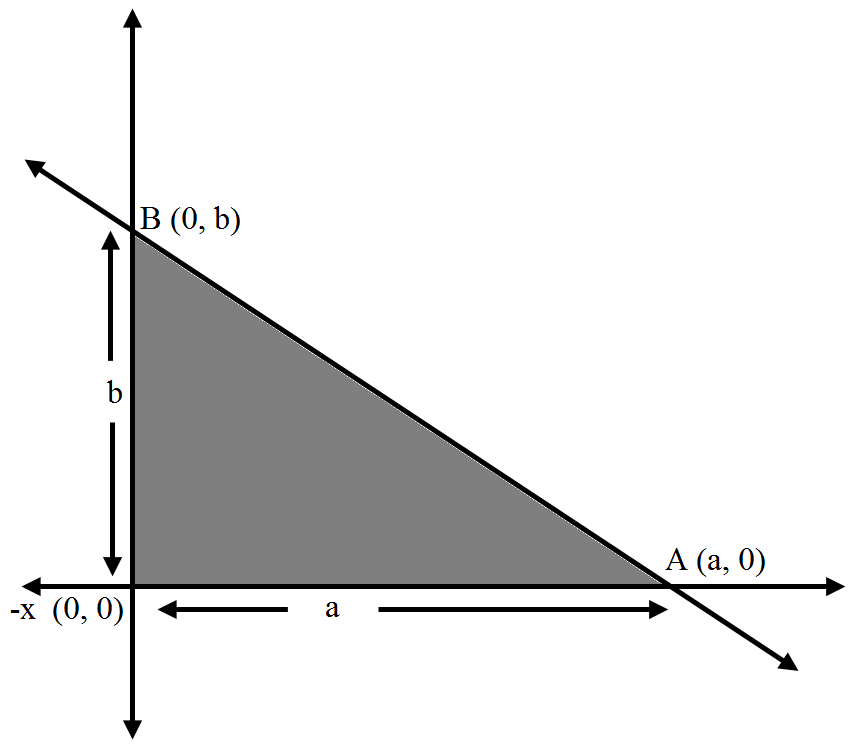
The area of the triangle formed by the line $\frac{\text{x}}{\text{a}}+\frac{\text{y}}{\text{b}} =1$ with the co $-$ ordinate axis is :
- A
${2}\text{ab}\text{ sq}.\text{units}$
- B
$\text{ab}\text{ sq}.\text{units}$
- C
$\frac{1}{4}\text{ab}\text{ sq}.\text{units}$
- ✓
$\frac{1}{2}\text{ab}\text{ sq}.\text{units}$
AnswerCorrect option: D. $\frac{1}{2}\text{ab}\text{ sq}.\text{units}$
Area of triangle $\text{OAB} = \frac{1}{2}\times\text{OA}\times\text{OB} = \frac{1}{2}\text{ab}$
View full question & answer→MCQ 181 Mark
The father’s age is six times his son’s age. Four years later, the age of the father will be four times his son’s age. The present ages, in years, of the son and the father are, respectively :
- ✓
$6$ and $36$
- B
$4$ and $24$
- C
$3$ and $24$
- D
$5$ and $30$
AnswerCorrect option: A. $6$ and $36$
Let $'x\ ’$ year be the present age of father and $'y\ ’$ year be the present age of son.
Four years later, given condition becomes,
$(x + 4) = 4(y + 4)$
$a$
$x + 4 = 4y + 16$
$x - 4y - 12 = 0 … (i)$
and initially, $x = 6y … (ii)$
On putting the value of from Eq. $(ii)$ in Eq. $(i),$ we get
$6y - 4y - 12 = 0$
$2y = 12$
Hence, $y = 6$
Putting $y = 6,$ we get $x = 36.$
present age of father is $36$ years and age of son is $6$ years.
View full question & answer→MCQ 191 Mark
The lines representing the pair of equations $5x - 4y + 8 = 0$ and $7x + 6y - 9 = 0$ :
Answer$= \frac{\text{a}_{1}}{\text{a}_{2}} = \frac{5}{7}$
$= \frac{\text{b}_{1}}{\text{b}_{2}} = -\frac{4}{6}$
Since $,\frac{\text{a}_{1}}{\text{a}_{2}}\neq\frac{\text{b}_{1}}{\text{b}_{2}}$
$\therefore$ lines are intersecting at a point
View full question & answer→MCQ 201 Mark
Directions : In the following questions, the Assertions $(A)$ and Reason $(s)\ (R)$ have been put forward. Read both the statements carefully and choose the correct alternative from the following:
Assertion : Pair of linear equations : $9x+ 3y+ 12 = 0, 8x+ 6y+ 24 = 0$ have infinitely many solutions.
Reason : Pair of linear equations $a_1x+b_1y + c_1=0$ and $a_2x+b_2y+c_2=0$ have infinitely many solutions, if $\frac{\text{a}_1}{\text{a}_2}=\frac{\text{b}_1}{\text{b}_2}=\frac{\text{c}_1}{\text{c}_2}$
- ✓
Both assertion $(A)$ and reason $(R) $ are true and reason $(R)$ isthe correct explanation of assertion $(A)$.
- B
Both assertion $(A)$ and reason $(R)$ are true but reason $(R)$ is not the correct explanation of assertion $(A).$
- C
Assertion $(A)$ is true but reason $(R)$ is false.
- D
Assertion $(A) $ is false but reason $(R)$ is true
AnswerCorrect option: A. Both assertion $(A)$ and reason $(R) $ are true and reason $(R)$ isthe correct explanation of assertion $(A)$.
From the given equations, we have
$\frac{9}{18}=\frac{6}{3}=\frac{12}{24}$
$\frac{1}{2}=\frac{1}{2}=\frac{1}{2}$
i.e $.,\frac{\text{a}_1}{\text{a}_2}=\frac{\text{b}_1}{\text{b}_2}=\frac{\text{c}_1}{\text{c}_2}$
So, both $A$ and $R$ are correct and $R$ explains $A$.
View full question & answer→MCQ 211 Mark
One equation of a pair of dependent linear equations is $-5x + 7y = 2,$ then the second equation can be :
- ✓
$10x - 14y + 4 = 0$
- B
$-10x - 14y + 4 = 0$
- C
$10x + 14y + 4 = 0$
- D
$-10x + 14y + 4 = 0$
AnswerCorrect option: A. $10x - 14y + 4 = 0$
If the equations of a pair of dependent linear equations, then $\frac{\text{a}_{1}}{\text{a}_{2}} = \frac{\text{b}_{1}}{\text{b}_{2}} = \frac{\text{c}_{1}}{\text{c}_{2}} $
Give: $a_1=-5, b_1=-5$, and $c_1=2$
For satisfying the condition of dependent linear equations,
the value of $a_2, b_2$, and $c_2$ should be the multiples of the value of $a_1, b_1$ and $c_1$
$\therefore$ The value would be $a_2= -5 \times (-2) = 10, b_2= 7 \times (-2) = -14$ and $c_1= 2 \times (-2) = -4$
$\therefore$ The second equations can be $10x - 14y = -4$
View full question & answer→MCQ 221 Mark
5 pencils and 7 pens together cost Rs. 50 whereas 7 pencils ands pens together cost Rs. 46. The cost of 1 pen is:
AnswerLet, cost in (RS) of one pencil = $x$
and cost in (RS) of one pen = $y$
$5x + 7y = 50$ ... (1)
$7x + 5y = 46$ ... (2)
Multiply equation (1) by $7$ and equation (2) by $5$ we get
$7(5x + 7y) = 7 50$
$35x + 49y = 350$ ... (3)
and $5(7x + 5y) = 5 \times 46$
$35x + 25y = 230$ ... (4)
Subtract equation (4) from equation $3$, we get
$35x + 49y - 35x - 25y = 350 - 230$
$49y - 25y = 120$
$24y = 120$
$\text{y} = \frac{120}{24}$
$y = 5$
Substitute $y = 5$ in equation $1$, we get
$5x + 7 \times 5 = 50$
$5x + 35 = 50$
$5x = 50 - 35$
$5x = 15$
$\text{x} = \frac{15}{3}$
$x = 3$ Cost of One Pen = $y = 5$
View full question & answer→MCQ 231 Mark
If $6x + 3y = c - 3$ and $12x + cy = c$ has infinitely many solutions, then $c =$
AnswerGiven : $a_1=6, a_2=12, b_1=3, b_2=c, c_1=c-3, c_2=c$
Since the pair of given linear equations has infinitely many solutions,
$\therefore\frac{\text{a}_{1}}{\text{a}_{2}}=\frac{\text{b}_{1}}{\text{b}_{2}}= \frac{\text{c}_{1}}{\text{c}_{2}}$
$\Rightarrow \frac{6}{12}=\frac{3}{\text{c}} = \frac{\text{c - 3}}{\text{c}}$
Taking
$\Rightarrow \frac{6}{12}=\frac{3}{\text{c}} $
$\Rightarrow \text{c} = \frac{{3}\times{12}}{6} = {6}$
View full question & answer→MCQ 241 Mark
If $\frac{2\text{x}}{3}-\frac{\text{y}}{2}+\frac{1}{6}=0$ and $\frac{\text{x}}{2}+\frac{2\text{y}}{3}=3$ then :
- ✓
$x = 2, y = 3$
- B
$x = -2, y = 3$
- C
$x = 2, y = -3$
- D
$x = -2, y = -3$
AnswerCorrect option: A. $x = 2, y = 3$
$\frac{2\text{x}}{3}-\frac{\text{y}}{2}+\frac{1}{6}=0$
Multiply by the $\text{LCM}, 6.$
$\Rightarrow 4x - 3y + 1 = 0$
$\Rightarrow 4x - 3y = -1 ....(i)$
$\frac{\text{x}}{2}+\frac{2\text{y}}{3}=3$
Multiply by the $\text{LCM}, 6.$
$3x + 4y = 18 ...(ii)$
Multiply equation $(i)$ and $(ii)$ by $4$ and $3$ respectively.
$16x - 12y = -4 ...(iii)$
$9x + 12y = 54 ...(iv)$
Adding equations $(iii)$ and $(iv)$, we get
$25x = 50$
$\Rightarrow x = 2$
Substituting $x = 2$ in $(ii),$ we get $y = 3$.
View full question & answer→MCQ 251 Mark
The sum of the digits of a two digit number is $9$. if $27$ is added to it, the digits of the number get reversed. The number is :
AnswerSince the sum of the digits of a two $-$ digit number is $9,$ therefore
$x + y = 9 .....(i)$
It says if the digits are reversed, the new number is $27$ less than the original.
Since we are looking at the number like $xy,$ to separate them, it is actually $10x + y$ for $x$ is a tens digit.
$10y+ x = 10x + y + 27$
Simplify it, we get $9y = 9x + 27$
$y = x + 3 ....(ii)$
Substitute $(ii)$ into $(i),$ we will have
$x + (x + 3) = 9$
$\Rightarrow 2x + 3 = 9$
$\Rightarrow 2x = 6$
$\Rightarrow x = 3$
Put back into equation $(i),$
$\Rightarrow 3 + y = 9$
$\Rightarrow y = 6$
The original number is $36$.
View full question & answer→MCQ 261 Mark
Choose the correct answer from the given four options : The pair of equations $x = a$ and $y = b$ graphically represents lines which are :
- A
- B
Intersecting at $(b, a)$.
- C
- ✓
Intersecting at $(a, b)$.
AnswerCorrect option: D. Intersecting at $(a, b)$.
By graphically in every condition. if $a, b >> 0; a, b < 0, a > 0, b < 0; a < 0, b > 0$ but $\text{a}=\text{b}\neq0.$
The pair of equations $x = a$ and $y = b$ graphically represents lines which are interesectin at $(a, b)$. If $a, b > 0.$
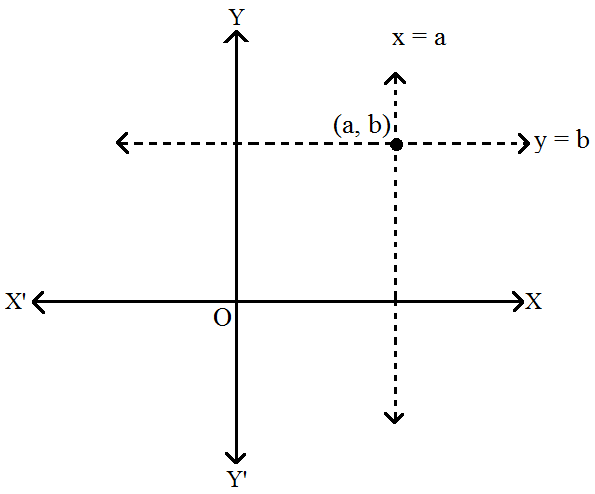
Similarly, in all cases two lines intersect at $(a, b)$. View full question & answer→MCQ 271 Mark
If the system $6x - 2y = 3, kx - y = 2$ has a unique solution, then :
- A
$\text{k}\neq{4}$
- B
$\text{k} = 4$
- ✓
$\text{k} \neq 3$
- D
$\text{k} = 3$
AnswerCorrect option: C. $\text{k} \neq 3$
If the system has a unique solution, then $\frac{\text{a}_{1}}{\text{a}_{2}}\neq\frac{\text{b}_{1}}{\text{b}_{2}}$
Here $a_1=6, a_2=k, b_1=-2$ and $b_2=-1$
$\therefore\frac{6}{\text{k}}\neq\frac{-2}{-1}$
$\Rightarrow {3}\text{k}\neq{6}$
$\Rightarrow\text{k}\neq{3}$
${2}\text{k}\neq{6}, \text{ k}\neq{3}$
View full question & answer→MCQ 281 Mark
One equation of a pair of inconsistent linear equations is $2x - 3y = 4,$ then the second equation can be :
- A
$3x - 2y = 4$
- B
$6x - 9y = 12$
- C
$4x - 6y = 8$
- ✓
$4x - 6y = 9$
AnswerCorrect option: D. $4x - 6y = 9$
If equations of a pair of dependent linear equations, then $\frac{\text{a}_{1}}{\text{a}_{2}}=\frac{\text{b}_{1}}{\text{b}_{2}}\neq\frac{\text{c}_{1}}{\text{c}_{2}}$
Give : $a_1=2, b_1=-3$, and $c_1=4$
For satisfying the condition of dependent linear equations, the value of $a_2, b_2$, and $c_2$ should be the multiples of the value of $a_1, b_1$ and $c_1$
$\therefore$ The value would be $\mathrm{a}_2=2 \times(2)=4, \mathrm{~b}_2=6 \times 2=12$ and $\mathrm{c}_1=4 \times 2=8$
$\therefore$ The second equations can be $4x - 6y = 8$
View full question & answer→MCQ 291 Mark
If $am \neq bl,$ then the system of equations $ax + by = clx + my = nax + by = clx + my = n.$
- ✓
- B
- C
Has infinitely many solutions.
- D
May or may not have a solution.
AnswerHas a unique solution.
Given $\text{am}\neq\text{bl},$ the system of equations has
$ax + by = c$
$lx + my = n$
We know that intersecting lines have unique solution $\frac{\text{a}_1}{\text{a}_2}\neq\frac{\text{b}_1}{\text{b}_2}$
$\text{a}_1\times\text{b}_2\neq\text{a}_2\times\text{b}_1$
Here $a_1=a, a_2=l, b_1=b, b_2=m$
$\frac{\text{a}}{\text{l}}\neq\frac{\text{b}}{\text{m}}$
$\text{a}\times\text{m}\neq\text{l}\times\text{b}$
Therefore intersecting lines, have unique solution.
Hence, the correct choice is a.
View full question & answer→MCQ 301 Mark
The number of solutions for two linear equations representing parallel lines is /are :
AnswerThe number of solutions of two linear equations representing parallel lines is $0$ because two linear equations representing parallel lines has no solution and they are inconsistent.
View full question & answer→MCQ 311 Mark
If the lines representing the pair of linear equations $a_1 x+b_1 y+c_1=0$ and $a_2 x+b_2 y+c_2=0$ are coincident, then :
- A
$\frac{\text{a}_{1}}{\text{a}_{2}} = \frac{\text{b}_{1}}{\text{b}_{2}}$
- B
$\frac{\text{a}_{1}}{\text{a}_{2}} = \frac{\text{b}_{1}}{\text{b}_{2}}=\frac{\text{c}_{1}}{\text{c}_{2}}$
- ✓
$\frac{\text{a}_{1}}{\text{a}_{2}} \neq \frac{\text{b}_{1}}{\text{b}_{2}}$
- D
$\frac{\text{a}_{1}}{\text{a}_{2}} = \frac{\text{b}_{1}}{\text{b}_{2}}\neq\frac{\text{c}_{1}}{\text{c}_{2}}$
AnswerCorrect option: C. $\frac{\text{a}_{1}}{\text{a}_{2}} \neq \frac{\text{b}_{1}}{\text{b}_{2}}$
$\frac{\text{a}_{1}}{\text{a}_{2}} \neq \frac{\text{b}_{1}}{\text{b}_{2}}$
View full question & answer→MCQ 321 Mark
The sum of the numerator and denominator of a fraction is $18.$ If the denominator is increased by $2,$ the fraction reduces to $\frac{1}{3}$ The fraction is :
- ✓
$\frac{5}{13}$
- B
$\frac{-5}{13}$
- C
$\frac{7}{11}$
- D
$\frac{-7}{11}$
AnswerCorrect option: A. $\frac{5}{13}$
Let the fraction be $\frac{\text{x}}{\text{y}}$
According to questions
$x + y = 18 ... (i)$
And $\frac{\text{x}}{\text{y+2}}=\frac{1}{3}$
$\Rightarrow 3x = y + 2$
$\Rightarrow 3x - y = 2 ... (ii)$
On solving eq. $(i)$ and eq. $(ii),$ we get
$x = 5, y = 13$
$\therefore$ the fraction is $\frac{5}{13}$
View full question & answer→MCQ 331 Mark
Directions: In the following questions, the Assertions $(A)$ and Reason$(s) (R)$ have been put forward. Read both the statements carefully and choose the correct alternative from the following:
Assertion: The value of $k$ for which the system of linear equations $kx - y = 2$ and $6x - 2y = 3$ has a unique solution is $3$.
Reason: The system of linear equations $a_1 x+b_1 y+c_1=0$ and $a_2 x+b_2 y+c_2=0$ has a unique solution if $\frac{\text{a}_1}{\text{a}_2}\ne\frac{\text{b}_1}{\text{b}_2}$
- A
Both assertion $(A)$ and reason $(R)$ are true and reason $(R)$ is the correct explanation of assertion $(A)$.
- B
Both assertion $(A)$ and reason $(R)$ are true but reason $(R)$ is not the correct explanation of assertion $(A)$.
- C
Assertion $(A)$ is true but reason $(R)$ is false.
- ✓
Assertion $(A)$ is false but reason $(R)$ is true.
AnswerCorrect option: D. Assertion $(A)$ is false but reason $(R)$ is true.
Assertion $(A)$ is false but reason $(R)$ is true.
View full question & answer→MCQ 341 Mark
If a pair of linear equations is consistent, then the lines are :
- A
- B
- C
- ✓
Intersecting or coincident
AnswerCorrect option: D. Intersecting or coincident
$\because$ the two lines definitely have a solution.
View full question & answer→MCQ 351 Mark
The sum of the digits of a two $-$ digit number is $15.$ The number obtained by interchanging the digits exceeds the given number by $9.$ The number is :
AnswerLet the two $-$ digit number be $xy$.
The given number $= 10x + y$
So $, x + y = 15 ...(i)$
The number obtained by interchanging the digits is $yx$.
$\Rightarrow 10y + x = 10x + y + 9$
$\Rightarrow -9x + 9y = 9$
$\Rightarrow -x + y = 1 ...(ii)$
Adding $(i)$ and $(ii),$ we get
$2y = 16$
$\Rightarrow y = 8$
Substituting in $(i),$ we get $x = 7.$
So, the given number is $xy = 78.$
View full question & answer→MCQ 361 Mark
The solution of $217x + 131y = 913$ and $131x + 217y = 827$ is :
- A
$x = 2$ and $y = 2$
- B
$x = 3$ and $y = 3$
- ✓
$x = 3$ and $y = 2$
- D
$x = 2$ and $y = 3$
AnswerCorrect option: C. $x = 3$ and $y = 2$
Firstly add up both eq.
$217x + 131y = 913,$
$131x + 217y = 827,$
$348x + 348y = 1740$
Dividing both side by $348$
We get $x + y = 5 ... (i)$
Similarly Subtract given eqn $217x + 131y$
$= 913 - (131x + 217y = 827)$
$86x - 86y = 86$
Dividing both side by $86$
We get $x - y = 1 ... (ii)$ equation
Now, solve equation $(i)$ and $(ii)$
$x + y = 5$
$x - y = 1$
$2x = 6$
$\Rightarrow x = 3$
Put $x = 3$ in equation $(i)$
$x + y = 5$
$3 + y = 5$
$y = 5 -3$
$\Rightarrow y = 2$
$x = 3 , y = 2$
View full question & answer→MCQ 371 Mark
Ten students of class $x$ took part in Mathematics quiz. The number of girls is $4$ more than that of the boys. The algebraic representation of the above situation is :
- A
$x = y - 12$ and $y = 6 + x$
- ✓
$y = x + 4$ and $x = 10 - y$
- C
$x - y = 10$ and $x + y = 4$
- D
AnswerCorrect option: B. $y = x + 4$ and $x = 10 - y$
Let the number of boys $= x$
Number of girls $= y$
Given, that total number of student is $10$.
So that $x + y = 10$
Subtracting $y$ on both sides, we get
$x = 10 - y$
Given, that If the number of girls is $4$ more than the number of boys
So that $, y = x + 4$
View full question & answer→MCQ 381 Mark
A system of two linear equations in two variables have no solution if their graphs :
- A
Cut the $x-$ axis
- B
Intersect only at a point
- C
- ✓
Do not intersect at any point
AnswerCorrect option: D. Do not intersect at any point
A system of two linear equations in two variables is inconsistent if their graphs do not intersect at any point.
In this case, a pair of lines represented by the system are parallel to each other.
so they do not intersect at any point means they are parallel to each other then there are no solutions that are true for both equations.
View full question & answer→MCQ 391 Mark
Choose the correct answer from the given four options : The father's age is six times his son’s age. Four years hence, the age of the father will be four times his son’s age. The present ages, in years, of the son and the father are, respectively :
- A
$4$ and $24$.
- B
$5$ and $30$.
- ✓
$6$ and $36$.
- D
$3$ and $24$.
AnswerCorrect option: C. $6$ and $36$.
Let $x$ yr be the present age of father and $y$ yr br the present afe of son.
Four years hence, it has relation by given condition,
$(x + 4) = 4(y + 4)$
$\Rightarrow x - 4y = 12 .....(i)$
and $x = 6y .....(ii)$
on putting the value of $x$ from
Eq. $(ii)$ in Eq. $(i),$ we get
$6y - 4y = 12$
$\Rightarrow 2y = 12$
$\Rightarrow y = 6$
When $y = 6,$ then $x = 36$
Hence, present age of father is $36$ yr and age of son is $6$ yr.
View full question & answer→MCQ 401 Mark
If $2x - 3y = 7$ and $(a + b)x - (a + b - 3)y = 4a + b$ represent coincident lines, then $a$ and $b$ satisfy the equation :
- A
$a + 5b = 0$
- B
$5a + b = 0$
- ✓
$a - 5b = 0$
- D
$5a - b = 0$
AnswerCorrect option: C. $a - 5b = 0$
The given equation are
$2a - 3y = 7 ......(i)$
$(a + b)x - (a + b - 3)y = 4a + b .....(ii)$
For coincident lines,
$\frac{\text{a}_1}{\text{a}_2}=\frac{\text{b}_1}{\text{b}_2}=\frac{\text{c}_1}{\text{c}_2}$
$\Rightarrow\frac{2}{(\text{a}+\text{b})}=\frac{-3}{-(\text{a}+\text{b}-3)}=\frac{-7}{-(4\text{a}+\text{b})}$
$\Rightarrow\frac{2}{(\text{a}+\text{b})}=\frac{3}{(\text{a}+\text{b}-3)}$
$\Rightarrow 2(a + b - .3) = 3(a + b)$
$\Rightarrow 2a + 2b - 6 = 3a + 3b$
$\Rightarrow a + b + 6 = 0 ......(iii)$
$\Rightarrow\frac{2}{(\text{a}+\text{b})}=\frac{7}{(4\text{a}+\text{b})}$
$\Rightarrow 2(4a + b) = 7(a + b)$
$\Rightarrow 8a + 2b = 7a + 7b$
$\Rightarrow a - 5b = 0$
$\Rightarrow a = 5b .....(iv)$
Putting $a = 5b$ in $(iii)$ we get
$\Rightarrow 5b + b + 6 = 0$
$\Rightarrow 6b + 6 = 0$
$\Rightarrow\text{b}=\frac{-6}{6}$
$\Rightarrow b = -1$
Putting $b = -1$ in $(iv)$ we get
$\Rightarrow a = 5(-1)$
$\Rightarrow a = -5$
Thus, $a - 5b = 0$
View full question & answer→MCQ 411 Mark
The sum of two numbers is $8,$ If their sum is four times their difference, then the numbers are :
- A
$7$ and $1$
- B
- C
$6$ and $2$
- ✓
$5$ and $3$
AnswerCorrect option: D. $5$ and $3$
$x + y = 8$
$x = 8 - y ... (i)$
$x + y = 4 (x - y) ... (ii)$
Substitute $(i)$ in $(ii)$
$8 = 4x - 4y$
$2 = x - y$
$2 = 8 - y$
$2y = 8 - 2$
$y = 3$
$\therefore x = 8 - 3 = 5$
Numbers are $5$ and $3$
View full question & answer→MCQ 421 Mark
If $29x + 37y = 103$ and $37x + 29y = 95$ then :
- ✓
$x = 1, y = 2$
- B
$x = 2, y = 1$
- C
$x = 2, y = 3$
- D
$x = 3, y = 2$
AnswerCorrect option: A. $x = 1, y = 2$
$29x + 37y = 103 ...... (i)$
$37x + 29y = 95 ...... (ii)$
Adding $(i)$ and $(ii),$
we get $66 (x + y) = 198$
$\Rightarrow x + y = 3.$
Subtracting $(ii)$ from $(i),$
we get $8 (y - x) = 8$
$\Rightarrow y - x = 1.$
Solve above equations we get
$x = 1, y = 2.$
View full question & answer→MCQ 431 Mark
If $2x - 3y = 7$ and $(a + b)x - (a + b - 3)y = 4a + b$ have an infinite number of solutions, then :
- A
$a = 5, b = 1$
- B
$a = -5, b = 1$
- C
$a = 5, b = -1$
- ✓
$a = -5, b = -1$
AnswerCorrect option: D. $a = -5, b = -1$
The given system equations can be written as follows :
$2x - 3y - 7 = 0$ and $(a + b) x - (a + b - 3) y - (4a + b) = 0$
The given equations are of the following form :
$a_1 x+b_1 y+c_1=0$ and $ a_2 x+b_2 y+c_2=0$
Here, $a_1=2, b_1=-3 c_1=-7$ and $a_2=(a+b), b_2=-(a+b-3)$ and $c_2=-(4 a+b)$
$\therefore\frac{\text{a}_1}{\text{a}_2}=\frac{2}{\text{(a+b)}},\frac{\text{b}_1}{\text{b}_2}=\frac{-3}{-(\text{a}+\text{b}-3)}=\frac{3}{-(\text{a}+\text{b}-3)}$ and $\frac{\text{c}_1}{\text{c}_2}=\frac{-7}{-(4\text{a}+\text{b)}}=\frac{7}{(4\text{a}+\text{b)}}$
For an infinite number of solution, we must have :
$\frac{\text{a}_1}{\text{a}_2}=\frac{\text{b}_1}{\text{b}_2}=\frac{\text{c}_1}{\text{c}_2}$
$\therefore\frac{2}{(\text{a}+\text{b)}}=\frac{3}{(\text{a}+\text{b}-3)}=\frac{7}{(4\text{a}+\text{b})}$
Now, we have :
$\frac{2}{\text({a}+\text{b})}=\frac{3}{(\text{a}+\text{b}-3)}$
$\Rightarrow\text{a}-6=\text{3a}+\text{3b}$
$\Rightarrow\text{a}+\text{b}+6=0\ ...(\text{i})$
Again, we have :
$\frac{3}{(\text{a}+\text{b}-3)}=\frac{7}{(4\text{a}+\text{b})}$
$\Rightarrow12\text{a}+3\text{b}=7\text{a}+7\text{b}-21$
$\Rightarrow5\text{a}-7\text{b}+21=0\ ....(\text{ii})$
On multiplying $(i)$ by $4,$ we get :
$4a + 4b + 24 = 0$
On substituting $a = -5$ in, we get :
$\Rightarrow -5 + b + 6 = 0$
$\Rightarrow b = -1$
$\therefore a = -5$ and $b = -1$
View full question & answer→MCQ 441 Mark
The value of $k$ for which the system of equations $3x + 5y = 0$ and $kx + 10y = 0$ has non $-$ zero solution, is :
AnswerThe given equations are
$3x + 5y = 0 .....(i)$
$kx + 10y = 0 ......(ii)$
For non $-$ zero solution,
$\frac{\text{a}_1}{\text{a}_2}=\frac{\text{b}_1}{\text{b}_2}$
$\Rightarrow\frac{3}{\text{k}}=\frac{5}{10}$
$\Rightarrow\frac{3}{\text{k}}=\frac{1}{2}$
$\Rightarrow\text{k}=6$
View full question & answer→MCQ 451 Mark
Determine graphically the co $-$ ordinates of the vertices of the triangle, the equations of whose sides are : $y = x, 3y = x, x + y = 8 (1) :$
- A
$13 \text{sq. units}$
- B
$21 \text{sq. units}$
- C
$11 \text{sq. units}$
- ✓
$12 \text{sq. units}$
AnswerCorrect option: D. $12 \text{sq. units}$
$y = x$
| $x$ |
$-2$ |
$2$ |
$5$ |
| $y$ |
$-2$ |
$2$ |
$5$ |
$\text{3y} = \text{x}$
$\Rightarrow\text{y}=\frac{\text{x}}{3}$
| $x$ |
$-3$ |
$3$ |
$-6$ |
| $y$ |
$-1$ |
$1$ |
$-2$ |
$x + y = 8$
$\Rightarrow y = (-x + 8)$
| $x$ |
$0$ |
$3$ |
$5$ |
| $y$ |
$8$ |
$5$ |
$3$ |
View full question & answer→MCQ 461 Mark
In the given fraction, if $1$ is subtracted from the numerator and $2$ is added to the denominator, it become $\frac{1}{2}.$ If $7$ is subtracted from the numerator and $2$ is subtracted from the denominator, it become $\frac{1}{3}.$ The fraction is :
- A
$\frac{13}{24}$
- ✓
$\frac{15}{26}$
- C
$\frac{16}{27}$
- D
$\frac{16}{21}$
AnswerCorrect option: B. $\frac{15}{26}$
Let the fraction be $\frac{\text{x}}{\text{y}}.$
According to the first condition,
$\frac{\text{x}-1}{\text{y}+2}=\frac{1}{2}$
$\Rightarrow2\text{x}-2=\text{y}+2$
$\Rightarrow2\text{x}-\text{y}=4\ ...(\text{i})$
According to the second condition,
$\frac{\text{x}-7}{\text{y}-2}=\frac{1}{3}$
$\Rightarrow3\text{x}-21=\text{y}-2$
$\Rightarrow3\text{x}-\text{y}=19\ ...(\text{ii})$
Subtracting in $(i)$ from $(ii),$ we get
$\Rightarrow x = 15$
Substituting in $(i),$ we get $y = 26$.
So, the fraction is $\frac{15}{26}.$
View full question & answer→MCQ 471 Mark
Choose the correct answer from the given four options : Aruna has only $Rs. 1$ and $Rs. 2$ coins with her. If the total number of coins that she has is $50$ and the amount of money with her is $Rs. 75,$ then the number of $Rs. 1$ and $Rs. 2$ coins are, respectively :
- A
$35$ and $15.$
- B
$35$ and $20.$
- C
$15$ and $35.$
- ✓
$25$ and $25$.
AnswerCorrect option: D. $25$ and $25$.
Let number of $Rs. 1$ coins $= x$
and number of $Rs. 2$ coins $= y$
Now, by given conditions $x + y = 50 .....(i)$
also, $x \times 1 + y \times 2 = 75$
$\Rightarrow x + 2y = 75 .....(ii)$
On subtracting Eq. $(i)$ From Eq. $(ii)$, we get
$(x + 2y)-(x + y) = 75 - 50$
$\Rightarrow y = 25$
When $y = 25,$ thne $x = 25$.
View full question & answer→MCQ 481 Mark
The system of linear equations $a_1 x+b_1 y+c_1=0$ and $a_2 x+b_2 y+c_2=0$ has infinitely many solutions if :
- A
$\frac{\text{a}_{1}}{\text{a}_{2}} = \frac{\text{b}_{1}}{\text{b}_{2}} = \frac{\text{c}_{1}}{\text{c}_{2}}$
- ✓
$\frac{\text{a}_{1}}{\text{a}_{2}} = \frac{\text{b}_{1}}{\text{b}_{2}} \neq \frac{\text{c}_{1}}{\text{c}_{2}}$
- C
$\frac{\text{a}_{1}}{\text{a}_{2}} \neq\frac{\text{b}_{1}}{\text{b}_{2}} $
- D
AnswerCorrect option: B. $\frac{\text{a}_{1}}{\text{a}_{2}} = \frac{\text{b}_{1}}{\text{b}_{2}} \neq \frac{\text{c}_{1}}{\text{c}_{2}}$
The system of linear equations $a_1 x+b_1 y+c_1=0$ and $a_2 x+b_2 y+c_2=0$ has infinitely many solutions because both the equation satisfy the condition
i.e. $\frac{\text{a}_{1}}{\text{a}_{2}} = \frac{\text{b}_{1}}{\text{b}_{2}} = \frac{\text{c}_{1}}{\text{c}_{2}}$
View full question & answer→MCQ 491 Mark
Directions : In the following questions, the Assertions $(A)$ and Reason $(s)\ (R)$ have been put forward. Read both the statements carefully and choose the correct alternative from the following:
Assertion : $(A)$ The graphical representation of $x + 2y — 4 =0$ and $2x + 4y —12=0$ will be a pair of parallel lines.
Reason : $(R)$ Let $a_1 x+b_1 y+c_1=0$ and $a_2 x+b_2 x+c_2=0$ be two linear equations and if $\frac{\text{a}_1}{\text{a}_2}=\frac{\text{b}_1}{\text{b}_2}\neq\frac{\text{c}_1}{\text{c}_2},$ then the pair of equations represent parallel lines and they have no solution.
- ✓
$A$ is true, $R$ is true; $R$ is acorrect explanation for $A$.
- B
$A$ is true, $R$ is true; $R$ is not a correct explanation for $A$.
- C
$A$ is true; $R$ is False.
- D
$A$ is false; $R$ is true.
AnswerCorrect option: A. $A$ is true, $R$ is true; $R$ is acorrect explanation for $A$.
$A$ is true, $R$ is true; $R$ is acorrect explanation for $A$.
View full question & answer→MCQ 501 Mark
The graphs of the equations $6x - 2y + 9 = 0$ and $3x - y + 12 = 0$ are two lines which are :
- A
- ✓
- C
Intersecting exactly at one point.
- D
Perpendicular to each other.
Answer$6x - 2y + 9 = 0$ and $3x - y + 12 = 0$
$\frac{\text{a}_1}{\text{a}_2}=\frac{6}{3}=2$
$\frac{\text{b}_1}{\text{b}_2}=\frac{-2}{-1}=2$
$\frac{\text{c}_1}{\text{c}_2}=\frac{9}{12}=\frac{3}{4}$
Clearly, $\frac{\text{a}_1}{\text{a}_2}=\frac{\text{b}_1}{\text{b}_2}\neq\frac{\text{c}_1}{\text{c}_2}.$
We know that,
If in a system of linear equations $a_1 x+b_1 y+c_1=0$
$ a_2 x+b_2 y+c_2=0$
We have $\frac{\text{a}_1}{\text{a}_2}=\frac{\text{b}_1}{\text{b}_2}\neq\frac{\text{c}_1}{\text{c}_2},$ then the given system has no solution.
So, the lines are parallel.
View full question & answer→