Questions

3 Marks Question

Take a timed test

15 questions · self-marked practice — reveal the answer and mark yourself.

Question 13 Marks
Find the value(s) of p in (i) to (iv) and p and q in (v) for the following pair of equations:
$3x - y - 5 = 0$ and $6x - 2y - p = 0,$
If the lines represented by these equations are parallel.
Answer
Given pair of linear equations is
$3x - y - 5 = 0 .....(i)$
and $6x - 2y - p = 0 .....(ii)$
On comparing with $az + by + c = 0$, we get
$a_1 = 3, b_1 = -1$ and $c_1 = -5$ [from eq. (i)]
a$_2 = 6, b2 = -2$ and $c_2 = -p$ [from Eq . (ii)]
Since, the lines represented by these equations are parallel, then
$\frac{\text{a}_1}{\text{a}_2}=\frac{\text{b}_1}{\text{b}_2}\neq\frac{\text{c}_1}{\text{c}_2}$
$\frac{3}{6}=\frac{-1}{-2}\neq\frac{-5}{-\text{p}}$
Taking last two parts, we get $\frac{-1}{-2}\neq\frac{-5}{-\text{p}}$
$\Rightarrow\ \frac{1}{2}\neq\frac{5}{\text{p}}$
$\Rightarrow\ \text{p}\neq10$
Hence, the given pair of linear equations are parallel for all real values of p except $10$ i.e., $\text{p}\in\text{R}-\{10\}$.
View full question & answer
Question 23 Marks
Find the value(s) of p in (i) to (iv) and p and q in (v) for the following pair of equations:
$-x + py = 1$ and $px - y = 1,$
if the pair of equations has no solution.
Answer
Given pair of linear equations is
$-x + py = 1 .....(i)$
and $px - y = 1 .....(ii)$
On comparing with ax + by + c = 0, we get
$a_1 = -1, b_1 = p$ and $c_1 = -1$ [from Eq. (i)]
$a_2 = p, b_2 = -1$ and $c_2 = -1$ [from Eq. (ii)]
Since, the pair of linear equations has so solution i.e., both lines are parallel to each other,
$\therefore\ \frac{\text{a}_1}{\text{a}_2}=\frac{\text{b}_1}{\text{b}_2}\neq\frac{\text{c}_1}{\text{c}_2}\Rightarrow\ \frac{-1}{\text{p}}=\frac{-\text{p}}{-1}\neq\frac{-1}{-1}$
Taking last two parts, we get
$\frac{-\text{p}}{-1}\neq\frac{-1}{-1}$
$\Rightarrow\ \text{p}\neq-1$
Taking first two parts, we get
$\frac{-1}{\text{p}}=\frac{-\text{p}}{-1}$
$\Rightarrow\ \text{p}^2=1$
$\Rightarrow\ \text{p}=\pm1$
but $\text{p}\neq-1$
$\therefore\ \text{p}=1$
Hence, the given pair of linear equations has no solution for p = 1.
View full question & answer
Question 33 Marks
Solve the following pairs of equations:
$\frac{\text{x}}{\text{a}}-\frac{1}{\text{y}}=-1,\frac{1}{\text{x}}+\frac{1}{2\text{y}}=8,\text{ x},\text{ y}\neq0$.
Answer
Given pair of linear equations is
$\frac{1}{2\text{x}}-\frac{1}{\text{y}}=-1\ .....(\text{i})$
and $\frac{1}{\text{x}}+\frac{1}{2\text{y}}=8\text{ x},\text{ y}\neq0\ .....(\text{ii})$
Let $\text{u}=\frac{1}{\text{x}}$ and $\text{v}=\frac{1}{\text{y}}$, then the above equations becomes
$\frac{\text{u}}{2}-\text{v}=-1$
$\Rightarrow\ \text{u}-2\text{v}=-2\ .....(\text{iii})$
and $\text{u}+\frac{\text{v}}{2}=8$
$\Rightarrow\ 2\text{u}+\text{v}=16\ .....(\text{iv})$
On, miltiplying Eq. (iv) by 2 and then adding with Eq. (iii), we get
$4\text{u}+2\text{v}\ \ =32 \\ \ \ \text{u} -2\text{v}\ \ =-2 \\ \overline{\ \ \ \ \ \ \ \ \ \ \ \ \ \ \ \ \ \ \ \ \ \ \ \ \ \ \ \ \ \ \ \ } \\ \ \ 5\text{u}\ \ \ \ \ \ \ = \ \ \ 30$
$\Rightarrow\ \text{u}=6$
Now, put the value of u in Eq. (iv), we get
2 × 6 + v = 16
⇒ v = 16 - 12 = 4
⇒ v = 4
$\therefore\ \text{x}=\frac{1}{\text{u}}=\frac{1}{6}$ and $\text{y}=\frac{1}{\text{v}}=\frac{1}{4}$
Hence, the required values of x and y are $\frac{1}{6}$ and $\frac{1}{4}$, respectively.
View full question & answer
Question 43 Marks
Two years ago, Salim was thrice as old as his daughter and six years later, he will be four years older than twice her age. How old are they now?
Answer
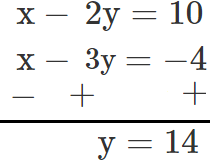
Let salim and his daughter's age be x and y yr respectively. Now. by first condition Two years ago, salim was thrics as old as his daughter. i.e., x - 2 = 3(y - 2) ⇒ x - 2 = 3y - 6 ⇒ x - 3y = -4 .....(i) and by second condition, six years later, Salim will be four years older than twice her age. x + 6 = 2(y + 6) + 4 ⇒ x + 6 = 2y + 12 + 4 ⇒ x - 2y = 16 - 6 ⇒ x - 2y = 10 .....(ii) On subtracting Eq. (i) from Eq. (ii), we get
Put the value of y in Eq. (ii), we get x - 2 × 14 = 10 ⇒ x = 10 + 28 ⇒ x = 38 Hence,salim and his daughter's are are 38 yr and 14 yr, respectively.
View full question & answer
Question 53 Marks
If 2x + y = 23 and 4x - y = 19, find the values of 5y - 2x and $\frac{\text{y}}{\text{x}}-2$.
Answer
Given equations are
2x + y = 23 .....(i)
and 4x - y = 19 .....(ii)
On adding both equations, we get
6x = 42 ⇒ x = 7
Put the value of x in Eq. (i), we get
2(7) + y = 23
⇒ 14 + y = 23
⇒ y = 23 -14
⇒ y = 9
We have, 5y - 2x = 5 × 9 - 2 × 7
= 45 - 14 = 31
and $\frac{\text{y}}{\text{x}}-2=\frac{4}{\text{x}}-2=\frac{9}{7}-2=\frac{9-14}{7}=-\frac{5}{7}$
Hence, the values of (5y - 2x) and $\Big(\frac{\text{y}}{\text{x}}-2\Big)$ are 31 and $\frac{-5}{7}$ respectively.
View full question & answer
Question 63 Marks
Solve the following pairs of equations:
$4\text{x}+\frac{6}{\text{y}}=15,6\text{x}-\frac{8}{\text{y}}=14,\text{y}\neq0$
Answer
Given pair of linear equations are
$4\text{x}+\frac{6}{\text{y}}=15\ .....(\text{i})$
and $6\text{x}-\frac{8}{\text{y}}=14$, $\text{y}\neq0 \ .....(\text{ii})$
Let $\text{u}=\frac{1}{\text{y}}$, then above equation becomes
4x + 6u = 15 .....(iii)
and 6x - 8u = 14 .....(iv)
On multiplying Eq. (iii) by 8 and Eq. (iv) by 6 and then adding both of them, we get
32x + 48u = 120
36x - 48u = 84 ⇒ 68x = 204
⇒ x = 3
Now, put the value of x in Eq. (iii), we get
4 × 3 + 6u = 15
⇒ 6u = 15 - 12 ⇒ 6u = 3
$\Rightarrow\ \text{u}=\frac{1}{2}\Rightarrow\frac{1}{\text{y}}=\frac{1}{2}\ \Big[\because\ \text{u}=\frac{1}{\text{y}}\Big]$
$\Rightarrow\ \text{y}=2$
Hence, the required values of x and y are 3 and 2, respectively.
View full question & answer
Question 73 Marks
A shopkeeper gives books on rent for reading. She takes a fixed charge for the first two days, and an additional charge for each day thereafter. Latika paid Rs. 22 for a book kept for six days, while Anand paid Rs. 16 for the book kept for four days. Find the fixed charges and the charge for each extra day.
Answer
Let Latika takes a fixed charge for the first two day is Rs. x and additional charge for each day thereafter is Rs. y.
Now by first condition.
Latika paid Rs. 22 for a book kept for six days i.e.,
x + 4y = 22 .....(i)
and by second condition
Anand paid Rs. 16 for a book kept for four days i.e.,
x + 2y = 16 .....(ii)
Now, subtracting Eq. (ii) from Eq. (i), we get
2y = 6 ⇒ y = 3
On putting the value of y in Eq. (ii), we get
x + 2 × 3 = 16
x = 16 - 6 = 10
Hence, the fixed charge = Rs. 10
and the charge for each extra day = Rs. 3
View full question & answer
Question 83 Marks
Find the value(s) of p in (i) to (iv) and p and q in (v) for the following pair of equations:
$-3x + 5y = 7$ and $2px - 3y = 1,$
if the lines represented by these equations are intersecting at a unique point.
Answer
Given pair of linear equations is
$-3x + 5y = 7 .....(i)$
and $2px - 3y = 1 .....(ii)$
On comparing with ax + by + c = 0, we get
$a_1 = -3, b_1 = 5$ and $c_1 = -7$ [from Eq. (i)]
$a_2 = 2p, b_2 = -3$, and $c_2 = -1$ [from Eq. (ii)]
Since, the lines are intersecting at a unique point i.e., it has a unique solution.
$\therefore\ \frac{\text{a}_1}{\text{a}_2}\neq\frac{\text{b}_1}{\text{b}_2}$
$\Rightarrow\ \frac{-3}{3\text{p}}\neq\frac{5}{-3}$
$\Rightarrow\ 9\neq10\text{p}$
$\Rightarrow\ \text{p}\neq\frac{9}{10}$
Hence, the lines represented by these equations are intersecting at a unique point for all real values of p except $\frac{9}{10}$.
View full question & answer
Question 93 Marks
Find the value(s) of p in (i) to (iv) and p and q in (v) for the following pair of equations:
$2x + 3y - 5 = 0$ and $px - 6y - 8 = 0,$
if the pair of equations has a unique solution.
Answer
Given pair of linear equations is
$2x + 3y - 5 = 0 .....(i)$
and $px - 6y - 8 = 0 .....(ii)$
On comparing with $a x+b y+c=0$, we get
$a_1=2, b_1=3$ and $c_1=-5[$ from Eq. (i)]
$a_2=p, b_2=-6$ and $c_2=-8$ [from Eq. (ii)]
Since, the pair of linear equations has a unique solution.
$\therefore\ \frac{\text{a}_1}{\text{a}_2}\neq\frac{\text{b}_1}{\text{b}_2}$
$\Rightarrow\ \frac{2}{\text{p}}\neq\frac{3}{-6}$
$\Rightarrow\ \text{p}\neq-4$
Hence, the pair of linear equations has a unique solution for all values of except -4 i.e.,
View full question & answer
Question 103 Marks
A person, rowing at the rate of 5km/hr in still water, takes thrice as much time in going 40km upstream as in going 40km downstream. Find the speed of the stream.
Answer
Let the speed of the stream be x km/hr.
And, the speed of the boat in still ware = 5km/hr
Speed of the boat upstream = (5 - x)km/hr
Speed pf the boat downstream = (5 + x)km/hr
Time taken in roeing 40km upstream $=\frac{40}{5-\text{x}}\text{hrs}$
Time taken in rowing 40km downstream $=\frac{40}{5+\text{x}}\text{hrs}$
Accoeding to the question, we have
Time taken in 40km upstream = 3 × Time taken in 40km downstream
$\therefore\ \frac{40}{5-\text{x}}=\frac{3\times40}{5+\text{x}}$
$\Rightarrow\ \frac{1}{5-\text{x}}=\frac{3}{5+\text{x}}$
$\Rightarrow\ -3\text{x}+15=\text{x}+5$
$\Rightarrow\ -3\text{x}-\text{x}=5-15$
$\Rightarrow\ -4\text{x}=-10$
$\Rightarrow\ \text{x}=\frac{10}{4}$
$\Rightarrow\ \text{x}=2.5\text{km/hr}$
Hence, the speed of stream is 2.5km/hr.
View full question & answer
Question 113 Marks
Find the solution of the pair of equations $\frac{\text{x}}{10}+\frac{\text{y}}{5}-1=0$ and $\frac{\text{x}}{8}+\frac{\text{y}}{6}=15$ Hence, find if $\text{y}=\lambda\text{x}+5$.
Answer
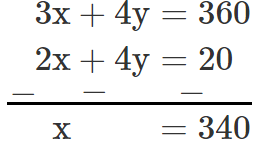
Given pair of equations is $\frac{\text{x}}{10}+\frac{\text{y}}{5}-1=0\ .....(\text{i})$ and $\frac{\text{x}}{8}+\frac{\text{y}}{6}=15\ .....(\text{ii})$ Now, multiplying both sides of Eq. (i) by LCM (10, 5) = 10, we ger x + 2y - 10 = 0 ⇒ x + 2y = 10 .....(iii) Again, multiplying both sides of Eq. (v) by LCM (8, 6) = 24 we get 3x + 4y = 360 .....(iv) On multiplying Eq. (iii) by 2 then subtracting from Eq. (iv), we get
Put the value of x in Eq. (iii), we get 340 + 2y = 10 ⇒ 2y = 10 - 340 = -330 ⇒ y = -165 Given that,the linear ralation between x, y and $\lambda$ is $\text{y}=\lambda\text{x}+5$ Now, put the values of x and y in above relation, we get $-165=\lambda(340)+5$ $\Rightarrow\ 340\lambda=-170$ $\Rightarrow\ \lambda=-\frac{1}{2}$ Hence, the solution of the pair of equations is x = 340, y = -165 and the required value of $\lambda$ is $-\frac{1}{2}$.
View full question & answer
Question 123 Marks
If $x + 1$ is a factor of $2x^3 + ax^2 + 2bx + 1$, then find the values of a and b given that $2a - 3b = 4$
Answer
ven that, $(x+1)$ is a factor of $f(x)=2 x^5+a x^2+2 b x+1$, then $f(-1)=0$. [if $(x+a)$ is a factor of $f(x)=a x^2+b x+c$, then $f (-)=0]$
$\Rightarrow 2(-1)^3 + a(-1)^2 + 2b(-1) + 1 = 0$
$\Rightarrow -2 + a - 2b + 1 = 0$
$\Rightarrow a - 2b - 1 = 0 .....(i)$
Also, $2a - 3b + 4$
$\Rightarrow 3b = 2a - 4$
$\Rightarrow\ \text{b}=\Big(\frac{2\text{a}-4}{3}\Big)$
now, put the value of b in Eq. (i), we get
$\text{a}-2\Big(\frac{2\text{a}-4}{3}\Big)-1=0$
$\Rightarrow 3a - 2(2a - 4) - 3 = 0$
$\Rightarrow 3a - 4a + 8 - 3 = 0$
$\Rightarrow -a + 5 = 0$
$\Rightarrow a = 5$
Now, put the value of a in Eq. (i), we get
$5 - 2b - 1 = 0$
$\Rightarrow 2b = 4$
$\Rightarrow b = 2$
Hence, the required values of a and b are 5 and 2, respectively.
View full question & answer
Question 133 Marks
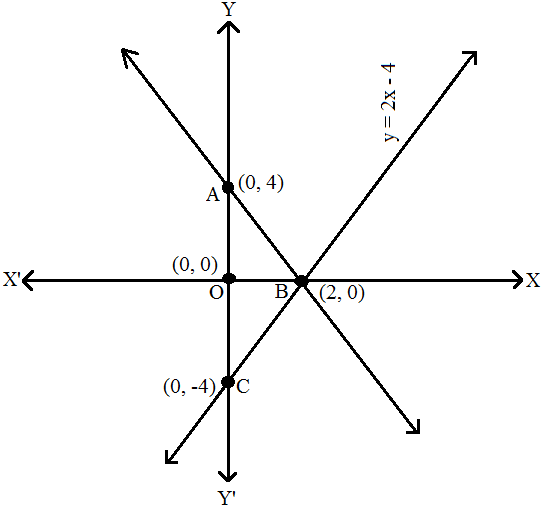
Draw the graph of the pair of equations 2x + y = 4 and 2x - y = 4. Write the vertices of the triangle formed by these lines and the y-axis. Also find the area of this triangle.
Answer
The given pair of linear equations Table for line 2x + y = 4,
x 0 2
y = 4 - 2x 4 0
Points A B
and table for line 2x - y = 4,
x 0 2
y = 2x - 4 -4 0
Points C B

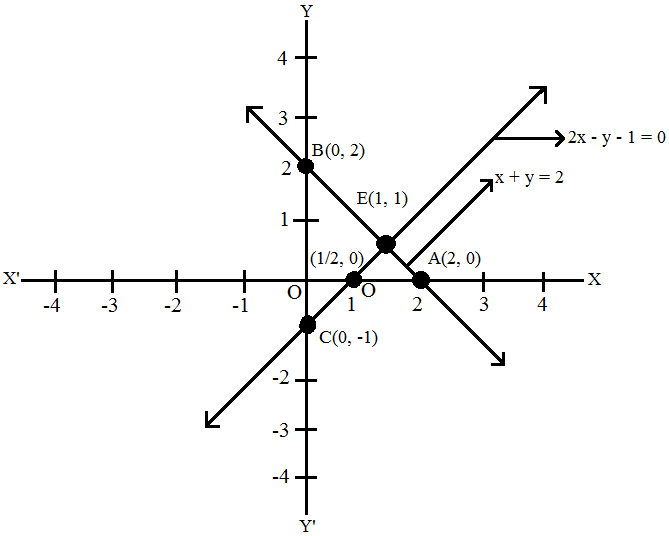
Graphical representation of both lines. Here, both lines and y-axis form a $\Delta\text{ABC}$ Hence, the vertices of a $\Delta\text{ABC}$ are a(0, 4) B(2, 0) and C(0, -4). $\therefore$ Required area of $\Delta\text{ABC}=3\times\text{area of }\Delta\text{ABC} $ $=2\times\frac{1}{2}\times4\times2=8\text{sq units}$ Hence, the required area of the triangle is 8sq units. If x = 0, then y = -1; if $\text{x}=\frac{1}{2}$; then y = 0 and if x = 1, then y = 1
x
0
$\frac{1}{2}$
1
y
-1
0
1
Points
C
D
E
View full question & answer
Question 143 Marks
A shopkeeper sells a saree at 8% profit and a sweater at 10% discount, thereby, getting a sum Rs. 1008. If she had sold the saree at 10% profit and the sweater at 8% discount, she would have got Rs. 1028. Find the cost price of the saree and the list price (price before discount) of the sweater.
Answer
Let the cost price of a saree = Rs. x and the list price of sweater = Rs. y Case I: (S.P. of saree at 8% profit) + (S.P. of a sweater at 10% discount) = Rs. 1008 $\Rightarrow\ \frac{(100+8)}{100}\text{x}+\frac{(100-10)}{100}\text{y}=1008$ $\Rightarrow\ 108\text{x}+90\text{y}=100800$ $\Rightarrow\ 6\text{x}+5\text{y}=5600\ .....(\text{i})$Case II:
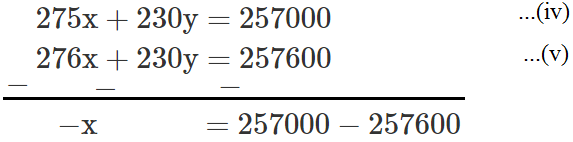
(S.P. of saree at 10% profit) + (S.P. of a sweater at 18% discount) = Rs. 1028 $\Rightarrow\ \frac{(100+10)}{100}\text{x}+\frac{(100-8)}{100}\text{y}=1028$ $\Rightarrow\ 110\text{x}+92\text{y}=102800\ .....(\text{i})$ Dividing (ii) by 2, we have 55x + 46y = 51400 .....(iii) Again, multiplying (iii) by 5, we get 275x + 230y = 257600 .....(iv) Multiplying (i) by 46, we get 276x + 230y = 257600 .....(v) Subtracting (v) from (iv), we ger ⇒ -x = -600 ⇒ x = 600 Now, 6x + 5y = 5600 [from (i)] ⇒ 6 × 600 + 5y = 5600 [$\because$ x = 600] ⇒ 5y = 5600 - 3600 $\Rightarrow\ =\frac{2000}{5}$ ⇒ y = 400 Hence, the C.P. of a saree and L.P. of sewater are Rs. 600, Rs. 400 respectively.
View full question & answer
Question 153 Marks
The cost of 4 pens and 4 pencil boxes is Rs. 100. Three times the cost of a pen is Rs. 15 more than the cost of a pencil box. Form the pair of linear equations for the above situation. Find the cost of a pen and a pencil box.
Answer
Let the cost of a pen = Rs. x
Let the of a pancil box = Rs. y
$\therefore$ The cost of 4 pens and 4 pencil boxes = Rs 100 [Given]
According to the second condition, we have
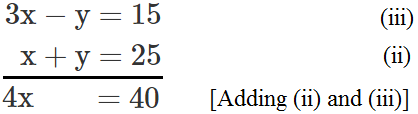
3x = y + 15

$\Rightarrow\ \text{x}=\frac{40}{4}=10$
Now, x + y = 25 [from (ii)]
⇒ 10 + y = 25 [$\because$ x = 10]
⇒ y = 25 - 10 = Rs. 15
So, x = Rs. 10 and y = Rs. 15
Hence, the cost of a pen and a pencil box are Rs. 10 and Rs. 15 respectively.
View full question & answer