Questions

3 Marks Question

Take a timed test

12 questions · self-marked practice — reveal the answer and mark yourself.

Question 13 Marks
A box contains 5 red marbles, 8 white marbles and 4 green marbles. One marble is taken out of the box at random. What is the probability that the marble taken out will be
  1. red ?
  2. white ?
  3. not green ?
Answer
Total number of marbles in the box = 5 + 8 + 4 = 17
$\therefore$Total number of elementary events = 17

$Proabibilty\;of\;the\;event=\frac{Number\;of\;favourble\;outcomes}{Total\;number\;of\;possible\;outcomes}$

  1. There are 5 red marbles in the box.
    $\therefore$Favourable number of elementary events = 5
    $\therefore$P (getting a red marble) = $\frac5{17}$
  2. There are 8 white marbles in the box.
    $\therefore$Favourable number of elementary events = 8
    $\therefore$P (getting a white marble) = $\frac8{17}$
  3. There are 5 + 8 = 13 marbles in the box, which are not green.
    $\therefore$Favourable number of elementary events = 13
    $\therefore$P (not getting a green marble) = $\frac{13}{17}$
View full question & answer
Question 23 Marks
It is given that in a group of 3 students, the probability of 2 students not having the same birthday is 0.992. What is the probability that the 2 students have the same birthday?
Answer
  1. The probability that she takes out an orange flavoured candy is 0 because the bag contains lemon flavoured candies only.
  2. Probability that she takes out a lemon flavoured candy is 1 because the bag contains lemon flavoured candies only.
View full question & answer
Question 33 Marks
Why is tossing a coin considered to be a fair way of deciding which team should get the ball at the beginning of a football game?
Answer
It is an equally likely event because in the given experiment, “A baby is born, It is a boy or a girl, we know that there are only two possible outcomes – either a boy or a girl.
View full question & answer
Question 43 Marks
A box contains 90 discs which are numbered from 1 to 90. If one disc is drawn at random from the box, find the probability that it bears
  1. a two-digit number
  2. a perfect square number
  3. a number divisible by 5.
Answer
Total number of favourable outcomes = 90

$Probability\;of\;the\;event=\frac{Number\;of\;favourble\;outcomes}{Total\;number\;of\;possible\;outcomes}$

  1. Number of two-digit numbers from 1 to 90 are 90 - 9 = 81
    $\therefore$Favourable outcomes = 81
    Hence, P (getting a disc bearing a two-digit number) = $\frac{81}{90}=\frac9{10}$
  2. From 1 to 90, the perfect squares are 1, 4, 9, 16, 25, 36, 49, 64 and 81.
    $\therefore$Favourable outcomes = 9
    Hence P (getting a perfect square) = $\frac9{90}=\frac1{10}$
  3. The numbers divisible by 5 from 1 to 90 are 18.
    $\therefore$Favourable outcomes = 18
    Hence P (getting a number divisible by 5) = $\frac{18}{90}=\frac15$
View full question & answer
Question 53 Marks
A die is thrown once. Find the probability of getting
  1. a prime number;
  2. a number lying between 2 and 6
  3. an odd number.
Answer
Number of all possible outcome (1, 2, 3, 4, 5, 6) = 6
  1. Let E be the event of getting a prime number. Then, the outcomes favourable to E are 2, 3 and 5.
    Therefore, the number outcomes favourable to E is 3.
    So, $\mathrm { P } ( \mathrm { E } ) = \frac { \text { Number of outcomes favourable to } \mathrm { E } } { \text { Number of all possible outcomes } } = \frac { 3 } { 6 } = \frac { 1 } { 2 }$
  2. Let E be the event of getting a number lying between 2 and 6.
    Then, the outcomes favourable to E are 3, 4, and 5. Therefore, the number of outcomes favourable to E is 3.
    So, $\mathrm { P } ( \mathrm { E } ) = \frac { \mathrm { Number~of~outcomes } \text { favourable to } \mathrm { E } } { \text { Number of all possible outcomes } } = \frac { 3 } { 6 } = \frac { 1 } { 2 }$
  3. Let E be the event getting an odd number.
    Then, the outcomes favourable to E are 1, 3, and 5. Therefore, the number of outcomes favourable to E is 3.
    So, $\mathrm { P } ( \mathrm { E } ) = \frac { \text { Number of outcomes favourable to } \mathrm { E } } { \text { Number of all possible outcomes } } = \frac { 3 } { 6 } = \frac { 1 } { 2 }$
View full question & answer
Question 63 Marks
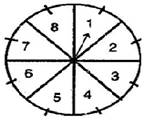
A game of chance consists of spinning an arrow which comes to rest pointing at one of the numbers 1, 2, 3, 4, 5, 6, 7, 8 (see figure) and these are equally likely outcomes. What is the probability that it will point at:

  1. 8?
  2. an odd number?
  3. a number greater than 2?
  4. a number less than 9?
Answer
Out of 8 numbers, an arrow can point any of the numbers in 8 ways.
$\therefore$Total number of outcomes = 8
$Proabibilty\;of\;the\;event=\frac{Number\;of\;favourble\;outcomes}{Total\;number\;of\;possible\;outcomes}$
  1. Favourable number of outcomes = 1
    Hence, P (arrow points at 8) = $\frac18$
  2. Favourable number of outcomes = 4
    Hence, P (arrow points at an odd number) = $\frac48=\frac12$
  3. Favourable number of outcomes = 6
    Hence, P (arrow points at a number greater than 2) = $\frac68=\frac34$
  4. Favourable number of outcomes = 8
    Hence, P (arrow points at a number less than 9) = $\frac88=1$
View full question & answer
Question 73 Marks
A piggy bank contains hundred 50 p coins, fifty ₹ 1 coins, twenty ₹ 2 coins and ten ₹ 5 coins. If it is equally likely that one of the coins will fall out when the bank is turned upside down, what is the probability that the coin
  1. will be a 50 p coin?
  2. will not be a ₹ 5 coin?
Answer
Number 50 p coins in the piggy bank = 100
Number of Re. 1 coins in the piggy bank = 50
Number of Rs. 2 coins in the piggy bank = 20
Number of Rs. 5 coins in the piggy bank = 10
∴ Total number of coins in the piggy bank = 100 + 50 + 20 -10 = 180
∴ Number of all possible outcomes = 180
  1. Number of favourable outcomes to the event that the coin will be a 50 p coin = 100
    ∴ Probability that the coin will be a 50 p coin
    $\frac{Number\;of\;favourable\;outcomes\;to\;the\;event\;that\;the\;coin\;will\;be\;a\;50\;p\;coin}{\;Number\;of\;all\;possible\;outcomes}$ $\frac{100}{180}=\frac59$
  2. Number of favourable outcomes to the event that the coin will not be a Rs. 5 coin
    = 100 + 50 + 20 = 170
    ∴ Probability that the coin will not be Rs. 5 coin
    $\frac{Total \ no.\;of\;favourable\;outcomes}{Total\;number\;of\;possible\;outcomes}$ $\frac{170}{180}=\frac{17}{18}$
View full question & answer
Question 83 Marks
Harpreet tosses two different coins simultaneously (say, one is of ₹ 1 and other of ₹ 2). What is the probability that he gets at least one head?
Answer
If we suppose , H for 'head' and T for 'tail'. When two coins are tossed simultaneously, the possible outcomes are (H,H),(H,T),(T,H),(T,T), which are all equally likely. Here (Rs.2). Similarly (H,T) means head up on the first coin (say on Rs1) and head up on the second coin and so on.
The outcomes favourable to the event E, 'at least one head' are (H, H),(H, T) and (T, H).
So, the number of outcomes favourable to E is 3.
Therefore, P(E) = $\frac{3}{4}$
i.e, the probability that Harpreet gets at least one head is $\frac{3}{4}$.
Note you can also find P(E) as follows:
P(E) = 1 - $P ( \overline { E } )$ = 1 - $\frac{1}{4}$= $\frac{3}{4}$ (Since $P ( \overline { E } )$ = P(no head) = $\frac{1}{4}$
View full question & answer
Question 93 Marks
A box contains 3 blue, 2 white, and 4 red marbles. If a marble is drawn at random from the box, what is the probability that it will be
  1. white?
  2. blue?
  3. red?
Answer
Total no. of possible outcomes = 3+2+4 = 9
No. of favourable outcomes for white marbles = 2

$Proabibilty\;of\;the\;event=\frac{Number\;of\;favourble\;outcomes}{Total\;number\;of\;possible\;outcomes}$
Required probability

P(white marbles) = $\frac29$
No. of favourable outcomes for blue marbles = 3
Required probability

P(Blue marbles) = $\frac39=\frac13$
No. of favourable outcomes for red marbles = 4
Required probability

P(red marbles) = $\frac49$

View full question & answer
Question 103 Marks
A bag contains a red ball, a blue ball and a yellow ball, all the balls being of the same size. Kritika takes out a ball from the bag without looking into it. What is the probability that she takes out the
  1. yellow ball?
  2. red ball?
  3. blue ball?
Answer
Kritika takes out a ball from the bag without looking into it. So, it is equally likely that she takes out any one of them.
Let Y be the event that ‘the ball taken out is yellow’, B be the event that ‘the ball taken out is blue’ and R be the event that ‘the ball taken out is red’.
Now, the number of possible outcomes = 3.
  1. The number of outcomes favourable to the event Y = 1.
    So, $P(Y)=\frac{1}{3}$
    Similarly,
  2. $P(R)=\frac{1}{3}$
  3. $P(B)=\frac{1}{3}$
View full question & answer
Question 113 Marks
Two dice, one blue and one grey are thrown at the same time. Write down all the possible outcomes. What is the probability that the sum of the two numbers appearing on the top of the dice is
  1. 8?
  2. 13?
  3. less than or equal to 12?
Answer
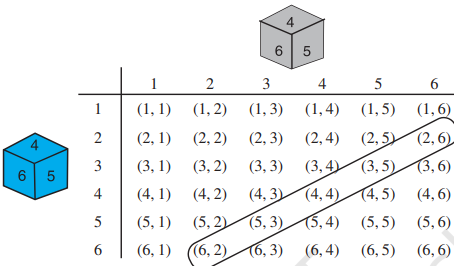
When the blue die shows ‘1’, the grey die could show any one of the numbers 1, 2, 3, 4, 5, 6. The same is true when the blue die shows ‘2’, ‘3’, ‘4’, ‘5’ or ‘6’. The possible outcomes of the experiment are listed in the table below; the first number in each ordered pair is the number appearing on the blue die and the second number is that on the grey die.

So, the number of possible outcomes = 6 × 6 = 36.
  1. The outcomes favourable to the event ‘the sum of the two numbers is 8’ denoted by E, are: (2, 6), (3, 5), (4, 4), (5, 3), (6, 2) (see Fig.)
    i.e., the number of outcomes favourable to E = 5.
    Hence, P(E) = $\frac{5}{36}$
  2. As you can see from Fig., there is no outcome favourable to the event F, ‘the sum of two numbers is 13’.
    So, $P(F) = \frac{0}{36} = 0$
  3. As you can see from Fig., all the outcomes are favourable to the event G, ‘sum of two numbers ≤ 12’.
    So, P(G) = $\frac{36}{36}=1$
View full question & answer
Question 123 Marks
In a musical chair game, the person playing the music has been advised to stop playing the music at any time within 2 minutes after she starts playing. What is the probability that the music will stop within the first half-minute after starting?
Answer
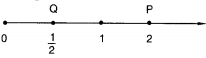
The possible outcomes are all the numbers between $0\ and\ 2$.
Suppose A be the event 'music is stopped within the first half minute'.
$\therefore$ Outcomes favourable to the event A are all points on the number line from O to Q i.e. from $0\ to\ \frac{1}{2}$

Total number of outcomes are the points on the number line from O to P i.e. from 0 to 2.
$\therefore$$P ( A ) = \frac { \text { Length } O Q } { \text { Length } O P } = \frac { 1 / 2 } { 2 } = \frac { 1 } { 4 }$
View full question & answer