Questions

5 Marks Questions

Take a timed test

25 questions · self-marked practice — reveal the answer and mark yourself.

Question 15 Marks
A piggy bank contains hundred 50 paise coins, fifity ₹1 coins, twenty ₹2 coins and ten ₹5 coins. If it is equally likely that one of the coins will fall out when the bank is turned upside down, find the probability that the coin which fell:
  1. Will be a 50 paise coin.
  2. Will be of value more than ₹1.
  3. Will be of value less than ₹5.
  4. Will be a ₹1 or ₹2 coin.
Answer
Total number of coins = 100 + 50 + 20 + 10 = 180
So, the total number of outcomes is 180.
  1. Number of 50 paise coins = 100
So, the favourable number of outcomes are 100.

$\therefore$ P(the coin which fell is a 50 paise coin)

$=\frac{\text{Favourable number of outcomes}}{\text{Total number of outcomes}}$

$=\frac{100}{180}=\frac{5}{9}$
  1. A coin of value more than 1 can be ₹2 or ₹5 coin.
Number of ₹2 or ₹5 coins = 20 + 10 = 30

So, the favourable number of outcomes are 30.

$\therefore$ P(the coin which fell has value more than ₹1)

$=\frac{\text{Favourable number of outcomes}}{\text{Total number of outcomes}}$

$=\frac{30}{180}=\frac{1}{6}$
  1. A coin of value less than 5 can be 50 paise or ₹1 or ₹2 coin.
Number of 50 paise or ₹1 or ₹2 coins = 100 + 50 + 20 = 170

So, the favourable number of outcomes are 170.

$\therefore$ P(the coin which fell has value less than ₹5)

$=\frac{\text{Favourable number of outcomes}}{\text{Total number of outcomes}}$

$=\frac{170}{180}=\frac{17}{18}$
  1. Number of ₹1 or ₹2 coins = 50 + 20 = 70
So, the favourable number of outcomes are 70.

$\therefore$ P(the coin which fell will be a ₹1 of ₹2 coin)

$=\frac{\text{Favourable number of outcomes}}{\text{Total number of outcomes}}$

$=\frac{70}{180}=\frac{7}{18}$
View full question & answer
Question 25 Marks
Cards numbered 1 to 30 are put in a bag. A card is drawn at random from this bag. Find the probability that the number on the drawn card is:
  1. Not divisible by 3.
  2. A prime number great than 7.
  3. Not a perfect square number.
Answer
No of total cards = 30
  1. Not divisible by 3, are
1, 2, 4, 5, 7, 8, 10, 11, 13, 14, 16, 17, 19, 20, 22, 23, 25, 26, 28, 29

$\therefore$ Total = 20

$\therefore\ \text{Probability P(E)}=\frac{20}{30}=\frac{2}{3}$
  1. A prime number greater than 7 are
11, 13, 17, 19, 23, 29 = 6

$\therefore\ \text{Probability P(E)}=\frac{6}{30}=\frac{1}{5}$
  1. Not a perfect square,
Numbers are, 2, 3, 5, 6, 7, 8, 10, 11, 12, 13, 14, 15, 17, 18, 19, 20, 21, 22, 23, 24, 23, 27, 28, 29, 30, = 25

$\therefore\ \text{Probability P(E)}=\frac{25}{30}=\frac{5}{6}$
View full question & answer
Question 35 Marks
Cards marked with numbers 13, 14, 15, ....., 60 are placed in a box and mixed thoroughly. One card is drawn at random from the box. Find the probability that number on the card drawn is:
  1. Divisible by 5.
  2. A number is a perfect square.
Answer
Given: Cards are marked with numbers 13 to 60 are placed in a box and mixed thoroughly. If one card is drawn at random from the box
To Find: Probability that it bears
  • A number divisible by 5
  • A perfect square
Total number of cards is 60 - 13 + 1 = 48
  1. Cards marked with a number divisible by 5 are
15, 20, 25, 30, 35, 40, 45, 50, 55 and 60

Total numbers of cards marked numbers divisible by 5 from 13 to 60 is 10

We know that $\text{Probability}=\frac{\text{Number of favourable event}}{\text{Total number of event}}$

Hence probability of getting card marked with numbers divisible by 5 from 13 to 60 is $\frac{10}{48}=\frac{5}{24}$
  1. Cards marked a perfect squared numbers are 16, 25, 36 and 49
Total number of disc marked with perfect square from 13 to 60 is 4

We know that $\text{Probability}=\frac{\text{Number of favourable event}}{\text{Total number of event}}$

Hence probability of getting disc marked with perfect square numbers from 13 to 60 is $\frac{4}{48}=\frac{1}{12}$
View full question & answer
Question 45 Marks
A bag contains 6 red balls and some blue balls. if the probability of a drawing a blue ball from the bag is twice that of a red ball, find the number of blue balls in the bag.
Answer
Given: A bag contains 6 red balls and some blue balls. If the probability of drawing a blue ball from the bag is twice that of a red ball,
To Find: the number of blue balls in the bag.
Let the probability of getting a red ball be P(E) = x
The probability of not getting a red ball or getting a blue ball be $\text{P}(\bar{\text{E}})=2\text{x}$
We know that sum of probability of occurrence of an event and probability of non occurrence of an event is. So
$\text{P(E)}+\text{P}(\bar{\text{E}})=1$
$\text{x}+2\text{x}=1$
$3\text{x}=1$
$\text{x}=\frac{1}{3}$
Hence the probability of getting a red ball is $\frac{1}{3}$
We know that $\text{Probability}=\frac{\text{Number of favourable event}}{\text{Total number of event}}$
$\frac{1}{3}=\frac{6}{\text{Total number of balls}}$
⇒ Total number of balls = 18 balls
Hence total number of blue balls = total number of balls - red balls
= 18 - 6
= 12 balls
Hence total number of blue balls is 12 balls.
View full question & answer
Question 55 Marks
All the black face cards are removed from a pack of 52 cards. The remaining cards are well shuffled and then a card is drawn at random. Find the probability to getting a:
  1. Face card.
  2. Red card.
  3. Black card.
  4. King.
Answer
After removing the black face cards, total number of remaining cards = 52 - 6 = 46
  1. Probability of one face card $=\frac{6}{46}=\frac{3}{23}$
  2. Probability of red card $=\frac{26}{46}=\frac{13}{23}$
  3. Probability of black card $=\frac{26-6}{46}=\frac{20}{46}=\frac{10}{13}$
  4. Probability of a king $=\frac{2}{46}=\frac{1}{23}$
View full question & answer
Question 65 Marks
A bag contains 3 red balls, 5 black balls and 4 white balls. A ball is drawn at random from the bag. What is the probability that the ball drawn is:
  1. White.
  2. Red.
  3. Black.
  4. Not red.
Answer
Given: A bag contains 3 red, 5 black and 4 white balls
To Find: Probability of getting a
  • White ball
  • Red ball
  • Black ball
  • Not red ball
Total number of balls 3 + 5 + 4 = 12
  1. Total number white balls is 4
We know that $\text{Probability}=\frac{\text{Number of favourable event}}{\text{Total number of event}}$

Hence probability of getting white ball $=\frac{4}{12}=\frac{1}{3}$
  1. Total number red balls are 3
We know that $\text{Probability}=\frac{\text{Number of favourable event}}{\text{Total number of event}}$

Hence probability of getting red ball is $\frac{3}{12}=\frac{1}{4}$
  1. Total number of black balls is 5
We know that $\text{Probability}=\frac{\text{Number of favourable event}}{\text{Total number of event}}$

Hence probability of getting black ball $=\frac{5}{12}$
  1. Total number of non red balls are 4 white balls and 5 black balls i.e., 4 + 5 = 9
We know that $\text{Probability}=\frac{\text{Number of favourable event}}{\text{Total number of event}}$

Hence probability of getting non red ball $\frac{9}{12}=\frac{3}{4}$
View full question & answer
Question 75 Marks
Cards numbered from 11 to 60 are kept in a box. If a card is drawn at random from the box, find the probability that the number on the drawn card is:
  1. An odd number.
  2. A perfect square number.
  3. Divisible by 5.
  4. A prime number less than 20.
Answer
The cards are numbered from 11 to 60.$\therefore$ Total number of outcomes = 60 - 10 = 50
The odd numbers from 11 to 60 are 11, 13, 15, ....., 59.
The numbers 11, 13, 15, ....., 59 are in AP.
Here, a = 11 and d = 2.
Suppose there are n terms in the AP.
$\therefore$ $a_n = 59$
$\Rightarrow 11 + (n - 1) \times 2 = 59 [an = a + (n - 1)d]$
$\Rightarrow 2n + 9 = 59$
$\Rightarrow 2n = 59 - 9 = 50$
$\Rightarrow n = 25$
So the favourable number of outcomes are 25.
$\therefore$ P(number on the drawn card is odd)
$=\frac{\text{Favourable number of outcomes}}{\text{Total number of outcomes}}$
$=\frac{25}{50}=\frac{1}{2}$
The perfect square numbers from 11 to 60 are 16, 25, 36 and 49.
So, the favourable number of outcomes are 4.
$\therefore$ P(number on the drawn card is a perfect square)
$=\frac{\text{Favourable number of outcomes}}{\text{Total number of outcomes}}$
$=\frac{4}{50}=\frac{2}{25}$
The numbers from 11 to 60 divisible by 5 are 15, 20, 25, 30, 35, 40, 45, 50, 55 and 60.
So, the favourable number of outcomes are 10.
$\therefore$ P(number on the drawn card is divisible by 5)
$=\frac{\text{Favourable number of outcomes}}{\text{Total number of outcomes}}$
$=\frac{10}{50}=\frac{1}{5}$
Prime number less than 20 from 11 to 60 are 11, 13, 17 and 19.
So, the favourable number if outcomes are 4.
$\therefore$ P(number on the drawn card is a prime number less than 20)
$=\frac{\text{Favourable number of outcomes}}{\text{Total number of outcomes}}$
$=\frac{4}{50}=\frac{2}{25}$
View full question & answer
Question 85 Marks
A bag contains 3 red balls and 5 black balls. A ball is draw at random from the bag. What is the probability that the ball drawn is:
  1. Red?
  2. Not red?
Answer
Given: A bag contains 3 red and 5 black balls and a ball is drawn at random from the bag.
To Find: Probability of getting a
  • Red ball
  • Not red ball
Total number of balls 3 + 5 = 8
  1. Total number red balls are 3
We know that $\text{Probability}=\frac{\text{Number of favourable event}}{\text{Total number of event}}$

Hence probability of getting red ball is $=\frac{3}{8}$
  1. Probability of getting red ball $\text{P(E)}=\frac{3}{8}$
We know that sum of probability of occurrence of an event and probability of non occurrence of an event is 1.

$\text{P(E)}+\text{P}(\bar{\text{E}})=1$

$\frac{3}{8}+\text{P}(\bar{\text{E}})=1$

$\text{P}(\bar{\text{E}})=1-\frac{3}{8}$

$\text{P}(\bar{\text{E}})=\frac{8-3}{8}=\frac{5}{8}$

Hence the probability of getting not red ball $\text{P}(\bar{\text{E}})=\frac{5}{8}$
View full question & answer
Question 95 Marks
A bag contains cards numbered from 1 to 49. A card is drawn from the bag at random, after mixing the card thoroughly. Find the probability that the number on the drawn card is:
  1. An odd number.
  2. A multiple of 5.
  3. A perfect square.
  4. An even prime number.
Answer
Number of cards bearing numbers 1 to 49 = 49
  1. No. of odd number = 25
(1, 3, 5, 7, ....., 49)

$\therefore\ \text{Probability}=\frac{25}{49}$
  1. Multiples of 5 are 5, 10, 15, 20, 25, 30, 35, 40, 45 = 9
$\therefore\ \text{Probability}=\frac{9}{49}$
  1. Perfect squares are 1, 4, 9, 16, 25, 36, 49 = 7
$\therefore\ \text{Probability}=\frac{7}{49}=\frac{1}{7}$
  1. Even number are 2, 4, 6, 8, 10, ....., 48 = 24
$\therefore\ \text{Probability}=\frac{24}{49}$
View full question & answer
Question 105 Marks
Two dice, one blue and one grey, are thrown at the same time. Complete the following table:
Event 'Sum on two dice' 2 3 4 5 6 7 8 9 10 11 12
Probability                      
From the above table a student argues that there are 11 possible outcomes 2, 3, 4, 5, 6, 7, 8, 9, 10, 11 and 12. Therefore, each of them has a probability $\frac{1}{11}$. Do you agree with this argument?
Answer
Two dice (one blue and one green) are thrown at the same time
$\therefore$ Total number of outcomes (n) = 6 × 6 = 36
When sum of two dise = 2, then these will be (1, 1) = 1
When sum is 3, then (1, 2) (2, 1) = 2
When sum is 4, then (1, 3), (2, 2), (3, 1) = 3
When sum is 5, then (1, 4), (2, 3), (3, 2), (4, 1) = 4
When sum is 6, then (1, 5), (2, 4), (3, 3), (4, 2), (5, 1) = 5
When sum is 7, then (1, 6), (2, 5), (3, 4), (4, 3), (5, 2), (6, 1) = 6
When sum is 8, then (2, 6), (3, 5), (4, 4), (5, 3), (6, 2) = 5
When sum is 9, then (3, 6), (4, 5), (5, 4), (6, 2) = 4
When sum is 10, then (4, 6), (5, 5), (6, 4) = 3
When sum is 11, then (5, 6), (6, 5) = 2
When sum is 12, then (6, 6) = 1
Now we will complete the given table as below
Event' Sum on two dice' 2 3 4 5 6 7 8 9 10 11 12
Probability $\frac{1}{36}$ $\frac{2}{36}$ $\frac{3}{36}$ $\frac{4}{36}$ $\frac{5}{36}$ $\frac{6}{36}$ $\frac{5}{36}$ $\frac{4}{36}$ $\frac{3}{36}$ $\frac{2}{36}$ $\frac{1}{36}$
No, the outcomes are not equally likely.
View full question & answer
Question 115 Marks
A bag contains 5 red, 8 white and 7 black balls. A ball is drawn at random form the bag. Find the probability that the drawn ball is:
  1. Red or white.
  2. Not black.
  3. Neither white nor black.
Answer
Total no. of possible outcomes = 20 {5 Red, 8 White & 7 Black}
  1. E ⟶ event of drawing red or white ball
No. of favourable outcomes = 13 {5 Red, 8 White}

Probability, $\text{P(E)}=\frac{\text{No. of favorable outcomes}}{\text{Total no. of possible outcomes}}$

$\text{P(E)}=\frac{13}{20}$
  1. Let E ⟶ be event of getting black ball
No. of favourable outcomes = 13 {5 Red, 8 White}

$\text{P(E)}=\frac{7}{20}$

$(\bar{\text{E}})\rightarrow$ event of not getting black ball

$\text{P}(\bar{\text{E}})=1-\text{P(E)}$

$=1-\frac{7}{20}=\frac{13}{20}$
  1. Let E ⟶ be event of getting neither white nor black ball
No. of favourable outcomes = 20 - 8 - 7 = 5 {total balls - no. of white balls - no. of black balls}

$\text{P(E)}=\frac{5}{20}=\frac{1}{4}$
View full question & answer
Question 125 Marks
A box contains cards numbered 3, 5, 7, 9, ....., 35, 37. A card is drawn at random form the box. Find the probability that the number on the drawn card is a prime number.
Answer
The numbers 3, 5, 7, 9, ....., 35, 37 are in AP.
Here,
a = 3 and d = 5 - 3 = 2
Suppose there are n terms in the AP.
$\therefore$ $a_n = 37$
$\Rightarrow 3 + (n - 1) \times 2 = 37 [a_n = a + (n - 1)d]$
$\Rightarrow 2n + 1 = 37$
$\Rightarrow 2n = 37 - 1 = 36$
$\Rightarrow n = 18$
$\therefore$ Total number of outcomes = 18
Let E be the event of drawing a card with prime number on it.
Out of the given numbers, the prime numbers are 3, 5, 7, 11, 13, 17, 19, 23, 29, 31 and 37.
So, the favourable number of outcomes are 11.
$\therefore$ Required Probability
$\text{P(E)}=\frac{\text{Favoutable number of outcomes}}{\text{Total number of outcomes}}=\frac{11}{18}$
View full question & answer
Question 135 Marks
A box contains 100 red cards, 200 yellow cards and 50 blue cards. If a card is drawn at random from the box, then find the probability that it will be:
  1. A blue card.
  2. Not a yellow card.
  3. Neither yellow nor a blue card.
Answer
No. of red cards = 100
No. of yellow cards = 200
No. ofnlue cards = 50
$\therefore$ Total number of cards = 100 + 200 + 50 = 350
One card is drawn at random
  1. $\therefore$ Probability of blue card $P_{(E)}$
$=\frac{\text{Total number of blue cards}}{\text{No. of total cards}}$

$=\frac{50}{350}=\frac{1}{7}$
  1. Numbers of cards which is not a yellow = 350 - 200 = 150
$\therefore\ \text{Probability P}_\text{(E)}=\frac{150}{350}=\frac{3}{7}$
  1. Number of cards which are neither yellow nor blue = 350 - (200 + 50)
= 350 - 250 = 100

$\therefore\ \text{Probability P}_\text{(E)}=\frac{100}{350}=\frac{2}{7}$
View full question & answer
Question 145 Marks
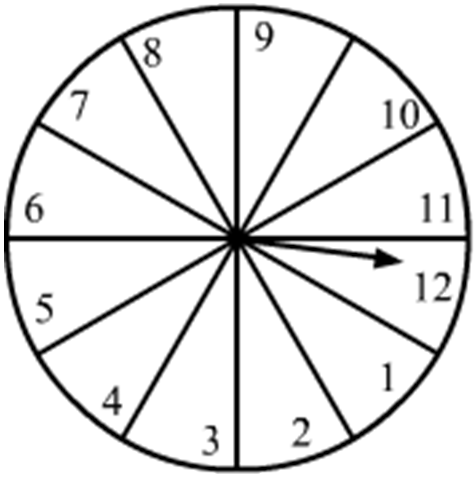
A game of chance consists of spinning an arrow which is equally likely to come to rest pointing to one of the number 1, 2, 3, ....., 12 as shown in following figure. What is the probability that it will point to:
  1. 10?
  2. An odd number?
  3. A number which is multiple of 3?
  4. An even number?
Answer
Given: A game of chance consists of spinning an arrow which is equally likely to come to rest pointing number 1, 2, 3…..12.
To Find: Probability of following
Total number on the spin is 12
  1. Favorable event i.e. to get 10 is 1
Total number of Favorable event i.e. to get 10 is 1

We know that $\text{Probability}=\frac{\text{Number of favourable event}}{\text{Total number of event}}$

Hence probability of getting a10 $=\frac{1}{12}$
  1. Favorable event i.e. to get an odd number are 1, 3, 5, 7, 9, 11.
Total number of Favorable event i.e. to get a prime number is 6

We know that $\text{Probability}=\frac{\text{Number of favourable event}}{\text{Total number of event}}$

Hence probability of getting a prime number is $\frac{6}{12}=\frac{1}{2}$
  1. Favorable event i.e. to get an multiple of 3 are 3, 6, 9, 12
Total number of Favorable event i.e. to get a multiple of 3 is 4

We know that $\text{Probability}=\frac{\text{Number of favourable event}}{\text{Total number of event}}$

Hence probability of getting multiple of 3 $\frac{4}{12}=\frac{1}{3}$
  1. Favorable event i.e. to get an even number are 2, 4, 6, 8, 10, 12
Total number of Favorable events i.e. to get an even number is 6

We know that $\text{Probability}=\frac{\text{Number of favourable event}}{\text{Total number of event}}$

Hence probability of getting an even number is $\frac{6}{12}=\frac{1}{2}$
View full question & answer
Question 155 Marks
A bag contains 4 red, 5 black and 6 white balls. A ball is drawn from the bag at random. Find the probability that the ball drawn is:
  1. White.
  2. Red.
  3. Not black.
  4. Red or white.
Answer
Total no. of possible outcomes = 15 {4 red, 5 black, 6 white balls}
  1. E ⟶ event of drawing white ball.
No. of favourable outcomes = 6 {6 white}

Probability, $\text{P(E)}=\frac{\text{No. of favorable outcomes}}{\text{Total no. of possible outcomes}}$

$\text{P(E)}=\frac{6}{15}=\frac{2}{5}$
  1. E ⟶ event of drawing red ball
No. of favourable outcomes = 4 {4 red balls}

$\text{P(E)}=\frac{4}{15}$
  1. E ⟶ event of drawing black ball
No. of favourable outcomes = 5 {5 black balls}

$\text{P(E)}=\frac{5}{15}=\frac{1}{3}$

$\bar{\text{E}}\rightarrow$ enent of not drawing black ball

$\text{P}(\bar{\text{E}})=1-\frac{1}{3}=\frac{2}{3}$
  1. E ⟶ event of drawing red or white ball
No. of favourable outcomes = 10 {4 red & 6 white}

$\text{P(E)}=\frac{10}{15}=\frac{2}{3}$
View full question & answer
Question 165 Marks
From a pack of 52 playing cards Jacks, queens, Kings and aces of red colour are removed. From the remaining, a card is drawn at random. Find the probability that the card drawn is:
  1. A black queen.
  2. A red card.
  3. A black jack.
  4. A picture card (Jacks, queens and Kings are picture cards).
Answer
Given: The Kings, Queens, Aces and Jacks of red color are removed from a deck of 52 playing cards and the remaining cards are shuffled and a card is drawn at random from the remaining cards
To Find: Probability of getting a card of
  • A black queen
  • A red card
  • A black jack
  • A picture card
After removing the kings, queens, aces and the jacks of red color from the pack of 52 playing cards
Total number of cards left: 52 - 8 = 44
  1. Cards which are black queen is 2
We know that $\text{Probability}=\frac{\text{Number of favourable event}}{\text{Total number of event}}$

Hence probability of getting a black queen $=\frac{2}{44}=\frac{1}{22}$
  1. Cards which are red are from 2 suits
Total number of red cards is 13 × 2 = 26

From this the kings, queens, aces and jacks of red color are taken out.

Hence total number of red cards left is 26 - 8 = 18

We know that $\text{Probability}=\frac{\text{Number of favourable event}}{\text{Total number of event}}$

Hence probability of getting a red card is $\frac{18}{44}=\frac{9}{22}$
  1. Cards which are black jack are from 2 suits
    Total number of black jack is 2 × 1 = 2
We know that $\text{Probability}=\frac{\text{Number of favourable event}}{\text{Total number of event}}$

Hence probability of getting a black jack card $\frac{2}{44}=\frac{1}{22}$
  1. Cards which are picture cared are from 4 suits
Total number of picture cards is 4 × 3 = 12

From this the kings, queens, and jacks of red color are taken out.

Hence total number of picture card left is 12 - 6 = 6

We know that $\text{Probability}=\frac{\text{Number of favourable event}}{\text{Total number of event}}$

Hence probability of getting an picture card $=\frac{6}{44}=\frac{3}{22}$
View full question & answer
Question 175 Marks
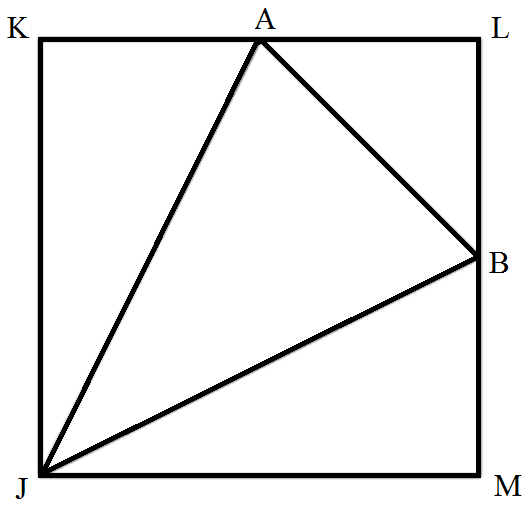
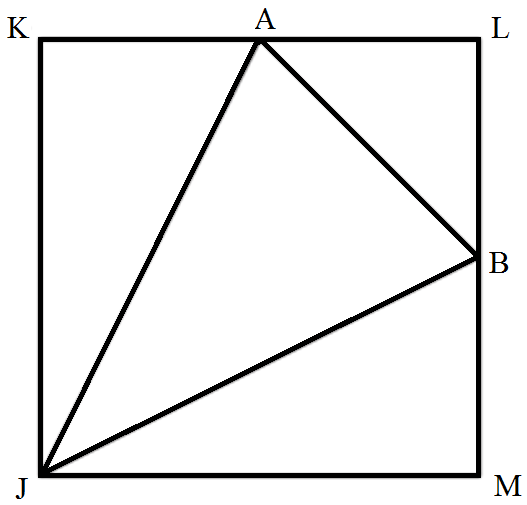
In the given figure, JKLM is a square with sides of length 6 units. Points A and B are the mid points of sides KL and LM respectively. If a point is selected at random from the interior of the square. What is the probability that the point will be chosen from the interior of $\triangle\text{JAB}.$
Answer
Given: JKLM is a square with sides of length 6 units. Points A and B are the midpoints of sides KL and ML respectively. If a point is selected at random from the interior of the square
To find: Probability that the point will be chosen from the interior of $\triangle\text{JAB}$.
We the following figure

Area of square JLKM is equal to
$= 6^2$
= 36 eq units
Now we have
ar $(\triangle\text{KAJ})=\frac{1}{2}\times\text{AK}\times\text{KJ}$
$=\frac{1}{2}\times3\times6$
$=9\text{ unit square}$
ar $(\triangle\text{JMB})=\frac{1}{2}\times\text{JM}\times\text{BM}$
$=\frac{1}{2}\times6\times3$
$=9\text{ units}^2$
ar $(\triangle\text{ALB})=\frac{1}{2}\times\text{AL}\times\text{BL}$
$=\frac{1}{2}\times3\times3$
$=\frac{9}{2}\text{ units}^2$
Now area of the triangle AJB
ar $(\triangle\text{AJB})=36-9-9-\frac{9}{2}$
$=\frac{27}{2}\text{ units}^2$
We know that $\text{Probability}=\frac{\text{Number of favourable event}}{\text{Total number of event}}$
$=\frac{\frac{27}{2}}{36}$
$=\frac{27}{2\times36}$
$=\frac{3}{8}$
Hence the Probability that the point will be chosen from the interior of $\triangle\text{AJB}$ is $\frac{3}{8}$
View full question & answer
Question 185 Marks
In a bag there are 44 identical cards with figure of circle or square on them. There are 24 circles, of which 9 are blue and rest are green and 20 squares of which 11 are blue and rest are green. One card is drawn from the bag at random. Find the probability that it has the figure of:
  1. Square.
  2. Green colour.
  3. Blue circle.
  4. Green.
Answer
There are 44 identical cards with figure of circle or square in the bag.
$\therefore$ Total number of outcomes = 44
  1. There are 20 squares on the cards.
So, the favourable number of outcomes is 20.

$\therefore$ P (card drawn has the figure of square)

$=\frac{\text{Favourable number of outcomes}}{\text{Total number of outcomes}}$

$=\frac{20}{44}=\frac{5}{11}$
  1. Number of cards with green circle = 24 - 9 = 15
Number of cards with green square = 20 - 11 = 9

$\therefore$ Number of cards with green colour figure = 15 + 9 = 24

So, the favourable number of outcomes is 24.

$\therefore$ P(card drawn has the figure of green colour)

$=\frac{\text{Favourable number of outcomes}}{\text{Total number of outcomes}}$

$=\frac{24}{44}=\frac{6}{11}$
  1. There are 9 cards with circle of blue colour.
So, the favourable number of outcomes is 9.

$\therefore$ P(card drawn has the figure of blue circle)

$=\frac{\text{Favourable number of outcomes}}{\text{Total number of outcomes}}=\frac{9}{44}$
  1. Number of cards with green square = 20 - 11 = 9
So, the favourable number of outcomes is 9.

$\therefore$ P(card drawn has the figure of green square)

$=\frac{\text{Favourable number of outcomes}}{\text{Total number of outcomes}}=\frac{9}{44}$
View full question & answer
Question 195 Marks
The king, queen and jack of clubs are removed from a deck of 52 playing cards and the remaining cards are shuffled. A card is drawn from the remaining cards. Find the probability of getting a card of:
  1. Heart.
  2. Queen.
  3. Clubs.
  4. A face card.
  5. A queen of diamond.
Answer
Total no. of cards = 52
Cards removed = 3
$\therefore$ Remaining cards = 52 - 3 = 49
  1. Total number of heart cards = 13
$\therefore\ \text{P(E)}=\frac{\text{No. of actual events}}{\text{No. of possible events}}=\frac{13}{49}$
  1. No of queen = 4 - 1 = 3
$\therefore\ \text{P(E)}=\frac{\text{No. of actual events}}{\text{No. of possible events}}=\frac{3}{49}$
  1. No. of club cards = 13 - 3 = 10
$\therefore\ \text{P(E)}=\frac{\text{No. of actual events}}{\text{No. of possible events}}=\frac{10}{49}$
  1. No. of face cards = 12 - 3 = 9
$\therefore\ \text{P(E)}=\frac{\text{No. of actual events}}{\text{No. of possible events}}=\frac{9}{49}$
  1. No. of queen of diamond = 2 - 1 = 1
$\therefore\ \text{P(E)}=\frac{\text{No. of actual events}}{\text{No. of possible events}}=\frac{1}{49}$
View full question & answer
Question 205 Marks
Red queens and black jacks are removed from a pack of 52 playing cards. A card is drawn at random from the remaining cards, after reshuffling them. Find the probability that the card drawn is:
  1. A king.
  2. Of red colour.
  3. A face card.
  4. A queen.
Answer
In a pack of 52 playing cards, there are 2 red queens and 2 black jacks.
Red queens and black jacks are removed from the pack. Then,
Number of remaining cards = 52 - 4 = 48
$\therefore$ Total number of outcomes = 48
  1. There are 4 king cards in the remaining pack of cards.
So, the favourable number of outcomes are 4.

$\therefore$ P(drawing a king)

$=\frac{\text{Favourable number of outcomes}}{\text{Total number of outcomes}}=\frac{4}{48}=\frac{1}{12}$
  1. Two red queens are removed from the pack of cards.
Number of red cards in the remaining pack of cards = 26 - 2 = 24

So, the favourable number of outcomes are 24.

$\therefore$ P(drawing a red card)

$=\frac{\text{Favourable number of outcomes}}{\text{Total number of outcomes}}=\frac{24}{48}=\frac{1}{2}$
  1. There are 12 face cards in the pack, out of which 2 red queens and 2 black jacks are removed.
Number of face cards in the remaining pack of cards = 12 - (2 + 2) = 8

So, the favourable number of outcomes are 8.

$\therefore$ P(drawing a face card)

$=\frac{\text{Favourable number of outcomes}}{\text{Total number of outcomes}}=\frac{8}{48}=\frac{1}{6}$
  1. There are 4 queen cards in the pack, out of which 2 red queens are removed.
Number of queens in the remaining pack of cards = 4 - 2 = 2

So, the favourable number of outcomes are 2.

$\therefore$ P(getting a queen)

$=\frac{\text{Favourable number of outcomes}}{\text{Total number of outcomes}}=\frac{2}{48}=\frac{1}{24}$
View full question & answer
Question 215 Marks
Find the probability that a number selected at random from the numbers 1, 2, 3, ....., 35 is a:
  1. Prime number.
  2. Multiple of 7.
  3. A multiple of 3 or 5.
Answer
Total no. of possible outcomes = 35 {1, 2, 3, ..... 35}
  1. E → event of getting a prime no.
No. of favourable outcomes = 11 {2, 3, 4, 7, 11, 13, 17, 19, 23, 29, 31}

Probability, $\text{P(E)}=\frac{\text{No. of favorable outcomes}}{\text{Total no. of possible outcomes}}=\frac{11}{35}$
  1. E → event of getting no. which is multiple of 7
No. of favourable outcomes = 5 {7, 14, 21, 28, 35}

$\text{P(E)}=\frac{5}{35}=\frac{1}{7}$
  1. E → event of getting no which is multiple of 3 or 5
No. of fanourable outcomes = 16 {3, 6, 9, 12, 15, 18, 21, 24, 27, 30, 33, 5, 10, 20, 25, 35}

$\text{P(E)}=\frac{16}{35}$
View full question & answer
Question 225 Marks
Two customers are visiting a particular shop in the same week (Monday to Saturday). Each is equally likely to visit the shop on any one day as on another. What is the probability that both will visit the shop on:
  1. The same day?
  2. Different days?
  3. Consecutive days?
Answer
Given: Two customers are visiting a particular shop in the same week (Monday to Saturday). Each is equally likely to visit the shop on any one day as on another.
To Find: Probability that both will visit the shop on:
  • The same day.
  • Different days.
  • Consecutive days
Two customers can visit the shop on two days in 6 × 6 = 36 ways.
Hence total number of ways = 36
  1. Two customer can visit the shop on any day of the week i.e.
MONDAY, TUESDAY, WEDNESDAY, THURSDAY, FRIDAY, SATURDAY

Favorable number of ways = 6

We know that $\text{Probability}=\frac{\text{Number of favourable event}}{\text{Total number of event}}$

Hence probability of the customer visiting the shop on the same day $=\frac{6}{36}=\frac{1}{6}$
  1. We know that sum of probability of occurrence of an event and probability of non occurrence of an event is 1.
$\text{P(E)}=\text{P}(\bar{\text{E}})=1$

$\frac{1}{6}+\text{P}(\bar{\text{E}})=1$

$\text{P}(\bar{\text{E}})=1-\frac{1}{6}$

Hence probability of the customer visiting the shop on the different day is $\frac{5}{6}$
  1. Two costumer can visit the shop in two consecutive days in the following ways:
(MONDAY, TUESDAY), (WEDNESDAY, THURSDAY), (THURSDAY, FRIDAY) (FRIDAY, SATURDAY)

Favorable number of ways =5

We know that $\text{Probability}=\frac{\text{Number of favourable event}}{\text{Total number of event}}$

Hence probability of the customer visiting the shop on two consecutive days $=\frac{5}{36}$
View full question & answer
Question 235 Marks
A die is thrown, Find the probability of getting:
  1. A prime number.
  2. 2 or 4.
  3. A multiple of 2 or 3.
  4. An even prime number.
  5. A number greater than 5.
  6. A number lying between 2 and 6.
Answer
Total number on a dice is 6.
  1. Prime number on a dice are 2, 3, 5
Total number of prime numbers on dice is 3

We know the $\text{Probability}=\frac{\text{Number of favourable event}}{\text{Total number of event}}$

Hence probability of getting a prime number $=\frac{3}{6}=\frac{1}{2}$
  1. 2 or 4, here m = 2
$\therefore\ \text{P(A)}=\frac{\text{m}}{\text{n}}=\frac{2}{6}=\frac{1}{3}$
  1. E ⟶ Event of getting a multiple of 2 or 3
No. of favorable outcomes = 4 {2, 3, 4, 6}

Total no.of possible outcomes = 6

Thus, $\text{P(E)}=\frac{4}{6}=\frac{2}{3}$
  1. An even prime number is 2
Hence favorable outcome is 1

We know that $\text{Probability}=\frac{\text{Number of favourable event}}{\text{Total number of event}}$

Hencce probability of getting an even prime number $=\frac{1}{6}$
  1. A number more than 5 is 6.
$\therefore\ \text{P(A)}=\frac{\text{m}}{\text{n}}=\frac{1}{6}$
  1. E ⟶ Event of getting a no. lying between 2 and 6.
No. of favorable outcomes = 3 {3, 4, 5}

Total no. of possible outcomes = 6

$\text{P(E)}=\frac{3}{6}=\frac{1}{2}$
View full question & answer
Question 245 Marks
One card is drawn from a well shuffled deck of 52 cards. Find the probability of getting:
  1. A king of red suit.
  2. A face card.
  3. A red face card.
  4. A queen of black suit.
  5. A jack of hearts.
  6. A spade.
Answer
Given: One card is drawn from a well shuffled deck of 52 playing cards
To Find: Probability of following
Total number of cards is 52
  1. Cards which are king of red suit are 2
Total number of Cards which are king of red suit is 2

Number of favorable event i.e. Total number of Cards which are king of red suit is 2

We know that $\text{Probability}=\frac{\text{Number of favourable event}}{\text{Total number of event}}$

Hence probability of getting cards which are king of red suit is $\frac{2}{52}=\frac{1}{26}$
  1. Total number of face cards are 12
Number of favorable event i.e. total number of face cards is 12

We know that $\text{Probability}=\frac{\text{Number of favourable event}}{\text{Total number of event}}$

Hence probability of getting face cards is $\frac{12}{52}=\frac{3}{13}$
  1. Total number of red face cards are 6
Number of favorable events i.e. total number of red face cards is 6

We know that $\text{Probability}=\frac{\text{Number of favourable event}}{\text{Total number of event}}$

Hence probability of getting red face cards is $\frac{6}{52}=\frac{3}{26}$
  1. Total number of queen of black suit cards is 2
Total Number of favorable event i.e. total number of queen of black suit cards is 2

We know that $\text{Probability}=\frac{\text{Number of favourable event}}{\text{Total number of event}}$

Hence probability of getting cards which are queen of black suit cards is $\frac{2}{52}=\frac{1}{26}$
  1. Total number of jack of hearts is 1
We know that $\text{Probability}=\frac{\text{Number of favourable event}}{\text{Total number of event}}$

Hence probability of getting cards which are jack of heart is equal to $\frac{1}{52}$
  1. Total number of spade cards are 13
Total Number of favorable event i.e. total number of queen of black suit cards are 13

We know that $\text{Probability}=\frac{\text{Number of favourable event}}{\text{Total number of event}}$

Hence probability of getting spade cards is $\frac{13}{52}=\frac{1}{4}$
View full question & answer
Question 255 Marks
Three coins are tossed together. Find the probability of getting:
  1. Exactly two heads.
  2. At most two heads.
  3. At least one head and one tail.
  4. No tails.
Answer
Given: Three coins are tossed simultaneously.
To Find: We have to find the following probability
When three coins are tossed then the outcome will be TTT, THT, TTH, THH. HTT, HHT, HTH, HHH.
Hence total number of outcome is 8.
  1. For exactly two head we get favorable outcome as THH, HHT, HTH
Hence total number of favorable outcome i.e., exactly two head 3

We know that $\text{Probability}=\frac{\text{Number of favourable event}}{\text{Total number of event}}$

Hence probability of getting exactly two head is $\frac{3}{8}$
  1. In case, at least two head we have favorable outcome as TTT, THT, TTH, THH. HTT, HHT, HTH
Hence total number of favorable outcome i.e., at most two head is 7

We know that $\text{Probability}=\frac{\text{Number of favourable event}}{\text{Total number of event}}$

Hence probability of getting at most two head when three coins are tossed simultaneously is equal to 7878.
  1. At least one head and one tail we get in case THT, TTH, THH. HTT, HHT, HTH,
Hence total number of favorable outcome i.e., at least one tail and one head is 6

We know that $\text{Probability}=\frac{\text{Number of favourable event}}{\text{Total number of event}}$

Hence probability of getting at least one head and one tail is equal to $\frac{6}{8}=\frac{3}{4}$
  1. No tail i.e., HHH
Hence total number of favorable outcome is 1

We know that $\text{Probability}=\frac{\text{Number of favourable event}}{\text{Total number of event}}$

Hence probability of getting no tail is $\frac{1}{8}$
View full question & answer