Questions

2 Marks Questions

Take a timed test

17 questions · self-marked practice — reveal the answer and mark yourself.

Question 12 Marks
Is the following situation possible? If so, determine their present ages. The sum of the ages of two friends is 20 years. Four years ago, the product of their ages in years was 48.
Answer
Let the present age of one friend be x years.Also, sum of ages of both friends = 20 years
hence age of 2nd friend will be (20 - x) years.
4 years ago, age of 1st friend = (x - 4 ) years.
age of 2nd friend= (20-x)- 4 = (16-x) years.
According to the question;
(x - 4 )( 1 6 - x ) = 48
$\Rightarrow$ $x^2 - 20x + 112 = 0$
Let D be the discriminant of this quadratic. Then,
D =$b^2-4ac$ = 400 - 448 = -48 < 0. (here, a=1 b=-20, c=112)
So, above equation does not have real roots. Hence, the given situation is not possible.
View full question & answer
Question 22 Marks
Is it possible to design a rectangular mango grove whose length is twice its breadth and the area is 800 m$^2$? If so, find its length and breadth.
Answer
Let the breadth of the rectangle be x metres and the length is $2 x$ metres.
So, area of rectangle is $800 sq . m$.
$(x)(2 x)=800$
$2 x^2=800$
$x^2=400$
$x=\$ 1 p m \$ 20$
But breadth of rectangle cannot be negative, so $x=20$ and yes, it is possible to design it.
So, Breadth is 20 m and length is 40 m .
View full question & answer
Question 32 Marks
Find the value of k for the quadratic equation kx(x − 2) + 6 = 0, so that they have two equal roots.
Answer
$k x(x-2)+6=0$
$\Rightarrow k x^2-2 k x+6=0$
Comparing quadratic equation $kx ^2-2 kx +6=0$ with general form $ax ^2+ bx + c =0$, we get $a = k , b =-2 k$ and $c =6$ Discriminant $= b ^2-4 ac =(-2 k )^2-4( k )(6)=4 k ^2-24 k$
We know that two roots of quadratic equation are equal only if discriminant is equal to zero.
Putting discriminant equal to zero
$4 k^2-24 k=0$
$\Rightarrow 4 k(k-6) \Rightarrow k=0,6$
The basic definition of quadratic equation says that quadratic equation is the equation of the form $a x^2+b x+c=0$, where $a \neq 0$
Therefore, in equation $k x^2-2 k x+6=0$, we cannot have $k=0$.
Therefore, we discard $k =0$.
Hence the answer is $k=6$.
View full question & answer
Question 42 Marks
Find the value of k for the quadratic equation $2 x ^2+ kx +3=0$, so that they have two real equal roots.
Answer
The given quadratic equation is
$2 x^2+k x+3=0$
Here, $a=2, b=k, c=3$
Therefore, discriminant $=b^2-4 a c$
$=(k)^2-4(2)(3)=k^2-24$
If the given quadratic equation has two equal real roots, then
$b^2-4 ac=0$
$\Rightarrow k^2-24=0 \Rightarrow k^2=24$
$\Rightarrow k= \pm \sqrt{24} \Rightarrow k \pm 2 \sqrt{6}$
Hence, the required values of $k$ are $\pm 2 \sqrt{6}$.
i.e., $2 \sqrt{6}$ and $-2 \sqrt{6}$
View full question & answer
Question 52 Marks
Find the nature of the roots of the quadratic equation $3 x ^ { 2 } - 4 \sqrt { 3 } x + 4 = 0$. If the real roots exist. Find it.
Answer
The given quadratic equation is
$3 x ^ { 2 } - 4 \sqrt { 3 } x + 4 = 0$
Here, a = 3, $b = - 4 \sqrt { 3 }$, c = 4
$\therefore$ discriminant = $b^2 - 4ac$
$= ( - 4 \sqrt { 3 } ) ^ { 2 } - 4 ( 3 ) ( 4 )$
= 48 - 48 = 0
Hence, the given quadratic equation
has two equal real roots.
The roots are $= - \frac { b } { 2 a } , - \frac { b } { 2 a }$
$\text { i.e. } - \frac { ( - 4 \sqrt { 3 } ) } { 2 \times 3 } , - \frac { ( - 4 \sqrt { 3 } ) } { 2 \times 3 } , \text { i.e. } \frac { 2 } { \sqrt { 3 } } , \frac { 2 } { \sqrt { 3 } }$
View full question & answer
Question 62 Marks
Find the nature of the roots of the quadratic equation $2 x^2-6 x+3=0$. If the real roots exist. Find it.
Answer
The given quadratic equation is
$2 x^2-6 x+3=0$
Here, $a=2, b=-6, c=3$
Therefore, discriminant $=b^2-4 a c$
$=(-6)^2-4(2)(3)=36-24$
$=12>0$
So, the given quadratic equation has two distinct real roots
Solving the quadratic equation $2 x^2-6 x+3=0$, by the quadratic formula, $x=\frac{-b \pm \sqrt{b^2-4 a c}}{2 a}$
we get $=\frac{-(-6) \pm \sqrt{12}}{2(2)}=\frac{6 \pm 2 \sqrt{3}}{4}=\frac{3 \pm \sqrt{3}}{2}$
Therefore, the roots are $\frac{3 \pm \sqrt{3}}{2}$, i.e. $\frac{3+\sqrt{3}}{2}$ and $\frac{3-\sqrt{3}}{2}$
View full question & answer
Question 72 Marks
A cottage industry produces a certain number of pottery articles in a day. It was observed on a particular day that cost of production of each article (in rupees) was 3 more than twice the number of articles produced on that day. If, the total cost of production on that day was ₹ 90, find the number of articles produced and the cost of each article.
Answer
Let cost of production of each article be Rs x
We are given total cost of production on that particular day = Rs 90
Therefore, total number of articles produced that day = 90/x
According to the given conditions,
$ x = 2 \left( \frac { 90 } { x } \right) + 3$
$\Rightarrow x = \frac { 180 } { x } + 3$
$\Rightarrow x = \frac { 180 + 3 x } { x }$
$\Rightarrow x ^ { 2 } = 180 + 3 x$
$\Rightarrow x ^ { 2 } - 3 x - 180 = 0$
$\Rightarrow x ^ { 2 } - 15 x + 12 x - 180 = 0$
⇒ x (x − 15) + 12 (x − 15) = 0
⇒ (x − 15) (x + 12) = 0 ⇒ x = 15, −12
Cost cannot be in negative, therefore, we discard x = − 12
Therefore, x = Rs 15 which is the cost of production of each article.
Number of articles produced on that particular day = $ \frac { 90 } { 15 }$ = 6
View full question & answer
Question 82 Marks
The altitude of a right triangle is 7 cm less than its base. If the hypotenuse is 13 cm, find the other two sides.
Answer
Let the base of the right triangle be $x cm$. Then altitude $=(x-7) cm$
Hypotenuse $=13 cm$
By Pythagoras theorem
$\text { (Base }^2+(\text { Altitude })^2=(\text { Hypotenuse })^2$
$\Longrightarrow x^2+(x-7)^2=(13)^2$
$\Longrightarrow x^2+x^2-14 x+49=169$
$\Longrightarrow 2 x^2-14 x-120=0$
$\Longrightarrow 2\left(x^2-7 x-60\right)=0 \text { or } x^2-7 x-60=0$
$\Longrightarrow x^2-12 x+5 x-60=0$
$\Longrightarrow x(x-12)+5(x-12)=0$
$\Longrightarrow(x+5)(x-12)=0$
Either $x+5=0$ or $x-12=0$
$\Longrightarrow x=-5,12$
Since side of the triangle cannot be negative. So, $x=12 cm$ and $x=-5$ is rejected.
Hence, length of the other two sides are $12 cm,(12-7)=5 cm$.
View full question & answer
Question 92 Marks
Find two consecutive positive integers, sum of whose squares is 365.
Answer
Let the two consecutive positive integers be $x$ and $x+1$ According to the question
$x^2+(x+1)^2=365$
$\Longrightarrow x^2+x^2+2 x+1=365$
$\Longrightarrow 2 x^2+2 x-364=0$
$\Longrightarrow 2\left(x^2+x-182\right)=0 \text { or } x^2+x-182=0$
$\Longrightarrow x^2+14 x-13 x-182=0$
$\Longrightarrow x(x+14)-13(x+14)=0$
$\Longrightarrow(x-13)(x+14)=0$
Either $x-13=0$ or $x+14=0$
$\Longrightarrow x=13,-14$
Since the numbers are positive. so $x=-14$ is rejected.
Hence the required consecutive positive integers are $13,13+1=14$.
View full question & answer
Question 102 Marks
Find two numbers whose sum is 27 and product is 182.
Answer
Let the two numbers be x, 27 - x.According to the question
$x(27-x)=182 $
$\Longrightarrow 27 x-x^2-182=0 $
$\Longrightarrow x^2-27 x+182=0 $
$\Longrightarrow x^2-13 x-14 x+182=0 $
$\Longrightarrow x(x-13)-14(x-13)=0 $
$\Longrightarrow(x-13)(x-14)=0 $
$\text { Either } x-13=0 \text { or } x-14=0 $
$\Longrightarrow x=13,14$
Hence, the required numbers are 13,14
View full question & answer
Question 112 Marks
A cottage industry produces a certain number of toys in a day. The cost of production of each toy (in rupees) was found to be $55$ minus the number of toys produced in a day. On a particular day, the total cost of production was ₹ $750$. We would like to find out the number of toys produced on that day. Represent the situations mathematically (quadratic equation).
Answer
Let the number of toys produced be x.
$\therefore$ Cost of production of each toy $= Rs (55 − x)$
It is given that, total production of the toys $= Rs 750$
$\therefore$ $x(55 – x) = 750$
$\Rightarrow x^2 – 55x + 750 = 0$
Now to factorize this equation we have to find two numbers such that their product is $750$ and sum is $55$
$\Rightarrow x^2 – 25x – 30x + 750 = 0$
$\Rightarrow x(x – 25 ) – 30(x – 25 ) = 0$
$\Rightarrow (x – 25)(x – 30) = 0$
$Either x – 25 = 0 or x − 30 = 0$
$i.e., x = 25 or x = 30$
Hence, the number of toys will be either $25$ or $30.$
View full question & answer
Question 122 Marks
Represent the situation in the form of the quadratic equation:
A train travels a distance of $480$ km at a uniform speed. If the speed had been 8 km/hr less, then it would have taken $3$ hours more to cover the same distance. We need to find the speed of the train.
Answer
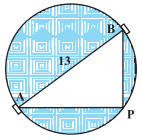
Let P be the position of the pole and $A & B$ be the opposite fixed gates. Let, $BP = x$ metres.
$\therefore$ $AP = x + 7$
In right triangle $APB$,

$AP^2 + BP^2 = AB^2$​​​​​​​
$\Rightarrow (x + 7)^2 + x^2 = 13^2$
$\Rightarrow x^2 + 49 + 14x + x^2 = 169$
$\Rightarrow  2x^2 + 14x + 49 - 169 = 0$
$\Rightarrow 2x^2 + 14x - 120 = 0$
$\Rightarrow 2(x^2 + 7x - 60) = 0$
$\Rightarrow  x^2 + 7x - 60 = 0$
$\Rightarrow x^2 + 12x - 5x - 60 = 0$
$\Rightarrow  x(x + 12) - 5(x + 12) = 0$
$\Rightarrow (x + 12)(x - 5) = 0$
Either $x+12=0$, then $x=-12$ which is not possible being negative or $x-5=0$, then $x=5$.
Thus $P$ is at a distance of 5 m from $B$ and $5+7=12 m$ from $A$.
View full question & answer
Question 132 Marks
Represent the situation in the form of the quadratic equation:
Rohan's mother is $26$ years older than him. The product of their ages $3$ years from now will be $360$. We would like to find Rohan's present age.
Answer
Let Rohan's present age be x years.
Then, his mother's age is (x + 26) years.
Rohan's age after 3 years = (x + 3) years.
After 3 years the age of Rohan's mother = (x + 26 + 3) years = (x + 29) years.
According to the question,
$$ (x + 3)(x + 29) = 360.
$\Rightarrow$$x^2 + 32x - 273 = 0.$
This is the required quadratic equation.
View full question & answer
Question 142 Marks
Represent the situation in the form of the quadratic equation:
The product of two consecutive positive integers is 306. Form the quadratic equation to find the integers.
Answer
Let the required consecutive positive integers be x and (x + 1).
Then, we have
$x(x + 1) = 306$
$\Rightarrow$ $x^2 + x - 306 = 0$
$\Rightarrow$ $x^2 + 18x - 17x  - 306 = 0$
$\Rightarrow$ $x(x + 18) - 17(x + 18) = 0$
$\Rightarrow$ $x + 18 = 0$ or $x - 17 = 0$
$\Rightarrow$ x = -18 or x = 17
Since x is a positive integer, x $\neq$ -18.
$\Rightarrow$ x = 17
$\Rightarrow$ x + 1 = 17 + 1 = 18
Hence, the required positive intergers are 17 and 18.
View full question & answer
Question 152 Marks
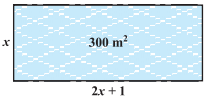
Find the dimensions of the prayer hall given in the below figure.
Answer
In the figure we found that if the breadth of the hall is x m, then x satisfies the equation $2x^2 + x – 300 = 0$
Applying the factorisation method, we write this equation as
$2x^2 – 24x + 25x – 300 = 0$
$2x (x – 12) + 25 (x – 12) = 0$
$i.e., (x – 12)(2x + 25) = 0$
So, the roots of the given equation are $x=12$ or $x=-12.5$.
Since $x$ is the breadth of the hall, it cannot be negative.
Thus, the breadth of the hall is 12 m and its length $=2 x +1=25 m$
View full question & answer
Question 162 Marks
Find the roots of the quadratic equation $3 x^{2}-2 \sqrt{6} x+2=0$.
Answer
We have $3 x^{2}-2 \sqrt{6} x+2$ it can be factorise as:
$3 x^{2}-2 \sqrt{6} x+2=3 x^{2}-\sqrt{6} x-\sqrt{6} x+2$
$=\sqrt{3} x(\sqrt{3} x-\sqrt{2})-\sqrt{2}(\sqrt{3} x-\sqrt{2})$
$=(\sqrt{3} x-\sqrt{2})(\sqrt{3} x-\sqrt{2})$
So, the roots of the equation are the values of x for which
$(\sqrt{3} x-\sqrt{2})(\sqrt{3} x-\sqrt{2})=0$
Now, $\sqrt{3} x-\sqrt{2}=0 \text { for } x=\sqrt{\frac{2}{3}}$
So, this root is repeated twice, one for each repeated factor $\sqrt{3} x-\sqrt{2}$
Therefore, the roots of $3x^{2}-2 \sqrt{6} x+2=0$ are $\sqrt{\frac{2}{3}}, \sqrt{\frac{2}{3}}$
View full question & answer
Question 172 Marks
John and Jivanti together have $45$ marbles. Both of them lost 5 marbles each, and the product of the number of marbles they now have is $124$. We would like to find out how many marbles they had to start with. Represent situation mathematically (quadratic equation).
Answer
Let the number of John’s marbles be $x.$
Therefore, number of Jivanti’s marble$ = 45 − x$
After losing 5 marbles,
Number of John’s marbles $= x − 5$
Number of Jivanti’s marbles$ = 45 − x − 5 = 40 − x$​​​​​​​
Given that the product of their marbles is 124.
$\therefore (x – 5) (40 – x) = 124$
$\Rightarrow x^2 – 45x +324 = 0$
View full question & answer