MCQ 11 Mark
The roots of the quadratic equation $2x^2- x - 6 = 0$ are :
- A
$-2,\frac{3}{2}$
- ✓
$2,\frac{-3}{2}$
- C
$-2,\frac{-3}{2}$
- D
$2,\frac{3}{2}$
AnswerCorrect option: B. $2,\frac{-3}{2}$
Given that, $2 x^2-x-6=0 $
$ \Rightarrow 2 x^2-(4 x-3 x)-6=0 $
$ \Rightarrow 2 x^2-4 x+3 x-6=0 $
$ \Rightarrow 2 x(x-2)+3(x-2)=0 $
$ \Rightarrow(x-2)(2 x+3)=0 $
$\Rightarrow\text{x}=2,\frac{-3}{2}$
View full question & answer→MCQ 21 Mark
The roots of the equation $x^2- 3x - m(m + 3) = 0,$ where $m$ is a constant, are :
- A
$m, m + 3$
- ✓
$-m, m + 3$
- C
$m, -(m + 3)$
- D
$-m, -(m: 3)$
AnswerCorrect option: B. $-m, m + 3$
The given quadratic equation is $x^2- 3x - m(m + 3) = 0, $
where $m$ is a constant.
$ x^2-3 x-m(m+3)=0 $
$ \therefore x^2-[(m+3)-m] x-m(m+3)=0 $
$ \Rightarrow x^2-(m+3) x+m x-m(m+3)=0 $
$\Rightarrow x [x - (m +3)] + m[x - (m + 3)] = 0$
$\Rightarrow [x - (m +3)] (x + m) = 0$
$\Rightarrow x - (m +3) = 0$ or $x + m = 0$
$\Rightarrow x = m + 3$ or $x = -m$
Thus, the roots of the given quadratic equation are $m + 3$ and $-m$.
View full question & answer→MCQ 31 Mark
If $1$ is a root of the equations $ay^2+ ay + 3 = 0$ and $y^2+ y + b = 0$, then $ab$ equals :
- ✓
$3$
- B
$-\frac{7}{2}$
- C
$6$
- D
$-3$
AnswerGiven :
$1$ is the root.
So, $ay^2+ ay + 3 = 0$
$(\because\ \text{root is 1})$
$a(1)^2+ a.1 + 3 = 0$
$\Rightarrow a+ a + 3 = 0$
$\Rightarrow 2a + 3 = 0$
$\Rightarrow\text{a}=\frac{-3}{2}$
Again,
$y^2+ y + b = 0$
$\Rightarrow 1 + 1 + b = 0$
$\Rightarrow 2 + b = 0$
$\Rightarrow b = -2$
Hence , required product is
$\text{a}=\frac{-3}{2},\text{b}=-2$
$(\text{ab})=\frac{-3}{2}(-2)=3$
View full question & answer→MCQ 41 Mark
The roots of the equation $x^2+ x - p(p + 1) = 0$, where $p$ is a constant, are :
- A
$p, p + 1$
- B
$-p, p + 1$
- ✓
$p, - (p + 1)$
- D
$−p, - (p + 1)$
AnswerCorrect option: C. $p, - (p + 1)$
$ x^2+x-p(p+1)=0 $
$x^2+(p+1) x-p x-p(p+1)=0 $
$ x(x+p+1)-p(x+p+1)=0 $
$ (x+p+1)(x-p)=0 $
$ x=-p-1, p $
View full question & answer→MCQ 51 Mark
The value $(s)$ of $k$ for which the quadratic equation $2x^2+ kx + 2 = 0$ has equal roots, is :
AnswerCorrect option: B. $\pm4$
Given equation is $2 x^2+k x+2=0$
On comparing with $a x^2+b x+c=0$, we get
$a = 2, b = k$ and $c = 2$
For equal roots, the discriminant must be zero.
$D=b^2-4 a c=0$
$k^2-4 \times 2 \times 2=0$
$k^2-16=0$
$\text{k}=\pm4$
View full question & answer→MCQ 61 Mark
The equation $x^2-8 x+k=0$ has real and distinct roots if :
- A
$k = 16$
- B
$k > 16$
- C
$k = 8$
- ✓
$k < 16$
AnswerCorrect option: D. $k < 16$
Since the given equation has real roots,
i.e., $D=b^2-4 a c=0$
Here $, a = 1, b = -8, c = k$
$\therefore(-8)^2-4(1)(\text{k})\geq0$
Or, $64-4\text{k}\geq0$
$4\text{k}\leq64$
OR
$\text{k}\leq\frac{64}{4}$
Or, $\text{k}\leq16$
View full question & answer→MCQ 71 Mark
The quadratic equation $x^2– 4x + k = 0$ has distinct real roots if :
- A
$k = 4$
- B
$k > 4$
- C
$k = 16$
- ✓
$k < 4$
AnswerCorrect option: D. $k < 4$
The given quadric equation is $x^2+ 4x + k = 0,$ and roots are real and distinct.
Then find the value of $k$.
Here $, a = 1, b = 4$ and $c = k$
As we know that $D = b^2- 4ac$
Putting the value of $a = 1, b = 4$ and $, c = k$
Putting the value of $a = 1, b = 4$ and $, c = k$
$(4)^2- 4 \times 1 \times k$
$= 16 - 4k$
The given equation will have real and distinct roots, if $D > 0$
$16 - 4k > 0$
$4k < 16$
$\text{ k} < \frac{16}{4}$
$k < 4$
$\therefore$ The value of $k < 4$.
View full question & answer→MCQ 81 Mark
If $\triangle\text{ABC} \sim \triangle\text{DEF}$ such that $AB = 1.2\ cm$ and $DE = 1.4\ cm,$ the ratio of the areas of $\triangle\text{ABC}$ and $\triangle\text{DEF}$ is :
- A
$49 : 36$
- B
$6 : 7$
- C
$7 : 6$
- ✓
$36 : 49$
AnswerCorrect option: D. $36 : 49$
We have,
$\triangle\text{ABC} \sim \triangle\text{DEF}$
$AB = 1.2\ cm$ and $DF = 1.4\ cm$
By area of similar triangle theorem
$\frac{\text{Area}(\triangle\text{ABC})}{\text{Area}(\triangle\text{DEF})}=\frac{\text{AB}^2}{\text{DE}^2}$
$=\frac{1.2^2}{1.4^2}$
$=\frac{1.44}{1.96}$
$=\frac{36}{49}$
View full question & answer→MCQ 91 Mark
The common difference of an $AP,$ whose $n^{th}$ term is $an = (3n + 7),$ is :
Answer$ a_n=3 n+7 $
$ a_1=3 \times 1+7=10 $
$ a_2=3 \times 2+7=13 $
$ d=a_2-a_1 $
$d = 13 - 10$
$d = 3$
common difference $= 3$
View full question & answer→MCQ 101 Mark
The roots of the quadratic equation $x^2-0.04=0$ are :
- ✓
$\pm0.2$
- B
$\pm00.2$
- C
$0.4$
- D
$2$
AnswerCorrect option: A. $\pm0.2$
$\text{x}^2-0.04=0$
$\Rightarrow\text{x}^2=0.04$
$\Rightarrow \text{x}= \sqrt{0.04}$
$\Rightarrow\text{x}= \pm 0.2$
View full question & answer→MCQ 111 Mark
$5x^2+ 8x + 4 = 2x^2+ 4x + 6$ is $a$ :
AnswerGiven : $ 5 x^2+8 x+4=2 x^2+4 x+6 $
$ \Rightarrow 5 x^2-2 x^2+8 x-4 x+4-6 $
$ \Rightarrow 3 x^2+4 x-2=0 $
Here, the degree is $2,$
$\therefore$ it is a quadratic equation.
View full question & answer→MCQ 121 Mark
The ratio of the sum and product of the roots of the equation $7x^2- 12x + 18 = 0$ is :
- A
$7 : 12$
- B
$7 : 18$
- C
$3 : 2$
- ✓
$2 : 3$
AnswerCorrect option: D. $2 : 3$
$7x^2- 12x + 18 = 0$
Comparing with $ax^2+ bx + c = 0$, we have
$a = 7, b = -12, c = 18$
Sum of the roots $=-\frac{\text{b}}{\text{a}}=-\frac{(-12)}{7}=\frac{12}{7}$
Product of the roots $=\frac{\text{c}}{\text{a}}=\frac{18}{7}$
Now $, \frac{\text{Sum of the roots}}{\text{Product of the roots}}=\frac{\frac{12}{7}}{\frac{18}{7}}=\frac{12}{18}$
$=\frac{2}{3}=2:3$
View full question & answer→MCQ 131 Mark
If the equation $x^2- kx + 1 = 0$ has no real roots, then :
- A
$k < -2$
- B
$k > 2$
- ✓
$-2 < k < 2$
- D
AnswerCorrect option: C. $-2 < k < 2$
Since the equation $x^2+ 5kx + 16 = 0$ has no real roots,
$\Rightarrow D < 0$
$\Rightarrow b^2- 4ac > 0$
$\Rightarrow (-k)^2- 4 \times 1 \times 1 < 0$
$\Rightarrow k^2- 4 < 0$
$\Rightarrow k^2 < 4$
$\Rightarrow\text{k}<\sqrt{4}$ or $\text{k}>-\sqrt{4}$
$\Rightarrow k < 2$ or $k > -2$
$\Rightarrow -2 < k < 2$
View full question & answer→MCQ 141 Mark
If $\sin \alpha$ and $\cos\alpha$ are the roots of the equations $a x^2+b x+c=0$, then $b^2=$
- A
$ a^2-2 a c $
- ✓
$ a^2+2 a c $
- C
$ a^2-a c $
- D
$ a 2+a c $
AnswerCorrect option: B. $ a^2+2 a c $
The given quadric equation is $ax^2+ bx + c = 0$, and $\sin\alpha$ and $\cos\beta$ are roots of given equation.
And, $a = a, b = b$ and $c = c$
Then, as we know that sum of the roots
$\sin\alpha+\cos\beta=\frac{-\text{b}}{\text{a}}\ ...(\text{i})$
And the product of the roots
$\sin\alpha\cdot\cos\beta=\frac{\text{c}}{\text{a}}\ ....(\text{ii})$
Squaring both sides of equation (i) we get
$(\sin\alpha+\cos\beta)^2=\Big(\frac{-\text{b}}{\text{a}}\Big)^2$
$\sin^2\alpha+\cos^2\beta+2\sin\alpha\cos\beta=\frac{\text{b}^2}{\text{a}^2}$
Putting the value of $\sin\alpha+\cos\beta=1$ we get
$1+2\sin\alpha\cos\beta=\frac{\text{b}^2}{\text{a}^2}$
$\text{a}^2(1+2\sin\alpha\cos\beta)=\text{b}^2$
Putting the value of $\sin\alpha\cdot\cos\beta=\frac{\text{c}}{\text{a}}$ we get
$\text{a}^2\Big(1+2\frac{\text{c}}{\text{a}}\Big)=\text{b}^2$
$\text{a}^2\Big(\frac{\text{a}+2\text{c}}{\text{a}}\Big)=\text{b}^2$
$\text{a}^2+2\text{ac}=\text{b}^2$
Threfore, the value of $b^2= a^2+ 2ac$
Thus, the correct answer is $(b)$
View full question & answer→MCQ 151 Mark
If $2$ is a root of the equation $x^2+ bx + 12 = 0$ and the equation $x^2+ bx + q = 0$ has equal roots, then $q =$
Answer$2$ is the common roots given quadric equation are $x^2+ bx + 12 = 0$, and $x^2+ bx + q = 0$
Then find the value of $q$.
Here, $x^2+ bx + 12 = 0 ....(i)$
$x^2+ bx + q = 0 ....(ii)$
Putting the value of $x = 2$ in equation $(i)$ we get
$2^2+ b \times 2 + 12 = 0$
$4 + 2b + 12 = 0$
$2b = -16$
$b = -8$
Now, putting the value of $b = -8$ in equation $(ii)$ we get
$x^2- 8x + q = 0$
Then,
$a_2= 1, b_2= -8$ and $c_2= q$
As we know that $D_1= b^2- 4ac$
Putting the value of $a_2= 1, b_2= -8$ and $c_2= q$
$= (-8)^2- 4 \times 1 \times q$
$= 64 - 4q$
The given equation will have equal roots, if $D = 0$
$64 - 4q = 0$
$4q = 64$
$\text{q}=\frac{64}{4}$
$q = 16$
Thus, the correct answer is $(c)$
View full question & answer→MCQ 161 Mark
If the equation $ax^2+ 2x + a = 0$ has two distinct roots, if :
- ✓
$\text{a}=\pm1$
- B
$a = 0$
- C
$a = 0, 1$
- D
$a = -1, 0$
AnswerCorrect option: A. $\text{a}=\pm1$
In the equation $ax^2+ 2x + a = 0$
$\Rightarrow D = b^2- 4ac$
$\Rightarrow D = (2)^2- 4 \times a \times a$
$\Rightarrow D = 4 - 4a^2$
Roots are real and equal
$\Rightarrow D = 0$
$\Rightarrow 4 - 4a^2= 0$
$\Rightarrow 4 = 4a^2$
$\Rightarrow 1 = a^2$
$\Rightarrow a^2= 1$
$\Rightarrow\text{a}^2=(\pm1)^2$
$\Rightarrow\text{a}=\pm1$
View full question & answer→MCQ 171 Mark
The number of quadratic equations having real roots and which do not change by squaring their roots is :
AnswerWe are given that quadratic equations have real roots and the quadratic equation does not change by squaring their roots.
We have to find the number of quadratic equations.
The possible roots $(1, 1) (1, 0) (0, 0)$
The general formula of quadratic equation is.
$x^2- ($sum of roots$)\ x \ +$ product of roots
So, we have:
Case $-I:$ When roots are $1$ and $1$
$x^2- (1 + 1) x + 1 = 0$
$x^2- 2x + 1 = 0$
Case $-II:$ When roots are $1$ and $0$
$x^2- x = 0$
Case $-III:$ When roots are $0$ and $0$
Then, $x^2= 0$
$\therefore 3$ possible quadratic equation.
View full question & answer→MCQ 181 Mark
Choose the correct answer from the given four options in the following questions : $(x^2+ 1)^2- x^2= 0$ has :
AnswerGiven equation is $\left(x^2+1\right)^2-x^2=0$
$ \Rightarrow x^4+1+2 x-x^2=0 $
$ {\left[\because(a+b)^2=a^2+b^2+2 a b\right]} $
$ \Rightarrow x^4+x^2+1=0$
Let $x^2=y$
$ \therefore\left(x^2\right)^2+x^2+1=0$
$ y^2+y+1=0$
On comparing with $a y^2+b y+c=0$, we get
$a = 1, b = 1$ and $c= 1$
Discrinimant, $ D=b^2-4 a c $
$ =(1)^2-4(1)(1) $
$ =1-4=-3 $
Since $, D<0 $
$ \therefore y^2+y+1=0$
i.e.$ , x^4+x^2+1=0 $ or
$ \left(x^2+1\right)^2-x^2=0$ has no real roots.
View full question & answer→MCQ 191 Mark
The product of two consecutive integers is $240$. The quadratic representation of the above situation is :
- A
$x^2+(x+1)=240$
- B
$x + (x + 1) = 240$
- C
$x(x+1)^2=240$
- ✓
$x(x + 1) = 240$
AnswerCorrect option: D. $x(x + 1) = 240$
Let one of the two consecutive integers be $x$
Then the other consecutive integer will be $(x + 1)$
$\therefore$ According to question $, (x) \times (x + 1) = 240$
$\Rightarrow x(x + 1) = 240$
View full question & answer→MCQ 201 Mark
If the equation $x^2+ 4x + k = 0$ has real and distinct roots, then :
- ✓
$\text{k}<4$
- B
$\text{k}>4$
- C
$\text{k}\geq4$
- D
$\text{k}\leq4$
AnswerCorrect option: A. $\text{k}<4$
In the equation $x^2+4 x+k=0$
$ a=1, b=4, c=k $
$ \Rightarrow D=b^2-4 a c $
$ \Rightarrow D=(4)^2-4 \times 1 \times k$
$\Rightarrow D = 16 - 4k$
Roots are real and distinct
$\Rightarrow D > 0$
$\Rightarrow 16 - 4k > 0$
$\Rightarrow 16 > 4k$
$\Rightarrow 4 > k$
$\Rightarrow k < 4$
View full question & answer→MCQ 211 Mark
A quadratic equation $ax^2+ bx + c = 0$ has non $-$ real roots, if :
- A
$ b^2-4 a c=0 $
- ✓
$ b^2-4 a c > 0 $
- C
$ b^2-4 a c < 0 $
- D
$ b^2-a c=0 $
AnswerCorrect option: B. $ b^2-4 a c > 0 $
The roots of the quadratic equation $a x^2+b x+c=0,$ In this formula the term $b^2-4 a c$ is called the discriminant. If $b^2-4 a c=0,$
so the equation has a single repeated root. If $b^2-4 a c>0,$ the equation has two real roots.
If $b^2-4 a c<0,$ the equation has two complex roots.
View full question & answer→MCQ 221 Mark
Let $b = a + c$. Then the equation $ax^2+ bx + c = 0$ has equal roots if :
- A
$a = -c$
- B
$a = 2c$
- ✓
$a = c$
- D
$a = -2c$
AnswerCorrect option: C. $a = c$
Since, If $a x^2+b x+c=0$ has equal roots,
then $ b^2-4 a c=0 $
$ \Rightarrow(a+c)^2-4 a c=0\ [$Given : $b=a+c]$
$ \Rightarrow a^2+c^2+2 a c-4 a c=0 $
$ \Rightarrow a^2+c^2-2 a c=0 $
$ \Rightarrow(a-c)^2=0$
$\Rightarrow a - c = 0$
$\Rightarrow a = c$
View full question & answer→MCQ 231 Mark
If $x = 3$ is a solution of the equation $3x^2+ (k - 1)x + 9 = 0$ then $k = ?$
AnswerSince $x=3$ is a solution of the equation $3 x^2+(k-1) x+9=0$,
we have $3(3)^2+(k-1) 3+9=0$
$\Rightarrow 27 + 3k - 3 + 9 = 0$
$\Rightarrow 3k + 33 = 0$
$\Rightarrow 3k = -33$
$\Rightarrow k = -11$
View full question & answer→MCQ 241 Mark
Directions : In the following questions, the Assertions $(A)$ and Reason $(s) \ (R)$ have been put forward. Read both the statements carefully and choose the correct alternative from the following :
Assertion : $(2 x-1)^2-4 x^2+5=0$ is not a quadratic equation.
Reason : $x = 0,3$ are the roots of the equation $2 x^2-6 x=0$
- A
If both assertion and reason are true and reason is the correct explanation of assertion.
- ✓
If both assertion and reason are true but reason is not the correct explanation of assertion.
- C
If assertion is true but reason is false.
- D
If both assertion and reason are false.
AnswerCorrect option: B. If both assertion and reason are true but reason is not the correct explanation of assertion.
Assertion $(2x - 1)2 - 4x^2 + 5 = 0$
$\Rightarrow -4x + 6 = 0$
Reason $2x^2 - 6x = 0$
$\Rightarrow 2x (x - 3) = 0 $
$\Rightarrow x = 0$
and $x = 3$
View full question & answer→MCQ 251 Mark
The angry Arjun carried some arrows for fighting with Bheeshma. With half the arrows, he cut down the arrows thrown by Bheeshma on him and with six other arrows he killed the rath driver of Bheeshma. With one arrow each, he knocked down respectively the rath, flag and bow of Bheeshma. Finally, with one more than four times the square root of arrows, he laid Bheeshma unconscious on an arrow bed. The total number of arrows that Arjun had, is:
AnswerLet Arjun had $x$ arrows.
According to question,
$\frac{\text{x}}{2}+6+3+{4}\sqrt{\text{x}}+1=\text{x}$
$\Rightarrow10+4\sqrt{\text{x}} = \frac{\text{x}}{2}$
$\Rightarrow{20+8}\sqrt{\text{x}}=\text{x}$
${8}\sqrt{\text{x}}=\text{x}-20$
$ \Rightarrow 64 x=x^2-40 x+400 $
$ \Rightarrow x^2-104 x+400=0 $
$ \Rightarrow x^2-100 x-4 x+400=0 $
$\Rightarrow x(x - 100) -4(x - 100) = 0$
$\Rightarrow (x - 100) (x - 4) = 0$
$\Rightarrow x - 100 = 0 $ and $x - 4 = 0$
$\Rightarrow x = 100$ and $x = 4\ [$which is not possible$]$
$\therefore$ Arjun had $100$ arrows.
View full question & answer→MCQ 261 Mark
If $x = 3$ is a solution of the equation $3x^2+ (k - 1)x + 9 = 0$ then $k = $?
Answer$3x^2+ (k - 1)x + 9 = 0$
$x = 3$ is a solution of the equation means it satisfies the equation
Put $x = 3,$ we get
$3(3)^2+ (k - 1) 3 + 9 = 0$
$27 + 3k - 3 + 9 = 0$
$27 + 3k + 6 = 0$
$3k = -33$
$k = -11$
View full question & answer→MCQ 271 Mark
A quadratic equation $ax^2+ bx + c = 0,$ has coincident roots, if :
- A
$ b^2-4 a c<0 $
- B
$ b^2-4 a c>0 $
- ✓
$ b^2-4 a c=0 $
- D
$ b^2-a c=0 $
AnswerCorrect option: C. $ b^2-4 a c=0 $
The roots of the quadratic equation $a x^2+b x+c=0$, In this formula the term $b^2-4 a c$ is called the discriminant.
If $b^2-4 a c=0$ so the equation has a single repeated root.
If $b^2-4 a c>0$, the equation has two real roots.
If $b^2-4 a c<0,$ the equation has two complex roots.
View full question & answer→MCQ 281 Mark
Directions : In the following questions, the Assertions $(A)$ and Reason $(s) \ (R)$ have been put forward. Read both the statements carefully and choose the correct alternative from the following:
Assertion : $(2x - 1)2 - 4x^2+ 5 = 0$ is not a quadratic equation.
Reason : $x = 0, 3$ are the roots of the equation $2x^2- 6x = 0.$
- A
Both assertion $(A)$ and reason $(R)$ are true and reason $(R)$ isthe correct explanation of assertion $(A$).
- ✓
Both assertion $(A)$ and reason $(R)$ are true but reason $(R)$ is not the correct explanation of assertion $(A)$.
- C
Assertion $(A)$ is true but reason $(R)$ is false.
- D
Assertion $(A)$ is false but reason $(R)$ is true
AnswerCorrect option: B. Both assertion $(A)$ and reason $(R)$ are true but reason $(R)$ is not the correct explanation of assertion $(A)$.
Assertion and Reason both are true statements.
But Reason is not the correct explanation.
Assertion $(2 x-1)^2-4 x^2+5=0$
$=-4 x+6=0$
Reason $2 x^2-6 x=0$
$2x(x - 3) = 0 x = 0$
and $x = 3$
View full question & answer→MCQ 291 Mark
A train travels $360\ km$ at a uniform speed. If the speed had been $5\ km/ hr$ more, it would have taken $1$ hour less for the same journey, then the actual speed of the train is :
- A
$48km/ hr$
- ✓
$40km/ hr$
- C
$36km/ hr$
- D
$45km/ hr$
AnswerCorrect option: B. $40km/ hr$
Let the actual speed of the train be $x \ km/ hr$
Time taken to cover $360\ km$ at this speed $=\frac{360}{\text{x}}\text{hr}$
Time taken to cover $360\ km$ at the increased speed $=\frac{360}{\text{x + 5}}\text{hr}$
According to condition, $\frac{360}{\text{x}}-\frac{360}{\text{x}+5} = 1$
$\Rightarrow 360\big[\frac{1}{\text{x}}-\frac{1}{\text{x}+5}\big] = 1$
$\Rightarrow{360}\big[\frac{\text{x}+5\text{-x}}{{\text{x}}(\text{x}+5)}\big] = 1$
$\Rightarrow{360}\big[\frac5{{\text{x}}(\text{x}+5)}\big] = 1$
$ \Rightarrow x^2+5 x-1800=0 $
$ \Rightarrow x^2+45 x-40 x-1800 $
$\Rightarrow x(x + 45) -40(x + 45) = 0$
$\Rightarrow (x - 40) (x - 45) = 0$
$\Rightarrow x - 40 = 0$ and $x + 45 = 0$
$\Rightarrow x = 40\ km/ hr$ and $x = -45\ km/ hr\ [$But $x = -45$ is not possible$]$
$\therefore$ The actual speed of the train is $40\ km/ hr$
View full question & answer→MCQ 301 Mark
Directions : In the following questions, the Assertions $(A)$ and Reason $(s) \ (R)$ have been put forward. Read both the statements carefully and choose the correct alternative from the following:
Assertion : Both the roots of the equation $x^2- x + 1 = 0$ are real.
Reason : The roots of the equation $ax^2+ bx + c = 0$ are real if and only if $b^2 - 4ac \geq 0.$
- A
If both assertion and reason are true and reason is the correct explanation of assertion.
- B
If both assertion and reason are true but reason is not the correct explanation of assertion.
- C
If assertion is true but reason is false.
- ✓
If both assertion and reason are false.
AnswerCorrect option: D. If both assertion and reason are false.
Clearly, Reason is Correct.
Now, given quadratic equation is $x^2-x+1=0$
$ D=b^2-4 a c $
$ \Rightarrow D=(-1)^2-4(1)(1)$
$\Rightarrow D = -3 < 0$
View full question & answer→MCQ 311 Mark
The value of $c$ for which the equation $ax^2+ 2bx + c = 0$ has equal roots is :
- ✓
$\frac{\text{b}^2}{\text{a}}$
- B
$\frac{\text{b}^2}{4\text{a}}$
- C
$\frac{\text{a}^2}{\text{b}}$
- D
$\frac{\text{a}^2}{4\text{b}}$
AnswerCorrect option: A. $\frac{\text{b}^2}{\text{a}}$
$ \Rightarrow a x^2+2 b x+c=0 $
$ \Rightarrow D=b^2-4 a c $
$ \Rightarrow D=(2 b)^2-4 \times a \times c $
$ \Rightarrow D=4 b^2-4 a c$
Roots are equal
$ \Rightarrow D=0 $
$ \Rightarrow 4 b^2-4 a c=0 $
$ \Rightarrow 4 a c=4 b^2 $
$\Rightarrow\text{c}=\frac{4\text{b}^2}{4\text{a}}$
$\Rightarrow\text{c}=\frac{\text{b}^2}{\text{a}}$
View full question & answer→MCQ 321 Mark
The perimeter of a right triangle is $70\ cm$ and its hypotenuse is $29\ cm$. The area of the triangle is :
- A
$200 \text{sq. cm}$
- B
$250 \text{sq. cm}$
- ✓
$210 \text{sq. cm}$
- D
$180 \text{sq. cm}$
AnswerCorrect option: C. $210 \text{sq. cm}$
Let base of the right triangle be $x \ cm$.
Given: Perpendicular $= x + 29 = 70$
$\Rightarrow $ Perpendicular $= (41- x) (41- x)\ cm$
Now, using Pythagoras theorem,
$ (29)^2=x^2+(41-x)^2 $
$ \Rightarrow 841=1681+x^2-82 x+x^2 $
$ \Rightarrow 2 x^2-82 x+840=0 $
$ \Rightarrow x^2-41 x+420=0 $
$ \Rightarrow x^2-20 x-21 x+420=0 $
$\Rightarrow x(x - 20) -21(x - 20) = 0$
$\Rightarrow (x - 20) (x - 21) = 0$
$\Rightarrow x - 20 = 0$ and $x - 21 = 0$
$\Rightarrow x = 20$ and $x = 21$
$\therefore$ The two sides other than hypotenuse are of $20\ cm$ and $21\ cm.$
View full question & answer→MCQ 331 Mark
If the product of the roots of the equation $x^2- 3x + k = 10$ is $-2$ then the value of $k$ is :
Answer$ x^2-3 x+k=10 $
$ \Rightarrow x^2-3 x+(k-10)=0$
Comparing with $ {ax}^2+ {bx}+ {c}=0,$ we have
$a = 1, b = -3, c = k - 10$
Product of the roots $= -2$
$ \Rightarrow\frac{\text{c}}{\text{a}}=-2$
$\Rightarrow\text{k}-10=-2$
$\Rightarrow\text{k}=8$
View full question & answer→MCQ 341 Mark
If the sum of a number and its reciprocal is $2\frac{1}{2}$ then the number are :
- A
$3$ and $\frac{1}{3}$
- ✓
$2$ and $\frac{1}{2}$
- C
$1$ and $\frac{3}{2}$
- D
AnswerCorrect option: B. $2$ and $\frac{1}{2}$
Let the one number be $x$ then its reciprocal will be $\frac{1}{\text{x}}$ According to question,
$\Rightarrow\frac{{\text{x}}^{2}+{1}}{\text{x}}=\frac{5}{2}$
$ \Rightarrow 2 x^2+2=5 x $
$ \Rightarrow 2 x^2-5 x+2=0$
using factorisation method
$ \Rightarrow 2 x^2-4 x-x+2=0$
$\Rightarrow 2x(x - 2) -1(x - 2) = 0$
$\Rightarrow (x - 2) (2x - 1) = 0$
$\Rightarrow x - 2 = 0$ and $2x - 1 = 0$
$\Rightarrow x = 2$ and $\text{x}=\frac{1}{2}$
$\therefore$ The number are $2$ and $\frac{1}{2}$
View full question & answer→MCQ 351 Mark
If the equation $x^2+ 5kx + 16 = 0$ has no real roots then :
AnswerCorrect option: C. $\frac{-8}{5} < \text{k} < \frac{8}{5}$
Since the equation $x^2+ 5kx + 16 = 0$ has no real roots,
$\Rightarrow D < 0$
$ \Rightarrow b^2-4 a c>0 $
$ \Rightarrow(5 k)^2-4 \times 16<0 $
$ \Rightarrow 25 k^2-64<0 $
$ \Rightarrow 25 k^2<64 $
$\Rightarrow\text{k}^2<\frac{64}{25}$
$\Rightarrow\text{k}<\sqrt{\frac{64}{25}}$ or $\text{k}>-\sqrt{\frac{64}{25}}$
$\Rightarrow\text{k}<\frac{8}{5}$ or $\text{k}>-\frac{8}{5}$
$\Rightarrow-\frac{8}{5}<\text{k}<\frac{8}{5}$
View full question & answer→MCQ 361 Mark
$2x^2- 3x + 2 = 0$ have :
Answer$D = b^2- 4ac$
$D = (-3)^2- 4 \times 2 \times 2$
$D = 9 - 16$
$D = - 7$
$D < 0$.
No Real roots.
View full question & answer→MCQ 371 Mark
Rohan’s mother is $26$ years older than him. The product of their ages $3$ years from now will be $360,$ then Rohan’s present age is :
- A
$10$ years
- B
$6$ years
- ✓
$7$ years
- D
$8$ years
AnswerCorrect option: C. $7$ years
Let Rohan’s present age be $x$ years.
Then Rohan’s mother age will be $(x + 26)$ years.
And after $3$ years their ages will be $(x + 3)$ and $(x + 29)$ years.
According to question,
$(x + 3) (x + 29) = 360$
$ \Rightarrow x^2+29 x+3 x+87=360 $
$ \Rightarrow x^2+32 x-273=0 $
$ \Rightarrow x^2+39 x+7 x-273=0 $
$\Rightarrow x(x + 39) -7(x + 39) = 0$
$\Rightarrow (x - 7) (x + 39) = 0$
$\Rightarrow (x - 7) = 0 $ and $x + 39 = 0$
$\Rightarrow x = 7$ and $x = -39 \ [x = -39$ is not possible$]$
$\therefore$ Rohan’s present is $7$ years.
View full question & answer→MCQ 381 Mark
The sum of the roots of the equation $x^2-6 x+2=0$ is :
AnswerSum of the roots of the equation of $a x^2+b x+c=0$ is $\frac{-\text{b}}{\text{a}}$
Here $, a = 1, b = -6, c = 2$
By substitution of values we get
$\frac{-\text{b}}{\text{a}}=\frac{-(-6)}{1} = 6$
View full question & answer→MCQ 391 Mark
A quadratic equation $ax^2+ bx + c = 0$ has real and equal roots, if :
- A
$ b^2-4 a c>0 $
- ✓
$ b^2-4 a c=0 $
- C
$ b^2-4 a c<0 $
- D
AnswerCorrect option: B. $ b^2-4 a c=0 $
A quadratic equation $ax^2+ bx + c = 0$ has real and equal roots, if $ b^2-4 a c=0 $
View full question & answer→MCQ 401 Mark
If the equation $9x^2+ 6kx + 4 = 0$ has equal roots then $k = ?$
- A
$2$ or $0$
- B
$-2$ or $0$
- ✓
$2$ or $-2$
- D
$0$ only
AnswerCorrect option: C. $2$ or $-2$
Since the roots of the equation $9x^2+ 6kx + 4 = 0$ are equal,
$D = 0$
$ \Rightarrow b^2-4 a c=0 $
$ \Rightarrow(6 k)^2-4 \times 9 \times 4=0 $
$ \Rightarrow 36 k^2-144=0 $
$ \Rightarrow 36 k^2=144 $
$ \Rightarrow k^2=4 $
$\Rightarrow\text{k}=\pm2$
View full question & answer→MCQ 411 Mark
The ratio of sum and the product of the roots of $7 x^2-12 x+18=0$ is :
- A
$3 : 2$
- B
$7 : 12$
- C
$7 : 18$
- ✓
$2 : 3$
AnswerCorrect option: D. $2 : 3$
Ratio of sum and product of the roots $7 x^2-12 x+18=0$ is $\frac{\alpha+\beta}{\alpha\beta}$
$\Rightarrow\frac{-\text{b}}{\text{c}}$
$\Rightarrow \frac{12}{18}=\frac{2}{3} = 2:3$
View full question & answer→MCQ 421 Mark
The sum of two number is $17$ and the sum of their reciprocals is $\frac{17}{36}$ The quadratic representation of the above situation is :
- A
$\frac{1}{\text{x}} - \frac{1}{17-\text{ x}} = \frac{17}{62}$
- B
$\frac{1}{\text{x}(17 - \text{x)}}=\frac{17}{62}$
- ✓
$\frac{1}{\text{x}} + \frac{1}{17-\text{ x}} = \frac{17}{62}$
- D
$\frac{1}{\text{x}} + \frac{1}{\text{x+17}} = \frac{17}{62}$
AnswerCorrect option: C. $\frac{1}{\text{x}} + \frac{1}{17-\text{ x}} = \frac{17}{62}$
Let one number be $x,$ as the sum of the number is $17,$ then the other number will be $(17 - x) $
their reciprocals will be $\frac{1}{\text{x}}$ and $\frac{1}{17-\text{x}}$
$\therefore$ According to question, $\frac{1}{\text{x}} + \frac{1}{17-\text{ x}} = \frac{17}{62}$
View full question & answer→MCQ 431 Mark
If one root of the equation $2x^2+ ax + 6 = 0$ is $2$ then $a =$ ?
- A
$\frac{-7}{2}$
- B
$\frac{7}{2}$
- ✓
$-7$
- D
$7$
AnswerOne root of the equation $2 x^2+a x+6=0$ is $2$
i.e. it satisfies the equation
$2(2)^2+2 a+6=0$
$8 + 2a + 6 = 0$
$2a = -14$
$a = -7$
View full question & answer→MCQ 441 Mark
If one root of $5 x^2+13 x+k=0$ be the reciprocal of the other root, then the value of $k$ is :
AnswerLet one root of the given equation be $\alpha.$
Then, its root will be $\frac{1}{\alpha}.$
Given equation is $5 x^2+13 x+k=0$
Comparing with $a x^2+b x+c=0,$
we have $a = 5, b = 13, c = k$
Now,
Product of the roots $=\frac{\text{c}}{\text{a}}$
$\Rightarrow\alpha\times\frac{1}{\alpha}=\frac{\text{k}}5{}$
$\Rightarrow\text{k}=5$
View full question & answer→MCQ 451 Mark
The positive value of $k$ for which the equation $x^2+ kx + 64 = 0$ and $x^2- 8x + k = 0$ will both have real roots, is :
AnswerThe given quadric equation are $x^2+k x+64=0$ and $x^2-8 x+k=0$ roots are real.
Then find the value of a.
Here, $x^2+k x+64=0$
$ x^2-8 x+k=0 \ldots \text { (ii) } $
$ a_1=1, b_1=k $ and $ c_1=64 $
$ a_2=1, b_2=-8 $ and $ c_2=k$
As we know that $D_1=b^2-4 a c$
Putting the value of $a_1=1, b_1=k$ and $c_1=64$
$ =(k)^2-4 \times 1 \times 64 $
$ =k^2-256$
The given equation will have real and distinct roots, if $D > 0$
$ k^2-256=0 $
$ k^2=256 $
$ k=\sqrt{256} $
$ k= \pm 16 $
Therefore, putting the value of $k=16$ in equation $(ii)$ we get
$ x^2-8 x+16=0 $
$ (x-4)^2=0 $
$x - 4 = 0$
$x = 4$
The value of $k = 16$ satisfying to both equations.
Thus, the correct answer is $(d)$
View full question & answer→MCQ 461 Mark
$......$ is called the Discriminant of the quadratic equation $ax^2+ bx + c = 0:$
- A
$ a^2-4 b c $
- ✓
$ b^2-4 a c $
- C
$ c^2-4 a b $
- D
AnswerCorrect option: B. $ b^2-4 a c $
Discriminant of the quadratic equation $ax^2+ bx + c = 0$ is $D = b^2- 4ac$.
View full question & answer→MCQ 471 Mark
$2$ One of the roots of the quadratic equation $ a^2 x^2-2 a b x+2 b^2=0$ is :
- A
$\frac{\text{-2b}}{\text{a}}$
- B
$\frac{\text{-2a}}{\text{b}}$
- ✓
$\frac{\text{2b}}{\text{a}}$
- D
$\frac{\text{2a}}{\text{b}}$
AnswerCorrect option: C. $\frac{\text{2b}}{\text{a}}$
$\Rightarrow a^2 x^2-2 a b x+2 b^2=0$
$\Rightarrow ax(ax - 2b) -b(ax - 2b) = 0$
$\Rightarrow (ax - b) (ax - 2b) = 0$
$\Rightarrow ax - b = 0$ and $ax - 2b = 0$
$\Rightarrow\text{x} = \frac{\text{b}}{\text{a}}$ and $\text{x} = \frac{\text{2b}}{\text{a}}$
View full question & answer→MCQ 481 Mark
The values of $k$ for which the quadratic equation $16x^2+ 4kx + 9 = 0$ has real and equal roots are :
AnswerCorrect option: C. $6,-6$
The given quadratic equation $16 x^2+4 k x+9=0,$ has equal roots.
Here $, a = 16, b = 4k$ and $c = 9$
As we know that $D=b^2-4 a c$
Putting the value of $a = 16, b = 4k$ and $c = 9$
$ \Rightarrow D=(4 k)^2-4(16)(9) $
$ \Rightarrow D=16 k^2-576$
The given equation will have real and equal roots, if $D = 0$
Thus, $16 k^2-576=0$
$\Rightarrow \mathrm{k}^2-36=0$
$\Rightarrow (k + 6)(k - 6) = 0$
$\Rightarrow k + 6 = 0$ or $k = 6$
Therefore, the value of $k$ is $6, -6$
Hence, the correct option is $(c)$
View full question & answer→MCQ 491 Mark
Directions : In the following questions, the Assertions $(A)$ and Reason $(s)\ (R)$ have been put forward. Read both the statements carefully and choose the correct alternative from the following:
Assertion : The roots of the quadratic equation $x^2+ 2x + 2 = 0$ are imaginary.
Reason : If discriminant $D = b^2- 4ac < 0$ then the roots of quadratic equation $ax^2+ bx + c = 0$ are imaginary.
- A
If both assertion and reason are true and reason is the correct explanation of assertion.
- ✓
If both assertion and reason are true but reason is not the correct explanation of assertion.
- C
If assertion is true but reason is false.
- D
If both assertion and reason are false.
AnswerCorrect option: B. If both assertion and reason are true but reason is not the correct explanation of assertion.
$x^2+2 x+2=0$
Discriminant, $D=b^2-4 a c$
$\Rightarrow D=(2)^2-4(1)(c)$
$\Rightarrow D = 4 - 8 = -4 < 0$
Roots are imaginary.
View full question & answer→MCQ 501 Mark
If the equation $x^2- ax + 1 = 0$ has two distinct roots, then :
- A
$|a| = 2$
- B
$|a| < 2$
- ✓
$|a| >2$
- D
AnswerCorrect option: C. $|a| >2$
The given quadric equation is $x^2-a x+1=0$, and roots are dostinct.
Then fond the value of a.
Here $, a = 1, b = a$ and $c = 1$
As we know that $D = D=b^2-4 a c$
Putting the value of $a = 1, b = a$ and $c = 1$
$ =(a)^2-4 \times 1 \times 1 $
$ =a^2-4$
The given equation will have real and distinct roots, if $D > 0$
$ a^2-4>0 $
$ a^2>4$
$\text{a}>\sqrt{4}$
$\text{a}>\pm2$
Therefore, the value of $|a| > 2$
Thus, the correct answer is $(c)$
View full question & answer→MCQ 511 Mark
If $x^2+ 5kx + 16 = 0,$ has equal roots, then the value of $k$ is :
- ✓
$\underline{+}\frac{8}{5}$
- B
$\underline{+}\frac{64}{25}$
- C
$\underline{+}\frac{25}{64}$
- D
$\underline{+}\frac{5}{8}$
AnswerCorrect option: A. $\underline{+}\frac{8}{5}$
Here $, a = 1, b = 5k, c = 16$
If $x^2+5 k x+16=0$ has equal roots
then, $b^2-4 a c=0$
$ \Rightarrow(5 k)^2-4 \times 1 \times 16=0$
$ \Rightarrow 25 k^2-64=0$
$ \Rightarrow 25 k^2=64$
$\Rightarrow \text{k}^{2} = \frac{64}{25}$
$\text{k} = \underline{+}\frac{8}{5}$
View full question & answer→MCQ 521 Mark
The values of $k$ for which the quadratic equation $2x^2- kx + k = 0$ has equal roots is :
- A
$8$ only
- B
$0$ only
- C
$4$
- ✓
$0, 8$
AnswerCorrect option: D. $0, 8$
If a quadratic equation $ax^2+ bx + c = 0, a \neq 0$ has two equal roots, then its discriminant value will be equal to zero
i.e. $D=b^2-4 a c=0$
Given, $2 x^2-k x+k=0$
For equal roots,
$ D=b^2-4 a c=0 $
$ \Rightarrow(-k)^2-4(2)^{(k)}=0 $
$ \Rightarrow k^2-8 k=0$
$\Rightarrow k(k - 8) = 0$
$\therefore k = 0, 8$
View full question & answer→MCQ 531 Mark
Choose the correct answer from the given four options in the following questions:
Which constant must be added and subtracted to solve the quadratic equation $9\text{x}^2+\frac{3}{4}\text{x}-\sqrt{2}=0$ by the method of completing the square ?
- A
$\frac{1}{8}$
- ✓
$\frac{1}{64}$
- C
$\frac{1}{4}$
- D
$\frac{9}{64}$
AnswerCorrect option: B. $\frac{1}{64}$
Given equation is $9\text{x}^2+\frac{3}{4}\text{x}-\sqrt{2}=0.$
$(3\text{x})^2+\frac{1}{4}(3\text{x})-\sqrt{2}=0$
On putting $3x = y,$ we have $\text{y}^2+\frac{1}{4}\text{y}-\sqrt{2}=0$
$\text{y}^2+\frac{1}{4}\text{y}+\Big(\frac{1}{8}\Big)^2-\Big(\frac{1}{8}\Big)^2-\sqrt{2}=0$
$\Big(\text{y}+\frac{1}{8}\Big)^2=\frac{1}{64}+\sqrt{2}$
$\Big(\text{y}+\frac{1}{8}\Big)^2=\frac{1+64\sqrt{2}}{64}$
Thus, $\frac{1}{64}$ must be added and subtracted to solve the given equation.
View full question & answer→MCQ 541 Mark
If the sum of the roots of the equation $k x^2+2 x+3 x=0$ is equal to their product, then the value of $k$ is :
- A
$\frac{1}{3}$
- B
$\frac{-1}{3}$
- C
$\frac{2}{3}$
- ✓
$\frac{-2}{3}$
AnswerCorrect option: D. $\frac{-2}{3}$
Given equation is $k x^2+2 x+3 x=0$
Comparing with $a x^2+b x+c=0,$
we have $a = k, b = 2, c = 3k$
Now,
Sum of the roots $=$ product of the roots
$\Rightarrow\frac{-2}{\text{k}}=\frac{\text{3k}}{\text{k}}$
$\Rightarrow\text{3k}=-2$
$\Rightarrow\text{k}=\frac{-2}3{}$
View full question & answer→MCQ 551 Mark
If one root of the equation $4\text{x}^2 - 2\text{x}+ (\lambda - 4) = 0 $ be the reciprocal of the other, then the value of $\lambda$ is :
AnswerLet one root be $\alpha$ then other root will be $\frac{1}{\alpha}$
Product of the root
$\Rightarrow\alpha \times \frac{1}{\alpha} = \frac{\text{c}}{\text{a}}$
$\Rightarrow 1=\frac{\lambda - 4}{4}$
$\Rightarrow\lambda - 4 = 4$
$\Rightarrow\lambda = 8$
View full question & answer→MCQ 561 Mark
The quadratic equation whose roots are $7 + \sqrt{3}$ and $7 - \sqrt{3}$ is :
- ✓
$ x^2-14 x+46=0 $
- B
$ x^2-14 x-46=0 $
- C
$ x^2+14 x+46=0 $
- D
$ x^2+14 x-46=0 $
AnswerCorrect option: A. $ x^2-14 x+46=0 $
Given : $\alpha = 7+\sqrt{3}$ and $\beta= 7-\sqrt{3}$
$\therefore\text{x}^{2}-(\alpha+\beta)\text{ x}+\alpha\beta = {0}$
$\Rightarrow\text{x}^{2} -(7+\sqrt{3}+7-\sqrt{3})\text{ x}+(7+\sqrt{3}) (7-\sqrt{3})=0$
$\Rightarrow\text{x}^{2} - {14}\text{x}+(49-3) = 0$
$\Rightarrow\text{x}^{2} - {14}\text{x}+46 = 0$
View full question & answer→MCQ 571 Mark
If the quadratic equation $kx(x - 2) + 6 = 0$ has equal roots, then the value of $k$ is :
AnswerGiven : $kx(x - 2) + 6 = 0$
$\Rightarrow k x^2-2 k x+6=0$
If the quadratic equation $k x^2-2 k x+6=0$ has equal roots,
then $b^2-4 a c=0 $
$\Rightarrow(-2 k)^2-4 \times k \times 6=0 $
$ \Rightarrow 4 k^2-24 k=0$
$\Rightarrow 4k(k - 6) = 0$
$\Rightarrow 4k = 0$ and $k - 6 = 0$
$\Rightarrow k = 0$ and $k = 6$
View full question & answer→MCQ 581 Mark
The quadratic equation $ax^2+ 2x + a = 0$ has two distinct roots, if :
AnswerCorrect option: C. $\text{a} = \underline{+} 1$
In the equation $a x^2+2 x+a=0$
$D=b^2-4 a c=(2)^2-4 \times a \times a=4-4 a^2$
Roots are real and equal
$ D=0 $
$ \Rightarrow 4-4 a^2=0$
$ \Rightarrow 4=4 a^2$
$ \Rightarrow 1=a^2 $
$ \Rightarrow a^2=1$
$\Rightarrow\text{a}^2 = (\underline+1)^2$
$\Rightarrow\text{ a} = \underline+1$
View full question & answer→MCQ 591 Mark
Choose the correct answer from the given four options in the following questions: Values of $k$ for which the quadratic equation $2x^2- kx + k = 0$ has equal roots is :
- A
$0$ only.
- B
$4.$
- C
$8$ only.
- ✓
$0, 8.$
AnswerCorrect option: D. $0, 8.$
Given equation is $2 x^2-k x+k=0$
On comparing with $a x^2+b x+c=0$, we get
$a = 2, b = -k$ and $c = k$
For equal roots, the discriminant must be zero.
i.e., $D=b^2-4 a c=0$
$\Rightarrow(-k)^2-4(2) k=0$
$\Rightarrow k^2-8 k=0$
$\Rightarrow k(k - 8) = 0$
$\therefore k = 0, 8$
Hence, the required values of $k$ are $0$ and $8$.
View full question & answer→MCQ 601 Mark
Choose the correct answer from the given four options in the following questions : The quadratic equation $2\text{x}^2-\sqrt{5}\text{x}+1=0$ has.
AnswerGiven equation is $2\text{x}^2-\sqrt{5}\text{x}+1=0$
On comparing with $a x^2+b x+c=0,$ we get
$a = 2, \text{b}=-\sqrt{5}$ and $c = 1$
$\therefore$ Discriminant, $D=b^2-4 a c$
$=\Big(-\sqrt{5}\Big)^2-4\times(2)\times(1)=5-8$
$=-3<0$
Since, discriminant is negative,
therefore quadratic equation $2\text{x}^2 - \sqrt{5}\text{x}+1=0$ has no real roots
i.e., imaginary roots.
View full question & answer→MCQ 611 Mark
The roots of the equation $2x^2- 6x + 3 = 0$ are :
- A
Real, unequal and rational.
- ✓
Real, unequal and irrational.
- C
- D
AnswerCorrect option: B. Real, unequal and irrational.
Given equation $2x^2- 6x + 3 = 0$
Here $,a = 2, b = -6, c = 3$
Discriminant $,D = b^2- 4ac$
$= (-6)^2- 4 \times 2 \times 3$
$= 36 - 24$
$= 12 < 0$
Also $,12$ is not a perfect square.
Hence, the roots of the given equation are real, unequal and irrational.
View full question & answer→MCQ 621 Mark
$x^2- 30x + 225 = 0$ have :
Answer$D = (-30)^2- 4 \times 1 \times 225$
$D = 900 - 900$
$D = 0.$
Real and Equal roots.
View full question & answer→MCQ 631 Mark
If one root of the equation $ax^2+ bx + c = 0$ is three times the other, then $b^2: ac =$
- A
$3 : 1$
- B
$3 : 16$
- ✓
$16 : 3$
- D
$16 : 1$
AnswerCorrect option: C. $16 : 3$
Quad equation is $ax^2+ bx + c = 0$
Let first root $=\alpha,$ Then
Second root $=3\alpha$
$\therefore$ Sum of root $=\alpha+3\alpha=\frac{-\text{b}}{\text{a}}$
$\Rightarrow4\alpha=\frac{-\text{b}}{\text{a}}$
$\Rightarrow\alpha=\frac{-\text{b}}{4\text{a}}\ ....(\text{i})$
and produt of roots $=\alpha\times3\alpha=\frac{\text{c}}{\text{a}}$
$\Rightarrow3\alpha^2=\frac{\text{c}}{\text{a}}$
$\Rightarrow\alpha^2=\frac{\text{c}}{3\text{a}}$
$\Rightarrow\Big(\frac{-\text{b}}{4\text{a}}\Big)^2=\frac{\text{c}}{3\text{a}}\ [$From $(i)]$
$\Rightarrow\frac{\text{b}^2}{16\text{a}^2}=\frac{\text{c}}{3\text{a}} \ ($Dividing by $a)$
$\Rightarrow\frac{\text{b}^2}{16\text{a}}=\frac{\text{c}}{3}$
$\Rightarrow\frac{\text{b}^2}{\text{ac}}=\frac{16}{3}$
$\Rightarrow\text{b}^2:\text{ac}=16:3$
View full question & answer→MCQ 641 Mark
The roots of a quadratic equation $x^2- 4px + 4p^2- q^2= 0$ are :
- A
$2p + q, 2p + q$
- B
$p + 2q, p - 2q$
- C
$2p - q, 2p - q$
- ✓
$2p + q, 2p - q$
AnswerCorrect option: D. $2p + q, 2p - q$
Given : $x^2-4 p x+4 p^2-q^2=0$
$\Rightarrow(x-2 p)^2-q^2=0$
Using, ${a}^2-{b}^2=({a}+{b})({a}-{b})$,
$\Rightarrow (x - 2p + q) (x - 2p - q) = 0$
$\Rightarrow x - 2p + q = 0$ and $ x - 2p - q = 0$
$\Rightarrow x = 2p - q $ and $x = 2p + q$
View full question & answer→MCQ 651 Mark
If $p$ and $q$ are the roots of the equation $x^2+ px + q = 0,$ then :
- A
$p = -2, q = l$
- B
$p = -2, q = 0$
- ✓
$p = 1, q = -2$
- D
$b = 0, 9 = 1$
AnswerCorrect option: C. $p = 1, q = -2$
Given: sum of roots, $S = p + q = -p$ and product $pq = q$
$\Rightarrow q(p - 1) = 0$
i.e. $q = 0$ or $p = 1$
Now If $q = 0$ then $p = 0,$ this implies $p = q$
If $p = 1,$ then $p + q = -p$
$q = -2p$
$q = -2(1)$
$q = -2$
View full question & answer→MCQ 661 Mark
The common root of $2x^2+ x - 6 = 0$ and $x^2- 3x - 10 = 0$ is :
AnswerGiven : Putting $x = -2$ in given equations
$p(x)=2 x^2+x-6=0$ and $q(x)=x^2-3 x-10=0$
$\therefore p(-2)=2(-2)^3+(-2)-6=0$
$= 8 - 2 - 6 = 8 - 8 = 0$
$\therefore q(-2)=(-2)^2-3(-2)-10=0$
$= 4 + 6 - 10$
$= 10 - 10 = 0$
Since $,p(-2) = 0$ and $q(-2) = 0$
$\therefore -2$ is the common root of $2x^2+ x - 6 = 0$ and $x^2- 3x - 10 = 0.$
View full question & answer→MCQ 671 Mark
The roots of a quadratic equation are $5$ and $-2.$ Then, the equation is :
- A
$ x^2-3 x+10=0 $
- B
$ x^2+3 x-10=0 $
- C
$ x^2+3 x+10=0 $
- ✓
$ x^2-3 x-10=0 $
AnswerCorrect option: D. $ x^2-3 x-10=0 $
Sum of the roots $= 5 + (-2) = 3,$ product of roots $= 5 \times (-2) = -10.$
$\therefore x^2 - ($sum of roots$)\ x\ +$ product of roots $= 0.$
$ x^2-3 x-10=0 $
View full question & answer→MCQ 681 Mark
If the roots of the equations $(a^2+ b^2)x^2- 2b(a + c)x + (b^2+ c^2) = 0$ are equal, then :
AnswerCorrect option: B. $b^2= ac$
The given quadric equation is $\left(a^2+b^2\right) x^2-2 b(a+c) x+\left(b^2+c^2\right)=0$, and roots equal.
Here, $a=\left(a^2+b^2\right), b=-2 b(a+c)$ and $c=b^2+c^2$
As we know that $D=b^2-4 a c$
Putting the value of $a=\left(a^2+b^2\right), b=-2 b(a+c)$ and $c=b^2+c^2$
$ =\{-2 b(a+c)\}^2-4 \times\left(a^2+b^2\right) \times\left(b^2+c^2\right) $
$=4 a^2 b^2+4 b^2 c^2+8 a b^2 c-4\left(a^2 b^2+a^2 c^2+b^4+b^2 c^2\right) $
$ =4 a^2 b^2+4 b^2 c^2+8 a b^2 c-4 a^2 b^2-4 a^2 c^2-4 b^4-4 b^2 c^2 $
$ =+8 a b^2 c-4 a^2 c^2-4 b^4 $
$ =-4\left(a^2 c^2+b^4-2 a b^2 c\right) $
The given equation will have equal roots, if $D = 0$
$ -4\left(a^2 c^2+b^4-2 a b^2 c\right)=0 $
$ a^2 c^2+b^4-2 a b^2 c=0 $
$ \left(a c-b^2\right)^2=0 $
$ a c-b^2=0 $
$ a c=b^2 $
Thus, the correct answer is $(b)$
View full question & answer→MCQ 691 Mark
Choose the correct answer from the given four options in the following questions : Which of the following equations has the sum of its roots as $3?$
- A
$2\text{x}^2-3\text{x}+6=0.$
- ✓
$-\text{x}^2+3\text{x}-3=0.$
- C
$\sqrt{2}\text{x}^2-\frac{3}{\sqrt{2}}\text{x}+1=0.$
- D
$3\text{x}^2-3\text{x}+3=0$
AnswerCorrect option: B. $-\text{x}^2+3\text{x}-3=0.$
$(a)$ Given that, $2\text{x}^2-3\text{x}+6=0.$
On comparing with $ax^2+ bx + c = 0$, we get
$a = 2, b = -3$ and $c = 6$
$\therefore$ Sum of the roots $=\frac{-\text{b}}{\text{a}}=\frac{-(-3)}{2}=\frac{3}{2}$
So, sum of the roots of the quadratic equation $2\text{x}^2-3\text{x}+6=0.$ is not $3;$ so it is not the answer.
$(b) $ Given that, $-\text{x}^2+3\text{x}-3=0.$
On compare with $ax^2+ bx + c = 0$, we get
$a = -1, b = 3$ and $c = -3$
$\therefore$ Sum of the roots $=\frac{-\text{b}}{\text{a}}=\frac{-(3)}{-1}=3$
So, sum of the roots of the quadratic equation $-\text{x}^2+3\text{x}-3=0.$ is $3, $ so it is the answer.
$(c)$ Given that, $\sqrt{2}\text{x}^2-\frac{3}{\sqrt{2}}\text{x}+1=0$
$\Rightarrow\ 2\text{x}^2-3\text{x}+\sqrt{2}=0$
On comparing with $ax^2+ bx + c = 0,$ we get
$a = 2, b = -3$ and $\text{c}=\sqrt{2}$
$\therefore$ Sum of the roots $=\frac{-\text{b}}{\text{a}}=\frac{-(-3)}{2}=\frac{3}{2}$
So, sum of the roots of the quadratic equation $\sqrt{2}\text{x}^2-\frac{3}{\sqrt{2}}\text{x}+1=0$ is not $3,$ so it is not the answer,
$(d)$ Given that, $3x^2- 3x + 3 = 0$
$\Rightarrow x^2- x + 1 = 0$
On comparing with $ax^2+ bx + c = 0$, we get
$a = 1, b = -1$ and $c = 1$
$\therefore$ Sum of the roots $=\frac{-\text{b}}{\text{a}}=\frac{-(-1)}{1}=1$
So, sum of the roots of the quadratic equation $3x^2- 3x + 3 = 0$ is not $3,$ so it is not the answer.
View full question & answer→MCQ 701 Mark
If the sum and product of the roots of the equation $kx^2+ 6x + 4k = 0$ are equal, then $k =$
- A
$-\frac{3}{2}$
- ✓
$\frac{3}{2}$
- C
$\frac{2}{3}$
- D
$-\frac{2}{3}$
AnswerCorrect option: B. $\frac{3}{2}$
$k x^2+6 x+4 k=0$
Here $a = k, b = 6, c = 4k$
$\Rightarrow D=b^2-4 a c$
$\Rightarrow D=(6)^2-4 \times k \times 4 k$
$\Rightarrow D=36-16 k^2$
Roots are equal
$\Rightarrow D = 0$
$\Rightarrow 36-16 \mathrm{k}^2=0$
$\Rightarrow 16 \mathrm{k}^2=36$
$\Rightarrow\text{k}^2=\frac{36}{16}$
$\Rightarrow\text{k}^2=\Big(\frac{6}{4}\Big)^2$
$\Rightarrow\text{k}=\frac{6}{4}$
$\Rightarrow\text{k}=\frac{3}{2}$
View full question & answer→MCQ 711 Mark
If $a$ and $b$ are roots of the equation $x^2+ ax + b = 0,$ then $a + b =$
Answer$a$ and $b$ are the roots of the equation $x^2+ ax + b = 0$
Sum of roots $= -a$ and product of roots $= b$
Now $a + b = -a$
and $ab = b$
$\Rightarrow a = 1 ....(i)$
$\Rightarrow 2a + b = 0$
$\Rightarrow 2 \times 1 + b = 0$
$\Rightarrow b = -2$
Now $a + b = 1 - 2 = -1$
View full question & answer→MCQ 721 Mark
Choose the correct answer from the given four options in the following questions : Which of the following is not a quadratic equation?
- A
$ x^2-4 x+5=0 $
- B
$ x^2+3 x-12=0 $
- ✓
$ 2 x^2-7 x+6=0 $
- D
$ 3 x^2-6 x-2=0 $
AnswerCorrect option: C. $ 2 x^2-7 x+6=0 $
$(a)$ Substituting $x=2$ in $x^2-4 x+5$, we get
$(2)^2-4(2)+5$
$= 4 - 8 + 5 = 1 \neq 0.$
So $,x=2$ is not a root of $x^2-4 x+5=0$.
$(b)$ Substituting $x=2$ in $x^2+3 x-12$ we get
$(2)^2+3(2)-12$
$=4+6-12=-2\neq0$
So $, x = 2$ is not a root $x^2-3 x-12=0$.
$(c)$ Substituting $x=2$ in $2 x^2-7 x+6$, we get
$2(2)^2-7(2)+6=2(4)-14+6$
$= 8 - 14 + 6 = 14 - 14 = 0$
So $,x=2$ is root of the equation $2 x^2-7 x+6=0$.
$(d)$ Substituting $x=2$ in $3 x^2-6 x-2$, we get
$ 3(2)^2-6(2)-2 $
$ =12-12-2=-2 \neq 0$
So $,x=2$ is not a root of $3 x^2-6 x-2=0$.
View full question & answer→MCQ 731 Mark
If the sum of the roots of the equation $x^2-(k+6) x+2(2 k-1)=0$ is equal to half of their product, then $k =$
AnswerThe given quadric equation is $x^2-(k+6) x+2(2 k-1)=0,$ and roots are equal
Then find the value of $k$.
Let $\alpha$ and $\beta$ be two roots of given equation
And $, a = 1, b = -(k + 6)$ and of the roots
$\alpha+\beta=\frac{-\text{b}}{\text{a}}$
$\alpha+\beta=\frac{-\{-(\text{k}+6)\}}{1}$
$\alpha+\beta=(\text{k}+6)$
And the product of the roots
$\alpha\cdot\beta=\frac{\text{c}}{\text{a}}$
$\alpha\beta=\frac{2(2\text{k}-1)}{1}$
$\alpha\beta=2(2\text{k}-1)$
According to question, sum of the roots $=\frac{1}{2}\times$ product of the roots
$(\text{k}+6)=\frac{1}{2}\times2(2\text{k}-1)$
$\text{k}+6=2\text{k}-1$
$6+1=2\text{k}-\text{k}$
$7=\text{k}$
Therefore, the value of $k = 7$
Thus, the correct answer is $(b)$
View full question & answer→MCQ 741 Mark
A quadratic equation whose one root is $3$ and the sum of the roots is zero is :
- A
$ x^2+9=0 $
- B
$ 9 x^2-1=0 $
- ✓
$ x^2-9=0 $
- D
$ 9 x^2+1=0 $
AnswerCorrect option: C. $ x^2-9=0 $
Let one root be $3$
then, other root will be $0 - 3 = -3$
$\therefore$ The quadratic equation will be $\text{x}^2 - (\alpha+\beta) + \alpha\beta = 0$
$\Rightarrow x^2- (3 - 3) x + 3 \times (-3) = 0$
$ \Rightarrow x^2-9=0 $
View full question & answer→MCQ 751 Mark
If the sum of the roots of the equation $\text{x}^2-\text{x}=\lambda(2\text{x}-1)$ is zero, then $\lambda=$
- A
$-2$
- B
$2$
- ✓
$-\frac{1}{2}$
- D
$\frac{1}{2}$
AnswerCorrect option: C. $-\frac{1}{2}$
$\Rightarrow\text{x}^2-\text{x}=\lambda(2\text{x}-1)$
$\Rightarrow\text{x}^2-\text{x}=2\lambda\text{x}-\lambda$
$\Rightarrow\text{x}^2-\text{x}-2\lambda\text{x}+\lambda=0$
$\Rightarrow\text{x}^2-(1+2\lambda)\text{x}+\lambda=0$
Sum of roots $=\frac{-\text{b}}{\text{a}}$
$=\frac{1+2\lambda}{1}$
$\frac{1+2\lambda}{1}=0$
$\Rightarrow2\lambda=-1$
$\lambda=-\frac{1}{2}$
View full question & answer→MCQ 761 Mark
If $\alpha$ and $\beta$ are the roots of the equation $3 x^2+8 x+2=0$ then $\Big(\frac{1}{\alpha}+\frac{1}{\beta}\Big)=?$
- A
$\frac{-3}{8}$
- B
$\frac{2}{3}$
- ✓
$-4$
- D
$4$
AnswerThe given equation is $3 x^2+8 x+2=0$
Here $, a = 3, b = 8, c = 2$
$\alpha+\beta=-\frac{8}{3}$ and $\alpha\times\beta=\frac{2}3{}$
Now, $\frac{1}{\alpha}+\frac{1}{\beta}=\frac{\alpha+\beta}{\alpha\beta}$
$=\frac{\frac{-8}{3}}{\frac{2}{3}}=-4$
View full question & answer→MCQ 771 Mark
A quadratic equation whose one root is $2$ and the sum of whose roots is zero, is :
- A
$ x^2+a^4=0 $
- ✓
$ x^2-4=0 $
- C
$ 4 x^2-1=0 $
- D
$ x^2-2=0 $
AnswerCorrect option: B. $ x^2-4=0 $
Let $\alpha$ and $\beta$ be the roots of quadratic equation in such a way that $\alpha=2$
Then, according to question sum of the roots
$\alpha+\beta=0$
$2+\beta=0$
$\beta=-2$
And the product of the roots
$\alpha\cdot\beta=2\times(-2)$
$\alpha\cdot\beta=-4$
As we know that the quadratic equation
$\text{x}^2-(\alpha+\beta)\text{x}+\alpha\beta=0$
Putting the value of $\alpha$ and $\beta$ in above
Therefore, the require be
$\text{x}^2-0\times\text{x}+(-4)=0$
$\text{x}^2-4=0$
Thus, the correct answer is $(b)$
View full question & answer→MCQ 781 Mark
The quadratic equation $\text{2x}^2 – \sqrt{5\text{x}} + 1 = 0$ has :
- A
More than $2$ real roots
- B
- C
- ✓
AnswerDiscriminant $= 5 - 4(2)(1) < 0$
$\therefore$ no real root.
View full question & answer→MCQ 791 Mark
The sum of the roots of the equation $x^2- 6x + 2 = 0$ is :
Answer$x^2- 6x + 2 = 0$
Comparing with $ax^2+ bx + c = 0,$
we have $a = 1, b = -6, c = 2$
Sum of the roots $=-\frac{\text{b}}{\text{a}}=-\frac{(-6)}{1}=6$
View full question & answer→MCQ 801 Mark
If one root of the equation $x^2+a x+3=0$ is $1,$ then its other root is :
AnswerThe quad equation is $x^2+a x+3=0$
One root $= 1$
and product of roots $=\frac{\text{c}}{\text{a}}=\frac{3}{1}=3$
Second root $=\frac{3}{1}=3$
View full question & answer→MCQ 811 Mark
$3x^2+ 2x - 1 = 0$ have :
Answer$D = b^2- 4ac$
$D = 2^2- 4 \times 3 \times (-1)$
$D = 4 + 12$
$D = 16$
$D > 0$.
Real and distinct roots.
View full question & answer→MCQ 821 Mark
In a cricket match, Kumble took three wickets less than twice the number of wickets taken by Srinath. The product of the number of wickets taken by these two is $20,$ then the number of wickets taken by Kumble is :
AnswerLet the number of wickets taken by Srinath be $x$
then, the number of wickets taken by Kumble will be $2x - 3$
According to question $, x(2x - 3) = 20$
$ \Rightarrow 2 x^2-3 x-20=0 $
$ \Rightarrow 2 x^2-8 x+5 x-20=0 $
$\Rightarrow 2x(x - 4) + 5(x - 4) = 0$
$\Rightarrow (x - 4) (2x + 5) = 0$
$\Rightarrow x - 4 = 0$ and $2x + 5 = 0$
$\Rightarrow \text{x = 4}$ and $\text{ x} =\frac{-5}{2}[\text{x}=\frac{-5}{2}$ is not possible$]$
The number of wickets taken by Srinath is $4$.
Then, the number of wickets taken by Kumble $= 2 \times 4 - 3 = 5$
View full question & answer→MCQ 831 Mark
$\sqrt{2}\text{x}^{2} - \text{3x}-5 = 0$ have :
Answer$\text{D} = (-3)^{2} - 4\times\sqrt{2}\times(-5)$
$\text{D} = 9+20\sqrt{2}$
$\text{D}>0.$
Real and distinct roots.
View full question & answer→MCQ 841 Mark
If $a$ and $b$ can take values $1, 2, 3, 4$. Then the number of the equations of the from $ax^2+ bx + 1 = 0$ having real roots is :
AnswerGiven that the equation $ax^2+ bx + 1 = 0$
For given equation to have real roots, discriminant $(\text{D})\geq0$
$\Rightarrow\text{b}^2-4\text{a}\geq0$
$\Rightarrow\text{b}^2\geq4\text{a}$
$\Rightarrow\text{b}\geq2\sqrt{\text{a}}$
Now, it is given that $a$ and $b$ can take values of $1, 2, 3$ and $4$
The above condition $\text{b}\geq2\sqrt{\text{a}}$ can be satisfied when
$b = 4$ and $a = 1, 2, 3, 4$
$b = 3$ and $a = 1, 2$
$b = 2$ and $a = 1$
So, there will be a maximum of $7$ equations for the values of $(a, b) $
$= (1, 4), (2, 4), (3, 4), (4, 4), (1, 3), (2, 3)$ and $(1, 2)$
Thus, the correct option is $(b)$
View full question & answer→MCQ 851 Mark
The discriminant of $4x^2+ 3x - 2 = 0$ is:
AnswerHere,
$a = 4, b = 3, c = -2$
Discriminant = $b^2- 4ac$
$= (3)^2- 4 \times 4 \times (-2)$
$= 9 + 32 = 41$
View full question & answer→MCQ 861 Mark
If $ax^2+ bx + c = 0$ has equal roots, then $c$ is equal to :
- A
$-\frac{\text{b}^2}{\text{2a}}$
- B
$-\frac{\text{b}^2}{\text{4a}}$
- C
$\frac{\text{b}^2}{\text{4a}}$
- ✓
$\frac{\text{b}^2}{\text{4a}}$
AnswerCorrect option: D. $\frac{\text{b}^2}{\text{4a}}$
If $ax^2+ bx + c = 0$ has equal roots,
then $b^2- 4ac = 0$
$\Rightarrow 4ac = b^2$
$\Rightarrow\text{c} = \frac{\text{b}^2}{\text{4a}}$
View full question & answer→MCQ 871 Mark
If the sum and product of the equations $k x^2+6 x+4 k=0$ are equal, then $k =$
- A
$\frac{-2}{3}$
- ✓
$\frac{-3}{2}$
- C
$\frac{2}{3}$
- D
$\frac{3}{2}$
AnswerCorrect option: B. $\frac{-3}{2}$
Given : $\alpha+\beta = \alpha\beta$
Sum of roots $=$ product of roots
$\Rightarrow\frac{-\text{b}}{\text{a}} = \frac{\text{c}}{\text{a}}$
$\Rightarrow-\text{b} = \text{c}$
$\Rightarrow -6 = \text{4k}$
$\Rightarrow\text{k}=\frac{-3}{2}$
View full question & answer→MCQ 881 Mark
Directions : In the following questions, the Assertions $(A)$ and Reason $(s)\ (R)$ have been put forward. Read both the statements carefully and choose the correct alternative from the following:
Assertion : The values of $x$ are $-a^2,$ a for a quadratic equation $2 \times 2+a x-a^2=0$.
Reason : For quadratic equation $a \times 2+b x+c=0 \text{x}=\frac{-\text{b}\pm\sqrt{\text{b}^2-4\text{ac}}}{2\text{a}}$
- A
If both assertion and reason are true and reason is the correct explanation of assertion.
- B
If both assertion and reason are true but reason is not the correct explanation of assertion.
- C
If assertion is true but reason is false.
- ✓
If both assertion and reason are false.
AnswerCorrect option: D. If both assertion and reason are false.
$=2\text{x}^2+\text{ax}−\text{a}^2=0$
$=\text{x}=\frac{-\text{a}\pm\sqrt{\text{a}^2-8\text{a}^2}}{4}$
$\Rightarrow\text{x}=\frac{-\text{a}+3\text{a}}{4}$
$\Rightarrow\text{x}=\frac{2\text{a}}4,\frac{-4\text{a}}{4}$
$\Rightarrow\text{x}=\frac{\text{a}}2,-\text{a}$
View full question & answer→MCQ 891 Mark
For what values of $k,$ the equation $k x^2-6 x-2=0$ has real roots ?
AnswerCorrect option: B. $\text{k}\ge\frac{-9}{2}$
Given, the roots of $k x^2-6 x-2=0$ are real
$\Rightarrow\text{D}\ge0$
$\Rightarrow\text{b}^2-\text{4ac}\ge0$
$\Rightarrow(-6)^2-4\times\text{k}\times(-2)\ge0$
$\Rightarrow36+\text{8k}\ge0$
$\Rightarrow\text{8k}\ge-36$
$\Rightarrow\text{k}\ge-\frac{9}{2}$
View full question & answer→MCQ 901 Mark
If $x = 1$ is a common root of the equations $ax^2+ ax + 3 = 0$ and $x^2+ x + b = 0,$ then $ab =$
AnswerIn the equation $a^2+a x+3=0$ and $x^2+x+b=0$
Substituting the value of $x = 1,$ then in $a x^2+a x+3=0$
$a(1)^2+a(1)+3=0$
$\Rightarrow a + a + 3 = 0$
$\Rightarrow 2a + 3 = 0$
$\Rightarrow 2a = -3$
$\Rightarrow a = -32$
and in $x^2+x+b=0$
$(1)^2+ 1 + b = 0$
$\Rightarrow 1 + 1 + b = 0$
$\Rightarrow b = -2$
$\therefore\text{ab} = \frac{-3}{2}\times(-2) = 3$
View full question & answer→MCQ 911 Mark
$(x - 1) (2x - 1) = 0$ discriminant of the given equation is :
Answer$(x - 1) (2x - 1) = 0$
$ 2 x^2-3 x+1=0 $
$ D=b^2-4 a c $
$ D=(-3)^2-4 \times 2 \times 1$
$D = 9 - 8$
$D = 1$
View full question & answer→MCQ 921 Mark
If $p$ and $q$ are the roots of the equation $x^2- px + q + 0,$ then :
- ✓
$p = 1, q = -2$
- B
$p = 0, q = 1$
- C
$p = -2, q = 0$
- D
$p = -2, q = 1$
AnswerCorrect option: A. $p = 1, q = -2$
Given that $p$ and $q$ be the roots of the equation $x^2- Px + q + 0$
Then find the value of $p$ and $q.$
Here $, a = 1, b = -p$ and $c = q$
$p$ and $q$ be the roots of the given equation
Therefore, sum of the roots
$\text{p}+\text{q}=\frac{-\text{b}}{\text{a}}$
$\text{p}+\text{q}=\frac{-\text{p}}{1}$
$\text{p}+\text{q}=-\text{p}$
$\text{q}=-\text{p}-\text{p}$
$\text{q}=-2\text{p}\ ....(\text{i})$
Product of the roots
$\text{p}\times\text{q}=\frac{\text{q}}{1}$
As we know that
$\text{p}=\frac{\text{q}}{\text{q}}$
$\text{p}=1$
Putting the value of $p = 1$ in equation $(i)$
$q = -2 \times 1$
$q = -2$
Therefore, the value of $p = 1, q = -2$
Thus, the correct answer is $(a)$
View full question & answer→MCQ 931 Mark
If one root of the equation $3x^2- 10x + 3 = 0$ is $\frac{1}{3}$ then the other root is :
- A
$\frac{-1}{3}$
- B
$\frac{1}{3}$
- C
$-3$
- ✓
$3$
AnswerLet the other root be $\alpha.$
Given equation is $3 x^2-10 x+3=0$
Comparing with $ax^2+bx+c=0,$
we have $a = 3, b = -10, c = 3$
Product of the roots $=\frac{\text{c}}{\text{a}}$
$\Rightarrow\alpha\times\frac{1}{3}=\frac{3}{3}$
$\Rightarrow\alpha=3$
View full question & answer→MCQ 941 Mark
If the equation $(a^2+ b^2)x^2- 2(ac + bd)x + c^2+ d^2 = 0$ has equal roots, then :
AnswerCorrect option: B. $\text{ad}=\text{bc}$
In the equation
$ \Rightarrow\left(a^2+b^2\right) x^2-2(a c+b d) x+\left(c^2+d^2\right)=0 $
$ \Rightarrow D=B^2-4 \ AC $
$ \Rightarrow D=[-2(a c+b d)]^2-4\left(a^2+b^2\right)\left(c^2+d^2\right) $
$ \Rightarrow D=4\left[a^2 c^2+b 2 d^2+2 a b c d\right]-4\left[a^2 c^2+a^2 d^2+b^2 c^2+b^2 d^2\right] $
$ \Rightarrow D=4 a^2 c^2+4 b^2 d^2+8 a b c d-4 a^2 c^2-4 a^2 d^2-4 b^2 c^2-4 b^2 d^2 $
$ \Rightarrow D=8 a b c d-4 a^2 d 2-4 b^2 c^2 $
$ \Rightarrow D=-4\left[a^2 d^2+b^2 c^2-2 a b c d\right] $
$ \Rightarrow D=-4(a d-b c)^2 $
$\because$ Roots are equal
$\therefore D = 0$
$\Rightarrow -4(ad - bc)^2= 0$
$\Rightarrow ad - bc = 0$
$\Rightarrow ad = bc$
View full question & answer→MCQ 951 Mark
The length of a rectangular field exceeds its breadth by $8m$ and the area of the field is $240m^2$. The breadth of the field is :
AnswerLet the breadth of the rectangle be $x m$.
Then, length of the rectangle $= (x + 8)m$
Now Area $= 240m^2$
$\Rightarrow$ Length $\times$ Breadth $= 240$
$\Rightarrow x(x + 8) = 240$
$\Rightarrow x^2+8 x=240$
$\Rightarrow x^2+8 x-240=0$
$\Rightarrow x^2+20 x-12 x-240=0$
$\Rightarrow x(x + 20) - 12(x + 20) = 0$
$\Rightarrow (x + 20)(x - 12) = 0$
$\Rightarrow x + 20 = 0$ or $x - 12 = 0$
$\Rightarrow x = -20$ or $x = 12$
$\Rightarrow x = 12 \ ($Breadth cannot be negative$)$.
View full question & answer→MCQ 961 Mark
If $\alpha$ and $\beta$ are the roots of $a x^2+b x+c=0,$ then the wrong statement is :
- A
$\frac{1}{\alpha}+\frac{1}{\beta} = \frac{-\text{b}}{\text{c}}$
- B
$\alpha\beta = \frac{\text{c}}{\text{a}}$
- C
$\alpha^2+\beta^2=\frac{\text{b}^2-2\text{ac}}{\text{a}^2}$
- ✓
$\alpha+\beta=\frac{\text{b}}{\text{a}}$
AnswerCorrect option: D. $\alpha+\beta=\frac{\text{b}}{\text{a}}$
If $\alpha$ and $\beta$ are the roots of $a x^2+b x+c=0,$
then $\alpha+\beta=\frac{\text{b}}{\text{a}}$
View full question & answer→MCQ 971 Mark
The roots of the equation $a x^2+b x+c=0$ will be reciprocal of each other if :
AnswerCorrect option: C. $c = a$
Product of the roots $=\frac{\text{c}}{\text{a}}$
Also $,{\alpha}\times\frac{1}{\alpha}=1$
$\Rightarrow\frac{\text{c}}{\text{a}}=1$
$\Rightarrow\text{c}=\text{a}$
View full question & answer→MCQ 981 Mark
The smallest value of $k$ for which the quadratic equation $x^2+ kx + 9 = 0$ has real roots is :
AnswerIf the quadratic equation $x^2+ kx + 9 = 0$ has real roots
then $, b^2-4 a c>0 $
$ \Rightarrow k^2-4 \times 1 \times 9>0 $
$ \Rightarrow k^2-36>0 $
$ \Rightarrow k^2>36 $
$\Rightarrow\text{k} > \underline{+ }{ 6}$
$\therefore$ The smallest value of $k$ is $-6$.
View full question & answer→MCQ 991 Mark
A two $-$ digit number is such that the product of the digits is $20$. When $9$ is added to the number then the digits interchange their places. The number is :
View full question & answer→MCQ 1001 Mark
The sum of a number and its reciprocal is $2\frac{1}{20}.$ The number is :
- ✓
$\frac{5}{4}$ or $\frac{4}{5}$
- B
$\frac{4}{3}$ or $\frac{3}{4}$
- C
$\frac{5}{6}$ or $\frac{6}{5}$
- D
$\frac{1}{6}$ or $6$
AnswerCorrect option: A. $\frac{5}{4}$ or $\frac{4}{5}$
Let the number be $x.$
Then, $\text{x}+\frac{1}{\text{x}}=\frac{41}{20}$
$\Rightarrow\frac{\text{x}^2+1}{\text{x}}=\frac{41}{20}$
$ \Rightarrow 20 x^2+20=41 x $
$ \Rightarrow 20 x^2-41 x+20=0 $
$ \Rightarrow 20 x^2-25 x-16 x+20=0 $
$\Rightarrow 5x(4x - 5) - 4(4x - 5) = 0$
$\Rightarrow (4x - 5)(5x - 4) = 0$
$\Rightarrow 4x - 5 = 0$ or $5x - 4 = 0$
$\Rightarrow 4x = 5$ or $5x = 4$
$\Rightarrow\text{x}=\frac{5}4{}$ or $\text{x}=\frac{4}{5}$
View full question & answer→MCQ 1011 Mark
If $\left(a^2+b^2\right) x^2+2(a b+b d) x+c^2+d^2=0$ has no real roots, then :
- A
$ab = bc$
- B
$ab = cd$
- C
$ac = bd$
- ✓
$\text{ad}\neq\text{bc}$
AnswerCorrect option: D. $\text{ad}\neq\text{bc}$
The given quadric equation is $\left(a^2+b^2\right) x^2+2(a b+b d) x+c^2+d^2=0$, and roots are equal.
Here, $a=\left(a^2+b^2\right), b=2(a b+b d)$ and, $c=c^2+d^2$
As we know that $D=b^2-4 a c$
Putting the value of $a=\left(a^2+b^2\right), b=2(a b+b d)$ and, $c=c^2+d^2$
$ =\{2(a b+b d)\}^2-4 \times\left(a^2+b^2\right) \times\left(c^2+d^2\right) $
$ =4 a^2 b^2+4 b^2 d^2+8 a b^2 d-4\left(a^2 c^2+a^2 d^2+b^2 c^2+b^2 d^2\right)$
$ =4 a^2 b^2+4 b^2 d^2+8 a b^2 d-4 a^2 c^2-4 a^2 d^2-4 b^2 c^2-4 a^2 d^2 $
$ =4 a^2 b^2+8 a b^2 d-4 a^2 c^2-4 a^2 d^2-4 b^2 c^2 $
$ =4\left(a^2 b^2+2 a b^2 d-a^2 c^2-a^2 d^2-b^2 c^2\right)$
The given equation will have no real roots, if $ {D}<0$
$4\left(a^2 b^2+2 a b^2 d-a^2 c^2-a^2 d^2-b^2 c^2\right)<0 $
$ a^2 b^2+2 a b^2 d-a^2 c^2-a^2 d^2-b^2 c^2<0$
$\text{ad}\neq\text{bc}$
Thus, the correct answer is $(d)$
View full question & answer→MCQ 1021 Mark
$2\text{x}^{2}+5\sqrt{3} \text{ x}+6 = 0$ have :
AnswerComparing the given equation to the below equation
$\text{ax}^{2} + \text{bx}+\text{c} = 0$
$\text{a} = 2,\text{b} = 5\sqrt{3},\text{c} = 6$
$\text{D} = \text{b}^{2}-\text{4ac}$
$\text{D} = (5\sqrt{3})^{2} - 4\times2\times6$
$\text{D} = 75 - 48$
$\text{D} = 27$
$\text{D}>0$
If $b^2-4 a c>0,$
then the equation has real and distinct roots.
View full question & answer→MCQ 1031 Mark
If the equation $4x^2- 3kx + 1 = 0$ has equal roots then $k = ?$
- A
$\pm\frac{2}{3}$
- B
$\pm\frac{1}{3}$
- C
$\pm\frac{3}{4}$
- ✓
$\pm\frac{4}{3}$
AnswerCorrect option: D. $\pm\frac{4}{3}$
Since the roots of the equation $4 {x}^2-3 {kx}+1=0$ are equal,
$D = 0$
$\Rightarrow b^2-4 a c=0$
$\Rightarrow(-3 k)^2-4 \times 4 \times 1=0$
$\Rightarrow 9 k^2-16=0$
$\Rightarrow 9 k^2=16$
$\Rightarrow\text{k}^2=\frac{16}{9}$
$\Rightarrow\text{k}=\pm\frac{4}{3}$
View full question & answer→MCQ 1041 Mark
The hypotenuse of a right triangle is 6m more than twice the shortest side. The third side is $2m$ less than the hypotenuse. The representation of the above situation in the form of a quadratic equation is :
- A
$(2 x+6)_2=x^2-(2 x+4)^2$
- B
- C
$(2 x+6)^2+x^2=(2 x+4)^2$
- ✓
$(2 x+6)^2=x^2+(2 x+4)^2$
AnswerCorrect option: D. $(2 x+6)^2=x^2+(2 x+4)^2$
Let the shortest side of a right angled triangle be $x$ meters.
Then according to question, its hypotenuse will be $(2x + 6)$ meters and,
The third side will be $(2x + 6 - 2) = (2x + 4)$ meters.
Now, using Pythagoras theorem, $\mathrm{(Hypotenuse)^2= (Base)^2+ (Perpendicular)^2}$
$\Rightarrow (2 x+6)^2=x^2+(2 x+4)^2$
View full question & answer→MCQ 1051 Mark
Which of the following is a quadratic equation ?
- A
$(\text{k}+1)\text{ x}^{2}+\frac{3}{2}\text{ x}-5 = 0, \text{k} = -1$
- ✓
$\text{x}^{3}-\text{x}^{2}=({\text{x}}-1)^{3}$
- C
$\text{x}^{2}+\text{2x}+1=(4-\text{x})^{2}+{3}$
- D
$-\text{2x}^{2} = (5-{\text{x}})(\text{2x}-\frac{2}{5})$
AnswerCorrect option: B. $\text{x}^{3}-\text{x}^{2}=({\text{x}}-1)^{3}$
In equation$ x^3-x^2=(x-1)^3 $
$ \Rightarrow x^3-x^2=x^3-1-3 x^2+3 x $
$ \Rightarrow-x^2+3 x^2-3 x+1=0 $
$ \Rightarrow 2 x^2-3 x+1=0 $
It is a quadratic equation as its degree is $2$.
View full question & answer→MCQ 1061 Mark
If $x = 2$ is a root of the quadratic equation $3x^2- px - 2 = 0,$ then the value of $p$ is :
AnswerGiven : $p(x)=3 x^2-p x-2=0$
$\therefore p(2)=3(2)^2-p(2)-2=0$
$\Rightarrow 12 - 2p - 2 = 0$
$\Rightarrow -2p = -10$
$\Rightarrow p = 5$
View full question & answer→MCQ 1071 Mark
If one root the equation $2x^2+ kx + 4 = 0$ is $2$, then the other root is :
AnswerLet $\alpha$ and $\beta$ be the roots of quadratic equation $2x^2+ kx + 4 = 0$ in such a way that $a = 2$
Here $, a = 2, b = k$ and $c = 4$
Then, according to question sum of the roots
$\alpha+\beta=\frac{-\text{b}}{\text{a}}$
$2+\beta=\frac{-\text{k}}{2}$
$\beta=\frac{-\text{k}}{2}-2$
$\beta=\frac{-\text{k}-4}{2}$
And the product of the roots
$\alpha\cdot\beta=\frac{\text{c}}{\text{a}}$
$\alpha\cdot\beta=\frac{4}{2}$
$\alpha\cdot\beta=2$
Putting the value $\beta=\frac{-\text{k}-4}{2}$ in above
$2\times\frac{(-\text{k}-4)}{2}=2$
$(-\text{k}-4)=2$
$\text{k}=-4-2$
$\text{k}=-6$
Putting the value of $k$ in $\beta=\frac{-\text{k}-4}{2}$
$\beta=\frac{-(-6)-4}{2}$
$\beta=\frac{6-4}{2}$
$\beta=\frac{2}{2}$
$\beta=1$
Therefore, value of other root be $\beta=1$
Thus, the correct answer is $(d)$
View full question & answer→MCQ 1081 Mark
A quadratic equation whose one root is $3$ is :
- A
$ x^2-5 x-6=0 $
- B
$ x^2-6 x-6=0 $
- ✓
$ x^2-5 x+6=0 $
- D
$ x^2+6 x-5=0 $
AnswerCorrect option: C. $ x^2-5 x+6=0 $
since $3$ is the root of the equation $, x = 3$ must satisfy the equation.
Applying $x = 3$ in the equation $ x^2-5 x+6=0 $
gives, $(3)^2- 5(3) + 6 = 0$
$\Rightarrow 9 - 15 + 6 =0$
$\Rightarrow 15 - 15 = 0$
$\Rightarrow 0 = 0$
$\Rightarrow \text{L.H.S. = R.H.S}$
$ x^2-5 x+6=0 $ is a required equation which has $3$ as root.
View full question & answer→MCQ 1091 Mark
Directions : In the following questions, the Assertions $(A)$ and Reason $(s)\ (R)$ have been put forward. Read both the statements carefully and choose the correct alternative from the following :
Assertion : $3y^2+ 17y - 30 = 0$ have distinct roots.
Reason : The quadratic equation $ax^2+ bx + c = 0$ have distinct roots $($real roots$)$ if $D > 0$.
- ✓
If both assertion and reason are true and reason is the correct explanation of assertion.
- B
If both assertion and reason are true but reason is not the correct explanation of assertion.
- C
If assertion is true but reason is false.
- D
If both assertion and reason are false.
AnswerCorrect option: A. If both assertion and reason are true and reason is the correct explanation of assertion.
$3 y^2+17 y-30=0$
Therefore, $D=b^2-4 a c$
$\Rightarrow D=(17)^2-4(3)(-30)$
$\Rightarrow D = 289 + 360$
$\Rightarrow D = 649 > 0$
So, roots are real and distinct.
View full question & answer→MCQ 1101 Mark
The two numbers whose sum is $27$ and their product is $182$ are :
- A
$14$ and $15$
- B
$12$ and $13$
- ✓
$13$ and $14$
- D
$12$ and $15$
AnswerCorrect option: C. $13$ and $14$
Let the one number be $x.$
As the sum of numbers is $27,$ then the other number will be $(27 - x)$
According to question.
$x(27 - x) = 182$
$ \Rightarrow 27 x-x^2=182$
$ \Rightarrow x^2-27 x+182=0 $
$ \Rightarrow x^2-14 x-13 x+182=0 $
$\Rightarrow x(x - 14) -13(x - 14) = 0$
$\Rightarrow (x - 13) (x - 14) = 0$
$\Rightarrow x - 13 = 0$ and $x - 14 = 0$
$x = 13$ and $x = 14$
Now, the other number $= 27 - 13 = 14$ and $27 - 14 = 13$
$\therefore$ The required two numbers are $13$ and $14.$
View full question & answer→MCQ 1111 Mark
$x^2- 6x + 6 = 0$ have :
AnswerComparing the given equation to the below equation
$ a x^2+b x+c=0 $
$a=1, b=-6, c=6$
$ D=b^2-4 a c $
$ D=(-6)^2-4 \times 1 \times 6 $
$D = 36 - 24$
$D = 12$
$D > 0.$
If $b^2- 4ac > 0$, then the equation has real and distinct roots
Real and Distinct roots.
View full question & answer→MCQ 1121 Mark
The roots of the quadratic equation $9a^2b^2x^2- 16\text{ abcdx} - 25c^2d^2= 0$ are :
- A
$\frac{{-25}\text{cd}}{{9}\text{ab}}$ and $\frac{-\text{cd}}{\text{ab}}$
- B
$\frac{{-25}\text{cd}}{{9}\text{ab}}$ and $\frac{\text{cd}}{\text{ab}}$
- C
$\frac{{25}\text{cd}}{{9}\text{ab}}$ and $\frac{\text{cd}}{\text{ab}}$
- ✓
$\frac{{25}\text{cd}}{{9}\text{ab}}$ and $\frac{\text{-cd}}{\text{ab}}$
AnswerCorrect option: D. $\frac{{25}\text{cd}}{{9}\text{ab}}$ and $\frac{\text{-cd}}{\text{ab}}$
Using factorisation method $9 a^2 b^2 x^2-16 \text{ abcdx}-25 c^2 d^2=0$
$\Rightarrow 9 a^2 b^2 x^2-25 \text{ abcdx}+9 \text{ abcdx} -25 c^2 d^2=0$
$\Rightarrow abx(9abx - 25cd) + cd(9abx - 25cd) = 0$
$(abx + cd) (9abx - 25cd) = 0$
$abx + cd = 0$ and $9abx - 25cd = 0$
$\Rightarrow \text{x}=\frac{-\text{cd}}{\text{ab}}$ and $\text{x}=\frac{{25}\text{cd}}{{9}\text{ab}}$
View full question & answer→MCQ 1131 Mark
$9x^2+ 12x + 4 = 0$ have :
AnswerComparing the given equation to the below equation.
$ax^2+ bx + c = 0$
$a = 9, b = 12, c = 4$
$D = b^2- 4ac$
$D = 122 - 4 \times 9 \times 4$
$D = 144 - 144$
$D = 0$
If $b^2- 4ac = 0$ then equation have equal and real roots.
View full question & answer→MCQ 1141 Mark
The roots of the quadratic equation $x^2- 11x - 10 = 0$ are :
AnswerHere $, a = 1, b = -11, c = -10$
Then $,b^2-4 a c=(-11)^2-4 \times 1 \times(-10)$
$\Rightarrow 121+40=161$
Since $,b^2-4 a c>0$
$\therefore$ The roots of the quadratic equation $x^2-11 x-10=0$ is real and distinct.
View full question & answer→MCQ 1151 Mark
For what value of $p,$ the quadratic equation $x^2- 4x + p = 0$ has real roots ?
AnswerCorrect option: D. $\text{p} \underline{<} 4$
If the quadratic equation $x^2- 4x + p = 0$ has real roots,
then $\text{b}^{2} - 4\text{ac} \underline{>} 0$
$\Rightarrow (-4)^{2} - 4 \times 1 \times \text{ p}\underline{>} 0$
$\Rightarrow 16 - 4\text{p} \underline{>} 0$
$\Rightarrow4-\text{ p}\underline {>} 0$
$\Rightarrow\text{p}\underline{<}4$
View full question & answer→MCQ 1161 Mark
The discriminant of the equation $(2a + b) x = x^2+ 2ab$ is $......$
- A
$ \left(2 a+b^2\right)$
- ✓
$(2 a-b)^2 $
- C
$ (2 a+b)^2 $
- D
$\left(2 a-b^2\right)$
AnswerCorrect option: B. $(2 a-b)^2 $
$ (2 a+b) x=x^2+2 a b $
$ x^2-(2 a+b) x+2 a b=0 $
$ D=b^2-4 a c $
$ D=[-(2 a+b)]^2-4 \times 1 \times 2 a b $
$ D=4 a^2+b^2+4 a b-8 a b $
$ D=4 a^2+b^2-4 a b $
$ D=(2 a-b)^2 $
View full question & answer→MCQ 1171 Mark
Choose the correct answer from the given four options in the following questions : Which of the following is a quadratic equation?
- A
$\text{x}^2+2\text{x}+1=(4-\text{x})^2+3.$
- B
$-2\text{x}^2=(5-\text{x})\Big(2\text{x}-\frac{2}{5}\Big).$
- C
$(\text{k}+1)\text{x}^2+\frac{3}{2}\text{x}=7,\text{ where k}=-1.$
- ✓
$\text{x}^3-\text{x}^2=(\text{x}-1)^3.$
AnswerCorrect option: D. $\text{x}^3-\text{x}^2=(\text{x}-1)^3.$
$(a) $Given that, $x^2+2 x+1=(4-x)^2+3$
$\Rightarrow x^2+2 x+1=16+x^2-8 x+3$
$\Rightarrow 10x - 18 = 0$
Which is not of the form $\text{ax}^2+\text{bx}+\text{c},\text{ a}\neq0$.
Thus, the equation is not a quadratic equation.
$(b)$ Given that, $-2\text{x}^2=(5-\text{x})\Big(2\text{x}-\frac{2}{5}\Big)$
$\Rightarrow-2\text{x}^2=10\text{x}-2\text{x}^2-2+\frac{2\text{x}}{5}$
$\Rightarrow\ 50\text{x}+2\text{x}-10=0$
$\Rightarrow\ 52\text{x}-10=0$
which is also not a quadratic equation.
$(c)$ Given that, $\text{x}^2(\text{k} + 1)+\frac{3}{2}\text{x}=7$
Given, $\text{k}=-1$
$\Rightarrow\ \text{x}^2(-1+1)+\frac{3}{2}\text{x}=7$
$\Rightarrow\ 3\text{x}-14=0$
which is also not a quadratic equation.
$(d)$ Given that $, x^3-x^2=(x-1)^3 $
$ \Rightarrow x^3-x^2=x^3-3 x^2(1)+3 x(1)^2-(1)^3 $
$ {\left[\because(a-b)^3=a^3-b^3+3 a b^2-3 a^2 b\right]} $
$ \Rightarrow x^3-x^2=x^3-3 x^2+3 x-1 $
$ \Rightarrow-x^2+3 x^2-3 x+1=0 $
$ \Rightarrow 2 x^2-3 x+1=0 $
which represents a quadratic equation because it has the quadratic from $\text{ax}^2+\text{bx}+\text{c},\text{ a}\neq0$.
View full question & answer→MCQ 1181 Mark
The roots of $a x^2+b x+c=0, a \neq 0$ are real and unequal, if $\left(b^2-4 a c\right)$ is :
AnswerSince the roots of the equation $ax^2+ bx + c = 0,$
$\text{a}\neq0$ are real and unequal,
we must have $D > 0$
$\Rightarrow b^2- 4ac > 0$
View full question & answer→MCQ 1191 Mark
Choose the correct answer from the given four options in the following questions : If $\frac{1}{2}$ is a root of the equation $\text{x}^2+\text{kx}-\frac{5}{4}=0,$ then the value of $k$ is.
- ✓
$2$
- B
$-2$
- C
$\frac{1}{4}$
- D
$\frac{1}{2}$
AnswerSince, $\frac{1}{2}$ is a root of the quadratic equation $\text{x}^2+\text{kx}-\frac{5}{4}=0$.
Then, $\Big(\frac{1}{2}\Big)^2+\text{k}\Big(\frac{1}{2}\Big)-\frac{5}{4}=0$
$\Rightarrow\ \frac{1}{4}+\frac{\text{k}}{2}-\frac{5}{4}=0$
$\Rightarrow\ \frac{1+2\text{k}-5}{4}=0$
$\Rightarrow\ 2\text{k}-4=0$
$\Rightarrow\ 2\text{k}=4$
$\Rightarrow\ \text{k}=2.$
View full question & answer→MCQ 1201 Mark
A quadratic equation $ax^2+ bx + c = 0$ has real and distinct roots, if :
- A
- B
$ b^2-4 a c<0 $
- C
$ b^2-4 a c=0 $
- ✓
$ b^2-4 a c>0 $
AnswerCorrect option: D. $ b^2-4 a c>0 $
A quadratic equation $ax^2+ bx + c = 0$ has real and distinct roots, if $ b^2-4 a c>0 $
View full question & answer→MCQ 1211 Mark
$(x + 2)^3= 2x (x^2- 1)$ is a :
AnswerGiven : $(x+2)^3=2 x\left(x^2-1\right) $
$ \Rightarrow x^3+8+3 x x \times 2(x+2)=2 x^3-2 x $
$ \Rightarrow x^3+8+6 x^2+12 x=2 x^3-2 x $
$ \Rightarrow 2 x^3-x^3-6 x^2-12 x-2 x-8=0 $
$ \Rightarrow x^3-6 x^2-14 x-8=0 $
Here since the degree is $3,$
$\therefore$ it is a cubic equation.
View full question & answer→MCQ 1221 Mark
$4x^2- 2x - 3 = 0$ have :
Answer$ D=b^2-4 a c $
$ D=(-2)^2-4 \times 4 \times(-3) $
$D = 4 + 48$
$D = 52$
$D > 0$.
Real and Distinct roots.
View full question & answer→MCQ 1231 Mark
Directions : In the following questions, the Assertions $(A)$ and Reason $(s) \ (R)$ have been put forward. Read both the statements carefully and choose the correct alternative from the following :
Assertion $(A) : $ The equation $a^2+ 3x + 1 = (x - 2)^2$ is a quadratic equation.
Reason $(R) : $ Any equation of the form $ax^2+ bx + c = 0 \text{a}\neq0,$ is a quadratic equation.
- A
Both assertion $(A)$ and reason $(R)$ are true and reason $(R)$ isthe correct explanation of assertion $(A)$.
- B
Both assertion $(A)$ and reason $(R)$ are true but reason $(R)$ is not the correct explanation of assertion $(A)$.
- C
Assertion $(A)$ is true but reason $(R)$ is false.
- ✓
Assertion $(A)$ is false but reason $(R)$ is true
AnswerCorrect option: D. Assertion $(A)$ is false but reason $(R)$ is true
Assertion $(A)$ is false but reason $(R)$ is true
View full question & answer→MCQ 1241 Mark
$500$ bananas were divided equally among a certain number of students. If there were $25$ more students, each would have received one banana less. Then the number of students is :
AnswerLet the number of students be $x$
$\therefore$ Each student would get $= \frac{500}{\text{x}}$ bananas
$\therefore$ if there were $25$ more students, then each student would get $= \frac{500}{\text{x}+25}$ bananas
According to questions, $\frac{500}{\text{x}}-\frac{500}{\text{x}+25} = 1$
$\Rightarrow\frac{500\text{x}+12500-500\text{x}}{\text{x}(\text{x}+25)} = 1$
$\Rightarrow\frac{500}{{\text{x}}^{2}+25\text{x}} = 1$
$ \Rightarrow x^2+25 x-12500=0$
$\Rightarrow x^2+125 x-100 x-12500=0$
$\Rightarrow x(x + 125) -100(x + 125) = 0$
$\Rightarrow (x + 125) (x - 100) = 0$
$\Rightarrow x + 125 = 0$ and $x - 100 = 0$
$\Rightarrow x = -125$ and $x = 100 [x = -125$ is not possible$]$
$\therefore$ The number of student is $100$
View full question & answer→MCQ 1251 Mark
If the roots of $5 x^2-k x+1=0$ are real and distinct, then :
AnswerCorrect option: D. either $\text{k}>2\sqrt5$ or $\text{k}<-2\sqrt5$
Given, the roots of $5 x^2-k x+1=0$ are real and distinct.
$\Rightarrow D > 0$
$ \Rightarrow b^2-4 a c>0 $
$\Rightarrow(-k)^2-4 \times 5 \times 1>0 $
$ \Rightarrow k^2-20>0 $
$ \Rightarrow k^2>20$
$\Rightarrow\text{k}>\sqrt{20}$ or $\text{k}<-\sqrt{20}$
$\Rightarrow\text{k}>2\sqrt5$ or $\text{k}<-2\sqrt5$
View full question & answer→MCQ 1261 Mark
If $p = -7$ and $q = 12$ and $x^2+ px + q = 0,$ Then the value of $x$ is :
- ✓
$3$ and $4$
- B
$3$ and $-4$
- C
$-3$ and $-4$
- D
$-3$ and $4$
AnswerCorrect option: A. $3$ and $4$
Putting the values of $p$ and $q$ in given equation, we get
$ x^2+(-7) x+12=0 $
$ \Rightarrow x^2-7 x+12=0 $
$ \Rightarrow x^2-4 x-3 x+12=0 $
$\Rightarrow x(x - 4) -3(x - 4) = 0$
$\Rightarrow (x - 3) (x - 4) = 0$
$\Rightarrow x - 3 = 0 $ and $x - 4 = 0$
$\Rightarrow x = 3$ and $x = 4$
View full question & answer→MCQ 1271 Mark
$9x^2- 6x - 4 = 0$ have :
Answer$ D=b^2-4 a c $
$ D=(-6)^2-4 \times 9 \times(-4)$
$D = 36 + 144$
$D = 180$
$D > 0.$
Real and Distinct roots.
View full question & answer→MCQ 1281 Mark
Choose the correct answer from the given four options in the following questions:
Which of the following is not a quadratic equation?
- A
$2(\text{x} - 1)^2 = 4\text{x}^2 - 2\text{x} + 1.$
- B
$2\text{x} - \text{x}^2 = \text{x}^2 + 5.$
- ✓
$\big(\sqrt{2}\text{x}+\sqrt{3}\big)^2=3\text{x}^2-5\text{x}.$
- D
$(\text{x}^2 + 2\text{x})^2 = \text{x}^{4} + 3 + 4\text{x}^3.$
AnswerCorrect option: C. $\big(\sqrt{2}\text{x}+\sqrt{3}\big)^2=3\text{x}^2-5\text{x}.$
$\big(\sqrt{2}\text{x}+\sqrt{3}\big)^2=3\text{x}^2-5\text{x}.$
View full question & answer→MCQ 1291 Mark
In the equation $a x^2+b x+c=0$, it is given that $D=\left(b^2-4 a c\right)>0$. Then, the roots of the equation are :
AnswerFor equation $a x^2+b x+c=0,$ it is given that $D=\left(b^2-4 a c\right)>0$.
This means that the roots of the equation are real and unequal.
View full question & answer→MCQ 1301 Mark
If the roots of the equation $a x^2+b x+c=0$ are equal, then then $c = ?$
- A
$\frac{-\text{b}}{\text{2a}}$
- B
$\frac{\text{b}}{\text{2a}}$
- C
$\frac{-\text{b}^2}{\text{4a}}$
- ✓
$\frac{\text{b}^2}{\text{4a}}$
AnswerCorrect option: D. $\frac{\text{b}^2}{\text{4a}}$
Since roots of the equation $a x^2+b x+c=0$ are equal,
$D = 0$
$\Rightarrow b^2-4 a c=0$
$\Rightarrow b^2=4 a c$
$\Rightarrow\text{c}=\frac{\text{b}^2}{\text{4a}}$
View full question & answer→MCQ 1311 Mark
The perimeter of a rectangle is $82m$ and its area is $400m^2$. The breadth of the rectangle is :
AnswerPerimeter of a rectangle $= 82m$
Let the breadth of the rectangle be $x m.$
Then, length of the rectangle $=\frac{\text{Perimeter}}{2}-\text{Breadth}$
$=\frac{82}{2}-\text{x}=(41-\text{x})\text{m}$
Now Area $= 400m^2$
$\Rightarrow$ Length $\times$ Breadth $= 400$
$\Rightarrow x(41 - x) = 400$
$ \Rightarrow 41 x-x^2=400 $
$ \Rightarrow x^2-41 x+400=0 $
$ \Rightarrow x^2-25 x-16 x+400=0 $
$\Rightarrow x(x - 25) - 16(x - 25) = 0$
$\Rightarrow (x - 25)(x - 16) = 0$
$\Rightarrow x - 25 = 0$ or $x - 16 = 0$
$\Rightarrow x = 25$ or $x = 16$
Hence, the length is $25m$ and the breadth is $16m.$
View full question & answer→MCQ 1321 Mark
Choose the correct answer from the given four options in the following questions : Which of the following equations has two distinct real roots ?
- A
$2\text{x}^2-3\sqrt{2}\text{x}+\frac{9}{2}=0$
- ✓
$\text{x}^2+\text{x}-5=0$
- C
$\text{x}^2+3\text{x}+2\sqrt{2}=0$
- D
$5\text{x}^2-3\text{x}+1=0.$
AnswerCorrect option: B. $\text{x}^2+\text{x}-5=0$
$(a)$ Given equation is $2\text{x}^2-3\sqrt{2}\text{x}+\frac{9}{4}=0,$
On comparing with $ax^2+ bx + c = 0$
$\text{a}=2,\text{b}=-3\sqrt{2}$ and $\text{C}=\frac{9}{4}$
Now, $D = b^2- 4ac$
$=\big(-3\sqrt{2}\big)-4(2)\Big(\frac{9}{4}\Big)=18-18=0$
Thus, the equation has real and equal roots.
$(b)$ The given equation is $x^2+x-5=0$
On comparing with $a x^2+b x+c=0$, we get
$a = 1, b = 1$ and $c = -5$
The discriminant of $x^2+x-5=0$ is
$D=b^2-4 a c=(1)^2-4(1)(-5)$
$= 1 + 20 = 21$
$b^2-4 a c>0$
So, $x^2+x-5=0$ has two distinct real roots.
$(c)$ Given equation is $\text{x}^2+3\text{x}+2\sqrt{2}=0$
on comparing with $ax^2+ bx + c = 0$
$a = 1, b = 3$ and $\text{c}=2\sqrt{2}$
Now, $D = b^2- 4ac$
$=(3)^2-4(1)(2\sqrt{2})=9-8\sqrt{2}<0$
$\therefore$ Roots of the equation are not real.
$(d)$ Given equation is, $5x^2- 3x + 1 = 0$
On comparing with $ax^2+ bx + c = 0$
$a = 5, b = -3 c = 1$
Now, $D = b^2- 4ac$
$= (-3)^2- 4(5)(1) = 9 - 20 < 0$
Hence, roots of the equation are not real.
View full question & answer→MCQ 1331 Mark
if $x^2+ k(4x + k - 1) + 2 = 0$ has equal $r$ rots, then $k =$
- A
$-\frac{2}{3},1$
- ✓
$\frac{2}{3},-1$
- C
$\frac{3}{2},\frac{1}{3}$
- D
$-\frac{3}{2},-\frac{1}{3}$
AnswerCorrect option: B. $\frac{2}{3},-1$
The given quadric equation is $x^2+ k(4x + k - 1) + 2 = 0,$ and roots are equal
Then find the value of $k$.
$x^2+ k(4x + k - 1) + 2 = 0$
$x^2+ 4kx + (k^2- k + 2) = 0$
Here $, a = 1, b = 4k$ and $c = k^2- k + 2$
As we know that $D = b^2- 4ac$
Putting the value of $a = 1, b = 4k$ and $c = k^2- k + 2$
$=(4 k)^2-4 \times 1 \times\left(k^2-k+2\right)$
$=16 k^2-4 k^2+4 k-8$
$=12 k^2+4 k-8$
$=4\left(3 k^2+k-2\right)$
The given equation will have real and distinct roots, if $D = 0$
$4\left(3 k^2+k-2\right)=0$
$3 k^2+k-2=0$
$3 k^2+3 k-2 k-2=0$
$3k(k + 1) - 2(k + 1) = 0$
$(k + 1)(3k - 2) = 0$
$(k + 1) = 0$ or $(3k - 2) = 0$
$k = -1$ or $\text{k}=\frac{2}{3}$
Therefore, the value of $\text{k}=\frac{2}{3},-1$
Thus, the correct answer is $(b)$
View full question & answer→MCQ 1341 Mark
The sum $S$ of first n even natural numbers is given by the relation $S = n (n + 1)$. If the sum is $420,$ then the value of $n$ is :
AnswerGiven : $n(n + 1) = 420$
$ \Rightarrow n^2+n=420 $
$ \Rightarrow n^2+n-420=0 $
$ \Rightarrow n^2+21 n-20 n-420=0 $
$\Rightarrow n(n + 21) -20(n + 21) = 0$
$\Rightarrow (n - 20) (n + 21) = 0$
$\Rightarrow n - 20 = 0, n + 21 = 0$
$\Rightarrow n = 20 $ and $n = -21 [n = -21$ is not possible$]$
$\therefore$ The value of $n$ is $20.$
View full question & answer→MCQ 1351 Mark
If the equation $x^2+ 6(k + 2)x + 9k = 0$ has equal roots then $k = ?$
- ✓
$1$ or $4$
- B
$-1$ or $4$
- C
$1$ or $-4$
- D
$-1$ or $-4$
AnswerCorrect option: A. $1$ or $4$
Since the roots of the equation $x^2+ 6(k + 2)x + 9k = 0$ are equal,
$D = 0$
$ \Rightarrow b^2-4 a c=0 $
$ \Rightarrow[2(k+2)]^2-4 \times 1 \times 9 k=0 $
$ \Rightarrow 4\left(k^2+4 k+4\right)-36 k=0 $
$ \Rightarrow 4 k^2+16 k+16-36 k=0 $
$ \Rightarrow 4 k^2-20 k+16=0 $
$ \Rightarrow k^2-5 k+4=0 $
$ \Rightarrow k^2-4 k-k+4=0 $
$\Rightarrow k(k - 4) -1(k - 4) = 0$
$\Rightarrow (k - 4)(k - 1) = 0$
$\Rightarrow k - 4 = 0$ or $k - 1 = 0$
$\Rightarrow k = 4$ or $k = 1$
View full question & answer→MCQ 1361 Mark
The value of $\sqrt{6+\sqrt{6+\sqrt{6+}}} ...$ is :
AnswerLet $\text{x}=\sqrt{6+\sqrt{6+\sqrt{6+}}}...$
$\Rightarrow\text{x}=\sqrt{6+\text{x}}$
$ \Rightarrow x^2=6+x $
$ \Rightarrow x^2-x-6=0 $
$ \Rightarrow x^2-3 x+2 x-6=0 $
$\Rightarrow x(x - 3) + 2(x - 3) = 0$
$\Rightarrow (x - 3)(x + 2) = 0$
Either $x - 3 = 0,$ then $x = 3$
Or $x + 2 = 0,$ then $x = -2$
Now if $x = 3,$ then
$3=\sqrt{6+\sqrt{6+\sqrt{6+}}}...$
$=\sqrt{6+ 3}=\sqrt{9}$
$=3$
If $x = -2,$ then
$\Rightarrow\text{x}=\sqrt{6+\text{x}}$
$\Rightarrow-2=\sqrt{6-2}$
$\Rightarrow-2=\sqrt{4}$
$\Rightarrow-2\neq2$
Which is not possible $x = 3$ is correct.
View full question & answer→MCQ 1371 Mark
If one root of the equation $4\text{x}^2-2\text{x}+(\lambda-4)=0$ be the reciprocal of the other, then $\lambda=$
AnswerLet $\alpha$ and $\beta$ be the roots of quadratic equation $4\text{x}^2-2\text{x}+(\lambda-4)=0$ in such a way
Then, $\alpha=\frac{1}{\beta}$
Here, $\text{a}=4,\text{b}=-2$ and $\text{c}=(\lambda-4)$
Then, according to question sum of the roots
$\alpha+\beta=\frac{-\text{b}}{\text{a}}$
$\frac{1}{\beta}+\beta=\frac{-(-2)}{4}$
$\frac{1+\beta^2}{\beta}=\frac{1}{2}$
$2+2\beta^2=\beta$
$2\beta^2-\beta+2=0$
And the product of the roots
$\alpha\cdot\beta=\frac{\text{c}}{\text{a}}$
$\frac{1}{\beta}\times\beta=\frac{\lambda-4}{4}$
$1=\frac{\lambda-4}{4}$
$\lambda-4=4$
$\lambda=4+4$
$\lambda=8$
Therefore, value of $\lambda=8$
Thus, the correct answer is $(a)$
View full question & answer→MCQ 1381 Mark
If the quadratic equations $\text{bx}^2 - 2\sqrt{\text{acx}}+\text{b} = 0$ has equal roots, then :
- A
$ 2 b^2= {ac} $
- ✓
$ {b}^2= {ac} $
- C
$ {b}^2=2 {ac}$
- D
$ {b}^2=-{ac}$
AnswerCorrect option: B. $ {b}^2= {ac} $
If the quadratic equation $\text{bx}^2 - 2\sqrt{\text{acx}}+\text{b} = 0$ has equal roots,
then $b^2- 4ac = 0$
$\Rightarrow(- 2\sqrt{\text{ac}})^{2}-4\times\text{b}\times\text{b} = 0$
$\Rightarrow4\text{ac} - 4\text{b}^2$
$\Rightarrow \text{b}^2 = \text{ac}$
View full question & answer→MCQ 1391 Mark
If one root of the equation $2x^2+ ax + 6 = 0$ is $2$ then $a = ?$
- A
$7$
- ✓
$-7$
- C
$\frac{7}{2}$
- D
$\frac{-7}{2}$
AnswerSince $x = 3$ is a solution of the equation $2x^2+ ax + 6 = 0,$ we have
$2(2)^2+ a(2) + 6 = 0$
$\Rightarrow 8 + 2a + 6 = 0$
$\Rightarrow 2a = -14$
$\Rightarrow a = -7$
View full question & answer→MCQ 1401 Mark
If $'a\ ’$ and $'b\ ’$ are the roots of the equation $x^2+a x+b=0$ then $a + b =$
AnswerSince Sum of the roots $ = \frac{-\text{b}}{\text{a}}$
$\therefore\text{a + b} = \frac{-\text{a}}{1} = -\text{a}$
View full question & answer→MCQ 1411 Mark
If the equation $9x^2+ 6kx + 4 = 0,$ has equal roots, then the roots are both equal to.
- ✓
$\pm\frac{2}{3}$
- B
$\pm\frac{3}{2}$
- C
$0$
- D
$\pm3$
AnswerCorrect option: A. $\pm\frac{2}{3}$
In the equation
$9 x^2+6 k x+4=0$
$a = 9, b = 6k, c = 4$ then
$\Rightarrow D=b^2-4 a c$
$\Rightarrow D=(6 k)^2-4 \times 9 \times 4$
$\Rightarrow D=36 k^2-144$
Roots are equal
$\Rightarrow D = 0$
$\Rightarrow 36 k^2-144=0$
$\Rightarrow 36 k^2=144$
$\Rightarrow\text{k}^2=\frac{144}{36}$
$\Rightarrow\text{k}^2=4$
$\Rightarrow\text{k}^2=(\pm2)^2$
$\therefore\text{k}=\pm2$
$\therefore$ Roots are $=\frac{-\text{b}}{2\text{a}}$
$=\frac{\pm2\times6}{2\times9}$
$=\pm\frac{2}{3}$
View full question & answer→MCQ 1421 Mark
If $x = 1$ is a common roots of the equations $a x^2+a x+3=0,$ and $x^2+x+b=0,$ then $ab =$
Answer$x = 1$ is the common roots given quadric equation are $a x^2+a x+3=0,$ and $x^2+x+b=0$
Then find the value of $q$.
Here, $a x^2+a x+3=0 ....(i)$
$x^2+x+b=0 ....(ii)$
Putting the value of $x = 1$ in equation $(i)$ we get
$a \times 1^2+a \times 1+3=0$
$a + a + 3 = 0$
$2a = -3$
$\text{a}=-\frac{3}{2}$
Now, putting the value of $x = 1$ in equation $(ii)$ we get
$1^2+ 1 + b = 0$
$2 + b = 0$
$b = -2$
Then,
$\text{ab}=\frac{-3}{2}\times(-2)$
$=3$
Thus, the correct answer is $(a)$
View full question & answer→MCQ 1431 Mark
Choose the correct answer from the given four options in the following questions Which of the following equations has no real roots?
- ✓
$\text{x}^2-4\text{x}+3\sqrt{2}=0$
- B
$\text{x}^2+4\text{x}-3\sqrt{2}=0$
- C
$\text{x}^2-4\text{x}-3\sqrt{2}=0$
- D
$3\text{x}^2+4\sqrt{3}\text{x}+4=0$
AnswerCorrect option: A. $\text{x}^2-4\text{x}+3\sqrt{2}=0$
- The given equation $\text{x}^2-4\text{x}+3\sqrt{2}=0$
On comparing with $ax^2+ bx + c = 0$, we get
$a = 1, b = -4$ and $\text{c}=3\sqrt{2}$
The discriminant of $\text{x}^2-4\text{x}+3\sqrt{2}=0$ is
$D = b^2- 4ac$
$=(-4)^2-4(1)(3\sqrt{2})=16-12\sqrt{2}$
$=16-12\times(1.=41)$
$=16-16.92=-0.92$
$\Rightarrow\ \text{b}^2-4\text{ac}<0$
- The given equation is $\text{x}^2+4\text{x}-3\sqrt{2}=0$
On comparing the equation with $ax^2+ bx + c = 0$, we get
$a = 1, b = 4$ and $\text{c}=-3\sqrt{2}$
Then, $\text{D}=\text{b}^2-4\text{ac}=(-4)^2-4(1)(-3\sqrt{2})$
$=16+12\sqrt{2}>0$
Hence, the eqaution has real roots.
- Given equation is $\text{x}^2-4\text{x}-3\sqrt{2}=0$
Om comparing the equation with $ax^2+ bx + c = 0$, we get
$a = 1, b = -4 $ and $\text{c}=3\sqrt{2}$
Then, $D= b^2- 4ac$
$=(-4)^2-4(1)(-3\sqrt{2})$
$=16 + 12\sqrt{2}>0$
Hence, the equation has real roots.
- Given equation is $3\text{x}^2+4\sqrt{3}\text{x}+4=0$
On comparing the equation with $ax^2+ bx + c = 0$, we get
$a = 3, \text{b}=4\sqrt{3}$ and $c = 4$
Then, $D = b^2- 4ac$
$=4(\sqrt{3})^2-4(3)(4)=48-48=0$
Hence, the equation has real roots.
Hence, $\text{x}^2-4\text{x}+3\sqrt{2}=0$ has no real roots. View full question & answer→MCQ 1441 Mark
If $x = 1$ is a common root of $a x^2+a x+2=0$, and $x^2+x+b=0,$ then $ab =$
Answer$x = 1$ is the common roots given quadric equation are $a x^2+a x+2=0,$ and $x^2+x+b=0$
Then find the value of $ab$.
Here, $a x^2+a x+2=0 .....(i)$
$x^2+x+b=0 ....(ii)$
Putting the value of $x = 1$ in equation $(ii)$ we get
$1^2+1+b=0$
$2 + b = 0$
$b = -2$
Now, putting the value of $x = 1$ in equation $(i)$ we get
$a + a + 2 = 0$
$2a + 2 = 0$
$\text{a}=\frac{-2}{2}$
$a = -1$
$ab = (-1) \times (-2)$
Then $, ab = 2$
Thus, the correct answer is $(b)$
View full question & answer→MCQ 1451 Mark
Which of the following equations has $2$ as a root ?
- ✓
$ 2 x^2-7 x+6=0 $
- B
$ x^2-4 x+5=0 $
- C
$ 3 x^2-6 x-2=0 $
- D
$ x^2+3 x-12=0 $
AnswerCorrect option: A. $ 2 x^2-7 x+6=0 $
Given $, 2 x^2-7 x+6=0 $
If $2$ satisfies the above equation then $2$ is a root.
Now $,2(2)^2- 7(2) + 6 = 0$
$\therefore 2$ is a root of this equation
View full question & answer→MCQ 1461 Mark
If the equation $x^2- bx + 1 = 0$ does not possess real roots, then :
- A
$-3 < b < 3$
- ✓
$-2 < b < 2$
- C
$b > 2$
- D
$b < -2$
AnswerCorrect option: B. $-2 < b < 2$
In the equation
$x^2-b x+1=0$
$\Rightarrow D=b^2-4 a c$
$\Rightarrow D=(-b)^2-4 \times 1 \times 1$
$\Rightarrow D=b^2-4$
$\because$ The roots are not real
$\therefore D < 0$
$\Rightarrow b^2-4<0$
$\Rightarrow b^2<4$
$\text{b}^2<(\pm2)^2$
$\therefore b < 2$ and $b > -2$ or $-2 < b$
$\therefore -2 < b < 2$
View full question & answer→MCQ 1471 Mark
$3x^2+ 4x + 5 = 0$ have :
Answer$D = b^2- 4ac$
$D = 42 - 4 \times 3 \times 5$
$D = 16 - 60$
$D = - 44$
$D < 0.$
No Real roots.
View full question & answer→MCQ 1481 Mark
The product of two successive integral multiples of $5$ is $1050$. Then the numbers are :
- A
$35$ and $40$
- B
$25$ and $30$
- C
$25$ and $35$
- ✓
$30$ and $35$
AnswerCorrect option: D. $30$ and $35$
Let one multiple of $5$ be $x$ then the next consecutive multiple will be $(x + 5)$
According to question,
$x(x + 5) = 1050$
$ \Rightarrow x^2+5 x-1050=0 $
$ \Rightarrow x^2+35 x-30 x-1050=0 $
$\Rightarrow x(x + 35) -30(x + 35) = 0$
$\Rightarrow (x - 30) (x + 35) = 0$
$\Rightarrow x - 30 = 0$ and $x + 35 = 0$
$\Rightarrow x = 30$ and $x = -35$
$x = -35$ is not possible therefore $x = 30$
Then the other multiple of $5$ is
$= x + 5$
$= 30 + 5 = 35$
Then the number are $30$ and $35$.
View full question & answer→MCQ 1491 Mark
$4x^2- 20x + 25 = 0$ have :
Answer$D = b^2- 4ac$
$D = (-20)^2- 4 \times 4 \times 25$
$D = 400 - 400$
$D = 0$.
Real and equal roots.
View full question & answer→MCQ 1501 Mark
If the sum of the roots of a quadratic equation is $6$ and their product is $6,$ the equation is :
- A
$ x^2-6 x-6=0 $
- B
$x^2+6 x-6=0 $
- ✓
$ x^2-6 x+6=0 $
- D
$ x^2+6 x+6=0 $
AnswerCorrect option: C. $ x^2-6 x+6=0 $
Required equation is $ x^2-6 x+6=0 $
View full question & answer→MCQ 1511 Mark
The roots of the equation $2 x^2-6 x+7=0$0 are :
- A
Real, unequal and rational.
- B
Real, unequal and irrational.
- C
- ✓
AnswerGiven equation $2 x^2-6 x+7=0$
Here $, a = 2, b = -6, c = 7$
Discriminant $,D=b^2-4 a c$
$=(-6)^2-4 \times 2 \times 7$
$= 36 - 56$
$= -20 < 0$
Hence, the roots of the given equation are imaginary.
View full question & answer→MCQ 1521 Mark
A rectangular field is $16m$ long and $10m$ wide. There is a path of uniform width all around it having an area of $120\text{sq. m},$ then the width of the path is :
AnswerLet the width of the path be $x$ meter
$\therefore$ Area of path $= $ Area of $\text{ABCD} -$ Area of $\text{PQRS}$
$\Rightarrow 120 = (16 + 2x) (10 + 2x) -16 \times 10$
$\Rightarrow 120 = 160 + 32x + 20x + 4x2 - 160$
$ \Rightarrow 4 x^2+52 x-120=0 $
$ \Rightarrow x^2+13 x-30=0 $
$ \Rightarrow x^2+15 x-2 x-30=0 $
$\Rightarrow x(x + 15) -2(x + 15) = 0$
$\Rightarrow (x + 15) (x - 2) = 0$
$\Rightarrow x + 15 = 0$ and $x - 2 = 0$
$\Rightarrow x = -15$ and $x = 2 [x = -15$ is not possible$]$
$\therefore$ The width of the path is $2m$.
View full question & answer→MCQ 1531 Mark
Which of the following is not a quadratic equation ?
- ✓
$(\sqrt2\text{x}+\sqrt{3})^{2}+\text{x}^{2} = \text{3x}^{2}-\text{5x}$
- B
$\text{x}=\text{x}^{2}+{3}+\text{4x}^{2}$
- C
$2(\text{x }-1)^{2}=\text{4x}^{2}-\text{2x}+{1}$
- D
$\text{2x}-\text{x}^{2}=\text{x}^{2}+5$
AnswerCorrect option: A. $(\sqrt2\text{x}+\sqrt{3})^{2}+\text{x}^{2} = \text{3x}^{2}-\text{5x}$
In equation $(\sqrt{2}\text{x}+\sqrt{3})^{2}+\text{x}^{2}=\text{3x}^{2}-\text{5x}$
$\Rightarrow\text{2x}^{2}+3+2\sqrt{6}\text{x}+\text{x}^{2} = \text{3x}^{2}-\text{5x}$
$\Rightarrow \text{3x}^{2}-\text{3x}^{2}+\text{5x}+2\sqrt{6}\text{x}+3=0$
$\Rightarrow(5+2\sqrt{6})\text{ x}+3=0$
it is not the quadratic equation because its degree is not $2.$
View full question & answer→MCQ 1541 Mark
$x^2- 6ax = - 6a^2$ discriminant of the given equation is $.....$
- A
$ 4 a^2 $
- ✓
$ 12 a^2 $
- C
$ 2 a^2 $
- D
$ 6 a^2 $
AnswerCorrect option: B. $ 12 a^2 $
$ x^2-6 a x+6 a^2=0 $
$ D=b^2-4 a c $
$ D=(-6 a)^2-4 \times 1 \times 6 a^2 $
$ D=36 a^2-24 a^2 $
$ D=12 a^2 $
View full question & answer→MCQ 1551 Mark
If $a x^2+b x+c=0$ has equal roots, then $c =$
- A
$\frac{-\text{b}}{2\text{a}}$
- B
$\frac{\text{b}}{2\text{a}}$
- C
$\frac{-\text{b}^2}{4\text{a}}$
- ✓
$\frac{-\text{b}^2}{4\text{a}}$
AnswerCorrect option: D. $\frac{-\text{b}^2}{4\text{a}}$
The given quadric equation is $a x^2+b x+c=0,$ and roots are equal
Then find the value of $c$.
Let $\alpha$ and $\beta$ be two roots of given equation $\alpha=\beta$
Then, as we know that sum of the roots
$\alpha+\beta=\frac{-\text{b}}{\text{a}}$
$\alpha+\alpha=\frac{-\text{b}}{\text{a}}$
$2\alpha=\frac{-\text{b}}{\text{a}}$
$\alpha=\frac{-\text{b}}{2\text{a}}$
And the product of the roots
$\alpha\cdot\beta=\frac{\text{c}}{\text{a}}$
$\alpha\alpha=\frac{\text{c}}{\text{a}}$
Putting the value of $\alpha$
$\frac{-\text{b}}{2\text{a}}\times\frac{-\text{b}}{2\text{a}}=\frac{\text{c}}{\text{a}}$
$\frac{\text{b}^2}{4\text{a}}=\text{c}$
Therefore, the value of $\text{c}=\frac{\text{b}^2}{4\text{a}}$
Thus, the correct answer is $(d)$
View full question & answer→MCQ 1561 Mark
The constant that must be added and subtracted to solve the quadratic equations $9\text{x}^{2}+\frac{3}{4}\text{ x}-\sqrt{2}=0$ by the method of completing the square is :
- ✓
$\frac{1}{64}$
- B
$\frac{1}{8}$
- C
$\frac{9}{64}$
- D
$\frac{1}{16}$
AnswerCorrect option: A. $\frac{1}{64}$
$9\text{x}^{2} + \frac{3}{4}\text{ x}-\sqrt{2} =0$
$9\text{x}^{2}+2\times\text{3x}\times\frac{1}{8}+(\frac{1}{8})^{2}-(\frac{1}{8})^{2}-\sqrt{2} = 0$
$\Rightarrow 9\text{x}^{2}+2\times\text{3x}\times\frac{1}{8}+\frac{1}{64}-\frac{1}{64}-\sqrt{2} = 0$
$\therefore\frac{1}{64}$ must be added and subtracted.
View full question & answer→MCQ 1571 Mark
The root of a quadratic equation are $5$ and $-2$. Then, the equation is :
- A
$ x^2-3 x+10=0 $
- ✓
$ x^2-3 x-10=0 $
- C
$ x^2+3 x-10=0 $
- D
$ x^2+3 x+10=0 $
AnswerCorrect option: B. $ x^2-3 x-10=0 $
Sum of the roots $= 5 + (-2) = 3$
Product of the roots $= 5 \times (-2) = -10$
Required equation $= x^2- ($Sum of roots$)\ x\ +$ Product of roots $= 0$
$\Rightarrow x^2-3 x-10=0 $
View full question & answer→MCQ 1581 Mark
Which of the following is a quadratic equation?
- A
$\text{x}^2-3\sqrt{\text{x}}+2=0$
- B
$\text{x}+\frac{1}{\text{x}}=\text{x}^2$
- C
$\text{x}^2+\frac{1}{\text{x}^2}=5$
- ✓
$\text{2x}^2-\text{5x}=(\text{x}-1) ^2$
AnswerCorrect option: D. $\text{2x}^2-\text{5x}=(\text{x}-1) ^2$
- $\text{x}^2-3\sqrt{\text{x}}+2=0$ is not a quadratic equation, since it contains a term involving $\sqrt{\text{x}},$ i.e., $\text{x}^{\frac{1}{2}},$ where $\frac{1}{2}$ is not a integer.
- $\text{x}+\frac{1}{\text{x}}=\text{x}^2$
$\Rightarrow\text{x}^2+1=\text{x}^4$
$\Rightarrow\text{x}^2-\text{x}^2-1=0,$ which is a polynomial of degree $4.$
- $\text{x}^2+\frac{1}{\text{x}^2}=\text{5}$
$\Rightarrow\text{x}^4+1=\text{5x}^2$
$\Rightarrow\text{x}^4-\text{5x}^2+1=0,$ which is a polynomial of degree $4.$
- $\text{2x}^2-\text{5x}=(\text{x}-1)^2$
$\Rightarrow\text{2x}^2-\text{5x}=\text{x}^2-\text{2x}+1$
$\Rightarrow\text{x}^2-\text{3x}-1=0$ This is a quadratic equation. View full question & answer→MCQ 1591 Mark
If $y = 1$ is a common root of the equations $ay^2+ ay + 3 = 0$ and $y^2+ y + b = 0,$ then ab equals :
- ✓
$3$
- B
$-\frac{1}{2}$
- C
$6$
- D
$-3$
Answer$\Rightarrow y = 1$
$ \Rightarrow a y^2+a y+3=0 $
$ \therefore a \times(1)^2+a \cdot 1+3=0 $
$ \Rightarrow a+a+3=0 $
$ \Rightarrow 2 a=-3 $
$ \Rightarrow a=\frac{-3}{2} $
and $ y^2+y+b=0 $
$ \Rightarrow(1)^2+(1)+b=0 $
$\Rightarrow 1 + 1 + b = 0$
$\Rightarrow 2 + b = 0$
$\therefore b = -2$
$\text{ab}=\frac{-3}{2}\times(-2)=3$
View full question & answer→MCQ 1601 Mark
If $2$ is a root of the equation $x^2+ ax + 12 = 0$ and the quadratic equation $x^2+ ax + q = 0$ has equal roots, then $q =$
Answer$2$ is a root of equation $x^2+a x+12=0$
$\Rightarrow(2)^2+\mathrm{a} \times 2+12=0$
$\Rightarrow 4 + 2a + 12 = 0$
$\Rightarrow 2a = -(12 + 4)$
$\Rightarrow 2a = -16$
$\Rightarrow\text{a}=\frac{-16}{2}$
$\Rightarrow a = -8$
and in quadratic equation roots are equal $x^2+a x+q=0$
$\Rightarrow b^2-4 a c=0$
$\Rightarrow a^2-4 q=0$
$\Rightarrow(-8)^2-4 q=0$
$\Rightarrow 64 - 4q = 0$
$\Rightarrow 4q = 64$
$\Rightarrow\text{q}=\frac{64}{4}$
$\Rightarrow q = 16$
$\therefore q = 16$
View full question & answer→MCQ 1611 Mark
The roots of the quadratic equation $2x^2- x - 6 = 0$ are :
- A
$-2,\ \frac{3}{2}$
- ✓
$2,\ \frac{-3}{2}$
- C
$-2,\ \frac{-3}{2}$
- D
$2,\ \frac{3}{2}$
AnswerCorrect option: B. $2,\ \frac{-3}{2}$
$ \Rightarrow 2 x^2-x-6=0 $
$ \Rightarrow 2 x^2-4 x+3 x-6=0 $
$\Rightarrow 2x(x - 2) + 3(x - 2) = 0$
$\Rightarrow (x - 2)(2x + 3) = 0$
$\Rightarrow x - 2 = 0$ or $2x + 3 = 0$
$\Rightarrow x = 2$ or $\text{x}=\frac{-3}{2}$
Thus, the roots of the given equation are $2$ and $\frac{-3}{2}.$
View full question & answer→MCQ 1621 Mark
The roots of the equation $8 x^2-22 x-21=0$ are
- ✓
$\frac{7}{2},-\frac{3}{4}$
- B
$-\frac{7}{2}, \frac{3}{4}$
- C
$\frac{3}{2},-\frac{7}{4}$
- D
$\frac{5}{2}, \frac{3}{4}$
AnswerCorrect option: A. $\frac{7}{2},-\frac{3}{4}$
We have, $8 x^2-22 x-21=0$
$\Rightarrow 8 x^2-28 x+6 x-21=0$
$\Rightarrow 4 x(2 x-7)+3(2 x-7)=0$
$\Rightarrow \quad(2 x-7)(4 x+3)=0 $
$\Rightarrow 2 x-7=0 \text { or } 4 x+3=0$
$\Rightarrow x=\frac{7}{2} \text { or } x=-\frac{3}{4}$
Hence, $\frac{7}{2}$ and $-\frac{3}{4}$ are the roots of the given equation.
View full question & answer→MCQ 1631 Mark
The roots of the quadratic equation $100 x^2-20 x+1=0$ are
- ✓
$\frac{1}{10}, \frac{1}{10}$
- B
$-10,-10$
- C
$-10, \frac{1}{10}$
- D
$\frac{-1}{10}, \frac{-1}{10}$
AnswerCorrect option: A. $\frac{1}{10}, \frac{1}{10}$
(a): We have, $100 x^2-20 x+1=0$
$
\Rightarrow \quad(10 x-1)^2=0 \quad \Rightarrow \quad x=\frac{1}{10}, \frac{1}{10}
$
View full question & answer→MCQ 1641 Mark
If the quadratic equation $m x^2+2 x+m=0$ has two equal roots, then find the values of $m$.
AnswerCorrect option: C. $\pm 1$
For roots of $m x^2+2 x+m=0$ to be equal, Discriminant, $D=0$
$\therefore (2)^2-4(m)(m)=0$
$\Rightarrow 4-4 m^2=0$
$ \Rightarrow m^2=1 $
$\Rightarrow m= \pm 1 .$
View full question & answer→MCQ 1651 Mark
If 1 is a root of the equations $a y^2+a y+3=0$ and $y^2+y+b=0$, then find the value of $a b$.
Answer(a) : Given, 1 is the root of $a y^2+a y+3=0$ and $y^2+y+b=0$
$\therefore \quad y=1$ will satisfy these equations.
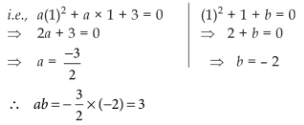
View full question & answer→MCQ 1661 Mark
The roots of the equation $\sqrt{x^2+15}=8$ are
- A
$x=7$
- ✓
$x= \pm 7$
- C
$x=-7$
- D
$x=0$
AnswerCorrect option: B. $x= \pm 7$
We have, $\sqrt{x^2+15}=8$
$\Rightarrow x^2+15=64\ [$Squaring both sides$]$
$\Rightarrow x^2=49 $
$\Rightarrow x= \pm 7$
View full question & answer→MCQ 1671 Mark
Find the roots of the following quadratic equation $2 \sqrt{3} x^2-5 x+\sqrt{3}=0$.
- A
$\frac{-\sqrt{3}}{2}, \frac{1}{\sqrt{3}}$
- B
$\frac{\sqrt{3}}{2}, \frac{-1}{\sqrt{3}}$
- ✓
$\frac{\sqrt{3}}{2}, \frac{1}{\sqrt{3}}$
- D
$\frac{-\sqrt{3}}{2}, \frac{-1}{\sqrt{3}}$
AnswerCorrect option: C. $\frac{\sqrt{3}}{2}, \frac{1}{\sqrt{3}}$
(c) : We have, $2 \sqrt{3} x^2-5 x+\sqrt{3}=0$
Discriminant, $D=25-4 \times 2 \sqrt{3} \times \sqrt{3}=25-24=1$
Using quadratic formula,
$
\begin{aligned}
x & =\frac{5 \pm \sqrt{1}}{2 \times 2 \sqrt{3}}=\frac{5 \pm 1}{4 \sqrt{3}} \\
\Rightarrow x & =\frac{6}{4 \sqrt{3}}=\frac{\sqrt{3}}{2} \quad \text { or } x=\frac{4}{4 \sqrt{3}}=\frac{1}{\sqrt{3}}
\end{aligned}
$
View full question & answer→MCQ 1681 Mark
The solution of the quadratic equation $\frac{x^2-8}{x^2+20}=\frac{1}{2}$ is shown below :
We have, $\frac{x^2-8}{x^2+20}=\frac{1}{2}$
$\Rightarrow 2 x^2-16=x^2+20($ step 1$)$
$\Rightarrow x^2=36$ (step 2)
$\Rightarrow x= \pm 5$ (step 3$)$
In which step is there an error in solving ?
Answer(c) : As $x^2=36 \Rightarrow x= \pm 6$
View full question & answer→MCQ 1691 Mark
For what value of $t, x=\frac{2}{3}$ is a root of $7 x^2+t x-3=0$ ?
- A
$\frac{1}{6}$
- ✓
$-\frac{1}{6}$
- C
$\frac{1}{5}$
- D
$\frac{1}{8}$
AnswerCorrect option: B. $-\frac{1}{6}$
Since $x=\frac{2}{3}$ is a root of $7 x^2+t x-3=0$
$\therefore 7\left(\frac{2}{3}\right)^2+t\left(\frac{2}{3}\right)-3=0$
$\Rightarrow \frac{28}{9}+\frac{2 t}{3}-3=0$
$\Rightarrow \frac{2 t}{3}+\frac{1}{9}=0 $
$\Rightarrow t=\frac{-1}{9} \times \frac{3}{2}=-\frac{1}{6}$
View full question & answer→MCQ 1701 Mark
Find the roots of quadratic equation $6 x^2-13 x+5=0$
- A
$2, \frac{3}{5}$
- B
$-2, \frac{-5}{3}$
- C
$\frac{1}{2}, \frac{-3}{5}$
- ✓
$\frac{1}{2}, \frac{5}{3}$
AnswerCorrect option: D. $\frac{1}{2}, \frac{5}{3}$
We have$, 6 x^2-13 x+5=0$
$\Rightarrow 6 x^2-3 x-10 x+5=0$
$\Rightarrow (2 x-1)(3 x-5)=0$
$\Rightarrow x=\frac{1}{2}, \frac{5}{3}$
View full question & answer→MCQ 1711 Mark
If $x=\sqrt{2+\sqrt{2+\sqrt{2+\ldots \infty}}}$ and $x$ is a natural number, then
- A
$x^2+x-2=0$
- B
$x^2+2 x+2=0$
- ✓
$x^2-x-2=0$
- D
$x^2-x+2=0$
AnswerCorrect option: C. $x^2-x-2=0$
(c) : We have, $x=\sqrt{2+\sqrt{2+\sqrt{2+\ldots \infty}}}$
$
\Rightarrow x=\sqrt{2+x} \quad[\because x=\sqrt{2+\sqrt{2+\sqrt{2+\ldots \infty}}}]
$
On squaring both sides, we get
$
x^2=2+x \Rightarrow x^2-x-2=0
$
View full question & answer→MCQ 1721 Mark
Solve the following quadratic equation for $x$ : $4 \sqrt{3} x^2+5 x-2 \sqrt{3}=0$
- ✓
$\frac{\sqrt{3}}{4}, \frac{-2}{\sqrt{3}}$
- B
$\frac{-\sqrt{3}}{4}, \frac{-2}{\sqrt{3}}$
- C
$\frac{\sqrt{3}}{4}, \frac{2}{\sqrt{3}}$
- D
$\frac{-\sqrt{3}}{4}, \frac{2}{\sqrt{3}}$
AnswerCorrect option: A. $\frac{\sqrt{3}}{4}, \frac{-2}{\sqrt{3}}$
We have, $4 \sqrt{3} x^2+5 x-2 \sqrt{3}=0$
$\Rightarrow 4 \sqrt{3} x^2+8 x-3 x-2 \sqrt{3}=0$
$\Rightarrow 4 x(\sqrt{3} x+2)-\sqrt{3}(\sqrt{3} x+2)=0$
$\Rightarrow(4 x-\sqrt{3})(\sqrt{3} x+2)=0$
$\therefore x=\frac{\sqrt{3}}{4} \text { or } x=-\frac{2}{\sqrt{3}}$
View full question & answer→MCQ 1731 Mark
Find the roots of the quadratic equation $x^2-3 \sqrt{5} x+10=0$.
- A
$-2 \sqrt{5}, \sqrt{5}$
- ✓
$2 \sqrt{5}, \sqrt{5}$
- C
$-2 \sqrt{5},-\sqrt{5}$
- D
$2 \sqrt{5},-\sqrt{5}$
AnswerCorrect option: B. $2 \sqrt{5}, \sqrt{5}$
Given, $x^2-3 \sqrt{5} x+10=0$
Using quadratic formula,
$x=\frac{3 \sqrt{5} \pm \sqrt{(-3 \sqrt{5})^2-4(1)(10)}}{2(1)}=\frac{3 \sqrt{5} \pm \sqrt{5}}{2}$
$\Rightarrow x=\frac{4 \sqrt{5}}{2} \text { or } x=\frac{2 \sqrt{5}}{2}$
$\Rightarrow x=2 \sqrt{5} \text { or } x=\sqrt{5}$
View full question & answer→MCQ 1741 Mark
The number of real roots of the equation $(x-1)^2+(x-2)^2+(x-3)^2=0$ is
AnswerWe have, $(x-1)^2+(x-2)^2+(x-3)^2=0$
$\Rightarrow x^2+1-2 x+x^2+4-4 x+x^2+9-6 x=0$
$\Rightarrow 3 x^2-12 x+14=0\ldots(i)$
For real roots, $D=b^2-4 a c \geq 0$
$\Rightarrow D=144-4(3)(14)$
$=144-168=-24<0$
$\therefore $ Equation $(i)$ has no real root.
View full question & answer→MCQ 1751 Mark
The discriminant of the equation $x^2+9 x-13=0$ is
AnswerWe have, $x^2+9 x-13=0$
Here, $a=1, b=9$ and $c=-13$.
$\therefore$ Discriminant$, D=b^2-4 a c=(9)^2-4(1)(-13)$
$=81+52=133$
View full question & answer→MCQ 1761 Mark
Which of the following is a root of the quadratic equation $\sqrt{3} x^2+10 x+7 \sqrt{3}=0$ ?
- ✓
$-\sqrt{3}$
- B
$\sqrt{3}$
- C
$7 \sqrt{3}$
- D
$-7 \sqrt{3}$
AnswerCorrect option: A. $-\sqrt{3}$
We have, $\sqrt{3} x^2+10 x+7 \sqrt{3}=0$
$\Rightarrow \sqrt{3} x^2+7 x+3 x+7 \sqrt{3}=0$
$\Rightarrow x(\sqrt{3} x+7)+\sqrt{3}(\sqrt{3} x+7)=0$
$\Rightarrow \quad(\sqrt{3} x+7)(x+\sqrt{3})=0$
$\Rightarrow x=\frac{-7}{\sqrt{3}} \text { or } x=-\sqrt{3}$
View full question & answer→MCQ 1771 Mark
The roots of the quadratic equation $2 x^2-3 x-5=0$ are
Answer(c) : We have, $2 x^2-3 x-5=0$
Here, $a=2, b=-3$ and $c=-5$.
$\therefore \quad D=b^2-4 a c=(-3)^2-4(2)(-5)$
$=9+40=49>0$ and 49 is a perfect square also.
Thus, given equation has rational and unequal roots.
View full question & answer→MCQ 1781 Mark
If $-2$ is a root of the quadratic equation $3 x^2+p x-8=0$ and the quadratic equation $4 x^2-2 p x+k=0$ has equal roots, then find the value of $k$.
AnswerSince $-2$ is a root of equation $3 x^2+p x-8=0$
$\therefore 3(-2)^2+p(-2)-8=0$
$\Rightarrow 12-2 p-8=0$
$ \Rightarrow 2 p=4$
$\Rightarrow p=2$
Now, the equation $4 x^2-2 p x+k=0$ has equal roots.
$\therefore D=0 $
$\Rightarrow(-2 p)^2-4(4)(k)=0$
$\Rightarrow (-2 \times 2)^2-16 k=0 $
$\Rightarrow k=1$
View full question & answer→MCQ 1791 Mark
If $\frac{1}{3}$ is a root of the equation $x^2+k x-\frac{5}{9}=0$, then find the value of $k$.
- A
$\frac{3}{4}$
- ✓
$\frac{4}{3}$
- C
$\frac{2}{3}$
- D
$\frac{3}{2}$
AnswerCorrect option: B. $\frac{4}{3}$
(b) : Since $\frac{1}{3}$ is a root of the equation, $x^2+k x-\frac{5}{9}=0$
$\therefore \quad\left(\frac{1}{3}\right)^2+k\left(\frac{1}{3}\right)-\frac{5}{9}=0$
$\Rightarrow \quad \frac{1}{3} k=\frac{5}{9}-\frac{1}{9}=\frac{4}{9} \Rightarrow k=\frac{4}{9} \times 3=\frac{4}{3}$
View full question & answer→MCQ 1801 Mark
The roots of the equation $x^2-2 x-\left(r^2-1\right)=0$ are
- A
$1-r,-r-1$
- ✓
$1-r, r+1$
- C
$1, r$
- D
$1-r, r$
AnswerCorrect option: B. $1-r, r+1$
We have, $x^2-2 x-\left(r^2-1\right)=0$
$\Rightarrow x^2-2 x+1=r^2 $.
$\Rightarrow(x-1)^2=r^2$
$\Rightarrow(x-1)= \pm r $.
$\Rightarrow x=1 \pm r$
View full question & answer→MCQ 1811 Mark
The sum of the squares of two consecutive natural numbers is $41$ . Represent this situation in the form of a quadratic equation.
- ✓
$x^2+x-20=0$
- B
$x^2-x-20=0$
- C
$x^2+x+20=0$
- D
$x^2-x+20=0$
AnswerCorrect option: A. $x^2+x-20=0$
Let the two consecutive natural numbers be $x$ and $x+1$.
Then, their squares are $x^2$ and $(x+1)^2$ respectively.
$\therefore$ The required equation is, $x^2+(x+1)^2=41$
$\Rightarrow x^2+x^2+1+2 x=41$
$\Rightarrow 2 x^2+2 x-40=0$
$\Rightarrow x^2+x-20=0$
View full question & answer→MCQ 1821 Mark
If $(x+4)(x-4)=9$, then the values of $x$ are
AnswerCorrect option: A. $\pm 5$
(a): We have, $(x+4)(x-4)=9$
$\Rightarrow x^2-16=9 \Rightarrow x^2=25 \Rightarrow x= \pm 5$
View full question & answer→MCQ 1831 Mark
Which of the following equations has the sum of its roots as 3?
AnswerCorrect option: B. $-x^2+3 x-3=0$
(b) : Consider, $-x^2+3 x-3=0$
On comparing with $a x^2+b x+c=0$, we get
$a=-1, b=3 \text { and } c=-3$
$\therefore$ Sum of the roots $=-\frac{b}{a}=-\frac{3}{-1}=3$
Therefore, sum of the roots of the quadratic equation $-x^2+3 x-3=0$ is 3 .
View full question & answer→MCQ 1841 Mark
The roots of the quadratic equation $2 x^2-x-6=0$ are
- A
$-2,3 / 2$
- ✓
$2,-3 / 2$
- C
$-2,-3 / 2$
- D
$2,3 / 2$
AnswerCorrect option: B. $2,-3 / 2$
We have, $2 x^2-x-6=0$
$\Rightarrow 2 x^2-4 x+3 x-6=0$
$\Rightarrow 2 x(x-2)+3(x-2)=0 $
$\Rightarrow(x-2)(2 x+3)=0$
$\Rightarrow x-2=0 \text { or } 2 x+3=0$
$\Rightarrow x=2 \text { or } x=-\frac{3}{2}$
View full question & answer→MCQ 1851 Mark
The value(s) of $k$ for which the quadratic equation $2 x^2+k x+2=0$ has equal roots, is
AnswerCorrect option: B. $\pm 4$
(b) : Given quadratic equation is
$2 x^2+k x+2=0$
Since the equation has equal roots.
$\begin{array}{ll}
\therefore & \text { Discriminant }=0 \\
\Rightarrow & k^2-4 \times 2 \times 2=0 \\
\Rightarrow & k^2-16=0 \\
\Rightarrow & k^2=16 \Rightarrow k= \pm 4
\end{array}$
View full question & answer→MCQ 1861 Mark
The roots of the equation $x^2+x-p(p+1)=0$, where $p$ is a constant, are
- A
$p, p+2$
- B
$-p, p-1$
- ✓
$p,-(p+1)$
- D
$-p,-(p+1)$
AnswerCorrect option: C. $p,-(p+1)$
(c): Given equation is $x^2+x-p(p+1)=0$
Using quadratic formula,
$\begin{aligned}
x= & \frac{-1 \pm \sqrt{1-(4)\left(-p^2-p\right)}}{2} \\
& =\frac{-1 \pm \sqrt{(2 p+1)^2}}{2}=\frac{-1 \pm(2 p+1)}{2} \\
\therefore \quad x & =\frac{-1+(2 p+1)}{2} \text { or } x=\frac{-1-(2 p+1)}{2} \\
\Rightarrow & x=\frac{2 p}{2}=p \text { or } x=\frac{-2-2 p}{2}=-(p+1)
\end{aligned}$
View full question & answer→MCQ 1871 Mark
The integral value of $k$ for which the equation $(k-12) x^2+2(k-12) x+2=0$ possesses no real solutions, is
Answer(b): We have, $(k-12) x^2+2(k-12) x+2=0$
For no real solution, $D<0$ i.e., $b^2-4 a c<0$
$\begin{aligned} & \Rightarrow \quad[2(k-12)]^2-4(k-12) \times 2<0
\\ & \Rightarrow \quad 2(k-12)[2(k-12)-4]<0
\\ & \Rightarrow \quad(k-12)[2 k-24-4]<0
\\ & \Rightarrow \quad(k-12)(2 k-28)<0 \Rightarrow 12<k<14 \Rightarrow k=13\end{aligned}$
View full question & answer→MCQ 1881 Mark
In the Maths test two representatives, while solving a quadratic equation, committed the following mistakes:
(i) One of them made a mistake in the constant term and got the roots as 5 and 9 .
(ii) Another one committed an error in the coefficient of $x$ and got the roots as 12 and 4 .
But in the meantime, they realised that they are wrong and they managed to get it right jointly. Find the correct quadratic equation.
- A
$x^2+4 x+14=0$
- B
$2 x^2+7 x-24=0$
- ✓
$x^2-14 x+48=0$
- D
$3 x^2-17 x+52=0$
AnswerCorrect option: C. $x^2-14 x+48=0$
(c) : Since, $1^{\text {st }}$ person made a mistake in constant term. Therefore, sum of roots $=14$ and $2^{\text {nd }}$ person made a mistake in coefficient of $x$
$\therefore \quad$ Product of roots $=48$
$\Rightarrow$ Required quadratic equation is
$x^2-14 x+48=0$
View full question & answer→MCQ 1891 Mark
Two equations are given below :
(i) $(x+1)(x+3)-x+7=0$
(ii) $x^2+2 x+\frac{1}{x}=0 ; x \neq 0$
Rohit and Mohit said the following :
Rohit : Equation (i) is quadratic.
Mohit : Equation (ii) is quadratic.
Which of them is/are correct ?
Answer(a) : (i) $(x+1)(x+3)-x+7=0$
$\Rightarrow x^2+4 x+3-x+7=0$
$\Rightarrow x^2+3 x+10=0$, which is a quadratic equation.
(ii) $x^2+2 x+\frac{1}{x}=0$
$\Rightarrow x^3+2 x^2+1=0$ which is a cubic equation.
View full question & answer→MCQ 1901 Mark
If $x=k$ be a solution of the quadratic equation $x^2+4 x+3=0$, then the possible values of $k$ will be
- A
$-1,2$
- ✓
$-1,-3$
- C
$-1,3$
- D
$-1,-2$
AnswerCorrect option: B. $-1,-3$
We have, $k^2+4 k+3=0 $
$\Rightarrow k^2+3 k+k+3=0$
$\Rightarrow k(k+3)+1(k+3)=0 $
$\Rightarrow(k+3)(k+1)=0$
$\Rightarrow k=-1,-3$
View full question & answer→MCQ 1911 Mark
Which of the following equations has no real roots?
- A
$x^2=10 x-2$
- B
$x^2-12 x=16$
- C
$7 x^2-1=-8 x$
- ✓
$2 x^2+5 x+5=0$
AnswerCorrect option: D. $2 x^2+5 x+5=0$
(d) : To have no real roots, discriminant $\left(D=b^2-4 a c\right)$ must be $<0$.
(a) $D=(-10)^2-4(1)(2)=100-8=92>0$
(b) $D=(-12)^2-4(1)(-16)=144+64=208>0$
(c) $D=(8)^2-4(7)(-1)=64+28=92>0$
(d) $D=(5)^2-4(2)(5)=25-40=-15<0$
View full question & answer→MCQ 1921 Mark
Find the roots of quadratic equation $2 x^2+x-300=0$
- A
$30, \frac{2}{15}$
- B
$60, \frac{-2}{5}$
- ✓
$12, \frac{-25}{2}$
- D
AnswerCorrect option: C. $12, \frac{-25}{2}$
We have$, 2 x^2+x-300=0$
$\Rightarrow 2 x^2-24 x+25 x-300=0$
$\Rightarrow (x-12)(2 x+25)=0$
$\Rightarrow x=12, \frac{-25}{2}$
View full question & answer→MCQ 1931 Mark
Find the positive value of $k$ for which quadratic equations $x^2+k x+64=0$ and $x^2-8 x+k=0$ will have real roots.
Answer(a): We have, $x^2+k x+64=0$
Since, roots are real. $\therefore b^2-4 a c \geq 0$
$\Rightarrow k^2-4(1)(64) \geq 0 \Rightarrow k^2 \geq 256\ldots(i)$
Also, $x^2-8 x+k=0$ has real roots.
$\Rightarrow 64-4 k \geq 0 \Rightarrow 64 \geq 4 k \Rightarrow k \leq 16\ldots(ii)$
From (i) and (ii), we get $k=16$.
View full question & answer→MCQ 1941 Mark
The necessary condition for $a x^2+b x+c=0$ to be quadratic is
- ✓
$a \neq 0$
- B
$a=0$
- C
$c \neq 0$
- D
AnswerCorrect option: A. $a \neq 0$
(a): The necessary condition for $a x^2+b x+c=0$ to be quadratic is $a \neq 0$.
View full question & answer→MCQ 1951 Mark
Which of the following equations has two distinct real roots?
AnswerCorrect option: B. $x^2+x-5=0$
(b) : To have two distinct real roots, discriminant $\left(D=b^2-4 a c\right)$ must be $>0$.
(a) $D=(-3 \sqrt{2})^2-4(2) \times\left(\frac{9}{4}\right)=18-18=0$
(b) $D=(1)^2-4(1)(-5)=1+20=21>0$
(c) $D=(3)^2-4(1)(2 \sqrt{2})=9-8 \sqrt{2}<0$
(d) $D=(-3)^2-4(5)(1)=9-20=-11<0$
View full question & answer→MCQ 1961 Mark
The roots of the quadratic equation $\frac{11}{3+x}=4(3-x)$ are
- A
$\pm \frac{1}{5}$
- ✓
$\pm \frac{5}{2}$
- C
$\pm 2$
- D
$\pm 5$
AnswerCorrect option: B. $\pm \frac{5}{2}$
We have$, \frac{11}{3+x}=4(3-x)$
$\Rightarrow 4(3+x)(3-x)=11 $
$\Rightarrow 4\left(9-x^2\right)=11$
$\Rightarrow 36-4 x^2=11$
$\Rightarrow 4 x^2=25$
$\Rightarrow x^2=\frac{25}{4}=\left(\frac{5}{2}\right)^2 $
$\therefore x= \pm \frac{5}{2}$
View full question & answer→MCQ 1971 Mark
$a x^2+b x+c=0, a>0, b=0, c>0$ has
Answer$D=b^2-4 a c=(0)^2-4 a c\ \left[
{[\because b=0}
\right]$
$=-4 a c<0$
$\therefore a x^2+b x+c=0$ has no real roots.
View full question & answer→MCQ 1981 Mark
The roots of the equation $x^2+5 x+5=0$ are
- ✓
$\frac{-5+\sqrt{5}}{2}, \frac{-5-\sqrt{5}}{2}$
- B
$\frac{5-\sqrt{5}}{2}, \frac{5+\sqrt{5}}{2}$
- C
$\frac{-3+\sqrt{5}}{2}, \frac{-3-\sqrt{5}}{2}$
- D
$\frac{3-\sqrt{5}}{2}, \frac{3+\sqrt{5}}{2}$
AnswerCorrect option: A. $\frac{-5+\sqrt{5}}{2}, \frac{-5-\sqrt{5}}{2}$
(a) : The given equation is $x^2+5 x+5=0$.
Here, $a=1, b=5$ and $c=5$
$\therefore D=b^2-4 a c=25-4 \times 1 \times 5=5$
The roots are given by $\alpha=\frac{-b+\sqrt{D}}{2 a}=\frac{-5+\sqrt{5}}{2}$ and
$\beta=\frac{-b-\sqrt{D}}{2 a}=\frac{-5-\sqrt{5}}{2}$
View full question & answer→MCQ 1991 Mark
The two roots of a quadratic equation are $2$ and $-1$ . The equation is
- A
$x^2+2 x-2=0$
- B
$x^2+x+2=0$
- C
$x^2-2 x+2=0$
- ✓
$x^2-x-2=0$
AnswerCorrect option: D. $x^2-x-2=0$
Putting $x=2,-1$ in $x^2-x-2$, we get
$(2)^2-2-2=4-2-2=0$
and $(-1)^2-(-1)-2=1+1-2=0$
So$, 2$ and $-1$ are the roots of the equation $x^2-x-2=0$.
View full question & answer→MCQ 2001 Mark
A rope of $16 \ m$ is divided into two parts such that twice the square of the greater part exceeds the square of the smaller part by $164 .$ Then greater and smaller parts are respectively
- A
$11 m , 5 m$
- B
$9 m , 7 m$
- C
$12 m , 4 m$
- ✓
$10 m , 6 m$
AnswerCorrect option: D. $10 m , 6 m$
Let the greater part be $x m$.
$\therefore$ Smaller part will be $(16-x) m$.
According to the question, $2 x^2=(16-x)^2+164$
$\Rightarrow 2 x^2=256+x^2-32 x+164$
$\Rightarrow x^2+32 x-420=0$
$\Rightarrow x^2+42 x-10 x-420=0$
$\Rightarrow x(x+42)-10(x+42)=0$
$\Rightarrow(x+42)(x-10)=0$
$\Rightarrow x=10,-42 \therefore x=10$
$($Neglecting $x=-42$ as length can not be negative$)$
$\therefore$ Two parts are of length $10 m$ and $(16-10) m =6 m$.
View full question & answer→MCQ 2011 Mark
If roots of the quadratic equation
$3 a x^2+2 b x+c=0$ are in the ratio $2: 3$, then
Ram and Shyam said the following :
Ram $: 8 a c=25 b$
Shyam : $8 b^2=9 a c$
Which of them is/are correct?
AnswerLet $\alpha$ and $\beta$ be the roots of $3 a x^2+2 b x+c=0$.
Then, $\alpha+\beta=\frac{-2 b}{3 a}, \alpha \beta=\frac{c}{3 a}$.
Given $, \frac{\alpha}{\beta}=\frac{2}{3} $
$\Rightarrow \alpha=\frac{2}{3} \beta$
$\therefore \frac{2}{3} \beta+\beta=-\frac{2 b}{3 a} $
$\Rightarrow \frac{5 \beta}{3}=\frac{-2 b}{3 a} $
$\Rightarrow \beta=\frac{-2 b}{5 a}$
$\therefore \alpha=\frac{2}{3} \times \frac{-2 b}{5 a}=\frac{-4 b}{15 a}$
Now, $\alpha \beta=\frac{c}{3 a}$
$ \Rightarrow\left(\frac{-4 b}{15 a}\right) \times\left(\frac{-2 b}{5 a}\right)=\frac{c}{3 a} $
$\Rightarrow 8 b^2=25 a c$
View full question & answer→MCQ 2021 Mark
The roots of the equation $2 x-\frac{3}{x}=1 \ (x \neq 0)$ are
- A
$\frac{1}{2},-1$
- B
$\frac{3}{2}, 1$
- ✓
$\frac{3}{2},-1$
- D
AnswerCorrect option: C. $\frac{3}{2},-1$
$2 x-\frac{3}{x}=1 $
$\Rightarrow 2 x^2-3=x$
$\Rightarrow 2 x^2-x-3=0 $
$\Rightarrow 2 x^2-3 x+2 x-3=0$
$\Rightarrow x(2 x-3)+1(2 x-3)=0$
$\Rightarrow(2 x-3)(x+1)=0 $
$\Rightarrow x=-1,3 / 2$
View full question & answer→MCQ 2031 Mark
The quadratic equation $a x^2-4 a x+2 a+1=0$ has repeated roots, if $a=$
AnswerCorrect option: B. $1 / 2$
The roots are said to be repeated, if
$B^2-4 A C=0 $
$\Rightarrow(-4 a)^2-4 \times a \times(2 a+1)=0$
$\Rightarrow 16 a^2-4 a(2 a+1)-0$
$ \Rightarrow 16 a^2-8 a^2-4 a-0$
$\Rightarrow 8 a^2-4 a=0 $
$\Rightarrow a(8 a-4)=0 $
$\Rightarrow a=0 \text { or } 8 a-4=0$
$\therefore a=1 / 2 \ (\because a \neq 0)$
View full question & answer→