Questions

5 Marks Questions

Take a timed test

8 questions · self-marked practice — reveal the answer and mark yourself.

Question 15 Marks
At present Asha’s age (in years) is 2 more than the square of her daughter Nisha’s age. When Nisha grows to her mother’s present age, Asha’s age would be one year less than 10 times the present age of Nisha. Find the present ages of both Asha and Nisha.
Answer
Let the present age of Asha = x yearsand the present age of her daughter Nisha = y years
At present, Asha's age, $x = (y^2) + 2 .....(I)$
Age of Nisha will be equal to age of her mpther (x) after
= Age of Mother - Age of Daughter
$= x - y$
$= y^2 + 2 - y = y^2 - y + 2$
$\therefore$ Age of (Nisha) daughter after $(y^2 - y + 2)$ years
$= y^2 - y + 2 + y = (y^2 + 2)$years
Age of Asha (mother) after $(y^3 - y + 2)$ years
$= x + y^2 -y + 2$
$= y^2 + 2+ y^2 - y + 2$ [From I]
$= 2y^2 - y + 4$ years
After $(y^2 - y - 2)$ years, age of Asha $= 2y^2 - y + 4 = 10y - 1$
$\Rightarrow 2y^2 - y - 10y + 5 = 0$
$\Rightarrow 2y^2 - 11y + 5 = 0$
$\Rightarrow 2y^2 - 10y - 1y + 5 = 0$
$\Rightarrow 2y(y - 5) -1(y - 5) = 0$
$\Rightarrow (y - 5)(2y - 1) = 0$
$\Rightarrow y - 5 = 0 or 2y - 1 = 0$
$\Rightarrow y = 5$ or $\text{y}=\frac{1}{2}\text{years}$
From I, we have
$x = y^2 + 2$
Putting y = 5, we have
$x = (5)^2 + 2 = 25 + 2 = 27$
Putting $\text{y}=\frac{1}{2}$, we have
$\text{x}=\Big(\frac{1}{2}\Big)^2+2=2\frac{1}{4}\text{years}$
Mother's age can never be $2\frac{1}{4}$ years, so it is relected.
Hence, the ages of Asha and Nisha are 27 years and 5 years respectively.
View full question & answer
Question 25 Marks
Find the roots of the quadratic equations by using the quadratic formula in each of the following:
$\text{x}^2+2\sqrt{2}\text{x}-6=0.$
Answer
Given equation is $\text{x}^2+2\sqrt{2}\text{x}-6=0$On comparing with $ax^2 + bx + c = 0$, we get
a = 1, $\text{b}=2\sqrt{2}$ and c = -6
By quadratic formula, $\text{x}=\frac{-\text{b}\pm\sqrt{\text{b}^2-4\text{ac}}}{2\text{a}}$
$=\frac{(2\sqrt{2})\pm\sqrt{(2\sqrt{2})^2-4(1)(-6)}}{2(1)}=\frac{-2\sqrt{2}\pm\sqrt{8+24}}{2}$
$=\frac{-2\sqrt{2}\pm\sqrt{32}}{2}=\frac{-2\sqrt{2}\pm4\sqrt{2}}{2}$
$=\frac{-2\sqrt{2}+4\sqrt{2}}{2},\frac{-2\sqrt{2}-4\sqrt{2}}{2}=\sqrt{2},-3\sqrt{2}$
So, $\sqrt{2}$ and $-3\sqrt{2}$ are the roots of the given equation.
View full question & answer
Question 35 Marks
If Zeba were younger by 5 years than what she really is, then the square of her age (in years) would have been 11 more than five times her actual age. What is her age now?
Answer
Let Zeba's actual (real) age now = x years
$\therefore$ Zeba's age when she was 5 years younger than now = (x - 5) years
According to the question,
$(x - 5)^2 = 5x + 11$
$\Rightarrow (x)^2 + (5)^2 - 2(x)(5) - 5x - 11 = 0$
$\Rightarrow x^2 + 25 - 10x - 5x - 11 = 0$
$\Rightarrow x^2 - 15x + 14 = 0$
$\Rightarrow x^2 - 14x - 1x + 14 = 0$
$\Rightarrow x(x - 14) - 1(x - 14) = 0$
$\Rightarrow (x - 14)(x - 1) = 0$
$\Rightarrow x - 14 = 0 or x - 1 = 0$
$\Rightarrow x = 14 or x = 1$ year
When 5 is subtracted from 1, we get negative age so x = 1 is rejected.
Hence, the age of Zeba is 14 years.
View full question & answer
Question 45 Marks
Find whether the following equations have real roots. If real roots exist, find them.
$\frac{1}{2\text{x}-3}+\frac{1}{\text{x}-5}=1,\text{x}\neq\frac{3}{2},5.$
Answer
Main concept used: For real roots of quadratic equation. $ax^2 + bx + c = 0, b^2 - 4ac > 0$ The Given equation is $\frac{1}{2\text{x}-3}+\frac{1}{\text{x}-5}=1,\text{x}\neq\frac{3}{2},5$
$\Rightarrow\ \frac{(\text{x}-5)+(2\text{x}-3)}{(2\text{x}-3)(\text{x}-5)}=1$
$\Rightarrow 2x^2 - 10x - 3x + 15 = x - 5 + 2x - 3$
$\Rightarrow 2x^2 - 13x + 15 = 3x - 8$
$\Rightarrow 2x^2 - 13x + 15 - 3x + 8 = 0$
$\Rightarrow 2x^2 - 16x + 23 = 0$ Discriminant
$(D) = b^2 - 4ac= (-16)^2 - 4(2)(23) (a = 2, b = -16, c = 23)$
$\Rightarrow D = 256 - 184 = 72 > 0$
$\Rightarrow\ \sqrt{\text{D}}=\sqrt{72}$
$\Rightarrow\ \sqrt{\text{D}}=6\sqrt{2}$
Now, $\text{x}=\frac{-\text{b}\pm\sqrt{\text{D}}}{2\text{a}}=\frac{+16\pm\sqrt{2}}{2\times2}=\frac{16}{4}\pm\frac{6\sqrt{2}}{4}$
$\Rightarrow\ \text{x}_1=4+\frac{3}{2}\sqrt{2}$ and $\text{x}_2=4-\frac{3}{2}\sqrt{2}$
Hence, the roots of the given quadratic equation are
$\bigg(4+\frac{3}{2}\sqrt{2}\bigg)$ and $\bigg(4-\frac{3}{2}\sqrt{2}\bigg)$
View full question & answer
Question 55 Marks
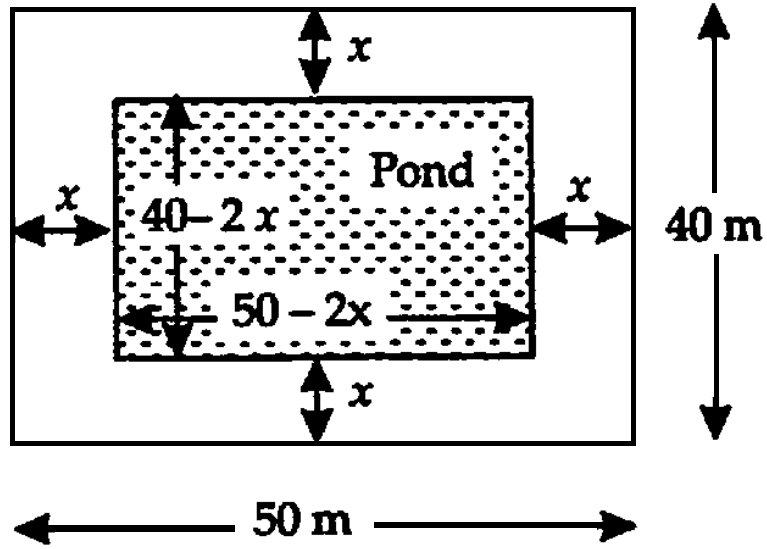
In the centre of a rectangular lawn of dimensions 50m × 40m, a rectangular pond has to be constructed so that the area of the grass surrounding the pond would be $1184m^2$. Find the length and breadth of the pond.
Answer
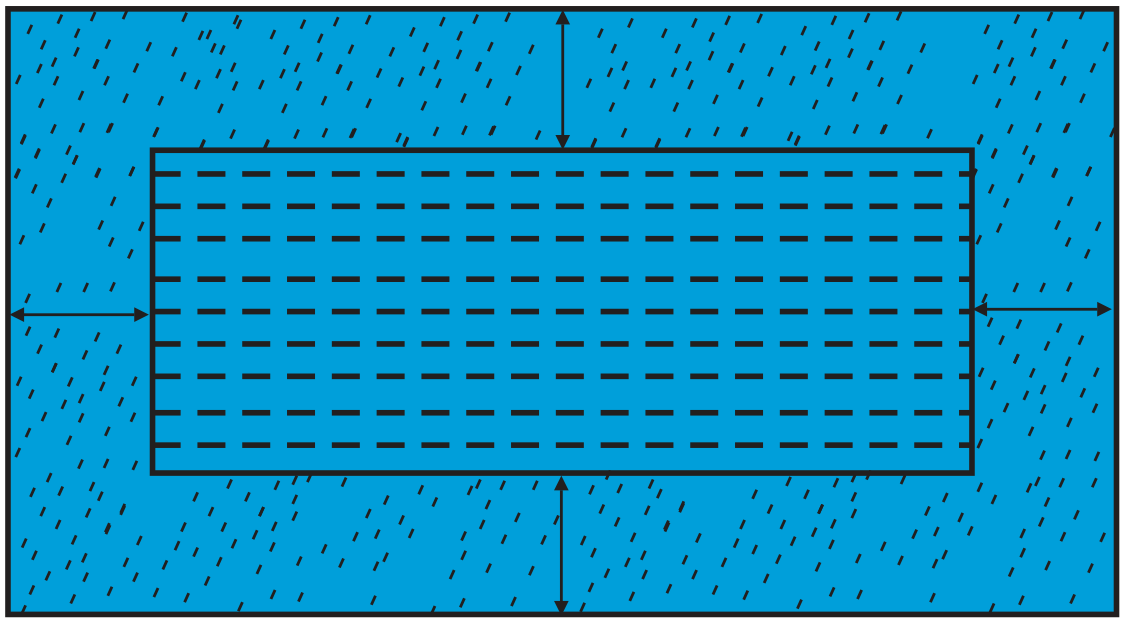
Pond and lawn both are rectangular. Pond is inside the lawn.

Let the length of pond = (50 - 2x)m
and the breadth of pond = (40 - 2x)m
But, Area of grass around the pond $= 1184m^2$​​​​​​​
⇒ Area of Lawn - Area of Pond = 1184
$\Rightarrow 50 \times 40 - (50 - 2x)(40 - 2x) = 1184$
$\Rightarrow 2000 - (2000 - 100x - 80x + 4x^2) - 1184 = 0$
$\Rightarrow 2000 - (2000 - 180x + 4x^2) - 1184 = 0$
$\Rightarrow 2000 - 2000 + 180x - 4x^2 - 1184 = 0$
$\Rightarrow 4x^2 - 180x + 1184 = 0$
$\Rightarrow x^2 - 45x + 296 = 0$
$\Rightarrow x^2 - 37x - 8x + 296 = 0$
$\Rightarrow x(x - 37) - 8(x - 37) = 0$
$\Rightarrow (x - 37)(x - 8) = 0$
$\Rightarrow x - 37 = 0 or x - 8 = 0$
$\Rightarrow 3 = 37 or x = 8$
When x = 37, then
the length of pond = 50 - 2 × 37
$= 50 - 74$
$= -24m$
Length cannot be negative. So, x = 37 is rejected.
When x = 8, then
the length of pond = 50 - 2x
$= 50 - 2 × 8$
$= 50 - 16$
= 34m
and the breadth of the pond
$= 40 - 2x$
$= 40 - 2 × 8$
$= 40 - 16$
$= 24m$
Hence, the length and breadth of the pond are 34m abd 24m respectively.
View full question & answer
Question 65 Marks
A train, travelling at a uniform speed for 360km, would have taken 48 minutes less to travel the same distance if its speed were 5km/hr more. Find the original speed of the train.
Answer
Let the original speed of train = x km/hr
So, the new increased speed of train = (x + 5)km/hr
Time taken by train in covering 360km with original speed
$=\frac{\text{Distance}}{\text{Speed}}=\frac{360}{\text{x}}\text{hr}$
Time taken by train in covering 360km with new speed $=\frac{360}{\text{x}+5}\text{hr}$
According to the question,
$\frac{360}{\text{x}}-\frac{360}{\text{x}+5}=\frac{48}{60}\text{hr}$
$\Rightarrow\ 360\bigg[\frac{1}{\text{x}}-\frac{1}{(\text{x}+5)}\bigg]=\frac{4}{5}$
$\Rightarrow\ 360\bigg[\frac{\text{x}+5-\text{x}}{\text{x}(\text{x}+5)}\bigg]=\frac{4}{5}$
$\Rightarrow\ \frac{90[5]}{\text{x}^2+5\text{x}}=\frac{1}{5}$
$\Rightarrow x^2 + 5x = 90 \times 25$
$\Rightarrow x^2 + 5x - 90 \times 25 = 0$
$\Rightarrow x^2 + 50x - 45x - 90 \times 25 = 0$
$\Rightarrow x(x + 50) -45[x + 10 \times 5] = 0$
$\Rightarrow (x + 50)(x - 45) = 0$
$\Rightarrow x + 50 = 0 or x - 45 = 0$
$\Rightarrow x = -50 or x = 45$
x = -50 is rejected as it is negative,
Hence, the original speed of train is 45km/hr.
View full question & answer
Question 75 Marks
Find the roots of the following quadratic equations by the factorisation method:
$21\text{x}^2-2\text{x}+\frac{1}{21}=0.$
Answer
Given equation is $21\text{x}^2-2\text{x}+\frac{1}{21}=0$
On multiplying bt 21 on both sides, we get
$441x^2 - 42x + 1 = 0$
$441x^2 - (21x + 21x) + 1 = 0$ [by splitting the middle term]
$\Rightarrow 441x^2 - 21x - 21x + 1 = 0$
$\Rightarrow 21x(21x - 1) - 1(21x - 1) = 0$
$\Rightarrow (21x - 1)(21x - 1) = 0$
Now, $21\text{x}-1=0\Rightarrow\ \text{x}=\frac{1}{21}$ and $21\text{x}-1=0$
$\therefore\ \text{x}=\frac{1}{21}$
Hence, the roots of the equation $441x^2 - 42x + 1 = 0$ are $\frac{1}{21}$ and $\frac{1}{21}$.
View full question & answer
Question 85 Marks
Find the roots of the quadratic equations by using the quadratic formula in each of the following:
$\frac{1}{2}\text{x}^2-\sqrt{11}\text{x}+1=0.$
Answer
Given equation is $\frac{1}{2}\text{x}^2-\sqrt{11}\text{x}+1=0$
On comparing with $ax^2 + bx + c = 0$, we get
$\text{a}=\frac{1}{2}$, $\text{b}=-\sqrt{11}$ and c = 10
$\therefore$ By quadratic formula, $\text{x}=\frac{-\text{b}\pm\sqrt{\text{b}^2-4\text{ac}}}{2\text{a}}$
$=\frac{-(-\sqrt{11})\pm\sqrt{(-\sqrt{11})^2-4\times\frac{1}{2}\times1}}{2\Big(\frac{1}{2}\Big)}$
$=\frac{\sqrt{11}\pm\sqrt{11-2}}{1}=\text{11}\pm\sqrt{9}$
$=\sqrt{11}\pm3=3+\sqrt{11},\sqrt{11}-3$
So, $3+\sqrt{11}$ and $\sqrt{11}-3$ are the roots of the given equation.
View full question & answer