Questions

2 Marks Questions

Take a timed test

12 questions · self-marked practice — reveal the answer and mark yourself.

Question 12 Marks
Check whether $6^n$ can end with the digit 0 for any natural number $n$.
Answer
If any number ends with the digit 0 , it should be divisible by 10 or in other words, it will also be divisible by 2 and 5 as $10=2 \times 5$
Prime factorisation of $6^n=(2 \times 3)^n$
It can be observed that 5 is not in the prime factorisation of $6^n$.
Hence, for any value of $n, 6^n$ will not be divisible by 5 .
Therefore, $6^{ n }$ cannot end with the digit 0 for any natural number $n$.
View full question & answer
Question 22 Marks

Given that HCF (306, 657) = 9, find LCM (306, 657).

Answer

As we know that, HCF $\times$ LCM = Product of two numbers
LCM (306, 657) = $\frac{306 \times 657}{HCF(306,657)}$ = $\frac{306 \times 657}{9}$ = 22338.

View full question & answer
Question 32 Marks
Find the LCM and HCF of 12, 15 and 21 integers by applying the prime factorisation method.
Answer
$12, 15$ and $21$
$12 = 2^2 \times 3$
$15 = 3 \times 5$
$21 = 3 \times 7$
$HCF = 3$
$LCM = 2^2 \times 3 \times 5 \times 7 = 420$
View full question & answer
Question 42 Marks
Find the LCM and HCF of 8, 9 and 25 integers by applying the prime factorisation method.
Answer
$8,9 \text { and } 25$
$8=2 \times 2 \times 2=2^3$
$9=3 \times 3=3^2$
$25=5 \times 5=5^2$
$\text { HCF }=1$
$\text { LCM }=2^3 \times 3^2 \times 5^2=1800$
View full question & answer
Question 52 Marks

Find the LCM and HCF of 17, 23 and 29 integers by applying the prime factorisation method.

Answer

Given numbers are: 17, 23 and 29
Since the three numbers are prime, we have
17 = 1 × 17
23 = 1 × 23
29 = 1 × 29
$\Rightarrow$ HCF = 1
and LCM = 17 × 23 × 29 = 11339

View full question & answer
Question 62 Marks

Find the LCM and HCF of 510 and 92 pairs of integers and verify that LCM $\times$ HCF = product of the two numbers.

Answer

510 and 92
510= 2 × 3 × 5× 17
92 = 2 × 2 × 23
HCF = 2
LCM = 2 × 2 × 3 × 5 × 17 × 23 = 23460
Product of two numbers 510 and 92 = 510 × 92 = 46920
HCF × LCM = 2 × 23460 = 46920
Hence, product of two numbers = HCF × LCM

View full question & answer
Question 72 Marks

Find the LCM and HCF of 26 and 91 pairs of integers and verify that LCM $\times$ HCF = product of the two numbers.

Answer

26 and 91
26= 2 × 13
91 = 7 × 13
HCF = 13
LCM = 2 × 7 × 13 = 182
Product of two numbers 26 and 91 = 26 × 91 = 2366
HCF × LCM = 13 × 182 = 2366
Hence, product of two numbers = HCF × LCM

View full question & answer
Question 92 Marks

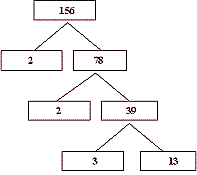
Express 156 as the product of its prime factors.

Answer


So, the factors of 156 are 2 $\times$ 2 $\times$ 3 $\times$ 13

View full question & answer
Question 102 Marks
Find the HCF and LCM of 6, 72 and 120, using the prime factorisation method.
Answer
We have: $6=2 \times 3,72=2^3 \times 3^2, 120=2^3 \times 3 \times 5$
Here, $2^1$ and $3^1$ are the smallest powers of the common factors 2 and 3 respectively.
So, $\operatorname{HCF}(6,72,120)=2^{1 \times} 3^1=2^{\times} 3=6$
$2^3, 3^2$ and $5^1$ are the greatest powers of prime factors 2,3 and 5 respectively involved in the three numbers.
So, $\operatorname{LCM}(6,72,120)=2^{3 \times} 3^{2 \times} 5^1=360$
View full question & answer
Question 112 Marks

Find the HCF of 96 and 404 by prime factorisation method. Hence, find their LCM.

Answer
We have,
$96 = 2 ^ { 5 } \times 3$ and $404 = 2 ^ { 2 } \times 101$
$\therefore \quad \mathrm { HCF } = 2 ^ { 2 } = 4$
Now, $\mathrm { HCF } \times \mathrm { LCM } = 96 \times 404$
$\Rightarrow \quad \mathrm { LCM } = \frac { 96 \times 404 } { \mathrm { HCF } } = \frac { 96 \times 404 } { 4 }$ $= 96 \times 101 = 9696$
View full question & answer
Question 122 Marks
Find the LCM and HCF of 6 and 20 by the prime factorisation method.
Answer
We have: $6=2^1 \times 3^1$ and $20=2 \times 2 \times 5=2^2 \times 5^1$
Now $\operatorname{HCF}(6,20)=2^1=2$ = Product of the smallest power of each common prime factor and $\operatorname{LCM}(6,20)=2^2 \times 3^1 \times 5^1=60=$ Product of the greatest power of each prime factor
View full question & answer