Questions

5 Marks Questions

Take a timed test

6 questions · self-marked practice — reveal the answer and mark yourself.

Question 15 Marks
The angle of elevation of a stationery cloud from a point 2500m above a lake is 15° and the angle of depression of its reflection in the lake is 45°. What is the height of the cloud above the lake level? (Use tan 15° = 0.268)
Answer
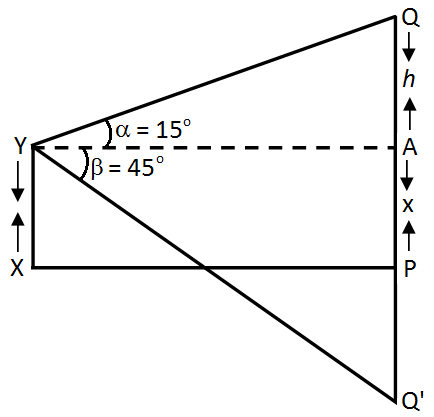
Let cloud be at height PQ as represented from lake level
From point x, 2500 meters above the lake angle of elevation of top of cloud $\alpha=15^\circ$
Angle of depression of shadow reflection in water $\beta=45^\circ$
Here PQ = PQ' draw $\text{AY}\bot\text{PQ}$
Let AQ = 'h' m, AP = 'x' m
PQ = (h + x)m, PQ' = (h + x)m
The above data is represented in from of figure as shown,
In right triangle if one of included angle is $\theta$ then,
$\tan\theta=\frac{\text{Opposite side}}{\text{Adjacent side}}$
$\tan15^\circ=\frac{\text{AQ}}{\text{AY}}$
$\Rightarrow\ 0.268=\frac{\text{h}}{\text{AY}}$
$\Rightarrow\ \text{AY}=\frac{\text{h}}{0.268}\ ......(1)$
$\tan45^\circ=\frac{\text{AB}'}{\text{AY}}=\frac{\text{AP}+\text{PQ}'}{\text{AY}}$
$\Rightarrow\ \text{AY}=\text{x}+(\text{h}+\text{x})$
$=\text{h}+2\text{x}$
$\Rightarrow\ \text{AY}=\text{h}+2\text{x}\ ......(2)$
From (1) and (2)
$\frac{\text{h}}{0.268}=\text{h}+2\text{x}$
$\Rightarrow\ 3.131\text{h}-\text{h}=2\times2500$
$\Rightarrow\ \text{h}=\frac{5000}{0.731}=1830.8312$
Height of cloud above lake = h + x
= 1830.8312 + 2500
= 4300.8312m
View full question & answer
Question 25 Marks
If the angle of elevation of a cloud from a point h metres above a lake is a and the angle of depression of its reflection in the lake be b, prove that the distance of the cloud from the point of observation is, $\frac{2\text{h}\sec\alpha}{\tan\beta-\tan\alpha}.$
Answer
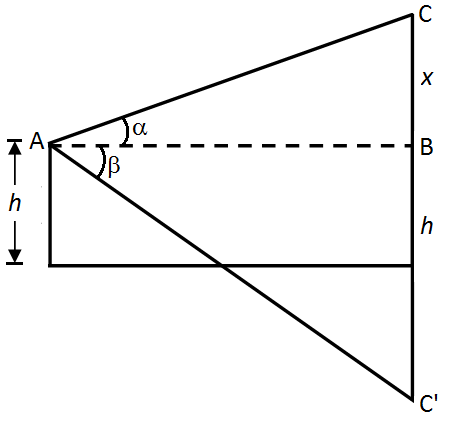
Let C′ be the image of cloud C. We have $\angle\text{CAB}=\alpha$ and $\angle\text{BAC}'=\beta.$
Again let BC = x and AC be the distance of cloud from point of observation.
We have to prove that,
$\text{AC}=\frac{2\text{h}\sec\alpha}{(\tan\beta-\tan\alpha)}$
The corresponding figure is as follows,

We use trigonometric ratios.
In $\triangle\text{ABC}$
$\Rightarrow\ \tan\alpha=\frac{\text{BC}}{\text{AB}}$
$\Rightarrow\ \tan\alpha=\frac{\text{x}}{\text{AB}}$
Again in $\triangle\text{ABC}'$
$\Rightarrow\ \tan\beta=\frac{\text{BC}'}{\text{AB}}$
$\Rightarrow\ \tan\beta=\frac{\text{x}+2\text{h}}{\text{AB}}$
Now,
$\Rightarrow\ \tan\beta-\tan\alpha=\frac{\text{x}+2\text{h}}{\text{AB}}-\frac{\text{x}}{\text{AB}}$
$\Rightarrow\ \tan\beta-\tan\alpha=\frac{2\text{h}}{\text{AB}}$
$\Rightarrow\ \text{AB}=\frac{2\text{h}}{\tan\beta-\tan\alpha}$
Again in $\triangle\text{ABC}$
$\Rightarrow\ \cos\alpha=\frac{\text{AB}}{\text{AC}}$
$\Rightarrow\ \text{AC}=\frac{\text{AB}}{\cos\alpha}$
$\Rightarrow\ \text{AC}=\frac{2\text{h}\sec\alpha}{(\tan\beta-\tan\alpha)}$
Hence distance of cloud from points of observation is $\frac{2\text{h}\sec\alpha}{(\tan\beta-\tan\alpha)}.$
View full question & answer
Question 35 Marks
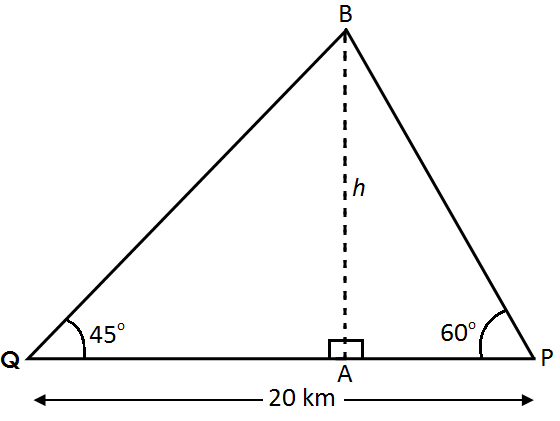
A fire in a building B is reported on telephone to two fire stations P and Q, 20km a part from each other on a straight road. P observes that the fire is at an angle of 60° to the road and Q observes that it is at an angle of 45° to the road. Which station should send its team and how much will this team have to travel?
Answer
Let B is the building one fire and P and Q the fire stations which are 20km apart i.e., PQ = 20km.

P and Q observes the angles with B, as 60° and 45° respectively.
Draw $\text{BA}\bot\text{PQ}$
Let AB = h Now in right $\triangle\text{BAQ}$
$\tan\theta=\frac{\text{Perpendicular}}{\text{Base}}=\frac{\text{BA}}{\text{AQ}}$
$\Rightarrow\ \tan45^\circ=\frac{\text{h}}{\text{AQ}}$
$\Rightarrow\ 1=\frac{\text{h}}{\text{AQ}}\Rightarrow\ \text{AQ}=\text{h}$
$\therefore$ PA = 20 - h
Similarly in right $\triangle\text{BAP}$
$\tan60^\circ=\frac{\text{BA}}{\text{AP}}$
$\Rightarrow\ \sqrt{3}=\frac{\text{h}}{20-\text{h}}$
$\Rightarrow\ (20-\text{h})\sqrt{3}=\text{h}$
$\Rightarrow\ 20\sqrt{3}-\sqrt{3}\text{h}=\text{h}$
$\Rightarrow\ \sqrt{3}\text{h}+\text{h}=20\sqrt{3}$
$\Rightarrow\ \text{h}(\sqrt{3}+1)=20\sqrt{3}$
$\Rightarrow\ \text{h}=\frac{20\sqrt{3}}{\sqrt{3}+1}=\frac{20\sqrt{3}(\sqrt{3}-1)}{(\sqrt{3}+1)(\sqrt{3}-1)}$
$=\frac{20\sqrt{3}(\sqrt{3}-1)}{3-1}$
$=\frac{20\sqrt{3}(\sqrt{3}-1)}{2}$
$=10\sqrt{3}(\sqrt{3}-1)$
$=10\times3-10\sqrt{3}$
= 30 - 10 × 1.732
= 30 - 17.3 = 12.7km
$\therefore$ AQ = 12.7km and AP = 20.0 - 12.7 = 7.3km
Now, $\sin45^\circ=\frac{\text{Perpendicular}}{\text{Hypotenuse}}$
$\Rightarrow\ \frac{1}{\sqrt{2}}=\frac{\text{h}}{\text{BQ}}$
$\Rightarrow\ \frac{1}{\sqrt{2}}=\frac{12.7}{\text{BQ}}$
$\Rightarrow\ \text{BQ}=12.7\times\sqrt{2}=12.7\times1.41$
$\Rightarrow\ \text{BQ}=17.91\text{km}$
Similarly, $\sin60^\circ=\frac{\text{BA}}{\text{BP}}=\frac{12.7}{\text{BP}}$
$\Rightarrow\ \frac{\sqrt{3}}{2}=\frac{12.7}{\text{BP}}\Rightarrow\ \text{BP}=\frac{12.7\times2}{\sqrt{3}}$
$\Rightarrow\ \text{BP}=\frac{25.4}{1.73}=14.68$
It is clear that P fire station is nearer and its team will reach the building after coming 14.6km
View full question & answer
Question 45 Marks
A tree standing on a horizontal plane is leaning towards east. At two points situated at distances a and b exactly due west on it, the angles of elevation of the top are respectively $\alpha$ and $\beta.$ Prove that the height of the top from the ground is, $\frac{(\text{b}-\text{a})\tan\alpha\tan\beta}{\tan\alpha-\tan\beta}.$
Answer
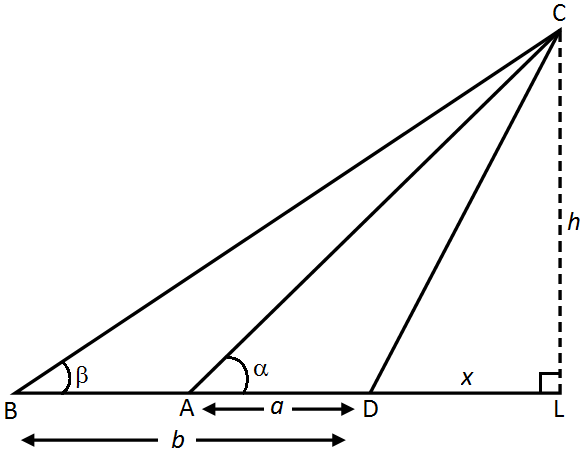
Let CD is the tree which is leaning towards east and A and B are two points on the West making angles of elevation with top C of the tree as $\alpha$ and $\beta.$
A and B are at the distance of a and b from the foot of the tree CD, then AD = a, BD = b.

Draw $\text{CL}\bot\text{BD}$ produced and let DL = x and CL = h
Now in right $\triangle\text{CAL,}$
$\tan\alpha=\frac{\text{Perpendicular}}{\text{Base}}=\frac{\text{CL}}{\text{AL}}=\frac{\text{h}}{\text{a}+\text{x}}$
$\Rightarrow \text{a}+\text{x}=\frac{\text{h}}{\tan\alpha}\ .....(\text{i})$
Similarly in right $\triangle\text{CBL,}$
$\tan\beta=\frac{\text{CL}}{\text{BL}}=\frac{\text{h}}{\text{b}+\text{x}}$
$\Rightarrow\ \text{b}+\text{x}=\frac{\text{h}}{\tan\beta}\ .....(\text{ii})$
From (i) and (ii)
$\text{x}=\frac{\text{h}}{\tan\alpha}-\text{a}$
$\text{x}=\frac{\text{h}}{\tan\beta}-\text{b}$
$\therefore\ \frac{\text{h}}{\tan\alpha}-\text{a}=\frac{\text{h}}{\tan\beta}-\text{b}$
$\Rightarrow\ \frac{\text{h}}{\tan\beta}-\frac{\text{h}}{\tan\alpha}=\text{b}-\text{a}$
$\Rightarrow\ \text{h}\Big(\frac{1}{\tan\beta}-\frac{1}{\tan\alpha}\Big)=\text{b}-\text{a}$
$\Rightarrow\ \text{h}\Big(\frac{\tan\alpha-\tan\beta}{\tan\beta\tan\alpha}\Big)=\text{b}-\text{a}$
$\Rightarrow\ \text{h}=\frac{(\text{b}-\text{a})\tan\alpha\tan\beta}{\tan\alpha-\tan\beta}.$
Hence proved.
View full question & answer
Question 55 Marks
PQ is a post of given height a, and AB is a tower at some distance. If $\alpha$ and $\beta$ are the angles of elevation of B, the top of the tower, at P and Q respectively. Find the height of the tower and its distance from the post.
Answer

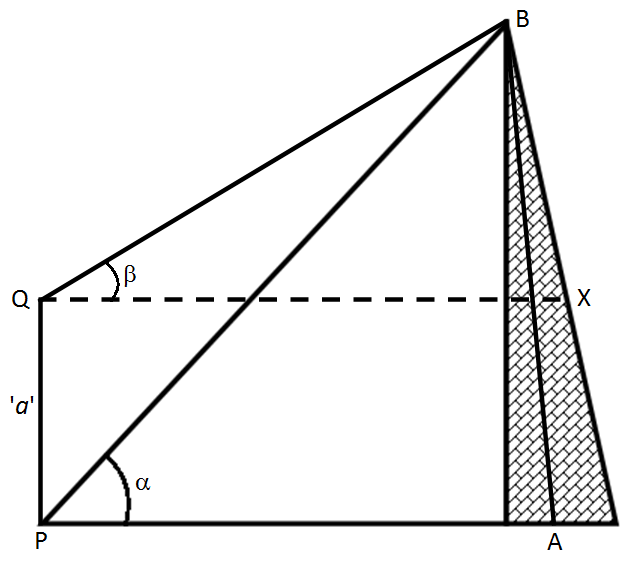
PQ is part height = 'a' m AB is tower height
Angle of elevation of B from $\text{P}=\alpha$
Angle of elevation of B from $\text{Q}=\beta$
The above information is represented in form of figure as shown
In right triangle if one of the included angle is $\theta,$ then $\tan\theta=\frac{\text{Opposite side}}{\text{Adjacent side}}$
Draw $\text{QX}\bot\text{AB},$ PQ = AK
In $\triangle\text{BQX}$
$\tan\beta=\frac{\text{BX}}{\text{QX}}$
$\Rightarrow\ \tan\beta=\frac{\text{AB}-\text{AX}}{\text{QX}}$
$\Rightarrow\ \tan\beta=\frac{\text{AB}-\text{a}}{\text{QX}}\ .....(1)$
In $\triangle\text{BPA}$
$\tan\alpha=\frac{\text{AB}}{\text{AP}}$
$\Rightarrow\ \tan\beta=\frac{\text{AB}}{\text{QX}}\ .....(2)$
(1) divided by (2)
$\Rightarrow\ \frac{\tan\beta}{\tan\alpha}=\frac{\text{AB}-\text{a}}{\text{AB}}=1-\frac{\text{a}}{\text{AB}}$
$\Rightarrow\ \frac{\text{a}}{\text{AB}}=1-\frac{\tan\beta}{\tan\alpha}=\frac{\tan\alpha-\tan\beta}{\tan\alpha}$
$\Rightarrow\ \text{AB}=\frac{\text{a}\tan\alpha}{\tan\alpha-\tan\beta}$
Height of power $=\text{a}\tan\alpha(\tan\alpha-\tan\beta)$
Distance between past and tower $=\text{a}(\tan\alpha-\tan\beta).$
View full question & answer
Question 65 Marks
A ladder rests against a wall at an angle $\alpha$ to the horizontal. Its foot is pulled away from the wall through a distance a, so that it slides a distance b down the wall making an angle $\beta$ with the horizontal. Show that, $\frac{\text{a}}{\text{b}}=\frac{\cos\alpha-\cos\beta}{\sin\beta-\sin\alpha}.$
Answer
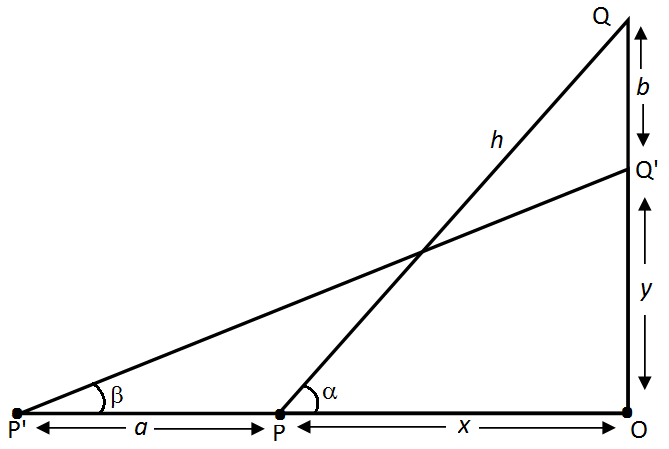
Let PQ be the ladder such that its top Q is on the wall OQ and bottom P is on the ground. The ladder is pulled away from the wall through a distance a, so that its top Q slides and takes position Q'. So PQ = P'Q'
$\angle\text{OPQ}=\alpha$ and $\angle\text{OP}'\text{Q}'=\beta.$ Let PQ = h
We have to prove that,
$\frac{\text{a}}{\text{b}}=\frac{\cos\alpha-\cos\beta}{\sin\beta-\sin\alpha}$
We have the corresponding figure as follows,

We use trigonometric ratios.
In $\triangle\text{POQ}$
$\Rightarrow\ \sin\alpha=\frac{\text{OQ}}{\text{PQ}}$
$\Rightarrow\ \sin\alpha=\frac{\text{b}+\text{y}}{\text{h}}$
And,
$\Rightarrow\ \cos\alpha=\frac{\text{OP}}{\text{PQ}}$
$\Rightarrow\ \cos\alpha=\frac{\text{x}}{\text{h}}$
Again in $\triangle\text{P}'\text{OQ}'$
$\Rightarrow\ \sin\beta=\frac{\text{OQ}'}{\text{P}'\text{Q}'}$
$\Rightarrow\ \sin\beta=\frac{\text{y}}{\text{h}}$
And,
$\Rightarrow\ \cos\beta=\frac{\text{OP}'}{\text{P}'\text{Q}'}$
$\Rightarrow\ \cos\beta=\frac{\text{a}+\text{x}}{\text{h}}$
Now,
$\Rightarrow\ \sin\alpha-\sin\beta=\frac{\text{b}+\text{y}}{\text{h}}-\frac{\text{y}}{\text{h}}$
$\Rightarrow\ \sin\alpha-\sin\beta=\frac{\text{b}}{\text{h}}$
And,
$\Rightarrow\ \cos\beta-\cos\alpha=\frac{\text{a}+\text{x}}{\text{h}}-\frac{\text{x}}{\text{h}}$
$\Rightarrow\ \cos\beta-\cos\alpha=\frac{\text{a}}{\text{h}}$
So,
$\Rightarrow\ \frac{\sin\alpha-\sin\beta}{\cos\beta-\cos\alpha}=\frac{\text{b}}{\text{a}}$
$\Rightarrow\ \frac{\text{a}}{\text{b}}=\frac{\cos\beta-\cos\alpha}{\sin\alpha-\sin\beta}$
$\Rightarrow\ \frac{\text{a}}{\text{b}}=\frac{\cos\alpha-\cos\beta}{\sin\beta-\sin\alpha}$
Hence $\frac{\text{a}}{\text{b}}=\frac{\cos\alpha-\cos\beta}{\sin\beta-\sin\alpha}.$
View full question & answer