Questions

3 Marks Question

Take a timed test

46 questions · self-marked practice — reveal the answer and mark yourself.

Question 13 Marks
Find the mean of each of the following frequency distributions:
Class interval
$10-30$
$30-50$
$50-70$
$70-90$
$90-110$
$110-130$
Frequency
$5$
$8$
$12$
$20$
$3$
$2$
Answer
Let assured mean (A) = 60
Class interval
Class Marks(x)
Frequency(f)
d = x - A
$f_id_i$
$10-30$
$20$
$5$
$-40$
$-200$
$30-50$
$40$
$8$
$-20$
$-160$
$50-70$
$60$
$12$
$0$
$0$
$70-90$
$80$
$20$
$20$
$400$
$90-110$
$100$
$3$
$40$
$120$
$110-130$
$120$
$2$
$60$
$120$
Total
 
$50$
 
$280$
$\text{Mean}=\text{A}+\frac{\sum\text{f}_\text{i}\text{d}_\text{i}}{\sum\text{f}}=60+\frac{280}{50}$
$=60+\frac{28}{5}=60+5.6=65.6$
View full question & answer
Question 23 Marks
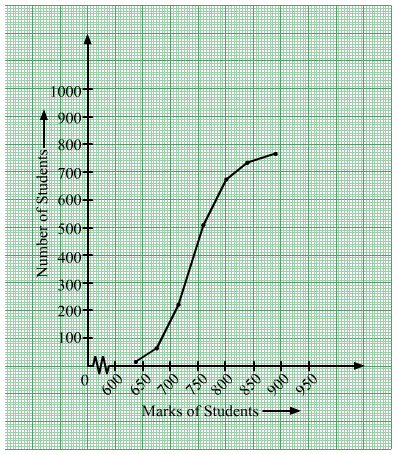
The marks scored by 750 students in an examination are given in the form of a frequency distribution table:
Marks
No. of students
600-640
16
640-680
45
680-720
156
720-760
284
760-800
172
800-840
59
840-880
18
Prepare a cumulative frequency table by less than method and
draw on ogive.
Answer
We first prepare the cumulative frequency table by less than method as given below
Marks
No. of students
Marks less than
Cumulative frequency
600-640
16
640
16
640-680
45
680
61
680-720
156
720
217
720-760
284
760
501
760-800
172
800
673
800-840
59
840
732
840-880
18
880
750
Now, we mark the upper class limits along x-axis and cumulative frequency along y-axis on a suitable gear. Thus, we plot the points (640, 16), (680, 61), (720, 217), (760, 501), (800, 673), (840, 732) and (880, 750)
View full question & answer
Question 33 Marks
The following table gives the number of children of $150$ families in a village:
No of children (x)
$0$
$1$
$2$
$3$
$4$
$5$
No of familles (f)
$10$
$21$
$55$
$42$
$15$
$7$
Find the average number of children per family.
Answer
Let the assured mean (A) = 2
No of children $(x_i)$
No of faimlies ($f_i$)
$u_i = x_i- A = x_i = 2$
$f_iu_i$
$0$
$10$
$-2$
$-20$
$1$
$21$
$-1$
$-21$
$2$ $55$ $0$ $0$
$3$
$42$
$1$
$42$
$4$
$15$
$2$
$30$
$5$
$7$
$3$
$21$
 
N = 150
 
$\sum\text{f}_\text{i}\text{u}_\text{i}=52$
$\therefore$ Average number of children for family $=\text{A}+\frac{\sum\text{f}_\text{i}\text{u}_\text{i}}{\text{N}}$
$=2+\frac{52}{150}$
$=\frac{300+52}{150}$
$=\frac{352}{150}$
$=2.35(\text{approx})$
View full question & answer
Question 43 Marks
Find the mean of each of the following frequency distributions:
Class interval
$0-10$
$10-20$ $20-30$ $30-40$ $40-50$
Frequency
$9$ $12$
$15$
$10$
$14$
Answer
Let assumed mean (A) = 25
Class interval
Class Marks(x)
Frequency(f)
d = x - A
$f_id_i$
$0-10$
$5$
$9$
$-20$
$-180$
$10-20$
$15$
$12$
$-10$
$-120$
$20-30$
$25 - A$
$15$
$0$
$0$
$30-40$
$35$
$10$
$10$
$100$
$40-50$
$45$
$14$
$20$
$280$
Total
 
$60$
 
$80$
$\text{Mean}=\text{A}+\frac{\sum\text{f}_\text{i}\text{d}_\text{i}}{\sum\text{f}}=25+\frac{80}{60}$
$=25+\frac{4}{3}=25+1.333=26.333$
View full question & answer
Question 53 Marks
The number of students absent in a class were recorded every day for $120 $days and the:
No of Students absent (x)
$0$
$1$
$2$
$3$
$4$
$5$
$6$
$7$
No of days (y)
$1$
$4$
$10$
$50$
$34$
$15$
$4$
$2$
Answer
Let assumed mean = 3
Number of students absent (x)
Number of days (f)
d = x - A, A = 3
$f_id_i$
$0$
$1$
$-3$
$-3$
$1$
$4$
$-2$
$-8$
$2$
$10$
$-1$
$-10$
$3 - A$
$50$
$0$
$0$
$4$
$34$
$1$
$34$
$5$
$15$
$2$
$30$
$6$
$4$
$3$
$12$
$7$
$2$
$4$
$8$
Total
120
 
63
$\text{Mean}=\text{A}+\frac{\sum\text{f}_\text{i}\text{d}_\text{i}}{\sum\text{f}}=3+\frac{63}{120}$
$=3+0.525=3.525=3.53\ (\text{approx})$
View full question & answer
Question 63 Marks
In the first proof reading of a book containing $300$ pages the following distribution of misprints was obtained:
No. of misprints per page (x)
$0$
$1$
$2$
$3$
$4$
$5$
No. of page (f)
$154$
$95$
$36$
$9$
$5$
$1$
Find the average number of misprints per page.
Answer
Let the assumed mean $(A) = 2$
No. of misprints per page ($x_i)$
No. of days $(f_i)$
$u_i = x_i - A = x _i - 2 $
$f_{iu}i$
$0$
$154$
$-2$
$-308$
$1$
$95$
$-1$
$-95$
$2$
$36$
$0$
$0$
$3$
$9$
$1$
$9$
$4$
$5$
$2$
$10$
$5$
$1$
$3$
$3$
 
$N = 300$
 
$\sum\text{f}_\text{i}\text{u}_\text{i}=-381$
Average number of mis prints per day $=\text{A}+\frac{\text{f}_\text{i}\text{u}_\text{i}}{\text{N}}$
$=2-\frac{381}{300}$
$=\frac{600-381}{300}$
$=\frac{219}{300}$
$=0.73$
View full question & answer
Question 73 Marks
In a retail market, fruit vendors were selling mangoes kept in packing boxes. These boxes contained varying number of mangoes. The following was the distribution of mangoes according to the number of boxes.
Number of mangoes
$50-52$
$53-55$
$56-58$
$59-61$
$62-64$
Number of boxes
$15$
$110$
$135$
$115$
$25$
Find the mean number of mangoes kept in a packing box. Which method of finding the mean did you choose?
Answer
We shall apply the assumed mean deviation method
Let assumed mean (A) = 57
We shall choose the method of assumed mean deviation:
No. of mangoes
Class marks (x)
No. of boxes (f)
$d_i = x_i - A A = 57$
$\text{u}_\text{i}=\frac{\text{d}_\text{i}}{\text{h}}\\\text{h}=3$
$f_i u_i$
$50-52$
$51$
$15$
$-6$
$-2$
$-30$
$53-55$
$54$
$110$
$-3$
$-1$
$-110$
$56-58$
$57 - A$
$135$
$0$
$0$
$0$
$59-61$
$60$
$115$
$3$
$1$
$115$
$61-64$
$63$
$25$
$6$
$2$
$50$
Total
 
400
 
 
25
$\text{Mean}=\text{A}+\text{h}\times\frac{{\sum\text{f}_\text{i}\text{u}_\text{i}}}{\sum\text{f}_\text{i}}$
$=57+3\times\frac{25}{100}$
$=57+\frac{3}{16}$
$=57+0.1875=57.1875=57.19$
View full question & answer
Question 83 Marks
A class teacher has the following absentee record of 40 students of a class for the whole term. Find the mean number of days student was absent.
Number of days
0-6
6-10
10-14
14-20
20-28
28-38
38-40
Number of students
11
10
7
4
4
3
1
Answer
No. of days
Class Marks (x)
No. of students (f)
fx
0-6
3
11
33
6-10
8
10
80
10-14
12
7
84
14-20
17
4
68
20-28
24
4
96
28-38
33
3
99
38-40
39
1
39
Total
 
40
499
Mean $= \frac{\sum\text{f}\ \text{x}}{\sum\ \text{f}}=\frac{499}{40}=12.475$
$\therefore$ Mean number of days a students was absent = 12.475
View full question & answer
Question 93 Marks
Find the mean from the following frequency distribution of marks at a test in statistics:
Marks (x)
5
10
15
20
25
30
35
40
45
50
No. of students (f)
15
50
80
76
72
45
39
9
8
6
Answer
Let assumed mean = 25
Marks (x)
No. of students (f)
d = x - A (A = 25)
fd
5
15
-20
-300
10
50
-15
-750
15
80
-10
-800
20
76
- 5
-380
25 - A
72
0
0
30
45
5
245
35
39
10
390
40
9
15
135
45
8
20
160
50
6
25
150
Total
400
 
-1170
$\text{Mean}=\text{A}+\frac{\sum\text{f}_\text{i}\text{d}_\text{i}}{\sum\text{f}_\text{i}}=25+\frac{-1170}{400}$
$=25-\frac{117}{40}=25-2.925=22.075$
$\therefore$ Average of marked obtained per student = 22.075
View full question & answer
Question 103 Marks
If the mean of the following data is 18.75. Find the value of p.
x 10 15 P 25 30
f 5 10 7 8 2
Answer
x f fx
10 5 50
15 10 150
P 7 7P
25 8 200
30 2 60
  N = 32 $\sum\text{fx}=7\text{P}+460.$
$\Rightarrow\text{Given mean=18.75}$
$\Rightarrow\frac{\sum\text{fx}}{\text{N}}=18.75$
$\Rightarrow\frac{7\text{P}+460}{32}=18.75$
$\Rightarrow7\text{P}+460=600$
$\Rightarrow7\text{P}=140$
$\Rightarrow\text{P}=\frac{140}{7}$
$\Rightarrow\text{P}=20$
View full question & answer
Question 113 Marks
Five coins were simultaneously tossed 1000 times, and at each toss the number of heads was observed. The number of tosses during which 0, 1, 2, 3, 4, and 5 heads were obtained are shown in the table below. Find the mean number of heads per toss:
of heads per toss (x)
$0$
$1$
$2$
$3$
$4$
$5$
No of tosses (f)
$38$
$144$
$342$
$287$
$164$
$25$
Answer
Let the assume mean be A = 2.
No. of heads per toss $x_i$:
No. of toss $f_i:$
$d_i = x_i - A = x_i - 2$
$f_id_i$
$0$
$38$
$-2$
$-76$
$1$
$144$
$-1$
$-144$
$2$
$342$
$0$
$0$
$3$
$287$
$1$
$287$
$4$
$164$
$2$
$328$
$5$
$25$
$3$
$75$
 
$\sum\text{f}_\text{i}=1000$
 
$\sum\text{f}_\text{i}\text{d}_\text{i}=470$
We kniw that mean $\overline{\text{x}}=\text{A}+\frac{1}{\text{N}}\sum\limits_\text{i+1}^\text{n}\text{f}_\text{i}\text{d}_\text{i}$
Now, we have $\text{N}=\sum\text{f}_\text{i}=1000, \sum\text{f}_\text{i}\text{d}_\text{i}=470 $ and A = 2
Putting the values above in formula, we have
$\overline{\text{x}}=\text{A}+\frac{1}{\text{N}}\sum\limits_\text{i+1}^\text{n}\text{f}_\text{i}\text{d}_\text{i}$
$=2+\frac{1}{1000}\times470$
$=2+0.47$
$=2.47$
Hence, the mean number of heads per toss is 2.$47.$
View full question & answer
Question 123 Marks
The marks obtained out of $50$, by $102$ students in a Physics test are given in the frequency table below:
Marks (x)
$15$
$20$
$22$
$24$
$25$
$30$
$33$
$38$
$45$
Frequncy (f)
$5$
$8$
$11$
$20$
$23$
$18$
$13$
$3$
$1$
Find the average number of marks.
Answer
Let the assume mean be A = 25
Marker$ (x_i):$
Frequency $(f_i$):
$d_i = x_i - A = x_i- 25$
$f_id_i$
$15$
$5$
$-10$
$-504
$20$
$8$
$-5$
$-404
$22$
$11$
$-3$
$-33$
$24$
$20$
$-1$
$-204
$25$
$23$
$0$
$0$
$30$
$18$
$5$
$90$
$33$
$13$
$8$
$104$
$38$
$3$
$13$
$39$
$45$
$1$
$20$
$20$
 
$\sum\text{f}_\text{i}=102$
 
$\sum\text{f}_\text{i}\text{d}_\text{i}=110$
We know that mean, $\overline{\text{x}}=\text{A}+\frac{1}{\text{N}}\sum\limits_\text{i+1}^\text{n}\text{f}_\text{i}\text{d}_\text{i}$
Now, we have $\text{N}=\sum\text{f}_\text{i}=102,\sum \text{f}_\text{i}\text{d}_\text{i}=110$ and A = 25
Putting the values in the above formula, we ge
$\overline{\text{x}}=\text{A}+\frac{1}{\text{N}}\sum\limits_\text{i+1}^\text{n}\text{f}_\text{i}\text{d}_\text{i}$
$=25+\frac{1}{102}\times(110)$
$=25+\frac{110}{102}$
$=25+1.078$
$=26.078$
$=26.08\ (\text{approximate})$
Hence, the average number of marks is $26.08.$
View full question & answer
Question 133 Marks
Find the mean of each of the following frequency distributions:
Class interval
$0-8$
$8-16$ $16-24$ $24-32$ $32-40$
Frequency
$5$ $9$ $10$ $8$ $8$
Answer
Let the assumed mean $(A) = 20$
Class interval
Mid-value
$d_i = x_i- 20$
$\text{u}_\text{i}=\frac{\text{d}}{\text{h}}=\frac{\text{d}}{8}$
Frequency $f_i$
$f_iu_i$
$0-8$
$4$
$-16$
$-2$
$5$
$-10$
$8-16$
$12$
$-8$
$-1$
$9$
$-9$
$16-24$
$20$
$0$
$0$
$10$
$0$
$24-32$
$28$
$8$
$1$
$8$
$8$
$32-40$
$36$
$16$
$2$
$8$
$16$


N = 40
$\sum\text{f}_\text{i}\text{u}_\text{i}=5$
We have
$\text{A}=20,\text{h}-8$
$\text{Mean}=\text{A}+\text{h}\times\frac{\sum\text{f}_\text{i}\text{u}_\text{i}}{\text{N}}$
$=20+8\times\frac{5}{40}$ $=20+1$ $=21$
View full question & answer
Question 143 Marks
The following table gives the number of boys of a particular age in a class of $40$ students. Calculate the mean age of the students:
Age(in years) $15$ $16$ $17$ $18$ $19$ $20$
No. of students $3$ $8$ $10$ $10$ $5$ $4$
Answer
Given,
Age (in years):$ x_i$ $15$ $16$ $17$ $18$ $19$ $20$
No.of students: $f_i$ $3$ $8$ $10$ $10$ $5$ $4$
First of all prepare the frequency table in such a way that its first column consist of the values of the variate($x_i$​​​​​​​) and the second column the corresponding frequencies($f_i$).
Thereafter multiply the frequency of each row with corresponding values of variable to obtain third column containing($f_ix_i​​​​​​​$​​​​​​​).
Then, sum of all entries in the column second and denoted by $\sum\text{f}_\text{i}$ and in the third column to obtain $\sum\text{f}_\text{i}\text{x}_\text{i}$
Age (in years) $x_i$ No. of students $f_i$ $f_ix_i$
$15$ $3$ $45$
$16$ $8$ $128$
$17$ $10$ $170$
$18$ $10$ $180$
$19$ $5$ $95$
$20$ $4$ $80$
  $\sum\text{f}_\text{i}=40$ $\sum\text{f}_\text{i}\text{x}_\text{i}=698$
We know that mean, $\overline{\text{X}}=\frac{\sum\text{f}_\text{i}\text{x}_\text{i}}{\sum\text{f}_\text{i}}$
$\overline{\text{X}}=\frac{698}{40}$
$=17.45$
Hence, the mean age of the students $=17.45\ \text{years}$
View full question & answer
Question 153 Marks
The following table gives the daily income of 50 workers of a factory:
Daily income (in ₹)
$100-120$
$120-140$
$140-160$
$160-180$
$180-200$
Number of workers
$12$
$14$
$8$
$6$
$1$
Find the mean, mode and median of the above data.
Answer
Daily income (in ₹)
No. of workers $f_1$
Mid value$x_1$
$\text{d}_1=\frac{\text{x}_1-150}{20}$
f.d.
$100-120$
$12$
$110$
$-2$
$-24$
$120-140$
$14$
$130$
$-1$
$-14$
$140-160$
$8$
$a = 150$
$0$
$0$
$160-180$
$6$
$170$
$1$
$6$
$180-200$
$10$
$190$
$2$
$20$
Total
$50$
 
 
$-12$
Here i = 20 and AM = 150
  1. $\text{Mean}=\text{a}+\frac{\sum\text{f}\text{d}_i}{\sum\text{f}_i}\times\text{i}$
$=150+\frac{-12}{50}\times20=150-4.8=145.2$
  1. Mix frequency = 14
$\therefore\text{Modle Class}=120-140$
Now $\text{Mode}=\text{I}+\frac{\text{f}_1-\text{f}_2}{2\text{f}_1-\text{f}_0-\text{f}_2}$
$=120+\frac{2}{28-20}\times20=120+\frac{40}{8}$
$=120+5=125$
  1. $\text{n}=5$
$\therefore\text{Median class}=120-140$
$\therefore\text{Medim}=\text{l}+\bigg(\frac{\frac{\text{n}}{2}-\text{c.f.}}{\text{f}}\bigg)\times\text{i}$
$=120+\frac{25-12}{14}\times20=120+\frac{13\times20}{14}=120+\frac{130}{7}$
$=120+18.57=138.57$
$\therefore\text{Median}=138.57$
View full question & answer
Question 163 Marks
Find the mean of the following data:
$x$ $19$ $21$ $23$ $25$ $27$ $29$ $31$
$f$ $13$ $15$ $16$ $18$ $16$ $15$ $13$
Answer
Given:
$x_1$ $19$ $21$ $23$ $25$ $27$ $29$ $31$
$f_1$ $13$ $15$ $16$ $18$ $16$ $15$ $13$
First of all prepare the frequency table in such a way that its first column consist of the values of the variate($x_1$​​​​​​​) and the second column the corresponding frequencies($f_1​​​​​​​$​​​​​​​).
Thereafter multiply the frequency of each row with corresponding values of variable to obtain third column containing($f_1x_1​​​​​​​$​​​​​​​).
Then, sum of all entries in the column second and denoted by $\sum\text{f}_1$ and in the third column to obtain$\sum\text{f}_1\text{x}_1$.
$\text{x}_1$ $\text{f}_1$ $\text{f}_1\text{x}_1$
$19$ $13$ $247$
$21$ $15$ $315$
$23$ $16$ $368$
$25$ $18$ $450$
$27$ $16$ $432$
$29$ $15$ $435$
$31$ $13$ $403$
  $\sum\text{f}_1=106$ $\sum\text{f}_1\text{x}_1=2650$
We know that mean, $\overline{\text{x}}=\frac{\sum\text{f}_1\text{x}_1}{\sum\text{f}_1}$
$=\frac{2650}{106}$
$= 25$
Hence, mean $= 25$
View full question & answer
Question 173 Marks
A student noted the number of cars passing through a spot on a road for $100$ periods each of $3$ minutes and summarised it in the table given below. Find the mode of the data.
Number of cars
$0-10$
$10-20$
$20-30$
$30-40$
$40-50$
$50-60$
$60-70$
$70--80$
Frequency
$7$
$14$
$13$
$12$
$20$
$11$
$15$
$8$
Answer
No. of cars
Frequency
$0-10$
$7$
$10-20$
$14$
$20-30$
$13$
$30-40$
$12$
$40-50$
$20$
$50-60$
$11$
$60-70$
$15$
$70-80$
$8$
We see that class $40-50$ has the maximum frequency
$\therefore$ lt is a modal class
Here $l = 40, f = 20, f_1 = 12, f_2 = 11, h = 10$
$\text{Mode}=\text{l}+\frac{\text{f}-\text{f}_1}{2\text{f}-\text{f}_1-\text{f}_2}\times\text{h}$
$=40+\frac{20-12}{2\times20-12-11}\times10$
$=40+\frac{8\times10}{40-23}=40+\frac{8\times10}{17}$
$=40+\frac{80}{17}=40+4.70=44.7\text{ cars}$
View full question & answer
Question 183 Marks
Five coins were simultaneously tossed 1000 times and at each toss the number of heads were observed. The number of tosses during which 0, 1, 2, 3, 4 and 5 heads were obtained are shown in the table below. Find the mean number of heads per toss:
No of head per toss No. of tosses
0 38
1 144
2 342
3 287
4 164
5 25
Total 1000
Answer
No. of head per toss No. of tosses
0 38
1 144
2 342
3 287
4 164
5 25
No. of heads per toss No. of tosses fx
0 28 0
1 144 144
2 342 684
3 287 861
4 164 656
5 25 125
Mean number of head per toss $=\frac{\sum\text{fx}}{\text{N}}$
$=\frac{2470}{1000}$
$=2.47$
$\text{Mean}=2.47$
View full question & answer
Question 193 Marks
The following distribution gives the number of accidents met by $160$ workers in a factory during a month,
No. of accidents (x) $0$ $1$ $2$ $3$ $4$
No. of workera (f) $70$ $52$ $34$ $3$ $1$
Find the average number of accidents per worker.
Answer
Let the assume mean be A = 2.
No. of accidents ($x_i$)
No. of workers ($f_i$)
$d_i = x_i - A = x_i - 2$
$f_id_i$
$0$
$70$
$-2$
$-140$
$1$
$52$
$-1$
$-52$
$2$
$34$
$0$
$0$
$3$
$3$
$1$
$3$
$4$
$1$
$2$
$2$
 
$\sum\text{f}_\text{i}=160$
 
$\sum\text{f}_\text{i}\text{d}_\text{i}=-187$
We know that mean, $\overline{\text{x}}=\text{A}+\frac{1}{\text{N}}\sum\limits_\text{i+1}^\text{n}\text{f}_\text{i}\text{d}_\text{i}$
Now, we have $\text{N}=\sum\text{f}_\text{i}=160,\sum\text{f}_\text{i}\text{d}_\text{i}=-187$ and $\text{A}=2$
Putting the values in the above formula, we get
$\overline{\text{x}}=\text{A}+\frac{1}{\text{N}}\sum\limits_\text{i+1}^\text{n}\text{f}_\text{i}\text{d}_\text{i}$
$=2+\frac{1}{160}\times (-187)$
$=2-\frac{187}{160}$
$=2-1.168$
$=0.83$
Hence, the average number of accidents per worker is 0.83.
View full question & answer
Question 203 Marks
The following table gives the number of branches and number of plants in the garden of a school.
No of branches (x)
$2$
$3$
$4$
$5$
$6$
No of plants (x)
$49$
$43$
$57$
$38$
$13$
Calculate the average number of branches per plant.
Answer
Let assumed mean $(A) = 4$
No of brances $(x_i)$
No of plants n ($f_i)$
$d_i = x_i - A, A = 4$
$f_i\times d_i$
$2$
$A49$
$-2$
$-98$
$3$
$43$
$-1$
$-43$
$4 - A$
$57$
$0$
$0$
$5$
$38$
$1$
$38$
$6$
$13$
$2$
$26$
Total
$200$
 
$-77$
$\text{Mean}=\text{A}+\frac{\sum\text{f}_\text{i}\text{d}_\text{i}}{\sum\text{f}_\text{i}}=4+\frac{-77}{200}=4-0.385$
$=3.615=3.62(\text{approx})$
$\therefore$ Mean number of branches per plant = 3.62
View full question & answer
Question 213 Marks
The following is the distribution of height of students of a certain class in a certain city:
Hight (in cms)
$160-162$
$163-165$
$166-168$
$169-171$
$172-174$
No. of students
$15$
$118$
$142$
$127$
$18$
Answer
Hight (in cms)
$160-162$
$163-165$
$166-168$
$169-171$
$172-174$
No. of students
$15$
$118$
$142$
$127$
$18$
Here model class is 165.5
and $l = 165.5 h = 3, f = 142, f_1= 118, f_2= 127$
$\therefore\text{Mode}=\text{l}+\frac{\text{f}-\text{f}_1}{2\text{f}-\text{f}_1-\text{f}_2}\times\text{h}$
$=165.5+\frac{142-118}{2\times142-118-127}\times3$
$=165.5+\frac{24\times3}{284-245}$
$=165.5+\frac{72}{39}$
$=165.5+1.8=167.3$
View full question & answer
Question 223 Marks
The following data gives the information on the observed lifetimes (in hours) of 225 electrical components:
Lifetimes (in hours)
0-20
20-40
40-60
60-80
80-100
100-120
No. of components
10
35
52
61
38
29
Determine the modal lifetimes of the components.
View full question & answer
Question 233 Marks
Consider the following distribution of daily wages of $50$ workers of a facotry.
Daily wages (in Rs.)
$100-120$
$120-140$
$140-160$
$160-180$
$180-200$
Number of workers
$12$
$14$
$8$
$6$
$10$
Find the mean daily wages of the workers of the factory by using an appropriate method.
Answer
Let assumed mean$ (A) = 150$
Daily wages (in Rs.)
Class Marks (x)
No. of workers (f)
$di = x_i- A A = 150$
$\text{u}_\text{i}=\frac{\text{d}}{\text{h}}\\\text{h}=20$
$u_if_i$
$100-120$
$110$
$12$
$-40$
$-2$
$-24$
$120-140$
$130$
$14$
$-20$
$-1$
$-14$
$140-160$
$150 - A$
$8$
$0$
$0$
$0$
$160-180$
$170$
$6$
$20$
$1$
$6$
$180-200$
$190$
$10$
$40$
$2$
$20$
Total
 
$50$
 
 
$-12$
Mean $=\text{A}+\text{h}\times \frac{\sum\text{u}_\text{i}\text{f}_\text{i}}{\sum\text{f}_\text{i}}$
$= 150+20\times\frac{-12}{50}=150-\frac{240}{50}$
$=150-4.80=145.20$
Mean daily wages per worker = Rs. 145.20
View full question & answer
Question 243 Marks
During the medical check-up of 35 students of a class, their weights were recorded as follows:
Weight (in kg)
No. of students
Less than 38
0
Less than 40
3
Less than 42
5
Less than 44
9
Less than 46
14
Less than 48
28
Less than 50
32
Less than 52
35
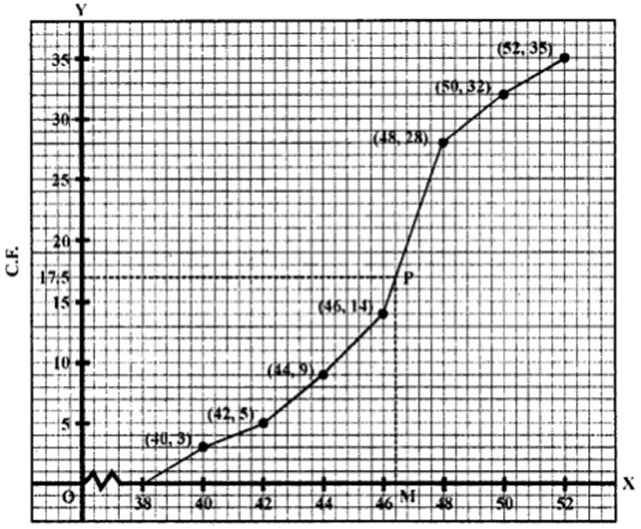
Draw a less than type ogive for the given data. Hence, obtain the median weight from the graph and verify the result by using the formula
Answer
Weight (in kg)
No. of students
Class
c.f.
Less than 38
0
36-38
0
Less than 40
3
38-40
3
Less than 42
5
40-42
2
Less than 44
9
42-44
4
Less than 46
14
44-46
5
Less than 48
28
46-48
14
Less than 50
32
48-50
4
Less than 52
35
50-52
3

Plot the points (38, 0), (40, 3), (42, 5), (44, 9), (46, 14), (48, 28), (50, 32), (52, 35) on the graph and join them in free hand to get an ogive as shown.
Here N = 35 which is odd
$\therefore\frac{\text{N}}{2}=\frac{25}{2}=17.5$
From 17.5 on y-axis draw a line parallel to x-axis meeting the curve at P.
From P, draw PM ⊥ x-axis
$\therefore$ Median which is 46.5 (approx)
Now N = 17.5 lies in the class 46 – 48 (as 14 < 17.5 < 28)
$\therefore$ 46-48 is the median class
$\therefore\text{Median}=\text{I}+\frac{\frac{\text{N}}{2}-\text{F}}{\text{f}}\times\text{h}$
$=46+\frac{17.5-14}{14}\times2$
$=46+\frac{3.5\times2}{14}$
$=46+0.5=46.5$
View full question & answer
Question 253 Marks
Find the missing value of p for the following distribution whose mean is 12.58.
x 5 8 10 12 P 20 25
f 2 5 8 22 7 4 2
Answer
Mean = 12.58
x f fx
5 2 10
8 5 40
10 8 80
12 22 264
P 7 7P
20 4 80
25 2 50
Total 50 524 + 7P
Mean$=\frac{\sum\text{f}\text{x}}{\sum\text{f}}$
$\Rightarrow12.58=\frac{524+7\text{P}}{50}$
$\Rightarrow524+7\text{P}=50\times12.58=629.00$
$\Rightarrow\text{P}=\frac{105}{7}=15$
$\therefore\text{P}=15$
View full question & answer
Question 263 Marks
The following is the cummulative frequency distribution (of less than type) of $1000$ persons each of age $20$ years and above. Determine the mean age.
Age below (in year):
$30$
$40$
$50$
$60$
$70$
Number of persons:
$100$
$220$
$350$
$750$
$950$
Answer
First, we make the frequency distribution of the given data and then proceed to calculate mean by computing class marks $(x_i)$, $u_i’s$ and $f_iu_i‘s$ as follows:
Class
Frequency ($f_i$)
Class mark ($x_i$)
$\text{u}_\text{i}=\frac{\text{x}_\text{i}-45}{10}$
$f_iu_i$
$20-30
$100$
$25$
$-2$
$-200$
$3040$
$120$
$35$
$-1$
$-120$
$4050$
$130$
$45$
$0$
$0$
$5060$
$400$
$55$
$1$
$400$
$6070$
$200$
$65$
$2$
$400$
$7080$
50$
$75$
$3$
$150$
 
$\sum\text{f}_\text{i}=1000$
 
 
$\sum\text{f}_\text{i}\text{u}_\text{i}=630$
We have taken assumed mean (a) = 45. Here, h = class size = 10 using the formula
$\text{Mean}\ \overline{\text{x}}=\text{a}+\text{h}\Big(\frac{{{\sum\text{f}_\text{i}\text{u}_\text{i}}}}{{\sum\text{f}_\text{i}}}\Big)$
$=45+10\Big(\frac{630}{1000}\Big)$
$=45+6.3=51.3$
Thus, the mean age is $51.3$ years.
View full question & answer
Question 273 Marks
A survey was conducted by a group of students as a part of their environment awareness programme, in which they collected the following data regarding the number of a plants in$ 20$ houses in a locality. Find the mean number of plants per house.
Number of plants
$0-2$
$2-4$
$4-6$
$6-8$
$8-10$
$10-12$
$12-14$
Number of Houses
$1$
$2$
$1$
$5$
$6$
$2$
$3$
Which method did you use for finding the mean, and why?
Answer
We may prepare the table as shown:
No. of plants
Mid value ($x_i$)
No. of Houses ($f_i$)
$f_ix_i$
$0-2$
$1$
$1$
$1$
$2-4$
$3$
$2$
$6$
$4-6$
$5$
$1$
$5$
$6-8$
$7$
$5$
$35$
$8-10$
$9$
$6$
$54$
$10-12$
$11$
$2$
$22$
$12-14$
$13$
$3$
$39$
 
 
$\sum\text{f}_\text{i}=20$
$\sum\text{f}_\text{i}\text{x}_\text{i}=162$
We know that mean, $\overline{\text{X}}=\frac{\sum\text{f}_\text{i}\text{x}_\text{i}}{\sum\text{f}_\text{i}}$
$=\frac{162}{20}$
$=8.1$
Hence, mean $=8.1$
Direct method is easier than other methods. Therefore, we used direct method.
View full question & answer
Question 283 Marks
The monthly income of $100$ families are given as below:
Income in ₹
Number of families
$0-5000$
$8$
$5000-10000$
$26$
$10000-15000$
$41$
$15000-20000$
$16$
$20000-25000$
$3$
$25000-30000$
$3$
$30000-35000$
$2$
$35000-40000$
$1$
Calculate the modal income.
Answer
In a given data, the highest frequency is $41$ ,
which lies in the interval $10000-15000.$
Here, $I =10000, f _1=41, f _0=26, f _2=16$ and $h =5000$
$\therefore\text{Modal}=\text{l}+\Big(\frac{\text{f}_1-\text{f}_0}{\text{2f}_1-\text{f}_0-\text{f}_2}\Big)\times\text{h}$
$=10000+\Big(\frac{41-26}{2\times41-26-16}\Big)\times5000$
$=10000+\Big(\frac{15}{82-42}\Big)\times5000$
$=10000+\Big(\frac{15}{40}\Big)\times5000$
$=10000+15\times125=10000+1875=₹11875$
Hence, the modal income is ₹ 11875.
View full question & answer
Question 293 Marks
For the following distribution, calculate mean using all suitable methods.
Size of item
$1-4$
$4-9$
$9-16$
$16-27$
Frequency
$6$
$12$
$26$
$20$
Answer
Let assumed mean (A) = 12.5
Size of item
Class Marks (x)
Frequency (f)
$d_i = x - A A = 12.5$
$f_id_i$
$1-4$
$2.5$
$6$
$-10$
$-60$
$4-9$
$6.5$
$12$
$-6$
$-72$
$9-16$
$12.5 - A$
$26$
$0$
$0$
$16-27$
$21.5$
$20$
$9$
$180$
Total
 
$64$
 
$48$
$\text{Mean}=\text{A}+\text{hx}\frac{\sum\text{f}_\text{i}\text{d}_\text{i}}{\sum\text{f}_\text{i}}=12.5+\frac{48}{64}$
$=12.5+\frac{3}{4}=12.5+0.75=13.25$
View full question & answer
Question 303 Marks
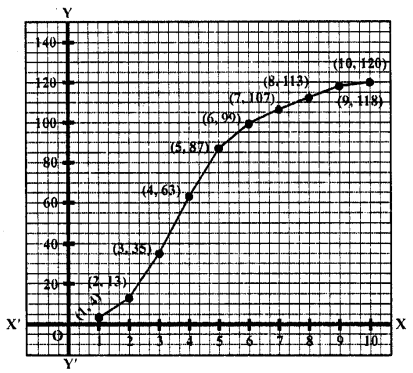
Draw an ogive by less than method for the following data:
No. of rooms
1
2
3
4
5
6
7
8
9
10
No. of houses
4
9
22
28
24
12
78
6
5
2
Answer
No. of rooms
N. of houses (f)
c.f.
1
4
4
2
9
13
3
22
35
4
28
63
5
24
87
6
12
99
7
8
107
8
6
113
9
5
118
10
2
120

Take numbers of rooms along the x-axis and c.f along the y-axis Plot the points (1, 4), (2, 13), (3, 35), (4, 63), (5, 87), (6, 99), (7, 107), (8, 113), (9, 118) and (10, 120) on the graph and join them and with free hand to get an ogive as shown. This is the less than ogive.
View full question & answer
Question 313 Marks
The annual profits earned by 30 shops of a shopping complex in a locality give rise to the following distribution:
Profit (in lakhs in ₹)
No. of shops (frequency)
More than or equal to 5
30
More than or equal to 10
28
More than or equal to 15
16
More than or equal to 20
14
More than or equal to 25
10
More than or equal to 30
7
More than or equal to 35
3
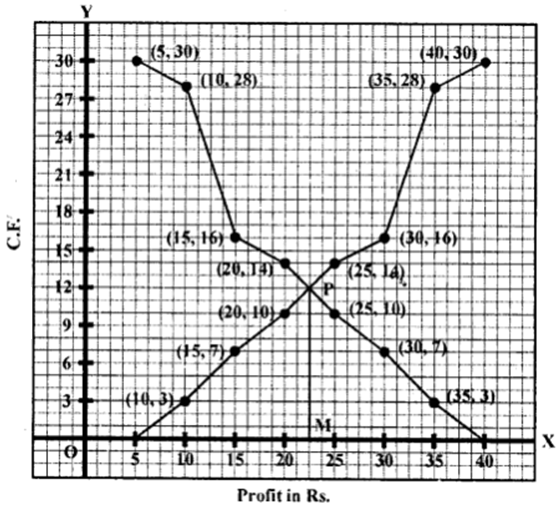
Draw both ogives for the above data and hence obtain the median.
Answer
Profit (in lakhs in ₹)
Class intervals
Number of shops (c.f.)
Frequency
More than or equal to 5
5-10
30
2
More than or equal to 10
10-15
28
12
More than or equal to 15
15-20
16
2
More than or equal to 20
20-25
14
4
More than or equal to 25
25-30
10
3
More than or equal to 30
30-35
7
4
More than or equal to 35
35-40
3
3
Now plot the points (5, 30), (10, 28), (15, 16), (20, 14), (25, 10), (30, 7) and (35, 3) on the graph and join them to get a more than curve.
Less than curve:
Class intervals
Frequency
c.f.
5-10
3
3
10-15
4
7
15-20
3
10
20-25
4
14
25-30
2
16
30-35
12
28
35-40
2
30
 

Now plot the points (10, 3), (15, 7), (20, 10), (25, 14), (30, 16), (35, 28) and (40, 30) on the graph and join them to get a less them ogive. The two curved intersect at P. From P, draw PM 1 x-axis, M is the median which is 22.5
$\therefore$ Median = Rs. 22.5 lakh
View full question & answer
Question 323 Marks
Find the mean of each of the following frequency distributions:
Class interval $0-8$ $8-16$ $16-24$ $24-32$ $32-40$
Frequency $6$ $7$ $10$ $8$ $9$
Answer
Let assured mean$ (A) = 20$
Class inteval
Class Marks (x)
Requency (f)
$d = x - A A = 20$
$f_id_i$
$0-8$
$4$
$6$
$-16$
$-96$
$8-16$
$12$
$7$
$-8$
$-56$
$16-24$
$20 - A$
$10$
$0$
$0$
$24-32$
$28$
$8$
$8$
$64$
$32-40$
$36$
$9$
$16$
$144$
Total
 
$40$
 
$56$
Mean $\text{A}+\frac{\sum\text{f}_\text{i}\text{d}_\text{i}}{\sum\text{f}_\text{i}} =20+\frac{56}{40}=20+\frac{7}{5}$
$= 20 + 1.4 = 21.4$
View full question & answer
Question 333 Marks
The arithmetic mean of the following data is $14$, find the value of k.
$x$ $5$ $10$ $15$ $20$ $25$
$f$ $7$ $k$ $8$ $4$ $5$
Answer
Given:
$x_i$ $5$ $10$ $15$ $20$ $25$
$f_i$ $7$ $k$ $8$ $4$ $5$
Mean = 14
First of all prepare the frequency table in such a way that its first column consist of the values of the variate( $x_i$) and the second column the corresponding frequencies( $f_i$).
Thereafter multiply the frequency of each row with corresponding values of variable to obtain third column containing($f_ix_i$).
Then, sum of all entries in the column second and denoted by $\sum\text{f}_\text{i}$ and in the third column to obtain $\sum\text{f}_\text{i}\text{x}_\text{i}$.
$x_i$ $f_i$ $f_ix_i$
$5$ $7$ $35$
$10$ $k$ $10k$
$15$ $8$ $120$
$20$ $4$ $80$
$25$ $5$ $125$
  $\sum\text{f}_\text{i}=24+\text{k}$ $\sum\text{f}_\text{i}\text{x}_\text{i}=360+10\text{k}$
We know that mean, $\overline{\text{X}}=\frac{\sum\text{f}_\text{i}\text{x}_\text{i}}{\sum\text{f}_\text{i}}$
$14=\frac{360+10\text{k}}{24+\text{k}}$
By using cross multiplication method,
$336+14\text{k}=360+10\text{k}$
$14\text{k}-10\text{k}=360-336$
$4\text{k}=24$
$\text{k}=6$
Hence, k = 6
View full question & answer
Question 343 Marks
Following are the lives in hours of 15 pieces of the components of aircraft engine. Find the median:
715, 724, 725, 710, 729, 745, 694, 699, 696, 712, 734, 728, 716, 705, 719
Answer
Arranging in ascending order, we get 694, 696, 699, 705, 710, 712, 715, 716, 719, 724, 725, 728, 729, 734, 745Here N = 15 which is odd
Median $=\frac{\text{N}+1}{2}$ th term $=\frac{15+1}{2}$ th term = 8th term Which is 716 Hence median = 716
View full question & answer
Question 353 Marks
Calculate the median from the following data:
Rent (in Rs.)
15-25
25-35
35-45
45-55
55-65
65-75
75-85
85-95
No. of Houses
8
10
15
25
40
20
15
7
Answer
Writing the given data in cumulative frequency table as shown
Rent (in Rs.)
No. of houses (f)
e.f.
15-25
8
8
25-35
10
18
35-45
15
33
45-55
25
58
55-65
40
98
65-75
20
118
75-85
15
133
85-95
7
140
Here N = 140
$\therefore \frac{\text{N}}{2}=\frac{140}{2}=70$
$\therefore$ Corresponding mediam class $=55-65$
$\text{l}=55,\text{f}=40,\text{F}=58$ and h = 10
$\therefore \text{mediam}=\text{l}+\frac{\frac{\text{N}}{2}-\text{F}}{\text{f}}\times\text{h}$
$=55+\frac{70-58}{40}\times10$
$\Rightarrow 55+\frac{12}{40}\times10$
$=55+3=58$
View full question & answer
Question 363 Marks
Find the mean of each the following frequency distributions: $(5 – 14)$
Class interval
$0-6$
$6-124$
$12-18$
$18-24$
$24-30$
Frequency
$64
$8$
$104
$9$
$7$
Answer
Let a assume mean be $15$
Class interval
Mid-value $x_i$
$d_i = x_i - 15$
$\text{u}_\text{i}=\frac{\text{x}_\text{i}-15}{6}$
$f_i$
$f_iu_i$
$0-6$
$3$
$-12$
$-2$
$6$
$-12$
$6-12$
$9$
$-6$
$-1$
$8$
$-8$
$12-18$
$15$
$0$
$0$
$10$
$0$
$18-24$
$21$
$6$
$1$
$$9
$9$
$24-30$
$27$
$18$
$2$
$7$
$14$
Total


$N = 40$
$3$
$A = 15, h = 6$
$\text{Mean}=\text{A}+\text{h}\frac{\sum\text{f}_\text{i}\text{x}_\text{i}}{\text{N}}$
$=15+6\times\frac{3}{40}$
$= 15 + 0.45$
$= 15.45$
View full question & answer
Question 373 Marks
The following distribution gives the daily income of 50 workers of a factory:
Daily income (in ₹)
100-120
120-140
140-160
160-180
180-200
Number of workers
12
14
8
6
10
Convert the above distribution to a less than type cumulative frequency distribution and draw its ogive.
Answer
We first prepare the cumulative frequency table by less thsn method as given below.
Daily income (in ₹)
Cumulative frequency
<120
12
<140
26
<160
34
<180
40
<200
50
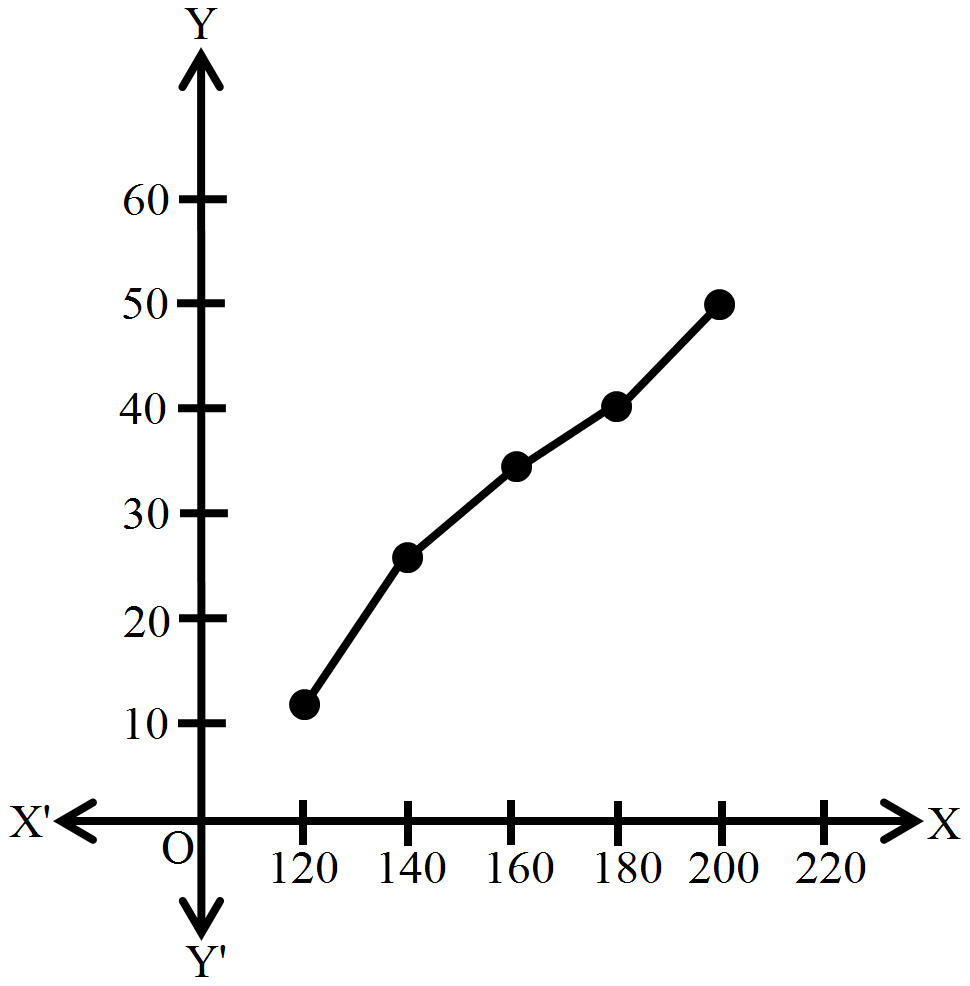
Now, we mark on x– axis upper class limit, y– axis cumulative frequencies.
Thus, we plot the points (120, 12) (140, 26) (160, 34) (180, 40) (200, 50)
View full question & answer
Question 383 Marks
Thirty women were examined in a hospital by a doctor and the number of heart beats per minute recorded and summarised as follows. Find the mean heart beats per minute for these women, choosing a suitable method.
Number of heart beat per minute
$65-68$
$68-71$
$71-74$
$74-77$
$77-80$
$80-83$
$83-86$
Number of women
$2$
$4$
$3$
$8$
$7$
$4$
$2$
Find the mean of each of the following frequency distribution $(5 - 14)$
Answer
We may find class marks of each interval ($x_i$)by using the relation
$\text{x}_\text{i}=\frac{\text{Upper class limit+lower limit class limit}}2{}$
Class size of this data $= 3$
Now taking 75.5 as assured mean (a) we
May calculate,$ d_{i,}u_i, f, u$, as following.
Number of heart beat per minnute
Number of women($x_i$)
$x_i$
$d_i = x_i - 75.5$
$\text{u}_\text{i}=\frac{\text{x}_\text{i}-755}{\text{h}}$
$f_iu_i$
$65-68$
$2$
$66.5$
$-9$
$-3$
$-6$
$68-71$
$4$
$69.5$
$-6$
$-2$
$-8$
$71-74$
$3$
$72.5$
$-3$
$-1$
$-3$
$74-77$
$8$
$75.5$
$0$
$0$
$0$
$77-80$
$7$
$78.5$
$3$
$1$
$7$
$80-83$
$4$
$81.5$
$6$
$2$
$8$
$83-86$
$2$
$84.5$
$9$
$3$
$6$
 
$30$


$4$
Now we may observe from table that $ \sum\text{f}_\text{i}= 30,\sum\text{f}_\text{i}\text{u}_\text{i}=4$
Mean $\overline{\text{x}}=\text{A}+\text{h}\Big[\frac{\sum\text{f}_\text{i}\text{u}_\text{i}}{\sum\text{f}_\text{i}}\Big]=75.5+3\Big(\frac{4}{30}\Big)$
$=75.5+0.4=75.9$
So mean hear beats per minute forn those women are 75.9 beats per minute.
View full question & answer
Question 393 Marks
The following distribution shows the daily pocket allowance given to the children of a multistory building. The average pocket allowance is Rs. $18.00$. Find out the missing frequency.
Class interval
$11-13$
$13-15$
$15-17$
$17-19$
$19-21$
$21-23$
$23-25$
Frequency
$7$
$6$
$9$
$13$
-
$5$
$4$
Answer
Given mean$ = 18$, let missing frequency be v
Class interval
Mid-value
Frequency $f_i$
$f_iu_i$
$11-13$
$12$
$7$
$83$
$13-15$
$14$
$6$
$88$
$15-17$
$16$
$9$
$144$
$17-19$
$18$
$9$
$234$
$19-21$
$20$
$x$
$20x$
$21-23$
$22$
$5$
$110$
$23-25$
$14$
$4$
$56$
 
 
$N = 44 + x$
$752 + 20x$
Mean $=\frac{\sum\text{f}_\text{i}\text{x}_\text{i}}{\text{N}}$
$18=\frac{752+20\text{x}}{44+\text{x}}$
$792+18\text{x}=752+20\text{x}$
$2\text{x}=40$
$\text{x}=20$
View full question & answer
Question 403 Marks
The following table gives the height of trees:
Height
No. of trees
Less than 7
26
Less than 14
57
Less than 21
92
Less than 28
134
Less than 35
216
Less than 42
287
Less than 49
341
Less than 56
360
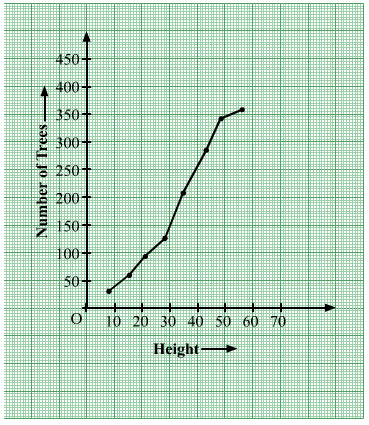
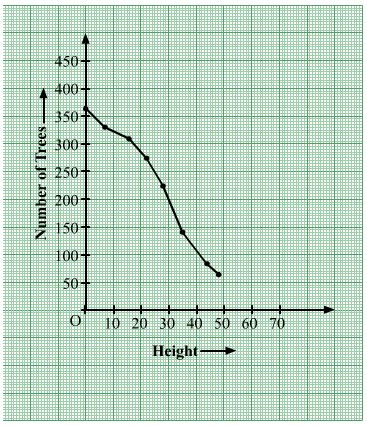
Draw 'less than' ogive and 'more than' ogive.
Answer
Consider the following table.
Height (less than)
Height-class
No. of trees
Cumulative frequency
Suitable points
7
0-7
26
26
(7, 26)
14
7-14
31
57
(14, 57)
21
14-21
35
92
(21, 92)
28
21-28
42
134
(28, 134)
35
28-35
82
216
(35, 216)
42
35-42
71
287
(42, 287)
49
42-49
54
341
(49, 341)
56
49-56
19
360
(56, 360)
Now, draw the less than ogive using suitable points.
Now, prepare the cumulative frequency table for more than series.
Heith
No. of trees
Height (more than)
Cumulative frequency
Suitable points
0-7
26
0
360
(0, 360)
7-14
31
7
334
(7, 334)
14-21
35
14
303
(14, 303)
21-28
42
21
268
(21, 268)
28-35
82
28
226
(28, 226)
35-42
71
35
144
(35, 144)
42-49
54
42
73
(42, 73)
49-56
19
49
54
(49, 54)
Now, draw the more than ogive using suitable points.
View full question & answer
Question 413 Marks
The. number of telephone calls received at an exchange per interval for $250$ successive one-minute intervals are given in the following frequency table:
No of calls (x)
$0$
$1$
$2$
$3$
$4$
$5$
$6$
No of intervals (f)
$15$
$24$
$29$
$46$
$54$
$43$
$39$
Compute the mean number of calls per interval.
Answer
Let be assumed mean $(A) = 3$
No of calls ($x_i$)
No of intevals ($f_i​​​​​​​$)
$u_i= x; - A = x_i - 3$
$f_iu_i;$
$0$
$15$
$-3$
$-45$
$1$
$24$
$-2$
$-48$
$2$
$29$
$-1$
$-29$
$3$
$46$
$0$
$0$
$4$
$54$
$1$
$54$
$5$
$43$
$2$
$86$
$6$
$39$
$3$
$117$
 
$N = 250$
 
$\sum\text{f}_\text{i}\text{u}_\text{i}=135$
Mean number of calls $=\text{A}+\frac{\sum\text{f}_\text{i}\text{u}_\text{i};}{\text{N}}$
$=3+\frac{135}{250}$
$=\frac{750+135}{250}$
$=\frac{885}{250}$
$=3.54$
View full question & answer
Question 423 Marks
Find the value of p for the following distribution whose mean is $16.6.$
$x$ $8$ $12$ $15$ $P$ $20$ $25$ $30$
$f$ $12$ $16$ $20$ $24$ $16$ $8$ $4$
Answer
Given:
$x_i$
$8$
$12$
$15$
$P$
$20$
$25$
$30$
$f_i$
$12$
$16$
$20$
$24$
$16$
$8$
$4$
Mean = 16.6
First of all prepare the frequency table in such a way that its first column consist of the values of the variate ($x_i$) and the second column the corresponding frequencies$(f_i).$
Thereafter multiply the frequency of each row with corresponding values of variable to obtain third column containing$(f_ix_i).$
Then, sum of all entries in the column second and denoted by $\sum\text{f}_\text{i}$and in the third column to obtain$\sum\text{f}_\text{i}\text{x}_\text{i}$
$x_i$ $f_i$ $f_ix_i$
$8$ $12$ $96$
$12$ $16$ $192$
$15$ $20$ $300$
$P$ $24$ $24P$
$20$ $16$ $320$
$25$ $8$ $200$
$30$ $4$ $120$
  $\sum\text{f}_\text{i}=100$ $\sum\text{f}_\text{i}\text{x}_\text{i}=1228+24\text{P}$
We know that mean, $\overline{\text{X}}=\frac{\sum\text{f}_\text{i}\text{x}_\text{i}}{\sum\text{f}_\text{i}}$
$16.6=\frac{1228+24\text{P}}{100}$
By using cross multiplication method
$1228+24\text{P}=16.6\times100$
$24\text{P}=1660-1228$
$=\frac{432}{24}$
$=18$
Hence,$\text{P}=18$
View full question & answer
Question 433 Marks
The annual rainfall record of a city for 66 days is given in the following tab:
Rainfull (in cm):
0-10
10-20
20-30
30-40
40-50
50-60
Number of days:
22
10
8
15
5
6
Calculate the median rainfall using ogives of more than type and less than type.
Answer
We observe that, the annual rainfall record of a city less than 0 is 0. Similarly, less than 10 include the annual rainfall record of a city from 0 as well as the annual rainfall record of a city from 0-10. So, the total annual rainfall record of a city for less than 10 cm is 0 + 22 = 22 days. Continuing in this manner, we will get remaining less than 20, 30, 40, 50 and 60. Also, we observe that annual rainfall record of a city for 66 days is more than or equal to 0 cm. Since, 22 days lies in the interval 0-10. So, annual rainfall record for 66 – 22 = 44 days is more than or equal to 10 cm. Continuing in this manner we will get remaining more than or equal to 20, 30 , 40, 50, and 60. Now, we construct a table for less than and more than type.
Less than type More than type
Rainfull (in cm) No. of days Rainfull (in cm) No. of days
Less than 0
Less than 10
Less than 20
Less than 30
Less than 40
Less than 50
Less than 60
0
0 + 22 = 22
22 + 10 = 32
32 + 8 = 40
40 + 15 = 55
55 + 5 = 60
60 + 6 = 66
More than or equal to 0
More than or equal to 10
More than or equal to 20
More than or equal to 30
More than or equal to 40
More than or equal to 50
More than or equal to 60
66
66 - 22 = 44
44 - 10 = 34
34 - 8 = 26
26 - 15 = 11
11 - 5 = 6
6 - 6 = 0
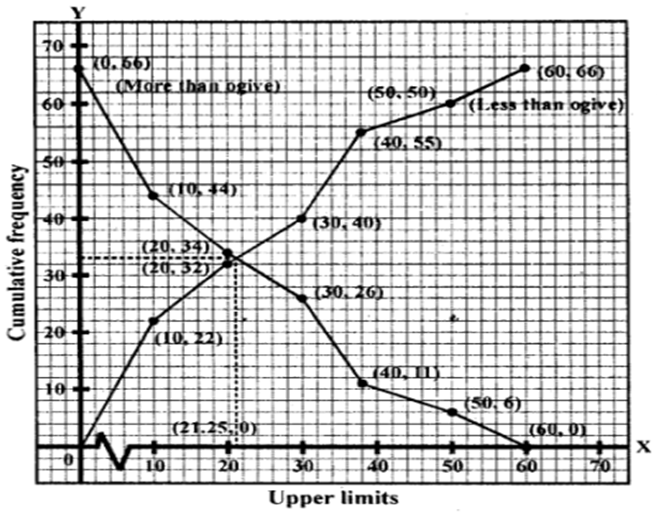
To draw less than type ogive we plot the points (0, 0), (10, 22), (20, 32), (30, 40), (40, 55), (50, 60), (60, 66) on the paper and join them by free hand. To draw the more than type ogive we plot the points (0, 66), (10, 44), (20, 34), (30, 26), (40, 11), (50, 6) and (60, 0) on the graph paper and join them by free hand.
Firstly, we plot a line parallel to X-axis at intersection point of both ogives, which further intersect at (0, 33) on Y- axis. Now, we draw a line perpendicular to X-axis at intersection point of both ogives, which further intersect at (21.25, 0) on X-axis. Which is the required median using ogives. Hence, median rainfall = 21.25 cm.
View full question & answer
Question 443 Marks
The daily income of a sample of $50$ employees are tabulated as follows:
Income (in Rs.):
$1-200$
$201-400$
$401-600$
$601-800$
No. of employees:
$14$
$15$
$14$
$7$
Find the mean daily income of employees.
Answer
Since, given data is not continuous, so we subtract 0.5 from the lower limit and add 0.5 in the upper limit of each class.
Now we first, find the class mark xt of each class and then proceed as follows:
Income (in Rs.)
Class marks ($x_i$)
Number of employees ($f_i$)
$\text{u}_\text{i}=\frac{\text{x}_\text{i}-\text{a}}{\text{h}}\\=\frac{\text{x}_\text{i}-300.5}{200}$
$f_iu_i$
$0.5-200.5
$100.5$
$14$
$-1$
$-14$
$200.5-400.5$
$a = 300.5$
$15$
$0$
$0$
$400.5-600.5$
$500.5$
$14$
$1$
$14$
$600.5-800.5$
$700.5$
$7$
$2$
$14$
 
 
$\text{N}=\sum\text{f}_\text{i}=50$
 
$\sum\text{f}_\text{i}\text{u}_\text{i}=14$
$\therefore$ Assumed mean,$ a = 300.5$
Class width,$ h = 200$
and total observation, $N = 50$
By step deviation method,
$\text{Mean}=\text{A}+\frac{\sum\text{f}_\text{i}\text{u}_\text{i}}{\sum\text{f}_\text{i}}\times\text{h}$
$=300.5+\frac{14}{50}\times200$
$=300.5+14\times4$
$=300.5+56=356.5$
View full question & answer
Question 453 Marks
The arithmetic mean of the following data is 25, find the value of k.
x 5 15 25 35 45
f 3 k 3 6 2
Answer
x f fx
5 3 15
15 k 15k
25 3 75
35 6 210
45 2 90
Total 14 + k 390 + 15k
$\text{Mean}=\frac{\sum\text{f}\times\text{x}}{\sum\text{f}}$
$\Rightarrow25=\frac{390+15\text{k}}{14+\text{k}}$
$\Rightarrow25(14+\text{k})=390+15\text{k}$
$\Rightarrow350+25\text{k}=390+15\text{k}$
$\Rightarrow25\text{k}-15\text{k}=390-350$
$\Rightarrow10\text{k}=40$
$\Rightarrow\text{k}=\frac{40}{10}=4$
Hence, k = 4
View full question & answer
Question 463 Marks
Find the mean of each of the following frequency distributions:
Class interval
$25-35$
$35-45$
$45-55$
$55-65$
$65-75$
Frequency
$6$
$10$
$8$
$12$
$4$
Answer
Let the assume (A) = 50
Class interval
Mid-value $x_i$
$d_i = x_i - 50$
$\text{u}_\text{i}=\frac{\text{d}}{\text{h}}=\frac{\text{d}}{10}$
Frequency $f_i$
$f_iu_i$
$25-35
$30
$-20
$-2
$6
$-12
$35-45
$40
$-10
$-1
$10
$-10
$45-55
$50
$0
$0
$8
$0
$55-65$
$60$
$10$
$1$
$12$
$12$
$65-75$
$70$
$20$
$2$
$4$
$8$


$N = 40$
$\sum\text{f}_\text{i}\text{u}_\text{i}=-2$
We have
$A = 50, h = 10$
$\text{Mean}=\text{A}+\text{h}\frac{\sum\text{f}_\text{i}\text{u}_\text{i}}{\text{N}}$
$=50+10\Big(\frac{-2}{40}\Big)$
$=50-0.5$
$=49.5$
View full question & answer