Questions

3 Marks Question

Take a timed test

5 questions · self-marked practice — reveal the answer and mark yourself.

Question 13 Marks

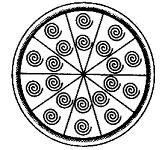
A brooch is made with silver wire in the form of a circle with diameter 35 mm. The wire is also used in making 5 diameters which divide the circle into 10 equal sectors as shown in figure. Find:

  1. the total length of the silver wire required.
  2. the area of each sector of the brooch.
    Image
Answer
  1. $\because $ Diameter = 35 mm
    $\therefore $ Radius = $\frac { 35 } { 2 } \mathrm { mm }$
    $\therefore $ Circum ference = $2\pi r$
    $= 2 \times \frac { 22 } { 7 } \times \frac { 35 } { 2 } $= 110mm ..... (1)
    Length of 5 diameters
    $= 35 \times 5 $= 175 mm ...... ( 2 )
    $\therefore $ The total length of the silver wire required
    = 110 + 175 = 285 mm ​​​​​
  2. $r = \frac { 35 } { 2 } m m , \theta = \frac { 360 ^ { \circ } } { 10 } = 36 ^ { \circ }$
    $\therefore $ The area of each sector of the brooch
    $= \frac { \theta } { 360 } \times \pi r ^ { 2 }$
    $= \frac { 36 } { 360 } \times \frac { 22 } { 7 } \times \frac { 35 } { 2 } \times \frac { 35 } { 2 } = \frac { 385 } { 4 } \mathrm { mm } ^ { 2 }$​​​​​​​
View full question & answer
Question 23 Marks
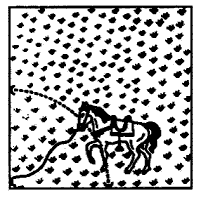
A horse is tied to a peg at one corner of a square shaped grass field of side $15 \ m$ by means of a $5 \ m$ long rope. Find
  1. the area of that part of the field in which the horse can graze.
  2. the increase in the grazing area if the rope were $10 \ m$ long instead of 5 m (Use $\pi$ = 3.14)
    Image
Answer
  1. The area of that part of the field in which the horse can graze if the length of the rope is 5cm
    $= \frac { 1 } { 4 } \pi r ^ { 2 } = \frac { 1 } { 4 } \times 3.14 \times ( 5 ) ^ { 2 } = \frac { 1 } { 4 } \times 78.5 = 19.625 \mathrm { m } ^ { 2 }$
  2. The area of that part of the field in which the horse can graze if the length of the rope is 10 m
    $= \frac { 1 } { 4 } \pi r ^ { 2 } = \frac { 1 } { 4 } \times 3.14 \times ( 10 ) ^ { 2 } = 78.5 \mathrm { m } ^ { 2 }$
    $\therefore $ The increase in the grazing area
  3. $= 78.5 - 19.625 = 58.875cm^2$
View full question & answer
Question 33 Marks

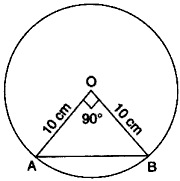
A chord of a circle of radius 10 cm subtends a right angle at the centre. Find the area of the corresponding:

  1. minor segment
  2. major sector.
Answer
  1. r = 10 cm, $\theta = 90 ^ { \circ }$
    Area of minor sector = $\frac { \theta } { 360 } \times \pi r ^ { 2 }$
    $= \frac { 90 } { 360 } \times 3.14 \times 10 \times 10 = 78.5 \mathrm { cm } ^ { 2 }$
    Area of $\triangle O A B = \frac { O A \times O B } { 2 }$
    $= \frac { 10 \times 10 } { 2 } = 50 \mathrm { cm } ^ { 2 }$
    $\therefore $ Area of the minor segment
    = Area of minor sector - Area of $\triangle O A B$
    $= 78.5 \mathrm { cm } ^ { 2 } - 50 \mathrm { cm } ^ { 2 } = 28.5 \mathrm { cm } ^ { 2 }$
  2. Area of major sector = $\pi x ^ { 2 } - 28.5$
    $= 3.14 \times 10 \times 10 - 28.5$
    $= 314 - 28.5 = 285.5 \mathrm { cm } ^ { 2 }$
    Image
View full question & answer
Question 43 Marks

Find the area of a quadrant of a circle whose circumference is 22 cm.

Answer

Let the radius of the circle be r cm.
Then, circumference of the circle = 2$\pi$r cm
According to the question,
2$\pi$r = 22
$\Rightarrow 2 \times \frac { 22 } { 7 } \times \mathrm { r } = 22$
$\Rightarrow \mathrm { r } = \frac { 22 \times 7 } { 2 \times 22 } \Rightarrow \mathrm { r } = \frac { 7 } { 2 } \mathrm { cm }$
For a quadrant of a circle,
Area = $\frac{1}{4} \pi r^2$
$= \frac {1 } { 4 } \times \frac { 22 } { 7 } \times \left( \frac { 7 } { 2 } \right) ^ { 2 }$
$= \frac { 1 } { 4 } \times \frac { 22 } { 7 } \times \frac { 7 } { 2 } \times \frac { 7 } { 2 } = \frac { 77 } { 8 } \mathrm { cm } ^ { 2 }$

View full question & answer
Question 53 Marks
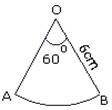
Find the area of a sector of a circle with radius 6 cm, if the angle of the sector is $60^o.$
Answer
Image
We know that Area of sector =$\frac { \theta } { 360 } \pi r ^ { 2 }$
Here, $ \theta = 60 , r = 6$
$\therefore$ Required area $= \frac { 60 } { 360 } \times \frac { 22 } { 7 } \times ( 6 ) ^ { 2 }$
$= \frac { 1 } { 6 } \times \frac { 22 } { 7 } \times 36$
$= \frac { 22 \times 6 } { 7 }$
$= \frac { 132 } { 7 } = 18 \frac { 6 } { 7 } c m ^ { 2 }$
View full question & answer