Questions

[3 Mark Questions]

🎯

Test yourself on this topic

47 questions · timed · auto-graded

Question 13 Marks
We are advised to take iodised salt in our diet by doctors. Justify it's importance in our body.
Answer
→ Iodine is essential for the synthesis of thyroxin hormone.
→ Thyroxin regulates carbohydrate, protein and fat metabolism in the body.
→ Thyroxin provide best balance for growth in the body.
View full question & answer
Question 23 Marks
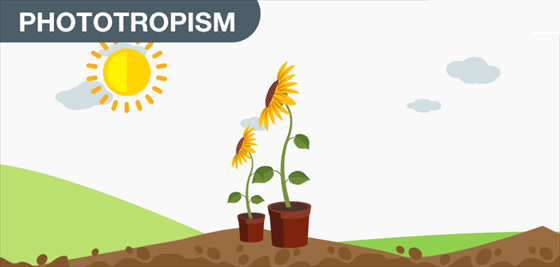
What is 'Phototropism'? How does it occur in plants ? Describe an activity to demonstrate phototropism.
Answer
The movement of a plant or other organism in response to light is called phototropism, either towards the source of light (positive phototropism) or away from it (negative phototropism).
This movement is caused due to more growth of cells towards the shaded side of the shoot as compared to the side of shoot towards light. More growth of cells is due to secretion of auxin towards the shaded side.
To demonstrate it we will place a potted plant in a box in which light comes from only one direction. In a few days we will observe that the shoot has moved towards the side from which light came in the box.
View full question & answer
Question 33 Marks
Define ‘hormones’. Name the hormone secreted by thyroid. Write its function. Why is the use of iodised salt advised to us?
Answer
Hormones are complex organic compound which is released endocrine glands in a very small quantity to keep control over growth and development.Thyroid gland secrets thyroxin:
It plays vital roles in digestion, heart and muscle function, brain development and maintenance of bones Iodine is needed by the thyroid gland for the production thyroxin hormone. This hormone regulates fat, protein and carbohydrate metabolism in our body If this is in deficient quantity then the neck will swell up due to the enlargement of thyroid gland. This deficiency disease is known as goitre. Therefore the iodized salt is advised.
View full question & answer
Question 43 Marks
Name the hormones secreted by the following endocrine glands and specify one function of each:
  1. Thyroid.
  2. Pituitary.
  3. Pancreas.
Answer
Gland
Hormones
Functions
Thyroid
Thyroxine
Regulates metabolism of carbohydrates, proteins and fats in the body.
Pituitary
Growth hormone
Regulates the growth and development of bones and muscles.
Prolactin
Regulates the functioning of mammary glands in females.
Vasopressin
Regulates the balance of water and electrolytes in the body.
Oxytocin
Regulates the ejection of milk during lactation in females.
Pancreas
Glucagon
Helps to increase the sugar level in the body.
Insulin
Helps to decrease the sugar level in the body.
View full question & answer
Question 53 Marks
  1. What is tropism?
  2. How do auxins promote the growth of a·tendril around a support?
Answer
  1. Directional movements of the plant part towards or away from the stimulus.
  2. When the tip of the tendril comes in contact with the support, more auxin is diffused from the tip towards the side of the tendril away from the support. As a result, that side grows faster and causes the tendril to bend around the support.
View full question & answer
Question 63 Marks
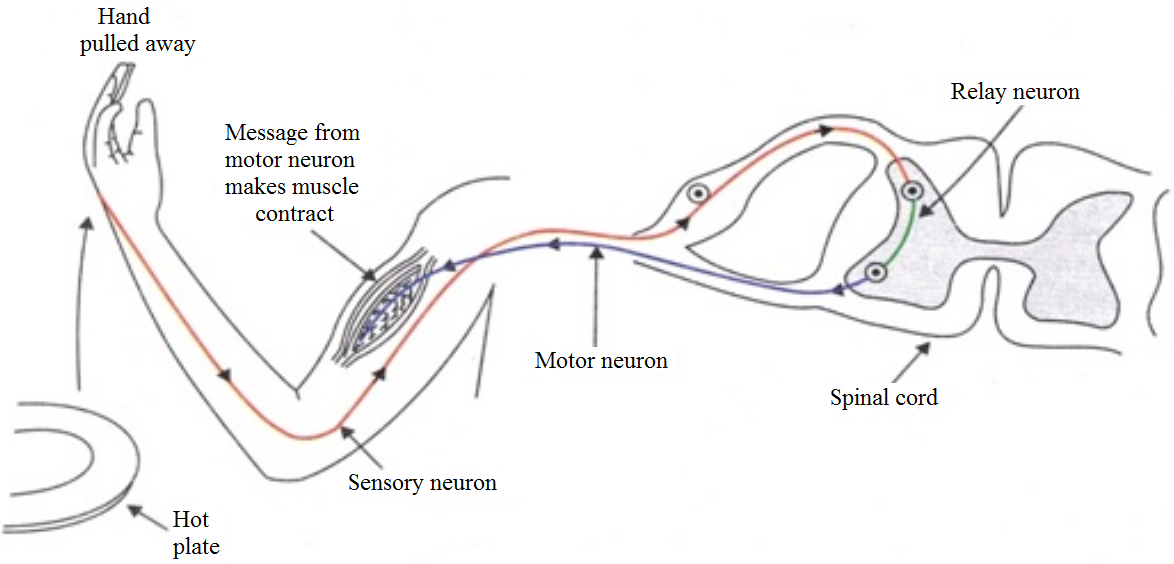
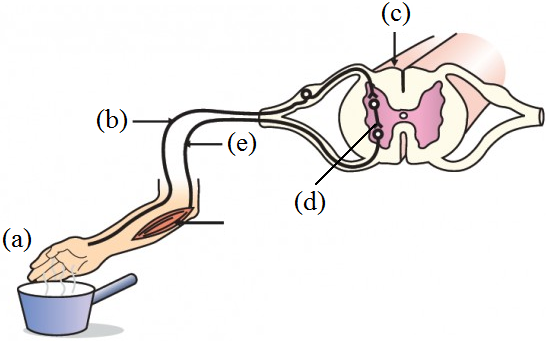
Name the parts (a) to (e) in the following diagram.

What is the term given to the sequence of events occurring in the diagram?
Answer
a - Receptor/ skin.
b - Sensory neuron.
c - Spinal cord.
d - Relay neuron.
e - Motor neuron.
  • Reflex Arc.
View full question & answer
Question 73 Marks
What is photosynthesis? Explain its mechanism.
Answer
A process in which green plants takes carbon dioxide and water and convert them into carbohydrates/ food in the presence of sunlight and chlorophyll.
Mechanism:
  1. Absorption of light energy by chlorophyll.
  2. Conversion of light energy to chemical energy.
  3. Splitting of water molecules into hydrogen and oxygen.
  4. Reduction of carbon dioxide to carbohydrate.
View full question & answer
Question 83 Marks
What are plant hormones? Name the plant hormones responsible for the following:
  1. Growth of stem.
  2. Promotion of cell division.
  3. Inhibition of growth.
  4. Elongation of cells.
Answer
In plants, growth, development, and response to the environment are controlled and coordinated by a special class of chemical substances known as phytohormones. They are naturally occurring organic substances which are synthesized in minute quantities. These hormones are produced in one part of the plant body and are translocated to other parts. For example, a hormone produced in the roots is translocated to other parts where they are required.
  1. Gibberellins
  2. Cytokinins
  3. Abscisic acid
  4. Auxins
View full question & answer
Question 93 Marks
A squirrel is in a scary situation. Its body has to prepare for either fighting or running away. State the immediate changes that take place in its body so that the squirrel is able to either fight or run?
Answer
  • The adrenaline hormone is secreted into the blood.
  • The heart beats faster resulting in supply of more oxygen to the muscles.
  • Blood is diverted to skeletal muscles.
  • The breathing rate increases.
  • The blood supply to digestive systems and skin is reduced.
View full question & answer
Question 103 Marks
Why is chemical communication better than electrical impulses as a means of communication between cells in a multi-cellular organism?
Answer
  • Electrical impulses have limited access to only those cells that are connected by nervous tissue/ neurons, whereas chemical signals can reach each and every cell of the body.
  • Cells need time to reset in order to create repeated/ new electrical impulses whereas no such time is required for chemical communication.
View full question & answer
Question 113 Marks
The feedback mechanism is an important aspect of hormonal coordination. Explain.
Answer
Yes feedback mechanism is a very important aspect of hormonal co-ordination. The feedback mechanism of hormones is the mechanism through which the balance of hormone in the blood/ body is maintained. The increase or decrease in the concentration of that hormone can either stimulate the secretion of that particular hormone or inhibit the hormone secretion. This is called feedback.
View full question & answer
Question 123 Marks
Compare and contrast nervous and hormonal mechanisms for control and coordination in animals.
Answer
  Nervous system mechanism   Hormonal system mechanism
1 The information is conveyed in the form of electric impulse. 1 The information is conveyed in the form of chemical messengers.
2 The axons and dendrites transmit the information through a coordinated effort. 2 The information is transmitted or transported through blood.
3 The flow of information is rapid and the response is quick. 3 The information travels slowly and the response is slow.
4 Its effects are short lived. 4 It has prolonged effects.
View full question & answer
Question 133 Marks
A plant in the laboratory is given an increased dose of a hormone, which promotes the development of seedless fruits. Identify the hormone and write its other two functions.
Answer
Auxins are a class of plant hormones(or plant growth regulators) with some morphogen-like characteristics. Auxins have a cardinal role in coordination of many growth and behavioral processes in the plant's life cycle and are essential for plant body development.
View full question & answer
Question 143 Marks
What are receptors with reference to the nervous system? List three types of receptors and mention their functions. How do receptors pass the information to the brain.
Answer
Receptors are groups of specialised cells. They detect a change in the environment(stimulus) and stimulate electrical impulses in response. Sense organs contain groups of receptors that respond to specific stimuli.
Three types of receptors are:
  1. Olfactory receptor: They detect the smell.
  2. Gustavo receptor: They detect the taste.
  3. Thermo receptor: they detect the temperature of the outer world.
Receptor through sensory motor passes the information to the spinal cord which then sends the information to the brain.
View full question & answer
Question 153 Marks
How does control and coordination take place in plants? How does it differ from that in animals?
Answer
The plants do not have a nervous system but they can sense things in the presence of stimuli such as light, touch, water etc. and respond to them by the action of hormones. Thus, the plants coordinate their behavior against environmental behavior by using organic chemicals called hormones. This is called chemical coordination. The hormones in plants coordinate their behavior by affecting the growth of a part of the plant resulting in the movement of that plant part in response to a stimulus. The control and coordination in animals takes place by both nervous system and hormones.
View full question & answer
Question 163 Marks
The human brain can be broadly divided into three regions. Name these three regions.
Answer
The 3 regions of human brain are:
  1. Forebrain.
  2. Midbrain and
  3. Hindbrain.
View full question & answer
Question 173 Marks
Write the main difference between auxins and cytokinin.
Answer
 
Auxins
Cytokinins
1.
Auxin is first introduced by F.W. Went.
Cytokinin is first isolated by Miller and Skoog.
2.
It is produced in the shoot apex and leaf primordia.
It is found in the endosperm and embryo of seeds, in fruits and roots.
3.
Auxins promote the growth of apical bud.
Cytokinins promote the growth of lateral buds.
View full question & answer
Question 183 Marks
P, Q, R and S are four major types of phytohormones. P is a phytohormone which functions mainly as a growth inhibitor. It promotes the wilting and falling of leaves. Q, R and S are phytohormones which all promote growth of plants in various ways. Q is responsible for the phenomenon of phototropism in plants. R is involved mainly in shoot extensions. The phytohormone S helps in breaking the dormancy of seeds and buds. What are P, Q, R and S? Give one reason each for your choice.
Answer
P is abscisic acid because it is antagonistic to growth and inhibits it.
Q is auxin because it causes bending of shoots towards the light.
R is gibberellins because it increases the cell division in a plant shoot and increases its length. S is cytokinin because it breaks the dormancy of buds and seeds.
View full question & answer
Question 193 Marks
What is the difference between a voluntary and an involuntary action? Which kind of action is digestion? Explain your choice.
Answer
Voluntary Action
Involuntary Action
Those action which need think and are performed by us knowingly are called voluntary action. Explanation: Writing, dancing.
Those actios which do not need thinking and are not performed by us knowingly are called involuntary action. Example: Digestion, respiration.
Digestion is an involuntary action as it does not involve the thinking process and is performed unknowingly by our digestive system.
View full question & answer
Question 203 Marks
In what ways are puberty and adolescence result of the activity of some glands in the human body?
Answer
Puberty and adolescence are the results of sex glands in human beings. In males, testes make male sex hormones called testosterone which is associated with male puberty, which the boys attain an age of 13 - 14 years. In females the oestrogen hormone is responsible for all the changes associated with female puberty which the girl attains at an age of 10 - 12 years.
View full question & answer
Question 213 Marks
How do we detect the smell of an incense stick (agarbatti)?
Answer
When the agarbatti burns, it produces vapours having a characteristic pleasant smell which is detected by the olfactory receptors present inside our nose. The action of smell of agarbatti or receptors sets off chemical reactions which generate electrical impulses. The sensory neurons carry these electric al impulses to the sensory area of fore brain called cerebrum. This makes us detect the smell of burning agarbatti.
View full question & answer
Question 223 Marks
Give the exact location and function of the cerebellum.
Answer
Cerebellum is located in hind-brain it is the largest structure of the hindbrain. The cerebellum receives information from the sensory systems, the spinal cord, and other parts of the brain and then regulates motor movements. The cerebellum coordinates voluntary movements such as posture, balance, coordination, and speech, resulting in smooth and balanced muscular activity.
View full question & answer
Question 233 Marks
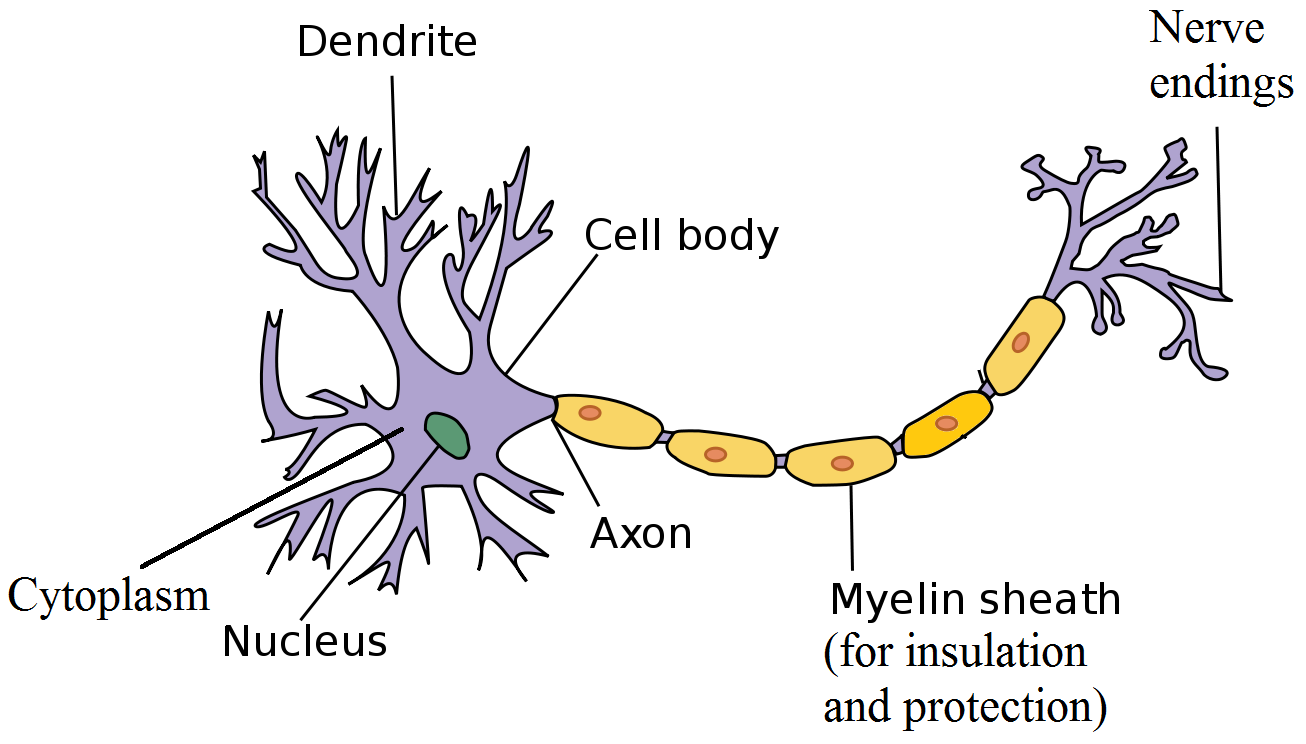
What is a neuron? Draw a labelled diagram of a neuron.
Answer
The unit which makes up the nervous system is called a neuron.

A neuron (or nerve cell).
View full question & answer
Question 243 Marks
What is voluntary nervous system? Explain the working of voluntary nervous system with an example.
Answer
The voluntary nervous system is a system which helps us to take voluntary actions which are under the conscious control of the brain.
Example: If a student is getting late for school and sees his watch. He starts walking fast. In this process, the eyes see the time and send the information to the brain through the sensory nerves. The brain analyses the information and sends the instructions to walk faster to the muscle of our legs through the motor nerves. The muscles of the legs act accordingly and make the student walk faster.
View full question & answer
Question 253 Marks
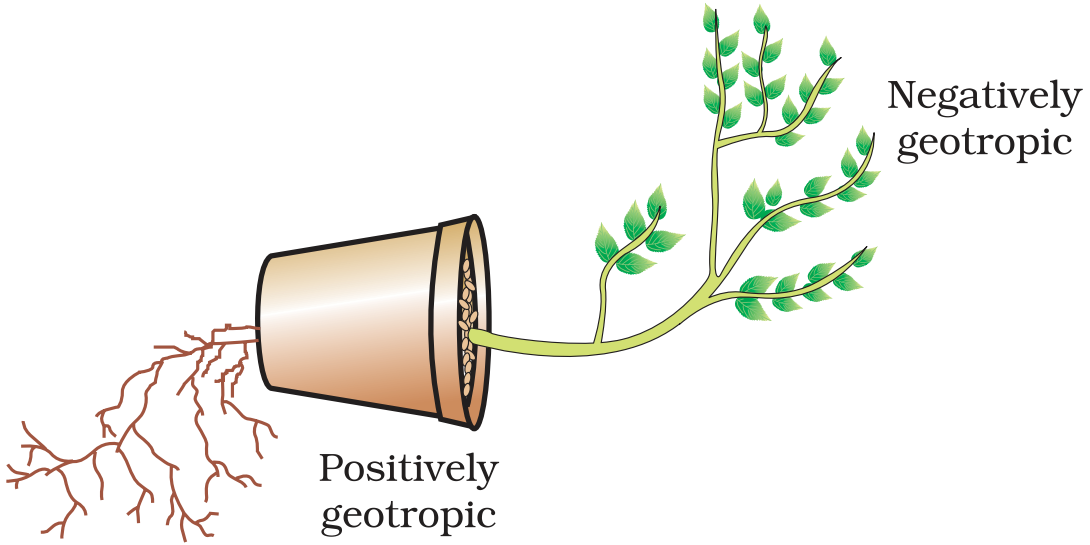
What is meant by positive tropism and negative tropism? Explain with examples.
Answer
The growth of a plant part in response to a stimulus is called positive tropism and if the growth of a plant part is away from the stimulus, then it is called negative tropism. Example: The roots of a plant go towards earth in response to gravity is an example of positive geotropism whereas stem grows away from earth against gravity is an example of negative geotropism.
View full question & answer
Question 263 Marks
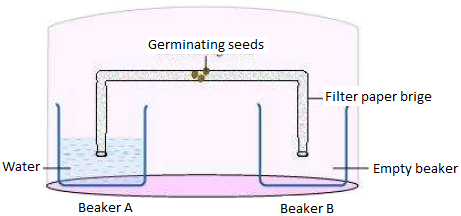
Design an experiment to demonstrate hydrotropism.
Answer

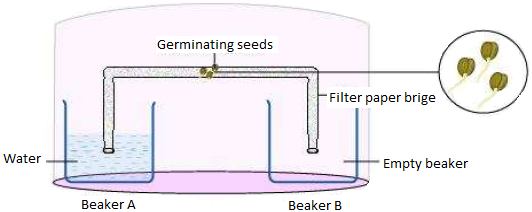
Take two small beakers and label them as A and B. Fill beaker A with water. Now make a cylindrical-shaped roll from a filter paper and keep it as a bridge between beaker A and beaker B, as shown in the figure. Attach few germinating seeds in the middle of the filter paper bridge. Now, cover the entire set-up with a transparent plastic container so that the moisture is retained.

Observation:
The roots of the germinating seeds will grow towards beaker A.

This experiment demonstrates the phenomenon of hydrotropism.
View full question & answer
Question 273 Marks
How does phototropism occur in plants?
Answer
The growth movement in plants in response to light stimulus is known as phototropism. The shoots show positive phototropism and the roots show negative phototropism. This means that the shoots bend towards the source of light whereas the roots bend away from the light source.
For Example: The flower head of sunflower is positively phototropic and hence it moves from east to west along with the sun.
View full question & answer
Question 283 Marks
How do tropisms differ from nasties (or nastic movements)?
Answer
Tropisms:
  1. These movements are always in the direction of the stimulus.
  2. These movements are slow.
  3. These movements are exhibited by all parts of a plant. For example, movement of shoot towards the light and not towards.
Nasties:
  1. These movements are neither away nor towards the stimulus.
  2. These movements are fast.
  3. These movements are exhibited by the flat organs (like leaves and petals of flowers) of a plant. For example, the bending and dropping of leaves in ‘Touch-me-not’ plant.
View full question & answer
Question 293 Marks
How does chemical coordination take place in human beings?
Answer
The chemical coordination in animals takes place through the actions of chemicals called hormones which are release directly into the blood and are carried by the blood circulatory system to other parts of the body. Hormones travel all over the body but affect only particular organs at particular places which are called target organs. The organs control and coordinate several functions of animal body such as growth, development, metabolism, behavior and secondary sexual characteristics, etc.
View full question & answer
Question 303 Marks
What is the need for a system of control and coordination in an organism?
Answer
There are various organs in an organism. These organs must be carefully controlled and coordinated for the survival of an organisms. In the body of an organism various fluids are secreted from the glands of the endocrine system. These hormones are responsible for the overall growth and development of an organism. All others daily decision that includes voluntary and involuntary action are controlled by central nervous system(CNS).
View full question & answer
Question 313 Marks
What is the role of sensory neuron in a reflex arc?
Answer
The path taken by the nerve impulses in a reflex is called a reflex arc. In higher animals, most sensory neurons do not pass directly into the brain, but Sensory neurons passes signals from the receptors to the spinal cord from where they travel to brain and then brain sends them back via motor neuron to the effector part which helps in quick reflex. For example when we touch the hot pan by mistake we suddenly pull-off our hands. This response to the stimuli is known as reflex action.
View full question & answer
Question 323 Marks
What is the difference between the manner in which movement takes place in a sensitive plant and the movement in our legs?
Answer
Movement in sensitive plants Movement in our legs
The movement in a sensitive plant is a response to stimulus(touch) which is a involuntary action. Movement in our legs is a voluntary action.
No special tissue is there for the transfer of information A complete system CNS and PNS is there for the information exchange.
Plant cells do not have specialised protein for movements. Animal cells have specialised protein which help muscles to contract.
View full question & answer
Question 333 Marks
Define reflex action.
Answer
Reflex actions are sudden, involuntary reactions of the body in response to stimuli. They occur without the involvement of the conscious areas of the brain. Therefore, all reflex actions are unconscious actions. Somatic nervous system is responsible for reflex arcs. Reflex arc is the path of impulses in the reflex action.Reflex arcs are formed in the spinal cord and the information (input) reaches the brain. The brain is only aware of the signal and the response that has taken place. However, the brain has no role to play in the creation of the response.
View full question & answer
Question 343 Marks
A person walks across a room in barefeet and puts his foot on a drawing pin lying on the floor. He lets out a cry. Explain what happens in his nervous system in bringing about this response.
Answer
It is an example of reflex action. The stimulus here is drawing pin lying on the floor. The pain is sensed by the receptors in the skin which triggers and impulse in a sensory neuron and transmits the message to the spinal cord. The impulse is passed onto a relay neuron, which in turn, passes it to the motor neuron. The motor neuron passes the impulse to a muscle in the feet. The muscle then contracts and pulls our feet away from the drawing pin.
View full question & answer
Question 353 Marks
How does our body respond when adrenaline is secreted in large amounts into the blood?
Answer
The adrenaline hormone prepares our body to function at maximum efficiency during emergency situations like danger, anger etc. This adrenaline hormone increases our heartbeat, breathing rate, blood flow into muscles and causes liver to put more stored glucose into our blood. All these actions produce a lot of energy in our body and help us to cope up the emergency situations. Thus, when adrenaline is secreted in large amounts it prepares our body for action.
View full question & answer
Question 363 Marks
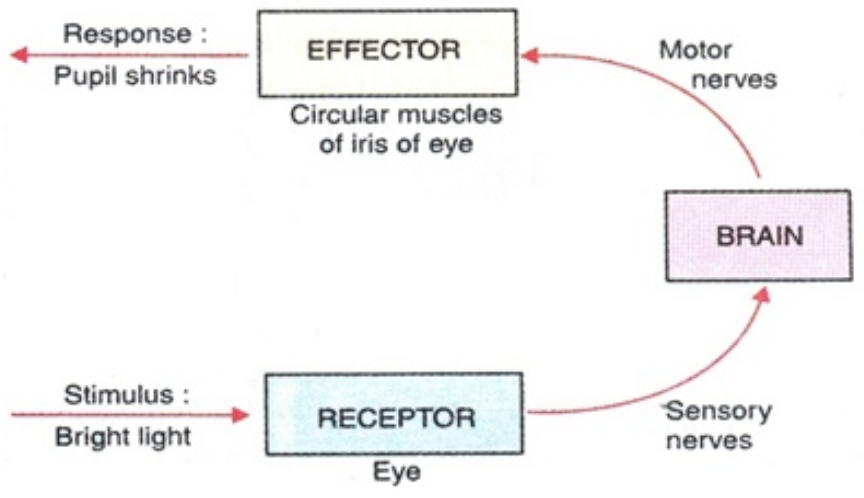
Define reflex arc. Give the flow chart of a spinal reflex arc.
Answer
The pathway taken by the never impulses in our reflex action is called the reflex arc.

A reflex are (This is actually a spinal reflex are).
View full question & answer
Question 373 Marks
Identify the stimulus in the following movements:
  1. Phototropism.
  2. Geotropism.
  3. Chemotropism
Answer
  1. Phototropism: the growth response of a plant in response to light direction. Different parts of a plant exhibit different reactions to light. Stems exhibit positive phototropism while most roots exhibit negative phototropism.
  1. Geotropism: the growth response of a plant in response to gravity. Roots exhibit positive geotropism while stems and leaves exhibit negative geotropism.
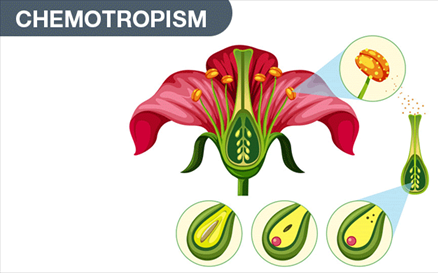
  1. Chemotropism: the growth response of a plant to a particular chemical. Roots grow toward useful minerals in the soil but away from acids.
View full question & answer
Question 383 Marks
Adrenal glands are located on top of each kidney. What will happen if these glands do not secrete adrenaline?
Answer
The adrenal glands are small glands located on top of each kidney. Theyproduce hormones that you can't live without, including sex hormones and cortisol. Cortisol helps you respond to stress and has many other important functions. With adrenal gland disorders, your glands make too much or not enough hormones.
View full question & answer
Question 393 Marks
What is the difference between thigmotropism and thigmonasty? Name one plant which exhibits thigmotropism and one plant which exhibits thigmonasty. What behaviour (or responses) of these plants make you think that they exhibit thigmotropism and thigmonasty respectively?
View full question & answer
Question 403 Marks
What constitutes Central Nervous System (CNS)?
Answer
The central nervous system (CNS) controls most functions of the body and mind. It consists of two parts: the brain and the spinal cord. spinal cord is centre for all the reflex actions. Brain the major centre of co-ordination in the body. The brain is the center of our thoughts, the interpreter of our external environment, and the origin of control over body movement.
View full question & answer
Question 413 Marks
What is meant by positive phototropism and negative phototropism? Give one example of each type.
Answer
The movement of a plant part towards light is called positive phototropism. Example? the stem of the growing bends towards light. The movement of a plant part away from light is called negative phototropism. Example? The roots of a plant move away from light.
View full question & answer
Question 423 Marks
Mention the part of the brain involved in thinking. State one more function of this part.
Answer
The Human brain has three parts- fore-brain, mid-brain, and hind-brain. Fore-brain Fore Brain It is the main thinking part of the brain and controls the voluntary actions. The forebrain processes sensory information that is collected from the various sense organs such as ears, eyes, nose, tongue, skin.
View full question & answer
Question 433 Marks
Give one example to show how the endocrine system coordinates our body activities.
Answer
Adrenal gland is an endocrine gland which secretes adrenaline and helps us to face emergency situations. Some of its examples are dryness of mouth when fear or shivering of body when fear. This shows that the endocrine system coordinates our body activities.
View full question & answer
Question 443 Marks
What is a reflex action? Explain with the help of an example.
Answer

The rapid, automatic response to a stimulus which is not under the voluntary action of the brain is called reflex action. Example: Moving our hand away on touching a hot plate.
View full question & answer
Question 453 Marks
Compare the nervous system and endocrine system (hormonal system) for control and coordination in humans.
Answer
Nervous System It is a system to coordinate the activities of bodies. It helps all other system of our body to work together. It receives information from the surroundings, processes it, interprets it and then responds accordingly. Endocrine System It is a group of endocrine glands which produces various hormones that helps in coordinating the activities of our body. The hormones produced by the endocrine glands act as messengers between the nervous system and the organs of our body.
View full question & answer
Question 463 Marks
How does chemical coordination take place in animals?
Answer
Hormones are the long range chemical messengers that are released into blood by endocrine gland in response to some signal. These hormones exert their effect on the target cells present distantly from their site of release. These hormones serve the function of chemical coordination in animals.
Hormones are released into the blood stream and can reach all cells but they affect only target cells. This is followed by generation of stimulus specific biochemical or physiological activity. In this way, hormones regulate functioning of different organs and tissues. Each hormone is under regulation of feedback mechanism which in turn ensures reliability of the system.
View full question & answer
Question 473 Marks
How does chemical coordination occur in plants?
Answer
  1. Chemical coordination occurs in plants with the help of plant hormones. Different plant hormones help to coordinate growth, development, and responses to the environment.
  2. They are synthesized at places away from where they act and diffuse to the area for action; for example, auxin promotes cell growth, gibberellins promote stem growth, cytokinins promote cell division, and abscisic acid inhibits growth, and its effects include wilting of leaves.
View full question & answer