Questions

case /data -based (4 Marks)

Take a timed test

11 questions · self-marked practice — reveal the answer and mark yourself.

Question 14 Marks
The thyroid is a small, butterfly-shaped gland located at the base of your neck just below the Adam's apple. It is part of an intricate network of glands called the endocrine system. The endocrine system is responsible for coordinating many of your body's activities. The thyroid gland manufactures hormones that regulate your body's metabolism.
Several different disorders can arise when your thyroid produces too much hormone (hyperthyroidism) or not enough (hypothyroidism). Four common disorders of the thyroid are Hashimoto's disease, Graves' disease, goitre and thyroid nodules.
In hyperthyroidism, the thyroid gland is overactive. It produces too much of its hormone. Hyperthyroidism affects about 1 percent of women. It's less common in men.
Graves' disease is the most common cause of hyperthyroidism, affecting about 70 percent of people with an overactive thyroid. Nodules on the thyroid - a condition called toxic nodular goitre or multinodular goitre can also cause the gland to overproduce its hormones.
Excessive thyroid hormone production leads to symptoms such as : restlessness nervousness, racing heart, irritability, increased sweating, shaking, anxiety, trouble sleeping, thin skin, brittle hair and nails, muscle weakness, weight loss, bulging eyes (in Graves' disease).
(i) What is thyroid gland?
(ii) What is the function of the thyroid gland ?
(iii) Name some common disorders of the thyroid.
or
(iv) Give some symptoms of hyperthyroidism.
Answer
(i) It is a small, butter-shaped gland located at the base of your neck just below the Adam's apple. It is part of an intricate network of glands called the endocrine system.
(ii) The thyroid gland manufactures hormones that regulate body's metabolism.
(iii) Hashimoto's disease, Graves' disease, goitre and thyroid nodules.
(iv) Restlessness, nervousness, racing heart, irritability, increased sweating, shaking, anxiety, trouble sleeping, thin skin, brittle hair and nails, muscle weakness, weight loss, bulging eyes.
View full question & answer
Question 24 Marks

The human brain is the central organ of the human nervous system and with the spinal cord makes up the central nervous system. The brain consists of the cerebrum, the brain-stem and the cerebellum. It controls most of the activities of the body, processing, integrating and coordinating the information it receives from the sense organs and making decisions as to the instructions sent to the rest of the body. The brain is contained in and protected by, the skull bones of the head. The cerebrum is the largest part of the human brain. It is divided into two cerebral hemispheres. The cerebral cortex is an outer layer of grey matter, covering the core of white matter. The cortex is split into the neocortex and the much smaller allocortex. The neocortex is made up of six neuronal layers, while the allocortex has three or four. Each hemisphere is conventionally divided into four lobes - the frontal, temporal, parietal and occipital lobes. The frontal lobe is associated with executive functions including self-control, planning, reasoning and abstract thought, while the occipital lobe is dedicated to vision. The brain is protected by the skull, suspended in cerebrospinal fluid and isolated from the bloodstream by the blood brain barrier. Howvever, the brain is still susceptible to damage, disease and infection. Damage can be caused by trauma, or a loss of blood supply known as a stroke. The brain is susceptible to degenerative disorders, such as Parkinson's disease, dementias including Alzheimer's disease and multiple sclerosis. Psychiatric condition, including schizophrenia and clinical deprescion, are thought to be associated with brain dysfunctions. The brain can also be the site of tumours, both benign and malignant; these mostly originate from other sites in the body.The study of the anatomy of the brain is neuroanatomy, while the study of its function is neuroscience.

(i) Which is the central part of the nervous system?
(ii) What is the largest part of the human brain?
(iii) What are the functions of the brain?
or
(iv) What is the branch which studies the anatomy of brain?
Answer
(i) The central part of the nervous system is the brain.
(ii) The cerebrum is the largest part of the human brain.
(iii) It controls most of the activities of the body like processing, integrating and coordinating the information it receives from the sense organs and making decisions on the instructions sent to the rest of the body.
or
(iv) The study of the anatomy of the brain is neuroanatomy.
View full question & answer
Question 34 Marks
Plant hormones affect gene expression and transcription levels, cellular division and growth. They are naturally produced within plants, but very similar chemicals are produced by fungi and bacteria that can also affect plant growth. A large number of related chemical compounds are synthesized by humans. They are used to regulate the growth of cultivated plants, weeds and in vitro-grown plants and plant cells; these man-made compounds are called plant growth regulators or PGRs for short. Plant hormones are not nutrients, but chemicals that in small amounts promote and influence the growth, development and differentiation of cells and tissues. The biosynthesis of plant hormones within plant tissues is often diffused and not always localized. Plants lack glands to produce and store hormones, because, unlike animals which have two circulatory systems (lymphatic and cardiovascular) powered by a heart that moves fluids around the body. Plants use more passive means to move chemicals around their bodies. Plants utilize simple chemicals as hormones, which move more easily through their tissues. They are often produced and used on a local basis within the plant body. Plant cells produce hormones that affect different regions of the cell producing the hormone.
Different hormones can be sorted into different classes, depending on their chemical structures. Within each class of hormone the exact structures vary, but they have similar physiological effects. Initial research into plant hormones identified five major classes : abscisic acid, auxin, cytokinins, ethylene and gibberellins. This list was later expanded and brassinosteroids, jasmonates, salicylic acid and strigolactones are now considered as major plant hormones.
(i) What are the factors affected by the plant hormones?
(ii) What does $PGR$ stands for ?
(iii) Which class does plant hormones fall into ?
or
(iv) What were the five major plant hormones discovered in the initial research?
Answer
(i) Plant hormones affect gene expression and transcription levels, cellular division and growth.
(ii) PGR stands for plant growth regulators.
(iii) Plant hormones fall into the class of chemicals which promote and influence the growth, development and differentiation of cells and tissues.
or
(iv) The five major plant hormones discovered by the initial research were abscisic acid, auxin, cytokinins, ethylene and gibberellins.
View full question & answer
Question 44 Marks
The communication between the central nervous system and the other parts of the body is facilitated by the peripheral nervous system consisting of cranial nerves arising from the brain and spinal nerves arising from the spinal cord. The brain thus allows us to think and take actions based on that thinking.
The brain has three such major parts or regions, namely the fore-brain, mid-brain and hind-brain. The fore-brain is the main thinking part of the brain. It has regions which receive sensory impulses from various receptors. Separate areas of the fore-brain are specialised for hearing, smell, sight and so on. There are separate areas of association where this sensory information is interpreted by putting it together with information from other receptors as well as with information that is already stored in the brain. Based on all this, a decision is made about how to respond and the information is passed on to the motor areas which control the movement of voluntary muscles.
(i) Which system facilitates the communication between the central nervous system and the other parts of the body?
(ii) What is the role of the brain?
(iii) What are three parts of the human brain ?
(iv) Which is the main thinking part of the brain?
Answer
(i) The peripheral nervous system consisting of cranial nerves arising from the brain and spinal cord system facilitates the communication between the central nervous system and the other parts of the body.
(ii) The brain thus allows us to think and take actions based on that thinking.
(iii) The brain has three such major parts or regions, namely the fore-brain, mid-brain and hind-brain.
or
(iv) The fore-brain is the main thinking part of the brain.
View full question & answer
Question 54 Marks

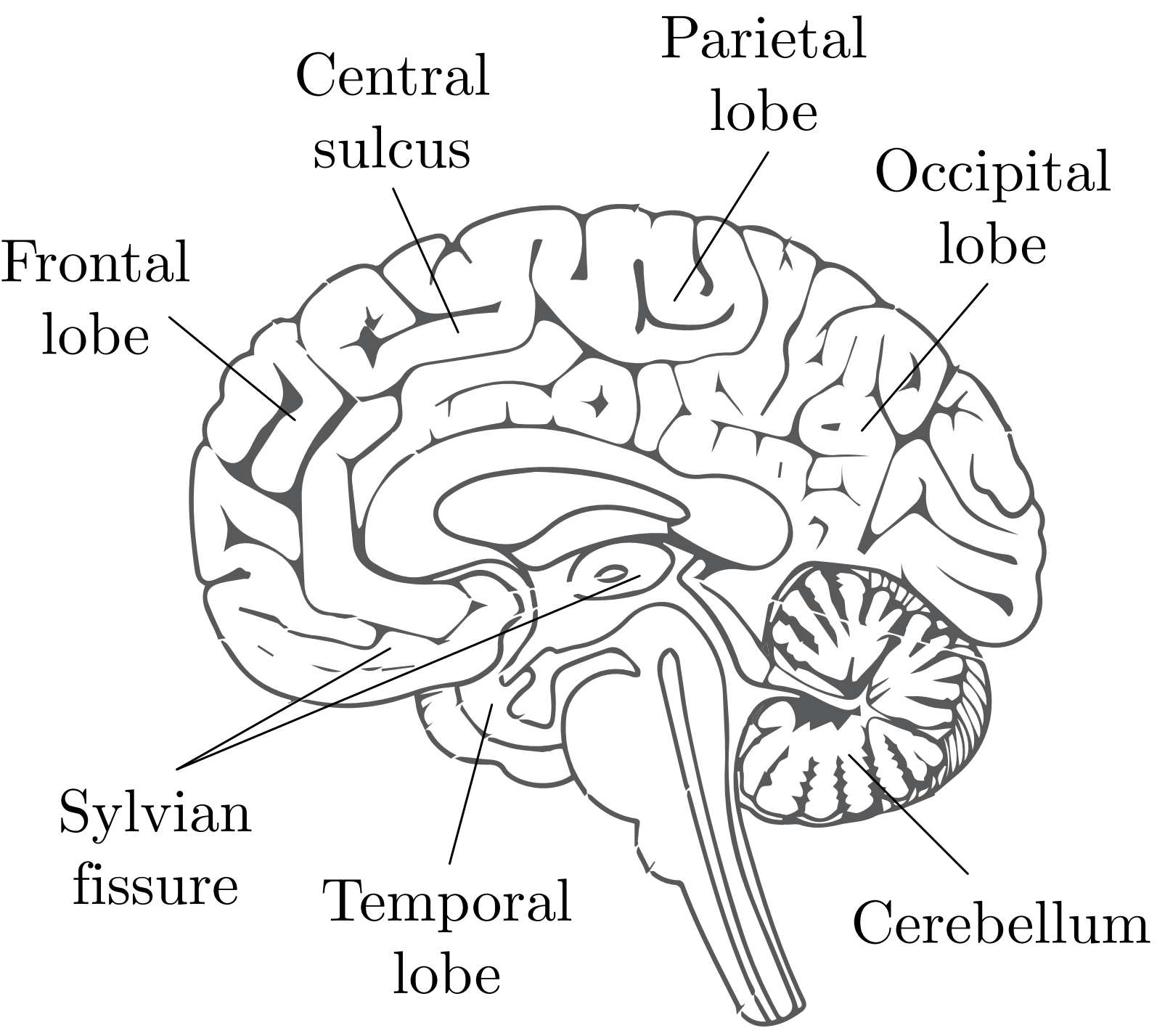
The human brain is the command centre for the human nervous system. It receives signals from the body's sensory organs and outputs information to the muscles. The human brain has the same basic structure as other mammal brains but is larger in relation to body size than the brains of many other mammals, such as dolphins, whales and elephants. The human brain weighs about 3 lbs. (1.4 kilograms) and makes up about $2 \%$ of a humans body weight. On average, male brains are about $10 \%$ larger than female brains, according to North-western Medicine in Illinois. The average male has a brain volume of nearly 78 cubic inches (1,274 cubic centimetres), while the average female brain has a volume of 69 cubic inches $(1,131$ cubic $cm )$. The cerebrum, which is the main part of the brain located in the front area of the skull, makes up $85 \%$ of the brain's weight.

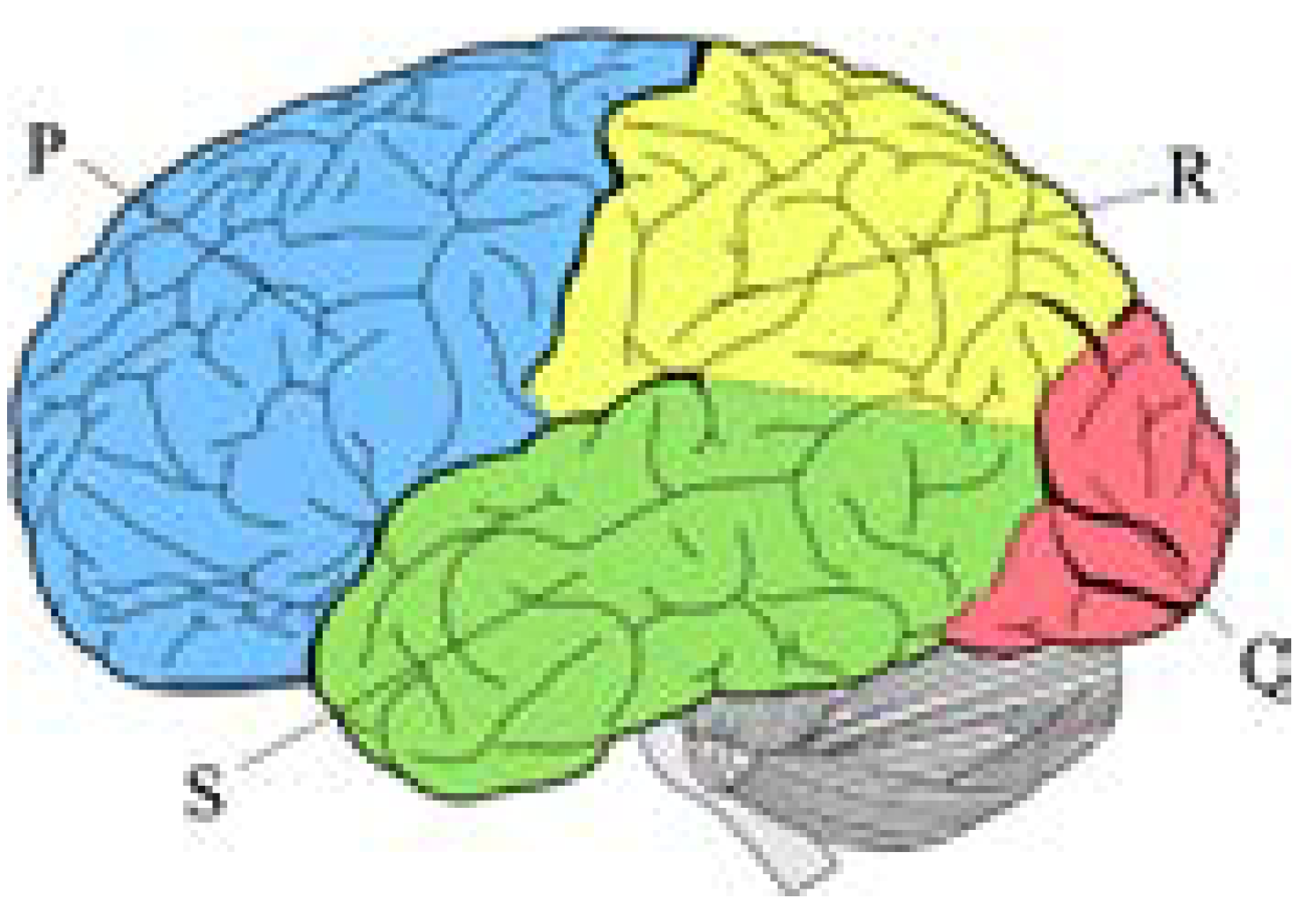
(i) Name the given figure and identify the labelled part $Q$ and $R$.
(ii) Which region is responding for pain and conscious association ?
(iii) Give two functions of the part ' $P$ '.
or
(iv) Facial muscular activities and auditory reception are respectively controlled by
Answer
(i) The given figure is of human brain showing major lobes. Here, $P$ is frontal lobe, $Q$ is occipital lobe, $R$ is parietal lobe and $S$ is temporal lobe.
(ii) Parietal lobe $R$ is the region for touch, pain, heat, cold and conscious association.
(iii) Functions of frontal lobe $P$ is :
(a) It controls involuntary movements of visceral organs.
(b) It controls voluntary movements of body parts. or
(iv) Frontal lobe $P$ is the region for facial muscular activities. While temporal lobe $S$ is the region for auditory reception.
View full question & answer
Question 64 Marks
Nastic movements in plants are not directional movements. They are not dependent on the stimulus and are growth independent. For example, the leaves of a touch me not plant (Mimosa pudica), fold up immediately when touched. These kinds of changes occur due to the changes in the amount of water in the leaves. Depending on the quantity, they either swell up or shrink. Plant hormones or phytohormones are responsible for the control and coordination of plants. There are different types of hormones, which affect the growth of a plant. Phytohormones are chemical compounds which are released by stimulated cells. These hormones are diffused around the plant cells. They have a role in the cell division, cell enlargement, cell differentiation, fruit growth, falling of leaves, ripening of fruits, ageing of plants etc.
(i) Name the phenomenon called for the movement in growth of plants.
(ii) What do you mean by nastic movement?
(iii) What are the different types of harmonies of plants?
or
(iv) The plant harmone help in the cell growth at the shoot tips by elongating the cells and help in the growth process is :
Answer
(i) Growth-dependent movements are called the Tropic Movements (towards or away from a stimulus).
(ii) Non-growth dependent movements called the nastic Movements (independent of stimulus).
(iii) The different types of phytohormones are :
(a) Auxins
(b) Gibberellins
(c) Cytokinins
(d) Abscisic acid
or
(iv) Auxins
View full question & answer
Question 74 Marks

To carry out a simple function such as eating food there has to be coordination of the eyes, hands and the mouth. The eyes have to focus on the food, the hands have to pick it up and take it to the mouth where it will be chewed. All these actions have to be coordinated in such a manner that they follow a particular sequence and the action is completed. A similar mechanism is also needed for internal functions of the body. This function is carried out by the nervous system.
It is composed of :
(a) specialised cells which can detect, receive and transmit different kinds of stimuli. These are called neurons.
(b) nerve fibres which are certain bundles of extended processes of nerve cells.

The individuals also have to adjust to the changing conditions of the body should vary their responses. At the same time, the internal conditions of the body should be maintained constant. This is called homeostasis. The internal conditions of the body are maintained at a constant by controlling the physiology of the organisms.
(i) What will the correct sequence in which conduction of information through nerves take place?
(ii) How homeostasis is said to maintain the equilibrium of the body?
(iii) What function does the central nervous system perform?
or
(iv) What happens when the dendrite tip of a nerve cell receives a signal?
Answer
(i) Dendries $\longrightarrow$ Cell body $\longrightarrow$ Axon $\longrightarrow$ Nerve endings at the tip of axon $\longrightarrow$ Synapse $\longrightarrow$ Dendrite of next neuron
(ii) Homeostasis maintains the equilibrium of the body and keep the overall system constant.
(iii) The central nervous system is comprised of the brain and the spinal cord which process the information received from the receptors on/in the body.
or
(iv) Upon receiving a signal the dendrite tip of a nerve cell sets off a chemical reaction that creates an electrical impulse in the dendrite.
View full question & answer
Question 84 Marks
A boy runs on seeing a stray dog. His breathing rate becomes very fast and blood pressure also increases.
  1. Name the hormone found to be high in his blood and the gland which produces it.
  2. What other effects are caused by this hormone?
Answer
  1. Adranalin produced by adrenal gland which is responsible for increase in heart rate.
  2. Supply of blood to digestive system and skin is reduced, supply of oxygen increased towards the muscles and also the blood supply to the heart is increased.
View full question & answer
Question 94 Marks
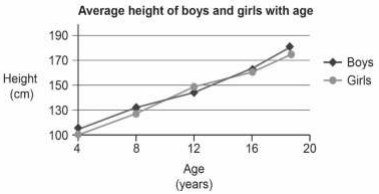
The graph shows the average height of boys and girls in a population.

Image
6. What does the graph indicate?
A. The average height of boys is always greater than that of girls.
B. The average height of girls is greater than that of boys in adulthood.
C. The average height of girls during puberty is greater than that of boys.
D. The average heights of girls and boys are the same between 4 and 20 years.
7. A student suggested a different title for the graph - ‘Height of boys and girls from birth to adulthood’.
Is the title correct? Explain your answer.
8. Which of the following statements are correct?
Circle ‘Yes’ or ‘No’ to mark your response.

Statement

Yes or No

Hormones are released directly into the bloodstream.

Yes/No

Endocrine glands use electrical impulses.

Yes/No

Sex hormones regulate changes associated with puberty.

Yes/No

9. The cerebellum in the brain controls voluntary actions of the body.
Which of these actions is controlled by the cerebellum?
A. Beating of the heart
B. Blinking of the eyes
D. Jumping from a height
C. Watering of the mouth
10. Which of these health conditions is caused by a hormonal imbalance in the body?
A. Scurvy
B. Typhoid
C. Diabetes
D. Common cold

Answer
6. C. The average height of girls during puberty is greater than that of boys.
7. Mentions that the title is incorrect because there is no data for height of girls and boys at birth
For example:
● The title is incorrect because the heights of boys and girls are shown from age 4 onwards.
OR
● The title is incorrect because the height of boys and girls from 0 to 3 years is not given.
8. Yes
No
Yes
9. D. Jumping from a height
10. C. Diabetes
View full question & answer
Question 104 Marks
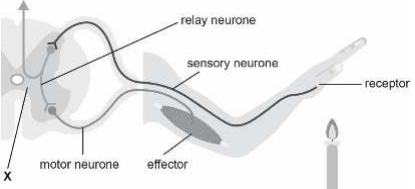
The igure shows a relex arc formed in response to heat.

Image
4. Which of these is the correct sequence of the low of information in the relex arc?
A. Sensory Neurone → Receptor → Motor Neurone → Relay Neurone → Effector
B. Receptor → Sensory Neurone → Relay Neurone → Motor Neurone → Effector
C. Sensory Neurone → Receptor → Motor Neurone → Relay Neurone → Effector
D. Effector → Motor Neurone → Relay Neurone → Sensory Neurone → Receptor
5. What is labelled as ‘X’ in the igure?
A. Cerebrum
B. Spinal cord
C. Pituitary gland
D. Hypothalamus

Answer
4. B. Receptor → Sensory Neurone → Relay Neurone → Motor Neurone → Effector
5. B. Spinal cord
View full question & answer
Question 114 Marks
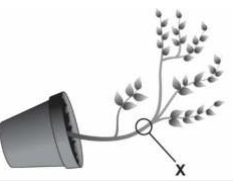
The igure shows the movement of a stem. X is a part of the stem.
The movement of plant hormone auxin in cells regulates cell elongation and growth of plants in a
particular direction.

Image
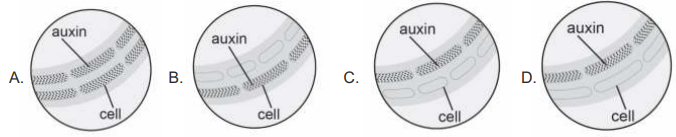
1.What would the size of cells and the distribution of auxin at part X of the stem look like?

Image
2. How can the movement of the stem in a particular direction be described?
A. Against gravity
B. Away from touch
C. Away from chemicals
D. Towards a source of water
3. Cell division in plants is promoted by _______________________.
A. Auxin
B. Abscisic acid
C. Cytokinins
D. Gibberellins

Answer
1. B. Image
2. B. Against gravity
3. C. Cytokinins
View full question & answer
case /data -based (4 Marks) - Science STD 10 Questions - Vidyadip