Questions

[5 marks Questions]

Take a timed test

25 questions · self-marked practice — reveal the answer and mark yourself.

Question 15 Marks
A 5V battery is connected to two $20 Ω$ resistors which are joined together in series.
  1. Draw a circuit diagram to represent this. Add an arrow to indicate the direction of conventional current flow in the circuit.
  2. What is the effective resistance of the two resistors?
  3. Calculate the current that flows from the battery.
  4. What is the p.d. across each resistor?
Answer
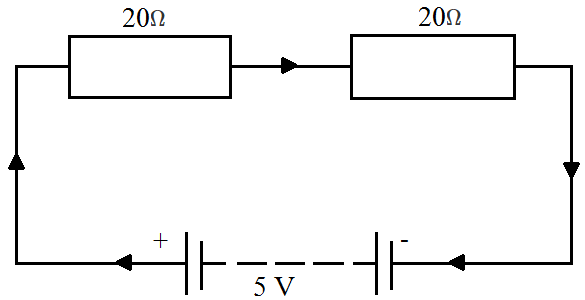
  1.  
  1. Effective resistance = 20 + 20 = 40 ohms.
  2. Current flowing through the circuit $=\text{I}=\frac{\text{V}}{\text{R}}=\frac{5}{40}=0.125\ \text{amps}.$
  3. p.d. across each resistance = I × R = 0.125 × 20 = 2.5V
View full question & answer
Question 25 Marks
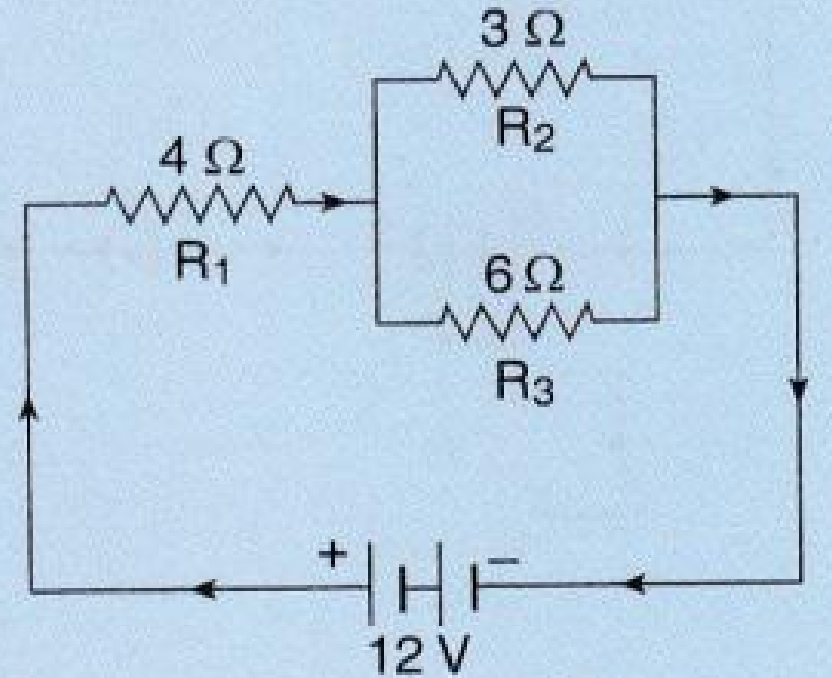
The circuit diagram given below shows the combination of three resistors $R_1 R_2$ and $R_3$ :

Find:
  1. Total resistance of the circuit.
  2. Total current flowing in the circuit.
  3. The potential difference across R.
Answer
  1. Total resistance of two resistors that are connected in parallel is:
$\frac{1}{\text{R}'}=\frac{1}{3}+\frac{1}{6}$

$\frac{1}{\text{R}'}=\frac{3}{6}$

R’ = 2ohms

Total resistance of the circuit = 2 + 4 ohms = 6 ohms
  1. Total current flowing through the circuit $=\frac{\text{V}}{\text{Total resistance}}$
$\text{I}=\frac{12}{6}=2\ \text{amps}$
  1. Potential difference across $R _1= R _1 \times I =4 \times 2=8 V$.
View full question & answer
Question 35 Marks
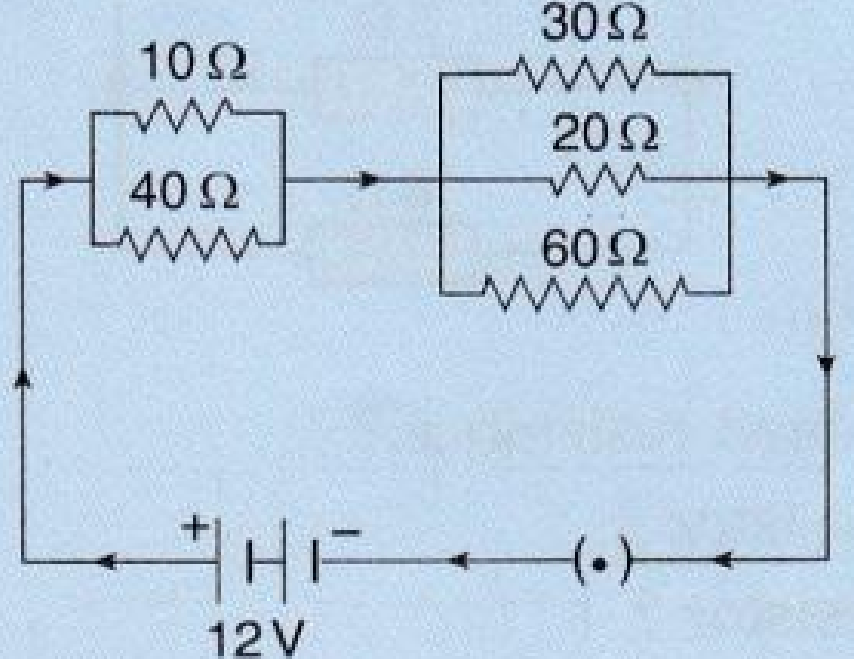
In the circuit diagram given below five resistances of $10 Ω, 40 Ω, 30 Ω, 20 Ω\ \text{and}\ 60 Ω$ are connected as shown to a 12V battery.
Calculate:
  1. Total resistance in the circuit.
  2. Total current flowing in the circuit.
Answer
  1. Equivalent resistance of $10\Omega$ and $40\Omega$ resistance (Connected in parallel) is $R_1$ given as:
$\frac{1}{\text{R}_1}=\frac{1}{10}+\frac{1}{40}=\frac{5}{40}$

$\text{R}_1=8\Omega$

Equivalent resistance of $30\Omega, 20\Omega$ and $60\Omega$ resistance (connected in parallel) is $R_2$ given as:

$\frac{1}{\text{R}_2}=\frac{1}{30}+\frac{1}{20}+\frac{1}{60}=\frac{6}{60}$

$\text{R}_2=10\Omega$

$R_1$ and $R_2$ are connected in series.
$\therefore$ Total resistance in the circuit is $R=R_1+R_2=8+10=18$
  1. Total current flowing in the circuit, $\text{I}=\frac{\text{V}}{\text{R}}=\frac{12}{18}=0.67\text{A}$
View full question & answer
Question 45 Marks
State whether an electric heater will consume more electrical energy or less electrical energy per second when the length of its heating element is reduced. Give reasons for your answer.
Answer
By reducing the length of element the resistance will decrease. Power is inversely proportional to resistance. So, this will result in more consumption of energy.
View full question & answer
Question 55 Marks
With the help of a circuit diagram, deduce the equivalent resistance of two resistances connected in series. Two resistances are connected in series as shown in the diagram:
  1. What is the current through the 5 ohm resistance?
  2. What is the current through R?
  3. What is the value of R?
  4. What is the value of V?
Answer
Fig shows two resistance $R_1$ and $R_2$ connected in series with a battery of $V$ volt. Let the p.d. across $R_1$ is $V_1$ and the p.d. across $R_2$ is $V_2$.
$\text { s.t. } V=V_1+V_2 \ldots . . .(1)$
Let the equivalent resistance be $R$ and current flowing through whole circuit is 1. By ohm's law's,
$\frac{V}{I}=R$
$V=I \times R$
Applying ohm's law to both R1 and R2
$V_1=I \times R_1 \ldots \ldots .(3)$
$V_2=I \times R_2 \ldots \ldots .(4)$
From eqs. (1), (2), (3) and (4), we get
$I \times R=I \times R_1+I \times R_2$
$I \times R=I \times\left(R_1+R_2\right)$
$R=R_1+R_2$
View full question & answer
Question 65 Marks
The p.d. across a lamp is 12V. How many joules of electrical energy are changed into heat and light when:
  1. A charge of 1C passes through it?
  2. A charge of 5C passes through it?
  3. A current of 2A flows through it for 10s?
Answer
P.d. = 12V
  1. $\text{P}.\text{d}.\frac{\text{Work done}}{\text{Charge Moved}}$
Work done = P.d. × Charge moved

= 12 × 1 = 12J

Amount of electrical energy changed into heat and light = 12J
  1. Work done = P.d. × Charge moved
= 12 × 5 = 60J

Amount of electrical energy changed into heat and light = 60J
  1. $\text{I}=\frac{\text{Q}}{\text{t}}$
Q × I × t

= 2 × 10 = 20C

Work done = p.d. × Charged moved

= 12 × 20 - 240J

Amount of electrical energy changed into heat and light = 240J
View full question & answer
Question 75 Marks
For the circuit shown in the diagram given below:
Calculate:
  1. The value of current through each resistor.
  2. The total current in the circuit.
  3. The total effective resistance of the circuit.
Answer
Let $5\Omega=\text{R}_1$ $10\Omega=\text{R}_2,$ $30\Omega=\text{R}_3 $
  1. Current through R1 $=\text{I}_1=\frac{\text{V}}{\text{R}_1}=\frac{6}{5}=1.2\text{A}$
Current through $\text{R}_2=\text{I}_2=\frac{\text{V}}{\text{R}_2}=\frac{6}{10}=0.6\text{A}$

Current through $\text{R}_3=\text{I}_3=\frac{\text{V}}{\text{R}_3}=\frac{6}{30}=0.2\text{A}$
  1. Total current in the circuit = 1.2 + 0.6 + 0.2 = 2A
  2. Effective resistance R is given as
$\frac{1}{\text{R}}=\frac{1}{\text{R}_1}+\frac{1}{\text{R}_2}+\frac{1}{\text{R}_3}$

$=\frac{1}{5}+\frac{1}{10}+\frac{1}{30}$

$=\frac{6+3+1}{30}=\frac{10}{30}$

$\text{R}=\frac{30}{10}=3\Omega$
View full question & answer
Question 85 Marks
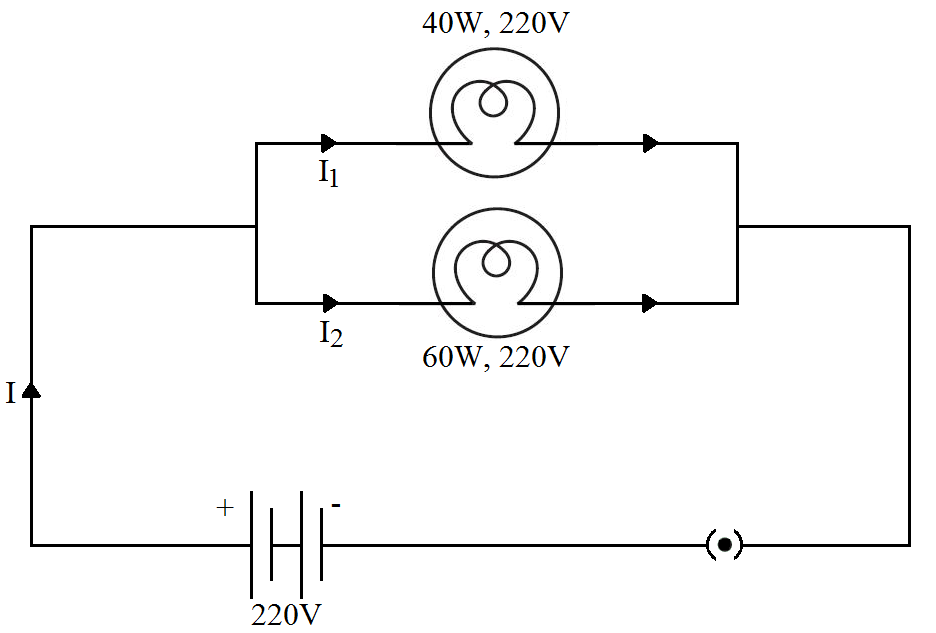
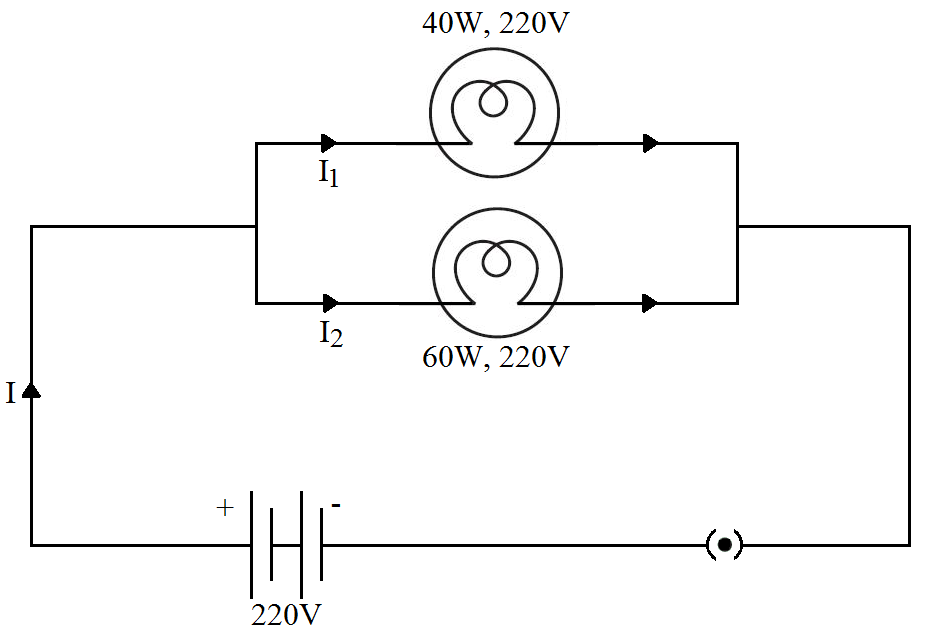
Two lamps, one rated 40W at 220V and the other 60W at 220V, are connected in parallel to the electric supply at 220V.
  1. 10 Draw a circuit diagram to show the connections.
  2. Calculate the current drawn from the electric supply.
  3. Calculate the total energy consumed by the two lamps together when they operate for one hour.
Answer
Given:
Lamps: $P_1=40 W, P _2=60 W$
V= 220V

Voltage across both the bulbs is same and is equal to 220V.
Current through 40W lamp $=\text{I}_1=\frac{\text{P}_1}{\text{V}}=\frac{40}{220}\text{A}$
Current through 60W lamp $=\text{I}_2=\frac{\text{P}_2}{\text{V}}=\frac{60}{220}\text{A}$
Total current drawn from the electric supply $=\frac{40}{220}+\frac{60}{220}=0.45\text{A}$
Energy consumed by 40 W lamp in 1 hr . E1 $= P _1 \times t =40 \times 1=40 Wh$
$1 Wh=3.6 kJ$
$E_1=40 \times 3.6=144 KJ$
Energy consumed by 60 W lamp in $1 hr , E _2= p _2 \times t =60 \times 1=60 Wh=216 KJ$
Total energy consumed = 144 + 216 = 360KJ
View full question & answer
Question 95 Marks
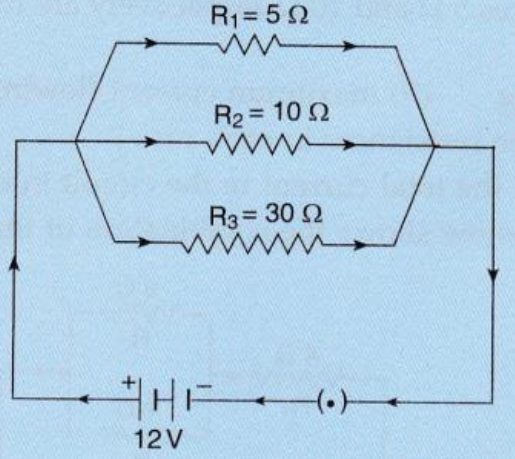
In the circuit diagram given below, three resistors R R , and R of $5 Ω, 10 Ω$ and $30 Ω,$ respectively are connected as shown.
Calculate:
  1. Current through each resistor.
  2. Total current in the circuit.
  3. Total resistance in the circuit.
Answer
V = 12V
$R_1, R_2$ and $R_3$ are connected in parallel.
current through $\text{R}_1=\frac{\text{V}}{\text{R}_1}=\frac{12}{5}=2.4\text{A}$
current through $\text{R}_2=\frac{\text{V}}{\text{R}_2}=\frac{12}{10}=1.2\text{A}$
current through $\text{R}_3=\frac{\text{V}}{\text{R}_2}=\frac{12}{30}=0.4\text{A}$
Total current in the circuit = 2.4 + 1.2 + 0.4 = 4A
Total resistance in the circuit = R
$\frac{1}{\text{R}}=\frac{1}{\text{R}_1}+\frac{1}{\text{R}_2}+\frac{1}{\text{R}_3}$
$\frac{1}{\text{R}}=\frac{1}{5}+\frac{1}{10}+\frac{1}{30}$
$\frac{1}{\text{R}}=\frac{10}{30}$
$\text{R}=3\ \text{ohm}$
View full question & answer
Question 105 Marks
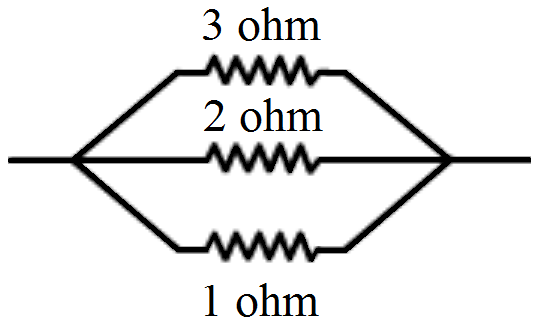
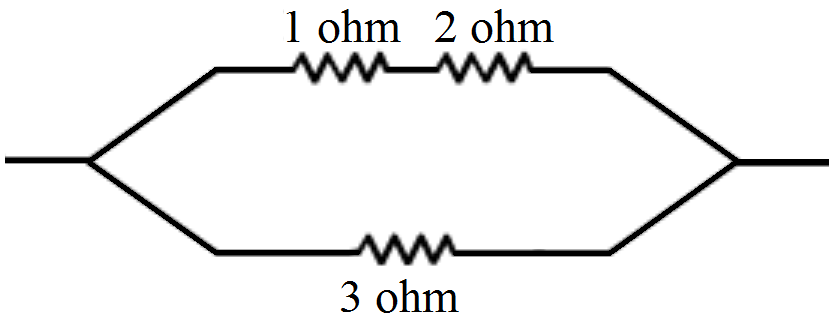
You are given three resistances of 1,2 and 3 ohms. Show by diagrams, how with the help of these resistances you can get:
  1. $6\Omega$
  2. $\frac{6}{11}\Omega$
  3. $1.5\Omega$
Answer

Equivalent resistance $=1\Omega+2\Omega+3\Omega=6\Omega$

Equivalent resistance
$\frac{1}{\text{R}}=\frac{1}{1}+\frac{1}{2}+\frac{1}{3}=\frac{6+3+2}{6}=\frac{11}{6}$
$\therefore\text{R}=\frac{6}{11}\Omega$

Equivalent resistance of first line
$=1\Omega+2\Omega=3\Omega$
Resistance of the secound line $=3\Omega$
Equivalent resistance
$\frac{1}{\text{R}}=\frac{1}{3}+\frac{1}{3}=\frac{2}{3}$
$\therefore\text{R}=\frac{3}{2}=1.5\Omega$
View full question & answer
Question 115 Marks
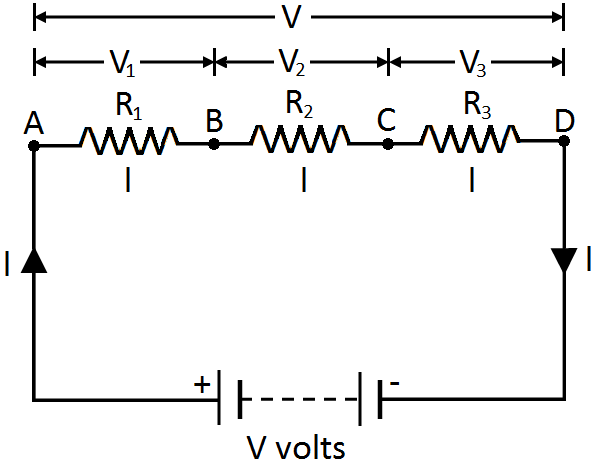
With the help of a diagram, derive the formula for the resultant resistance of three resistors connected in series.
Answer


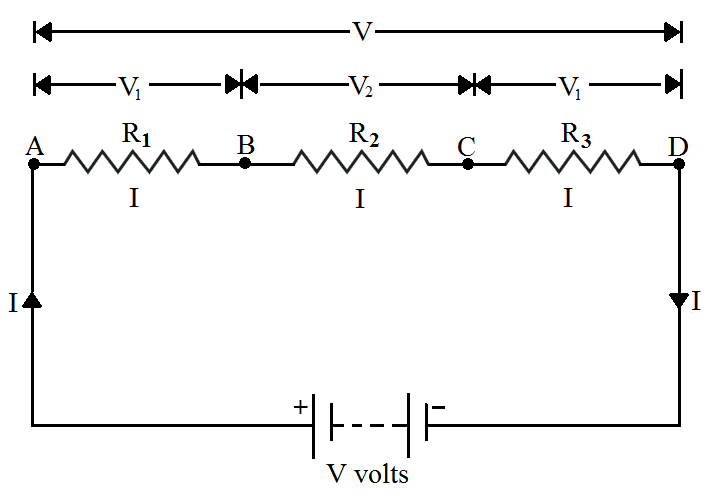
Fig shows three resistance $R_1, R_2$ and $R_3$ connected in series with a battery of $V$ volts Lets the p.d. across $R_1, R_2$ and $R_3$ is $V_1, V_2$ and $V_3$ respectively.
$\text { s.t. } V=V_1+V_3+V_2$
Let the equivalent resistance be R and current flowing through whole circuit is 1.
By ohm's law
$\frac{V}{I}=R$
$V=1 \times R$
Applying ohm's law to both $R_1, R_2$ and $R_3$.
$V_1=1 \times R_1$
$V_2=1 \times R_2$
$V_3=1 \times R_3$
From eq. (1), (2), (3), (4) and (5), we get
$I \times R=1 \times R_1+I \times R_2+I \times R_3$
$I \times R=1 \times\left(R_1+R_2+R_3\right)$
$R=R_1+R_2+R_3$
View full question & answer
Question 125 Marks
A p.d. of 4V is applied to two resistors of $6 Ω$ and $2 Ω$ connected in series. Calculate:
  1. The combined resistance.
  2. The current flowing.
  3. The p.d. across the $6 Ω$ resistor.
Answer
V = 4V,
$R_1=6$ ohm, $R_2=8$ ohm (in series)
Combined resistance, $R = R _1+ R _2+6+2=8$ ohm Current flowing, $I =\frac{ V }{ R }=\frac{4}{8}=0.5 amp$
p.d. across 6 ohm resistor $=I \times R_1=0.5 \times 63 V$.
View full question & answer
Question 135 Marks
In a house two 60W electric bulbs are lighted for 4 hours, and three 100W bulbs for 5 hours everyday. Calculate the electric energy consumed in 30 days.
Answer
Case 1:Power, $P _1=60 W$
Number, $n _1=2$
Time for use, $t _1=4 h$ everyday
Electrical energy consumed in 30 days $=30 \times 0.48=14.4 KWh$
Case 2:
Power, $P _2=100 W$
Number, $n _2=3$
Time for use, $t _2=5 h$ everyday
Electrical energy consumed in everyday, $E 2= n _2 \times P _2 \times t _2$
$=3 \times 100 \times 5=1500=1.5 kWh$
Electrical energy consumed in 30 days $=30 \times 1.5=45 kWh$
Total electrical energy consumed in 30 days $=14.4 kWh +45 kWh =59.4 KWh$
View full question & answer
Question 145 Marks
Two lamps, one rated 40W at 220V and the other 60W at 220V, are connected in parallel to the electric supply at 220V.
  1. 10 Draw a circuit diagram to show the connections.
  2. Calculate the current drawn from the electric supply.
  3. Calculate the total energy consumed by the two lamps together when they operate for one hour.
Answer
Given 2 Lamps: $P _1=40 W, P _2=60 W$
V= 220V

Voltage across both the bulbs is same and is equal to 220V.
Current through 40W lamp $=\text{I}_1=\frac{\text{P}_1}{\text{V}}=\frac{40}{220}\text{A}$
Current through 60W lamp $=\text{I}_2=\frac{\text{P}_2}{\text{V}}=\frac{60}{220}\text{A}$
Total current drawn from the electric supply $=\frac{40}{220}+\frac{60}{220}=0.45\text{A}$
Energy consumed by 40 W lamp in 1 hr . E1 $= P _1 \times t =40 \times 1=40 Wh$
$1 Wh=3.6 kJ$
$E_1=40 \times 3.6=144 KJ$
Energy consumed by 60 W lamp in $1 hr , E _2= p _2 \times t =60 \times 1=60 Wh=216 KJ$
Total energy consumed $=144+216=360 KJ$
View full question & answer
Question 155 Marks
Two resistors, with resistances $ 5 Ω$ and $10 Ω$ respectively are to be connected to a battery of emf 6V so as to obtain:
  1. Minimum current flowing.
  2. Maximum current flowing.
  1. How will you connect the resistances in each case?
  2. Calculate the strength of the total current in the circuit in the two cases.
Answer
Given: Two resistors with resistances $R _1=5$ ohm and $R _2=10$ ohm, $V =6$ volt
  1. For minimum current these two should be connected in series. For maximum current these two should be connected in parallel.
  1. In series,
Total resistance = 5 + 10 = 15 ohms

Therefore total current drawn $= \frac{\text{V}}{\text{R}}=\frac{6}{15}=0.4\ \text{amps}$

In parallel,

Total resistance R is given as

$\frac{1}{\text{R}}=\frac{1}{\text{R}_1}+\frac{1}{\text{R}_2}$

$\frac{1}{\text{R}}=\frac{1}{5}+\frac{1}{10}$

$\frac{1}{\text{R}}=\frac{3}{10}$

$\text{R}=\frac{10}{3}\ \text{ohm}$

Therefore total current drawn by the circuit $=\frac{\text{V}}{\text{R}}=\frac{6}{\big(\frac{10}{3}\big)}=1.8\ \text{amps}.$
View full question & answer
Question 165 Marks
In the circuit given below:
  1. What is the combined resistance?
  2. What is the p.d. across the combined resistance?
  3. What is the p.d. across the $3 Ω$ resistor?
  4. What is the current in the $3 Ω$ resistor?
  5. What is the current in the $6 Ω$ resistor?
Answer
Total current flowing through circuit, I = 6A
$R _1=3 ohm , R _2=6 ohm$
Combined resistance R is
$\frac{1}{\text{R}}=\frac{1}{3}+\frac{1}{6}$
$\frac{1}{\text{R}}=\frac{3}{6}$
R = 2 ohms
p.d. across the combined resistance = IR = 6 × 2 12V
p.d. across the 3 ohm resistor = p.d. across the combined resistance = 12V
Current flowing through the 3 ohm resistor $=\frac{\text{V}}{\text{R}_1}=\frac{12}{3}=4\text{A}$
Current flowing through the 3 ohm resistor $=\frac{\text{V}}{\text{R}_2}=\frac{12}{6}=2\text{A}$
View full question & answer
Question 175 Marks
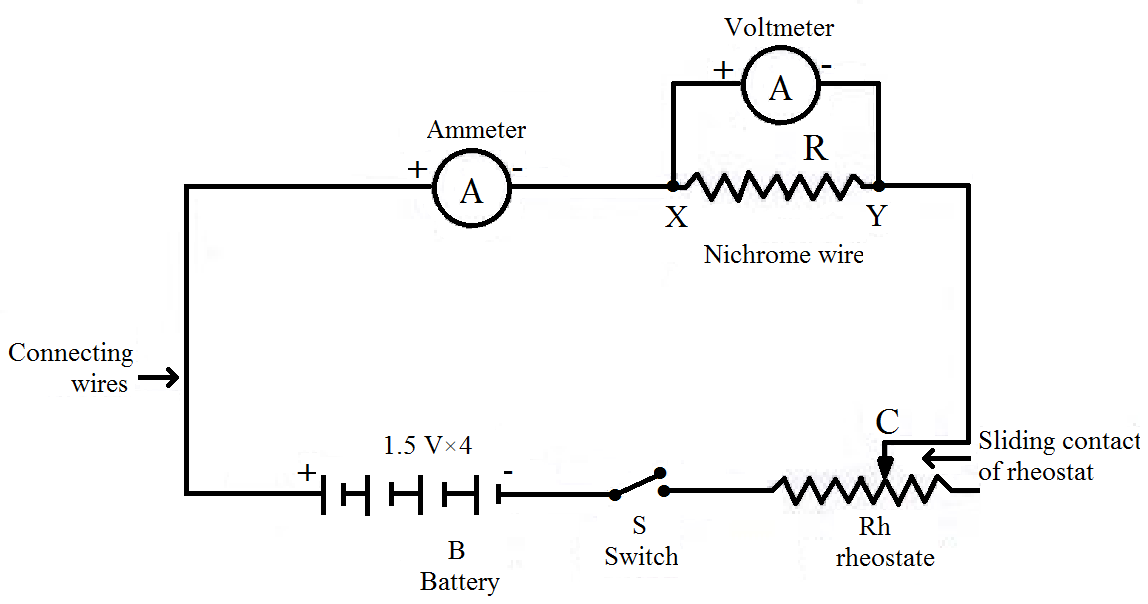
An electric circuit consisting of a 0.5m long nichrome wire XY, an ammeter, a voltmeter, four cells of 1.5V each and a plug key was set up.
  1. Draw a diagram of this electric circuit to study the relation between the potential difference maintained between the points ‘X’ and ‘Y’ and the electric current flowing through XY.
  2. Following graph was plotted between V and I values:
What would be the values of ratios when the potential difference is 0.8V, 1.2V and 1.6V respectively? What conclusion do you draw from these values?
  1. What is the resistance of the wire?
Answer
  1.  
  1. Since the graph is a straight line passing through the origin, so current is directly proportional to the potential difference.
Hence, the ration $\frac{\text{V}}{\text{I}}$ remains constant.

From graph when V = 1.5 volt, I = 0.6 amp

So, $\frac{\text{V}}{\text{I}}=-\frac{15}{0.6}-25\Omega$

For p.d. 0.8V, 1.2V and 1.6V, the value of $\frac{\text{V}}{\text{I}}$ ratio the same i.e., 2.5 ohm.
  1. The resistance of the wire is equal to the ratio of potential difference applied and the current passing through it.
$\text{R}-\frac{\text{V}}{\text{I}}-25\Omega$
View full question & answer
Question 185 Marks
A 2kW heater, a 200W TV and three 100W lamps are all switched on from 6m. to 10p.m. What is the total cost at Rs.5.50per kWh?
Answer
For heater
P = 2KW, t = 4h
E = P × t = 2 × 4 = 8KWh
For TV:
P = 200W = 0.2KW t = 4h
E = P × t = 0.2 × 4 = 0.08 KWh
Lamps:
P = 100W = 0.1KW, t = 4h, n = 3
E = n × P × t = 3 × 0.1 × 4 = 1.2 KWh
Total energy consumed = 8 + 0.8 + 1.2 = 10KWh
Cost of 1KWh = Rs. 5.50
Cost of 10KWh = Rs. 5.50 × 10 = Rs. 55
View full question & answer
Question 195 Marks
Show with the help of diagrams, how you would connect three resistors each of resistance $6 Ω,$ so that the combination has resistance of
  1. $9 Ω$
  2. $ 4 Ω.$
Answer
  1.  
Resultant resistance for parallel circuit = R

$\frac{1}{\text{R}}=\frac{1}{6}+\frac{1}{6}$

$\frac{1}{\text{R}}=\frac{2}{6}$

$\text{R} = 3$

Effective resistance = 6 + 3 = 9 ohms
  1.  
Resultant resistance for each parallel circuit = R

$\frac{1}{\text{R}}=\frac{1}{6}+\frac{1}{6}+\frac{1}{6}$

$\frac{1}{\text{R}}=\frac{3}{6}$

$\text{R} = 2$

Therefore effective resistance = 2 + 2 = 4 ohms.
View full question & answer
Question 205 Marks
For a heater rated at 4kW and 220V, calculate:
  1. The current,
  2. The resistance of the heater,
  3. The energy consumed in 2 hours, and
  4. The cost if 1kWh is priced at ₹60.
Answer
Given,
P = 4Kw, V = 220V
  1. I = ?
Power = VI = 250 × I

4000 = 250I

I = 16amp
  1. R = ?
$P=I^2 R$
$P=16^2 \times R$

$\text{R}=\frac{4000}{16^2}$

R = 15.25 ohm
  1. Energy consumed in two hour = P × t
= 4 × 2

= 8Kw - hr
  1. If 1KWh = Rs. 4.6
total cost = 8 × 4.6 = Rs. 36.8
View full question & answer
Question 215 Marks
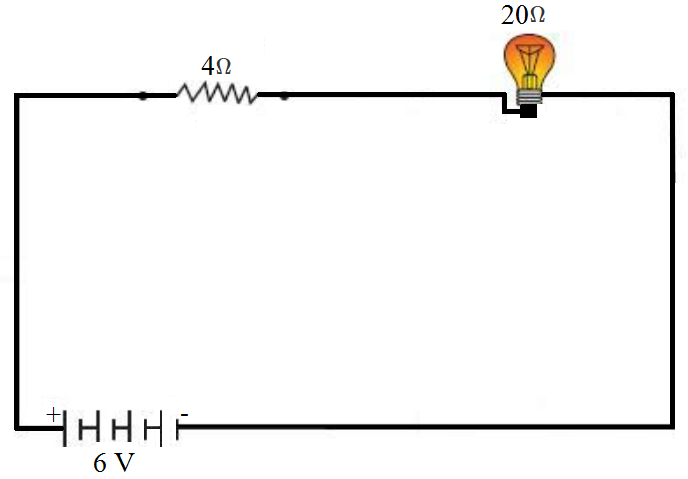
An electric bulb of resistance $20 Ω$ and a resistance wire of $4 Ω $are connected in series with a 6V battery. Draw the circuit diagram and calculate:
  1. Total resistance of the circuit.
  2. Current through the circuit.
  3. Potential difference across the electric bulb.
  4. Potential difference across the resistance wire.
Answer
  1. a. Total resistance of the circuit $=R_1+R_2=20+4=24$ ohm
    b. We know that
    $V=I R$
    Therefore
    $6=I \times 24$
    $I=\frac{6}{24}=0.25 amp$
    c. p.d. across bulb $= IR _1=0.25 \times 205 V$
    d. p.d. across resistance wire $=I R_2=0.25 \times 41 V$
View full question & answer
Question 225 Marks
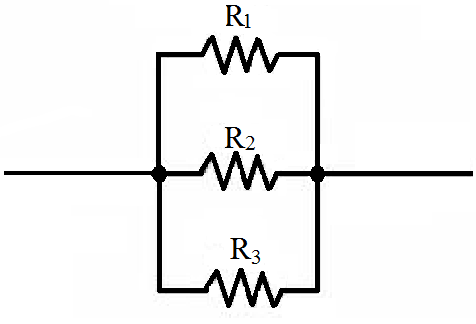
Calculate the combined resistance in each case:
Answer
a. $R_1=500$ ohm, $R_2=1000$ ohm
As per given figure,
$R=R_1+R_2=500+1000=1500 \text { ohm. }$
b. $R_1=2 ohm , R_2=2 ohm$
As per given figure,
$\frac{1}{R}=\frac{1}{R_1}+\frac{1}{R_2}$
$\frac{1}{R}=\frac{1}{2}+\frac{1}{2}$
$R=1$ ohm
c. $R_1=4$ ohm, $R_2=4$ ohm, $R_3$
As per given figure,
$\frac{1}{R}=\frac{1}{R_1}+\frac{1}{R_2}$
$\frac{1}{R}=\frac{1}{4}+\frac{1}{4}$
$R=2$ ohm
Total resistance $=R+R_3$
$= 2 + 3 = 5$ ohm
View full question & answer
Question 235 Marks
Explain with diagrams what is meant by the “series combination” and “parallel combination” of resistances. In which case the resultant resistance is:
  1. Less, and
  2. More, than either of the individual resistances?
Answer
  1. Series combination
When two or more resistance are connected end to end consecutively, they are said to be connected in series combination. The combined resistance if any number of resistance connected in series in equal to the sum of the individual reisistance.
$R = R _1+ R _2 \ldots \ldots$


The resultant resistance is more than either of the individual resistance.
  1. Parallel combination
When two or more resistance are connected between the same two points, they are said to be connected in parallel combination. The reciprocal of the combined resistance of a number of resistance connected in parallel is equal to the sum of the reciprocal of all the individual resistance.

$\frac{1}{\text{R}}=\frac{1}{\text{R} _1}+\frac{1}{\text{R}_2}+......$

View full question & answer
Question 245 Marks
An electric heater which is connected to a 220V supply line has two resistance coils A and B of $24 Ω$ resistance each. These coils can be used separately (one at a time), in series or in parallel. Calculate the current drawn when:
  1. Only one coil A is used.
  2. Coils A and B are used in series.
  3. Coils A and B are used in parallel.
Answer
a. Given $V =220 V$
$R_A=R_B=24 \text { ohm }$
Current drawn when only coil A is used:
$I=\frac{V}{R_{A}}=\frac{220}{24}$
$=9.16 amps$
b. Current drawn when coils A and B are used in series:
Total resistance, $R=R_A+R_B=24+24=48$ ohm
$\text{I}=\frac{\text{V}}{\text{R}}=\frac{220}{48}$
= 4.58 amps
  1. Current drawn when coils A and B are used in parallel:
Total resistance, $\frac{1}{\text{R}}=\frac{1}{\text{R}_\text{A}}+\frac{1}{\text{R}_\text{B}}=\frac{1}{24}+\frac{1}{24}=\frac{2}{24}=\frac{1}{12}$

R = 12 ohm

$\text{I}=\frac{\text{V}}{\text{R}}=\frac{220}{12}$

$=18.33\ \text{amps}$
View full question & answer
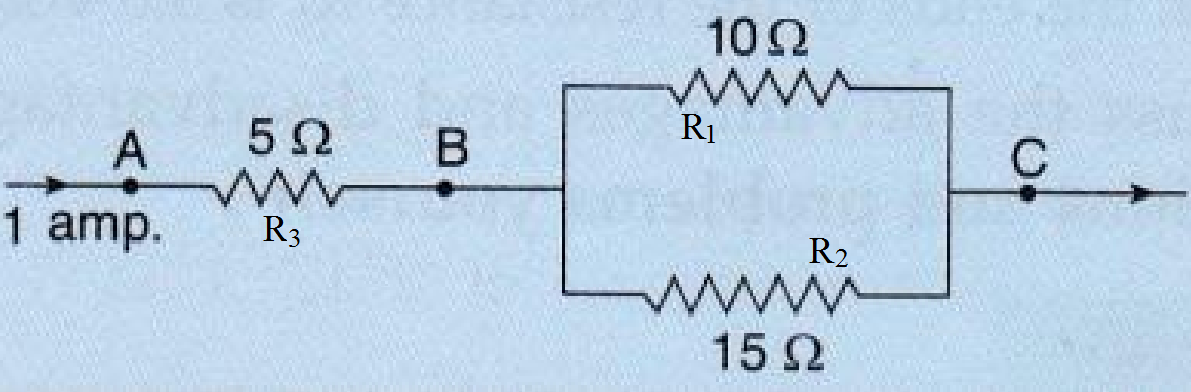
Question 255 Marks
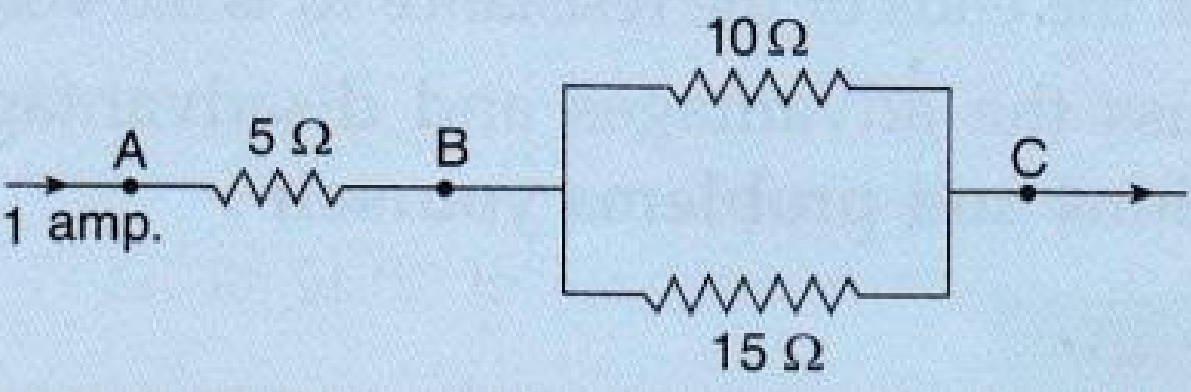
Three resistors are connected as shown in the diagram.

Through the resistor 5 ohm, a current of 1 ampere is flowing,
  1. What is the current through the other two resistors?
  2. What is the p.d. across AB and across AC?
  3. What is the total resistance?
Answer

According to the diagram
i. Total current I = 1 amp is entering the parallel combination of R1 and R. Let I1 current flows through R1 and I2 current flows through R2
Then
$I_1=\frac{IR_2}{R_1+R_2}$
$=\frac{1 \times 15}{10+15}=0.6 A$
$I_2=\frac{IR_2}{R_1+R_2}$
$=\frac{1 \times 10}{10+15}=0.4 A$
ii. p.d. across $A B= R _3=1 \times 5=5 V$
Equivalent resisyance between B and C is

$\frac{1}{\text{R}'}=\frac{1}{\text{R}_1}+\frac{1}{\text{R}_2}=\frac{1}{10}+\frac{1}{15}$

$\frac{1}{\text{R}'}=\frac{5}{30}$

R' = 6 ohm

Total resistance between A and C is R = 5 + 6 = 11 ohm

p.d. across AC = IR = 1 × 11 = 11V
  1. Total resistance = $R_3 + R' = 5 + 6 = 11$ ohm.
View full question & answer
[5 marks Questions] - Science STD 10 Questions - Vidyadip