MCQ 11 Mark
In the following questions, a statement of Assertion is given by the corresponding statement of Reason. Of the statements, mark the correct answer as :
Assertion : All the female gemetes will have only $X-$ chromosome.
Reason : Females are homogametic with two $X$ chromosomes.
- ✓
If both Assertion and Reason are true and Reason is the correct explanation of Assertion.
- B
If both Assertion and Reason are true, but Reason is not the correct explanation of Assertion.
- C
If Assertion is true, but Reason is false.
- D
If Assertion is false, but Reason is true.
AnswerCorrect option: A. If both Assertion and Reason are true and Reason is the correct explanation of Assertion.
All the gametes possess an $X-$ chromosome and the human female is said to be homogametic which means all the gametes produced will have only one type of sex chromosome which is the $X$ chromosome.
View full question & answer→MCQ 21 Mark
For two statements are given $-$ one labelled Assertion $(A)$ and the other labelled Reason $(R)$. Select the correct answer to these questions from the codes $\ce{(a), (b), (c)}$ and $(d)$ as given below :
Assertion : ln grasshoppers, females are hetero gametic and males are homo gametic.
Reason : ln grasshoppers, male has only one sex chromosome $(XO)$ whereas the female has sex chromosomes $(XX).$
- A
Both $A$ and $R$ are true, and $R$ is correct explanation of the assertion.
- B
Both $A$ and $R$ are true, but $R$ is not the correct explanation of the assertion.
- C
$A$ is true, but $R$ is false.
- ✓
$A$ is false, but $R$ is true.
AnswerCorrect option: D. $A$ is false, but $R$ is true.
ln grasshoppers, the male has only one sex chromosome $\ce{(XO)}$ whereas the female has two sex chromosomes i.e., homo gametic. This type of sex determination mechanism is called $\ce{XX-XO}$ mechanism.
View full question & answer→MCQ 31 Mark
For two statements are given $-$ one labelled Assertion $(A)$ and the other labelled Reason $(R)$. Select the correct answer to these questions from the codes $\ce{(a), (b), (c)}$ and $(d)$ as given below :
Assertion : ln some reptiles, the temperature at which fertilised egg is incubated before hatching plays a role in determining sex of offspring.
Reason : In turtle, high incubation temperature above $33^\circ C$ leads to development of female offspring whereas in lizards high incubation temperature results in male offspring.
- A
Both $A$ and $R$ are true, and $R$ is correct explanation of the assertion.
- ✓
Both $A$ and $R$ are true, but $R$ is not the correct explanation of the assertion.
- C
$A$ is true, but $R$ is false.
- D
$A$ is false, but $R$ is true.
AnswerCorrect option: B. Both $A$ and $R$ are true, but $R$ is not the correct explanation of the assertion.
View full question & answer→MCQ 41 Mark
For two statements are given$-$ one labelled
Assertion $(A)$ and the other labelled
Reason $(R)$. Select the correct answer to these questions from the codes $(a), (b), (c)$ and $(d)$ as given below:
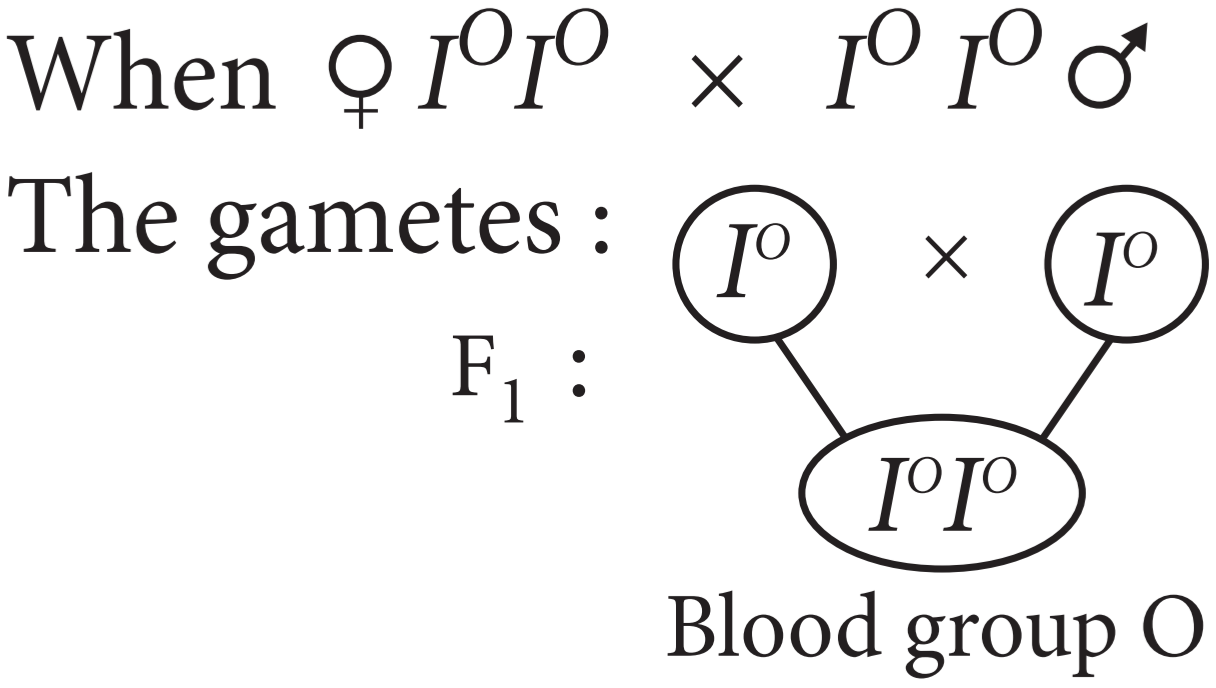
Assertion: If blood group of both mother and father is $'O'$ then the blood group of children will also be $O .$
Reason: Blood group in humans is determined by many alleles of a gene viz. $1^{ A }, 1^{ B }, 1^{ D }$.
- A
Both $A$ and $R$ are true, and $R$ is correct explanation of the assertion.
- ✓
Both $A$ and $R$ are true, but $R$ is not the correct explanation of the assertion.
- C
$A$ is true, but $R$ is false.
- D
$A$ is false, but $R$ is true.
AnswerCorrect option: B. Both $A$ and $R$ are true, but $R$ is not the correct explanation of the assertion.
The blood group system in humans is determined by a gene which has 3 different alleles viz. $I^A, I^B$ and $I^O. I^A$ and $I^B$ are dominant to $I^O$ but codominant to each other. Blood group A is indicated by genotype $I^A, I^A or I^A I^O,$ Blood group $B \rightarrow I^B I^B$ or $I^B I^O$, Blood group $A^B \rightarrow I^AI^B$ and blood group $O \rightarrow I^O I^O$
View full question & answer→MCQ 51 Mark
For two statements are given $-$ one labelled Assertion $(A)$ and the other labelled Reason $(R)$. Select the correct answer to these questions from the codes $\ce{(a), (b), (c)}$ and $(d)$ as given below :
Assertion : A tall plant which always produces tall offsprings is considered heterozygous for height and is represented by genotype $(Tt).$
Reason : A tall plant which always produces tall offspring is homozygous dominant and will always produce only one type of gamete $(T).$
- A
Both $A$ and $R$ are true, and $R$ is correct explanation of the assertion.
- B
Both $A$ and $R$ are true, but $R$ is not the correct explanation of the assertion.
- C
$A$ is true, but $R$ is false.
- ✓
$A$ is false, but $R$ is true.
AnswerCorrect option: D. $A$ is false, but $R$ is true.
A tall plant which always produces tall offspring is homozygous dominant with genotype $(TT).$ It will always produce only one type of gamete $(T).$
View full question & answer→MCQ 61 Mark
For two statements are given $-$ one labelled Assertion $(A)$ and the other labelled Reason $(R).$ Select the correct answer to these questions from the codes $\ce{(a), (b), (c)}$ and $(d)$ as given below :
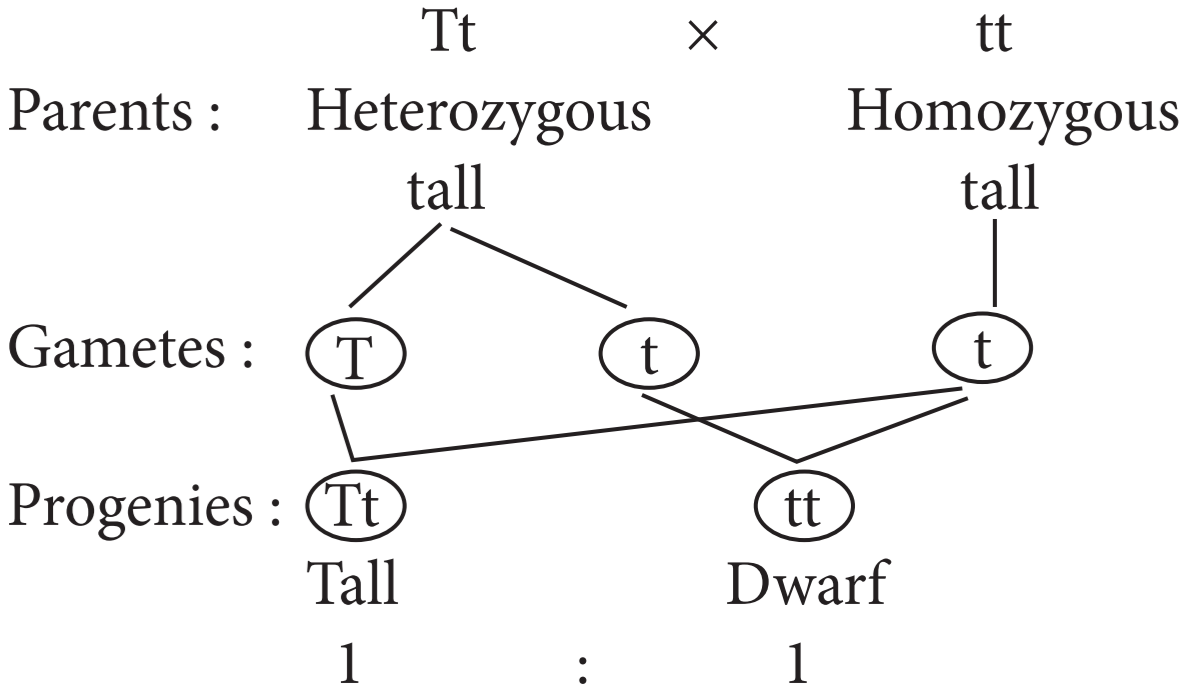
Assertion : A geneticist crossed two plants and got $50\%$ tall and $50\%$ dwarf progenies.
Reason : This cross follows Mendelian law as one of the parent plant might be heterozygous.
- A
Both $A$ and $R$ are true, and $R$ is correct explanation of the assertion.
- ✓
Both $A$ and $R$ are true, but $R$ is not the correct explanation of the assertion.
- C
$A$ is true, but $R$ is false.
- D
$A$ is false, but $R$ is true.
AnswerCorrect option: B. Both $A$ and $R$ are true, but $R$ is not the correct explanation of the assertion.
The given cross can be illustrated as follows :
View full question & answer→MCQ 71 Mark
For two statements are given $-$ one labelled Assertion $(A)$ and the other labelled Reason $(R)$. Select the correct answer to these questions from the codes $\ce{(a), (b), (c)}$ and $(d)$ as given below :
Assertion : ln human males all the chromosomes are perfectly paired except $X$ and $Y$ chromosomes.
Reason : $X$ and $Y$ are sex chromosomes.
- ✓
Both $A$ and $R$ are true, and $R$ is correct explanation of the assertion.
- B
Both $A$ and $R$ are true, but $R$ is not the correct explanation of the assertion.
- C
$A$ is true, but $R$ is false.
- D
$A$ is false, but $R$ is true.
AnswerCorrect option: A. Both $A$ and $R$ are true, and $R$ is correct explanation of the assertion.
View full question & answer→MCQ 81 Mark
For two statements are given $-$ one labelled Assertion $(A)$ and the other labelled Reason $(R)$. Select the correct answer to these questions from the codes $\ce{(a), (b), (c)}$ and $(d)$ as given below :
Assertion : Genes present in every cell of an organism control the traits of the organisms.
Reason : Gene is specific segment of $\text{DNA}$ occupying specific position on a chromosome.
- A
Both $A$ and $R$ are true, and $R$ is correct explanation of the assertion.
- ✓
Both $A$ and $R$ are true, but $R$ is not the correct explanation of the assertion.
- C
$A$ is true, but $R$ is false.
- D
$A$ is false, but $R$ is true.
AnswerCorrect option: B. Both $A$ and $R$ are true, but $R$ is not the correct explanation of the assertion.
View full question & answer→MCQ 91 Mark
In the following questions, a statement of Assertion is given by the corresponding statement of Reason. Of the statements, mark the correct answer as :
Assertion : Speciation is the development of one or more species from an existing species.
Reason : Classification is the arrangement of boat organisms into a series of groups based on physiological, biochemical or other relationships.
- A
If both Assertion and Reason are true and Reason is the correct explanation of Assertion.
- ✓
If both Assertion and Reason are true, but Reason is not the correct explanation of Assertion.
- C
If Assertion is true, but Reason is false.
- D
If Assertion is false, but Reason is true.
AnswerCorrect option: B. If both Assertion and Reason are true, but Reason is not the correct explanation of Assertion.
The movement of alleles from one population to another is called gene flow. occurs when members of different populations can no longer mate successfully with one another. speciation the rise of two or more species from one existing species is called speciation.
View full question & answer→MCQ 101 Mark
For two statements are given $-$ one labelled Assertion $(A)$ and the other labelled Reason $(R).$ Select the correct answer to these questions from the codes $\ce{(a), (b), (c)}$ and $(d)$ as given below :
Assertion : Round green seeds in pea can be represented by $\ce{RRyy}$ of $\ce{Rryy}$.
Reason : Round yellow seeds and green wrinkled seeds are parental combinations, whereas round green and wrinkled yellow are recombinants.
- A
Both $A$ and $R$ are true, and $R$ is correct explanation of the assertion.
- ✓
Both $A$ and $R$ are true, but $R$ is not the correct explanation of the assertion.
- C
$A$ is true, but $R$ is false.
- D
$A$ is false, but $R$ is true.
AnswerCorrect option: B. Both $A$ and $R$ are true, but $R$ is not the correct explanation of the assertion.
View full question & answer→MCQ 111 Mark
For two statements are given- one labelled
Assertion $(A)$ and the other labelled
Reason $(R)$. Select the correct answer to these questions from the codes $(a), (b), (c)$ and $(d)$ as given below:
Assertion: Traits like tallness and dwarfness in pea plant are inherited independently.
Reason: When a homozygous tall pea plant is crossed with dwarf pea plant, medium sized pea plant is obtained in $F_1$ generation.
- A
Both $A$ and $R$ are true, and $R$ is correct explanation of the assertion.
- B
Both $A$ and $R$ are true, but $R$ is not the correct explanation of the assertion.
- ✓
$A$ is true, but $R$ is false.
- D
$A$ is false, but $R$ is true.
AnswerCorrect option: C. $A$ is true, but $R$ is false.
Traits like tallness and dwarfness in pea plant are inherited independently and when a homozygous tall pea plant is crossed with a dwarf pea plant, only tall pea plants are obtained in $F_1$ generation.
View full question & answer→MCQ 121 Mark
For two statements are given $-$ one labelled Assertion $(A)$ and the other labelled Reason $(R)$. Select the correct answer to these questions from the codes $\ce{(a), (b), (c)}$ and $(d)$ as given below :
Assertion : Pea plant is considered ideal for hybridisation experiments.
Reason : Pea is self pollinating plant with short life cycle and bears visible contrasting traits.
- ✓
Both $A$ and $R$ are true, and $R$ is correct explanation of the assertion.
- B
Both $A$ and $R$ are true, but $R$ is not the correct explanation of the assertion.
- C
$A$ is true, but $R$ is false.
- D
$A$ is false, but $R$ is true.
AnswerCorrect option: A. Both $A$ and $R$ are true, and $R$ is correct explanation of the assertion.
Mendel chose pea plants for studying inheritance because of number of reasons. Pea plants are self pollinating which enables them to produce next generation of plants easily, also pure lines could be easily obtained. Due to short life cycle, many generations of pea plants can be produced in a comparatively short span of time. Also, pea plant shows a number of clear cut visible contrasting traits like tall and dwarf height, round and wrinkled seeds, etc.
View full question & answer→MCQ 131 Mark
For two statements are given $-$ one labelled Assertion $(A)$ and the other labelled Reason $(R).$ Select the correct answer to these questions from the codes $\ce{(a), (b), (c)}$ and $(d)$ as given below:
Assertion : ln humans, height is a trait which shows variation.
Reason : Some humans are very tall, some have medium height whereas others are short heighted.
- A
Both $A$ and $R$ are true, and $R$ is correct explanation of the assertion.
- ✓
Both $A$ and $R$ are true, but $R$ is not the correct explanation of the assertion.
- C
$A$ is true, but $R$ is false.
- D
$A$ is false, but $R$ is true.
AnswerCorrect option: B. Both $A$ and $R$ are true, but $R$ is not the correct explanation of the assertion.
View full question & answer→MCQ 141 Mark
For two statements are given $-$ one labelled Assertion $(A)$ and the other labelled Reason $(R).$ Select the correct answer to these questions from the codes $\ce{(a), (b), (c)}$ and $(d)$ as given below:
Assertion : If mother is homozygous for black hair and father has red hair then their child can inherit black hair.
Reason : Gene for black hair is recessive to gene for red hair in humans.
- A
Both $A$ and $R$ are true, and $R$ is correct explanation of the assertion.
- B
Both $A$ and $R$ are true, but $R$ is not the correct explanation of the assertion.
- ✓
$A$ is true, but $R$ is false.
- D
$A$ is false, but $R$ is true.
AnswerCorrect option: C. $A$ is true, but $R$ is false.
Gene for black hair colour is dominant to gene for red hair colour in humans, Mother has black hair and can be represented by $(BB)$ whereas father can be represented by $(bb).$
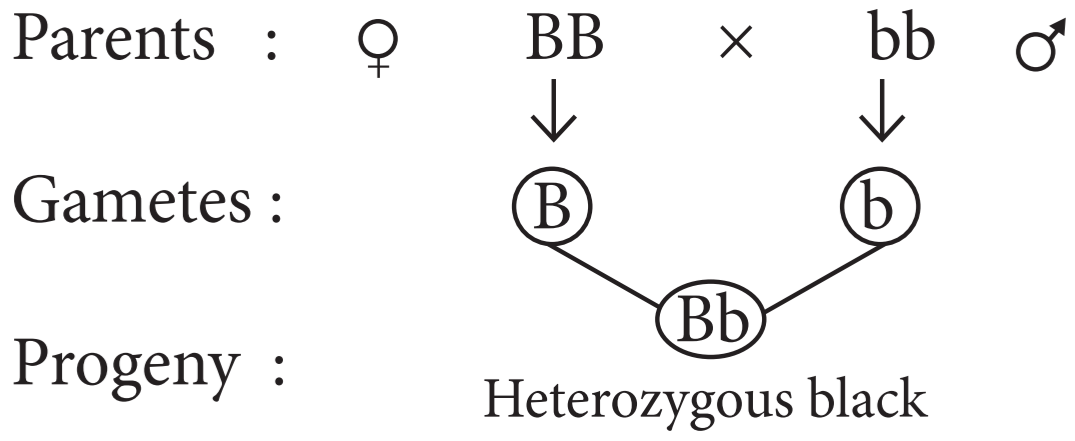
So, the child will be heterozygous for black hair colour. View full question & answer→MCQ 151 Mark
For two statements are given $-$ one labelled Assertion $(A)$ and the other labelled Reason $(R).$ Select the correct answer to these questions from the codes $\ce{(a), (b), (c)}$ and $(d)$ as given below :
Assertion : Monohybrid cross deals with inheritance of one pair of contrasting characters.
Reason : Dihybrid cross deals with inheritance of two pairs of contrasting characters.
- A
Both $A$ and $R$ are true, and $R$ is correct explanation of the assertion.
- ✓
Both $A$ and $R$ are true, but $R$ is not the correct explanation of the assertion.
- C
$A$ is true, but $R$ is false.
- D
$A$ is false, but $R$ is true.
AnswerCorrect option: B. Both $A$ and $R$ are true, but $R$ is not the correct explanation of the assertion.
In monohybrid cross we study the inheritance of one pair of contrasting characters of organism by their first generation and second generation progeny. In dihybrid cross we study the inheritance of two pairs of contrasting characters of organisms.
View full question & answer→MCQ 161 Mark
For two statements are given $-$ one labelled Assertion $(A)$ and the other labelled Reason $(R).$ Select the correct answer to these questions from the codes $\ce{(a), (b), (c)}$ and $(d)$ as given belown :
Assertion : If mother has two dominant alleles for black hair and father has two recessive alleles for blonde hair then their child will inherit one dominant allele from mother and one recessive allele from father and will have black hair.
Reason : Progeny inherits one genes for each trait from its parents, but the trait shown by progeny depends on inherited alleles.
- ✓
Both $A$ and $R$ are true, and $R$ is correct explanation of the assertion.
- B
Both $A$ and $R$ are true, but $R$ is not the correct explanation of the assertion.
- C
$A$ is true, but $R$ is false.
- D
$A$ is false, but $R$ is true.
AnswerCorrect option: A. Both $A$ and $R$ are true, and $R$ is correct explanation of the assertion.
View full question & answer→MCQ 171 Mark
In the following questions, a statement of Assertion is given by the corresponding statement of Reason. Of the statements, mark the correct answer as :
Assertion : The ratio of plants when Mendel took pea plants with two contrasting characters was $9 : 3 : 3 : 1.$
Reason : The ratio of plants when Mendel took pea plants with one contrasting character was $1 : 1.$
- A
If both Assertion and Reason are true and Reason is the correct explanation of Assertion.
- B
If both Assertion and Reason are true, but Reason is not the correct explanation of Assertion.
- ✓
If Assertion is true, but Reason is false.
- D
If Assertion is false, but Reason is true.
AnswerCorrect option: C. If Assertion is true, but Reason is false.
In a dihybrid cross experiment, Mendel considered two traits, each having two alleles. He crossed wrinkled $-$ green seed and round $-$ yellow seeds and observed that all the first generation progeny $(F_1$ progeny$)$ were round $-$ yellow. This meant that dominant traits were round shape and yellow color. He then self $-$ pollinated the $F_1$ progeny and obtained $4$ different traits wrinkled $-$ yellow, round $-$ yellow, wrinkled $-$ green seeds and round $-$ green in the ratio $9 : 3 : 3 : 1.$
Mendel found that $166$ of the plants bore only yellow peas, and each of the remaining $353$ plants bore a mixture of yellow and green peas in a $3 : 1$ ratio. Plants from green $F_2$ peas were then grown and selfed and were found to bear only green peas.
View full question & answer→MCQ 181 Mark
For two statements are given $-$ one labelled Assertion $(A)$ and the other labelled Reason $(R).$ Select the correct answer to these questions from the codes $\ce{(a), (b), (c)}$ and $(d)$ as given below :
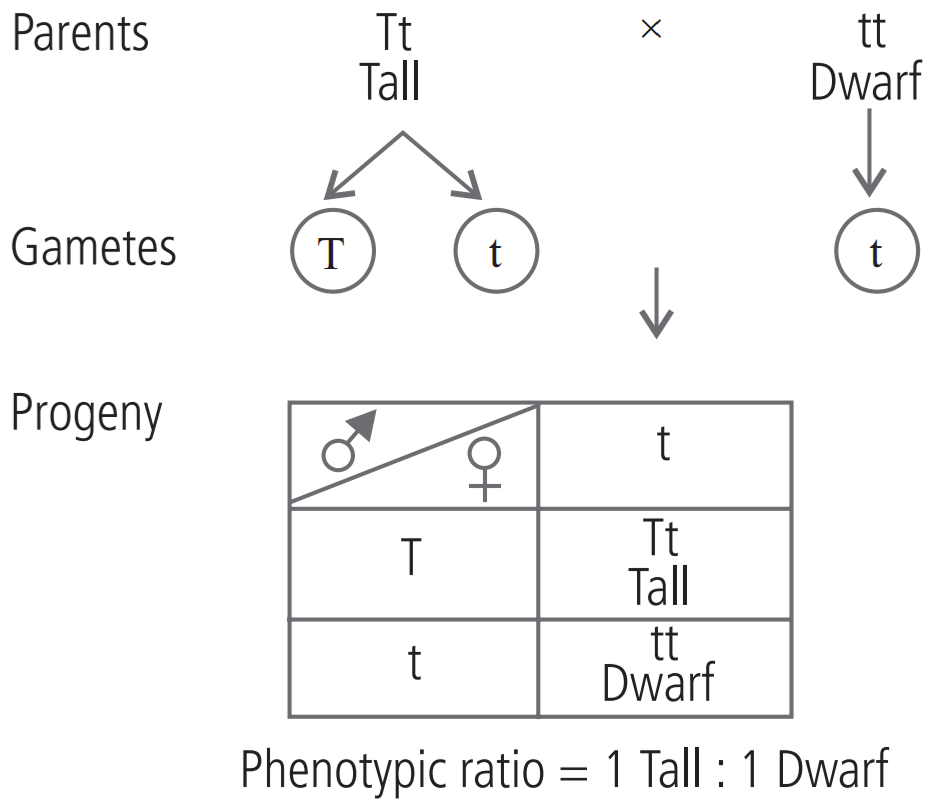
Assertion : A heterozygous tall plant when crossed with homozygous dwarf plant will produce tall and dwarf plants in the ratio of $3 : 1.$
Reason : A heterozygous tall plant will produce two types of gametes, i.e., one with $T$ and other with $t$ whereas homozygous dwarf plant produce all gametes with $t$ only.
- A
Both $A$ and $R$ are true, and $R$ is correct explanation of the assertion.
- B
Both $A$ and $R$ are true, but $R$ is not the correct explanation of the assertion.
- C
$A$ is true, but $R$ is false.
- ✓
$A$ is false, but $R$ is true.
AnswerCorrect option: D. $A$ is false, but $R$ is true.
A heterozygous tall plant when crossed with dwarf plant will give following result.
View full question & answer→MCQ 191 Mark
For two statements are given $-$ one labelled Assertion $(A)$ and the other labelled Reason $(R)$. Select the correct answer to these questions from the codes $\ce{(a), (b), (c)}$ and $(d)$ as given below :
Assertion : Accumulation of variation in a species increases the chances of its survival in changing environment.
Reason : Accumulation of heat resistance in some bacteria ensure their survival even when temperature in environment rises too much.
- ✓
Both $A$ and $R$ are true, and $R$ is correct explanation of the assertion.
- B
Both $A$ and $R$ are true, but $R$ is not the correct explanation of the assertion.
- C
$A$ is true, but $R$ is false.
- D
$A$ is false, but $R$ is true.
AnswerCorrect option: A. Both $A$ and $R$ are true, and $R$ is correct explanation of the assertion.
View full question & answer→MCQ 201 Mark
For two statements are given $-$ one labelled Assertion $(A)$ and the other labelled Reason $(R).$ Select the correct answer to these questions from the codes $\ce{(a), (b), (c)}$ and $(d)$ as given below :
Assertion : Selfing of a plant for several generations helps plant breeders to obtain pure breeding varieties.
Reason : Pure breeding plants are heterozygous for many traits.
- A
Both $A$ and $R$ are true, and $R$ is correct explanation of the assertion.
- B
Both $A$ and $R$ are true, but $R$ is not the correct explanation of the assertion.
- ✓
$A$ is true, but $R$ is false.
- D
$A$ is false, but $R$ is true.
AnswerCorrect option: C. $A$ is true, but $R$ is false.
Pure breeding plants are homozygous for many traits, i.e., they will have either both dominant genes or both recessive genes for a particular trait.
View full question & answer→MCQ 211 Mark
For two statements are given $-$ one labelled Assertion $(A)$ and the other labelled Reason $(R)$. Select the correct answer to these questions from the codes $\ce{(a), (b), (c)}$ and $(d)$ as given below :
Assertion : ln humans, male $($or father$)$ is responsible for sex of the baby which is born.
Reason : $Y$ chromosomes are present in only male gametes or sperms.
- ✓
Both $A$ and $R$ are true, and $R$ is correct explanation of the assertion.
- B
Both $A$ and $R$ are true, but $R$ is not the correct explanation of the assertion.
- C
$A$ is true, but $R$ is false.
- D
$A$ is false, but $R$ is true.
AnswerCorrect option: A. Both $A$ and $R$ are true, and $R$ is correct explanation of the assertion.
In humans, sex is determined by sex chromosomes. A male has one $X$ and one $Y$ chromosome $(XY)$. A female has two $X$ chromosomes $(XX)$. Male produces two types of sperms, one with $X$ and one with $Y$ whereas female produces only one type of egg with $X$ chromosome. When sperm with $X$ chromosome fertilises egg then zygote has both $XX$ chromosomes and develops into female progeny. If sperm with $Y$ chromosome fertilises egg then zygote has $XY$ chromosomes and develops into male progeny.
View full question & answer→MCQ 221 Mark
For two statements are given- one labelled
Assertion $(A)$ and the other labelled
Reason $(R).$ Select the correct answer to these questions from the codes $(a), (b), (c)$ and $(d)$ as given below:
Assertion: When pea plants $($pure line$)$ having round yellow seeds are crossed with pure line plants having wrinkled green seeds, then all pea plants obtained in $F_1$ generation bear wrinkled green seeds.
Reason: Round and yellow seeds are dominant to wrinkled and green seeds.
- A
Both $A$ and $R$ are true, and $R$ is correct explanation of the assertion.
- B
Both $A$ and $R$ are true, but $R$ is not the correct explanation of the assertion.
- C
$A$ is true, but $R$ is false.
- ✓
$A$ is false, but $R$ is true.
AnswerCorrect option: D. $A$ is false, but $R$ is true.
When pure line pea plants having round yellow seeds are crossed with that of wrinkled green seeds then plant obtained in $F_1$ are all with round yellow seeds as round yellow seeds are dominant to wrinkled green seeds.
View full question & answer→