Questions · Page 1 of 4

M.C.Q

Take a timed test

50 questions · auto-graded multiple-choice test.

MCQ 11 Mark
A sportsman, after a long break of his routine exercise, suffered muscular cramps during a heavy exercise session. This happened due to :
  • A
    lack of carbon dioxide and formation of pynivate.
  • B
    presence of oxygen and formation of ethanol.
  • lack of oxygen and formation of lactic acid.
  • D
    lack of oxygen and formation of carbon dioxide.
Answer
Correct option: C.
lack of oxygen and formation of lactic acid.
(C) lack of oxygen and formation of lactic acid.
View full question & answer
MCQ 21 Mark
Generally food is broken and absorbed within the body of organisms. In which of the following organisms is it done outside the body?
  • A
    Amoeba
  • Mushroom
  • C
    Paramoecium
  • D
    Lice
Answer
Correct option: B.
Mushroom
(B) Mushroom
View full question & answer
MCQ 31 Mark
The oxygen liberated during photosynthesis by green plants comes from :
  • A
    Glucose.
  • Water.
  • C
    Carbon-dioxide.
  • D
    Chlorophy ll.
Answer
Correct option: B.
Water.
During photosynthesis, the water molecule is split into hydrogen and oxygen.
View full question & answer
MCQ 41 Mark
Pancreatic juice contains enzymes which digest :
  • A
    Proteins and carbohydrates only.
  • B
    Proteins and fats only.
  • C
    Fats and carbohydrates only.
  • Proteins, fats and carbohydrates.
Answer
Correct option: D.
Proteins, fats and carbohydrates.
Pancreatic juice has the enzymes amylase for the digestion of carbohydrates, trypsin for the digestion of proteins and lipase for the digestion of emulsified fats.
 
View full question & answer
MCQ 51 Mark
Which chambers of human heart contain oxygenated blood?
  • A
    Left atrium and left ventricle.
  • Left atrium and right ventricle.
  • C
    Right atrium and left ventricle.
  • D
    Right atrium and right ventricle.
Answer
Correct option: B.
Left atrium and right ventricle.
The heart consists of four chambers in which blood flows. Blood enters the right atrium and passes through the right ventricle. The right ventricle pumps the blood to the lungs where it becomes oxygenated. The oxygenated blood is brought back to the heart by the pulmonary veins which enter the left atrium.
View full question & answer
MCQ 61 Mark
The inner lining of stomach is protected by one of the following from hydrochloric acid. Choose the correct one:
  • A
    Pepsin.
  • Mucus.
  • C
    Salivary amylase.
  • D
    Bile.
Answer
Correct option: B.
Mucus.
Mucus protects the inner lining of stomach from hydrochloric acid.
View full question & answer
MCQ 71 Mark
Coagulation of blood in a cut or wound is brought about by :
  • A
    Plasma.
  • Platelets.
  • C
    $\ce{WBC}.$
  • D
    $\ce{RBC}.$
Answer
Correct option: B.
Platelets.
Platelets release chemicals responsible for blood clotting at the site of a cut or a wound. These chemicals help in the coagulation of blood. The main function of the platelets is to form clot and prevent bleeding.
View full question & answer
MCQ 81 Mark
A plant is kept in the dark for two days. A leaf is used in an experiment to investigate the effect of two factors on photosynthesis as shown in the diagram.
What are the colours of $Q$ and $R,$ when the leaf is tested for starch, using iodine solution?
$Q$ $R$
$(a)$
Blue/ black
Brown
$(b)$
Brown
Brown
$(c)$
Blue/ black
Blue/ black
$(d)$
Brown
Blue/ black
  • A
    $\ce{(i)}$
  • B
    $\ce{(ii)}$
  • $\ce{(iii)}$
  • D
    $\ce{(iv)}$
Answer
Correct option: C.
$\ce{(iii)}$
Yes, there will be difference in results of two experiments.This is because, since it was kept in a dark room where there was no sunlight, the plant was unable to prepare the food by photosynthesis. An whne kept in sunlight, the plants prepare food which results in leaf turning blue $-$ black as there is presence of starch.
View full question & answer
MCQ 91 Mark
An experiment is set up as shown. Flasks 1 and 2 contain lime water. Air is pumped through the flasks.
What is the appearance of lime water flasks 1 and 2 after a period of ten minutes?
Flask 1 Flask 2
(a)
Clear
Clear
(b)
Clear
White/ Cloudy
(c)
White/ Cloudy
Clear
(d)
White/ Cloudy
White/ Cloudy
  • A
    (a)
  • (b)
  • C
    (c)
  • D
    (d)
Answer
Correct option: B.
(b)
Flask 1
Flask 2
(b)
Clear
White/ Cloudy
View full question & answer
MCQ 101 Mark
Which of the following carries substances upwards as well as downwards in a plant?
  • A
    Xylem.
  • B
    Companion cells.
  • Phloem.
  • D
    Tracheids.
Answer
Correct option: C.
Phloem.
In a plant, phloem carries substances $($food$)$ upwards as well as downwards.
View full question & answer
MCQ 111 Mark
Which breathing organ is helpful in initialising the process of inspiration and expiration of air?
  • Diaphragm.
  • B
    Alveoli.
  • C
    Larynx.
  • D
    Nostrils.
Answer
Correct option: A.
Diaphragm.
The diaphragm is a barrier method of birth control. It is moderately effective, with a one $-$ year failure rate of around $12\%$ with typical use. It is placed over the cervix with spermicide before sex and left in place for at least six hours after sex. Fitting by a healthcare provider is generally required.
View full question & answer
MCQ 121 Mark
The process of release of urine is called.
  • Micturition.
  • B
    Sweating.
  • C
    Egestion.
  • D
    Excretion.
Answer
Correct option: A.
Micturition.
Urination, also called Micturition, the process of excreting urine from the urinary bladder.
View full question & answer
MCQ 131 Mark
All reptiles have a three $-$ chambered heart except :
  • A
    Snake.
  • Crocodile.
  • C
    Lizard.
  • D
    Both $(b)$ and $(c).$
Answer
Correct option: B.
Crocodile.
Crocodule has four chambered heart.
View full question & answer
MCQ 141 Mark
Which of the following represents the photosynthesis correctly?
  • A
    $6\text{CO}_{2}+12\text{H}_{2}\text{O}\xrightarrow{ \ \ \ \ \ \ }\text{C}_{6}\text{H}_{12}\text{O}_{6}+\text{6H}_{2}\text{O}+\text{6O}_{2}$
  • B
    $6\text{CO}_{2}+12\text{H}_{2}\text{O}\xrightarrow{\text{Sunlight}}\text{C}_{6}\text{H}_{12}\text{O}_{6}+\text{O}_{2}+\text{6H}_{2}\text{O}$
  • C
    $6\text{CO}_{2}+12\text{H}_{2}\text{O}\xrightarrow[\text{Chlorophyll}]{\text{Sunlight}}\text{C}_{6}\text{H}_{12}\text{O}_{6}+\text{6HO}_{2}+\text{O}_{2}$
  • $6\text{CO}_{2}+12\text{H}_{2}\text{O}\xrightarrow[\text{Chlorophyll}]{\text{Sunlight}}\text{C}_{6}\text{H}_{12}\text{O}_{6}+\text{6CO}_{2}+\text{6H}_{2}\text{O}$
Answer
Correct option: D.
$6\text{CO}_{2}+12\text{H}_{2}\text{O}\xrightarrow[\text{Chlorophyll}]{\text{Sunlight}}\text{C}_{6}\text{H}_{12}\text{O}_{6}+\text{6CO}_{2}+\text{6H}_{2}\text{O}$
Oxygenic photosynthesis is written as follows :
$6\text{CO}_{2}+12\text{H}_{2}\text{O}\ \text{Light Energy}\xrightarrow{}\text{C}_{6}\text{H}_{12}\text{O}_{6}+\text{6O}_{2}+\text{6H}_{2}\text{O}$
View full question & answer
MCQ 151 Mark
One of the following organisms can live without oxygen of air. This organism is :
  • A
    Amoeba.
  • B
    Yak.
  • Yeast.
  • D
    Leech.
Answer
Correct option: C.
Yeast.
Yeast can live without the oxygen present in the air.
This is because it obtains energy by the process of anaerobic respiration.
View full question & answer
MCQ 161 Mark
During respiration, the exchange of gases takes place in :
  • A
    Bronchi.
  • Alveoli.
  • C
    Bronchioles.
  • D
    Trachea.
Answer
Correct option: B.
Alveoli.
Alveoli are the pouch $-$ like air sacs at the end of the small bronchioles. The walls of alveoli are very thin. Also, they are surrounded by very thin blood capillaries. It is in the alveoli that the gaseous exchange takes place.
View full question & answer
MCQ 171 Mark
Assertion : $(A)$ In the day time, $\mathrm{CO}_2$ generated during respiration is used up for photosynthesis.
Reason : $(R)$ There is no $\mathrm{CO}_2$ release during day.
  • Both $A$ and $R$ are true and $R$ is the correct explanation of $A$.
  • B
    Both $A$ and $R$ are true, but $R$ is not the correct explanation of $A.$
  • C
    $A$ is true, but $R$ is false.
  • D
    $A$ is false, but $R$ is false.
Answer
Correct option: A.
Both $A$ and $R$ are true and $R$ is the correct explanation of $A$.
View full question & answer
MCQ 181 Mark
Teeth breakup large insoluble molecules into smaller soluble molecules. Which statements are correct?
  • A
    $1$ and $2$
  • $2$ and $3$
  • C
    $3$ and $4$
  • D
    $1$ and $4$
Answer
Correct option: B.
$2$ and $3$
View full question & answer
MCQ 191 Mark
Absorption of light energy by chlorophy $\ce{ll}.$
  • A
    Only two of the following statements accurately describe what happens in the mouth.
  • B
    Amylase breaks down large starch molecules into smaller maltose molecules.
  • Chewing increases the surface area of food for digestion.
  • D
    Saliva emulsifies fats into smaller droplets.
Answer
Correct option: C.
Chewing increases the surface area of food for digestion.
Photosynthesis involves the conversion of light energy into chemical energy by chlorophy $\ce{ll}.$ In this process, carbon dioxide is reduced to carbohydrates.
View full question & answer
MCQ 201 Mark
In photosynthesis, which substances are used up, which are produced and which are necessary, but remain unchanged after the reaction?
Produced
Produced
Remain
(a)
Carbon dioxide
Water
Oxygen
(b)
Chlorophyll
Carbon dioxide
Water
(c)
Oxygen
Starch
Cellulose
(d)
Water
Oxygen
Chlorophyll
  • Which of the following events does not occur in photosynthesis?
  • B
    Conversion of light energy into chemical energy.
  • C
    Reduction of carbon-dioxide to carbohydrates.
  • D
    Oxidation of carbon to carbon-dioxide.
Answer
Correct option: A.
Which of the following events does not occur in photosynthesis?
Produced
Produced
Remain
(a)
Carbon dioxide
Water
Oxygen
Explanation:
In photosynthesis, water and carbon dioxide are used as raw materials to produce glucose and release out oxygen. This process occurs in the presence of green pigment chlorophyll present in leaves of the plant, which remains unchanged after the reaction.
View full question & answer
MCQ 211 Mark
In which of the following are the largest amounts of nitrogen excreted from a mammalian body?
  • A
    Breath.
  • B
    Sweat.
  • Urine.
  • D
    Faeces.
Answer
Correct option: C.
Urine.
The largest amount of nitrogen is excreted from a mammalian body as urine.
View full question & answer
MCQ 221 Mark
Which of the following are the correct functions of two components of pancreatic juice trypsin and lipase?
  • A
    Trypsin digests proteins and lipase carbohydrates.
  • B
    Trypsin digests emulsified fats and lipase proteins.
  • C
    Trypsin digests starch and lipase fats.
  • Trypsin digests proteins and lipase emulsified fats.
Answer
Correct option: D.
Trypsin digests proteins and lipase emulsified fats.
Trypsin and lipase are enzymes present in the pancreatic juice that digest proteins and emulsified fats, respectively.
View full question & answer
MCQ 231 Mark
Which of the following is accomplished in a plant by utilising the energy stored in $\text{ATP}\ ?$
  • Transport of food.
  • B
    Transport of water and minerals.
  • C
    Transport of oxygen.
  • D
    Transport of water, minerals and food.
Answer
Correct option: A.
Transport of food.
The translocation $($transport of food$)$ in phloem takes place by utilising the energy stored in the $\text{ATP}$ molecules. It takes place in the sieve tubes with the help of adjacent companion cells, both in upward and downward direction.
View full question & answer
MCQ 241 Mark
In which order do these events occur in human nutrition?
  • A
    Digestion $\rightarrow $ ingestion $\rightarrow $ absorption $\rightarrow $ assimilation.
  • B
    Digestion $\rightarrow $ ingestion $\rightarrow $ assimilation $\rightarrow $ absorption.
  • Ingestion $\rightarrow $ digestion $\rightarrow $ absorption $\rightarrow $ assimilation.
  • D
    Ingestion $\rightarrow $ digestion $\rightarrow $ assimilation $\rightarrow $ absorption.
Answer
Correct option: C.
Ingestion $\rightarrow $ digestion $\rightarrow $ absorption $\rightarrow $ assimilation.
  • Ingestion $–$ consumption/ taking in of food.
  • Digestion $–$ breaking up of food particles into small fragments.
  • Absorption $–$ absorption of broken down food particles into the blood.
  • Assimilation $–$ soluble food molecules move to different organs to provide energy through blood.
View full question & answer
MCQ 251 Mark
The table shows the characteristics of blood in one blood vessel of the body.
Oxygen concentration Carbon dioxide concentration Pressure
High Low High
Which blood vessel contains blood with these characteristics?
  • Aorta.
  • B
    Pulmonary artery.
  • C
    Pulmonary vein.
  • D
    Vena cava.
Answer
Correct option: A.
Aorta.
The aorta is the largest artery in the body. The aorta begins at the top of the left ventricle, the heart's muscular pumping chamber. The heart pumps blood from the left ventricle into the aorta through the aortic valve. Aorta is the only blood vessel which transports the oxygenated blood from the heart to different parts of the body. As the blood is oxygenated and this blood vessel the oxygen concentration is high, carbon dioxide concentration is low and the blood pressure is very high so as to supply the oxygenated blood to different parts of the body.
View full question & answer
MCQ 261 Mark
It has been found that people living in very high mountains have many more red corpuscles in their blood than people living in plains. Which one of the following best accounts for this phenomenon?
  • A
    The cold climate stimulates the production of red corpuscles to keep the body warm.
  • B
    People of high mountains breathe more quickly.
  • The low air pressure requires more red corpuscles to supply the body cells with oxygen.
  • D
    The low air pressure in high mountains speeds up the blood circulation so that more red corpuscles are needed.
Answer
Correct option: C.
The low air pressure requires more red corpuscles to supply the body cells with oxygen.
At high altitude, the atmospheric pressure of oxygen is low. As a result, the number of red blood cells in the body cannot meet the cell's demands for oxygen.
Therefore, the body increases its red blood cell count in order to supply more oxygen to the body cells, even with less oxygen in the atmosphere.
Hence, people living on very high mountains have more red corpuscles in their blood than those living in plains.
 
View full question & answer
MCQ 271 Mark
Choose the correct statement that describes arteries.
  • A
    They have thick elastic walls, blood flows under high pressure; collect blood from different organs and bring it back to the heart.
  • B
    They have thin walls with valves inside, blood flows under low pressure and carry blood away from the heart to various organs of the body.
  • C
    They have thick elastic walls, blood flows under low pressure; carry blood from the heart to various organs of the body.
  • They have thick elastic walls without valves inside, blood flows under high pressure and carry blood away from the heart to different parts of the body.
Answer
Correct option: D.
They have thick elastic walls without valves inside, blood flows under high pressure and carry blood away from the heart to different parts of the body.
Arteries are the valveless blood vessels which serve to transport the blood away from the heart to various body parts. The thick strong elastic walls of arteries withstand the high pressure of blood coming from heart.
View full question & answer
MCQ 281 Mark
In human digestive system, the enzymes pepsin and trypsin are secreted respectively by :
  • A
    Pancreas and liver.
  • B
    Stomach and salivary glands.
  • C
    Pancreas and gall bladder.
  • Stomach and pancreas.
Answer
Correct option: D.
Stomach and pancreas.
Pepsin is secreted by the stomach and trypsin is secreted by the pancreas.
View full question & answer
MCQ 291 Mark
The number of chamber $(s)$ present in human heart is :
  • A
    One.
  • B
    Two.
  • C
    Three.
  • Four.
Answer
Correct option: D.
Four.
In humans, other mammals, and birds, the heart is divided into four chambers : upper left and right atria and lower left and right ventricles. Commonly the right atrium and ventricle are referred together as the right heart and their left counterparts as the left heart.
View full question & answer
MCQ 301 Mark
The procedure of cleaning the blood of a person by using a kidney machine is known as :
  • A
    Ketolysis.
  • B
    Hydrolysis.
  • Dialysis.
  • D
    Photolysis.
Answer
Correct option: C.
Dialysis.
The process of removing wastes $($urea$)$ from the blood using a kidney machine is known as dialysis.
 
View full question & answer
MCQ 311 Mark
Which of the following statement $(s)$ is $($are$)$ correct?
  1. Pyruvate can be converted into ethanol and carbon dioxide by yeast.
  2. Fermentation takes place in aerobic bacteria.
  3. Fermentation takes place in mitochondria.
  4. Fermentation is a form of anaerobic respiration.
  • A
    $\ce{(i)}$ and $\ce{(iii)}.$
  • B
    $\ce{(ii)}$ and $\ce{(iv)}.$
  • C
    $\ce{(i)}$ and $\ce{(iv)}.$
  • $\ce{(ii)}$ and $\ce{(iii)}.$
Answer
Correct option: D.
$\ce{(ii)}$ and $\ce{(iii)}.$
Fermentation takes place in anaerobes. Fermentation does not take place in mitochondria.
Hence, Options $\ce{(ii)}$ and $\ce{(iii)}$ are incorrect.
View full question & answer
MCQ 321 Mark
Choose the event that does not occur in photosynthesis:
  • A
    Absorption of light energy by chlorophyll.
  • B
    Reduction of carbon dioxide to carbohydrates.
  • Oxidation of carbon to carbon dioxide.
  • D
    Conversion of light energy to chemical energy.
Answer
Correct option: C.
Oxidation of carbon to carbon dioxide.
Photosynthesis is the process wherein light as source of energy, carbon dioxide as chief carbon source and water as electron donor to fix the atmospheric carbon dioxide into organic compounds $($carbohydrates$).$
The main photosynthetic pigment chlorophyll a and accessory pigments chl $b,$ chl $c$ and carotenoids etc trap the Sunlight to carry out the light reactions of photosynthesis. The light reaction of photosynthesis produces $\text{ATP}$ and reducing agents which in turn serve as energy source to drive the second phase of photosynthesis $($dark reactions$)$ during which carbohydrate synthesis takes place.
Oxidation of complex carbon compounds take place during cellular respiration which makes option $C$ correct answer.
View full question & answer
MCQ 331 Mark
When carrying out the starch test on a leaf, why is it important to boil the leaf in alcohol?
  • A
    To dissolve the waxy cuticle.
  • B
    To make the cells more permeable to iodine solution.
  • To remove the chlorophy $\text{ll}.$
  • D
    To stop chemical reactions in the cells.
Answer
Correct option: C.
To remove the chlorophy $\text{ll}.$
when carrying out the starch test, it is important to remove the chlorophy $\text{ll}$ by boiling the leaf in alcohol. This is done because the green colour of the chlorophy ll interferes with the iodine test.
View full question & answer
MCQ 341 Mark
Which of the following statements are true about respiration?
  1. During inhalation, ribs move inward and diaphragm is raised.
  2. The gaseous exchange takes place in the alveoli.
  3. Haemoglobin has greater affinity for carbon $-$ dioxide than oxygen.
  4. Alveoli increase surface area of the exchange of gases.
  • A
    $\ce{(i)}$ and $\ce{(iv)}.$
  • B
    $\ce{(ii)}$ and $\ce{(iii).}$
  • C
    $\ce{(i)}$ and $\ce{(iii).}$
  • $\ce{(ii) }$ and $\ce{(iv).}$
Answer
Correct option: D.
$\ce{(ii) }$ and $\ce{(iv).}$
Statements $\ce{(ii)}$ and $\ce{(iv)}$ are correct.
The explanation for incorrect statements is given below:
During inhalation, ribs move outward and diaphragm moves downward.
Haemoglobin has greater affinity for carbon monoxide than oxygen.
View full question & answer
MCQ 351 Mark
An animal in which the oxygenation of blood does not take place in the lungs is :
  • A
    Cow.
  • Fish.
  • C
    Frog.
  • D
    Fox.
Answer
Correct option: B.
Fish.
The aquatic animals like fish have gills as their respiratory organs.
Gills extract oxygen dissolved in water and take away carbon-dioxide from the body. On the other hand, cow, frog and fox, breathe through lungs.
View full question & answer
MCQ 361 Mark
The autotrophic mode of nutrition requires :
  • A
    Carbon dioxide and water
  • B
    Chlorophyll
  • C
    Sunlight
  • All of the above.
Answer
Correct option: D.
All of the above.
View full question & answer
MCQ 371 Mark
During marathon, we sometimes get painful contractions of leg muscles due to the accumulation of one of the following in leg muscles. This is :
  • A
    Carbon $-$ dioxide.
  • B
    Alcohol.
  • C
    Lactose.
  • Lactic acid.
Answer
Correct option: D.
Lactic acid.
During a marathon, most of the energy in our muscles is produced through aerobic respiration, while anaerobic respiration provides some extra energy needed under these conditions. The anaerobic respiration by the muscles brings about partial breakdown of glucose to form lactic acid. The accumulation of lactic acid in the muscles causes muscle cramps.
View full question & answer
MCQ 381 Mark
An animal having double circulation in a three-chambered heart is :
  • A
    Fish.
  • Snake.
  • C
    Deer.
  • D
    Sparrow.
Answer
Correct option: B.
Snake.
Snake is a reptile and has a double circulation in a three $-$ chambered heart. Pisces $($e.g. fish$)$ has a single circulation in a two chambered heart, while mammals $($e.g. deer$)$ and birds $($e.g. sparrow$)$ have a double circulation in a four $-$ chambered heart.
View full question & answer
MCQ 391 Mark
Which of the following is the correct statement regarding bile?
  • A
    Secreted by bile duct and stores in liver.
  • B
    Secreted by gall bladder and stored in liver.
  • C
    Secreted by liver and stored in bile duct.
  • Secreted by liver and stored in gall bladder.
Answer
Correct option: D.
Secreted by liver and stored in gall bladder.
Bile is secreted by the liver and stored in the gall bladder till required.
 
View full question & answer
MCQ 401 Mark
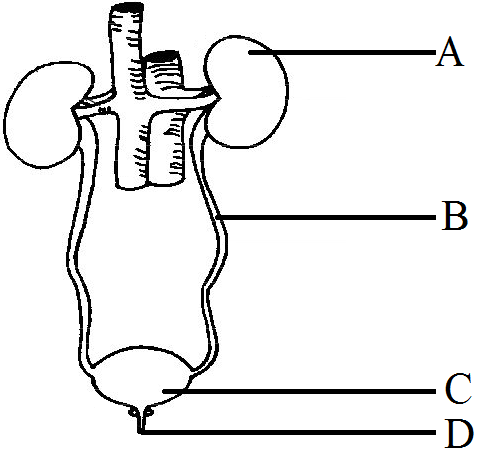
The diagram below represents a group of organs in the human body. Urine leaves the urinary blada, by passing through this structure labeled :
  • A
    $A$
  • B
    $B$
  • C
    $C$
  • $D$
Answer
Correct option: D.
$D$
The urethra, an internal sphincter at the junction of the urethra and bladder, and an external sphincter comprising the pelvic floor muscles, keep the urine in the bladder till it is ready to expel the urine.
View full question & answer
MCQ 411 Mark
When a person eats some egg white, proteins and water enter the stomach. Which substances are found leaving the stomach and leaving the small intestine?
Leaving the stomach
Leaving the Small Intestine
$(a)$
Amino acids, glycerol and water
Amino acids and water.
$(b)$
Fatty acids, glycerol and water
Fatty acids, glycerol and water.
$(c)$
Protein and water
Fatty acids, glycerol.
$(d)$
Protein, Amino acids and water
water.
  • $(a)$
  • B
    $(b)$
  • C
    $(c)$
  • D
    $(d)$
Answer
Correct option: A.
$(a)$
Leaving the stomach
Leaving the Small Intestine
$(a)$
Amino acids, glycerol and water
Amino acids and water.
View full question & answer
MCQ 421 Mark
Which of the following statements are correct?
  1. Pyruvate can be converted into ethanol and carbon $-$ dioxide by yeast.
  2. Fermentation takes place in the case of aerobic bacteria.
  3. Fermentation takes place in mitochondria.
  4. Fermentation is a form of anaerobic respiration.
  • A
    $\ce{(i)}$ and $\ce{(iii)}$.
  • B
    $\ce{(ii)}$ and $\ce{(iv)}.$
  • $\ce{(i)}$ and $\ce{(iv).}$
  • D
    $\ce{(ii)}$ and $\ce{(iii).}$
Answer
Correct option: C.
$\ce{(i)}$ and $\ce{(iv).}$
Statements $\ce{(i)}$ and $\ce{(iv)}$ are correct. The explanations for wrong statements are as follows :
Fermentation takes place in the case of anaerobic bacteria.
Fermentation takes place in cytoplasm.
View full question & answer
MCQ 431 Mark
Most of the plants absorb nitrogen in one of the following forms. This is :
  • A
    Proteins.
  • Nitrates and nitrites.
  • C
    Urea.
  • D
    Atmospheric nitrogen.
Answer
Correct option: B.
Nitrates and nitrites.
Plants cannot absorb atmospheric nitrogen. Plants can uptake nitrogen in the form of nitrates and nitrites only
View full question & answer
MCQ 441 Mark
One of the following organisms has a saprophytic mode of nutrition. This organism is :
  • Mushroom.
  • B
    Malarial parasite.
  • C
    Leech.
  • D
    Lice.
Answer
Correct option: A.
Mushroom.
Mushroom obtains its food from decaying organic materials like rotten wood.
Thus, it has a saprophytic mode of nutrition.
View full question & answer
MCQ 451 Mark
Which is the correct sequence of parts in human alimentary canal?
  • A
    Mouth $\rightarrow $ stomach $\rightarrow $ small intestine $\rightarrow $ oesophagus $\rightarrow $ large intestine
  • B
    Mouth $\rightarrow $ oesophagus $\rightarrow $ stomach $\rightarrow $ large intestine $\rightarrow $ small intestine
  • C
    Mouth $\rightarrow $ stomach $\rightarrow $ oesophagus $\rightarrow $ small intestine $\rightarrow $ large intestine
  • Mouth $\rightarrow $ oesophagus $\rightarrow $ stomach $\rightarrow $ small intestine $\rightarrow $ large intestine
Answer
Correct option: D.
Mouth $\rightarrow $ oesophagus $\rightarrow $ stomach $\rightarrow $ small intestine $\rightarrow $ large intestine
The various organs of the human digestive system in sequence are: Mouth, Oesophagus, Stomach, Small intestine and Large intestine.
View full question & answer
MCQ 461 Mark
The process of digestion in humans is completed in :
  • A
    Oesophagus.
  • Small intestine.
  • C
    Stomach.
  • D
    Large intestine.
Answer
Correct option: B.
Small intestine.
The digestion of food, i.e. carbohydrates, fats and proteins, completes in the small intestine.
 
View full question & answer
MCQ 471 Mark
If the saliva is lacking in salivary amylase, then which of the following processes taking place in the buccal cavity will be affected?
  • A
    Proteins breaking down into amino acids.
  • Starch breaking down into sugars.
  • C
    Fats breaking down into fatty acids and glycerol.
  • D
    Intestinal layer breaking down leading to ulcers.
Answer
Correct option: B.
Starch breaking down into sugars.
Salivary amylase digests carbohydrates. Starch is a carbohydrate, which is digested and broken down into sugars by the salivary amylase in the buccal cavity.
View full question & answer
MCQ 481 Mark
Which substances are produced by anaerobic respiration in yeast?
Carbon Dioxide Alcohol Lactic Acid Water
(a)
$\checkmark$
$\checkmark$
$\times$
$\times$
(b)
$\checkmark$
$\times$
$\checkmark$
$\times$
(c)
$\times$
$\checkmark$
$\times$
$\checkmark$
(d)
$\times$
$\times$
$\checkmark$
$\checkmark$
  • (a)
  • B
    (b)
  • C
    (c)
  • D
    (d)
Answer
Correct option: A.
(a)
Carbon Dioxide Alcohol Lactic Acid Water
(a)
$\checkmark$
$\checkmark$
$\times$
$\times$
Explanation:
Fermentation is anaerobic respiration and happens without oxygen. Glucose is converted to two ATP, ethanol, and carbon dioxide. Yeast contains the enzyme alcohol dehydrogenase which helps in the formation of alcohol. Due to this reason, fermentation will occur in yeast which will result in the formation of alcohol and $\mathrm{CO}_2$.
View full question & answer
MCQ 491 Mark
Which of the following is the correct statement?
  • A
    Heterotrophs synthesise their own food.
  • B
    Heterotrophs utilize solar energy for photosynthesis.
  • Heterotrophs do not synthesise their own food.
  • D
    Heterotrophs are capable of converting carbon dioxide and water into carbohydrates.
Answer
Correct option: C.
Heterotrophs do not synthesise their own food.
Heterotrophs cannot synthesis their food.
View full question & answer
MCQ 501 Mark
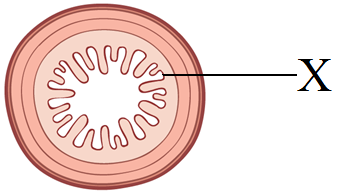
The diagram represents a section through the small intestine. What is the role of the structure labelled?

What is the role of the structure labelled $X\ ?$
  • A
    They help to move the food along.
  • They make a large surface area for absorption.
  • C
    They protect against bacteria.
  • D
    They move mucus over the surface.
Answer
Correct option: B.
They make a large surface area for absorption.
View full question & answer
M.C.Q - Science STD 10 Questions - Vidyadip