MCQ 11 Mark
For two statements are given $-$ one labelled Assertion $(A)$ and the other labelled Reason $(R)$. Select the correct answer to these questions from the codes $\ce{(a), (b), (c)}$ and $(d)$ as given below :
Assertion : In the case of concave mirror, the minimum distance between real object and its real image is zero.
Reason : If concave mirror forms virtual image of real object, the image is magnified.
- A
Both $A$ and $R$ are true, and $R$ is correct explanation of the assertion.
- ✓
Both $A$ and $R$ are true, but $R$ is not the correct explanation of the assertion.
- C
$A$ is true, but $R$ is false.
- D
$A$ is false, but $R$ is true.
AnswerCorrect option: B. Both $A$ and $R$ are true, but $R$ is not the correct explanation of the assertion.
If object is placed at centre of curvature of concave mirror, its image is at the centre of curvature. Thus, minimum distance between object and its real image is zero. If object is between pole and focus of concave mirror, its image is virtual and magnified.
View full question & answer→MCQ 21 Mark
For two statements are given $-$ one labelled Assertion $(A)$ and the other labelled Reason $(R).$ Select the correct answer to these questions from the codes $\ce{(a), (b), (c)}$ and $(d)$ as given below :
Assertion : Light is able to reach earth from the sun.
Reason : Light rays can travel in vaccum.
- ✓
Both $A$ and $R$ are true, and $R$ is correct explanation of the assertion.
- B
Both $A$ and $R$ are true, but $R$ is not the correct explanation of the assertion.
- C
$A$ is true, but $R$ is false.
- D
$A$ is false, but $R$ is true.
AnswerCorrect option: A. Both $A$ and $R$ are true, and $R$ is correct explanation of the assertion.
View full question & answer→MCQ 31 Mark
For two statements are given $-$ one labelled Assertion $(A)$ and the other labelled Reason $(R).$ Select the correct answer to these questions from the codes $\ce{(a), (b), (c)}$ and $(d)$ as given below :
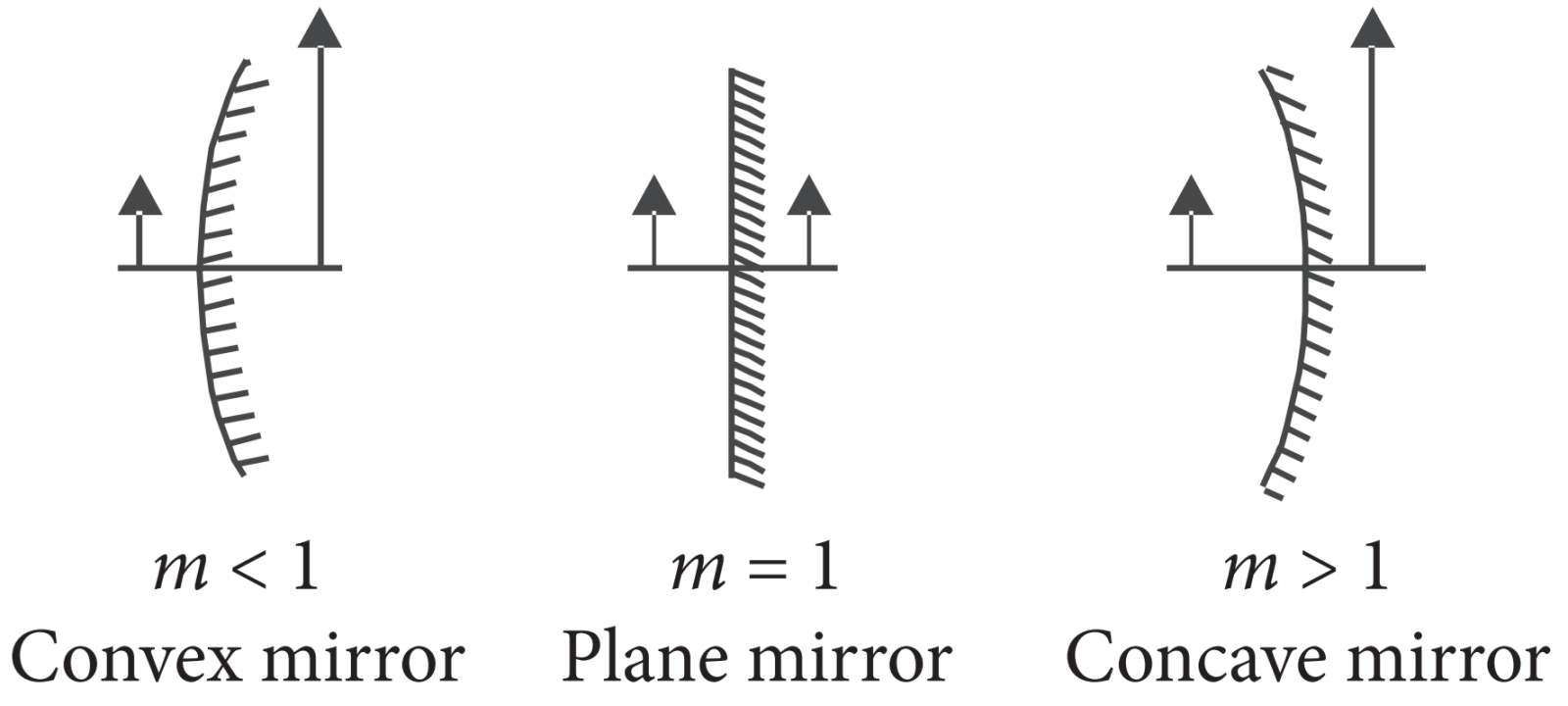
Assertion : We can decide the nature of a mirror by observing the size of erect image in the mirror.
Reason : The minimum distance between a real object and its real image in a concave mirror is non zero.
- A
Both $A$ and $R$ are true and $R$ is correct explanation of the assertion.
- B
Both $A$ and $R$ are true but $R$ is not the correct explanation of the assertion.
- C
$A$ is true but $R$ is false.
- ✓
$A$ is false but $R$ is true.
AnswerCorrect option: D. $A$ is false but $R$ is true.
View full question & answer→MCQ 41 Mark
For two statements are given $-$ one labelled Assertion $(A)$ and the other labelled Reason $(R).$ Select the correct answer to these questions from the codes $\ce{(a), (b), (c)}$ and $(d)$ as given below :
Assertion : A plane mirror neither converges parallel rays of light nor diverges them.
Reason : The focal length of a plane mirror can be considered to be infinite.
- ✓
Both $A$ and $R$ are true and $R$ is correct explanation of the assertion.
- B
Both $A$ and $R$ are true but $R$ is not the correct explanation of the assertion.
- C
$A$ is true but $R$ is false.
- D
$A$ is false but $R$ is true.
AnswerCorrect option: A. Both $A$ and $R$ are true and $R$ is correct explanation of the assertion.
View full question & answer→MCQ 51 Mark
For two statements are given $-$ one labelled Assertion $(A)$ and the other labelled Reason $(R)$. Select the correct answer to these questions from the codes $\ce{(a), (b), (c)}$ and $(d)$ as given below :
Assertion : A convex lens is made of two different materials. A point object is placed on the principal axis. The number of images formed by the lens will be two.
Reason : The image formed by convex lens is always virtual.
- A
Both $A$ and $R$ are true and $R$ is correct explanation of the assertion.
- B
Both $A$ and $R$ are true but $R$ is not the correct explanation of the assertion.
- ✓
$A$ is true but $R$ is false.
- D
$A$ is false but $R$ is true.
AnswerCorrect option: C. $A$ is true but $R$ is false.
Since the lens is made of two different materials of different refractive indices, there will be two different focal lengths of the lens. Hence two images will be formed. The image formed by convex lens is always real, except in case when object is placed between optical centre and focus.
View full question & answer→MCQ 61 Mark
In the following questions, a statement of Assertion is given by the corresponding statement of Reason. Of the statements, mark the correct answer as :
Assertion : Keeping a point object fixed, if a plane mirror is moved, the image will also move.Reason : In case of a plane mirror, distance of object and its image is equal from any point on the mirror.
- A
If both Assertion and Reason are true and Reason is the correct explanation of Assertion.
- B
If both Assertion and Reason are true, but Reason is not the correct explanation of Assertion.
- C
If Assertion is true, but Reason is false.
- ✓
If Assertion is false, but Reason is true.
AnswerCorrect option: D. If Assertion is false, but Reason is true.
In case the mirror is moving parallel to its plane then velocity of the image wrt to the plane will be $0 .......$ The Velocity of the image is, $2\ \times $ Velocity of the mirror $+\ c,$ that is equal to $c,$ therefore, does not matter whether the mirror was moving or not, speed of image will be the same always, i.e. $c.$
The image is said to be "upright", as opposed to inverted. A third characteristic of plane mirror images pertains to the relationship between the object's distance to the mirror and the image's distance to the mirror. For plane mirrors, the object distance is equal to the image distance.
View full question & answer→MCQ 71 Mark
For two statements are given $-$ one labelled Assertion $(A)$ and the other labelled Reason $(R).$ Select the correct answer to these questions from the codes $\ce{(a), (b), (c)}$ and $(d)$ as given below :
Assertion : If a ray of light is incident on a convex mirror along its principal axis, then the angle of incidence as well as the angle of reflection for a ray of light will be zero.
Reason : A ray of light going towards the centre of curvature of a convex mirror is reflected back along the same path.
- A
Both $A$ and $R$ are true and $R$ is correct explanation of the assertion.
- ✓
Both $A$ and $R$ are true but $R$ is not the correct explanation of the assertion.
- C
$A$ is true but $R$ is false.
- D
$A$ is false but $R$ is true.
AnswerCorrect option: B. Both $A$ and $R$ are true but $R$ is not the correct explanation of the assertion.
View full question & answer→MCQ 81 Mark
For two statements are given $-$ one labelled Assertion $(A)$ and the other labelled Reason $(R)$. Select the correct answer to these questions from the codes $\ce{(a), (b), (c)}$ and $(d)$ as given below :
Assertion : The image of a virtual object formed by a thin converging lens is always real.
Reason : In the case of a thin lens $\frac{1}{\text{v}}-\frac{1}{\text{u}}=\frac{1}{\text{f}}$
- A
Both $A$ and $R$ are true and $R$ is correct explanation of the assertion.
- ✓
Both $A$ and $R$ are true but $R$ is not the correct explanation of the assertion.
- C
$A$ is true but $R$ is false.
- D
$A$ is false but $R$ is true.
AnswerCorrect option: B. Both $A$ and $R$ are true but $R$ is not the correct explanation of the assertion.
For virtual object
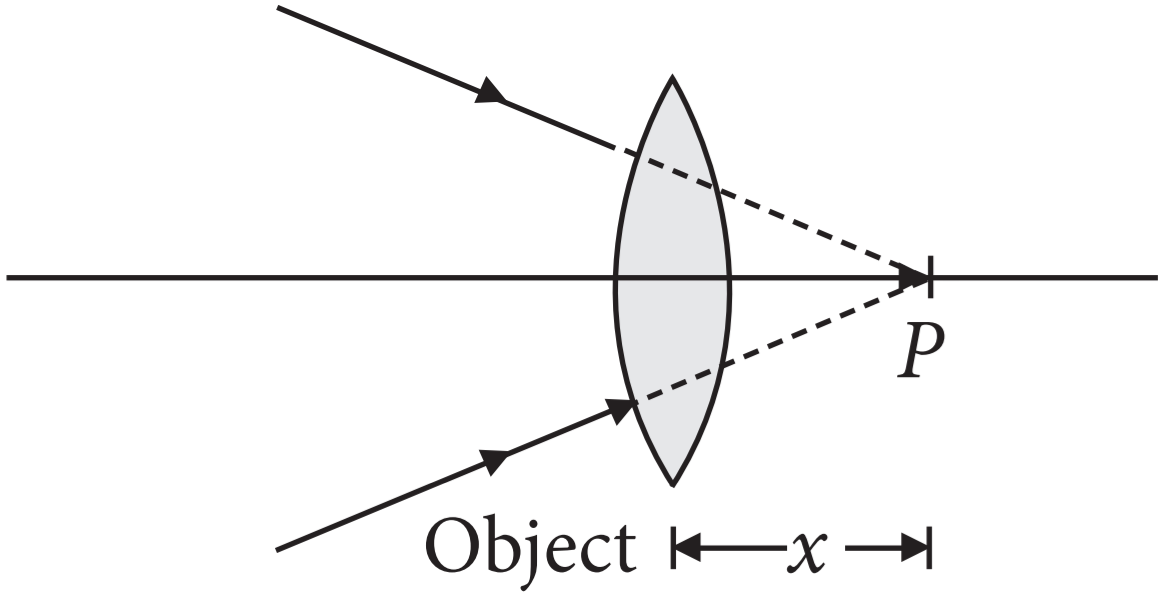
$\text{u} = \text{x}\text{F} = +\ \text{f}$
$\therefore\frac{1}{\text{v}}-\frac{1}{\text{u}}=\frac{1}{\text{f}}$
or $\frac{1}{\text{v}}-\frac{1}{\text{x}}=\frac{1}{\text{f}}$
or $\frac{1}{\text{v}}-\frac{1}{\text{f}}=\frac{1}{\text{x}}$
$\therefore v > 0,$ it means image is real. View full question & answer→MCQ 91 Mark
For two statements are given $-$ one labelled Assertion $(A)$ and the other labelled Reason $(R)$. Select the correct answer to these questions from the codes $\ce{(a), (b), (c)}$ and $(d)$ as given below :
Assertion : Linear magnification of a mirror has no unit.
Reason : The ratio of height of the image to the height of the object is the linear magnification produced by mirror.
- ✓
Both $A$ and $R$ are true and $R$ is correct explanation of the assertion.
- B
Both $A$ and $R$ are true but $R$ is not the correct explanation of the assertion.
- C
$A$ is true but $R$ is false.
- D
$A$ is false but $R$ is true.
AnswerCorrect option: A. Both $A$ and $R$ are true and $R$ is correct explanation of the assertion.
Linear magnification of a mirror is the ratio of height of the image $(cm)$ and the height of the object $(cm)$ and it has no unit.
View full question & answer→MCQ 101 Mark
For two statements are given-one labelled Assertion $(A)$ and the other labelled Reason $(R)$. Select the correct answer to these questions from the codes $\ce{(a), (b), (c)}$ and $(d)$ as given below :
Assertion : Property of converging of a convergent lens does not remain same in all media.
Reason : Property of lens whether the ray is diverging or converging is independent of the surrounding medium.
- A
Both $A$ and $R$ are true and $R$ is correct explanation of the assertion.
- B
Both $A$ and $R$ are true but $R$ is not the correct explanation of the assertion.
- ✓
$A$ is true but $R$ is false.
- D
$A$ is false but $R$ is true.
AnswerCorrect option: C. $A$ is true but $R$ is false.
A convex lens made of glass behaves as a convergent lens when placed in air or water. However when the same lens is immersed in carbon disulphide $(n = 1.63),$ it behaves as a divergent lens. Therefore, when a convergent lens is placed inside a transparent medium of refractive index greater than that of material of the lens, it behaves as a divergent lens. Behaviour of a lens depends on the refractive index of a surrounding medium.
View full question & answer→MCQ 111 Mark
In the following questions, a statement of Assertion is given by the corresponding statement of Reason. Of the statements, mark the correct answer as :
Assertion : $\text{ENT}$ specialist use a concave mirror as a head mirror to concentrate light on the body parts like eye, ear, nose etc.
Reason : A concave mirror is more effective and easily available.
- A
If both Assertion and Reason are true and Reason is the correct explanation of Assertion.
- ✓
If both Assertion and Reason are true, but Reason is not the correct explanation of Assertion.
- C
If Assertion is true, but Reason is false.
- D
If Assertion is false, but Reason is true.
AnswerCorrect option: B. If both Assertion and Reason are true, but Reason is not the correct explanation of Assertion.
The head mirror used by the $E$ and $T$ specialists and dentists is a concave mirror which has a property to converge the rays of light. Therefore, the head mirror focuses light coming from the lamp on the body part $($like eyes, ears, nose, and throat etc.$)$ to be examined properly.
View full question & answer→MCQ 121 Mark
For two statements are given $-$ one labelled Assertion $(A)$ and the other labelled Reason $(R)$. Select the correct answer to these questions from the codes $\ce{(a), (b), (c)}$ and $(d)$ as given below :
Assertion : ln diffused reflection, a parallel beam of incident light is reflected in different direction.
Reason : The diffused reflection of light is due to the failure of the laws of reflection.
- A
Both $A$ and $R$ are true and $R$ is correct explanation of the assertion.
- B
Both $A$ and $R$ are true but $R$ is not the correct explanation of the assertion.
- ✓
$A$ is true but $R$ is false.
- D
$A$ is false but $R$ is true.
AnswerCorrect option: C. $A$ is true but $R$ is false.
Diffuse reflection is caused by the roughness $($or irregularities$)$ in the reflecting surface of an object. The laws of reflection are valid at each point even on the rough surface of an object.
View full question & answer→MCQ 131 Mark
In the following questions, a statement of Assertion is given by the corresponding statement of Reason. Of the statements, mark the correct answer as :
Assertion : The speed of light in a rarer medium is greater than that in a denser medium.
Reason : One light year equal to $9.5 \times 10^{13} \ km$.
- A
If both Assertion and Reason are true and Reason is the correct explanation of Assertion.
- ✓
If both Assertion and Reason are true, but Reason is not the correct explanation of Assertion.
- C
If Assertion is true, but Reason is false.
- D
If Assertion is false, but Reason is true.
AnswerCorrect option: B. If both Assertion and Reason are true, but Reason is not the correct explanation of Assertion.
This constant is called refractive index. When a ray of light bends away from the normal, it goes from denser to rarer medium. It means that $P$ is a denser mediumand $Q$ is a rarer medium. The speed of light in a denser medium is less than in ararer medium.
One light $-$ year is equal to: exactly $9,460,730,472,580.8\ km\ ($about $9.5Pm).$
View full question & answer→MCQ 141 Mark
For two statements are given-one labelled Assertion $(A)$ and the other labelled Reason $(R)$. Select the correct answer to these questions from the codes $\ce{(a), (b), (c)}$ and $(d)$ as given below :
Assertion : The size of the mirror affect the nature of the image.
Reason : Small mirrors always form virtual images.
- A
Both $A$ and $R$ are true and $R$ is correct explanation of the assertion.
- B
Both $A$ and $R$ are true but $R$ is not the correct explanation of the assertion.
- C
$A$ is true but $R$ is false.
- ✓
$A$ is false but $R$ is true.
AnswerCorrect option: D. $A$ is false but $R$ is true.
The size of the image does not affect the nature of the image, except that a bigger image as it gathers more tight rays due to wider aperture.
View full question & answer→MCQ 151 Mark
For two statements are given $-$ one labelled Assertion $(A)$ and the other labelled Reason $(R)$. Select the correct answer to these questions from the codes $\ce{(a), (b), (c)}$ and $(d)$ as given below :
Assertion : Keeping a point object fixed, if a plane mirror is moved, the image will also move.
Reason : In case of a plane mirror, distance of object and its image is equal from any point on the mirror.
- ✓
Both $A$ and $R$ are true and $R$ is correct explanation of the assertion.
- B
Both $A$ and $R$ are true but $R$ is not the correct explanation of the assertion.
- C
$A$ is true but $R$ is false.
- D
$A$ is false but $R$ is true.
AnswerCorrect option: A. Both $A$ and $R$ are true and $R$ is correct explanation of the assertion.
The image formed in a plane mirror is at the same distance behind the mirror as the object is in the front of the mirror. Image and the object are at equal distances from a plane mirror.
View full question & answer→