Questions

M.C.Q

🎯

Test yourself on this topic

19 questions · timed · auto-graded

MCQ 11 Mark
The laws of reflection hold good for:
  • A
    Plane mirror only.
  • B
    Concave mirror only.
  • C
    Convex mirror only.
  • All mirrors irrespective of their shape.
Answer
Correct option: D.
All mirrors irrespective of their shape.

The laws of reflection holds good for light reflected form any smooth surface i.e., all mirrors regardless of its shape.
View full question & answer
MCQ 21 Mark
A 10mm long awl pin is placed vertically in front of a concave mirror. A 5mm long image of the awl pin is formed at 30cm in front of the mirror. The focal length of this mirror is:
  • A
    -30cm.
  • -20cm.
  • C
    -40cm.
  • D
    -60cm.
Answer
Correct option: B.
-20cm.

$\text{m}=\frac{\text{h}'}{\text{h}}=\frac{-\text{v}}{\text{u}}\text{ or}$
$\text{u}=\frac{-\text{v}\times\text{h}}{\text{h}'}=\frac{-(-30\text{cm})\times(10\text{mm})}{-5\text{mm}}$
$=-60\text{cm}$
$\therefore\ \frac{1}{\text{f}}=\frac{1}{\text{u}}+\frac{1}{\text{v}}=-\frac{1}{60}-\frac{1}{30}=-\frac{1}{20}$
$\text{or f }=-20\text{cm}.$

View full question & answer
MCQ 31 Mark

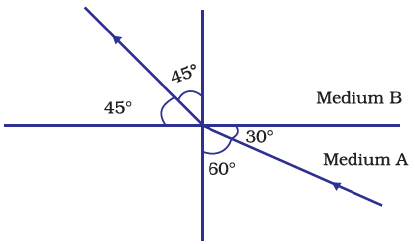
Figure shows a ray of light as it travels from medium A to medium B. Refractive index of the medium B relative to medium A is:
  • $\frac{\sqrt{3}}{\sqrt{2}}$
  • B
    $\frac{\sqrt{2}}{\sqrt{3}}$
  • C
    $\frac{1}{\sqrt{2}}$
  • D
    $\sqrt{2}$
Answer
Correct option: A.
$\frac{\sqrt{3}}{\sqrt{2}}$

$\text{n}_{\text{BA}}=\frac{\sin\text{i}}{\sin\text{r}}=\frac{\sin60^\circ}{\sin45^\circ}$
$=\frac{\frac{\sqrt{3}}{2}}{\frac{1}{\sqrt{2}}}=\frac{\sqrt{3}}{\sqrt{2}}$

View full question & answer
MCQ 41 Mark

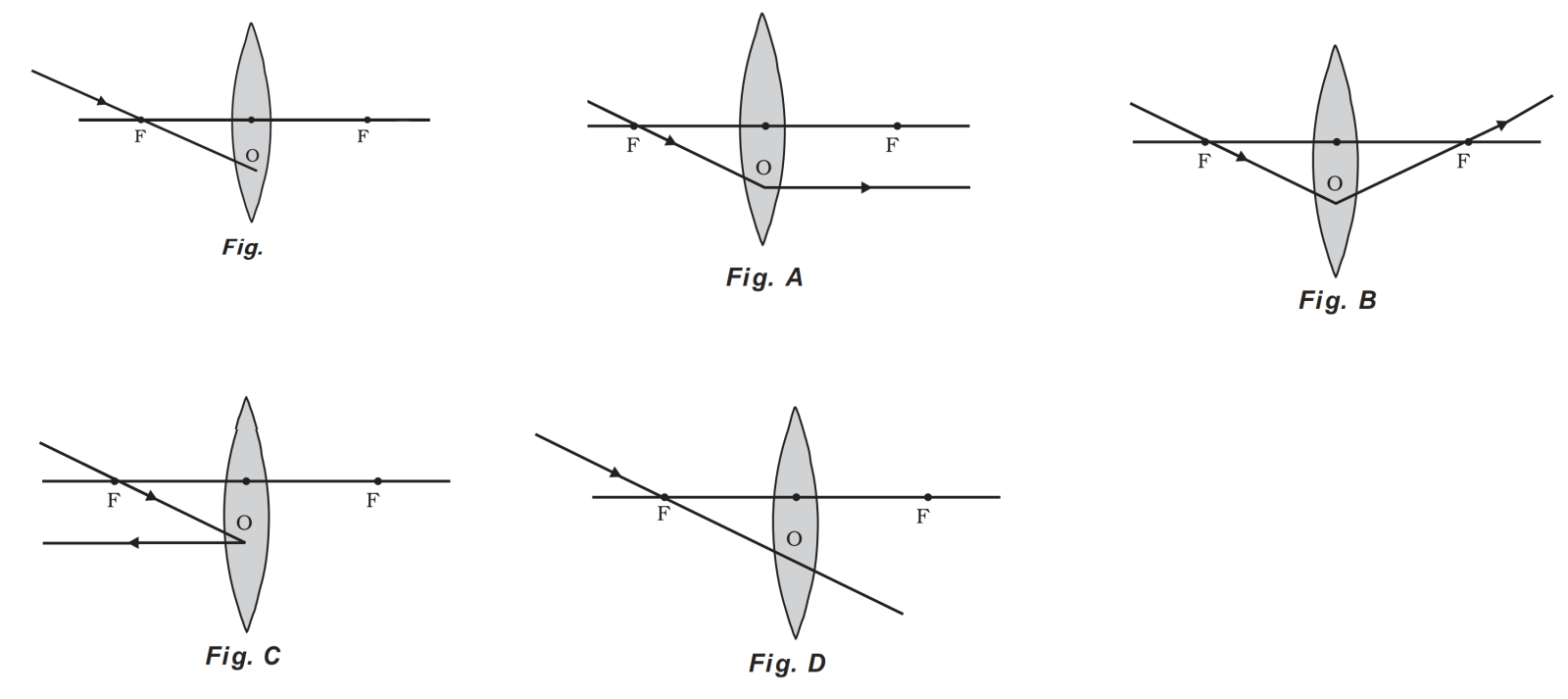
Which of the following ray diagrams is correct for the ray of light incident on a lens shown in Fig.?
  • Fig. A
  • B
    Fig. B
  • C
    Fig. C
  • D
    Fig. D
Answer
Correct option: A.
Fig. A

In convex lens, the incident ray passing through F goes parallel to the principal axis after refraction.

View full question & answer
MCQ 51 Mark

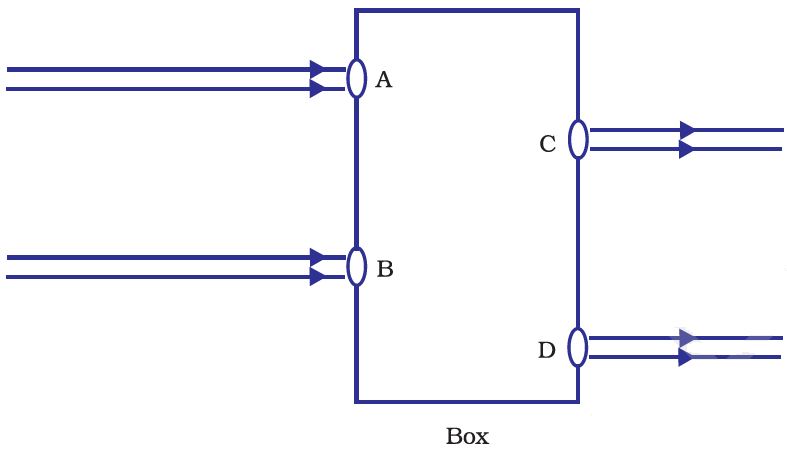
Beams of light are incident through the holes A and B and emerge out of box through the holes C and D respectively as shown in the Figure. Which of the following could be inside the box?
  • A rectangular glass slab.
  • B
    A convex lens.
  • C
    A concave lens.
  • D
    A prism.
Answer
Correct option: A.
A rectangular glass slab.
In this case, incident rays fall perpendicularly on the point of incidence. A rectangular glass slab would refract and then re-refract it.
View full question & answer
MCQ 61 Mark

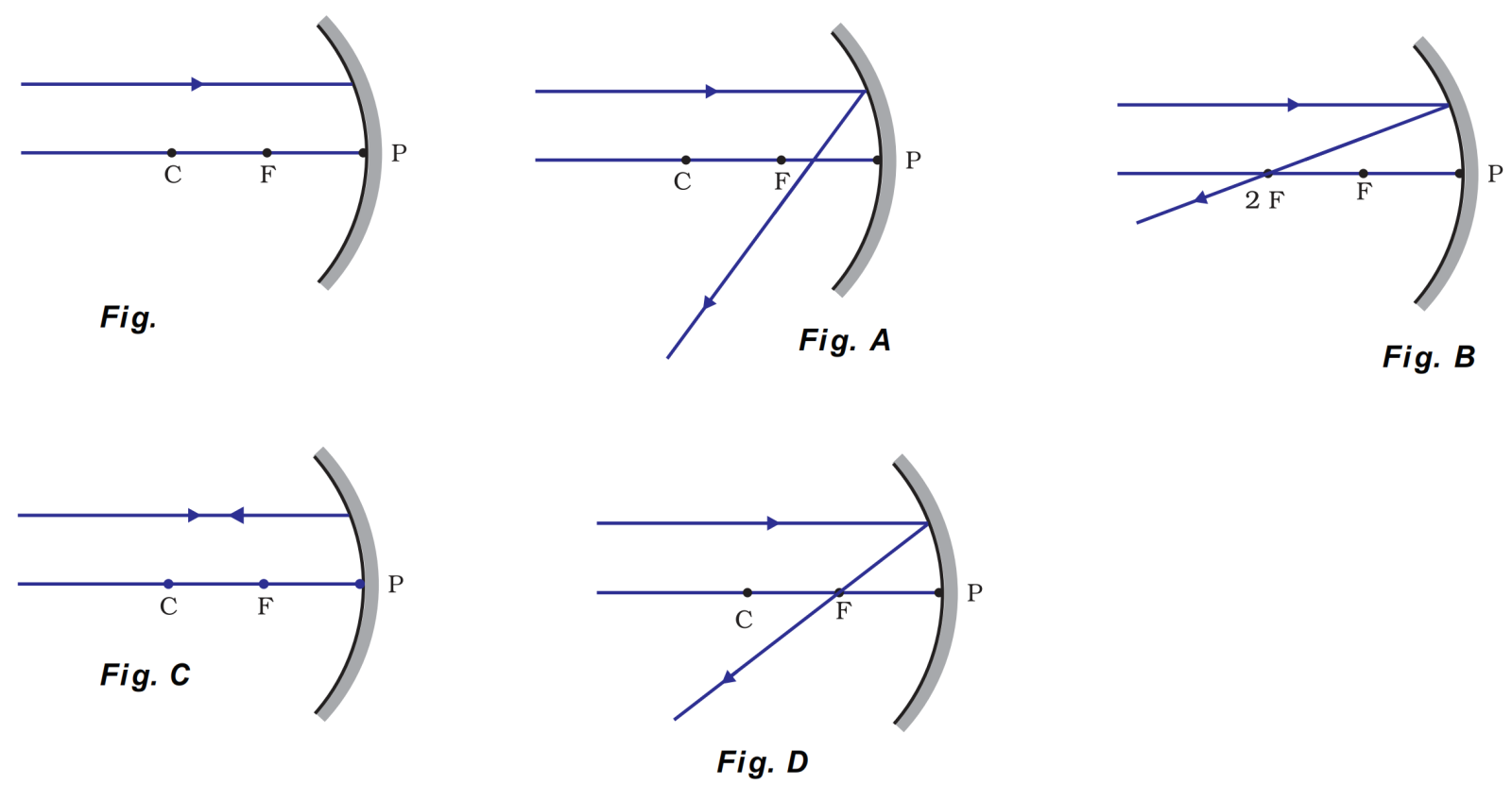
Which of the following ray diagrams is correct for the ray of light incident on a concave mirror as shown in Figure?
  • A
    Fig. A
  • B
    Fig. B
  • C
    Fig. C
  • Fig. D
Answer
Correct option: D.
Fig. D
Any ray of light parallel to the principal axis passes through the focus (F) after reflecting from the concave mirror.
View full question & answer
MCQ 71 Mark
Under which of the following conditions a concave mirror can form an image larger than the actual object?
  • A
    When the object is kept at a distance equal to its radius of curvature.
  • B
    When object is kept at a distance less than its focal length.
  • When object is placed between the focus and centre of curvature.
  • D
    When object is kept at a distance greater than its radius of curvature.
Answer
Correct option: C.
When object is placed between the focus and centre of curvature.
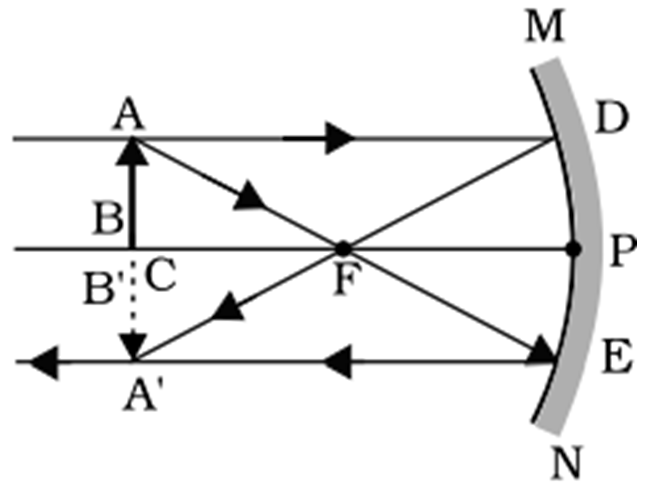
A concave mirror can form an image larger than the actual object when the object is placed between the focus and centre of curvature.Image formation is shown below, where object (AB) is placed between the focus and centre of curvature for which image (A’B’) is obtained behind the mirror.
View full question & answer
MCQ 81 Mark

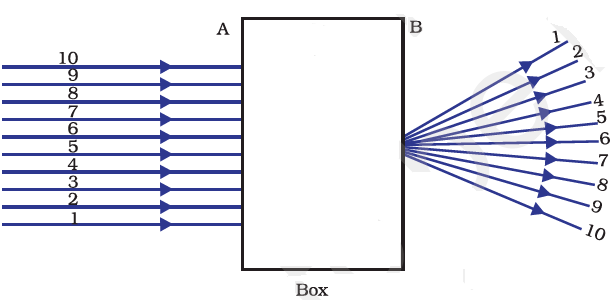
A beam of light is incident through the holes on side A and emerges out of the holes on the other face of the box as shown in the Figure. Which of the following could be inside the box?
  • A
    Concave lens.
  • B
    Rectangular glass slab.
  • C
    Prism.
  • Convex lens.
Answer
Correct option: D.
Convex lens.
View full question & answer
MCQ 91 Mark
In torches, search lights and headlights of vehicles the bulb is placed:
  • A
    Between the pole and the focus of the reflector.
  • Very near to the focus of the reflector.
  • C
    Between the focus and centre of curvature of the reflector.
  • D
    At the centre of curvature of the reflector.
Answer
Correct option: B.
Very near to the focus of the reflector.
View full question & answer
MCQ 101 Mark
In which of the following, the image of an object placed at infinity will be highly diminished and point sized?
  • A
    Concave mirror only.
  • B
    Convex mirror only.
  • C
    Convex lens only.
  • Concave mirror, convex mirror, concave lens and convex lens.
Answer
Correct option: D.
Concave mirror, convex mirror, concave lens and convex lens.
In case of all of the above, when an object is at infinity, image is highly diminished and point sized.
View full question & answer
MCQ 111 Mark
Magnification produced by a rear view mirror fitted in vehicles:
  • Is less than one.
  • B
    Is more than one.
  • C
    Is equal to one.
  • D
    Can be more than or less than one depending upon the position of the object in front of it.
Answer
Correct option: A.
Is less than one.
$\text{m}=\frac{\text{size of image}}{\text{size of object}}$
Rear view mirror is a convex mirror, which always forms an image whose size is less than the size of the object.
View full question & answer
MCQ 121 Mark
A child is standing in front of a magic mirror. She finds the image of her head bigger, the middle portion of her body of the same size and that of the legs smaller. The following is the order of combinations for the magic mirror from the top.
  • A
    Plane, convex and concave.
  • B
    Convex, concave and plane.
  • Concave, plane and convex.
  • D
    Convex, plane and concave.
Answer
Correct option: C.
Concave, plane and convex.
Concave mirror forms a magnified (enlarged) image of the object if the object is placed close to the concave mirror (i.e. a distance less than its focal length). Plane mirror always forms the image of the same size as that of the object.
View full question & answer
MCQ 131 Mark
Which of the following statements is true?
  • A convex lens has 4 dioptre power having a focal length 0.25m.
  • B
    A convex lens has -4 dioptre power having a focal length 0.25m.
  • C
    A concave lens has 4 dioptre power having a focal length 0.25m.
  • D
    A concave lens has -4 dioptre power having a focal length 0.25m.
Answer
Correct option: A.
A convex lens has 4 dioptre power having a focal length 0.25m.
The positive sign with the focal length indicates that it is a convex lens.
View full question & answer
MCQ 141 Mark
Which of the following can make a parallel beam of light when light from a point source is incident on it?
  • Concave mirror as well as convex lens.
  • B
    Convex mirror as well as concave lens.
  • C
    Two plane mirrors placed at 90° to each other.
  • D
    Concave mirror as well as concave lens.
Answer
Correct option: A.
Concave mirror as well as convex lens.
When a point source of light is at the focus of a concave mirror or a convex lens, then emergent rays of light make a parallel beam of light. This is the reason; concave mirror is used as reflector of headlights.
View full question & answer
MCQ 151 Mark
A full length image of a distant tall building can definitely be seen by using:
  • A
    A concave mirror.
  • A convex mirror.
  • C
    A plane mirror.
  • D
    Both concave as well as plane mirror.
Answer
Correct option: B.
A convex mirror.
A convex mirror forms virtual, erect and diminished image of the objects. So, out of given options, distant tall building can definitely be seen by using a convex mirror.
View full question & answer
MCQ 161 Mark

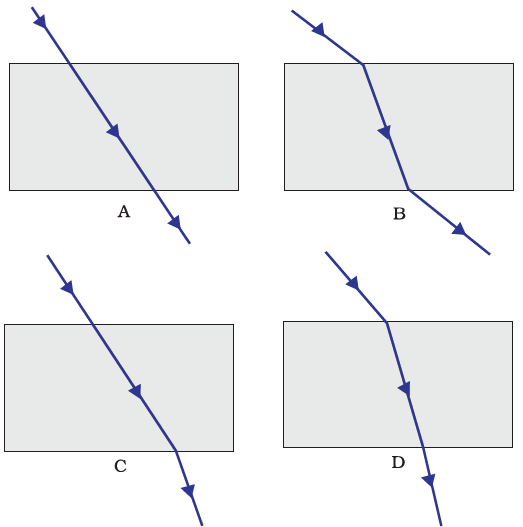
The path of a ray of light coming from air passing through a rectangular glass slab traced by four students are shown as A, B, C and D in Figure. Which one of them is correct?
  • A
    A.
  • B.
  • C
    C.
  • D
    D.
Answer
Correct option: B.
B.
When a light ray is passed through a glass slab obliquely then, emergent ray will be parallel to the direction of the incident ray.
View full question & answer
MCQ 171 Mark
You are given water, mustard oil, glycerine and kerosene. In which of these media a ray of light incident obliquely at same angle would bend the most?
  • A
    Kerosene.
  • B
    Water.
  • C
    Mustard oil.
  • Glycerine.
Answer
Correct option: D.
Glycerine.
Refractive index of water is 1.33, that of kerosene is 1.44, that of mustard oil is 1.46 and that of glycerine is 1.47.
View full question & answer
MCQ 181 Mark

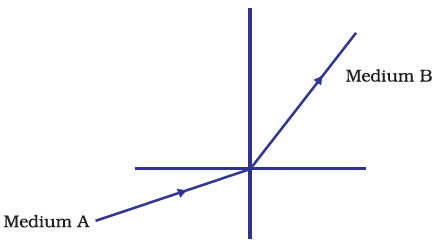
A light ray enters from medium A to medium B as shown in Figure. The refractive index of medium B relative to A will be:
  • Greater than unity.
  • B
    Less than unity.
  • C
    Equal to unity.
  • D
    Zero.
Answer
Correct option: A.
Greater than unity.
Since light rays in medium B goes towards normal. So it has greater restrictive index and lesser velocity of light with respect to medium A. So refractive index of medium B with respect to medium A is greater than unity.
View full question & answer
MCQ 191 Mark
Rays from Sun converge at a point 15cm in front of a concave mirror. Where should an object be placed so that size of its image is equal to the size of the object?
  • A
    15cm in front of the mirror.
  • 30cm in front of the mirror.
  • C
    Between 15cm and 30cm in front of the mirror.
  • D
    More than 30cm in front of the mirror.
Answer
Correct option: B.
30cm in front of the mirror.
In this case, f = -15cm and hence c = -30cm; because radius of curvature is double the focal length. When and object is placed on C, its image is of the same size, inverted and is formed on C.
View full question & answer
M.C.Q - Science STD 10 Questions - Vidyadip