Questions

case /data -based (4 Marks)

Take a timed test

15 questions · self-marked practice — reveal the answer and mark yourself.

Question 14 Marks
Read the following and answer any three questions from (i) to (iv).Ionic compound is a chemical compound in which ions are held together by ionic bonds. An ionic bond is the type of chemical bond in which two oppositely charged ions are held through electrostatic forces. We know that, metal atoms have loosely bound valence electrons in their valence shell and non-metal atoms need electrons in their valence shell to attain noble gas configuration. The metal atom loses the valence electrons while non-metal atom accepts these electrons. By losing electrons, metal atoms change to cations and by accepting electrons, non-metals form anions. Ionic compounds are generally solid and exist in the form of crystal. They have high melting and boiling points.
  1. Write two element which can change to a cation?
     
  2. Write two element which can change to an anion?
     
  3. Which Ionic compounds are soluble and how?

    OR
  4. What are Ionic compounds? Give two examples.
Answer
  1. (c) Potassium.
Explanation:

Potassium, being a metal, can change to cation by losing its valence electron.
  1. (a) Iodine.
​​​​​​​Explanation:

Iodine, being a non-metal, can change to anion by gaining electron.
  1. (c) Water.
​​​​​​​​​​​​​​​​​​​​​Explanation:

Ionic compounds are generally soluble in water and insoluble in kerosene and petrol.
  1. (d) II and III only.
​​​​​​​​​​​​​​​​​​​​​​​​​​​​Explanation:

Ionic compounds do not conduct electricity in solid state, as ions are very closely packed and are free to move.
  1. (c) Formation of ionic bonds involve sharing of electrons.
​​​​​​​​​​​​​​​​​​​​​​​​​​​​​​​​​​​Explanation:

Formation of ionic bonds involve complete transfer of electrons from metal atom to non-metal atom.
View full question & answer
Question 24 Marks
Corrosion is the phenomenon of deterioration of surface of metal in presence of air and moisture. It is a natural process and in the presence of a moist atmosphere, chemically active metals get corroded. This is oxidation reaction. Rusting is the process where iron corrodes due to exposure to the atmosphere. The main circumstance of corrosion occurs with iron because it is a structural material in construction, bridges, buildings, rail transport, ships, etc. Aluminium is also an important structural metal, but even aluminium undergoes oxidation reactions. However, aluminium doesn't corrode or oxidize as rapidly as its reactivity suggests. An alloy of aluminium or any other metal like magnesium can make aluminium stronger and harder.
Copper $( Cu )$ corrodes and forms a basic green carbonate and lead corrodes to form a white lead oxide or carbonate.
(i) What is rusting?
(ii) Which two metals do not corrode easily?
(iii) List two properties of alloys.
or
(iv) What is the effect of corrosion on electrical conductivity?
Answer
(i) The deterioration of surface of iron in presence of air and moisture is called rusting.
(ii) Gold and platinum
(iii)
(a) Alloys are more resistant to corrosion.
(b) The melting point of alloys are less than pure metals.
or
(iv) Corrosion increases the electrical conductivity of metals.
View full question & answer
Question 34 Marks
When a metal is attacked by substances around it such as moisture, acids, etc., it is said to corrode, and this process is called corrosion. The black coating on silver, green coating on copper and reddish-brown powder on iron surface are some examples of corrosion.

(i) What is the name given to the corrosion of iron?
(ii) What is the formula of green colour coating on copper?
(iii) Name two methods to prevent corrosion of iron.
or
(iv) Is corrosion a redox reaction?

Answer
COMING SOON
View full question & answer
Question 44 Marks
Electronic configuration of some of the elements are given :
Type of elementElementAtomic numberNumber of electrons in shell
MetalsSodium (Na)Magnesium (Mg)Aluminium (Al)1112132828283
Non-metalsOxygen (O)Sulphur (S)Chlorine (Cl)8161726286287

(i) State one physical property to distinguish between metals and non-metals.
(ii) What is the nature of the bond formed when magnesium reacts with chlorine? Write the formula of the compound.
or
(ii) What is common between oxygen and sulphur? Draw the electron dot structure of $O _2$ molecule.

Answer
(i) Metals are malleable and ductile while non-metals are brittle.
(ii) Ionic bond formed transfer of electrons from magnesium to chloride.
or
(ii) Both have same number of valence electron. Both belongs to the same group (Group 16) of the periodic table.
View full question & answer
Question 54 Marks
The arrangement of metals in a vertical column in the decreasing order of their re-activities is called the reactivity series or activity series of metals. The most reactive metal is at the top position of the reactivity series. The least reactive metal is at the bottom of the reactivity series.
Hydrogen, though a non-metal, has been included in the activity series of metals only for comparison. Apart from it, the hydrogen atom also has tendency to lose its valence electron and form cation like the behaviour shown by metals. Thus,
$H \longrightarrow H ^{+}+ e ^{-}$
(i) An element ' $X$ ' after reacting with acids liberate hydrogen gas and can displace lead and tin from their salt solution. Write down the Name of $X$ metal.
(ii) Which metal can be displaced by copper from its salt solution?
or
(ii) Write down the name of most reactive metal and which metal does not liberate hydrogen gas after reacting with acid?
Answer
(i) Nickel
(ii) Copper can displace $AgNO _3$ because Copper is more reactive than silver.
or
(ii) Potassium, Gold
View full question & answer
Question 64 Marks
Activity series : Relative reactivities of metals
PotassiumMost reactive
Sodium
Calcium
Magnesium
Aluminium
ZincReactivity decreases
Iron
Lead
Hydrogen
Copper
Mercury
Silver
GoldLeast reactive

(i) What happens when iron nail is added to copper sulphate solution? What is the colour change ?
(ii) Identify the metal which reacts with very dilute nitric acid to evolve hydrogen gas. Name one more metal not given in the above series which reacts in the same way with dilute nitric acid.
(iii) Name one important ore of copper with its chemical formula.
(iv) Which method is used to extract sodium from molten sodium chloride ?
or
(v) Which metal is used in the galvanization of iron?

Answer
(i) The colour changes from blue to green. (ii) Magnesium and manganese. (iii) Copper glance, $Cu _2 S$. (iv) Electrolytic reduction is used for the extraction of sodium. or (v) Zinc.A(i) The colour changes from blue to green.
(ii) Magnesium and manganese.
(iii) Copper glance, $Cu _2 S$.
(iv) Electrolytic reduction is used for the extraction of sodium.
or
(v) Zinc.
View full question & answer
Question 74 Marks
Some reaction of metal with some compounds are given in the table:
MetalIron (II) SulphateCopper (II) SulphateZinc SulphateSilver Nitrate
ANo reactionDisplacement………………………………
BDisplacement………………No reaction………………
CNo reactionNo reactionNo reactionDisplacement
DNo reactionNo reactionNo reactionNo reaction

(i) Name the most and least active metal.
(ii) Arrange the metals $A, B, C$ and $D$ in order of increasing reactivity.
or
(ii) Container of which metal can be used to store both zinc sulphate solution and silver nitrate solution?

Answer
(i) $\quad B$ is most reactive metal. $B$ can displace iron whereas no other metal can do. $D$ is least reactive metal.
(ii) $D<C<A<B$
or
(ii) Container of $D$ can be used to store both zinc sulphate solution and silver nitrate solution.
View full question & answer
Question 84 Marks
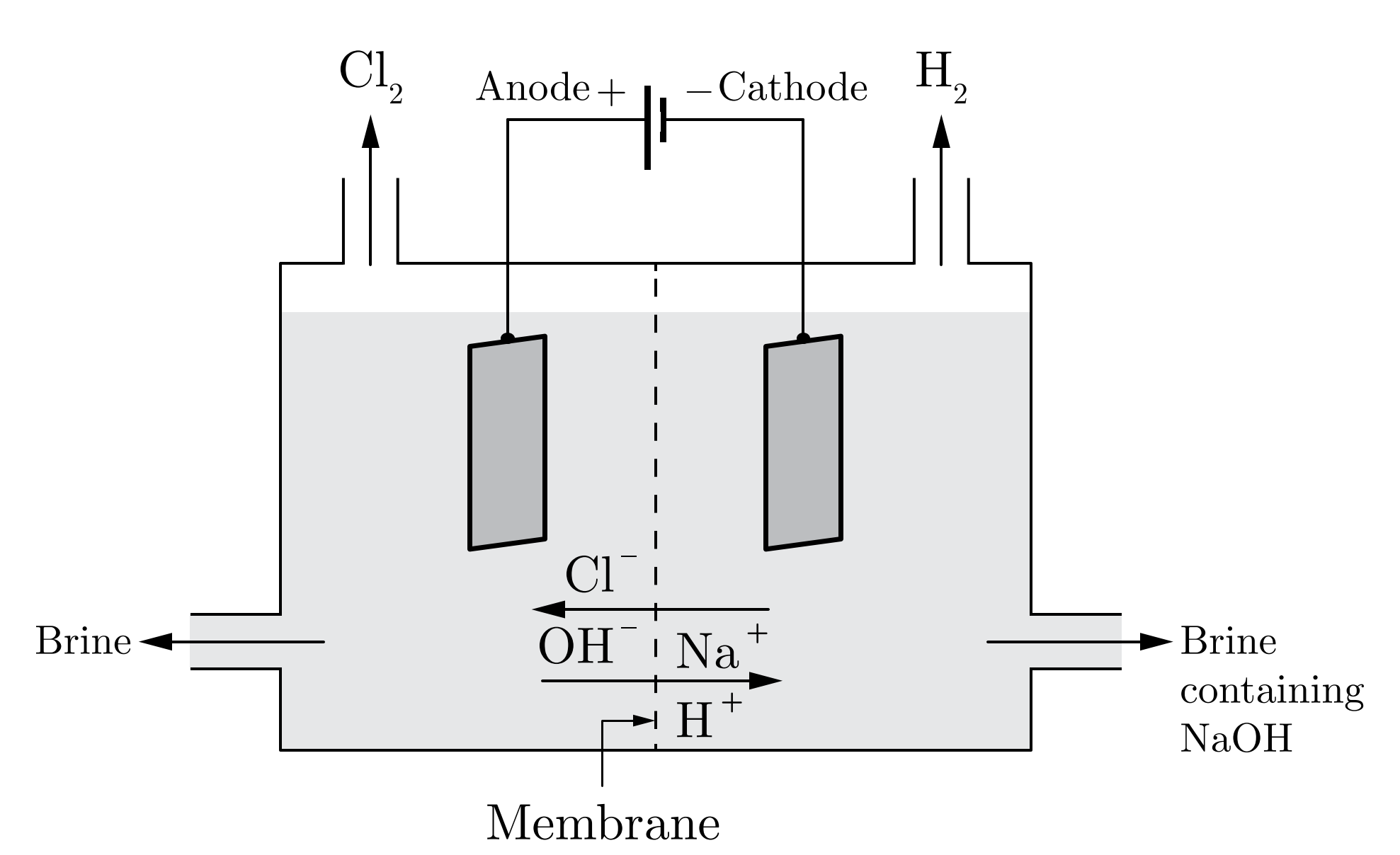
Refining is the process of purification of metals. One of the important method of refining is electrolysis. In electrolysis, electrical energy is used to bring about a non-spontaneous redox reaction. This is done by passing an electric current through a liquid containing ions, known as an electrolyte. In contrast to metals, the current in electrolytes is carried by the movement of ions rather than the movement of electrons. The solid conductors inserted into the liquid are called electrodes, the one with a positive charge is called the anode (because it attracts anions) and the one with the negative charge is called the cathode.
A diagrammatic representation of electrolysis of copper is shown below :


(i) Name the electrolyte used in refining of copper.
(ii) a. $Cu \longrightarrow Cu ^{2+}+2 e ^{-}$
b. $Cu ^{2+}+2 e ^{-} \longrightarrow Cu$
Which of these two reactions occur at cathode and anode?
or
(iii) What is anode mud? Name two metals which can be refined by electrolytic method.

Answer
(i) Acidified copper sulphate
(ii) (a) Reaction a. occurs at anode.
(b) Reaction b. occurs at cathode.
or
(ii) The impurities which settle at the bottom of anode as a result of electrolysis is called anode mud. Nickel and Zinc.
View full question & answer
Question 94 Marks
The earth's crust is the major source of metals-seawater contains some soluble salts such as sodium chloride, magnesium chloride, etc. The elements or compounds, which occur naturally in the earth's crust are known as minerals. At some places, minerals contain a very high percentage of a particular metal and the metal can be profitably extracted from it. These minerals are called ores.
(i) Name the chief ore of mercury and zinc.
(ii) Write equations for the extraction of copper from its sulphide ore.
or
(ii) Define the process used to convert carbonate ores into metal oxide.
Answer
(i) Mercury $\rightarrow$ Cinnabar, HgS
Zinc $\rightarrow$ zinc blende, ZnS.
(ii) $2 Cu _2 O ( s )+ Cu _2 S ( s ) \stackrel{\text { Heat }}{\longrightarrow} 6 Cu ( s )+ SO _2( g )$
or
(ii) The process is called calcination. It is defined as heating the carbonate ore strongly in the limited supply of air to form metal oxide.
View full question & answer
Question 104 Marks
Sample of four metals $P , Q , R$ and $S$ were taken and added to the following solution one by one. The results obtained have been tabulated as follows.
MetalFeSO_(4)CuSO_(4)ZnSO_(4)AgNO_(3)
PNo reactionDisplacement...........................................
QDisplacement No reactionDisplacement
RNo reactionNo reactionNo reaction
SNo reactionNo reactionNo reactionNo reaction

(i) Which is the most reactive metal ?
(ii) What would you observe if $Q$ is added to a solution of $CuSO _4$. Also, what is the colour change when $Q$ is added to $FeSO _4$.
or
What do you mean by displacement reaction?

Answer
(i) Metal Q is the most reactive metal.
(ii) Metal Q will displace copper from $CuSO _4$ solution and brown colour copper is deposited. The green colour of $FeSO _4$ solution fades away.
or
(ii) In a displacement reaction more reactive element displaces a less reactive element to form a compound. Displacement reaction can be seen in metals and non-metal both.
View full question & answer
Question 114 Marks
The reactivity series is a list of metals arranged in the order of their decreasing activities. The metal at the top of the reactivity series is the most reactive and metal at the bottom is the least reactive. The more reactive metal displaces less reactive metal from its salt solution.
KPotassiumMore reactive
NaSodium
CaCalcium
MgMagnesium
AlAluminium
ZnZincMore reactive
FeIron
PbLead
[H][ Hydrogen]
CuCopper
HgMercury
AgSilver
AuGoldLeast reactive

(i) Name the metals which react with steam but not with hot water.
(ii) What happen when calcium react with nitric acid and which method is used to extract metal present at the top of the reactivity series?
or
(ii) Which of the following metals exist in their native states in nature?
I. $Cu$
II. $Au$
III. $Zn$
IV. Ag

Answer
(i) Aluminium, iron and zinc.
(ii) Calcium reacts with nitric acid to form calcium nitrate, dinitrogen monoxide and water. Electrolytic reduction.
or
(ii) II and IV
View full question & answer
Question 124 Marks
The table shows four different materials and their resistivity.

Magnesium (Mg)

Sulphur (S)

Number of electrons in the shells of the atom

2, 8, 2

2, 8, 6

10. How many atoms of sulphur will react with one atom of magnesium to form a compound?
A. One
B. Two
C. Three
D. Four

Answer
10. A. One
View full question & answer
Question 134 Marks
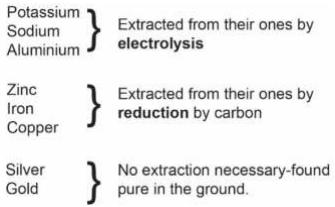
The chart shows the process of extraction of some metals.

Image

9. Which of these metals requires electricity for extraction from its ore?
A. Zinc
B. Silver
C. Copper
D. Aluminium

Answer
9. D. Aluminium
View full question & answer
Question 144 Marks
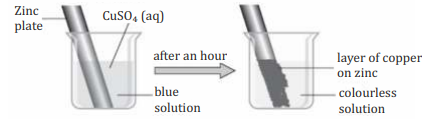
Reena immersed a zinc plate in an aqueous solution of copper sulphate.
She noticed a thick layer of copper on the surface of the zinc plate after an hour.

Image
3. What is the formula of the colourless solution formed after the reaction?
A. Zn
B. Cu
C. ZnSO₄
D. CuSO₄
4. What should Reena have done to make the reaction faster?
A. Use a thicker zinc plate
B. Use pieces of small zinc lakes
C. Use a copper vessel for the reaction
D. Use copper sulphate solution of higher concentration
5. No reaction takes place when a copper plate is immersed in an aqueous solution of zinc sulphate.
Explain the reason behind this.
6. What makes gold exist in free state in nature?
7. 2Al + 3H₂O Al₂O₃+ X
What is X in the reaction?
A. Al
B. H₂
C. O₃
D. AlH₃
8. Which of these is a property of an ionic compound?
Circle ‘Yes’ or ‘No’ to the correct response.

Is this a property of an ionic compound?

Yes or No

It is insoluble in water.

Yes/No

It has a high melting point.

Yes/No

It contains atoms of metal and non-metal.

Yes/No

Answer
3. C. ZnSO₄
4. B. Use pieces of small zinc lakes
5. Mentions that no reaction takes place as copper is less reactive than zinc.
For example:
● Copper is less reactive than zinc.
6. Mentions that gold has very low reactivity
7. B. H₂
8. No
Yes
Yes
View full question & answer
Question 154 Marks
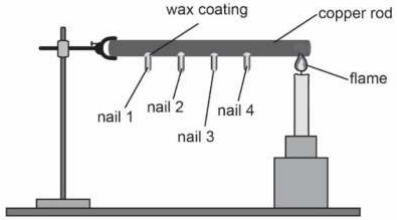
Riya wants to ind out how metal conducts heat.
She attaches four nails on a copper rod with wax.
Riya heats one end of the copper rod with a lame.

Image
1. Which nail will fall last?
A. Nail 1
B. Nail 2
C. Nail 3
D. Nail 4
2. What should Riya keep the same in her activity?
A. Length of the nails
B. Material of the nails
C. Thickness of wax coatings
D. Distance between the nails

Answer
1. D. Nail 4
2. C. Thickness of wax coatings
View full question & answer
case /data -based (4 Marks) - Science STD 10 Questions - Vidyadip