Questions

M.C.Q

Take a timed test

21 questions · auto-graded multiple-choice test.

MCQ 11 Mark
In a food chain, the third trophic level is always occupied by:
  • Carnivores.
  • B
    Herbivores.
  • C
    Decomposers.
  • D
    Producers.
Answer
Correct option: A.
Carnivores.
Plants occupy the first trophic level, herbivores constitute the second trophic level, carnivores constitute the third trophic level and higher carnivores occupy the fourth trophic level.
View full question & answer
MCQ 21 Mark
Depletion of ozone is mainly due to:
  • Chlorofluorocarbon compounds.
  • B
    Carbon monoxide.
  • C
    Methane.
  • D
    Pesticides.
Answer
Correct option: A.
Chlorofluorocarbon compounds.
Depletion of ozone is mainly due to chlorofluorocarbons (CFCs).
All other substances except chlorofluorocarbon compounds do not contribute to the depletion of ozone.
View full question & answer
MCQ 31 Mark
Which group of organisms are not constituents of a food chain?
  1. Grass, lion, rabbit, wolf.
  2. Plankton, man, fish, grasshopper.
  3. Wolf, grass, snake, tiger.
  4. Frog, snake, eagle, grass, grasshopper.
  • A
    $(i)$ and $(iii).$
  • B
    $(iii)$ and $(iv).$
  • $(ii)$ and $(iii).$
  • D
    $(i)$ and $(iv).$
Answer
Correct option: C.
$(ii)$ and $(iii).$
 In option $(ii)$ grasshopper does not eat plankton. In option $(iii)$ none of the animals eats grass.
View full question & answer
MCQ 41 Mark
Excessive exposure of humans to $\ce{UV}-$ rays results in :
  1. Damage to immune system.
  2. Damage to lungs.
  3. Skin cancer.
  4. Peptic ulcers.
  • A
    $(i)$ and $(ii).$
  • B
    $(ii)$ and $(iv).$
  • $(i)$ and $(iii).$
  • D
    $(iii)$ and $(iv).$
Answer
Correct option: C.
$(i)$ and $(iii).$
$\ce{UV}$ rays effect the cells of outer parts of our body. Sometimes, cells are damaged causing skin cancer which further lead to damage of our immune system.
View full question & answer
MCQ 51 Mark
Which one of the following is an artificial ecosystem?
  • A
    Pond.
  • Crop field.
  • C
    Lake.
  • D
    Forest.
Answer
Correct option: B.
Crop field.
 This ecosystem is created by humans.
View full question & answer
MCQ 61 Mark
Which of the statement is incorrect?
  • A
    All green plants and blue green algae are producers.
  • Green plants get their food from organic compounds.
  • C
    Producers prepare their own food from inorganic compounds.
  • D
    Plants convert solar energy into chemical energy.
Answer
Correct option: B.
Green plants get their food from organic compounds.
Producers use solar energy to make carbohydrates from water and carbon dioxides. Water and carbon dioxide are inorganic compounds.
View full question & answer
MCQ 71 Mark
The decomposers in an ecosystem:
  • A
    Convert inorganic material, to simpler forms.
  • Convert organic material to inorganic forms.
  • C
    Convert inorganic materials into organic compounds.
  • D
    Do not breakdown organic compounds.
Answer
Correct option: B.
Convert organic material to inorganic forms.
The microorganisms that break-down the complex organic substances into simple inorganic substances those goes into the soil and are used up once more by the plants.
View full question & answer
MCQ 81 Mark
Organisms of a higher trophic level which feed on several types of organisms belonging to a lower trophic level constitute the:
  • A
    Food web.
  • Ecological pyramid.
  • C
    Ecosystem.
  • D
    Food chain.
Answer
Correct option: B.
Ecological pyramid.
In ecological pyramid, number of organisms at higher tropic level is always less than number of organisms at lower trophic level. An organism at higher trophic level usually feeds on more than one type of organisms. For example, consumers are always less than producers.
View full question & answer
MCQ 91 Mark
Organisms which synthesise carbohydrates from inorganic compounds using radiant energy are called:
  • A
    Decomposers.
  • Producers.
  • C
    Herbivores.
  • D
    Carnivores.
Answer
Correct option: B.
Producers.
Producers use solar energy to make carbohydrates from water and carbon dioxides. Mainly the green leaves of the plant.
View full question & answer
MCQ 101 Mark
In the given food chain, suppose the amount of energy at fourth trophic level is $5\ kJ$, what will be the energy available at the producer level?
Grass $\rightarrow $ Grasshopper $\rightarrow $ Frog $\rightarrow $ Snake $\rightarrow $ Hawk
  • A
    $5\ kJ.$
  • B
    $50\ kJ.$
  • C
    $500\ kJ.$
  • $5000\ kJ.$
Answer
Correct option: D.
$5000\ kJ.$

Energy level available at a particular trophic level is $10$ times the energy level at the next trophic level. Hence, third trophic level has $50\ kJ, 2^{nd}$ has $500\ kJ$ and $1^{st} $has $5000\ kJ.$

View full question & answer
MCQ 111 Mark
The percentage of solar radiation absorbed by all the green plants for the process of photosynthesis is about:
  • 1%
  • B
    5%
  • C
    8%
  • D
    10%
Answer
Correct option: A.
1%
The green plants in a terrestrial ecosystem capture about 1% of the energy of sunlight that falls on their leaves and convert it into food energy.
View full question & answer
MCQ 121 Mark
Flow of energy in an ecosystem is always:
  • Unidirectional.
  • B
    Bidirectional.
  • C
    Multi directional.
  • D
    No specific direction.
Answer
Correct option: A.
Unidirectional.
The flow of energy in the ecosystem is unidirectional. The energy enters the plants (from the sun) through photosynthesis during the making of food. This energy is then passed on from one organism to another in a food chain.
The energy given out by the organisms as heat is lost to the environment, it does not return to be used by the plants again. This makes the flow of energy in ecosystem 'unidirectional'.
View full question & answer
MCQ 131 Mark
If a grass hopper is eaten by a frog, then the energy transfer will be from:
  • A
    Producer to decomposer.
  • B
    Producer to primary consumer.
  • Primary consumer to secondary consumer.
  • D
    Secondary consumer to primary consumer.
Answer
Correct option: C.
Primary consumer to secondary consumer.
​​​​​​​Grasshopper feeds on grass and hence is a primary consumer. Frogs feed on insects and hence are secondary consumers.
View full question & answer
MCQ 141 Mark
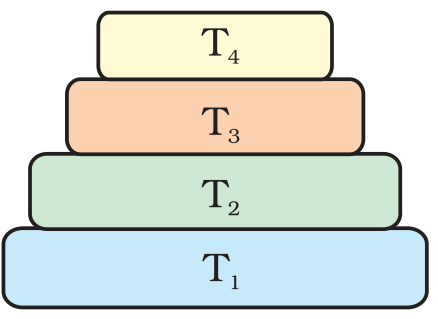
In the given Figure the various trophic levels are shown in a pyramid. At which trophic level is maximum energy available?
  • A
    $T_4$
  • B
    $T_2$
  • $T_1$
  • D
    $T_3$
Answer
Correct option: C.
$T_1$
Maximum energy is available at the producer’s level. Only $10\%$ of the energy consumed by an organism at a particular trophic level is available for the organism at next trophic level. $T_1 > T_2 > T_3 > T_4.$
View full question & answer
MCQ 151 Mark
In an ecosystem, the 10% of energy available for transfer from one trophic level to the next is in the form of:
  • A
    Heat energy.
  • B
    Light energy.
  • Chemical energy.
  • D
    Mechanical energy.
Answer
Correct option: C.
Chemical energy.
The 10% of energy available for transfer from one trophic level to the next in an ecosystem is in the form of chemical energy. The producers capture the energy present in sunlight and convert it into chemical energy which is passed into onto other trophic levels.
View full question & answer
MCQ 161 Mark
An ecosystem includes:
  • A
    All living organisms.
  • B
    Non-living objects.
  • Both living organisms and non-living objects.
  • D
    Sometimes living organisms and sometimes non-living objects.
Answer
Correct option: C.
Both living organisms and non-living objects.

Both biotic and abiotic factors are present in an ecosystem.

View full question & answer
MCQ 171 Mark
Disposable plastic plates should not be used because:
  • A
    They are made of materials with light weight.
  • B
    They are made of toxic materials.
  • C
    They are made of biodegradable materials.
  • They are made of non-biodegradable materials.
Answer
Correct option: D.
They are made of non-biodegradable materials.
Because of their non-biodegradable nature, plastic keeps on accumulating in the environment.
View full question & answer
MCQ 181 Mark
Which of the following limits the number of trophic levels in a food chain?
  • Decrease in energy at higher trophic levels.
  • B
    Dufficient food supply.
  • C
    Polluted air.
  • D
    Water.
Answer
Correct option: A.
Decrease in energy at higher trophic levels.

There is a loss of energy as we go from one trophic level to the next, this limits the number of trophic levels in a food-chain.

View full question & answer
MCQ 191 Mark
In the following groups of materials, which group $(s)$ contains only non $-$ biodegradable items?
  1. Wood, paper, leather.
  2. Polythene, detergent $,\text{PVC}.$
  3. Plastic, detergent, grass.
  4. Plastic, bakelite $,\text{DDT}.$
  • A
    $(iii).$
  • B
    $(iv).$
  • C
    $(i)$ and $(iii).$
  • $(ii)$ and $(iv).$
Answer
Correct option: D.
$(ii)$ and $(iv).$
The substances which can’t be decayed by the action of microbes are non-biodegradable substances e.g., polythene, Bakelite, $\text{PVC},$ detergent, $\text{DDT},$ plastic etc.
Substances which can be decayed by microbes are called biodegradable substances i.e., Wood, paper, grass etc.
View full question & answer
MCQ 201 Mark
What will happen if deer is missing in the food chain given below?
Grass → Deer → Tiger
  • A
    The population of tiger increases.
  • B
    The population of grass decreases.
  • C
    Tiger will start eating grass.
  • The population of tiger decreases and the population of grass increases.
Answer
Correct option: D.
The population of tiger decreases and the population of grass increases.

If deer is missing in the food chain then there will be no herbivore to consume grass, so population of grass will increase.

Tiger will start to die of hunger, so the population of tiger will decrease.

View full question & answer
MCQ 211 Mark
Accumulation of non-biodegradable pesticides in the food chain in increasing amount at each higher trophic level is known as:
  • A
    Eutrophication.
  • B
    Pollution.
  • Bio-magnification.
  • D
    Accumulation.
Answer
Correct option: C.
Bio-magnification.
Accumulation of non-biodegradable pesticides in the food chain in increasing amount at each higher trophic level is known as bio-magnification.
View full question & answer
M.C.Q - Science STD 10 Questions - Vidyadip