MCQ 11 Mark
According to kinetic theory of gases :
- A
Collisions are always elastic
- ✓
Heavier molecules transfer more momentum to the wall of the container
- C
Only a small number of molecules have very high velocity
- D
Only a small number of molecules have very high velocity
AnswerCorrect option: B. Heavier molecules transfer more momentum to the wall of the container
View full question & answer→MCQ 21 Mark
The certain volume of a gas exerts on its walls some pressure at a particular temperature. It has been found that by reducing the volume of the gas to half of its original value the pressure becomes twice that of the initial value at a constant temperature. This happens because :
- A
mass of the gas increases with pressure
- B
speed of the gas molecules decreases
- ✓
more number of gas molecules strikes the surface per second
- D
more number of gas molecules strikes the surface per second
AnswerCorrect option: C. more number of gas molecules strikes the surface per second
Certain volume of a gas exerts on its' walls some pressure at a particular temperature. It has been find that by reducing the volume of the gas to half of its' original value the pressure becomes twice that of the initial value at a constant temperature. This happens because- more number of gas molecules strikes the surface per second due to the reduce in volume at constant temperature.
View full question & answer→MCQ 31 Mark
The total pressure of a gaseous mixture is equalto the sum of the partial pressures is:
AnswerExplanation: (D) Daltons law
Dalton's law (also called Dalton's law of partial pressures) states that in a mixture of non-reacting gases, the total pressure exerted is equal to the sum of the partial pressures of the individual gases.
View full question & answer→MCQ 41 Mark
Which one of the following is not a category of states of matter?
AnswerThe three states of matter are solid, liquid and gas.
Semi $-$ solid is not the states of matter. It is a type of solid $-$ state in which solid is present along with a liquid.
View full question & answer→MCQ 51 Mark
The pressure exerted by the gaseous molecules is due to :
- A
The repulsion between gaseous molecules.
- B
The attraction between gaseous molecules.
- ✓
Collision of the particles with the walls of the container.
- D
Collision of the particles with the walls of the container.
AnswerCorrect option: C. Collision of the particles with the walls of the container.
Particles of gas move in all possible directions in straight line. During their random motion, they collide with each other and with the walls of the container.
View full question & answer→MCQ 61 Mark
A sample of water gas contains $42\%$ by volume of carbon monoxide,If the total pressure is $760 \ mm$. the partial pressure of carbon monoxide is?
- A
$380\ mm$
- ✓
$319.2\ mm$
- C
$38\ mm$
- D
$38\ mm$
AnswerCorrect option: B. $319.2\ mm$
View full question & answer→MCQ 71 Mark
Select the correct answer from the choices given below : The three states of matter are classified on the basis of differences of certain $ ......... :$
- A
- ✓
- C
physical and chemical properties
- D
physical and chemical properties
AnswerThe three states of matter are classified on the basis of differences of certain physical properties such as physical existence; solids are physically hard, they have fixed shape and size. Liquids do not have any fixed shape and size, they changed according to the shape of beakers in which they are placed. Gases do not have a fixed shape or volume.
View full question & answer→MCQ 81 Mark
Which of the following expression is true for an ideal gas?
- ✓
$\frac{\text{p}_1\text{V}_1}{\text{p}_2\text{V}_2}=\frac{\text{T}_1}{\text{T}_2}$
- B
$\frac{\text{V}_1\text{V}_2}{\text{p}_1\text{p}_2}=\text{T}_1\text{T}_2$
- C
$\frac{\text{p}_1\text{T}_1}{\text{p}_2\text{T}_2}=\frac{\text{V}_1}{\text{V}_2}$
- D
$\frac{\text{p}_1\text{T}_1}{\text{p}_2\text{T}_2}=\frac{\text{V}_1}{\text{V}_2}$
AnswerCorrect option: A. $\frac{\text{p}_1\text{V}_1}{\text{p}_2\text{V}_2}=\frac{\text{T}_1}{\text{T}_2}$
If n is contant, then $\frac{\text{p}_1\text{V}_1}{\text{T}_1}=\frac{\text{p}_2\text{V}_2}{\text{T}_2}$
$\Rightarrow \frac{\text{p}_1\text{V}_1}{\text{p}_2\text{V}_2}=\frac{\text{T}_1}{\text{T}_2}$
View full question & answer→MCQ 91 Mark
The gases are easily liquefied when :
- A
They are compressed at higher temperature.
- ✓
They are compressed at lower temperature.
- C
They are expanded at higher temperature.
- D
They are expanded at higher temperature.
AnswerCorrect option: B. They are compressed at lower temperature.
View full question & answer→MCQ 101 Mark
The gas which is used for cooking at our home is $ ..........:$
AnswerCorrect option: C. $\text{L.P.G}\ ($ liquefied petroleum gas$)$
Liquefied petroleum gas is used for cooking food at the homes.
View full question & answer→MCQ 111 Mark
$5$ gram each of the following gases at $87^\circ C$ and $750\ mm$ pressure is taken. Which of them will have the least volume?
- A
$\ce{HF}$
- B
$\ce{HCl}$
- C
$\ce{HBr}$
- ✓
$\ce{HI}$
AnswerCorrect option: D. $\ce{HI}$
From Ideal gas law,
$\text{PV}=\frac{\text{Weight}}{\text{Molar mass}}\times\text{RT}$
The gas with maximum molecular weight will have minimum volume.
HI has the maximum molecular weight, hence has the least volume.
View full question & answer→MCQ 121 Mark
The volume of gas is reduced to half from its original volume. The specific heat will be :
MCQ 131 Mark
The correction factor $'a\ '$ to the ideal gas equation corresponds to :
- A
Electric field present between the gas molecules
- B
Density of the gas molecules
- ✓
Forces of attraction between the gas molecules
- D
Forces of attraction between the gas molecules
AnswerCorrect option: C. Forces of attraction between the gas molecules
The correction factor $'a\ '$ to the ideal gas equation corresponds to forces of attraction between the gas molecules. Greater the value of $'a\ ',$ more easily a gas can be liquefied. The unit of $'a\ '$ is at $\text{mL}^2 \ce{ mol}^{-2}$.
View full question & answer→MCQ 141 Mark
The best evidence for the existence and movement of particles in liquids was provided by $ .......... :$
AnswerRobert brown observed a weak solution of milk and later pollen grains in suspension with a high $-$ powered microscope, and saw that the particles of milk and the pollen grains showed a violent and random motion. This motion was named as Browninan motion.
View full question & answer→MCQ 151 Mark
With regard to the gaseous state of matter which of the following statements are correct?
- A
Complete order of molecules.
- B
Complete disorder of molecules.
- C
Random motion of molecules.
- D
Random motion of molecules.
AnswerIn gaseous state, molecules are in a state of random motion, i.e., it is the state in which molecules are disorderly arranged. Gaseous state has higher entropy than the liquid as well as solid.
View full question & answer→MCQ 161 Mark
Critical temperature is the how so ever :
- ✓
Highest temperature above which gas cannot be liquefied.
- B
Highest temperature above which gas liquefies.
- C
Lowest temperature at which gas liquefies.
- D
Lowest temperature at which gas liquefies.
AnswerCorrect option: A. Highest temperature above which gas cannot be liquefied.
Critical temperature is the highest temperature above which gas cannot be liquefied how so ever pressure is applied, i.e. above this temperature it exists as a gas.
View full question & answer→MCQ 171 Mark
By what factor does the average velocity of a gaseous molecules increase when the temperature is doubled?
Answer$\text{V}=\sqrt{\frac{8\text{RT}}{\text{M}\pi}}$ when, temperature is doubled, $'V\ '$ will increase by $\sqrt{2}$ i.e. $1.414$ times.
View full question & answer→MCQ 181 Mark
Which one of the following gases is lighter than air?
AnswerHydrogen $($density $0.090g/ L$ at $\text{STP},$ average molecular mass $2.016\text{ g/ mol}) $ and helium $($density $0.179g/ L$ at $\text{STP},$ average molecular mass $4.003\text{g/ mol})$ are the most commonly used lift gases. Although helium is twice as heavy as $($diatomic$)$ hydrogen, they are both so much lighter than air that this difference only results in hydrogen having $8\%$ more buoyancy than helium.
View full question & answer→MCQ 191 Mark
If $Z$ is a compressibility factor, van der Waals' equation at low pressure can be written as :
- A
$\text{Z}=1+\frac{\text{RT}}{\text{pb}}$
- ✓
$\text{Z}=1-\frac{\text{a}}{\text{VRT}}$
- C
$\text{Z}=1-\frac{\text{pb}}{\text{RT}}$
- D
$Z =1-\frac{ pb }{ RT }$
AnswerCorrect option: B. $\text{Z}=1-\frac{\text{a}}{\text{VRT}}$
View full question & answer→MCQ 201 Mark
An ideal gas obeying kinetic gas equation :
- ✓
can be liquefied if its temperature is more than critical temperature
- B
can be liquefied at any value of any value $T$ and $P$
- C
can not be liquefied under any value of $T$ and $P$
- D
can not be liquefied under any value of $T$ and $P$
AnswerCorrect option: A. can be liquefied if its temperature is more than critical temperature
An ideal gas is meant to have no intermolecular force of attraction
That's why a real gas has to reach, lowest pressure and highest temperature enough to overcome the intermolecular force of attraction and behave like an ideal gas.
So ideal gas can't be liquefied at any $T$ and $P.$
View full question & answer→MCQ 211 Mark
If a gas expands at constant temperature, it indicates that :
- A
Kinetic energy of molecules decreases.
- B
Pressure of the gas increases.
- ✓
Kinetic energy of molecules remain the same.
- D
Kinetic energy of molecules remain the same.
AnswerCorrect option: C. Kinetic energy of molecules remain the same.
View full question & answer→MCQ 221 Mark
In the reaction $,\ce{N2+3H2\rightarrow 2NH3},$ the ratio of volumes of nitrogen, hydrogen and ammonia is $1 : 3: 2.$ These figures illustrate the law of :
AnswerCorrect option: B. Gay $-$ Lussac
Gay Lussac’s Law of Combining Volumes states that when gases react, they do so in volumes which bear a simple ratio to one another, and to the volume of the product $(s)$ formed if gaseous, provided the temperature and pressure remain constant.
View full question & answer→MCQ 231 Mark
If $\ce{PCl_5}$ is $80\%$ dissociated at $250$ then its vapour density at room temperature will be :
- A
$56.5$
- ✓
$104.25$
- C
$101.2$
- D
$101.5$
AnswerCorrect option: B. $104.25$
View full question & answer→MCQ 241 Mark
Critical temperature of $ \mathrm{H}_2 \mathrm{O} , \mathrm{NH}_3 , \mathrm{CO}_2 $ and $O_2$ are $647K, 405.6K, 304.10K,$ and $154.2K$ respectively. If the cooling starts from $500K$ to their critical temperature, the gas that liquefies first is :
AnswerCorrect option: A. $ \mathrm{H}_2 \mathrm{O} $
It will liquefies first due to maximum inter molecule forces.
View full question & answer→MCQ 251 Mark
Equal volumes of different gases at any definite temperature and pressure have :
AnswerAt equal volume of different gases at any definite temperature and pressure have equal no. of particles.
hence, equal number of moles.
View full question & answer→MCQ 261 Mark
The liquefaction behaviour of the temporary gases like $\ce{CO_2}$ approaches that of permanent gases like $\ce{N_2 , O_2}$ etc., as we go :
- A
Below critical temperature.
- ✓
Above critical temperature.
- C
- D
AnswerCorrect option: B. Above critical temperature.
Critical temperature of a gas is highest temperature at which liquefaction of gas first occur. Liquefaction of permanent gases requires cooling as well as considerable compression.
But temporary gases like $\ce{CO_2}$ and $\ce{CH_4}$ approach that of permanent gases as we go above the critical temperature.
View full question & answer→MCQ 271 Mark
Solids, liquids and gases can diffuse into $ ........ :$
AnswerSolids, liquids, gases can diffuse in liquid. E.g. sugar in water, oxygen dissolved in water, alcohol dissolved in water.
View full question & answer→MCQ 281 Mark
What volume in litres will be occupied by $4.4 g$ of $\ce{CO_2}$ at $\text{STP}\ ?$
- A
$22.4L$
- B
$44.8L$
- C
$12.2L$
- ✓
$12.2L$
AnswerCorrect option: D. $12.2L$
$44 g$ of $\ce{CO_2}$ occupies $22.4L$
$4.4 g$ of $\ce{CO_2}$ occupies $44$
$\frac{22.4}{44}\times4.4=2.24\text{L.}$
View full question & answer→MCQ 291 Mark
According to kinetic theory of gases :
- ✓
Collisions are always elastic
- B
Between collisions, the molecules move in straight lines with constant velocities
- C
Only a small number of molecules have a very high velocity
- D
Only a small number of molecules have a very high velocity
AnswerCorrect option: A. Collisions are always elastic
View full question & answer→MCQ 301 Mark
Total pressure of a gaseous mix is equal to the sum of the Partial Pressures is :
AnswerAccording to Dalton's law of partial pressure, the total pressure exerted by a gaseous mixture is equal to the sum of the partial pressures of the individual gases in the mixture.
View full question & answer→MCQ 311 Mark
The mass of $2.24 \times 10^{-3}m^{3}$ of a gas is $4.4g$ at $273.15K$ and $101.325 \text{ kpa}$. pressure. The gas may be :
AnswerCorrect option: C. $\mathrm{C}_3 \mathrm{H}_8$
$\text{pV}=\frac{\text{m}}{\text{M}}\times\text{RT}$
$\Rightarrow1\text{ atom}\times2.24\text{L}=\frac{4.4\text{g}}{\text{M}}\times0.0821\times273.15$
$\text{M}=44.05\text{g mole}$
View full question & answer→MCQ 321 Mark
Moles of $\mathrm{Na}_2 \mathrm{SO}_4$ to be dissolved in $12$ mole of water to lower its vapour pressure by $10$ millimeter Mercury at a temperature at which vapour pressure of pure water is $50$ millimeters?
- A
$1.5$ moles
- B
$2$ moles
- ✓
$1$ mole
- D
$1$ mole
AnswerCorrect option: C. $1$ mole
View full question & answer→MCQ 331 Mark
All gases obey Charle's law at :
- A
Low temperature and high pressure.
- B
Low temperature and low pressure.
- C
High temperature and high pressure.
- ✓
High temperature and high pressure.
AnswerCorrect option: D. High temperature and high pressure.
All gases obey Charle's law at very low pressures and high temperatures.
View full question & answer→MCQ 341 Mark
Which of the liquids in each of the following pairs has a higher vapour pressure?
AnswerAlcohol and glycerine have high vapour pressure because they have high intermolecular attraction.
As the intermolecular attraction increases vapour pressure increases.
View full question & answer→MCQ 351 Mark
The density of gas is $1.964g \ cm^{-3}$ at $273K$ and $76\ cm \ \ce{ Hg}$. The gas is :
AnswerCorrect option: B. $ \mathrm{CO}_2 $
$\text{d}=\frac{\text{PM}}{\text{RT}}$
$\Rightarrow \text{M}=\frac{\text{dRT}}{\text{P}}$
$=\frac{1.964\times0.0821\times273}{1}$
$=\frac{1.964\times22.4}{1}=44\text{g mole}^{-1}$
View full question & answer→MCQ 361 Mark
Most elements are solids at $25^\circ C$ and $1$ atm pressure, the exception being the $11$ elements that are gases and $2$ that are liquids. What $2$ elements are liquids?
- ✓
$\ce{Hg}$ and $\ce{Br}$
- B
$\ce{Hg}$ and $\ce{I}$
- C
$\ce{Ag}$ and $\ce{Kr}$
- D
$\ce{Ag}$ and $\ce{Kr}$
AnswerCorrect option: A. $\ce{Hg}$ and $\ce{Br}$
At room temperature, that is $25^\circ C$ and $1$ atm, Mercury and Bromine both exist as liquids. Hence option A gives the correct pair.
Iodine, Silver, Platinum, Cobalt are all solid at room temperature. Whereas, Krypton is a gas at room temperature.
View full question & answer→MCQ 371 Mark
All gases have the same number of moles in the same volume at constant $T$ and $P$ is stated by :
AnswerAvogadro's law states that, "equal volumes of all gases, at the same temperature and pressure, have the same number of molecules". For a given mass of an ideal gas, the volume and amount $($moles$)$ of the gas are directly proportional if the temperature and pressure are constant.
View full question & answer→MCQ 381 Mark
Which of the following exists as a liquid at room temperature due to the formation of associated molecules only?
AnswerBenzene is a non $-$ polar aromatic molecule. Benzene has a melting point of $5.5^\circ C$ and a boiling point of $80^\circ C$. It is therefore liquid at room temperature.
$\ce{NH_3}$ liquid boils at $ −33.3^\circ C$ and freezes at $−77.3^\circ C$ to white crystals. So at room temperature is gas.
Bromine evaporates readily to form coloured gas at room temperature.
Carbon disulphide evaporates at room temperature.
View full question & answer→MCQ 391 Mark
According to the Avogadro's Law, equal volumes of two different gases, under same conditions of temperature and pressure, contain equal number of :
AnswerAvogadro's Law states that equal volumes of two different gases, under the same conditions of temperature and pressure, contain an equal number of molecules.
View full question & answer→MCQ 401 Mark
The kinetic theory of matter helped a great deal in understanding the behaviour of gases. Which of the following statements did not belong to it?
- A
When the gas is heated by raising its temperature the molecules move faster
- B
The molecules in a gas are always moving
- C
Gases are made up of small particles called molecules
- ✓
Gases are made up of small particles called molecules
AnswerCorrect option: D. Gases are made up of small particles called molecules
When molecules collide, they lose energy.
The kinetic theory states that, no energy is gained or lost when molecules collide.
View full question & answer→MCQ 411 Mark
Which gas law should be used to solve a gas problem in which only the pressure and temperature of a gas change?
AnswerGay $-$ Lussac's law states that for a given mass and constant volume of an ideal gas, the pressure exerted on the sides of container is directly propotional to absolute temperature.
So, for pressure $-$ temperature graph, we use Gay $-$ Lussac's law.
View full question & answer→MCQ 421 Mark
Dipole $-$ dipole forces act between the molecules possessing permanent dipole. Ends of dipoles possess ‘partial charges’. The partial charge is :
- A
More than unit electronic charge.
- B
Equal to unit electronic charge.
- ✓
Less than unit electronic charge.
- D
Less than unit electronic charge.
AnswerCorrect option: C. Less than unit electronic charge.
Partial charge is a small charge developed by displacement of electrons. It is less than unit electronic charge and is represented as $\delta^+$ or $\ \delta^-.$
View full question & answer→MCQ 431 Mark
The pressure at which liquid and vapour can coexist at equilibrium is called the:
- A
- B
- C
- ✓
saturated vapour pressure
AnswerCorrect option: D. saturated vapour pressure
View full question & answer→MCQ 441 Mark
Which of the following statement about Avogadro's hypothesis is correct?
AnswerCorrect option: B. Under similar conditions of temperature and pressure, equal volumes of all gases contain same number of molecules
Avogadro’s Law states that under same conditions of temperature and pressure, equal volume of all the gases contain equal number of molecules.
View full question & answer→MCQ 451 Mark
The average kinetic energy per molecule of a gas at a given temperature, $T$ is given by :
- A
$\frac{3}{2}\text{RT}$
- B
$\sqrt{\frac{3\text{RT}}{\text{M}}}$
- C
$\sqrt{\frac{\frac{8\text{R}}{\text{NA}}\text{T}}{\pi\text{M}}}$
- ✓
$\sqrt{\frac{\frac{8\text{R}}{\text{NA}}\text{T}}{\pi\text{M}}}$
AnswerCorrect option: D. $\sqrt{\frac{\frac{8\text{R}}{\text{NA}}\text{T}}{\pi\text{M}}}$
$\text{PV}=\frac{1}{2}\text{Mu}^2 \ ($kinetic gas equation$)$
$\Rightarrow\text{RT}=\frac{2}{3}\times\frac{1}{2}\text{Mu}^2$
$\Rightarrow\text{K.E.} =\frac{2}{3} RT$ for $1$ mole, $\ce{KE}$
$=\frac{3}{2}\times\frac{\text{R}}{\text{N}_\text{A}}\times\text{T}$ per molecule.
Where $\ce{N_A}$ is Avogradro's number.
View full question & answer→MCQ 461 Mark
Which mixture of gases at room temp does not obey daltons law of partial pressure?
- A
$\mathrm{He}+\mathrm{Ne}+\mathrm{O}^2 $
- B
$\mathrm{CO}^2+\mathrm{N}^2+\mathrm{O}^2 $
- ✓
$\mathrm{NH}^3+\mathrm{HCl}+\mathrm{O}^2 $
- D
$\mathrm{NH}^3+\mathrm{HCl}+\mathrm{O}^2 $
AnswerCorrect option: C. $\mathrm{NH}^3+\mathrm{HCl}+\mathrm{O}^2 $
The mixture of $\ce{NH^3}$ and $\text{HCl}$ at room temperature does not obey Dalton's law of partial pressure.
$\ce{NH^3}$ and $\text{HCl}$ react spontaneously when putting together within the same apparatus. If they react, then the volume obviously changes. Which will not result in the pressure that you would predict if the two gases don't react and remained as separate entities.
View full question & answer→MCQ 471 Mark
The pressure in well inflated tyres of automobiles is almost constant, but on a hot summer day this increases considerably and tyre may burst. This phenomena is explained by :
MCQ 481 Mark
Equal volume of gases contain equal number of moles : State whether the above statement is true or false :
AnswerAvogadro's Law states that at the same temperature and pressure, equal volumes of different gases contain an equal number of particles.
View full question & answer→MCQ 491 Mark
According to the kinetic theory of gases, in an ideal gas, between two successive collisions, a gas molecule travels :
- A
- ✓
- C
with an accelerated velocity
- D
with an accelerated velocity
AnswerAccording to the postulates of kinetic theory of gases, the molecules of a gas move in a straight line between two successive collisions. They change their path only when they suffer collisions with the other molecules or with the walls of the container.
View full question & answer→MCQ 501 Mark
Gay Lussac's law of gaseous volume is derived from :
- A
law of definite proportions
- B
law of multiple proportions
- C
law of reciprocal proportions
- ✓
law of reciprocal proportions
AnswerCorrect option: D. law of reciprocal proportions
Gay Lussac's law of gaseous volume is derived from experimental observation. According to this law, at constant volume, pressure of a given mass of a gas varies directly with the temperature.
View full question & answer→MCQ 511 Mark
Dalton's law of partial pressure will not apply to which of the following mixture of gases?
- A
$\ce{H_2}$ and $\ce{SO_2}$
- ✓
$\ce{H_2}$ and $\ce{Cl_2}$
- C
$\ce{H_2}$ and $\ce{CO_2}$
- D
$\ce{H_2}$ and $\ce{CO_2}$
AnswerCorrect option: B. $\ce{H_2}$ and $\ce{Cl_2}$
View full question & answer→MCQ 521 Mark
The vapour pressure of a dilute solution of a solute is not influenced by :
AnswerVapour pressure of a dilute solution depends upon the temperature, mole fraction, and degree of dissociation of solute and independent of the melting point of solute.
View full question & answer→MCQ 531 Mark
Which of the following are the properties of solid?
- A
They have a definite shape
- B
They have distinct boundaries
- C
- ✓
AnswerSolids have a definite shape as they have strong intermolecular forces of attraction due to which they remain tightly packed. They remain in a definite shape due to which they have definite boundaries and if it has distinct boundaries, they will have a fixed volume.
View full question & answer→MCQ 541 Mark
Liquids are similar to gases because :
- A
both possess the property of flowing and take the volume of the containers
- ✓
both diffuse and take the shape of the containers
- C
both are readily compressible and diffuse
- D
both are readily compressible and diffuse
AnswerCorrect option: B. both diffuse and take the shape of the containers
Liquids and gases are similar in both shape and volume because they both have its' shape determined by its' surroundings.
$\Rightarrow $ Both diffuses and take the shape of containers.
View full question & answer→MCQ 551 Mark
The surface tension of which of the following liquid is maximum?
- A
$\mathrm{C}_2 \mathrm{H}_5 \mathrm{OH}$
- B
$ \mathrm{CH}_3 \mathrm{OH} $
- ✓
$ \mathrm{H}_2 \mathrm{O} $
- D
$ \mathrm{H}_3 \mathrm{O}$
AnswerCorrect option: C. $ \mathrm{H}_2 \mathrm{O} $
It has maximum surface tension due to maximum intermolecular forces of attraction.
View full question & answer→MCQ 561 Mark
Why rubber band is considered as a solid?
- A
It takes the shape of the container
- B
- C
It has negligible compressibility
- ✓
It has negligible compressibility
AnswerCorrect option: D. It has negligible compressibility
The particles of rubber band are loosely bounded by force of attraction, so as we stretch it moves to maximum elastic limit and as soon as it is released it regains its shape, therefore, it has some property of solids
View full question & answer→MCQ 571 Mark
In a given mixture of non $-$ reacting gases, the ratio of partial pressure of each gas is equal to its :
AnswerDalton's law of partial pressures states that in a mixture of non $-$ reacting gases, the total pressure exerted is equal to the sum of the partial pressures of the individual gases. The ratio of partial pressure of a gas to the total pressure is equal to the mole fraction of the gas.
View full question & answer→MCQ 581 Mark
Which of the following is a characteristic of matter?
- A
Particles are very small in size.
- B
Particles have space among them.
- C
Particles posses kinetic energy.
- ✓
Particles posses kinetic energy.
AnswerCorrect option: D. Particles posses kinetic energy.
Anything that occupies space and has mass is called as matter. A large number of particles constitute matter. These particles are very small in size and have spaces among them. They are always in motion i.e. they posses kinetic energy.
View full question & answer→MCQ 591 Mark
Which solution has the highest vapour pressure?
- A
$0.02 M\ \ce{NaCl}$ at $50^{\circ} \mathrm{C}$
- B
$0.03M$ sucrose at $50^{\circ} \mathrm{C}$
- ✓
$0.005M\ \ce{CaCl}_2$ at $50^{\circ} \mathrm{C}$
- D
$0.005M\ \ce{CaCl_2}$ at $50^{\circ} \mathrm{C}$
AnswerCorrect option: C. $0.005M\ \ce{CaCl}_2$ at $50^{\circ} \mathrm{C}$
View full question & answer→MCQ 601 Mark
The value of molar gas constant is :
- A
Mmaller for compound gases in comparison to other gases
- B
Different for different gases
- ✓
- D
AnswerThe value of molar gas constant is equal for all gases.
The molar gas constant also known as ideal gas constant have value $8.314 \text{ J/mol K}$ or $0.08206 \text{L atm/mol K}$
View full question & answer→MCQ 611 Mark
In the given equilibrium, $\mathrm{H}_2 \mathrm{O}(\mathrm{l}) \rightleftharpoons \mathrm{H} 2 \mathrm{O}(\mathrm{g})$ at $100^{\circ} \mathrm{C}$ the vapour pressure is $1$ atm. If the volume of the container is halved, after sometime the vapour pressure becomes : $($assuming constant temperature$)$
- A
$1.5$ atm
- B
$2.5$ atm
- C
$2$ atm
- ✓
$2$ atm
AnswerCorrect option: D. $2$ atm
The vapour pressure of a liquid depends solely on the temperature and the forces of intermolecular attraction amongst the molecules. If the volume of the container is halved and the temperature is constant, then it will have no effect on the intermolecular forces and hence the vapour pressure will remain the same as before, that is, $1$ atm.
View full question & answer→MCQ 621 Mark
Equal volumes of all gases at the same temperature and pressure contain equal number of molecules'. This law is called as :
AnswerAvogadro's Law states that 'Equal volumes of all gases at the same temperature and pressure contain equal number of molecules'.
View full question & answer→MCQ 631 Mark
Increase in kinetic energy can overcome intermolecular forces of attraction. How will the viscosity of liquid be affected by the increase in temperature?
AnswerIntermolecular force of liquid decreases with increase in temperature, hence viscosity of liquid also decreases. However, some exceptions are there like liquid proteins and liquid sulphur.
View full question & answer→MCQ 641 Mark
Which of the following property indicates weak intermolecular forces of attraction in liquid?
- A
High heat of vaporization
- ✓
- C
High critical temperature
- D
High critical temperature
AnswerThe molecules that are having weak intermolecular forces of attraction, they can easily dissociate and convert into vapour state, so, molecules with weak intractions have high vapour pressure.
View full question & answer→MCQ 651 Mark
Which is wrong according to kinetic theory of gases?
AnswerCorrect option: C. Pressure is due to collisions between molecules
In kinetic theory of gases pressure is due to the molecules colliding with the walls of the container and not when molecules collide with each other.
View full question & answer→MCQ 661 Mark
A person living in Shimla observed that cooking food without using pressure cooker takes more time. The reason for this observation is that at high altitude :
AnswerAt high altitudes, pressure is low. Hence, boiling takes place at lower temperature and therefore, cooking takes more time. In pressure cooker, pressure is high and hence boiling point increases.
View full question & answer→MCQ 671 Mark
Atmospheric pressures recorded in different cities are as follows :
|
Cities
|
Shimla
|
Bengaluru
|
Delhi
|
Mumbai
|
|
$p$ in $N/ m^2$
|
$1.01 \times 10^5$
|
$1.2 \times 10^5$
|
$1.02 \times 10^5$
|
$1.21 \times 10^5$ |
Consider the above data and mark the place at which liquid will boil first. AnswerBoiling point of liquid is directly proportional to atmosphere to atmospheric pressure. In shimla lowest pressure hence the boiling of liquid in shimla will be first.
View full question & answer→MCQ 681 Mark
$\ce{A_3L}$ container at $3$ atm pressure consist a mixture of $\ce{N_2}$ gas and $\ce{H_2O}$ vapours. Solid sphere of volume $0.5L$ is also present in same container. What will be the pressure of gas, if volume of container is reduced to $2L,$ at same temperature $(\ce{AQ}.$ tension $= 0.2$ atm$)?$
- A
$5.4$ atm
- B
$4.2$ atm
- ✓
$4.87$ atm
- D
$4.88$ atm
AnswerCorrect option: C. $4.87$ atm
View full question & answer→MCQ 691 Mark
Which of the following is correct?
- ✓
Van der waals radius of chlorine is bigger than nitrogen.
- B
Covalent radius of nitrogen is bigger than chlorine.
- C
Van der waals radius of chlorine is smaller than nitrogen.
- D
Van der waals radius of chlorine is smaller than nitrogen.
AnswerCorrect option: A. Van der waals radius of chlorine is bigger than nitrogen.
$(A)$ van der waals radius of chlorine is bigger than nitrogen
Van der waals radius of chlorine $= 175\text{pm}$
Van der waals radius of nitrogen $= 155\text{pm}$
View full question & answer→MCQ 701 Mark
On a humid day in summer, the mole fraction of gaseous $\ce{H_2O} ($water vapour$)$ in the air at $250C$ can be as high as $0.0287.$ Assuming a total pressure of $0.977$ atm. What is the partial pressure of dry air?
- A
$94.9$ atm
- ✓
$0.949$ atm
- C
$949$ atm
- D
$943$ atm
AnswerCorrect option: B. $0.949$ atm
$\ce{pH_2O = XH_2O}$ ptotal
$= 0.0287 \times 0.977$
$= 0.028$ atm
ptotal $=$ pdryair $+\ \ce{pH_2O}$
pdryair $=$ ptotal $−\ \ce{pH_2O}$
$= 0.977 − 0.028$
$= 0.949$ atm
View full question & answer→MCQ 711 Mark
The strong intermolecular forces between molecules hold them together and resist the movement of layers past one another. This property of liquid is called :
MCQ 721 Mark
The blotting paper absorbs liquids because :
- ✓
- B
- C
An absorbing chemical is mixed.
- D
An absorbing chemical is mixing
View full question & answer→MCQ 731 Mark
Which of the following is a correct statement?
- ✓
Surface tension of a liquid decreases with increase in temperature.
- B
Vapour pressure of a liquid decreases with increase in temperature.
- C
Viscosity of a liquid decreases with decrease in temperature.
- D
Viscosity of a liquid decreases with increase in temperature.
AnswerCorrect option: A. Surface tension of a liquid decreases with increase in temperature.
Surface tension of a liquid decreases with increase in temperature where as vapour pressure of Iiquid increases with increase in temperature. Viscosity of a liquid decreases on increasing the temperature.
View full question & answer→MCQ 741 Mark
Identify which of the following statements is $\text{FALSE}\ ?$
- A
The vapor pressure of a liquid decreases with increasing atmospheric pressure.
- B
The value of an equilibrium constant is dependent on temperature.
- C
The rate of a spontaneous reaction can be determined solely by its Gibbs free energy.
- ✓
The rate of a spontaneous reaction cannot be determined solely by its Gibbs free energy.
AnswerCorrect option: D. The rate of a spontaneous reaction cannot be determined solely by its Gibbs free energy.
since, during the phase transition; temperature is plotted at the $x-$ axis of the phase transition curve, hence, during phase transition, temperature is not constant.
View full question & answer→MCQ 751 Mark
At constant volume, pressure is directly proportional to the temperature, this law is popularly known as:
MCQ 761 Mark
If the ratio of masses of $\ce{SO_3}$ and $\ce{O_2}$ gases confined in a vessel is $1 : 1,$ then the ratio of their partial pressure would be :
- A
$5 : 2$
- ✓
$2 : 5$
- C
$2 : 1$
- D
$2 : 2$
AnswerCorrect option: B. $2 : 5$
$\frac{1}{80}:\frac{1}{31} $
$\Rightarrow 2:5$ The ratio of number of moles and partial pressure is $2 : 5.$
View full question & answer→MCQ 771 Mark
The value of $Z$ for real gases below Boyle's temperature initially :
AnswerBelow Boyle's temperature, real gases first show decrease in $Z$ value with increasing pressure, which reaches a minimum value.
View full question & answer→MCQ 781 Mark
"The total pressure exerted by the mixture of non $-$ reactive gases is equal to the sum of the partial pressures of individual gases". Above statement represents the :
- ✓
Dalton's law of partial pressure.
- B
- C
Graham's law of diffusion.
- D
AnswerCorrect option: A. Dalton's law of partial pressure.
View full question & answer→MCQ 791 Mark
Which of the following statements indicates that law of multiple proportion is being followed.
- A
Sample of carbon dioxide taken from any source will always have carbon and oxygen in the ratio $1 : 2.$
- ✓
Carbon forms two oxides namely $\ce{CO_2}$ and $CO$, where masses of oxygen which combine with fixed mass of carbon are in the simple ratio $2 : 1.$
- C
When magnesium burns in oxygen, the amount of magnesium taken for the reaction is equal to the amount of magnesium in magnesium oxide formed.
- D
When magnesium burns in oxygen, the amount of magnesium taken for the reaction is equal to the amount of magnesium in magnesium oxide formed.
AnswerCorrect option: B. Carbon forms two oxides namely $\ce{CO_2}$ and $CO$, where masses of oxygen which combine with fixed mass of carbon are in the simple ratio $2 : 1.$
The element, carbon, combines with oxygen to form two compounds, namely, carbon dioxide and carbon monoxide. In $CO_2, 12$ parts by mass of carbon combine with $32$ parts by mass of oxygen while in $CO, 12$ parts by mass of carbon combine with $16$ parts by mass of oxygen.
Therefore, the masses of oxygen combine with a fixed mass of carbon $(12$ parts$)$ in $\ce{CO_2}$ and $CO$ are $32$ and $16$ respectively. These masses of oxygen bear a simple ratio of $32 : 16$ or $2 : 1$ to each other.
This is an example of law of multiple proportions.
View full question & answer→MCQ 801 Mark
Vapour pressure of $\ce{CCl_4}$ at $25^\circ C$ is $\ce{143 mm Hg. 0.5gm} $ of a non $-$ volatile solute $($mol. wt. $65)$ is dissolved in $100\ ml$ of $\ce{CCl_4}$. Find the vapour pressure of the solution : $($Density of $\ce{CCl_4 = 1.58gm/cm^3)}$
- ✓
$141.93\ mm$
- B
$94.39\ mm$
- C
$199.34\ mm$
- D
$195.34\ mm$
AnswerCorrect option: A. $141.93\ mm$
View full question & answer→MCQ 811 Mark
Among the following substances, the lowest vapour pressure is exerted by :
AnswerVapor pressure of mercury is very low $($compared to a liquid like methyl alcohol$)$ because the forces of interaction between the individual metal atoms of mercury is quite a bit stronger than the cohesive molecular forces $($such as a hydrogen bonding$)$ that holds together several molecules in case of alcohols,ethers and water.
View full question & answer→MCQ 821 Mark
The force acting per unit length perpendicular to the line drawn on the surface of liquid and its $\text{SI}$ unit respectively are :
AnswerCorrect option: B. Surface tension, $Nm^{-1}$.
Surface tension is defined as the force acting per unit length perpendicular to the line drawn on the surface of liquid. Its $\text{SI}$ unit is $Nm^{-1}$.
View full question & answer→MCQ 831 Mark
Which tool allows liquids to be swirled with a low risk of spilling?
AnswerErlenmeyer flask $\rightarrow $
It is used as a container for liquids. Its Shape makes it easy and safe to swirl liquids without spilling, making them ideal for titration. It cannot be used to measure the volume of liquid because its shape makes it difficult to make accurate readings.
View full question & answer→MCQ 841 Mark
Which of the following solutions will have the lowest vapour pressure?
AnswerCorrect option: D. $0.1M\ \ce{Al_2(SO_4)_3}$
View full question & answer→MCQ 851 Mark
Under which of the following two conditions applied together, a gas deviates most from the ideal behaviour
AnswerA gas which obeys the ideal gas equation, $\text{pV = nRT}$ under all conditions of temperature and pressure is called an ‘ideal gas’.
However, there is no gas which obeys the ideal gas equation under all conditions of temperature and pressure. Hence, the concept of ideal gas is only theoretical or hypothetical. The gases are found to obey the gas laws fairly well when the pressure is low or the temperature is high.
Such gases are, therefore, known as ‘real gases’. All gases are real gases. Hence, at high pressure and low temperature, a real gas deviates most from ideal behavior.
View full question & answer→MCQ 861 Mark
Molecules are held together by which type of bonds?
AnswerIonic bonding and covalent bonding is between different atoms, not between different molecules. Molecules are rather held together by different inter-molecular forces of attraction.
View full question & answer→MCQ 871 Mark
Which of the following statement $(s)$ is/ are not correct?
AnswerCorrect option: C. Solids have largest inter $-$ particle space.
View full question & answer→MCQ 881 Mark
Which of the following changes decrease the vapour pressure of water kept in a sealed vessel?
- A
Decreasing the quantity of water.
- B
- C
Decreasing the volume of the vessel to one-half.
- ✓
Answer(D)
Explanation:
Vapor pressure does not depend upon the quantity of water or size of the vessel. It decreases on adding salt to water or decreasing the temperature of water.
View full question & answer→MCQ 891 Mark
At $1$ atm pressure the boiling temperature is called normal boiling point and if pressure is $1$ bar then the boiling point of the liquid is called :
View full question & answer→MCQ 901 Mark
Two gases $A$ and $B$ are taken in same volume containers under similar conditions of temperature and pressure. In container $A,$ there are $'2N\ '$ molecules of gas $A$. How many number molecules does container $B$ have?
AnswerAvogadro's law : Equal volumes of gases at the same temperature and pressure contain equal numbers of molecules.
View full question & answer→MCQ 911 Mark
The type of attractive forces operating between the polar molecules having permanent dipole and the molecules lacking permanent dipole is :
AnswerCorrect option: C. Dipole $-$ induced dipole.
View full question & answer→MCQ 921 Mark
Which curve in Fig. represents the curve of ideal gas?
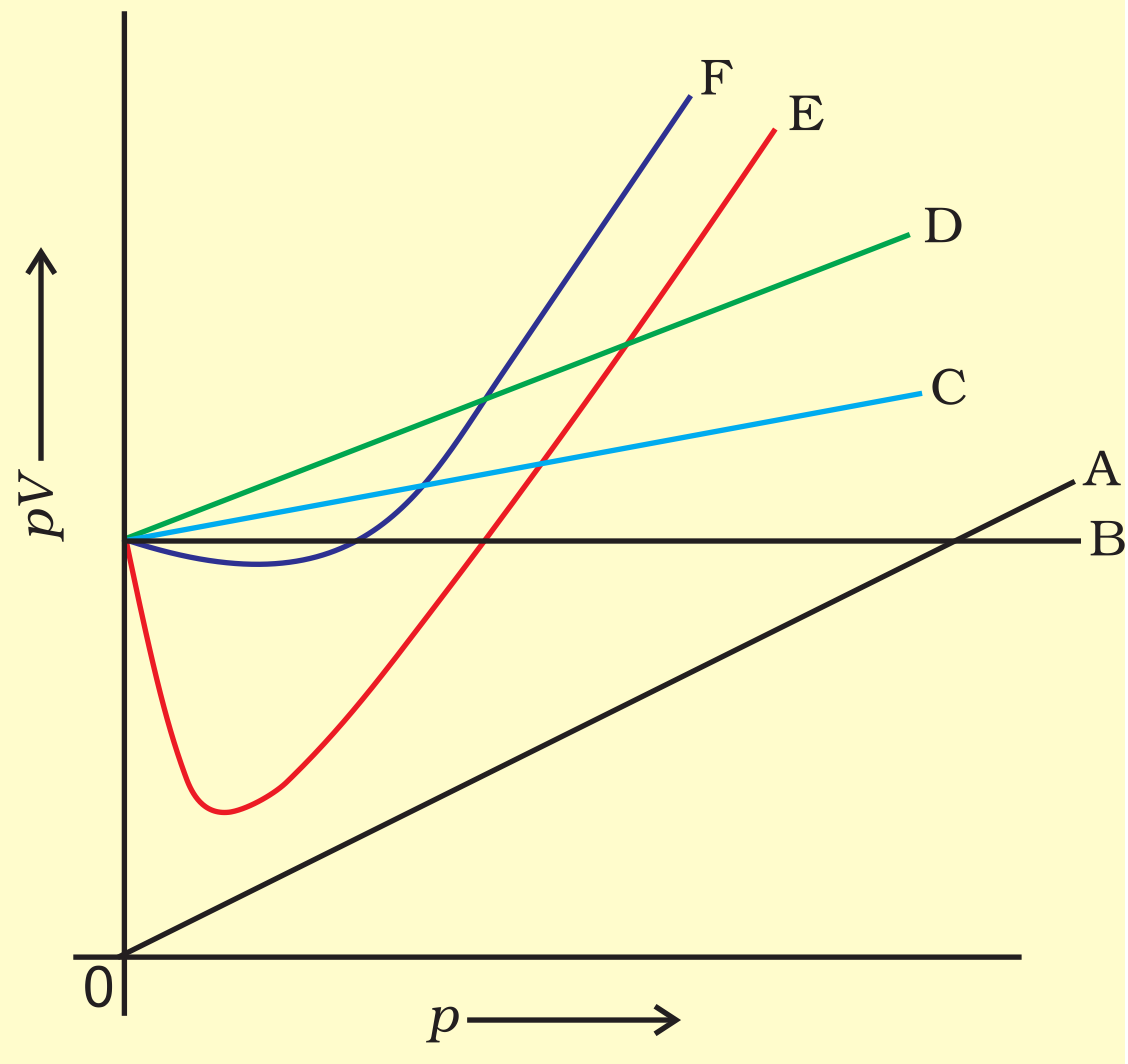
- ✓
$B$ only.
- B
$C$ and $D$ only.
- C
$E$ and $F$ only.
- D
AnswerCorrect option: A. $B$ only.
For curve $B,$ value of $\text{PV}$ is constant and for an ideal gas plot of $\text{PV}$ vs $P$ is a straight line.
View full question & answer→MCQ 931 Mark
Maximum deviation from ideal gas is expected from:
- A
$\mathrm{CH}_4$
- ✓
$\mathrm{NH}_3$
- C
$\mathrm{H}_2$
- D
AnswerCorrect option: B. $\mathrm{NH}_3$
Shows maximum deviation due to higher value of $'a\ ' \ ($intermolecular forces of attraction$)$.
View full question & answer→MCQ 941 Mark
At same temperature and pressure, equal volumes of gases contain the same number of :
AnswerAvogadro's hypothesis : All gases containing equal moles if substance occupy the same volume at the same temperature and pressure.
Hence, equal volumes of gases will have an equal number of particles that can be atoms or molecules.
View full question & answer→MCQ 951 Mark
The negative deviation from ideal behaviour means that the :
- A
Value of $\text{pV}$ decreases with decrease in pressure.
- ✓
Value of $\text{pV}$ decreases with increase in pressure.
- C
Value of $\text{pV}$ increases with increase in pressure.
- D
AnswerCorrect option: B. Value of $\text{pV}$ decreases with increase in pressure.
The negative deviation from an ideal behaviour means that the value of $\text{pV}$ decreases with increase in pressure.
View full question & answer→MCQ 961 Mark
The vapour pressure is least for?
- A
- B
$0.1m$ aqueous urea
- C
Both $a$ and $b$
- ✓
$0.3m$ aqueous urea
AnswerCorrect option: D. $0.3m$ aqueous urea
Vapour pressure decreases as content of any impurity increases in solution.
$V.P$ will be least for $0.3m$ aq.urea.
View full question & answer→MCQ 971 Mark
Consider the following figure :
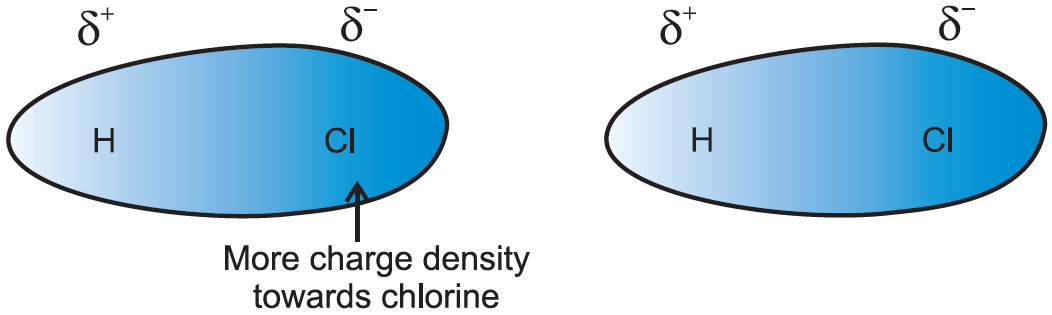
Which one of the following interactions is shown between the two $\text{HCl}$ molecules? AnswerCorrect option: A. Dipole $-$ dipole interaction.
View full question & answer→MCQ 981 Mark
What is $\ce{SI}$ unit of viscosity coefficient $(\eta )\ ?$
- A
- ✓
$Nsm^{-2}$.
- C
$km^{-2}s.$
- D
AnswerCorrect option: B. $Nsm^{-2}$.
The $\text{SI}$ unit of velocity coefficient $(\eta)$ is $N m^{-2} s$ or $ N m^{-2}$
As we know that, $\text{f}=\eta\text{A}\frac{\text{dv}}{\text{dx}}$
Where, $f =$ force
$(\eta) =$ viscosity coefficient.
$\frac{\text{dv}}{\text{dx}}=$ velocity gradient.
Substitute $\text{SI}$ units of $f = N, dx = m, A = m^2$ and $v = m s^{-1}$ in above equation,
We get,
$\eta=\frac{\text{N}\times\text{m}}{\text{m}^2\times\text{m s}^{-1}}=\text{N m}^{-2}\text{s}$
Hence, the $\text{SI}$ unit of $\eta =$ is $N s m^{-2}$.
View full question & answer→MCQ 991 Mark
The energy required to increase the surface area of the liquid by one unit is defined as :
AnswerThe energy required to increase the surface area of the liquid by one unit is called surface energy.
View full question & answer→MCQ 1001 Mark
London or dispersion force is a/ an :
- ✓
Attractive force that acts between two temporary dipoles.
- B
Attractive force that acts between two permanent dipoles.
- C
Repulsive force that acts between two permanent dipoles.
- D
AnswerCorrect option: A. Attractive force that acts between two temporary dipoles.
Force of attraction acting between two temporary dipoles is known as London force.
View full question & answer→MCQ 1011 Mark
The total energy of the gaseous molecules before and after the collision remains same because :
- ✓
Collisions of gaseous molecules are perfectly elastic.
- B
Gases are highly compressible.
- C
Both $(a)$ and $(b).$
- D
AnswerCorrect option: A. Collisions of gaseous molecules are perfectly elastic.
View full question & answer→MCQ 1021 Mark
Equal masses of $\ce{SO_2,CH_4}$ and $\ce{CH_4}$ are mixed in empty container at $298 K,$ when total pressure is $2.1$ atm. The partial pressure of $O_2$ in the mixture is :
- A
$0.5$ atm
- B
$0.75$ atm
- C
$1.5$ atm
- ✓
$1.2$ atm
AnswerCorrect option: D. $1.2$ atm
View full question & answer→MCQ 1031 Mark
Which of the following is correct?
- ✓
Van der waals radius of chlorine is bigger than nitrogen.
- B
Covalent radius of nitrogen is bigger than chlorine.
- C
Van der waals radius of chlorine is smaller than nitrogen.
- D
AnswerCorrect option: A. Van der waals radius of chlorine is bigger than nitrogen.
View full question & answer→MCQ 1041 Mark
In kinetic molecular theory, it is assumed that average kinetic energy of the gaseous molecules is directly proportional to the :
AnswerIn kinetic molecular theory, it is assumed that average kinetic energy of the gaseous molecules is directly proportional to the absolute temperature.
View full question & answer→MCQ 1051 Mark
Which of the following statements is correct?
AnswerCorrect option: C. Both $(a)$ and $(b)$ are correct.
Evaporation occurs only at the surface and it takes place at all temperatures.
View full question & answer→MCQ 1061 Mark
In van der Waals' equation of the gas law, the constant $'a'$ is a measure of :
- A
Intermolecular repulsion.
- ✓
Intermolecular attraction.
- C
Volume occupied by the molecules.
- D
AnswerCorrect option: B. Intermolecular attraction.
The value of $'a\ '$ is a measure of magnitude of intermolecular attractive forces within the gas and is independent of temperature and pressure.
View full question & answer→MCQ 1071 Mark
The gas which has higher critical temperature is :
- A
$\mathrm{H}_2$
- B
$\ce{He}$
- C
$\mathrm{N}_2$
- ✓
$\mathrm{CO}_2$
AnswerCorrect option: D. $\mathrm{CO}_2$
It has highest critical temperature due to more intermolecular force of attraction and high molar mass.
View full question & answer→MCQ 1081 Mark
Particles move randomly in $ ......... :$
AnswerParticles move randomly in a gaseous state. Here nitrogen is the only substance which is in a gaseous state.
View full question & answer→MCQ 1091 Mark
Four flasks of $1$ litre capacity each arc separately filled with gases $\mathrm{H}_2, \mathrm{He}, \mathrm{O}_2$ and $\mathrm{O}_3$. At the same temperature and pressure the ratio of the number of atoms of these gases present in different flasks would be:
- ✓
$1 : 1 : 1 : 1$
- B
$2 : 1 : 2 : 3$
- C
$1 : 2 : 1 : 3$
- D
$1 : 2 : 1 : 3$
AnswerCorrect option: A. $1 : 1 : 1 : 1$
Here in this question $4$ different types of gasses are filled in same volume of flasks i.e. all $4$ types of gasses have same number of molecules.
THe ratio of number of atoms of these gasses present in different flasks would be $= 1 : 1 : 1 : 1$
View full question & answer→MCQ 1101 Mark
The surface tension of the liquid at its boiling point :
- ✓
- B
- C
is equal to the value at room temperature
- D
AnswerThe surface tension of liquid decreases with increase in temperature.
The surface tension of a liquid become zero at its boiling point and vanishes at critical temperature.
View full question & answer→MCQ 1111 Mark
Dipole $-$ dipole forces act between the molecules possessing permanent dipole. Ends of dipoles possess 'partial charges'. The partial charge is :
- A
More than unit electronic charge
- B
Equal to unit electronic charge
- ✓
Less than unit electronic charge
- D
Less than unit electronic charge
AnswerCorrect option: C. Less than unit electronic charge
Partial charges are always less than the unit electronic charge $(1.6 \times 10^{-19}C).$
View full question & answer→MCQ 1121 Mark
Which of the following statement is not a postulate of kinetic molecular theory of gases?
AnswerCorrect option: B. $\text{K.E.}$ is dependent on pressure
Pressure does not have any effect on the kinetic energy of the molecule. Gas pressure is due to the molecules colliding to the walls of the container. the kinetic energy of the molecule directly proportional to the temperature.
View full question & answer→MCQ 1131 Mark
Vapours of a liquid can exist only at ?
- A
- ✓
below critical temperature
- C
below inversion temperature
- D
AnswerCorrect option: B. below critical temperature
At critical temperature, there will be an equilibrium between the vapors of liquid and gaseous state. The liquid starts changing to gaseous state above critical temperature. Hence, vapor of liquid exist only below critical temperature.
View full question & answer→MCQ 1141 Mark
What is $\ce{SI}$ unit of viscosity coefficient $0\ ?$
AnswerCorrect option: B. $Nsm^{-2}$
View full question & answer→MCQ 1151 Mark
Which of the following gases has the highest density under standard conditions?
AnswerCorrect option: D. $\mathrm{SO}_2$
Under Standard conditions The Compound with Highest Molecular has Highest Density $\text{(PM} = \rho \ce{RT)}$
$\mathrm{SO}_2$ has high molecular weight so it has the highest density.
View full question & answer→MCQ 1161 Mark
Dominance of strong repulsive forces among the molecules of the gas :
- A
Depends on $Z$ and indicated by $Z = 1.$
- ✓
Depends on $Z$ and indicated by $Z > 1.$
- C
Depends on $Z$ and indicated by $Z < 1.$
- D
AnswerCorrect option: B. Depends on $Z$ and indicated by $Z > 1.$
At high pressure, all the gases have $Z > 1$. These are most difficult to compress, i.e. dominance of strong repulsive forces among the molecules of the gas.
View full question & answer→MCQ 1171 Mark
Which of the following mixtures of gases does not obey Dalton's law of partial pressure?
- A
$\mathrm{O}_2$ and $\mathrm{CO}_2$
- B
$\mathrm{N}_2$ and $\mathrm{O}_2$
- C
$\mathrm{Cl}_2$ and $\mathrm{O}_3$
- ✓
$\mathrm{Cl}_2$ and $\mathrm{O}_2$
AnswerCorrect option: D. $\mathrm{Cl}_2$ and $\mathrm{O}_2$
When a mixture of $\ce{NH^3}$ and $\ce{HCl}$ react chemically with the spontaneous reaction it would lead in the formation of a chemical called $\ce{NH^4Cl}.$
By this, the volume of the gas is automatically changed and from this reaction, there is no formation of pressure.
Hence the two gases do not obey Dalton's law of partial pressure.
View full question & answer→MCQ 1181 Mark
Matter is made up of $ ........ :$
AnswerMatter is made up of by very tiny particles called as atom.
Atoms are the fundamental unit of matter.
View full question & answer→MCQ 1191 Mark
The ideal gas law was first stated by :
MCQ 1201 Mark
As the temperature increases, average kinetic energy of molecules increases. What would be the effect of increase of temperature on pressure provided the volume is constant?
AnswerAt constant volume, as the temperature is increased, pressure also increases.
View full question & answer→MCQ 1211 Mark
A gas is heated from $273K$ to $373K$ at $1$ atm pressure. If the initial volume of the gas is $10L,$ its final volume would be :
- A
$20dm^3$
- ✓
$13.66dm^3$
- C
$11dm^3$
- D
$10dm^3$
AnswerCorrect option: B. $13.66dm^3$
View full question & answer→MCQ 1221 Mark
A solution containing $30g $ of non $-$ volatile solute exactly in $90g$ of water has a vapour pressure of $2.8kPa$ at $298K$. Further $18g$ of water is then added to the solution and the new vapour pressure becomes $2.9kPa$ at $298k$ Calculate vapour pressure of water at $298K\ ?$
- A
$4.53kPa$
- ✓
$3.53kPa$
- C
$5.53kPa$
- D
$5.55kPa$
AnswerCorrect option: B. $3.53kPa$
View full question & answer→MCQ 1231 Mark
The three phases of water $($Solid, Liquid, Gas$)$ are :
AnswerThe three phases of water are ice $($present in solid state$),$ water $($present in liquid state$)$ and steam $($present in the gaseous state$).$
View full question & answer→MCQ 1241 Mark
'At constant temperature, the pressure of a fixed amount of gas varies inversely with its volume'. This law is known as :
MCQ 1251 Mark
What will be the minimum pressure required to compress $2L$ of gas at $1$ bar to $1L$ at $25^\circ C\ ?$
- A
$1$ bar
- ✓
$2$ bar
- C
$4$ bar
- D
$5$ bar
AnswerCorrect option: B. $2$ bar
View full question & answer→MCQ 1261 Mark
The ratio of the vapour pressure of a solution to the vapour pressure of the solvent is :
- ✓
Equal to the mole fraction of the solvent
- B
Equal to the mole fraction of the solute
- C
Directly proportional to mole fraction of the solute
- D
AnswerCorrect option: A. Equal to the mole fraction of the solvent
View full question & answer→MCQ 1271 Mark
Which of the following assumptions is incorrect according to kinetic theory of gases?
- A
Particles of a gas move in all possible directions in straight lines
- ✓
All the particles, at any particular time, have same speed and same kinetic energy
- C
There is no force of attraction between the particles of a gas at ordinary temperature and pressure
- D
AnswerCorrect option: B. All the particles, at any particular time, have same speed and same kinetic energy
Gases are made up of a large number of particles. They travel in a straight line until there take places a collision between them and an object $($eg: wall of the container$)$. They don't have any force of attraction with walls of the container. The average kinetic energy depends on the temperature of the gas.
View full question & answer→MCQ 1281 Mark
The pressure of a $1 : 4$ mixture of dihydrogen and dioxygen enclosed in a vessel is one atmosphere. What would be the partial pressure of dioxygen?
- A
$0.8 \times 10^5$ atm.
- B
$0.008 Nm ^{-2}$.
- ✓
$8 \times 10^4 Nm^{-2}$.
- D
AnswerCorrect option: C. $8 \times 10^4 Nm^{-2}$.
Partial pressure of $O_2 =$ mole fraction of $O_2\ \times$ total pressure of mixture.
$=\frac{4}{5}\times1\ \text{atm}=0.8\times10^5\text{Nm}^{-2}=8\times10^4\text{Nm}^{-2}$
View full question & answer→MCQ 1291 Mark
A balloon weighting $50\ kg$ is filled with $685\ kg$ of helium at $1$ atm pressure and $25^\circ C$. What will be its pay load if it displaced $5108\ kg$ of air?
- ✓
$4373\ kg$
- B
$4423\ kg$
- C
$5793\ kg$
- D
AnswerCorrect option: A. $4373\ kg$
The payload can be explained as the difference between the mass of the air displaced and that of the mass of balloon whereas mass of balloon is equal to the sum of the mass of balloon skin and mass of Helium filled in it.
Given that : $-$
Mass of air displaced $= 5108\ kg$
mass of balloon skin $= 50\ kg$
Mass of helium filled in it $= 685\ kg$
$\therefore$ Payload $= 5108 − (50 + 685)$
$= 5108 − 735$
$= 4373\ kg$
View full question & answer→MCQ 1301 Mark
The interaction energy of London force is inversely proportional to sixth power of the distance between two interacting particles but their magnitude depends upon :
- A
Charge of interacting particles.
- B
Mass of interacting particles.
- ✓
Polarisability of interacting particles.
- D
AnswerCorrect option: C. Polarisability of interacting particles.
London dispersion forces operate only over very short distance. The energy of interaction varies as
$1\ ($distance between two interacting particles$)^6$ Large or more complex are the molecules, greater is the magnitude of London forces. This is obviously due to the fact that the large electron clouds are easily distorted or polarised.
Hence, greater the polarisability of the interacting particles, greater is the magnitude of the interaction energy.
View full question & answer→MCQ 1311 Mark
If the gas particles in a rigid container slow down, what will happen to the pressure inside the container?
AnswerWhen the gas particles in a rigid container slow down, the temperature of the system also reduces
We know $\text{PKT}$
Hence pressure decreases, as the temperature reduces.
View full question & answer→MCQ 1321 Mark
At high altitudes, water boils at a lower temperature because :
- A
the atmospheric pressure is high at high altitudes
- B
the viscosity of water is reduced at high altitudes
- ✓
the atmospheric pressure is low at high altitudes
- D
AnswerCorrect option: C. the atmospheric pressure is low at high altitudes
The boiling of water depends on the atmospheric pressure at that altitude. At high altitudes, the pressure is lower, so water can not boil at $100^\circ .$
As the altitude increases, the boiling point of water reduces.
View full question & answer→MCQ 1331 Mark
Which of the following law is followed by ideal gases?
AnswerIdeal gas follows Charles Law, Boyles Law and Avogadro's Law.
Combining all, we get, $\text{PV = nRT}$ which is the ideal gas law.
View full question & answer→MCQ 1341 Mark
For which of the following reactions, is Gay Lussac's law not applicable?
- A
Formation of $\ce{HI}$ from its constituents
- B
Formation of $\ce{NH_3}$ from its constituents
- ✓
Formation of $\ce{CO_2}$ from its constituents
- D
AnswerCorrect option: C. Formation of $\ce{CO_2}$ from its constituents
Gay Lussac's law not applicable to formation of $\ce{CO_2}$ from its constituents as carbon and oxygen exist in different physical states.
View full question & answer→MCQ 1351 Mark
At same temperature and pressure equal volumes of two or more gases have the equal numbers of atoms. Above hypothesis was given by :
- A
- B
- C
Both $a$ and $b$
- ✓
Gay $-$ lussac
AnswerCorrect option: D. Gay $-$ lussac
At the same temperature and same pressure, equal volumes of gases contain equal number of atoms. This statement was given by Berzilius.
View full question & answer→MCQ 1361 Mark
If saturated vapours are compressed slowly $($temperature remains constant$)$ to half the initial volume, their pressure will :
AnswerWhen saturated vapour is compressed it's composition $($liq $-$ vapour$)$ changes which make sure that pressure remains constant. Saturated Vapour doesn't obey ideal gas law.
View full question & answer→MCQ 1371 Mark
Which of the following states of matter are called fluids?
AnswerFluids are the substances that can flow easily so gas and liquid are the states which flow easily.
View full question & answer→MCQ 1381 Mark
Dipole included dipole interations are present in which of the following pairs?
AnswerCorrect option: A. $\ce{HCl}$ and $\ce{He}$
$\ce{HCl}$ is polar $($dipole$)$ and $\ce{He}$ is non $-$ polar $($induced dipole$).$
View full question & answer→MCQ 1391 Mark
Pen, book, needle belong to which states of matter?
AnswerPen, book, needle belong to solid as they have a fixed shape and they occupy definite volume.
View full question & answer→MCQ 1401 Mark
For a non $-$ volatile solute :
- A
Vapour pressure of solution is more than vapour pressure of solvent
- B
Vapour pressure of solvent is zero
- ✓
Vapour pressure of solute is zero
- D
AnswerCorrect option: C. Vapour pressure of solute is zero
Non $-$ volatile solute always has zero vapour pressure since no vapour is form from solute.
View full question & answer→MCQ 1411 Mark
The condition of free vaporisation throughout the liquid is called :
AnswerVaporisation can occur throughout the bulk of the liquid and vapours expand freely into surroundings. The condition of free vaporisation throughout the liquid is called 'boiling'.
View full question & answer→MCQ 1421 Mark
Which statement is linked with the idea that two identical containers filled with different gases will contain the same number of particles?
AnswerAvagadro stated that when two identical containers are filled with different gases at same pressure and temperature, they contain same number of particles.
So, the statement is linked with Avagadro.
View full question & answer→MCQ 1431 Mark
The decreasing order of compressibility of states of matter is :
- ✓
Gas $ > $ solid $ > $ liquid
- B
Solid $ > $ liquid $ > $ gas
- C
Gas $ > $ liquid $ > $ solid
- D
AnswerCorrect option: A. Gas $ > $ solid $ > $ liquid
The gaseous state is the most compressible state as the particles are loosely bounded, followed by liquid and solids are the least compressible as the particles are already closely packed.
Hence the order of compressibility is : gas $ > $ liquid $ > $ solid.
View full question & answer→MCQ 1441 Mark
What is $\ce{SI}$ unit of viscosity coefficient $(\eta)$?
- A
- ✓
$Nsm^{-2}$.
- C
$km^{-2}s$.
- D
AnswerCorrect option: B. $Nsm^{-2}$.
View full question & answer→MCQ 1451 Mark
What is the effect on the pressure of a gas if its temperature is increased at constant volume?
- ✓
The pressure of the gas increases
- B
The pressure of the gas decreases
- C
The pressure of the gas remains same
- D
AnswerCorrect option: A. The pressure of the gas increases
According to Gay Lussac's law, at constant volume, the pressure of the gas is directly proportional to the temperature.
$\therefore\text{P}\propto\text{T}$
Thus, with an increase in temperature at constant volume the pressure of the gas increases.
View full question & answer→MCQ 1461 Mark
When two molecules of an ideal gas collide :
AnswerAccording to one of the postulates of kinetic gas theory, the kinetic energy of the gas molecules is not changed into any other form of energy and it remains constant before and after the collision between gas molecules.
View full question & answer→MCQ 1471 Mark
Hydrogen, oxygen and carbon dioxide are taken in containers of $2l$ volume each. Compare the ratio of the number of molecules of the three gases respectively, under same conditions of temperature and pressure :
- A
$1:8:22$
- ✓
$1:1:1$
- C
$1:16:44$
- D
$1:16:43$
AnswerCorrect option: B. $1:1:1$
Using ideal gas law : $\text{PV = nRT}$
$\text{n}=\frac{\text{V}}{\text{RT}}$
here $P, R$ and $T=$ Constant, $V = 2l$
hence number of moles also equal
the ration of moles equal to $1:1:1$
View full question & answer→MCQ 1481 Mark
How does the surface tension of a liquid vary with increase in temperature?
AnswerSurface tension of a liquid decreases with increase in temperature due to less forces of attraction between the molecules.
View full question & answer→MCQ 1491 Mark
Gases possess characteristic critical temperature which depends upon the magnitude of intermolecular forces between the particles. Following are the critical temperatures of some gases.
|
Gases
|
$\ce{H_2}$
|
$\ce{He}$
|
$\ce{O_2}$
|
$\ce{n_2}$
|
|
Critical temperature in Kelvin
|
$33.2$ |
$5.3$ |
$154.3$ |
$126$ |
From the above data what would be the order of liquefaction of these gases? Start writing the order from the gas liquefying first. - A
$\mathrm{H}_2, \mathrm{He}, \mathrm{O}_2, \mathrm{~N}_2$.
- B
$\mathrm{He}, \mathrm{O}_2, \mathrm{H}_2, \mathrm{~N}_2$.
- C
$\mathrm{N}_2, \mathrm{O}_2, \mathrm{He}, \mathrm{H}_2$.
- ✓
$\mathrm{N}_2, \mathrm{O}_2, \mathrm{He}, \mathrm{H}_2$.
AnswerCorrect option: D. $\mathrm{N}_2, \mathrm{O}_2, \mathrm{He}, \mathrm{H}_2$.
Higher the critical temperature, more easily is the gas liquefied.
Hence, order of liquefaction starting with the gas liquefying first will be : $\mathrm{N}_2, \mathrm{O}_2, \mathrm{He}, \mathrm{H}_2$.
View full question & answer→MCQ 1501 Mark
The total pressure of a mixture of two gases is equal to :
- ✓
Sum of their partial pressures
- B
The difference in partial pressures
- C
The product of partial pressures
- D
AnswerCorrect option: A. Sum of their partial pressures
The total pressure of a mixture of two gases is equal to sum of their partial pressures.
Let $\ce{P_A}$ and $\ce{P_B}$ be the partial pressures of two gases $A$ and $B$ and $\ce{P_T}$ be the total pressure of the gaseous mixture.
Then ${P_T=P_A+P_B}$
View full question & answer→MCQ 1511 Mark
The existence of the states of matter is due to $ ........ :$
- A
Necessity of defining the three states
- ✓
Variation in the characteristics particles of matter
- C
- D
AnswerCorrect option: B. Variation in the characteristics particles of matter
The existence of different states of matter is due to the variation in the characteristics of particles of matter.
Example : solids have a property like fixed shape and size whereas liquids and gases do not have fixed shape.
View full question & answer→MCQ 1521 Mark
At constant temperature, the behavior of a real gas more closely approximates that of an ideal as its volume increases due to which of the following?
- A
The average molecular kinetic energy decreases.
- B
The molecules have expanded.
- C
The average molecular speed decreases.
- ✓
AnswerAverage distance between molecules becomes greater.
View full question & answer→MCQ 1531 Mark
Vapour pressure of pure benzene is $119$ torr and of toluene is $37.0$ torr at the same temperature mole fraction of toluene in vapour phase which is in equilibrium with a solution of benzene and toluene having a mole fraction of toluene $0.50,$ will be :
- A
$0.137$
- B
$0.205$
- ✓
$0.237$
- D
$1.237$
AnswerCorrect option: C. $0.237$
View full question & answer→MCQ 1541 Mark
An ideal gas is compressed in a closed container its $U\ ?$
AnswerWhen an ideal gas is compressed in a closed container, its internal energy $\text{U}$ increases.
Compressing an ideal gas increases its temperature and its internal energy increases since $\text{U = f(t)}$ for an ideal gas.
View full question & answer→MCQ 1551 Mark
Collision frequency $(Z)$ of a gas at a particular pressure :
- A
Decreases with the rise in temperature
- ✓
Increases with the rise in temperature
- C
Decreases initially and thereafter increases
- D
AnswerCorrect option: B. Increases with the rise in temperature
Collision frequency $(Z)$ of a gas at a particular pressure Increases with the rise in temperature.
$\text{Z}\propto\text{T}\frac{3}{2}$
View full question & answer→MCQ 1561 Mark
The vapour pressure of $o-$nitrophenol at any given temperature is predicted to be:
- ✓
Higher than that of $p-$nitrophenol
- B
Lower than that of $p-$nitrophenol
- C
Same as that of $p-$nitrophenol
- D
Same as that of $p-$nitrophenol
AnswerCorrect option: A. Higher than that of $p-$nitrophenol
In $o-$ nitrophenol , there is intra$-$molecular as as well as inter$-$molecular hydrogen bonding while in $p-$nitrophenol there is only inter$-$molecular hydrogen bonding. Therefore, it is difficult to vaporize $o-$nitrophenol than $p-$nitrophenol . Hence the vapour pressure of $o-$nitrophenol is higher than that of $p-$nitrophenol.
View full question & answer→MCQ 1571 Mark
Ideal gas equation is also called equation of states because :
- A
it depends on states of matter
- ✓
it is relation between four variables and describes the state of any gas
- C
it is combination of various gas laws and any variable can be calculated
- D
it is combination of various gas laws and any variable can be calculated
AnswerCorrect option: B. it is relation between four variables and describes the state of any gas
Assuming an equilibrium state, the three properties needed to completely define the state of a system are pressure $(P),$ volume $(V),$ and temperature $(T).$ Hence, the definition: An Equation of State $\text{(EOS)}$ is a semi $-$ empirical functional relationship between pressure, volume and temperature of a pure substance. Ideal gas equation is also called equation of states because it is relation between four variables and describes the state of any gas.
View full question & answer→MCQ 1581 Mark
According to Avogadro's law the volume of a gas will $ ........ $ as $ ....... $ if $ ......... $ are held constant :
- ✓
increases, number of moles; $P$ and $T$
- B
decreases, number of moles; $P$ and $T$
- C
increases; $T$ and $P$; number of moles
- D
increases; $T$ and $P$; number of moles
AnswerCorrect option: A. increases, number of moles; $P$ and $T$
According to Avogadro's law : Equal volume of all gases at same temperature and pressure will have same no. of molecules.
OR
For a given mass of ideal gas, Volume $\alpha$ Number of moles of the gas $($if temperature and pressure are constant$).$
So, volume of the gas will increase as the number of moles if pressure $(P)$ and temperature $(T)$ are held constant.
View full question & answer→MCQ 1591 Mark
In three beakers labeled as $(A), (B)$ and $(C), 100\ mL$ of water, $100\ mL$ of $1M$ solution of glucose in water and $100\ mL$ of $0.5M$ solution of glucose in water are taken respectively and kept at same temperature.
Which of the following statements is correct?
- A
Vapour pressure in all the three beakers is same
- B
Vapour pressure of beaker $B$ is highest
- C
Vapour pressure of beaker $A$ is highest
- ✓
Vapour pressure of beaker $C$ is highest
AnswerCorrect option: D. Vapour pressure of beaker $C$ is highest
Liquid solution is formed when we dissolve a solid, liquid or gas in a particular liquid solvent. Vapour pressure of liquid solutions is defined as the pressure exerted by the vapours on the liquid solvent when kept in equilibrium and a certain temperature.
View full question & answer→MCQ 1601 Mark
Reaction of $\ce{NO}$ takes place with hydrogen if equal molar mixture of snow and hydrogen is taken at initial total pressure of $350\ mm$ of Mercury, total pressure reduces to half its value after $121$ seconds while if initial total pressure would have been $275\ mm$ it reduces to half of the 196 seconds calculate the order of reaction?
View full question & answer→MCQ 1611 Mark
Which of the following property of water can be used to explain the spherical shape of rain droplets?
AnswerDue to surface tension, the surface of the water drops is under tension and tends to take spherical shape to reduce the tension.
View full question & answer→MCQ 1621 Mark
Dipole $-$ dipole interaction is stronger than the London forces but is weaker than ion $-$ ion interaction because :
- ✓
Only partial charges are involved.
- B
Total charges are involved.
- C
Charge of more electronegative part is involve.
- D
Charge of more electronegative part is involve.
AnswerCorrect option: A. Only partial charges are involved.
It is because only partial charges are involved in dipole $-$ dipole interaction. e.g. $\ce{HCl}$ molecules.
View full question & answer→MCQ 1631 Mark
The value of the Avogadro constant is :
- A
$ 6.022 \times 10^{13} $
- B
$ 6.022 \times 10^{22}$
- ✓
$ 6.022 \times 10^{23} $
- D
$ 6.022 \times 10^{24} $
AnswerCorrect option: C. $ 6.022 \times 10^{23} $
The value of the Avogadro constant is $ 6.022 \times 10^{23} $.
It is a number of atoms or molecules or ions or particles present in one mole of a substance.
View full question & answer→MCQ 1641 Mark
All gases have the same number of moles in the same volume at constant temperature and pressure :
AnswerAccording to the Avogadro's principal, every gas have the same number of moles in the same volume at constant temperature and pressure.
View full question & answer→MCQ 1651 Mark
Which scientist discovered that the same amount of space was occupied by equal numbers of molecules of gases, irrespective of whether it was hydrogen or chlorine or fluorine?
AnswerAvogadro first discovered it.
It states that $1$ mole of any element or compound have $6.022 \times 10^{23}$ atoms or molecules present at any constant temperature and pressure.
View full question & answer→MCQ 1661 Mark
Thermal energy is directly proportional to the :
- A
- B
- ✓
Temperature of the substance.
- D
AnswerCorrect option: C. Temperature of the substance.
Thermal energy is directly proportional to the temperature of the substance.
View full question & answer→MCQ 1671 Mark
Under the same conditions, two gases have the same number of molecules. They must :
AnswerAvogadro's hypothesis : Equal volume of all gases have equal number of molecules $($not atoms$)$ at same temperature and pressures conditions.
View full question & answer→