Questions

3 Marks Question

Take a timed test

19 questions · self-marked practice — reveal the answer and mark yourself.

Question 13 Marks
Solve the inequality and represent the solution graphically on number line: 3x – 7 > 2 (x – 6) , 6 – x > 11 – 2x
Answer
We have 3x- 7 > 2 (x - 6) and 6 - x > 11 - 2x
$ \Rightarrow 3x - 7 > 2x - 12$ and 6 - x > 11 - 2x
$ \Rightarrow x > - 5$ and x > 5

View full question & answer
Question 23 Marks
Solve the inequality and represent the solution graphically on number line: 2 (x – 1) < x + 5, 3 (x + 2) > 2 – x
Answer
We have 2(x - 1) < x + 5, and 3(x + 2) > 2 - x
$ \Rightarrow 2x - 2 < x + 5$ and 3x + 6 > 2 - x
$ \Rightarrow x < 7$ and 4x > -4
$ \Rightarrow x < 7$ and x > -1

View full question & answer
Question 33 Marks
Solve the inequality and represent the solution graphically on number line: 5x + 1 > – 24, 5x – 1 < 24
Answer
Given inequalities 5x + 1 > -24 and 5x – 1 < 24
5x + 1 > -24
$\Rightarrow$ 5x > -24 – 1
$\Rightarrow$ 5x > -25
$\Rightarrow$ x > -5 ………(I)
5x – 1 < 24
$\Rightarrow$ 5x < 24 + 1
$\Rightarrow$ 5x < 25
$\Rightarrow$ x < 5 ……….(II)
From (I) and (II) we conclude that the solution of given inequalities is (-5, 5).

solution set (-5,5)

View full question & answer
Question 43 Marks
A solution is to be kept between 68°F and 77°F. What is the range of temperature in degree Celsius (C) if the Celsius / Fahrenheit (F) convension formula is given by $F = \frac{9}{5}C + 32$
Answer
It is given that 68° < F < 77°
Putting $F = \frac{9}{5}C + 32$, we have
$68^\circ < \frac{9}{5}C + 32 < 77^\circ $
$ \Rightarrow 36^\circ < \frac{{9C}}{5} < 45^\circ $$ \Rightarrow 180^\circ < 9C < 225^\circ $
$ \Rightarrow $ 20° < C < 25°
Thus the range of temperature between 20°C and 25°C
View full question & answer
Question 53 Marks
Solve the inequality and represent the solution graphically on number line: 5 (2x – 7) – 3 (2x + 3) $\le$ 0 , 2x + 19 $\le$ 6x + 47.
Answer
We have $5(2x - 7) - 3(2x + 3) \leqslant 0$ and $2x + 19 \leqslant 6x + 47$
$ \Rightarrow 10x - 35 - 6x - 9 \leqslant 0$ and $ - 4x \leqslant 28$
$ \Rightarrow 4x - 44 \leqslant 0$ and $x \geqslant - 7$
$ \Rightarrow 4x \leqslant 44$ and $x \geqslant - 7$
$ \Rightarrow x \leqslant 11$ and $x \geqslant - 7$

View full question & answer
Question 63 Marks
A man wants to cut three lengths from a single piece of board of length 91cm. The second length is to be 3cm longer than the shortest and the third length is to be twice as long as the shortest. What are the possible lengths of the shortest board if the third piece is to be at least 5cm longer than the second?
[Hint: If x is the length of the shortest board, then x , (x + 3) and 2x are the lengths of the second and third piece, respectively. Thus, x + (x + 3) + 2x $\leq$ 91 and 2x $\ge$ (x + 3) + 5].
Answer
Let the length of the shortest board be x cm
Then length of the second board = (x + 3) cm
length of the third board = 2x cm
Now $x + (x + 3) + 2x \leqslant 91$ and $2x \geqslant (x + 3) + 5$
$ \Rightarrow 4x + 3 \leqslant 91$ and $2x - (x + 3) \geqslant 5$
$ \Rightarrow 4x \leqslant 91 - 3$ and $2x - x - 3 \geqslant 5$
$ \Rightarrow 4x \leqslant 88$ and $x \geqslant 5 + 3$
$ \Rightarrow x \leqslant 22$ and $x \geqslant 8$
Thus minimum length of shortest board is 8 cm and maximum length is 22 cm.
View full question & answer
Question 73 Marks
The longest side of a triangle is 3 times the shortest side and the third side is 2 cm shorter than the longest side. If the perimeter of the triangle is at least 61 cm. Find the minimum length of the shortest side.
Answer
Let the length of the shortest side be x cm.
Then length of longest side = 3x cm
length of third side = (3x - 2)cm
Perimeter of triangle = x + 3x + 3x - 2
= (7x - 2)cm
Now $7x - 2 \geqslant 61$
$ \Rightarrow 7x \geqslant 61 + 2\Rightarrow 7x \geqslant 63 \Rightarrow x \geqslant 9$
Thus the minimum length of shortest side = 9 cm
View full question & answer
Question 83 Marks
Find all pairs of consecutive even positive integers, both of which are larger than 5 such that their sum is less than 23.
Answer
Let x and x + 2 be two consecutive even positive integers
Then x > 5 and x + x + 2 < 23
$ \Rightarrow $ x > 5 and 2x + 2 < 23
$ \Rightarrow $ x > 5 and 2 x < 23 - 2
$ \Rightarrow $ x > 5 and 2 x < 21
$ \Rightarrow $ x > 5 and $x < \frac{{21}}{2}$
$ \Rightarrow 5 < x < \frac{{21}}{2}$
$ \Rightarrow $ x = 6, 8, 10
Thus required pairs of even positive integers are (6, 8), (8, 10), and (10, 12).
View full question & answer
Question 93 Marks
Find all pairs of consecutive odd positive integers both of which are smaller than 10 such that their sum is more than 11.
Answer
Let x and x + 2 be two consecutive odd positive integers
Then x + 2 < 10 and x + x + 2 > 11.
$ \Rightarrow $ x < 8 and 2x + 2 > 11
$ \Rightarrow $ x < 8 and 2x > 9
$ \Rightarrow $ x <8 and 2x > 9
$ \Rightarrow x < 8$ and $x > \frac{9}{2}$
$ \Rightarrow \frac{9}{2} < x < 8$
$ \Rightarrow $ x = 5 and 7
Thus required pairs of odd positive integers are 5, and 7.
View full question & answer
Question 103 Marks
To receive Grade 'A', in a course, one must obtain an average of 90 marks or more in five examinations (each of 100 marks). If Sunita's marks in first four examinations are 87, 92, 94. and 95, find minimum marks that Sunita must obtain in fifth examination to get Grade 'A' in the course.
Answer
Let the marks obtained by Sunita in fifth examination be x.
Then average of five examinations $ = \frac{{87 + 92 + 94 + 95 + x}}{5}$
Now $\frac{{87 + 92 + 94 + 95 + x}}{5} \geqslant 90$ $ \Rightarrow \frac{{368 + x}}{5} \geqslant 90$
Multiplying both sides by 5, we have
$368 + x \geqslant 450 $
$\Rightarrow x \geqslant 450 - 368$
$ \Rightarrow x \geqslant 82$
Thus the minimum marks needed to be obtained by Sunita = 82.
View full question & answer
Question 113 Marks
Ravi obtained 70 and 75 marks in first two unit tests. Find the minimum marks he should get in the third test to have an average of at least 60 marks.
Answer
Let the marks obtained by Ravi in third test be x.
Then average of three tests $ = \frac{{70 + 75 + x}}{3}$
Now $\frac{{70 + 75 + x}}{3} \geqslant 60$ $ \Rightarrow \frac{{145 + x}}{3} \geqslant 60$
Multiplying both sides by 3, we have
$145 + x \geqslant 180$
$ \Rightarrow x \geqslant 180 - 145 \Rightarrow x \geqslant 35$
Thus the minimum marks needed to be obtained by Ravi = 35.
View full question & answer
Question 123 Marks
Solve the inequality and show the graph for the solution on number line: $\frac{x}{2} \geq \frac{(5 x-2)}{3}-\frac{(7 x-3)}{5}$
Answer
Here $\frac{x}{2} \geqslant \frac{{(5x - 2)}}{3} - \frac{{(7x - 3)}}{5}$
$ \Rightarrow \frac{x}{2} \geqslant \frac{{5x}}{3} - \frac{2}{3} - \frac{{7x}}{5} + \frac{3}{5}$
$ \Rightarrow \frac{{15x - 50x + 42x}}{{30}} \geqslant \frac{{ - 10 + 9}}{{15}}$
$ \Rightarrow \frac{{7x}}{{30}} \geqslant \frac{{ - 1}}{{15}}$
Multiplying both sides by 30, we have
$7x \geqslant - 2$
Dividing both sides by 7, we have
The solution set is $\left[ {\frac{{ - 2}}{7},\infty } \right)$
The representation of the solution set on the number line is

View full question & answer
Question 133 Marks
Solve the inequality and show the graph for the solution on number line: 3 (1 – x) < 2 (x + 4)
Answer
Here 3(1 - x) <2 (x + 4)
$ \Rightarrow 3 - 3x < 2x + 8$
$ \Rightarrow - 3x - 2x < 8 - 3$
$ \Rightarrow - 5x < 5$
Dividing both sides by -5, we have
x > -1
The solution set is $\left( { - 1,\infty } \right)$
The representation of the solution set on the number line is

View full question & answer
Question 143 Marks
Solve the inequality and show the graph for the solution on number line: 5x – 3 $\ge$ 3x – 5
Answer
Here $5x - 3 \geqslant 3x - 5$
$ \Rightarrow 5x - 3x \geqslant - 5 + 3$
$ \Rightarrow 2x \geqslant - 2$
Dividing both sides by 2, we have
$x \geqslant - 1$
The solution set is $\left[ { - 1,\infty } \right)$
The representation of the solution set on the number line is

View full question & answer
Question 153 Marks
Solve the inequality and show the graph for the solution on number line: 3x – 2 < 2x + 1
Answer
Here 3x - 2 < 2x + 1.
$ \Rightarrow 3x - 2x < 1 + 2$
$ \Rightarrow x < 3$
The solution set is $( - \infty ,3)$
The representation of the solution set on the number line is

View full question & answer
Question 163 Marks
A manufacturer has 600 litres of a 12% solution of acid. How many litres of a 30% acid solution must be added to it so that acid content in the resulting mixture will be more than 15% but less than 18%?
Answer
Let x liters of 30% acid solution is required to be added to the mixture.
Then Total mixture = (x + 600) litres
Therefore, 30% x + 12% of 600 > 15% of (x + 600)
& 30% x + 12% of 600 < 18% of (x + 600)
$\Rightarrow$ $\frac{30 x}{100}+\frac{12}{100}(600)>\frac{15}{100}$ (x + 600) and $\frac{30 x}{100}+\frac{12}{100}(600)<\frac{18}{100}$ (x + 600)
$\Rightarrow$30x + 7200 > 15x + 9000 and 30x + 7200 < 18x + 10800
$\Rightarrow$ 15x > 1800 and 12x < 3600
$\Rightarrow$ x > 120 and x < 300,
i.e. 120 < x < 300
Thus, the number of litres of the 30% solution of acid will have to be more than 120 litres but less than 300 litres.
View full question & answer
Question 173 Marks
In an experiment, a solution of hydrochloric acid is to be kept between 30° and 35° Celsius. What is the range of temperature in degree Fahrenheit if conversion formula is given by C = $\frac{5}{9}$ (F – 32), where C and F represent a temperature in degree Celsius and degree Fahrenheit, respectively.
Answer
It is given that 30 < C < 35.
Put, C = $\frac{5}{9}$ (F – 32), we get
30 < $\frac{5}{9}$ (F – 32) < 35,
$\Rightarrow$ $\frac{9}{5}$ $\times$ (30) < (F – 32) < $\frac{9}{5}$ $\times$ (35)
$\Rightarrow$ 54 + 32< (F – 32) + 32< 63 + 32
$\Rightarrow$ 86 < F < 95.
Thus, the required range of temperature is between 86° F and 95° F.
View full question & answer
Question 183 Marks
Solve the system of inequalities:
  1. $3x – 7 < 5 + x$
  2. $11 – 5 x \le 1$
and represent the solutions on the number line.
Answer
Given,
$3x – 7 < 5 + x ..... (1)$
$11 – 5 x \le 1 ..... (2)$
From inequality $(1),$ we have
$3x – 7 < 5 + x$
or $x < 6 ....(3)$
Also, from inequality $(2),$ we have
$11 – 5 x \le 1$
or $– 5 x \le – 10$
i.e., $x \ge 2 .....(4)$
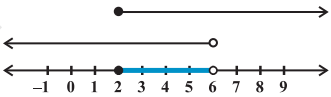
If we draw the graph of inequalities $(3)$ and $(4)$ on the number line, we see that the values of $x,$ which are common to both, are shown by a bold line in the figure.

Thus, the solution of the system are real numbers $x$ lying between $2$ and $6$ including $2,$
i.e.,
$2 \le x < 6$
View full question & answer
Question 193 Marks
Solve the following system of inequalities
  1. $8x + 3y \le 100$
  2. $x \ge 0$
  3. $y \ge 0$
Answer
Given, $8x + 3y \leq 100 ..... (1)$
We draw the graph of the line
$8x + 3y = 100$
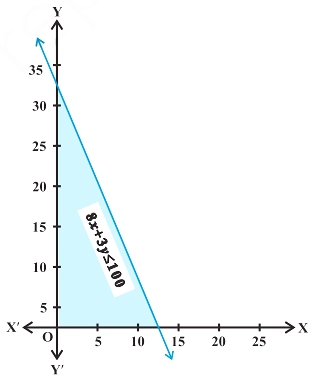
The inequality $8x + 3y ≤ 100$ represents the shaded region below the line, including the points on the line $8x +3y =100$

Since, $x \ge 0, y \ge 0,$ every point in the shaded region in the first quadrant, including the points on the line and the axes, represents the solution of the given system of inequalities.
View full question & answer