Question 11 Mark
Let $R$ be a relation from $N$ to $N$ defined by $R=\left\{(a, b): a, b \in N\right.$ and $\left.a=b^2\right\}$. Check whether, $(a, b) \in R,(b, c) \in R$ implies $(a, c) \in R$ ? Justify your answer.
AnswerWe have, $R=\left\{(a, b): a, b \in N\right.$ and $\left.a=b^2\right\}$
As we see, $(9,3) \in R,(16,4) \in R$ because $3,4,9,16 \in N$ and $9=3^2$ and $16=4^2$
Now, $9 \neq 4^2=16$; therefore, $(9,4)$ does not belong to $N$
Hence, the statement is not true.
View full question & answer→Question 21 Mark
Let $R$ be a relation from $N$ to $N$ defined by $R=\left\{(a, b): a, b \in N\right.$ and $\left.a=b^2\right\}$. Is the given statement true? $(a, b) \in R$, implies $(b, a) \in R$ ? Justify your answer.
AnswerHere we have, $R=\left\{(a, b): a, b \in N\right.$ and $\left.a=b^2\right\}$
Also $(\mathrm{a}, \mathrm{b}) \in \mathrm{R}$, implies $(b, a) \in R$
As we can see that $(4,2) \in N$ and $4=2^2=4$ but $2 \neq 4^2=16$. Hence, $(2,4)$ does not belong to $N$.
Hence, the statement is not true.
View full question & answer→Question 31 Mark
Let R be a relation from N to N defined by $\mathrm{R}=\left\{(\mathrm{a}, \mathrm{b}): \mathrm{a}, \mathrm{b} \in \mathrm{N}\right.$ and $\left.\mathrm{a}=\mathrm{b}^2\right\}$. Check whether $(a, a) \in R$ for all $a \in N$ ? Justify your answer.
AnswerWe have, $R=\left\{(a, b): a, b \in N\right.$ and $\left.a=b^2\right\}$
$(a, a) \in R$, for all $a \in N$
As we can see that $3 \in N$ but $3 \neq 3^2=9$
Hence, the statement is not true.
View full question & answer→Question 41 Mark
If A = {9, 10, 11, 12,13} and f : A $\rightarrow$ N be defined by f(n) = the highest prime factor of n, then find the range of f.
Answerf(n) = Highest prime factor of n
$\therefore$ $f(9) = 3, f(10) = 5$
$f(11 ) = 11, f(12) = 3$ and $f(13) = 13$
$\Rightarrow$ f = {$(9, 3), (10, 5), (11,11), (12, 3), (13, 13)$}
Hence, range of f = {3, 5,11,13}.
View full question & answer→Question 51 Mark
Let A = {1, 2, 3, 4}, B = {1, 5, 9, 11, 15, 16} and f = {(1, 5), (2, 9), (3, 1), (4, 5), (2,11)}. Is the given statement true? f is a function from A to B? Justify your answer.
AnswerHere it is given that: A = {1, 2, 3, 4}, B = {1, 5, 9, 11, 15, 16} and f = {(1, 5),(2, 9),(3, 1),(4, 5),(2, 11)}
Now we have, A B = {(1, 1), (1, 5), (1, 9), (1, 11), (1, 16), (2, 1), (2, 5), (2, 9), (2, 15), (2, 16), (3, 1), (3, 5), (3, 9), (3, 11), (3, 15), (3, 16), (4, 1), (4, 5),(4, 9), (4, 11), (4, 15), (4, 16)
f is a function from A to B.
f = {(1, 5),(2, 9),(3, 1),(4, 5),(2, 11)}
Since we observe that the same first element i.e. 2 corresponds to two different images that is 9 and 11. Thus f is not a function from A to B.
View full question & answer→Question 61 Mark
Let A = {1, 2, 3, 4}, B = {1, 5, 9, 11, 15, 16} and f = {(1, 5), (2, 9), (3, 1), (4, 5), (2,11)}. Is the following given statement true? f is a relation from A to B. Justify your answer.
AnswerHere it is given that: A = {1, 2, 3, 4}, B = {1, 5, 9, 11, 15, 16} and f = {(1, 5),(2, 9),(3, 1),(4, 5),(2, 11)}
Now, we have A $\times$ B = {(1, 1), (1, 5), (1, 9), (1, 11), (1, 16), (2, 1), (2, 5), (2, 9), (2, 15), (2, 16), (3, 1), (3, 5), (3, 9), (3, 11), (3, 15), (3, 16), (4, 1), (4, 5),(4, 9), (4, 11), (4, 15), (4, 16)}
Now f is a relation from A to B i.e,
f = {(1, 5), (2, 9), (3, 1), (4, 5), (2, 11)}
A relation from a non empty set A to a non empty set B is a subset of the Cartesian product A $\times$ B.
And we can see f is a subset of A $\times$ B.
Hence f is a relation from A to B statement is true.
View full question & answer→Question 71 Mark
Find the range of f(x) = x, x is a real number.
AnswerWe have, f(x) = x, where x is a real number.
It is clear that range of f(x) is set of all real numbers.
Hence, range of f(x) = R
View full question & answer→Question 81 Mark
Find the range of $f(x) = x^2 + 2, x$ is a real number.
AnswerHere we have, $f(x) = x^2+ 2, x$ is a real number.
As $x^2> 0$
$\Rightarrow x^{2}+2>0+2$
$\Rightarrow x^{2}+2>2$
$\Rightarrow f(x)>2$
Hence, range of $f(x) = [2, \infty)$
View full question & answer→Question 91 Mark
Find the range of f(x) = 2 - 3x, x $ \in $ R, x > 0.
AnswerLet $f(x) = y = 2 - 3x$ $\Rightarrow \quad x = \frac { 2 - y } { 3 }$
Now, x > 0 $\Rightarrow$ $2 - y$ > 0 $\Rightarrow$ y < 2
$\therefore$ Range (f) = {y: y $ \in $ R and $y \geq 2$} or $[ 2 , \infty )$
View full question & answer→Question 101 Mark
If the function t which maps temperature in degree Celcius into temperature in degree Fahrenheit is defined by t(C) = $\frac{9C}{5}$+ 32, then find t(0).
AnswerHere it is given that, $t(C) =$ $\frac{9 C}{5}$$+ 32$
Put C = 0, we get
$t(0) =$ $\frac{9 \times 0}{5}$ + 32 = 0 + 32 = 32
View full question & answer→Question 111 Mark
A function f is defined by f(x) = 2x –5. What is the value of f(-3)?
AnswerWe have, f(x) = 2x - 5
Putting x = -3
$\therefore f( - 3) = 2 \times - 3 - 5 = - 11$
View full question & answer→Question 121 Mark
A function f is defined by f(x) = 2x –5. What is the value of f(7)?
AnswerWe have, f(x) = 2x - 5
Putting x = 7
$\therefore f(7) = 2 \times 7 - 5 = 9$
View full question & answer→Question 131 Mark
A function f is defined by f(x) = 2x –5. What is the value of f(0)?
AnswerWe have, f(x) = 2x - 5
Putting x = 0
$\therefore $ f (0) = 2 $\times$ 0 - 5 = - 5
View full question & answer→Question 141 Mark
Find the domain and range of the real function: $\begin{equation} f(x)=\sqrt{9-x^{2}} \end{equation}$
AnswerHere the given function is: $\begin{equation} f(x)=\sqrt{9-x^{2}} \end{equation}$
Domain: These are the values of $x$ for which $f(x)$ is defined. From the given $f(x)$ we can say that, $f(x)$ should be real and for that, $9 - x^2 \geq 0 [$since a value less than $0$ will give an imaginary value$] (3 + x)(3 - x) \geq 0.$ Now there are two critical points, $x = +3$ and $x = -3$. Taking a value less than $-3$ and putting in the expression we get, $(3 - 5)(3 + 5) = -ve$ value and thus plotting these on number line we have
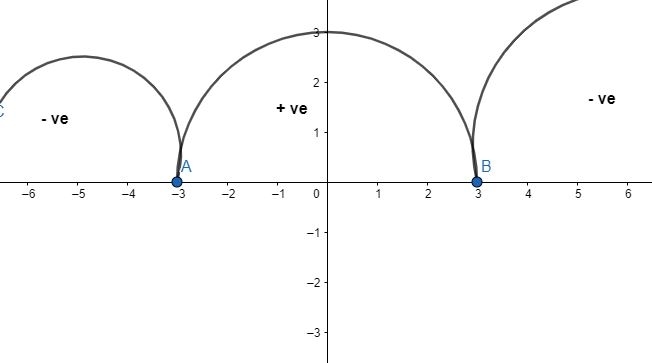
Since, $f(x)$ is defined for all real numbers that are greater than or equal to $-3$ and less than or equal to $3,$ the domain of $f(x)$ is $[-3, 3].$
Range: The values of $f(x)$ obtained by putting possible values of $x$. From the $f(x)$ we can see that, the values obtained will only be positive and can be any positive number less than $3$. Hence the range of $f(x) = [0, 3).$ View full question & answer→Question 151 Mark
Find the domain and range of the real function: $f(x) = - |x|$
AnswerHere the given function is:$ f(x) = -|x|$
As we know that,
$\begin{equation} |\mathrm{X}|=\left\{\begin{array}{l} {\mathrm{x}, \text { if } \mathrm{x} \geq 0} \\ {-\mathrm{x}, \text { if } \mathrm{x}<0} \end{array}\right. \end{equation}$
$\begin{equation} f(x)=-|x|=\left\{\begin{array}{l} {-x, \text { if } x \geq 0} \\ {x, \text { if } x<0} \end{array}\right. \end{equation}$
Domain: The values that can be put in the function to obtain real value.
For example $f(x) = x$, now we can put any value in place of $x$ and we will get a real value.
Hence, the domain of this function will be Real Numbers.
Range: The values that we obtain of the function after putting the value from the domain.
For Example: $f(x) = x + 1$,
now if we put $x = 0, f(x) = 1$ .
This $1$ is a value of Range that we obtained.
Since, $f(x)$ is defined for $x \in R$, the domain of $f$ is $R.$
It can be observed that the range of $f(x) = -|x|$ is all real numbers except positive real numbers.
Because we will always get a negative number when we put a value from a domain.
Thus, the range of function is $f(x)$ is $(-\infty, 0]$
View full question & answer→Question 161 Mark
State that the given relation is a function? Give reason. If it is a function, determine its domain and range:R= {(1, 3), (1, 5), (2, 5)}
AnswerWe have, R= {(1, 3), (1, 5), (2, 5)}
This relation is not a function because there is an element 1 which is associated to two elements 3 and 5.
View full question & answer→Question 171 Mark
State that the given relation is a function? Give reason. If it is a function, determine its domain and range. R={(2, 1), (4, 2), (6, 3), (8, 4), (10,5), (12, 6), (14, 7)}
AnswerThe given relation is,
{(2, 1), (4, 2), (6, 3), (8, 4), (10, 5), (12, 6), (14, 7)}
All values of x are distinct. Each value of x has a unique value of y.
Therefore, the relation is a function.
$\therefore $ Domain of function = {2, 4, 6, 8, 10, 12, 14}
Range of function = {1, 2, 3, 4, 5, 6, 7}
View full question & answer→Question 181 Mark
State that the given relation is a function? Give reason. If it is a function, determine its domain and range. {(2, 1), (5, 1), (8, 1), (11, 1), (14, 1), (17, 1)}
AnswerHere the given relation is:
{(2, 1), (5, 1), (8, 1), (11, 1), (14, 1), (17, 1)}
All values of x are distinct. Each value of x has a unique value of y.
So the relation is a function.
Therefore, the domain of function = {2,5, 8, 11, 14, 17}
Range of function = {1}
View full question & answer→Question 191 Mark
Let R be the relation on Z defined by R = {(a, b): $a,b \in {Z}$, a - b is an even integer. Find the domain and range of R.
AnswerHere R = {(a, b): a, b, $ \in Z$, a - b is an integer}
= {(a, b) : a, b $ \in Z$, both a and b are even or both a and b are odd}
= {(a, b): a, b $ \in Z$, (a and b are even) $ \cup $ (a and b are odd)}
$\therefore $ Domain of R = Z
Range of R = Z
View full question & answer→Question 201 Mark
Let $A=\{x, y, z\}$ and $B=\{1,2\}$. Find the number of relations from $A$ to $B$.
AnswerHere $A=\{x, y, z\}$ and $B=\{1,2\}$
Number of elements in set $A=3$
Number of elements in set $B=2$
Number of subsets of $A \times B=3 \times 2=6$
Number of relations from $A$ to $B=2^6$
View full question & answer→Question 211 Mark
Write the relation $R=\left\{\left(x, x^3\right): x\right.$ is a prime number less than 10$\}$ in roster form.
Answer$R=\left\{\left(x, x^3\right): x\right.$ is a prime number less than 10$\}$
Putting $x=2,3,5,7$
$R=\{(2,8),(3,27),(5,125),(7,343)\}$
View full question & answer→Question 221 Mark
Determine the domain and range of the relation R defined by R = {(x, x + 5): x $ \in $ (0, 1, 2, 3, 4, 5)}
AnswerHere R = {(x, x + 5): $x \in $(0, 1, 2, 3, 4, 5)}
= {(a, b): a = 0, 1, 2,3, 4, 5}
Now a = x and b = x + 5
Putting a = 0, 1, 2, 3, 4, 5 we get b = 5, 6, 7, 8, 9, 10
$\therefore $ Domain of R = {0, 1, 2, 3, 4, 5}
Range of R = {5, 6, 7, 8, 9, 10}
View full question & answer→Question 231 Mark
The figure shows a relationship between the sets P and Q. Write this relation roster form. What is its domain and range?
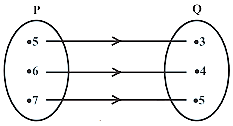
AnswerFrom the figure, the relation in roaster form is, R = {(5, 3), (6, 4), (7, 5)}
As Domain of R = set of all first elements of the order pairs in the relation.
$\Rightarrow$ Domain of R = {5, 6, 7}
Range of R = set of all second elements of the order pairs in the relation.
$\Rightarrow$ range of R = {3, 4, 5}.
View full question & answer→Question 241 Mark
The figure shows a relationship between the sets P and Q. Write this relation in the set-builder form. What is its domain and range?
Answer
The relation in set builder form is, R = {(x, y): y = x - 2; x $\in$ P}
or R = {(x, y): y = x - 2; for x = 5, 6, 7}
View full question & answer→Question 251 Mark
A = {1, 2, 3, 5} and B = {4, 6, 9}. Define a relation R from A to B by
R = {(x, y): the difference between x and y is odd, ${ x } \in A , y \in B \}$. Write R in roster form.
AnswerGiven, A = {1, 2, 3, 5} and B = {4, 6, 9}
R = {(x, y): the difference between x and y is odd, $x \in A , y \in B \}$
In roster form, R = {(1, 4), (1, 6), (2, 9), (3, 4), (3, 6), (5, 4), (5, 6)}.
View full question & answer→Question 261 Mark
Define a relation R on the set N of natural numbers by R = {(x, y): y = x + 5, x is a natural number less than 4; x, y $ \in N$]. Depict this relationship using roster from. Write down the domain and the range.
AnswerHere R = {(x, y) : y = x + 5, x is a natural number less than 4; $x,y \in N$}
Putting x = 1, 2, 3 in y = x + 5 we get y = 6, 7, 8
$\therefore $ R = {(1, 6), (2, 7), (3, 8)}
Domain = {1, 2, 3}
Range = {6, 7, 8}
View full question & answer→Question 271 Mark
Let A = {1, 2, 3, . . . 14}. Define a relation R from A to A by R = {(x, y): 3x - y = 0, where $x,y \in A$}. Write down its domain, codomain and range.
AnswerHere A = {1, 2, 3, . . . , 14}
We shall consider the ordered pairs which satisfy 3x - y = 0
They are (1, 3), (2, 6), (3, 9) and (4, 12)
Thus R = {(1, 3), (2, 6), (3, 9), (4, 12)}
$\therefore $ Domain = {1, 2, 3, 4}
Range = {3, 6, 9, 12}
Codomain = {1, 2,3, . . . , 14}
View full question & answer→Question 281 Mark
Let A and B be two sets such that n(A) = 3 and n(B) = 2. If (x, 1), (y, 2), (z, 1) are in A $\times$ B., find A and B, where x, y and z are distinct elements.
AnswerHere (x, 1) $\in$ A $\times$ B $\Rightarrow$ x $\in$ A and 1 $\in$ B
(y, 2) $\in$ A $\times$ B $\Rightarrow$ y $\in$ A and 2 $\in$ B
(z, 1) $\in$ A $\times$ B $\Rightarrow$ z $\in$ A and 1
It is given that n(A) = 3 and n(B) = 2
$\therefore $ A = {x, y, z}
and B = {1, 2}
View full question & answer→Question 291 Mark
Let A = {1, 2} and B = {3, 4}. Write $A \times B$. How many sub sets will $A \times B$ have? List them.
AnswerHere A = {1, 2} and B = {3, 4}
$\therefore A \times B = (1,2) \times (3,4\} $
= {(1, 3}, (1, 4), (2, 3), (2, 4)}
Number of elements in $A \times B = 4$
Number of subsets of $A \times B = {2^4} = 16$
The subset are:
$\phi ,${(1, 3)}, {(1, 4)}, {(2, 3)}, {(2, 4)}, {(1, 3), (1, 4)}, {(1, 3), (2, 3)}, {(1, 3), (2, 4)}, {(1,4), (2, 3)}, {(1, 4), (2, 4)}, {(2, 3), (2, 4)}, {(1, 3), (1, 4), (2, 3)}, {(1, 3), (1, 4), (2, 4)}, {(1, 3), (2, 3), (2, 4)} {(1, 4), (2, 3), (2, 4)}, {(1, 3), (1, 4), (2, 3), (2, 4)}
View full question & answer→Question 301 Mark
Let A = {1, 2}, B = {1, 2, 3, 4}, C = {5, 6} and D = {5, 6, 7, 8}. Verify that: A $\times$ C is a subset of B $\times$ D.
AnswerHere it is given that: $A=\{1,2\}, B=\{1,2,3,4\}, C=\{5,6\}\ and \ D=\{5,6,7,8\}$
To verify: A $\times$ C is a subset of B $\times$ D
(A $\times$ C) = {(1, 5),(1, 6),(2, 5),(2, 6)}
B $\times$ D = {(1, 5),(1, 6),(1, 7),(1, 8),(2, 5),(2, 5),(2, 7),(2, 8),(3, 5),(3, 6),(3, 8),(4, 5),(4, 7),(4, 8)}
As we see all the elements of set A $\times$ B are there in set B $\times$ D
Hence, A $\times$ C is a subset of B $\times$ D.
View full question & answer→Question 311 Mark
Let A = {1, 2}, B = {1, 2, 3, 4}, C = {5, 6} and D = {5, 6, 7, 8}. Verify that: A $\times$ (B $\cap$ C) = (A $\times$ B) $\cap$ (A $\times$ C)
AnswerGiven: $A=\{1,2\}, B=\{1,2,3,4\}, C=\{5,6\} \ and \ D=\{5,6,7,8\}$
To verify: $A \times(B \cap C)=(A \times B) \cap(A \times C)$
As we see, $\mathrm{B} \cap \mathrm{C}=\{1,2,3,4\} \cap\{5,6\}=\phi$
By definition if either of the two set P and Q is null set then $P \times Q$ will also be a null set. i.e. $P \times Q=\phi$
$\Rightarrow \mathrm{A} \times(\mathrm{B} \cap \mathrm{C})=\phi$ ......(i)
Now, $(A \times B)$ = {(1, 1),(1, 2),(1, 3),(1, 4),(2, 1),(2, 2),(2, 3),(2, 4)}
And $(A \times C)$ = {(1, 5),(1, 6),(2, 5),(2, 6)}
$\Rightarrow(A \times B) \cap(A \times C)=\phi$ ........(ii)
From (i) and (ii), we have
$\mathrm{A} \times(\mathrm{B} \cap \mathrm{C})=(\mathrm{A} \times \mathrm{B}) \cap(\mathrm{A} \times \mathrm{C})$
Hence proved.
View full question & answer→Question 321 Mark
If $A \times B$= {(a, x), (a, y), (b, x), (b, y)}, find A and B.
AnswerHere $A \times B$ = {(a, x), (a, y), (b, x), (b, y)}
A = set of first elements = {a, b}
B = set of second elements = {x, y}
View full question & answer→Question 331 Mark
If A = {-1, 1} find $A \times A \times A$
AnswerHere A= {-1, 1}
$A \times A$ = {(-1, -1), (-1, 1), (1, -1),(1,1)}
$\therefore A \times A \times A$= {(-1, -1, -1), (-1, -1, 1), (-1, 1, -1), (-1, 1, 1), (1, -1, -1)
(1, -1, 1), (1, 1, -1), (1, 1, 1)}
View full question & answer→Question 341 Mark
If G ={7, 8) and H = {5, 4, 2}, find $G \times H$and $H \times G$.
AnswerHere G = {7, 8} and H = {5, 4, 2}
$\therefore G \times H$= { (7, 5), (7, 4), (7, 2), (8, 5), (8, 4), (8, 2)}
and $H \times G$= {(5, 7), (5, 8), (4, 7), (4, 8), (2, 7), (2, 8)}
View full question & answer→Question 351 Mark
If the set A has 3 elements and set B = {3, 4, 5}, then find the number of elements in A $\times$ B.
AnswerSet A has 3 elements and set $B$ also has $3$ elements, $\therefore$ the number of elements in $A\times B = 3\times 3 = 9$
View full question & answer→Question 361 Mark
The Cartesian product $A \times A$ has 9 elements among which are found to be (-1, 0) and (0, 1). Find the set A and the remaining element of $A \times A$.
AnswerHere $( - 1,0) \in A \times A \Rightarrow - 1 \in A$ and $0 \in A$
(0, 1) $ \in A \times A \Rightarrow 0 \in A$ and $1 \in A$
$\therefore - 1,0,1, \in A$
It is given that $n(A \times A) = 9$ which implies that n (A) = 3
$\therefore $ A = (-1, 0, 1)
$\therefore $ $A \times A$ = {(-1, -1), (-1, 0), (-1, 1) (0, -1), (0, 0), (0, 1), (1, -1), (1, 0), (1, 1)}
So the remaining elements of $A \times A$ are
(-1, 1), (-1, 1), (0, -1), (0, 0), (1, -1), (1, 0) and (1, 1)
View full question & answer→Question 371 Mark
If $\left( \frac { x } { 3 } + 1 , y - \frac { 2 } { 3 } \right) = \left( \frac { 5 } { 3 } , \frac { 1 } { 3 } \right),$ find the values of x and y.
AnswerGiven, $\left( \frac { x } { 3 } + 1 , y - \frac { 2 } { 3 } \right) = \left( \frac { 5 } { 3 } , \frac { 1 } { 3 } \right)$
Comparing corresponding elements,
$\Rightarrow \frac { x } { 3 } + 1 = \frac { 5 } { 3 }$and $y - \frac { 2 } { 3 } = \frac { 1 } { 3 }$
$\Rightarrow \quad \frac { x } { 3 } = \frac { 5 } { 3 } - 1$and $y = \frac { 1 } { 3 } + \frac { 2 } { 3 }$
$\Rightarrow \quad \frac { x } { 3 } = \frac { 5 - 3 } { 3 }$and $y = \frac { 3 } { 3 }$
$\Rightarrow \quad \frac { x } { 3 } = \frac { 2 } { 3 }$ and $y = 1$
$\therefore$ $x = 2$ and $y = 1$
View full question & answer→Question 381 Mark
Let $A = \{1, 2\}$ and $B = \{3, 4\}$. Find the number of relations from $A$ to $B$.
AnswerGiven that, $A = \{1, 2\}$ and $B = \{3, 4\}$
We have, $A \times B = \{(1, 3), (1, 4), (2, 3), (2, 4)\}.$
Since $n (A \times B ) = 4,$ the number of subsets of $A \times B$ is $2^4.$
Therefore, the number of relations from $A$ into $B$ will be $2^4$
View full question & answer→Question 391 Mark
The fig.shows a relation between the sets P and Q. Write this relation in roster form. What is its domain and range?
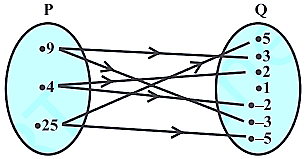
AnswerFrom the fig,we can write,
R = {(9, 3), (9, –3), (4, 2), (4, –2), (25, 5), (25, –5)}
The domain of this relation is {4, 9, 25}.
The range of this relation is {– 2, 2, –3, 3, –5, 5}
View full question & answer→Question 401 Mark
The fig.shows a relation between the sets P and Q. Write this relation in set-builder form
AnswerFrom the fig,we observe that the relation R is “x is the square of y”.
In set-builder form, R = {(x, y): x is the square of y, x $∈$ P, y $∈$ Q}
View full question & answer→Question 411 Mark
Let A = {1, 2, 3, 4, 5, 6}. Define a relation R from A to A by R = {(x, y) : y = x + 1 }. Write down the domain, codomain and range of R
AnswerWe have, R={(x,y):y=x+1}
Since A={1,2,3,4,5,6}
Therefore, R={(1,2),(2,3),(3,4),(4,5),(5,6)}
Therefore, domain ={1, 2, 3, 4, 5,}
Similarly, the range = {2, 3, 4, 5, 6} and the co-domain = {1, 2, 3, 4, 5, 6}
View full question & answer→Question 421 Mark
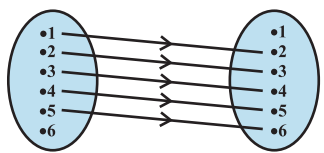
Let A = {1, 2, 3, 4, 5, 6}. Define a relation R from A to A by R = {(x, y) : y = x + 1 }. Depict this relation using an arrow diagram.
AnswerWe have,
R = {(1,2), (2,3), (3,4), (4,5), (5,6)}
The corresponding arrow diagram is shown in Fig.
View full question & answer→Question 431 Mark
If R is the set of all real numbers, what do the cartesian products R $\times$ R and R $\times$ R $\times$ R represent?
AnswerWe have, $$ R $\times$ R = {(x, y) : x, y $\in$ R}.
This represents the coordinates of all the points in two dimensional space and the cartesian product R $\times$ R $\times$ R represents the set R $\times$ R $\times$ R = {(x, y, z) : x, y, z $\in$ R} which represents the coordinates of all the points in three-dimensional space.
View full question & answer→Question 441 Mark
If P = {1, 2}, form the set P $\times$ P $\times$ P
Answer P $\times$ P $\times$ P = {(1, 1, 1), (1, 1, 2), (1, 2, 1), (1, 2, 2), (2, 1, 1), (2, 1, 2), (2, 2, 1), (2, 2, 2)}
View full question & answer→Question 451 Mark
If P = {a, b, c} and Q = {r}, form the sets P $\times$ Q and Q $\times$ P. Are these two products equal?
AnswerBy the definition of the cartesian product, P $\times$ Q = {(a, r), (b, r), (c, r)} and Q $\times$ P = {(r, a), (r, b), (r, c)}
By the definition of equality of ordered pairs, the pair (a, r) is not equal to the pair (r, a).
Therefore, we conclude that P $\times$ Q $\ne$ Q $\times$ P
However, the number of elements in each set will be the same.
View full question & answer→Question 461 Mark
Let R be a relation from Q to Q defined by R = {(a, b): a,b $∈$ Q and a – b $∈$ Z}. Show that (a, b) $∈$ R and (b, c) $∈$ R implies that (a, c) $∈$ R
Answer(a, b) and (b, c) $∈$ R implies that a – b $∈$ Z. b – c $∈$ Z.
Therefore, a – c = (a – b) + (b – c) $∈$ Z.
Hence, (a, c) $∈$ R
View full question & answer→Question 471 Mark
Let R be a relation from Q to Q defined by R = {(a, b): a,b $∈$ Q and a – b $∈$ Z}. Show that (a, b) $∈$ R implies that (b, a) $∈$ R
Answer(a, b) $∈$ R implies that a – b $∈$ Z.
So, b – a $∈$ Z. [$\because\ m\in Z \Rightarrow-m\in Z$]
Hence, (b, a) $∈$ R
View full question & answer→Question 481 Mark
Let R be a relation from Q to Q defined by R = {(a, b): a,b $∈$ Q and a – b $∈$ Z}. Show that (a, a) $∈$ R for all a $∈$ Q
AnswerWe have, a – a = 0 $∈$ Z, if follows that (a, a) $∈$ R
View full question & answer→Question 491 Mark
Let f(x) = $\sqrt x$ and g(x) = x be two functions defined over the set of non-negative real numbers. Find (f + g) (x), (f – g) (x), (fg) (x) and $\begin{equation} \left(\frac{f}{g}\right)(x) \end{equation}$.
AnswerWe have,
$(f + g) (x)=f(x)+g(x) = $$\sqrt x$ + x,
$(f – g) (x) =f(x)-g(x)= \sqrt x– x,$
$(fg) x = f(x).g(x)=$$ \sqrt{x}(x)=x^{\frac{3}{2}} $
$\left(\frac{f}{g}\right)(x)=\frac{f(x)}{g(x)}=\frac{\sqrt{x}}{x}=x^{-\frac{1}{2}}, x \neq 0 $
View full question & answer→Question 501 Mark
Let $f(x) = x^2 $ and $g(x) = 2x + 1$ be two real functions. Find $(f + g) (x), (f –g) (x), (fg) (x),$ $\begin{equation} \left(\frac{f}{g}\right)(x) \end{equation}$
AnswerWe have,
$(f + g) (x) =f(x)+g(x)= x^2 + 2x + 1,$
$(f – g) (x)=f(x)-g(x) = x^2 – 2x – 1,$
$(fg) (x)=f(x)g(x) = x^2 (2x + 1) = 2x^3 + x^2,$
$\begin{equation} \left(\frac{f}{g}\right)(x)=\frac{f(x)}{g(x)}=\frac{x^{2}}{2 x+1}, x \neq-\frac{1}{2} \end{equation}$
View full question & answer→Question 511 Mark
Tell whether the given relat is a function or not? Justify : R = {(1, 2),(2, 3),(3, 4), (4, 5), (5, 6), (6, 7)}
AnswerSince every element has one and only one image, therefore this relation is a function.
View full question & answer→Question 521 Mark
Tell whether the given relation is a function or not? Justify : R = {(2, 2),(2, 4),(3, 3), (4, 4)}
AnswerSince the same first element 2 corresponds to two different images 2 and 4, therefore, this relation is not a function.
View full question & answer→Question 531 Mark
Tell whether the given state is a function or not? Justify your answer.
R = {(2,1),(3,1), (4,2)}
AnswerR = {(2,1),(3,1), (4,2)}
Here we have, Since 2, 3, 4 are the elements of domain of R having their unique images, this relation R is a function.
View full question & answer→Question 541 Mark
If (x + 1, y – 2) = (3, 1), find the values of x and y
AnswerSince the ordered pairs are equal, the corresponding elements are equal.Then,we have,
x + 1 = 3 and y – 2 = 1
Solving we get x = 2 and y = 3
View full question & answer→