Question 12 Marks
Find the inverse relation $R^{-1}$ in the following case:
$R$ is a relation from $\{11,12,13\}$ to $(8,10,12\}$ defined by $y=x-3$.
AnswerWe have,
R is a relation from $\{11,12,13\}$ to $(8,10,12\}$ defined by $\mathrm{y}=\mathrm{x}-3$.
Now,
$y=x-3$
Putting $x=11,12,13$ we gets $y=8,9,10$ respectively.
$\Rightarrow(11,8) \in \mathrm{R},(12,9) \notin \mathrm{R}$
Thus,
$\mathrm{R}=\{(11,8),(13,10)\} $
$ \Rightarrow \mathrm{R}^{-1}=\{(8,11),(10,13)\}$
View full question & answer→Question 22 Marks
Determine the domain and range of the following relations:
$\text{R}=\{(\text{a, b}):\text{a}\in\text{N},\text{a}<5,\text{b}=4\}$
AnswerWe have,
$\text{R}=\{(\text{a, b}):\text{a}\in\text{N},\text{a}<5,\text{b}=4\}$
⇒ a = 1, 2, 3, 4 and b = 4
Thus, R = {(1, 4), (2, 4), (3, 4), (4, 4)}
Clearly, Domain(R) = {1, 2, 3, 4} and Range(R) = {4}
View full question & answer→Question 32 Marks
Define a relation $R$ on the set $N$ of natural number by $R = \{(x, y): y = x + 5\}, x$ is a natural number less than $4, \text{x, y}\in\text{N}\}$
Depict this relationship using:
- Roster form.
- An arrow diagram. Write down the domain and range or $R.$
AnswerWe have,
$R = \{(x, y): y = x + 5, x$ is a natural number less than $4, x, \text{y}\in\text{N}\}$
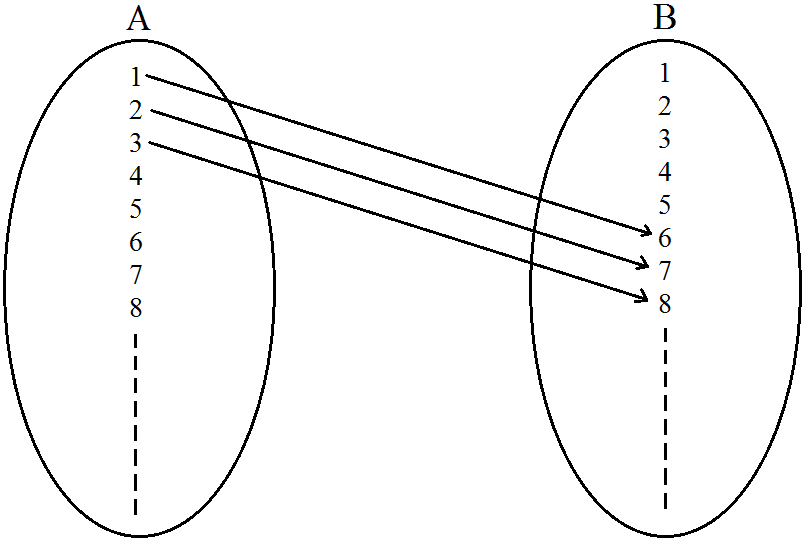
- Putting $x = 1, 2, 3$ we get $y = 6, 7, 8$ respectively.
$\therefore$ Relation $R$ in roster form is
$R = \{(1, 6), (2, 7), (3, 8)\}$
- The arrow diagram respresenting $r$ is follows:
Clearly, Domain$(R) = \{1, 2, 3\}$ and
Range$(R) = \{6, 7, 8\}$
View full question & answer→Question 42 Marks
Let $A$ be the set of first five natural numbers and let $R$ be a relation on $A$ defined as follows:
$(\text{x, y})\in\text{R}\Leftrightarrow\text{x}\leq\text{y}$
Express $R$ and $R^{-1}$ as sets of ordered pairs. Determine also:
- The domain of $R^{-1}$
- The range of $R.$
AnswerWe have,
$A = \{1, 2, 3, 4, 5\}$ $\big[\because A$ is the set of first five natural number$\big]$
It is given that $R$ be a relation on a defined as $(\text{x, y})\in\text{R}\Leftrightarrow\text{x}\leq\text{y}$
For the elements of the given sets $A$ and $A,$ we find that
$1=1,1<2,1<3,1<4,1<5,2$
$2=2,2<3,2<4,2<5$
$3=3,3<4,3<5,4=4,4<5,$ and $5=5$
$\therefore\ (1,1)\in\text{R},(1,2)\text{R}\in\text{(1,3)}\text{R}\in\text{R}(1,4)\in\text{R},(1,5)\in\text{R}$
$(2,2)\in\text{R},(2,3)\in\text{R},(2,4)\in\text{R},(2,5)\in\text{R}$
$(3,3)\in\text{R},(3,4)\in\text{R},(3,5)\in\text{R}$
$(4,5)\in\text{R}$ and $(5,5)\in\text{R}$
Thus,
$\text{R}=\big\{(1, 1), (1, 2), (1, 3), (1, 4), (1, 5),\\\ \ \ \ \ \ \ \ (2, 2), (2, 3), (2, 4),(2, 5),\\\ \ \ \ \ \ \ \ (3, 3), (3, 4), (3, 5), (4, 4), (4, 5), (5, 5)\big\}$
Also,
$\text{R}^{-1}=\big\{(1, 1), (2, 1), (3, 1), (4, 1), (5, 1), (2, 2), (3, 2),\\\ \ \ \ \ \ \ \ \ \ \ \ (4, 2), (5, 2), (3, 3), (4, 3), (5, 3), (4, 4), (5, 4), (5, 5)\big\}$
- Domain $(R-1) = \{1, 2, 3, 4, 5\}$
- Range $(R) = \{1, 2, 3, 4, 5\}$
View full question & answer→Question 52 Marks
Let R be a relation on N × N defined by:
$(\text{a, b})\text{ R }(\text{c, d})\Leftrightarrow\text{a}+\text{d}=\text{b}+\text{c}$ for all $(\text{a, b}),(\text{c, d})\in\text{N}\times\text{N}$
Show that:
$(\text{a},\text{b})\text{ R }(\text{c, d})\Rightarrow(\text{c},\text{d})\text{ R (a, b)}$ for all $\text{(a, b)(c, d)}\in\text{N}\times\text{N}$
AnswerWe have,
$(\text{a, b})\text{ R }(\text{c, d})\Leftrightarrow\text{a}+\text{d}=\text{b}+\text{c}$ for all $(\text{a, b}),(\text{c, d})\in\text{N}\times\text{N}$
Now,
(a, b) R (c, d)
⇒ a + d = b + c
⇒ c + b = d + a
⇒ (c, d) R (a, b)
View full question & answer→Question 62 Marks
Determine the domain and range of the following relations: $\text{S}=\{(\text{a, b}):\text{b}=|\text{a}-1|,\text{ a}\in\text{Z and |a|}\leq3\}$
AnswerWe have,
$\text{S}=\{(\text{a, b}):\text{b}=|\text{a}-1|,\text{ a}\in\text{Z and |a|}\leq3\}$
⇒ a = -3, -2, -1, 0, 1, 2, 3
For a = -3, -2, -1, 0, 1, 2, 3 we get
b = 4, 3, 2, 1, 0, 1, 2 respectively.
Thus, S = {(-3, 4), (-2, 3), (-1, 2), (0, 1), (2, 1), (3, 2)}
Domain(S) = {-3, -2, -1, 0, 1, 2, 3} and
Range(R) = {0, 1, 2, 3, 4}
View full question & answer→Question 72 Marks
Let R be a relation on N × N defined by:
$(\text{a, b})\text{ R }(\text{c, d})\Leftrightarrow\text{a}+\text{d}=\text{b}+\text{c}$ for all $(\text{a, b}),(\text{c, d})\in\text{N}\times\text{N}$
Show that:
$(\text{a},\text{b})\text{ R }(\text{a, b})\text{ for all }(\text{a, b})\in\text{N}\times\text{N}$
AnswerWe have,
$(\text{a, b})\text{ R }(\text{c, d})\Leftrightarrow\text{a}+\text{d}=\text{b}+\text{c}$ for all $(\text{a, b}),(\text{c, d})\in\text{N}\times\text{N}$
We have,
$\text{a}+\text{b}=\text{b}+\text{a}\ \forall\text{ a, b}\in\text{N} $
$\therefore(\text{a, b})\text{ R }(\text{a, b} )\forall\text{ a, b}\in\text{N}$
View full question & answer→Question 82 Marks
If $\text{a}\in\{2,4,6,9\}$ and $\text{b}\in\{4,6,18,27\},$ then form the set of all ordered pairs (a, b) such that a divides b and a < b.
AnswerWe have,
$\text{a}\in\{2,4,6,9\}$
and, $\text{b}\in\{4,6,18,27\}$
Now, $\frac{\text{a}}{\text{b}}$ stands for 'a divides b'. For the elements of the given sets, we find that $\frac{2}{4},\frac{2}{6},\frac{2}{18},\frac{6}{18},\frac{9}{18}$ and $\frac{9}{27}$
$\therefore$ {(2, 4), (2, 6), (2, 18), (6, 18), (9, 18), (9, 27)} are the required set of ordered pairs (a, b).
View full question & answer→Question 92 Marks
If A = {1, 2, 3}, B = {4, 5, 6}, the given following are relations from A to B? Give reason in support of your answer.
A × B.
AnswerWe have,
A = {1, 2, 3} and B = {4, 5, 6}
A × B, is a relation from A to B.
View full question & answer→Question 102 Marks
Let R be a relation from N to N defined by $\text{R}=\{(\text{a, b}):\text{a, b}\in\text{N and a}=\text{b}^2\}.$ Are the following statement true?
$(\text{a, b}):\text{R }\text{for all a}\in\text{N}$
AnswerWe have,
$\text{R}=\{(\text{a, b}):\text{a, b}\in\text{N and a}=\text{b}^2\}$
This statement is not true because $(5,5)\notin\text{R}$
View full question & answer→Question 112 Marks
If A = {1, 2, 4} and B = {1, 2, 3}, represent following sets graphically:
B × B
AnswerWe have, B = {1, 2, 4} $\therefore$ B × B = {1, 2, 3} × {1, 2, 3} = {(1, 1), (1, 2), (1, 3), (2, 1), (2, 2), (2, 3), (3, 1), (3, 2), (3, 3)} Graphical representation of B × B is as shown below: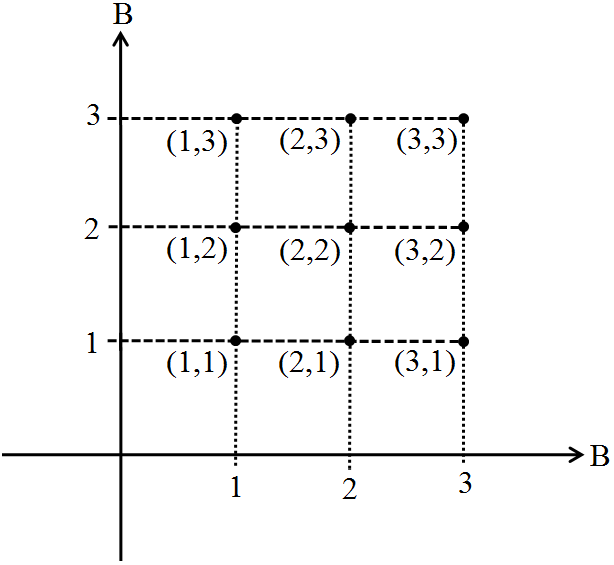
View full question & answer→Question 122 Marks
Let A = (3, 5) and B = (7, 11). Let $\text{R}=\{(\text{a, b}):\text{a}\in\text{A},\text{b}\in\text{B, a}-\text{b is odd}\}.$ Show that R is an empty relation from A into B.
AnswerWe have,
$\text{A} = \{3, 5\}, \text{ B} = \{7, 11\}$
and $\text{R}=\{(\text{a, b}):\text{a}\in\text{A},\text{b}\in\text{B, a}-\text{b is odd}\}$
For the elements of the given sets A and B, we find that
3 - 7 = -4, 3 - 11 = -8, 5 - 7 = -2 and 5 - 11 = -6
$\therefore\ (3,7)\notin\text{R},( 3,11)\not\in\text{R},(5,7)\not\in\text{R and }(5,11)\notin\text{R}$
Thus, R is an empty relation from A into B.
View full question & answer→Question 132 Marks
Let R be the relation on Z defined by:
$\text{R}=\{(\text{a, b}):\text{a},\text{b}\in\text{Z, a}-\text{b is an integer\}}$
Find the domain and range of R.
AnswerWe have,
$\text{R}=\{(\text{a, b}):\text{a},\text{b}\in\text{Z, a}-\text{b is an integer\}}$
Clearly, Domain(R) = z,
Range(R) = z
View full question & answer→Question 142 Marks
Let $R$ be a relation in $N$ defined by $\text{x, y}\in\text{R}\Leftrightarrow\text{x}+2\text{y}=8.$ Express $R$ and $R^{−1}$ as sets of ordered pairs.
AnswerWe have,
$\text{x, y}\in\text{R}\Leftrightarrow\text{x}+2\text{y}=8$
Now,
$x + 2y = 8$
$\Rightarrow x = 8 - 2y$
Putting $y = 1, 2, 3$, we get $x = 6, 4, 2$ respectively.
For $y = 4,$ we get $\text{x}=0\notin\text{N}$
Also, for $y > 4, \text{x}\notin\text{N}$
$\therefore R = \{(6, 1), (4, 2), (2, 3)\}$
Thus,
$R^{-1} = \{(1, 6), (2, 4), (3, 2)\}$
$\Rightarrow R^{-1} = \{(3, 2), (2, 4), (1, 6)\}$
View full question & answer→Question 152 Marks
For the relation $R_1$ defined on $R$ by the rule $(\text{a, b})\in\text{R}_1\Leftrightarrow1+\text{ab}>0$
Prove that, $(\text{a, b})\in\text{R}_1$ and $(\text{a},\text{b})\in\text{R}_1$ and $(\text{b},\text{c})\in\text{R}_1\Rightarrow(\text{a, c})\in\text{R}_1$ is not true for all $\text{a, b, c}\in\text{R}$
AnswerLet $\Big(1,\frac{-1}{2}\Big)\in\text{R}_1$ and $\Big(\frac{-1}{2},-4\Big)\in\text{R}_1$
$\Rightarrow1+1\times\frac{-1}{2}>0$ and $1+\Big(\frac{-1}{2}\Big)-4>0$
But, $1+1\times(-4)=1-4$
$=-3<0$
So, $(1,-4)\notin\text{R}_1$
View full question & answer→Question 162 Marks
Let A = {1, 2, 3, ......., 14}. Define a relation on a set A by
$\text{R}=\text{(x, y)} : 3\text{x}= 0, \text{where x, y} ∈ \text{A}$
Depict this relationship using an arrow diagram. Write down its domain, co-domain and range.
AnswerWe have, 3x - y = 0 ⇒ 3x = y ⇒ y = 3x Putting x = 1, 2, 3, 4 we get y = 3, 6, 9, 12 respectively. For x > 4, we get y > 14 which does not belong to set A. $\therefore$ R = {(1, 3), (2, 6), (3, 9), (4, 12)} The arrow diagram representing R is as follows: Clearly, Domain(R) = {1, 2, 3, 4} Co-domain(R) = {1, 2, 3, 4, ....., 14} and Range(R) = {3, 6, 9, 12}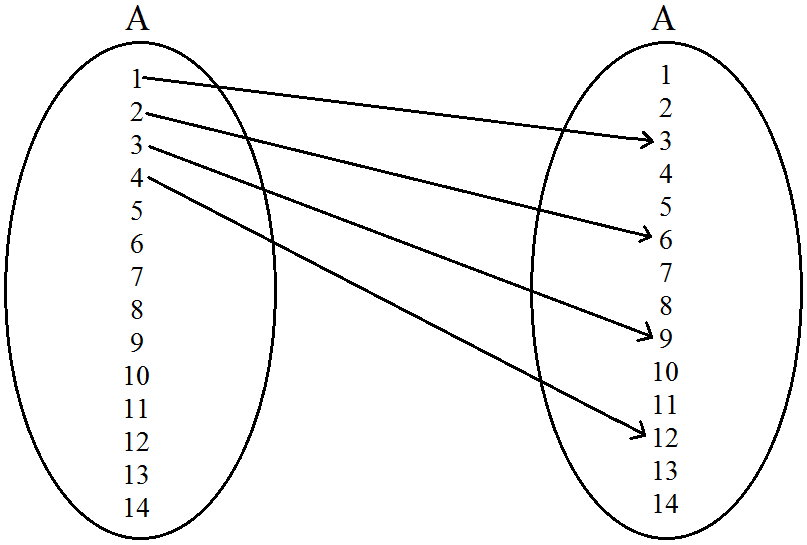
View full question & answer→Question 172 Marks
Find the inverse relation $R^{-1}$ in the following case:
$\text{R}=\{(\text{x, y}):\text{x},\text{ y}\in\text{N},\text{ x}+2\text{y}=8\}$
AnswerWe have,
$\text{R}=\{(\text{x, y}):\text{x},\text{ y}\in\text{N},\text{ x}+2\text{y}=8\}$
Now,
$x + 2y = 8$
$⇒ x = 8 - 2y$
Putting $y = 1, 2, 3$ we get $x = 6, 4, 2$ respectively.
For $y = 4,$ we get $\text{x}=0\notin\text{N}$ Also for $\text{y}>4,\text{ x}\notin\text{N}$
$\therefore\ \text{R}=\{(6,1),(4,2),(2,3)\}$
Thus,
$\text{R}^{-1}=\{(1,6),(2,4),(3,2)\}$
$\Rightarrow\text{R}^{-1}=\{(3,2),(2,4),(1,6)\}$
View full question & answer→Question 182 Marks
Let A and B be two sets such that n(A) = 3 and n(B) = 2. If (x, 1), (y, 2), (z, 1) are in A × B, find A and B, where x, y, z are distinct elements.
AnswerSince (x, 1), (y, 2), (z, 1) are elements of A × B. Therefore, $\text{x},\text{y},\text{z}\in\text{A}$ and $1,2\in\text{B}$
It is given that n(A) = 3 and n(B) = 2
$\therefore\ \text{x},\text{y},\text{z}\in\text{A}$ and n(A) = 3
$\Rightarrow\text{A}=\{\text{x},\text{y},\text{z}\}$
$1,2\in\text{B}$ and n(B) = 2
⇒ B = {1, 2}
View full question & answer→