Question 14 Marks
Each side of an equilateral triangle is $24 \mathrm{~cm}$. The mid-point of its sides are joined to form another triangle. This process is going continuously infinite.
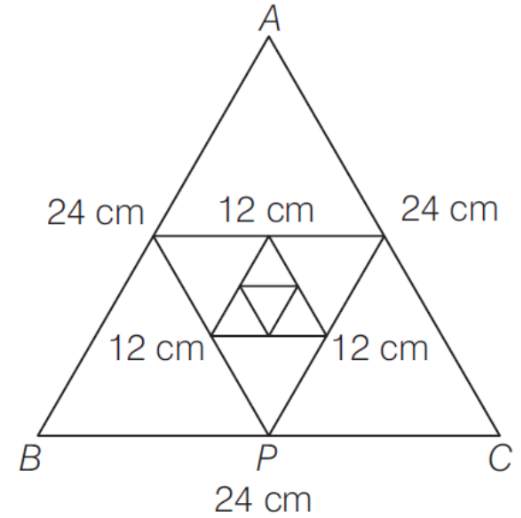
Based on above information, answer the following questions.
(i) The side of the 5th triangle is (in $\mathrm{cm}$)
(a) 3 (b) 6 (c) 1.5 (d) 0.75
(ii) The sum of perimeter of first 6 triangle is (in $\mathrm{cm}$)
(a) $\frac{569}{4}$ (b) $\frac{567}{4}$ (c) 120 (d) 144
(iii) The area of all the triangle is (in sq $\mathrm{cm}$ )
(a) 576 (b) $192 \sqrt{3}$ (c) $144 \sqrt{3}$ (d) $169 \sqrt{3}$
(iv) The sum of perimeter of all triangle is (in $\mathrm{cm}$ )
(a) 144 (b) 169 (c) 400 (d) 625
(v) The perimeter of 7 th triangle is (in $\mathrm{cm}$ )
(a) $\frac{7}{8}$ (b) $\frac{9}{8}$ (c) $\frac{5}{8}$ (d) $\frac{3}{4}$
Based on above information, answer the following questions.
(i) The side of the 5th triangle is (in $\mathrm{cm}$)
(a) 3 (b) 6 (c) 1.5 (d) 0.75
(ii) The sum of perimeter of first 6 triangle is (in $\mathrm{cm}$)
(a) $\frac{569}{4}$ (b) $\frac{567}{4}$ (c) 120 (d) 144
(iii) The area of all the triangle is (in sq $\mathrm{cm}$ )
(a) 576 (b) $192 \sqrt{3}$ (c) $144 \sqrt{3}$ (d) $169 \sqrt{3}$
(iv) The sum of perimeter of all triangle is (in $\mathrm{cm}$ )
(a) 144 (b) 169 (c) 400 (d) 625
(v) The perimeter of 7 th triangle is (in $\mathrm{cm}$ )
(a) $\frac{7}{8}$ (b) $\frac{9}{8}$ (c) $\frac{5}{8}$ (d) $\frac{3}{4}$
Answer
View full question & answer→(i) Side of first triangle is 24 .
Side of second triangle is $\frac{24}{2}=12$
Similarly, side of second triangle is $\frac{12}{2}=6$
$
\therefore a=24, r=\frac{12}{24}=\frac{1}{2}
$
$\therefore$ Side of the fifth triangle,
$\begin{aligned} a_5 & =a r^4=24 \times\left(\frac{1}{2}\right)^4 \\ & =\frac{24}{16}=\frac{3}{2}=1.5 \mathrm{~cm}\end{aligned}$
(ii) $\begin{aligned} & =\frac{72\left(1-\left(\frac{1}{2}\right)^6\right)}{1-\frac{1}{2}}=\frac{72 \times 63 \times 2}{2^6} \\ & =\frac{567}{4} \mathrm{~cm}\end{aligned}$
(iii) Area of first triangle is $\frac{\sqrt{3}}{4}(24)^2$
Area of second triangle $=\frac{\sqrt{3}}{4}\left(\frac{24}{2}\right)^2$ $=\frac{\sqrt{3}}{4}(24)^2 \times \frac{1}{4}$
$
\therefore a=\frac{\sqrt{3}}{4}(24)^2, r=\frac{1}{4}
$
$\therefore$ Sum of area of all triangles
$
\begin{aligned}
& =\frac{a}{1-r}=\frac{\sqrt{3}}{4} \frac{(24)^2}{1-\frac{1}{4}} \\
& =\frac{\sqrt{3} \times(24)^2}{3}=192 \sqrt{3} \mathrm{~cm}^2
\end{aligned}
$
(iv) The sum of perimeter of all triangle $3(24+12+6+\cdots)$ is
$
3\left(\frac{24}{1-\frac{1}{2}}\right)=144 \mathrm{~cm}\left[\because a=24, r=\frac{1}{2}\right]
$
(v) Here, $a=72, r=\frac{1}{2}$
$
\begin{aligned}
a_7 & =(72)\left(\frac{1}{2}\right)^6 \\
& =\frac{72}{64}=\frac{9}{8} \mathrm{~cm}
\end{aligned}
$
Side of second triangle is $\frac{24}{2}=12$
Similarly, side of second triangle is $\frac{12}{2}=6$
$
\therefore a=24, r=\frac{12}{24}=\frac{1}{2}
$
$\therefore$ Side of the fifth triangle,
$\begin{aligned} a_5 & =a r^4=24 \times\left(\frac{1}{2}\right)^4 \\ & =\frac{24}{16}=\frac{3}{2}=1.5 \mathrm{~cm}\end{aligned}$
(ii) $\begin{aligned} & =\frac{72\left(1-\left(\frac{1}{2}\right)^6\right)}{1-\frac{1}{2}}=\frac{72 \times 63 \times 2}{2^6} \\ & =\frac{567}{4} \mathrm{~cm}\end{aligned}$
(iii) Area of first triangle is $\frac{\sqrt{3}}{4}(24)^2$
Area of second triangle $=\frac{\sqrt{3}}{4}\left(\frac{24}{2}\right)^2$ $=\frac{\sqrt{3}}{4}(24)^2 \times \frac{1}{4}$
$
\therefore a=\frac{\sqrt{3}}{4}(24)^2, r=\frac{1}{4}
$
$\therefore$ Sum of area of all triangles
$
\begin{aligned}
& =\frac{a}{1-r}=\frac{\sqrt{3}}{4} \frac{(24)^2}{1-\frac{1}{4}} \\
& =\frac{\sqrt{3} \times(24)^2}{3}=192 \sqrt{3} \mathrm{~cm}^2
\end{aligned}
$
(iv) The sum of perimeter of all triangle $3(24+12+6+\cdots)$ is
$
3\left(\frac{24}{1-\frac{1}{2}}\right)=144 \mathrm{~cm}\left[\because a=24, r=\frac{1}{2}\right]
$
(v) Here, $a=72, r=\frac{1}{2}$
$
\begin{aligned}
a_7 & =(72)\left(\frac{1}{2}\right)^6 \\
& =\frac{72}{64}=\frac{9}{8} \mathrm{~cm}
\end{aligned}
$