Questions

2 Marks Questions

Take a timed test

18 questions · self-marked practice — reveal the answer and mark yourself.

Question 12 Marks
Is it true that for any sets A and B, $P(A) \cup P(B) = P(A \cup B)?$Justify your answer.
Answer
No, it is not true.
Take A = {1, 2} ad B = {2, 3}
Then $A \cup B = \{ 1,2,3\} $
$P(A) = \{ \phi ,\{ 1\} ,\{ 2\} ,\{ 1,2\} \}$
$P(B) = \{ \phi ,\{ 2\} ,\{ 3\} ,\{ 2,3\} \}$
$\therefore P(A) \cup P(B) = \{ \phi ,\{ 1\} ,\{ 2\} ,\{ 3\} ,\{ 1,2\} ,\{ 2,3\} \} $ . . (i)
$A \cup B = \{ 1,2,3\}$

$P(A \cup B) = \{ \phi \}$,{1}, {2}, {3}, {1, 2}, {2, 3}, {1, 3}, {1, 2, 3}} . . . (ii)
From (i) and (ii), we have
$P(A \cup B) \ne P(A) \cup P(B)$
View full question & answer
Question 22 Marks
Assume that P(A) = P(B) show that A = B.
Answer
Let $X \in A \Rightarrow \{ x\} \in P(A)$
$\Rightarrow \{ x\} \in P(B)\,[\because P(A) = P(B)]$
$\Rightarrow X \notin B$
$\therefore A \subset B$. . . (i)
Let $X \in B \Rightarrow \{ x\} \in P(B)$
$\Rightarrow \{ X\} \in P(A)\,[\because \,P(A) = P(B)]$
$ \Rightarrow X \in A$. . . (ii)
$\therefore B \subset A$
From (i) and (ii) we have A = B
View full question & answer
Question 32 Marks
Let A, B and C be the sets such that $A \cup B = A \cup C$ and $A \cap B = A \cap C$ Show that B = C.
Answer
We know that $A = A \cap (A \cup B)$ and $A = A \cup (A \cap B)$
Now $A \cap B = A \cap C$ and $A \cup B = A \cup C$
$\therefore B = B \cup (B \cap A) = B \cup (A \cap B) = B \cup (A \cap C)$$[\because \,A \cap B = A \cap C]$
$ = (B \cup A) \cap (B \cup C)$ (By distributive law)
$ = (A \cup C) \cap (B \cup C)$
$ = (A \cup C) \cap (B \cup C)$ $[\because \,A \cup B = A \cup C]$
$ = (C \cup A) \cap (C \cup B)$
$= C \cup (A \cap B)$ (by distributive law)
$ = C \cup (A \cap C)$ $[\because \,A \cap B = A \cap C]$
$ = C \cup (C \cap A) = C$
Hence B = C.
View full question & answer
Question 42 Marks
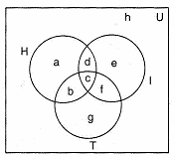
In a survey of 60 people, it was found that 25 people read newspaper H, 26 read newspaper T, 26 read newspaper I, 9 read both H and I, 11 read both H and T, 8 read both T and I, 3 read all three newspapers.
Find the number of people who read exactly one newspaper.
Answer
Here
n(U) = a + b + c + d + e + f + g + h = 60 ....(i)
n(H) = a + b + c +d = 25 ....(ii)
n(T) = b + c + f + g = 26 .....(iii)
n(I) = c + d + e + f = 26 ....(iv)
$n(H \cap I) $ = c + d = 9 ....(v)
$n(H \cap T) $= b + c = 11 .....(vi)
$n(T \cap I) $ = c + f = 8 .....(vii)
$n(H \cap T \cap I) $ = c = 3 ....(viii)

Putting value of c in (vii),
3 + f = 8 $\Rightarrow$ f = 5
Putting value of c in (vi),
3 + b = 11 $\Rightarrow$ b = 8
Putting values of c in (v),
3 + d = 9 $\Rightarrow$ d = 6
Putting value of c, d, f in (iv),
3 + 6 + e + 5 = 26 $\Rightarrow$ e = 26 - 14= 12
Putting value of b, c, f in (iii),
8 + 3 + 5 + g = 26 $\Rightarrow$ g = 26 - 16= 10
Putting value of b, c, d in (ii)
a + 8 + 3 + 6 = 25 $\Rightarrow$ a = 25 - 17 = 8
Number of people who read exactly one newspapers
= a + e + g
= 8 + 12 + 10 = 30
View full question & answer
Question 52 Marks
In a survey of 60 people, it was found that 25 people read newspaper H, 26 read newspaper T, 26 read newspaper I, 9 read both H and I, 11 read both H and T, 8 read both T and I, 3 read all three newspapers.
Find the number of people who read at least one of the newspaper.
Answer
Here
n(U) = a + b + c + d + e + f + g + h = 60 ....(i)
n (H) = a + b + c +d = 25 ....(ii)
n(T) = b + c + f + g = 26 .....(iii)
n(I) = c + d + e + f = 26 ....(iv)
$n(H \cap I) $ = c + d = 9 .....(v)
$n(H \cap T) $ = b + c = 11 .....(vi)
$n(T \cap I) $ = c + f = 8 ....(vii)
$n(H \cap T \cap I) $ = c = 3 ....(viii)

Putting value of c in (vii),
3 + f = 8 $\Rightarrow$ f = 5
Putting value of c in (vi),
3 + b = 11 $\Rightarrow$ b = 8
Putting values of c in (v),
3 + d = 9 $\Rightarrow$ d = 6
Putting value of c, d, f in (iv),
3 + 6 + e + 5 = 26 $\Rightarrow$ e = 26 - 14 = 12
Putting value of b, c, f in (iii),
8 + 3 + 5 + g = 26 $\Rightarrow$ g = 26 - 16 = 10
Putting value of b, c, d in (ii)
a + 8 + 3 + 6 = 25 $\Rightarrow$ a = 25 - 17 = 8
Number of people who read at least one of the three newspapers
= a + b + c + d + e + f + g
= 8 + 8 + 3 + 6 + 12 + 5 + 10 = 52
View full question & answer
Question 62 Marks
In a group of students, 100 students know Hindi, 50 know English and 25 know both. Each of the students knows either Hindi or English. How many students are there in the group?
Answer
Let H be the set of students who know Hindi and E be the set of students who know English.
Here n(H) = 100, n(E) = 50 and $n(H \cap E) = 25$
We know that $n(H \cup E) = n(H) + n(E) - n(H \cap E)$
= 100 + 50 - 25 = 125.
View full question & answer
Question 72 Marks
In a survey of 600 students in a school, 150 students were found to be taking tea and 225 taking coffee, 100 were taking both tea and coffee. Find how many students were taking neither tea nor coffee.
Answer
Let T be the set of students who like tea and C be the set of students who like coffee.
Here n(T) = 150, m (C) = 225 and $n(C \cap T) = 100$
We know that $n(C \cup T) = n(C) + n(T) - n(C \cap T)$
= 150 + 225 - 100 = 275
$\therefore$Number of students taking either tea or coffee += 275
$\therefore$Number of students taking neither tea nor coffee = 600 - 275 = 325
View full question & answer
Question 82 Marks
Find sets A, B and C such that $A \cap B,B \cap C$ and $A \cap C$ are non-empty sets and $A \cap B \cap C = \phi $
Answer
Take A = {1, 2} B = {1, 4} and C = {2, 4}
Now $A \cap B = \{ 1\} \ne \phi$
$B \cap C = \{ 4\} \ne \phi$
$A \cap C = \{ 2\} \ne \phi$
But $A \cap B \cap C = \phi$
View full question & answer
Question 92 Marks
If U = {1, 2, 3, 4, 5, 6, 7, 8, 9}, A = {2, 4, 6, 8} and B= {2, 3, 5, 7}, verify that: (A $\cap$ B)' = A' $\cup$ B'.
Answer
Here U = {1, 2, 3, 4, 5, 6, 7, 8, 9}
A = {2, 4, 6, 8} and B = {2, 3, 5, 7}
$A \cap B $ = {2, 4, 6, 8} $\cap$ {2, 3, 5, 7}
= {2}
$(A \cap B)' = U - (A \cap B) $ = {1, 2, 3, 4, 5, 6, 7, 8, 9} - {2}
= {1, 3, 4, 5, 6, 7, 8, 9} . . . (i)
A' = U - A = {1, 2, 3, 4, 5, 6, 7, 8, 9} - {2, 4, 6, 8}
= {1, 3, 5, 7, 8}
B' = U - B = {1, 2, 3, 4, 5, 6, 7, 8, 9} - {2, 3, 5, 7}
= {1, 4, 6, 8, 9}
$A' \cup B'$ = {1, 3, 5, 7, 9} $\cup$ {1, 4, 6, 8, 9}
= {1, 3, 4, 5, 6, 7, 8, 9} . . . (ii)
From (i) and (ii) we have
$(A \cap B)' = A' \cup B'$
View full question & answer
Question 102 Marks
If U = {1, 2, 3, 4, 5, 6, 7, 8, 9}, A = {2, 4, 6, 8} and B= {2, 3, 5, 7}, verify that: (A $\cup$ B)' = A' $\cap$ B'
Answer
Here U = {1, 2, 3, 4, 5, 6, 7, 8, 9}
A = {2, 4, 6, 8} and B = {2, 3, 5, 7}
$A \cup B $ = {2, 4, 6, 8} $\cup$ {2, 3, 5, 7}
= {2, 3, 4, 5, 6, 7,8}
$\therefore (A \cup B)' = U - (A \cup B)$= {1,2, 3, 4, 5, 6, 7, 8, 9} - {2, 3, 4, 5, 6, 7, 8}
= {1, 9} . . . (i)
A' = U - A = {1, 2, 3, 4, 5, 6, 7, 8, 9} - {2, 4, 6, 8}
= {1, 3, 5, 7, 9}
B' = U - B = {1, 2, 3, 4, 5, 6, 7, 8, 9} - {2, 3, 5, 7}
= {1, 4, 6, 8, 9}
$A' \cap B' $ = {1, 3, 5, 7, 9} $\cap$ {1, 4, 6, 8, 9} = {1, 9} ....(ii)
From (i) and (ii), we have
$(A \cup B)' = A' \cap B'$
View full question & answer
Question 112 Marks
Find the pairs of equal sets, if any, give reasons: $A = {0}, B = \{x : x > 15$ and $x < 5\}, C = \{x : x – 5 = 0\}, D = \{x: x^2 = 25\}, E =\{x : x$ is an integral positive root of the equation $x^2 – 2x –15 = 0\}$
Answer
Since $0 \in A$ and $0$ does not belong to any of the sets $B, C, D$ and $E, $ Therefore, $A \ne B, A \ne C, A \ne D, A \ne E.$
Since $B = \phi$ but none of the other sets are empty. Therefore $B \ne C, B \ne D$ and $B \ne E.$
Also $C = \{5\} but –5 \in D,$ hence $C \ne D.$
Since $E = \{5\}, C = E$. Further, $D = \{–5, 5\}$ and $E = \{5\},$ we find that, $D \ne E.$
Therefore, the only pair of equal sets is $C$ and $E.$
View full question & answer
Question 122 Marks
For sets A and B, show that: $P(A \cap B) = P(A) \cap P(B)$
Answer
Let $x \in P(A \cap B)$
$\Rightarrow x \subset (A \cap B)$
$\Rightarrow x \subset A$ and $x \subset B$
$\Rightarrow x \in P(A)$ and $x \in P(B)$
$\Rightarrow x \in P(A) \cap P(B)$
$\Rightarrow x \subset P(A) \cap P(B)$
$\therefore P(A \cap B) \subset P(A) \cap P(B)$. . . (i)
Let $x \in P(A) \cap P(B)$
$\Rightarrow x \in P(A)$ and $x \in P(B)$
$ \Rightarrow x \subset A$ and $\Rightarrow x \subset B$
$\Rightarrow x \subset A \cap B$
$ \Rightarrow x \subset P(A \cap B)$
$\therefore P(A) \cap P(B) \subset P(A \cap B)$. . . . (ii)
From (i) and (ii), we have
$P(A \cup B) = P(A) \cap P(B)$
View full question & answer
Question 132 Marks
Show that the set of letters needed to spell CATARACT and the set of letters needed to spell TRACT are equal.
Answer
The set formed by distinct letters of the word CATARACT are {A, C, R, T}
The set formed by distinct letters of the word TRACT are {A, C, R, T}
As we see, the set of letters to spell CATARACT is same to the set of letters to spell TRACT, we can say the two sets are equal.
View full question & answer
Question 142 Marks
In a school, there are 20 teachers who teach mathematics or physics. Of these, 12 teach mathematics and 4 teach physics and mathematics. How many teach physics?
Answer
Let n(P) denote the number of teachers who teach Physics and n(M) denote the number of teachers who teach mathematics.
We have,
n(P$\cup $M) = 20, n(M) = 12 and n(P$\cap$M) = 4
To find : n(P)
We know that
n(P$\cup $M) = n(P) + n(M) - n(P$\cap$M)
$\Rightarrow$ 20 = n(P) + 12 - 4
$\Rightarrow$ 20 = n(P) + 8
$\Rightarrow$ n(P) = 20 - 8
= 12
$\therefore$ 12 teachers teach Physics.
View full question & answer
Question 152 Marks
If X and Y are two sets such that X $\cup$ Y has 50 elements, X has 28 elements, and Y has 32 elements, how many elements does X $\cap$ Y have?
Answer
Here,
n (X $\cup$ Y) = 50, n (X) = 28, n (Y) = 32,
n (X $\cap$ Y) = ?
By using the formula,we have
n (X $\cup$ Y) = n (X) + n (Y) – n (X $\cap$ Y),
we find that
n (X $\cap$ Y) = n (X) + n (Y) – n (X $\cup$ Y)
= 28 + 32 – 50 = 10
View full question & answer
Question 162 Marks
Let U = {1, 2, 3, 4, 5, 6}, A = {2, 3} and B = {3, 4, 5}. Find A′, B′ , A′ $\cap$ B′, A $\cup$ B and hence show that (A $\cup$ B)′ = A′ $\cap$ B′
Answer
Clearly A′ = {1, 4, 5, 6}, B′ = { 1, 2, 6 }. Therefore, A′ $\cap$ B′ = { 1, 6 }
Also A $\cup$ B = { 2, 3, 4, 5 }, so that (A $\cup$ B )′ = { 1, 6 }
(A $\cup$ B)′ = {1, 6} = A′ $\cap$ B′
It can be shown that the above result is true in general. If A and B are any two
subsets of the universal set U, then ,we have
(A $\cup$ B)′ = A′ $\cap$ B′. Similarly, (A $\cap$ B)′ = A′ $\cup$ B′.
View full question & answer
Question 172 Marks
Let U = {1, 2, 3, 4, 5, 6, 7, 8, 9, 10} and A = {1, 3, 5, 7, 9}. Find A′.
Answer
We note that 2, 4, 6, 8, 10 are the only elements of U which do not belong to A.
Therefore, A′ = { 2, 4, 6, 8,10 }
View full question & answer
Question 182 Marks
Let A = {1, 2, 3, 4, 5, 6, 7, 8, 9, 10} and B = { 2, 3, 5, 7 }. Find A $\cap$ B and hence show that A $\cap$ B = B.
Answer
Here, A $\cap$ B = { 2, 3, 5, 7 } = B. We know that B $\subset$ A and that A $\cap$ B = B
View full question & answer