Questions

Case study (4 Marks)

Take a timed test

10 questions · self-marked practice — reveal the answer and mark yourself.

Question 14 Marks
Read the following and answer any four questions from (i) to (v) given below:
Tools used in the formation of recombinant DNA are of three types. These are enzymes, cloning vectors and competent host. lysing enzymes are used to extract DNA for experimental purpose from the cells. Cleaving enzymes break the DNA molecules. TI1ey are of three types : exonucleases, endonucleases and restriction endonucleases. A competent host is required for transformation with recombinant DNA and cloning vectors help to propagate DNA.
  1. Which of the following is an example of natural Iysing activity in a human body?
  1. Lysozyme present in tears dissolve the bacterial cell wall.
  2. Conversion of starch to maltose in the buccal cavity
  3. Absorption of digested food into the intestinal cells.
  4. Conversion of protein molecules into amino acids in the stomach.
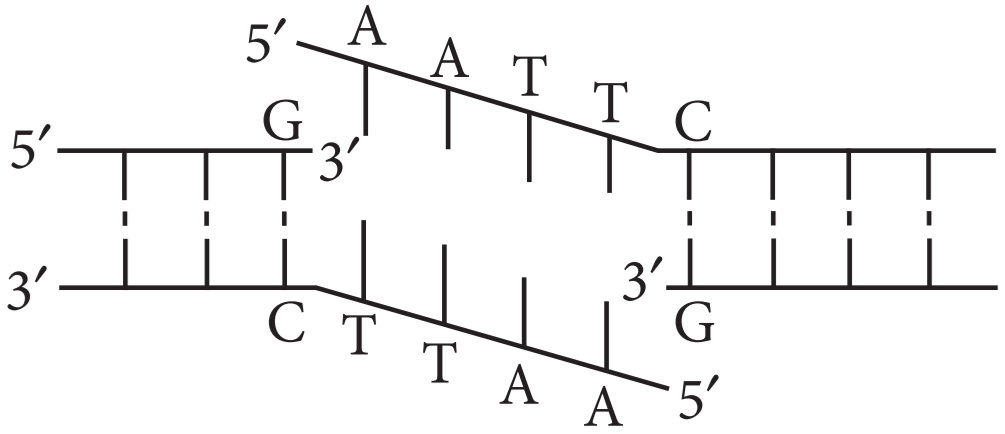
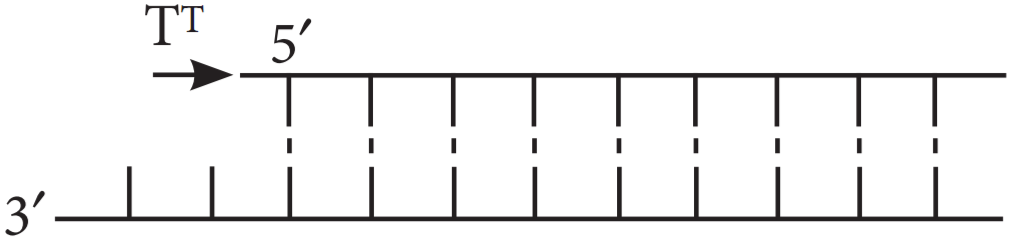
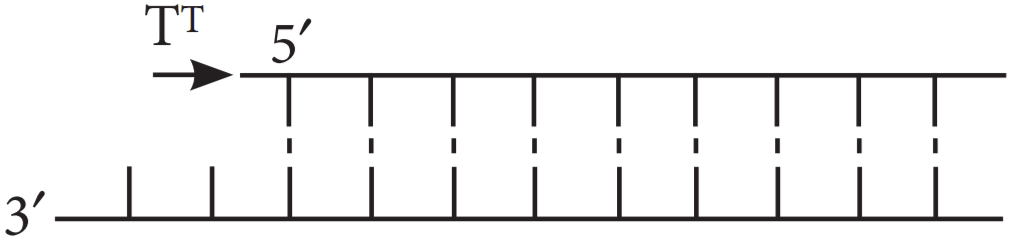
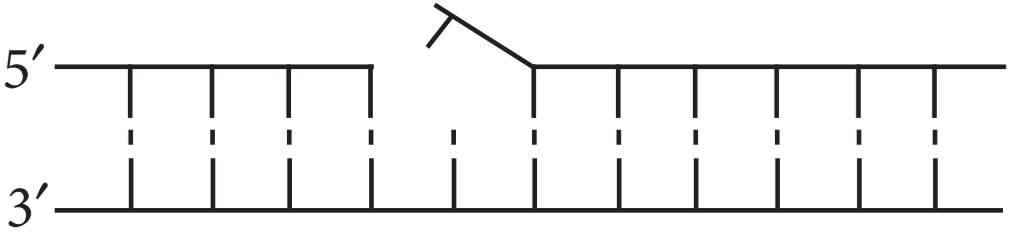
  1. Which of the following depicts exonuclease activity?
  1.  
  1.  
  1.  
  1. All of these
  1. Cloning vectors are the DNA molecules that.
  1. Carry foreign DNA segment but do not replicate inside the host cell.
  2. Carry foreign DNA segment and replicate inside the host cell.
  3. Transfer nuclear DNA form nucleus to the cytoplasm of the same cells.
  4. Help in sealing gaps in DNA segments.
  1. Transfer of DNA into a eucaryotic cell is called:
  1. Transformation.
  2. Transduction.
  3. Transfection.
  4. Electroporation.
  1. Assertion: Type I restriction enzymes are not used in rDNA technology.
Reason: Biotechnology mostly involves cutting and pasting of desired DNA fragments.
  1. Both assertion and reason are true and reason is the correct explanation of assertion.
  2. Both assertion and reason are true but reason is not the correct explanation of assertion.
  3. Assertion is true but reason is false.
  4. Both assertion and reason are false.
Answer
  1. (a) Lysozyme present in tears dissolve the bacterial cell wall.
Explanation:

Conversion of starch into maltose and protein into amino acids is due to hydrolysis.
  1. (a)
Explanation:

Exonuclease removes nucleotides from the terminal ends (either 5' or 3') of DNA in one strand of duplex.
  1. (b) Carry foreign DNA segment and replicate inside the host cell.
  1. (c) Transfection.
  1. (c) Assertion is true but reason is false.
Explanation:

In 1972, Paul Berg was able to introduce a gene of SV-40 virus into a bacterium with the help of lambda phage.
View full question & answer
Question 24 Marks
Read the following and answer any four questions from 7(i) to 7(v) given below:
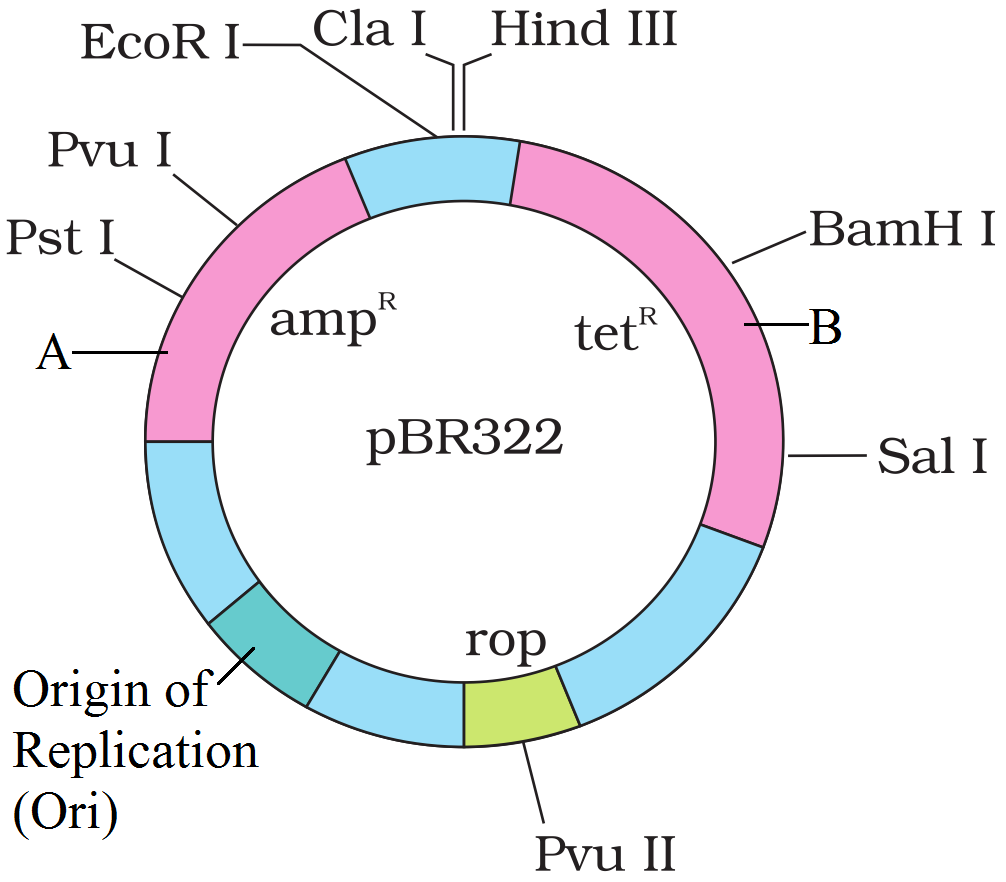
The vectors are DNA molecules that can carry a foreign DNA segment and replicate inside the host cell. Vectors may be plasmids, bacteriophages (viruses that attack bacteria), cosmids, yeast artificial chromosomes (YACs), Bacterial artificial chromosomes (BACs) and viruses. The most widely used, versatile, easily manipulated vector pBR 322 is an ideal plasmid vector. Features that are required to facilitate cloning into a vector includes origin of replication (Ori) which is a specific sequence of DNA bases responsible for initiating replication, selectable marker genes and cloning sites
  1. Pin pBR 322 denotes that it is a:
  1. plasmid
  2. prokaryote
  3. protist
  4. plant cell.
  1. Ori is a specific DNA sequence that help in.
  1. Attachment of primers.
  2. Initiation of replication.
  3. Extension of DNA base.
  4. Initiation of denaturation.
  1. A and B shown in the figure respectively indicates:
  1. Pvu II and Cla I.
  2. ROP and Sal I.
  3. $amp^R$ and $tet^R$.
  4. $tet^R$ and $amp^R.$
  1. Selectable markers in vector,
  1. Are responsible for replication.
  2. Help in selecting transformants from non-transform ants.
  3. Code for proteins involved in the replicating plasmids.
  4. Contain unique recognition sites.
  1. Plasmid vectors are:
  1. dsDNA molecule
  2. Extra-chromosomal
  3. Present in bacteria and yeast
  4. All of these.
Answer
  1. (a) plasmid
Explanation:

In pBR322 plasmid, P-denotes that it is a plasmid; BR-stands for Boliver and Rodriguez, who constructed this plasmid; 322-is a number given to distinguish this plasmid from others developed in the same laboratory.
  1. (b) Initiation of replication.
  1. (c) $amp^R$ and $tet^R$.
  1. (b) Help in selecting transformants from non-transform ants.
Explanation:

Plasmid pBR322 has two resistance gene, i.e., ampicillin resistance $(amp^R)$ and tetracyclin resistance $(let^R)$ which are considered useful for selectable markers.
  1. (d) All of these.
View full question & answer
Question 34 Marks
Read the following and answer any four questions from S(i) to S(v) given below:
Rajat is a student of biotechnology. His professor tells him that for transformation with recombinant DNA the bacterial cells must be made capable of taking up DNA as DNA do not pass through membrane. While doing experiment in the lab, Rajat noticed that bacterial cells were not taking up the foreign DNA even after treating it with sodium ion. He asked his professor, the reason behind this. His professor explained that he should check the valency and charge of the ion that he is using for the treatment.
  1. It is difficult for DNA to pass through the membrane as
  1. It is a hydrophilic molecule.
  2. It is a hydrophobic molecule.
  3. It is a circular molecule.
  4. It changes its shape when it comes in contact with host cell.
  1. What type of ions are used for DNA mediated gene transfers?
  1. Divalent anions.
  2. Divalent cations.
  3. Monovalent cations.
  4. Monovalent anions.
  1. rDNA stands for,
  1. reduced DNA
  2. red DNA
  3. recombinant DNA
  4. related DNA.
  1. Which of the following statements with regard to DNA is correct?
  1. DNA is a positively charged molecule having two polynucleotide chains.
  2. Nitrogen bases of two polynucleotide chain form complementary pairs, i.e., A opposite G and T opposite C.
  3. Backbone of DNA chain is built up of alternate deoxyribose sugar and phosphate group.
  4. Both (a) and (c)
  1. Assertion: Competent host is essential for transformation with rDNA.
Reason: Transfer of DNA in a prokaryotic cell is called transfection.
  1. Both assertion and reason are true and reason is the correct explanation of assertion.
  2. Both assertion and reason are true but reason is not the correct explanation of assertion.
  3. Assertion is true but reason is false.
  4. Both assertion and reason are false.
Answer
  1. (a) It is a hydrophilic molecule.
Explanation:

DNA is a hydrophilic molecule therefore it cannot pass through membrane.
  1. (b) Divalent cations.
Explanation:

Divalent cations, such as calcium increases the efficiency with which DNA enters the bacteria through pores in its walls.
  1. (c) recombinant DNA
  1. (c) Backbone of DNA chain is built up of alternate deoxyribose sugar and phosphate group.
Explanation:

DNA is a negatively charged molecule and in a DNA molecule nitrogen bases form complementary pairs, i.e., A opposite T and C opposite G.
  1. (c) Assertion is true but reason is false.
Explanation:

Transfer of DNA in a prokaryotic cell is called transformation.
View full question & answer
Question 44 Marks
Read the following and answer any four questions from (i) to (v) given below:
In recombinant DNA technology, the fragments of DNA generated after cutting the DNA by restriction enzymes are separated according to their size or length by gel electrophoresis. Gel electrophoresis is performed in a gel matrix so that molecules of similar electric charges can be separated on the basis of size. Most commonly used matrix in gel electrophoresis is agarose. The fragments are separated under the influence of electric field. The separated DNA fragments can be seen only after staining the DNA with compound known as ethidium bromide (EtBr) followed by exposure to UV radiation as bright orange band.
  1. Gel electrophoresis is used for the separation of
  1. DNA only.
  2. DNA and RNA only.
  3. DNA and proteins only.
  4. DNA, RNA and proteins.
  1. Most commonly used matrix is _____ which is a ______ extracted from _______.
  1. (i) agarose (ii) polysaccharide (iii) sea weed
  2. (i) agarose (ii) protein (iii) sea weed
  3. (i) EtBr (ii) polysaccharide (iii) sea weed
  4. (i) EtBr (ii) protein (iii) bacteria
  1. A DNA molecule was treated with a restriction endonuclease and three fragments of size (i) 426kb, (ii) 129kb and (iii) 46kb were obtained. Identify the order in which these bands will arrange themselves in the gel plate after gel electrophoresis is completed. (Assuming that negative part of electrode is towards the well)
  1. (iii) → (ii) → (i)
  2. (i) → (ii) → (iii)
  3. (i) → (iii) → (ii)
  4. (iii) → (i) → (ii)
  1. Which of the following statements regarding gel electrophoresis is incorrect?
  1. Separated DNA fragments can be seen only after staining DNA with EtBr.
  2. DNA fragments are separated according to their size.
  3. Under the influence of electric field, positively charged molecules move towards the anode and negatively charged molecules move towards the cathode.
  4. None of these.
  1. The factor that will not affect the rate of DNA migration in gel electrophoresis is:
  1. Size of DNA molecule.
  2. Concentration of DNA.
  3. Voltage supplied.
  4. Concentration of the gel.
Answer
  1. (d) DNA, RNA and proteins.
Explanation:

Gel electrophoresis is a technique used to separate fragments of molecules, i.e., DNA, RNA and protein.
  1. (a) (i) agarose (ii) polysaccharide (iii) sea weed
  1. (b) (i) → (ii) → (iii)
  1. (c) Under the influence of electric field, positively charged molecules move towards the anode and negatively charged molecules move towards the cathode.
Explanation:

Under the influence of electric field positively charged molecules move towards the cathode and negatively charged molecules move towards the anode.
  1. (b) Concentration of DNA.
Explanation:

Concentration of DNA will not affect the migration of DNA molecule in a gel electrophoresis, As in gel electrophoresis, molecules separate according to their size therefore DNA size will affect migration. Increased voltage supply will increase rate of migration and the more concentrated gel will reduce rate of migration.
View full question & answer
Question 54 Marks
Read the following and answer any four questions from 9(i) to 9(v) given below:
Bioreactors are considered as vessels in which raw materials are biologically converted into specific products by microbes, plant and animal cells or their enzymes. They are used for large scale production as they provide optimum growth conditions such as temperature, pH, substrate, vitamins, oxygen and salts for obtaining desired product. Most commonly used bioreactors are of stirring type which include simple stirred tank bioreactor and sparged stirred-tank bioreactor.
  1. Bioreactor are useful in:
  1. Amplifying a gene.
  2. Isolation of genetic material.
  3. Processing large volume of culture.
  4. Infecting DNA in a cell.
  1. Which of the following is essential to obtain desired product in a bioreactor?
  1. Size of the bioreactor.
  2. Sterile condition.
  3. Quantity of the raw material.
  4. All of these.
  1. Assertion: The stirred-tank is well suited for large scale production of microorganisms under aseptic conditions.
Reason: In sparged stirred tank bioreactor, surface area for oxygen transfer is increased.
  1. Both assertion and reason are true and reason is the correct explanation of assertion.
  2. Both assertion and reason are true but reason is not the correct explanation of assertion.
  3. Assertion is true but reason is false.
  4. Both assertion and reason are false.
  1. Growth condition that could affect the quality of obtained product in a bioreactor are:
  1. Temperature and pH only.
  2. pH and oxygen supply only.
  3. Temperature and oxygen supply only.
  4. Temperature, pH and oxygen supply.
  1. Vessels in which raw materials are biologically converted into specific products are.
  1. Bioreactors.
  2. Fermentors.
  3. Gene guns.
  4. Both (a) and (b).
Answer
  1. (c) Processing large volume of culture.
Explanation:

Bioreactors are considered as vessels in which raw molecules are biologically converted into specific products.
  1. (b) Sterile condition.
Explanation:

In a bioreactor, all operations must be carried under sterile conditions to avoid contamination.
  1. (b) Both assertion and reason are true but reason is not the correct explanation of assertion.
  1. (d) Temperature, pH and oxygen supply.
Explanation:

A bioreactor provides the optimal growth conditions such as temperature,pH, substrate, vitamins, oxygen and salts for obtaining the desired product.
  1. (d) Both (a) and (b).
View full question & answer
Question 64 Marks
Read the following and answer any four questions from (i) to (v) given below:
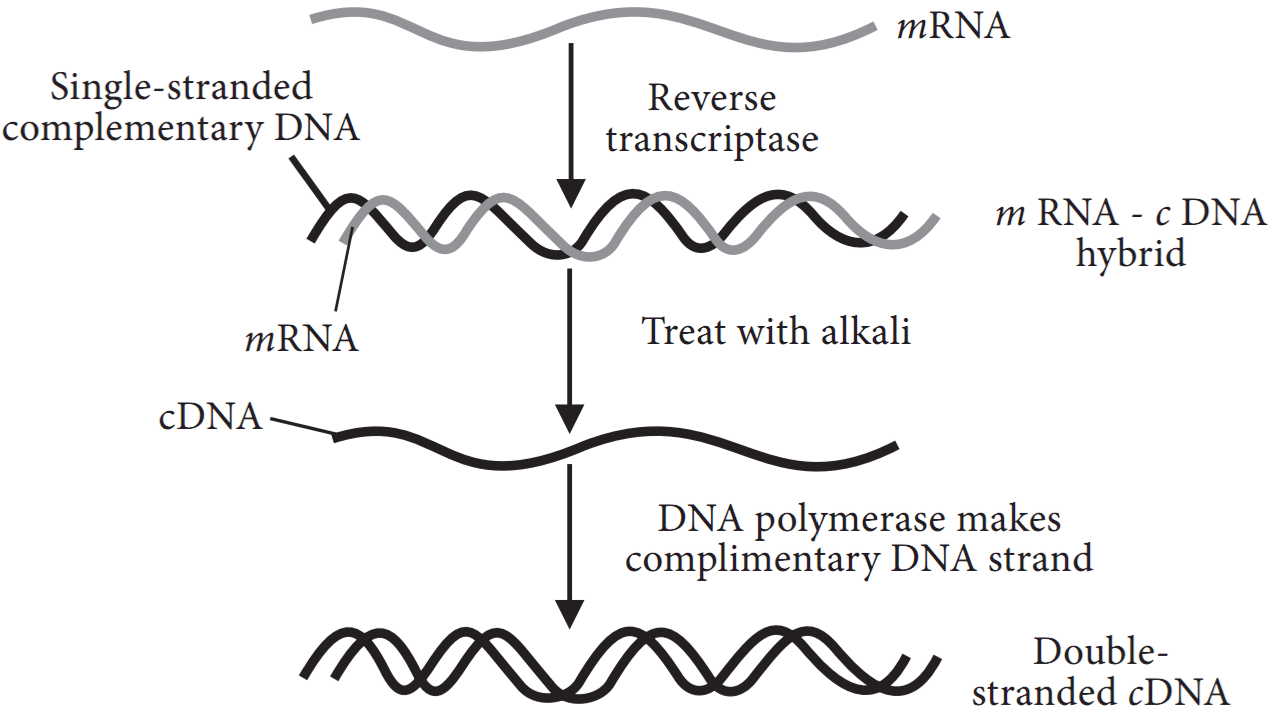
The DNA, which is transferred from one organism into another by joining it with the vehicle DNA is called passenger or foreign DNA. Generally three types of passenger DNAs are used. These are complementary DNA (cDNA), synthetic DNA (sDNA) and random DNA. Complementary DNA (cDNA) is synthesized on RNA template (usually mRNA) with the help of reverse transcriptase. Synthetic DNA (sDNA) is synthesized on DNA template or without a template. Random DNA are small fragments fanned by breaking a chromosome of an organism in the presence of restriction endonucleases.
  1. Reverse transcriptase enzyme was discovered by:
  1. Temin and Baltimore.
  2. Cohen and Boyer.
  3. Arber and Nathan.
  4. Paul Berg.
  1. During cDNA formation, what would happen if DNA formed by reverse transcriptase is not treated with the alkali?
  1. cDNA will not be digested.
  2. mRNA will not be digested.
  3. Hydrogen bonds will not form between base pairs.
  4. rnRNA will not be formed.
  1. Enzyme that helps in the formation of double stranded cDNA is:
  1. DNA synthetase
  2. Ligase
  3. DNA polymerase
  4. Helicase.
  1. DNA polymerase can be obtained form:
  1. Retrovirus.
  2. Agrobacteriurn.
  3. Tobacco mosaic virus.
  4. Thermus aquaticus.
  1. DNA synthesised without a template is referred to as:
  1. Complementary DNA.
  2. Random DNA.
  3. Synthetic DNA.
  4. Z-DNA..
Answer
  1. (a) Temin and Baltimore.
  1. (b) mRNA will not be digested.
The cDNA formation involves the alkaline denaturation of the mRNA-cDNA hybrid. The double stranded DNA molecule formed after the activity of reversetranscriptase is treated with alkali to digest mRNA.

In a bioreactor, all operations must be carried under sterile conditions to avoid contamination.
  1. (c) DNA polymerase
Explanation:

A cDNA strand is formed on the separated single stranded DNA template with the help of DNA polymerase enzyme.
  1. (d) Thermus aquaticus.
  1. (c) Synthetic DNA.
View full question & answer
Question 74 Marks
Read the following and answer any four questions from 2(i) to 2(v) given below: Restriction endonuclease was isolated for the first ti me by W. Arb er in 1962 in bacteria. Restriction endonucleases cut the DNA duplex at specific points therefore they are also called as molecular scissors or biological scissors. Three types of restriction endonucleases are Type I, Type II and Type III but only Type II restriction endonucleases are used in recombinant DNA technology. Restriction endonuclease EcoR I recognises the base sequence GAATTC in DNA duplex and cut strands between G and A.
  1. Only type II restriction enzymes are used in gene manipulation because
  1. ATP is not required for cleaving.
  2. It consists of three different subunits.
  3. It makes cleavage or cut in both the strands of DNA molecule.
  4. Both (a) and (c).
  1. Which of the following ions are used by restriction endonucleases for restriction?
  1. $ \mathrm{Mg}^{2+} \text { ions }$
  2. $ \mathrm{Mn}^{2+} \text { ions }$
  3. $ \mathrm{Na}^{2+} \text { ions }$
  4. $ \mathrm{K}^{2+} \text { ions }$
  1. Restriction endonuclease was isolated for the first time in a:
  1. Plant cell.
  2. Animal cell.
  3. Prokaryotic cell.
  4. Genninal cell.
  1. Restriction endonucleases are also called as molecular or biological scissors because,
  1. They cleave base pairs of DNA only at their terminal ends.
  2. They cleave one or both the strands of DNA.
  3. They act only on single stranded DNA.
  4. None of these.
  1. Select the option that correctly states the working action of restriction endonuclease EcoR I on DNA sequence GAATTC
  1. $\ \ \ \ \ \ \ \ \ \ \ \ \downarrow\\5'-\text{GAATTC}-3'\\3'-\text{CTTAAG}-5'\\\ \ \ \ \ \ \ \ \ \ \ \ \ \ \ \ \ \ \uparrow$
  2. $ \ \ \ \ \ \ \ \ \ \ \downarrow\\5'-\text{GAATTC}-3'\\3'-\text{CTTAAG}-5'\\\ \ \ \ \ \ \ \ \ \ \ \ \ \ \ \ \ \ \ \ \uparrow$
  3. $\ \ \ \ \ \ \ \ \ \ \ \ \ \ \ \ \ \ \ \ \ \downarrow\\5'-\text{GAATTC}-3'\\3'-\text{CTTAAG}-5'\\\ \ \ \ \ \ \ \ \ \uparrow$
  4. $\ \ \ \ \ \ \ \ \ \ \ \ \ \ \ \downarrow\\5'-\text{GAATTC}-3'\\3'-\text{CTTAAG}-5'\\\ \ \ \ \ \ \ \ \ \ \ \ \ \ \uparrow$
Answer
  1. (d) Both (a) and (c).
Explanation:

Only type II restriction enzymes are used in gene manipulation for two reasons : (a) No ATP is required for the cleaving action. (b) It makes cleavage or cut in both the strands of DNA molecule.
  1. (a) $Mg^{2+}$ ions
Explanation:

All the three types ofrestrictionendonucleases require $Mg_2$. ions for restriction.
  1. (c) Prokaryotic cell.
Explanation:

Restriction endonuclease was isolated for the first time by W. Arber in 1962 in bacteria.
  1. (b) They cleave one or both the strands of DNA.
Explanation:

In 1972, Paul Berg was able to introduce a gene of SV-40 virus into a bacterium with the help of lambda phage.
  1. (b) $ \ \ \ \ \ \ \ \ \ \ \downarrow\\5'-\text{GAATTC}-3'\\3'-\text{CTTAAG}-5'\\\ \ \ \ \ \ \ \ \ \ \ \ \ \ \ \ \ \ \ \ \uparrow$
View full question & answer
Question 84 Marks
Read the following and answer any four questions from (i) to (v) given below:
Gene manipulation is a fast emerging science. It started with development of recombinant DNA molecule. It is named variously as DNA manipulation biotechnology, recombinant DNA technology and genetic engineering. This technology, that mostly involves cutting and pasting of desired DNA fragments, is based on two important discoveries in bacteria, i.e., presence of plasmid in bacteria and restriction endonucleases. Paul Berg was able to introduce a gene ofSV-40 into a bacterium. The science of recombinant DNA technology took birth when Cohen and Boyer (1973) were able to introduce a piece of gene containing foreign DNA into plasmid of E.coli.
  1. Biotechnology is also known as:
  1. DNA manipulation biotechnology.
  2. Recombinant DNA technology.
  3. Genetic engineering.
  4. All of these.
  1. A bacterial plasmid is a/ an,
  1. Extra chromosomal material that do not replicate.
  2. Extra chromosomal material that undergo replication with or without chromosomal DNA.
  3. Tubular structures that help in conjugation.
  4. Bristle like solid structure that help in adhesion.
  1. Father of genetic engineering is:
  1. Paul Berg.
  2. Arber.
  3. Nathan.
  4. Smith.
  1. Which of the following is used by Paul Berg to introduce a gene of SV-40 in a bacterium?
  1. E. coli.
  2. cos-plasmids.
  3. Lambda phage.
  4. None of these.
  1. Read the given statements and select the correct option.
Assertion: Biotechnology started with the development of recombinant DNA molecule.

Reason: Biotechnology mostly involves cutting and pasting of desired DNA fragments.
  1. Both assertion and reason are true and reason is the correct explanation of assertion.
  2. Both assertion and reason are true but reason is not the correct explanation of assertion.
  3. Assertion is true but reason is false.
  4. Both assertion and reason are false.
Answer
  1. (d) All of these.
  1. (b) Extra chromosomal material that undergo replication with or without chromosomal DNA.
Explanation:

Plasmid in a bacterial cell is an extra chromosomal material that undergo replication with or without chromosomal DNA.
  1. (a) Paul Berg.
  1. (c) Lambda phage.
Explanation:

In 1972, Paul Berg was able to introduce a gene of SV-40 virus into a bacterium with the help of lambda phage.
  1. (b) Both assertion and reason are true but reason is not the correct explanation of assertion.
View full question & answer
Question 94 Marks
Read the following and answer any four questions from 6(i) to 6(v) given below:
Rama lives in a society where a robbery occurred last night. Robbers came into the flat and murdered the old lady residing there. Police came and restricted the entry into the flat. They took samples from the room, where the dead body was found. While examining, they found that there is some blood and tissue in the nails of old lady. According to their observation, police filtered out their inspection to three suspects viz. servant, cook and milkman. Finally after two days of robbery, police caught the criminal. It was the old lady's cook. Rama was amazed to see that how quickly police completed and shut the case. She asked the inspector that how they did it? The police man told her that it become possible due to the sample collected from the victim, that lead them to the criminal. TI1e sample taken from nail scraping was amplified using PCR and then tested.
  1. What technique was used by the police to identify the criminal?
  1. DNA fingerprinting.
  2. Gel electrophoresis.
  3. Molecular diagnosis.
  4. Clonning.
  1. In PCR, the temperature used to denature the DNA is about:
  1. 76º
  2. 25º
  3. 95º
  4. 40º
  1. Which of the following statements regarding PCR is correct?
  1. Taq polymerase, which is isolated from bacterium Thermus aquaticus is stable at low temperature only.
  2. With the help of DNA ligase, the complementary sticky ends of the DNA are joined to produce a rDNA.
  3. Since the sequence of primers are complementary to 5' end of the template DNA, they anneal to it.
  4. DNA purified from the cell is precipitated by adding hot ethanol.
  1. Taq polymerase synthesises DNA region between the primers using:
  1. $Mg^{2+}$
  2. dNTPs
  3. DNA ligase
  4. Both (a) and (b).
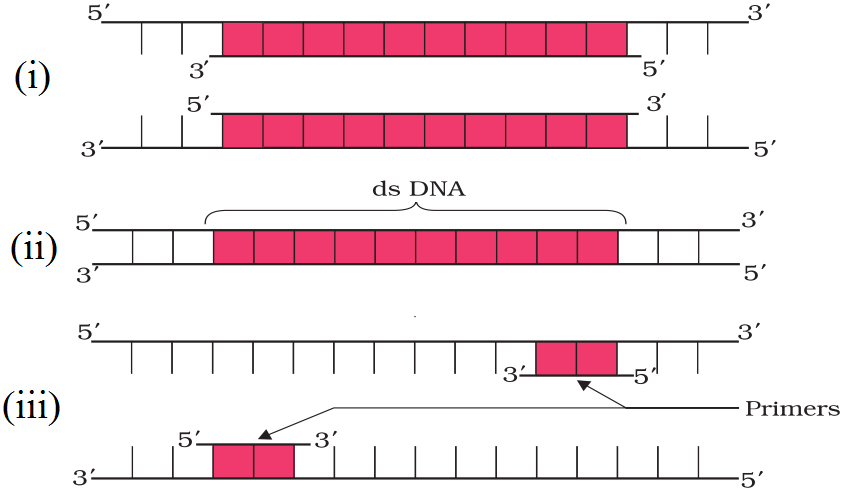
  1. Given below are steps of polymerase chain reaction.


Select the option that correctly mention the sequence in which they occur.
  1. (ii) → (iii) → (i)
  2. (i) → (ii) → (iii)
  3. (iii) → (i) → (ii)
  4. (ii) → (i) → (iii)
Answer
  1. (a) DNA fingerprinting.
Explanation:

DNA fingerprinting is one of highly accurate application of biotechnology. It is helpful in solving crime, legal disputes, establishing identity of criminal or parents, etc.
  1. (c) 95º
Explanation:

In PCR, during denaturation, the target DNA is heated at high temperature resulting in the separation of the two strands.
  1. (b) With the help of DNA ligase, the complementary sticky ends of the DNA are joined to produce a rDNA.
Explanation:

Taq polymerase isolated from bacterium Thermus aquaticus is stable at high temperature. Sequence of primers are complementary to 3' end of the template. Purified DNA is precipitated by adding chilled ethanol.
  1. (d) Both (a) and (b).
  1. (a) (ii) → (iii) → (i)
Explanation:

Three steps of PCR are : denaturation, annealing and extension.
View full question & answer
Question 104 Marks
Read the following and answer any four questions from (i) to (v) given below:
The foundations of recombinant DNA (rDNA) were laid by the discovery of restriction enzymes. These enzymes are present in many bacterias where they function as a part of their defense mechanism called the Restriction Modification system (RM system). Molecular basis of this system was explained first by Werner Arber in 1962. The Restriction Modification system consists of two components:
  • A restriction enzyme (called restriction endonuclease) identifies the introduced foreign DNA and cuts it into pieces.
  • The second component is a modification enzyme (methylase) that adds a methyl group to DNA at specific site to protect it from the restriction enzyme cleavage.
  1. Restriction endonucleases are enzymes present in ________ where they function as a part of _______ mechanism.
  1. (i) bacteria (ii) digestive
  2. (i) protists (ii) transcription
  3. (i) plant cells (ii) replication
  4. (i) prokaryotes (ii) defence
  1. Which of the following statements regarding modification enzyme is correct?
  1. It adds methyl group to one or two bases usually within the host DNA sequence to protect it from the restriction enzyme.
  2. It adds ethyl group to one or two bases usually within the sequence recognised by the restriction enzymes.
  3. It adds methyl group to only one of bases within the foreign DNA sequence that is recognised by the restriction enzymes.
  4. None of these.
  1. Which of the following is a type II restriction enzyme?
  1. Alu I
  2. EcoR I
  3. BamH I
  4. All of these.
  1. Which of the following is the first discovered restriction endonuclease?
  1. Sal I
  2. EcoR I
  3. Hind II
  4. EcoR II
  1. Components of Restriction Modification System include?
  1. Restriction enzyme.
  2. Modification enzyme.
  3. Lysing enzyme.
  4. Both (a) and (b).
Answer
  1. (d) (i) prokaryotes (ii) defence
  1. (a) It adds methyl group to one or two bases usually within the host DNA sequence to protect it from the restriction enzyme.
  1. (d) All of these.
Explanation:

Different examples of Type II restriction endonuclease are Alu I, EcoR I, BamH I, etc.
  1. (c) Hind II
  1. (d) Both (a) and (b).
Explanation:

The restriction modification system consists of two components (i) A restriction enzyme called restriction endonucleases which identifies the introduced foreign DNA and cuts it into pieces and (ii) A modification enzyme (methylase) that adds a methyl group to DNA at a specific site to protect the site from restriction endonuclease cleavage.
View full question & answer