Questions

1 Marks Question

Take a timed test

124 questions · 4 auto-graded MCQ + 120 self-marked written.

MCQ 21 Mark
Which one of the following has the largest population in a food chain?
  • A
    Producers.
  • B
    Primary consumers.
  • C
    Secondary consumers.
  • Decomposers.
Answer
Correct option: D.
Decomposers.
View full question & answer
Question 31 Mark
Fill in the blanks.
In an ecosystem dominated by trees, the pyramid (of numbers) is _________ type.
Answer
Spindle.
View full question & answer
Question 41 Mark
Fill in the blanks.
Common detritivores in our ecosystem are _________.
Answer
Earthworm, bacteria & fungi of decay and vulture.
View full question & answer
MCQ 51 Mark
Secondary producers are:
  • A
    Herbivores.
  • B
    Producers.
  • C
    Carnivores.
  • None of the above.
Answer
Correct option: D.
None of the above.
View full question & answer
MCQ 61 Mark
The second trophic level in a lake is$-$
  • A
    Phytoplankton.
  • Zooplankton.
  • C
    Benthos.
  • D
    Fishes.
Answer
Correct option: B.
Zooplankton.
Zooplankton are primary consumers in aquatic food chains that feed upon phytoplankton.
Therefore, they are present at the second trophic level in a lake.
View full question & answer
Question 81 Mark
Fill in the blanks.In aquatic ecosystems, the limiting factor for the productivity is _________.
Answer
Sunlight.
View full question & answer
MCQ 91 Mark
What is the percentage of photosynthetically active radiation $\text{(PAR)},$ in the incident solar radiation.
  • A
    $100\%$
  • $50\%$
  • C
    $1-5\%$
  • D
    $2-10\%$
Answer
Correct option: B.
$50\%$
Out of total incident solar radiation, about fifty percent of it forms photosynthetically active radiation $\text{(PAR)}.$
View full question & answer
Question 101 Mark
Write a difference between net primary productivity and gross productivity.
Answer
Gross productivity-Rate of production of organic matter during photosynthesis Net primary productivity -Available biomass for the consumption to heterotrophs/GPP-R = NPP.
View full question & answer
Question 111 Mark
State what does ‘standing crop’ of a trophic level represent?
Answer
There is unidirectional movement of energy the higher trophic level and its levels has a certain mass of living material at a particular time called as the standing crop. It represent values for dry blomass (standing crop).
View full question & answer
Question 121 Mark
How is ‘stratification’ represented in a forest ecosystem?
Answer
Trees occupy vertical stratra, shrubs the second layer and herbs/grasses occupy the bottom layers/vertical distribution of species, at different levels.
View full question & answer
Question 131 Mark
Write the equation that helps in deriving the net primary productivity of an ecosystem.
Answer
Net primary productivity (NPP) is an ecosystem can be derived using the following equation:
NPP = GPP-R.
= (Gross – Primary Productivity) - (Respiratory Losses).
View full question & answer
Question 141 Mark
What does ecological niche of an organism represent?
Answer
The ecological niche (of an organism) signifies the range of conditions it can tolerate, the resources it utilises, and its functional role in the ecological system.
View full question & answer
Question 151 Mark
Why is the rate of assimilation of energy at the herbivore level called secondary productivity?
Answer
It is because the biomass available to the consumer for consumption is a resultant of the primary productivity from plants.
View full question & answer
Question 161 Mark
Define primary production.
Answer
It is defined as the amount of biomass or organic matter produced per unit area over a certain time period by plants during photosynthesis.
View full question & answer
Question 171 Mark
Is the common edible mushroom an autotroph or a heterotroph?
Answer
Heterotroph (as it does not have chlorophyll).
View full question & answer
Question 181 Mark
Arrange the following as you observe in vertical stratification of a forest-Grass, Shrubby plants, Teak, Amaranthus.
Answer
Grass, Amaranthus, Shrubby plants, Teak.
View full question & answer
Question 191 Mark
How is stratification represented in forest ecosystem?
Answer
Stratification is the way in which different species in an ecosystem are placed or arranged vertically, occupying different levels. It is a way of minimising competition for limited resources vital for survival.
View full question & answer
Question 201 Mark
Answer the following questions:
Over the years, it has been observed that some of the lakes are disappearing due to urbanisation. In absence of human interference, depict by making a flow chart, how do the successional series progress from hydric to mesic condition.
Answer
Phytoplankton - hydric → Submerged plant stage → Submerged free floating plant stage → Reed swamp stage → Marsh - meadow stage → Scrub stage → Forest stage - Mesic.
View full question & answer
Question 211 Mark
What is meant by PAR?
Answer
The part of the solar radiation which can be absorbed and used by the plants for photosynthesis, is called photosynthetically active radiation (PAR).
View full question & answer
Question 221 Mark
How is net primary productivity different from gross primary productivity?
Answer
Net primary productivity refers to the biomass/ organic matter available at the producer level to the primary consumers, i.e. GPP-Respiratory losses. Gross primary productivity is the rate of production of biomass/ organic matter by producers during photosynthesis.
View full question & answer
Question 231 Mark
GPP - R = NPP
What does 'R' represent in the given equation for productivity in an ecosystem?
Answer
R represents the respiratory losses.
View full question & answer
Question 241 Mark
What do you understand by the term seral stage?
Answer
An individual transitional community in ecological succession.
View full question & answer
Question 261 Mark
What is meant by productivity of an organism? How is it expressed in a terrestrial ecosystem?
Answer
The rate of synthesis of energy containing biomass by any trophic level per unit area in unit time is called its productivity.
$\text { It is expressed in terms of } \mathrm{g}^{-2} \mathrm{yr}^{-1} \text { or } \mathrm{kcal} \mathrm{~m}^{-2} \mathrm{yr}^{-1} \text {. }$
View full question & answer
Question 271 Mark
Man can be a primary as well as secondary consumer'. Justify this statement.
Answer
Man can be a primary as well as secondary consumer because man eats plants as well as meat of other animals. So, man is herbivores as well as carnivores.
View full question & answer
Question 311 Mark
Answer the following questions:
Colonisation of a rocky terrain is a natural process. Mention the group of organisms which invade this area first. Give an example.
Answer
Pioneer species invade the area first.
For example, lichen.
View full question & answer
Question 321 Mark
What is a sere?
Answer
The entire sequence of communities, that successively change in a given area resulting in a climax community, is called a sere.
View full question & answer
Question 331 Mark
How much of carbon is:
  1. Fixed in the biosphere through photosynthesis annually?
  2. Dissolved in the ocean?
Answer
  1. $4 \times 10^{13}\ kg$ of carbon is fixed annually.
  2. $71\%$ of carbon is dissolved in the ocean.
View full question & answer
Question 341 Mark
Among bryophytes, lichens and fern which one is a pioneer species in a xeric succession?
Answer
Crustose lichens.
View full question & answer
Question 351 Mark
Mr. Galgotia eats curd/yoghurt. In this case, which trophic level will he occupy?
Answer
Tertiary consumer.
View full question & answer
Question 361 Mark
How is the net primary productivity of an ecosystem derived?
Answer
Gross primary productivity (GPP) – Respiratory loss (R) = Net primary productivity (NPP); it is the amount of energy/ biomass available in the producers for consumption by herbivores.
View full question & answer
Question 391 Mark
What are primary carnivores?
Answer
The herbivores (primary consumers) which depend on plants for their food are called primary carnivores. They are also called secondary consumer.
View full question & answer
Question 401 Mark
What is detritus?
Answer
Dead organic matter or remains of plant such as leaves, bark, flower and dead remain of animals, including faecal matter constitute detritus.
View full question & answer
Question 411 Mark
The carbon atoms fixed by producers have to pass through three species. Mention the trophic level of the third species.
Answer
Tertiary consumer.
View full question & answer
Question 421 Mark
A Volcano erupted in Hawaii, and lava covered land that had been framed for centuries. Eventually, new lichens, and then plants, grew on the lava. Is this an example of primary or secondary successions? Give the reason also.
Answer
This is an example of primary succession: Because this begins from a state of little or no life.
View full question & answer
Question 431 Mark
What is the significance of the process of mineralization by microbes?
Answer
The inorganic nutrients released from the humus by the microbes are used by plants as nutrients.
View full question & answer
Question 441 Mark
Mention one similarity between hydrarch and xerarch successions.
Answer
Both succession lead to medium water conditions (mesic), neither too dry, nor too wet.
View full question & answer
Question 451 Mark
Name two omnivores that occupy positions in both grazing food chain as well as detritus food chain.
Answer
Cockroaches and crows.
View full question & answer
Question 461 Mark
Write the name of four important functional aspects of ecosystem.
Answer
  1. Productivity.
  2. Decomposition.
  3. Energy flow.
  4. Nutrient cycling.
View full question & answer
Question 471 Mark
Name the basic requirement of any ecosystem to function and sustain properly.
Answer
A constant input of solar energy is the ultimate source of all energy and requirement of any ecosystem to function and sustain properly.
View full question & answer
Question 481 Mark
Cite an example of an inverted ecological pyramid. What kind of pyramid of energy would it have?
Answer
The pyramid of biomass in sea is an inverted pyramid. It would have an upright pyramid of energy.
View full question & answer
Question 491 Mark
Justify the pitcher plant as a producer.
Answer
Pitcher plant is chlorophyllous and is thus capable of photosynthesis and act as producer.
View full question & answer
Question 501 Mark
What percentage of productivity is contributed by oceans?
Answer
Oceans contribute about 55 billion tonnes, which is about 32.5%.
View full question & answer
Question 511 Mark
Mark the odd one in the following group.
Fragmentation, Stratification, Leaching, Catabolism.
Answer
Stratification.
View full question & answer
Question 521 Mark
What is net primary productivity?
Answer
The amount of energy or biomass remaining in a producer after meeting the cost of its respiration is called the net primary productivity.
View full question & answer
Question 531 Mark
Name the dominant producers in a deep aquatic ecosystem. What other name could you give to a primary consumer?
Answer
Phytoplanktons are the dominant producers in aquatic ecosystem. Primary consumers are also known as herbivores.
View full question & answer
Question 541 Mark
What is the starting point of a grazing food chain and detritus food chain, respectively?
Answer
The grazing food chain starts with producers while the detritus food chain starts with decomposers.
View full question & answer
Question 561 Mark
All primary productivity is not available for herbivores. Give one reason.
Answer
Some of the gross primary productivity gets lost in the form of respiration, that is why all primary productivity is not available for herbivores.
View full question & answer
Question 571 Mark
What is an ecosystem?
Answer
An ecosystem is a functional unit of nature, where biotic components (living organisms) interact among themselves and also with the abiotic environmental or physical factors.
View full question & answer
Question 581 Mark
Why the pyramid of energy is always upright?
Answer
Because when energy flows from a particular trophic level to the next trophic level, some energy is always lost as heat at each step.
View full question & answer
Question 591 Mark
Why is the pyramid of biomass inverted in a pond ecosystem?
Answer
The pyramid of biomass is inverted in a pond ecosystem because the biomass of fish (top consumer) is far larger than the producers (phytoplanktons).
View full question & answer
Question 601 Mark
Answer the following questions:
Identify the climax community of hydrarch and xerarch succession.
Answer
Forest is the climax community for both successions.
View full question & answer
Question 611 Mark
Differentiate between standing state and standing crop in an ecosystem.
Answer
Differences:
S.No.
Standing State
Strndirg Crop
(i)
Standing state refers to the amount of nutrients such as nitrogen, phosphorus, calcium, etc. present in the soil of an ecosystem at a given time.
Standing crop refers to the amount of biomass or organic matter available at a given rophic level/ ecosystem at a given time.
(ii)
It is in the abiotic comPonents.
It is in the biotic components.
View full question & answer
Question 631 Mark
Name the important steps in the process of decomposition.
Answer
Fragmentation, leaching, catabolism, humification and mineralisation.
View full question & answer
Question 641 Mark
What is meant by 10% law?
Answer
It states that only 10% energy of a trophic level is transferred to the next higher trophic level.
View full question & answer
Question 651 Mark
Climax stage is achieved quickly in secondary succession as compared to primary succession. Why?
Answer
The rate of succession is much faster in secondary succession as the substratum (soil) is already present as compared to primary succession where the process starts from a bare area (rock).
View full question & answer
Question 661 Mark
List two factors that determine the vegetation and soil type of an ecosystem.
Answer
Two factors that determine the vegetation and soil type of an ecosystem are:
  1. Precipitation.
  2. Temperature.
View full question & answer
Question 671 Mark
All the primary productivity is not available to a herbivore. Give one reason.
Answer
A considerable amount of gross primary productivity is used by the plants in respiration; so not all primary productivity is available for consumers.
View full question & answer
Question 691 Mark
Mr. Galgotia eats curd/ yoghurt In this case, which trophic level will he occupy?
Answer
He occupies third tropic level, i.e. he is a secondary consumer.
View full question & answer
Question 721 Mark
Arrange the following as observed in vertical stratification of a forest: Grass, Shrubby plants, Teak, Amaranths.
Answer
Grass (floor of forest) → Amaranthus → Shrubby plants → Teak (tree).
View full question & answer
Question 741 Mark
In terrestrial ecosystem DFC and GFC are interlinked at certain level. Justify the statement.
Answer
Some of the organisms of DFC are prey to the animal of GFC, hence they are interlinked.
View full question & answer
Question 751 Mark
Why are green algae not likely to be found in the deepest strata of the ocean?
Answer
Green algae are autotrophic organisms, i.e. they synthesise their own food with the help of photosynthesis. At deepest layers of ocean, light is absent. So, photosynthesis does not take place there and hence, green algae are not found in deep strata
View full question & answer
Question 761 Mark
Under what conditions would a particular stage in the process of succession revert back to an earlier stage?
Answer
Natural or human induced disturbances like fire, deforestation, etc.
View full question & answer
Question 771 Mark
Name the four levels of group organization of living things in order of increasing size.
Answer
Population, community, ecosystem, biosphere.
View full question & answer
Question 781 Mark
Define mineralisation.
Answer
The process of degradation of humus by microbial action and release of inorganic nutrients.
View full question & answer
Question 791 Mark
Give any two examples of xerarch succession.
Answer
  • Bare rocks $($xerosere$).$
  • Sandy areas $($psammosere$).$
View full question & answer
Question 811 Mark
Define biomass.
Answer
It is the amount of living material or organic matter present in an organism, community or biome.
View full question & answer
Question 821 Mark
How much of productivity is contributed by oceans?
Answer
Oceans contribute about 55 billion tons organic matter.
View full question & answer
Question 831 Mark
What is stratification in an ecosystem? Explain with an example.
Answer
The vertical distribution of different species occupying different levels in an ecosystem is called stratification. Trees occupy the topmost vertical layer of a forest, shrubs occupy the second layer and herbs and grasses occupy the bottom most or base layers.
View full question & answer
Question 841 Mark
How is primary productivity in an ecosystem determined?
Answer
Primary productivity is determined as the amount of biomass or organic matter produced per unit area over a time period by the plants during photosynthesis.
View full question & answer
Question 851 Mark
Write the equation that helps in deriving the net primary productivity of an ecosystem.
OR
How is the net primary productivity of an ecosystem derived?
Answer
Net Primary Productivity (NPP) is the weight of the organic matter stored by the producers which is available to heterotrophs for consumption. It is equal to the rate of organic matter produced during photosynthesis GPP minus respiratory losses (R), i.e. NPP = GPP - R
View full question & answer
Question 861 Mark
Name the term used for rate of storage of organic matter not used by heterotrophs.
Answer
Net primary productivity.
View full question & answer
Question 871 Mark
Why is measurement of biomass in terms of dry weight more accurate than fresh weight?
Answer
Measurement of biomass in terms of dry weight is more accurate because it avoids variations in weights due to seasonal moisture differences.
View full question & answer
Question 921 Mark
Who put a price tag for the ecosystem services? What is its value?
Answer
  1. Robert Constanza et al have tried to put a price tag.
  2. It's estimated to be about $33$ trillion $US$ dollars.
View full question & answer
Question 931 Mark
Mention any two reasons why the primary productivity varies in different types of ecosystems?
Answer
The primary productivity varies in different types of ecosystems as:
  1. It depends upon plant species $($producers$)$ of a given ecosystem and their photosynthetic capacity.
  2. It is dependent on various environmental factors like availability of nutrients.
View full question & answer
Question 941 Mark
Standing crop and biomass are related to each other, how?
Answer
The standing crop is measured as the mass of living organisms or the number in a unit area. The biomass of a species is expressed in terms of fresh or dry weight.
View full question & answer
Question 951 Mark
Name the two forms of reservoir of carbon, that regulate the ecosystem carbon cycle.
Answer
Atmosphere and oceans.
View full question & answer
Question 961 Mark
Why is a food web formed in nature?
Answer
Many organisms occupy positions in different food chains and several food chains become interconnected to form a food web.
View full question & answer
Question 971 Mark

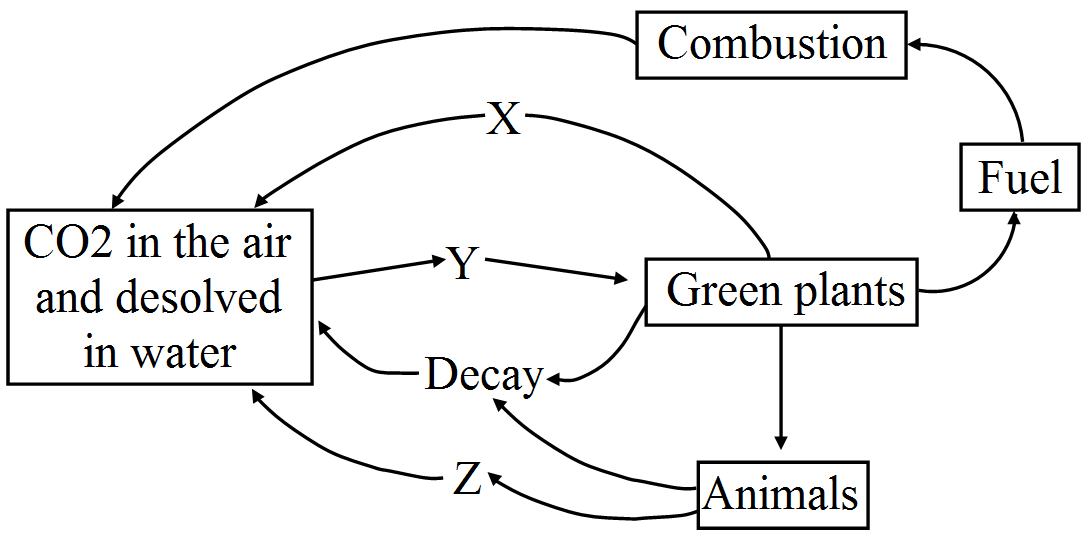
The diagram shows the carbon cycle.


Identify X, Y and Z.
Answer
X and Z- Respiration and Y- Photosynthesis.
View full question & answer
Question 981 Mark
'Ecosystem is called an interactive system'. Name a functional aspect of ecosystem which justifies the above statement.
Answer
Energy exchange and flow of nutrient cycling
View full question & answer
Question 991 Mark
List any two ways of measuring the standing crop of a trophic level.
Answer
Two ways of measuring the standing crop of a trophic level are:
  1. Biomass of living organisms.
  2. Number in an unit area.
View full question & answer
Question 1001 Mark
State what does standing crop of a trophic level represent.
Answer
Standing crop represents total amount of living matter or organic matter present in an ecosystem in an unit area and at a specific time.
View full question & answer
Question 1011 Mark
Define ecological succession.
Answer
Ecological succession is a community controlled phenomenon, in which the structure and composition of communities change in an orderly and sequential manner, leading ultimately to the establishment of a climax community.
View full question & answer
Question 1021 Mark
Mark the odd one in the following group.
Phytoplanktons, Zooplanktons, Reed-swamp stage, Lichens.
Answer
Lichens.
View full question & answer
Question 1031 Mark
Name the two climatic factors that regulate decomposition.
Answer
Temperature and soil moisture are the two climatic factors that regulate decomposition.
View full question & answer
Question 1051 Mark
Why is the assimilation of energy at the herbivore level, called secondary productivity?
Answer
Herbivores are the primary consumers; the rate of assimilation or formation of new biomass at the consumer level is secondary productivity.
View full question & answer
Question 1061 Mark
What is common to earthworm, mushroom, soil mites and dung beetle in an ecosystem.
Answer
They are all detritivores, i.e., decomposing organisms which feed on dead remains of plants and animals.
View full question & answer
Question 1081 Mark
Name the two forms of reservoirs of carbon that regulate the ecosystem carbon cycle.
Answer
Dissolved carbon in oceans and carbon in rocks, sediments and fossils are the two forms of carbon reservoirs.
View full question & answer
Question 1091 Mark
Where is the reservoir for gaseous type of biogeochemical cycle located?
Answer
It is in the atmosphere.
View full question & answer
Question 1101 Mark
In the following table the ecological units are mentioned in the first column vertically and their attributes are mentioned horizontally. Match the ecological units and its attribute and put a tick in the blank with the table:
Attribute $\rightarrow$
Ecological Unit $\downarrow$
Age
Flow of Energy
Natality
Predator prey relationship
Individual organism


Population


Commupity


Ecosystem


Answer
Attribute $\rightarrow$
Ecological Unit $\downarrow$
Age
Flow of Energy
Natality
Predator prey relationship
Individual organism
$\checkmark$


Population
 
 
$\checkmark$
 
Commupity


$\checkmark$
Ecosystem
 
$\checkmark$
 
 
View full question & answer
Question 1111 Mark
Name the natural reservoir of phosphorus and the form in which it is present.
Answer
  1. Rocks are the natural reservoir of phosphorus.
  2. It is present in the form of phosphates.
View full question & answer
Question 1121 Mark
What is meant by species composition in an ecosystem?
Answer
Species composition refers to all the plant, animal and microbial species present in a given ecosystem.
View full question & answer
Question 1141 Mark
What does 'R' represent in the given equation for productivity in an ecosystem?
GPP - R = NPP
Answer
In the given equation for productivity in an ecosystem, GPP-R= NPP. 'R' represents the energy utilised by plants or producers in respiration. It is also referred to as respiration losses.
View full question & answer
Question 1151 Mark
What is the starting point of a grazing food chain and of a detritus food chain? 6. Why is a food web formed in nature?
Answer
Producers and dead organic matter, respectively.
View full question & answer
Question 1161 Mark
Name the two forms of reservoir of carbon, that regulate the ecosystem carbon cycle.
Answer
  1. Dissolved carbon in oceans.
  2. Carbon in fossil fuels.
View full question & answer
Question 1171 Mark
What is 'stratification' in an ecosystem?
Answer
'Stratification' in an ecosystem refers to the vertical distribution of different species occupying different levels.
View full question & answer
Question 1181 Mark
Define the term transducers.
Answer
Producers are also called transducers because they are able to change radiant or light energy into chemical form.
View full question & answer
Question 1191 Mark
In the North East region of lndia, during the process of jhum cultlvation, forests are cleared by burning and left for regrowth after a year of cultivation. How would you explain the regrowth of forest in ecological terms?
Answer
It is secondary succession.
View full question & answer
Question 1201 Mark
What is meant by humification?
Answer
The process of formation of humus from detritus or organic matter is called humification.
View full question & answer
Question 1211 Mark
Define food chain.
Answer
It is referred to the transfer of energy (food) from the producers through a series of consumers.
View full question & answer
Question 1221 Mark
What is the approximate value of net primary productivity of the biosphere?
Answer
170 billion tons of (dry weight) organic matter.
View full question & answer
Question 1231 Mark
Write a difference between net primary productivity and gross primary productivity.
OR
How is net primary productivity different from gross primary productivity?
Answer
A difference between c and gross primary productivity is:
S. No.
gross primary productivity.
net primary productivity
1.
It is the rate of production of biomass/organic matter by producers during photosynthesis.
It refers to the biomass/ organic matter available for the consumption to heterotrophs, left after some respiratory losses.
View full question & answer
Question 1241 Mark
Define climax community.
Answer
The community established at the terminal stage of succession, is called climax community.
View full question & answer