Questions · Page 2 of 2

1 Marks Question

Question 511 Mark
Which of the following lattices has the highest packing efficiency:
  1. Simple cubic,
  2. Body-centred cubic and,
  3. Hexagonal close-packed lattice?
Answer
Packing efficiency of:
  1. Simple cubic = 52.4%
  2. Body-centred cubic = 68%
  3. Hexagonal close-packed = 74%
Hcp lattice has the highest packing efficiency.
View full question & answer
Question 521 Mark
A group 14 element is to be converted into n-type semiconductor by doping it with a suitable impurity. To which group should this impurity belong?
Answer
Impurity from group 15 should be added to get n-type semiconductor.
View full question & answer
Question 531 Mark
Face centred cubic unit cell?
Answer
8(corner atoms) $\times\frac{1}{8}+6$ (face centre atoms) $\frac{1}{2}=1+3=4$
View full question & answer
Question 551 Mark
What kind of attractive forces are present in the molecular crystalline solids?
Answer
Dispersion forces, dipole–dipole interactions and hydrogen bonds.
View full question & answer
Question 561 Mark
What is the difference in the semiconductors obtained by doping silicon with Al and with P?
Answer
Silicon doped with Al forms p-type semiconductors, while silicon doped with P produces n-type semiconductors.
View full question & answer
Question 571 Mark
What is the two dimensional coordination number of a molecule in square close-packed layer?
Answer
In 2D, square close-packed layer, an atom touches 4 nearest neighbouring atoms. Hence, its CN=4.
View full question & answer
Question 581 Mark
Ionic solids conduct electricity in molten state but not in solid state. Explain.
Answer
In solid state, the ions cannot move, they are held by strong electrostatic forces of attraction. So, ionic solids do not conduct electricity in solid state. However, in the molten state, they dissociate to give tree ions and hence conduct electricity.
View full question & answer
Question 601 Mark
Why is glass considered a super cooled liquid?
Answer
Similar to liquids, glass has a tendency to flow, though very slowly. Therefore, glass is considered as a super cooled liquid. This is the reason that glass windows and doors are slightly thicker at the bottom than at the top.
View full question & answer
Question 611 Mark
How does the electrical conductivity of semiconductors vary with temperature?
Answer
Electrical conductivity of semiconductors increases with increase in temperature as more electrons can jump from valence band to conduction band.
View full question & answer
Question 621 Mark
A compound $\mathrm{AB}_2$ possesses the $\mathrm{CaF}_2$ type crystal structure. Write the coordination number of $\mathrm{A}^{2+}$ and $\mathrm{B}^{-}$ions in its crystals.
Answer
Coordination no. of A = 8, Coordination no. of B = 4.
View full question & answer
Question 631 Mark
Define face-centred cubic structure.
Answer
A face-centred cubic structure has one atom at each corner and one atom at each face centre.
View full question & answer
Question 651 Mark
How many lattice point are there in one unit cell of each of the following lattice?
Face-centred cubic.
Answer
There are 14 (8 from the corners + 6 from the faces) lattice points in face-centred cubic.
View full question & answer
Question 661 Mark
What type of semiconductor is obtained when silicon is doped with arsenic?
Answer
n-type of semiconductor is obtained.
View full question & answer
Question 671 Mark
What is Frenkel defect?
Answer
When some ions (usually cations) are missing from the lattice sites and they occupy the interstitial sites so that electrical neutrality as well as stoichiometry is maintained, it is called Frenkel defect.
View full question & answer
Question 681 Mark
Explain how much portion of an atom located at:
  1. Corner and,
  2. Bodycentre of a cubic unit cell is part of its neighbouring unit cell.
Answer
  1. An atom located at the corner of a cubic unit cell is shared by eight adjacent unit cells.
Therefore, $\frac{1}{8}$ portion of the atom is shared by one unit cell.
  1. An atom located at the body centre of a cubic unit cell is not shared by its neighbouring unit cell. Therefore, the atom belongs only to the unit cell in which it is present i.e., its contribution to the unit cell is 1.
View full question & answer
Question 691 Mark
What type of magnetism is shown in the following alignment of magnetic moments?
$\uparrow\ \ \uparrow\ \ \uparrow\ \ \uparrow\ \ \uparrow\ \ \uparrow$
Answer
Ferromagnetism.
View full question & answer
Question 701 Mark
Why do solids have a definite volume?
Answer
The constituent particles of a solid have fixed positions and are not free to move about, i.e., they possess rigidity. That is why they have definite volume.
View full question & answer
Question 711 Mark
How many effective sodium ions are located at the edge centre of a unit cell in a sodium chloride crystal?
Answer
$12\times\frac{1}{4}=3.$
View full question & answer
Question 721 Mark
Why is the window glass of old buildings thick at the bottom?
Answer
Glass is not a true solid but a supercooled liquid of high viscosity (called pseudo-solid). It has the property to flow.
View full question & answer
Question 731 Mark
What type of crystal defect is produced when sodium chloride is doped with $\mathrm{MgCl}_2$ ?
Answer
A cation vacancy is formed, so impurity defect is produced. A substitutional solid solution is formed (because $2 \mathrm{Na}^{+}$ ions are replaced by one $\mathrm{Mg}^{2+}$ ion at the lattice site).
View full question & answer
Question 741 Mark
Why does Frenkel defect not change the density of AgCl crystals?
Answer
Because of the Frenkel defect, no ion is missing from the crystal, therefore there is no change in density.
View full question & answer
Question 751 Mark

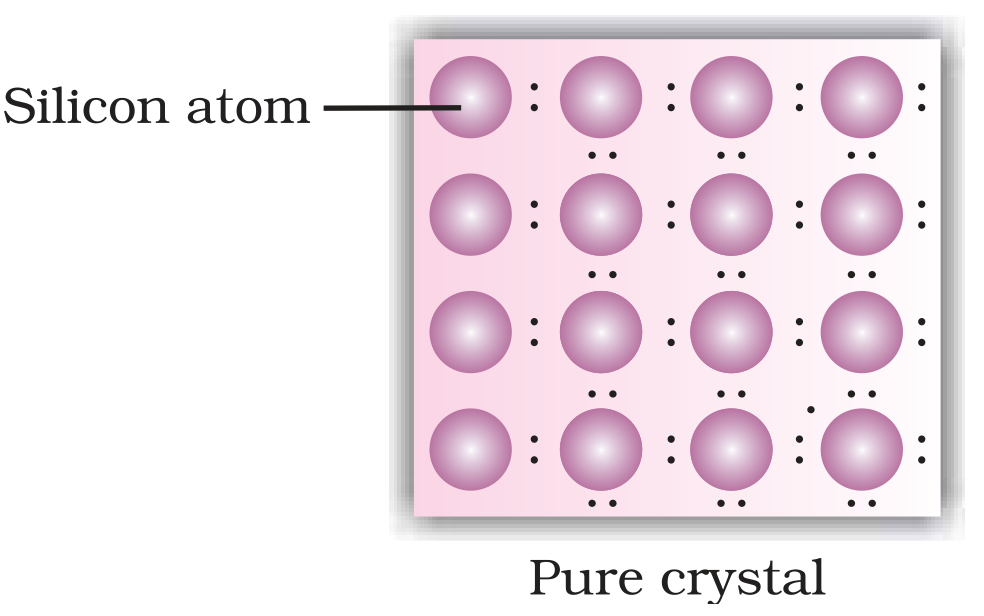
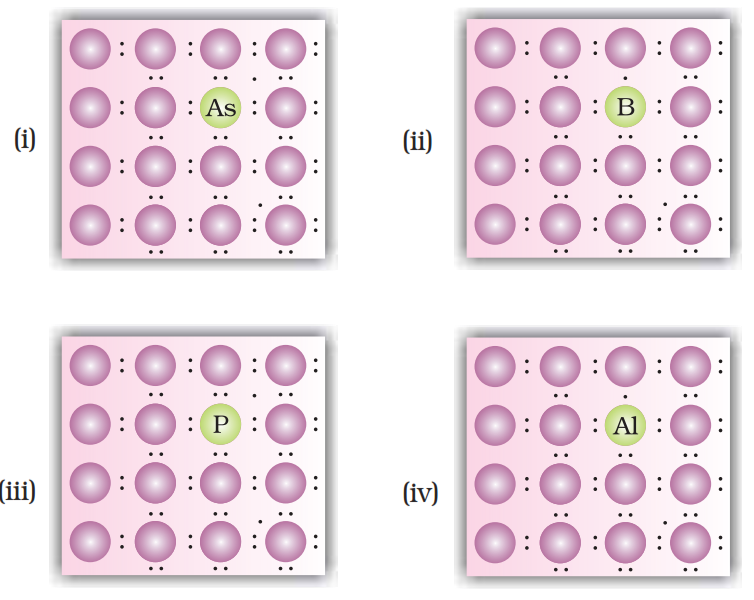
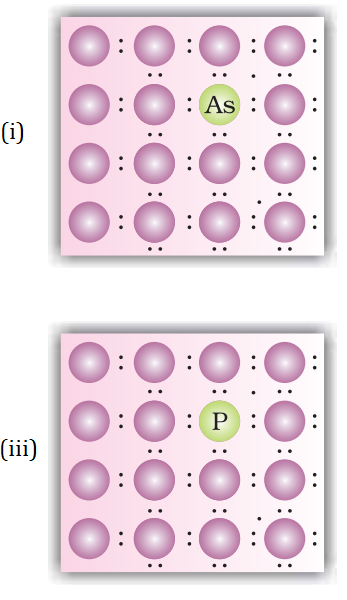
A perfect crystal of silicon is doped with some elements as given in the options. Which of these options show n-type semiconductors?

Answer


Explanation:
n-type semiconductors are prepared by doping perfect crystal of silicon (Si) with pentavalent elements of group 15 (viz. P and As). Some of the lattice sites in silicon crystal are occupied by fifth electron which is left over as extra electron and couldn't form a bond with tetravalent Si. The images (i) and (iii) exhibits this situation representing n-type semiconductor.
View full question & answer
Question 771 Mark
What is the meaning of the term imperfection in solids?
Answer
Imperfection refers to the irregularities in the arrangement of atoms, ions or molecules in the structure of crystalline substances.
View full question & answer
1 Marks Question - Page 2 - Chemistry STD 12 Science Questions - Vidyadip