Questions

1 Marks Question

Take a timed test

38 questions · self-marked practice — reveal the answer and mark yourself.
Question 21 Mark
Two wires one of copper and other of manganin have same resistance and equal length. Which wire is thicker and why?
Answer
  1. Manganin.
  2. $\text{R} = \frac{pl}{\text{A}^{.}}$ As $\rho$ increases A also increases.
Alternate Answer
$\text{R}_{c} = \rho_{c}\frac{l}{\text{A}_{c}} ; \text{R}_{m} = \rho_{m}\frac{l}{\text{A}_{m}}.\text{ since } \rho_{m} > \rho_{c}\therefore \text{A}_{m} > \text{A}_{c}$
View full question & answer
Question 31 Mark
Define the term relaxation time' in a conductor.
Answer
Def: The average time, between successive collisions of electrons, (in a conductor) is known as relaxation time.
View full question & answer
Question 41 Mark
The power factor of an a.c. circuit is 0.5. What is the phase difference between voltage and current in the circuit?
Answer
Phase angle = $60^\circ$.
View full question & answer
Question 51 Mark
What is the amount of work done in moving a point charge Q around a circular arc of radius ‘r' at the centre of which another point charge ‘q' is located?
Answer
Zero/No work done/None.
View full question & answer
Question 61 Mark
Define mobility of a charge carrier. What is its relation with relaxation time?
Answer
Drift velocity per unit field
$(\mu_{m} = u_{d}\big/\text{E})$
$\mu_{n}\propto\tau$.
View full question & answer
Question 71 Mark
What can be the cause of helical motion of a charged particle?
Answer
Charged particle moves inclined to the magnetic field (angle between $\overrightarrow{\vartheta}$ and $\overrightarrow{\text{B}}$ is neither $\frac{\pi}{2}$ nor 0).
(component of $\overrightarrow{\vartheta}$, parallel to $\overrightarrow{\text{B}}$ , is not zero.)
View full question & answer
Question 81 Mark
Why can't we see clearly through fog? Name the phenomenon responsible for it.
Answer
(Some) light gets deviated/scattered/absorbed.
Scattering of light.
View full question & answer
Question 101 Mark
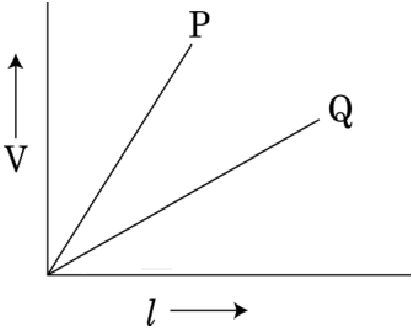
The variation of potential V with length l in case of two potentiometers wires P and Q is as shown. Which one of these will you prefer comparing emfs of two primary cells and why?
Answer
Potentiometer ‘Q’ will be preferred
Reason: $\text{Sensitivity}\propto\frac{1}{\text{potential gradient (k)}}$
Since potential gradient is less, sensitivity is more.
View full question & answer
Question 111 Mark
Why is the use of a.c. voltage preferred over d.c. voltage? Give two reasons.
Answer
Any two of the following reasons:
  1. AC can be transmitted with much lower energy losses as compared to DC.
  2. AC voltage can be adjusted (stepped up or stepped down) as per requirement.
  3. AC current in a circuit can be controlled using (almost) wattless devices like the choke coil.
  4. AC is easier to generate.
View full question & answer
Question 121 Mark
In which situation is there a displacement current but no conduction current?
Answer
Between plates of capacitor during charging/discharging.
Alternate Answer
In the region of time-varying electric field.
View full question & answer
Question 131 Mark
A signal of 5 kHz frequency is amplitude modulated on a carrier wave of frequency 2 MHz. What are the frequencies of the side bands produced?
Answer
$\text{V}_{side bands} = \text{V}_{c}\pm\text{u}_{m}$
= 2005 kHz ; 1995 kHz.
View full question & answer
Question 141 Mark
Define the term conductivity of a conductor. On what factors does it depend?
Answer
Conductivity of a conductor is the current flowing per unit area per unit electric field applied.
Alternate Answer
conductivity $\sigma = \frac{j}{\text{E}}$
Depends upon number density i.e. nature of material, and relaxation time i.e. temperature.
View full question & answer
Question 151 Mark
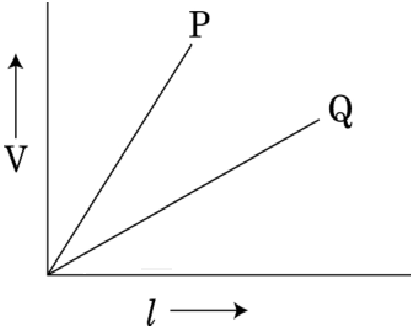
The variation of potential V with length l in case of two potentiometers wires P and Q is as shown. Which one of these will you prefer comparing emfs of two primary cells and why?
Answer
Potentiometer ‘Q’ will be preferred
Reason: $\text{Sensitivity}\propto\frac{1}{\text{potential gradient (k)}}$
Since potential gradient is less, sensitivity is more.
View full question & answer
Question 161 Mark
Explain why current flows through an ideal capacitor when it is connected to an a.c. Source but not when it is connected to a do. Source in a steady state.
Answer
For a.c. source, circuit is complete due to the presence of displacement current in the capacitor. For steady dc, there is no displacement current, therefore, circuit is not complete.
Alternate Answer
[Capacitive reactance $\text{X}_{c} =\frac{1}{2\pi\text{fC}} = \frac{1}{\omega\text{t}}$
So, capacitor allows easy path for a.c. Source. For d.c, f= 0, so Xc = infinity, So capacitor blocks d.c].
View full question & answer
Question 171 Mark
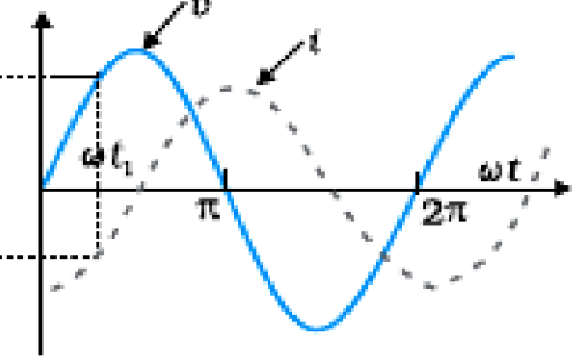
An a.c. source of voltage $\text{V} = \text{V}_{o} \sin \omega \text{t}$ is connected to an ideal inductor. Draw graphs of voltage V and current i versus $\omega\text{t}.$
Answer


Graph of V.
Graph of I.
View full question & answer
Question 181 Mark
The instantaneous current and voltage of an a.c. circuit are given by
i = 10 sin 300t A and v = 200 sin 300t V
What is the power dissipation in the circuit?
Answer
$\text{P} = \frac{1}{2}\text{E}_{0}\text{I}_{0}$
Power dissipated = 1000 W or 1 kW.
View full question & answer
Question 191 Mark
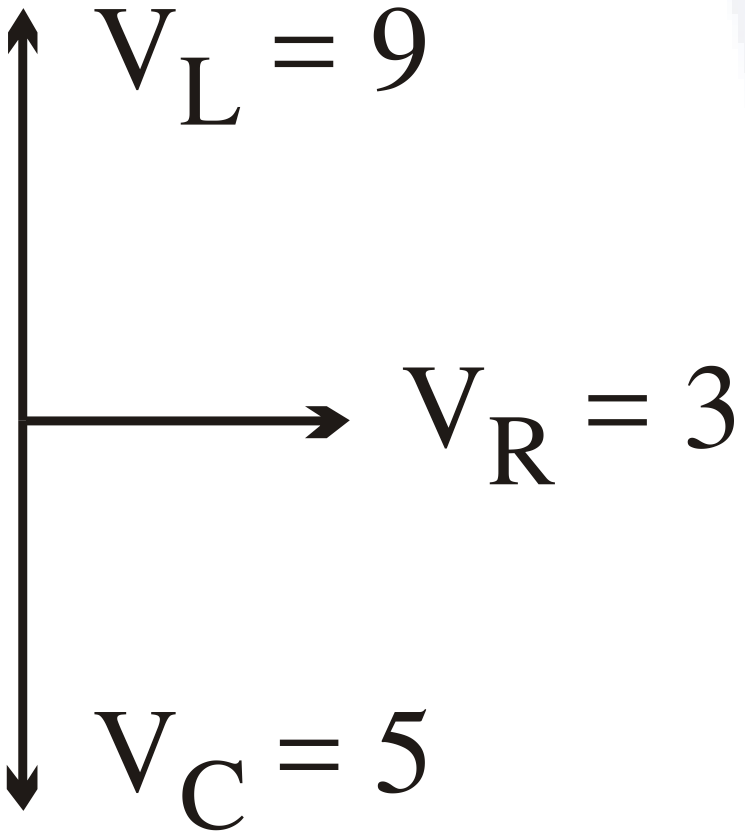
In a series LCR circuit, the voltages across an inductor, a capacitor and a resistor are 30 V, 30 V and 60 V respectively. What is the phase difference between the applied voltage and the current in the circuit?
Answer
Applied Voltage and current are in the same phase.Alternate Answer
$\theta = 0 $ or simply zero.Alternate Answer
tan $\theta = \frac{\text{V}_{L} -\text{V}_{c}}{\text{V}_{R}} = 0 $.Alternate Answer
$\tan \theta = 0 $.
View full question & answer
Question 201 Mark
Define capacitor reactance. Write its S.I. units.
Answer
It is defined as the opposition to the flow of current in AC circuits offered by a capacitor.
Alternate Answer
$\text{X}_{c} = \frac{1}{\omega\text{c}}$
S.l unit: ohm.
View full question & answer
Question 211 Mark
Define ‘quality factor’ of resonance in series LCR circuit. What is its SI unit?
Answer
Quality factor $\text{Q} = \frac{\omega_o}{2\Delta\omega} , $
Alternate Answer
Quality factor $\text{Q} = \frac{\omega_o\text{L}}{\text{R}} , $

Alternate Answer
It gives the sharpness of the resonance circuit.]
It has no unit.
View full question & answer
Question 221 Mark
Define the term 'wattless current'.
Answer
Current flowing in a circuit without any net dissipation of power, is called wattless current.
View full question & answer
Question 231 Mark
When an AC source is connected to a capacitor there is a steady-state current in the circuit. Does it mean thatthe charges jump from one plate to the other to complete the circuit?
Answer
No.
View full question & answer
Question 241 Mark
An AC source is connected to a capacitor. Will the rms current increase, decrease or remain constant if a dielectric slab is inserted into the capacitor?
Answer
$\text{X}_\text{c}=\frac{1}{\omega\text{C}}$ as slab is introduced $C$ increases and $X_C$ decreases so current increases.
View full question & answer
Question 251 Mark
Can a hot-wire ammeter be used to measure a direct current having a constant value? Do we have to change the graduations?
Answer
Yes, in this case $\mathrm{I}_{\mathrm{rms}}$ value will be same as the DC current.
View full question & answer
Question 261 Mark
What is the reactance of a capacitor connected to a constant DC source?
Answer
$\text{X}_\text{c}=\frac{1}{\omega\text{C}}$
As,
$\omega=0$
For,
$\text{DC},\text{X}_\text{c}=\infty.$
View full question & answer
Question 271 Mark
In a circuit containing a capacitor and an AC source the current is zero at the. stant the source voltage is maximum. Is it consistent with Ohm's law?
Answer
Ohm's law is valid for resistance.
View full question & answer
Question 281 Mark
Can the peak voltage across the inductor be greater than the peak voltage of the source in an LCR circuit?
Answer
Yes,
Consider example below:
View full question & answer
Question 291 Mark
A current $\text{i}_1=\text{i}_0\sin\omega\text{t}$ passes through a resistor of resistance R. How much thermal energy is produced in one time period? A current $\text{i}_2=-\text{i}_0\sin\omega\text{t}$ passes through the resistor. How much thermal energy is produced in one time period? If $i_1$, and $i_2$ both pass through the resistor simultaneously, how much thermal energy is produced? Is the principle of superposition obeyed in this case?
Answer
$\text{I}_\text{rms}^{2}\times\text{R}\times\frac{2\pi}{\omega}$ from definition of rms current.
$i_1$, and $i_2$ both pass through the resistor simultaneously, and same thermal energy is produced.
Similary, the principle of superposition obeyed in this case zero.
View full question & answer
Question 301 Mark
What is the phase difference between voltage and current in a LCR series circuit at resonance?
Answer
At resonance voltage and current are in the same phase, i.e., phase difference between voltage and current at resonance is zero.
View full question & answer
Question 311 Mark
Is energy produced when a transformer steps up the voltage?
Answer
No, as voltage increases current decreases. Hence, if efficiency is 100% power will be same.
View full question & answer
Question 321 Mark
When the frequency of the AC source in an LCR circuit equals the resonant frequency, the reactance of the circuit is zero. Does it mean that there is no current through the inductor or the capacitor?
Answer
There is current but the potential difference across inductor and capacitor cancel each other.
View full question & answer
Question 331 Mark
Can you, have an AG series circuit in which there is. a phase difference of 180° between the emf and the current? 120°?
Answer
No.
View full question & answer
Question 341 Mark
State which of the two, the capacitor or an inductor, tends to become a SHORT when the frequency of the applied alternating voltage has a very high value.
Answer
The capacitor $\text{X}_{\text{C}}=\frac{1}{\omega{\text{C}}}=\frac{1}{2\pi\text{vC}}$
When $\text{v}\rightarrow\infty(\text{very high})$
$\text{X}_{\text{C}}=0$
View full question & answer
Question 351 Mark
Two alternating currents are given by, $\text{i}_\text{i}=\text{i}_0\sin\omega\text{t}$ and $\text{i}_\text{i}=\text{i}_0\sin\Big(\omega\text{t}+\frac{\pi}{3}\Big)$ Will the rms values of the currents be equal or different?
Answer
$\mathrm{I}_{\mathrm{rms}}$ will be equal because in a complete cycle heat dissipated will be equal for both.
View full question & answer
Question 361 Mark
In India, Domestic power supply is at 220V, 50Hz; while in USA it is 110V, 50Hz. Give one advantage and one disadvantage of 220V supply over 110V supply.
Answer
Advantage: Line loss is low.
Disadvantage: High voltage is dangerous.
View full question & answer
Question 371 Mark
A pure inductor of $25.0 mH$ is connected to a source of $220 V$. Find the inductive reactance and rms current in the circuit if the frequency of the source is $50 Hz$.
Answer
The inductive reactance,
$
\begin{aligned}
X_L & =2 \pi v L=2 \times 3.14 \times 50 \times 25 \times 10^{-3} \Omega \\
& =7.85 \Omega
\end{aligned}
$
The rms current in the circuit is
$
I=\frac{V}{X_L}=\frac{220 V }{7.85 \Omega}=28 A
$
View full question & answer
Question 381 Mark
At an airport, a person is made to walk through the doorway of a metal detector, for security reasons. If she/he is carrying anything made of metal, the metal detector emits a sound. On what principle does this detector work?
Answer
The metal detector works on the principle of resonance in ac circuits. When you walk through a metal detector, you are, in fact, walking through a coil of many turns. The coil is connected to a capacitor tuned so that the circuit is in resonance. When you walk through with metal in your pocket, the impedance of the circuit changes - resulting in significant change in current in the circuit. This change in current is detected and the electronic circuitry causes a sound to be emitted as an alarm.
View full question & answer