Questions

2 Marks Questions

Take a timed test

6 questions · self-marked practice — reveal the answer and mark yourself.

Question 12 Marks
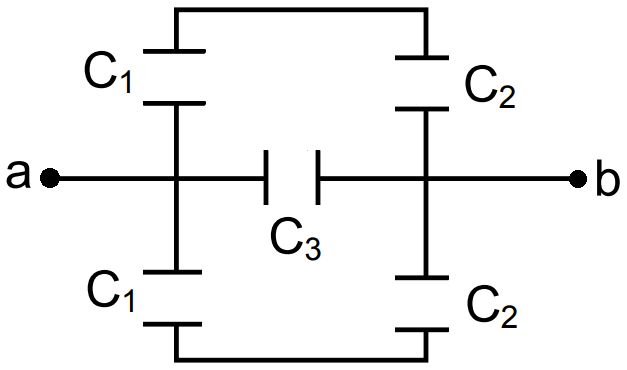
Find the equivalent capacitance of the syatem shown in figure between the points a and b.
Answer
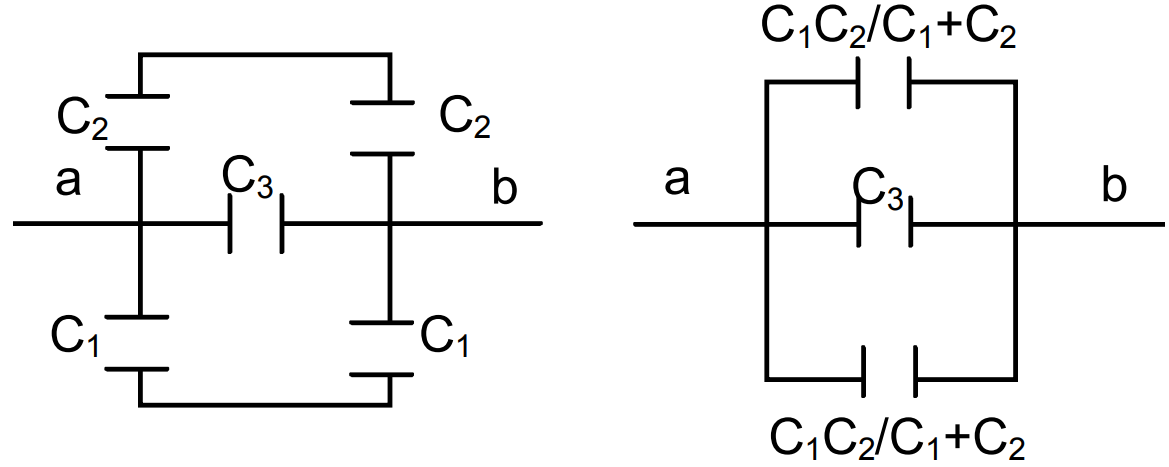
$C_{eq}$ between a & b
$=\frac{\text{C}_1\text{C}_2}{\text{C}_1+\text{C}_2}+\text{C}_3+\frac{\text{C}_1\text{C}_2}{\text{C}_1+\text{C}_2}$
$=\text{C}_3+\frac{2\text{C}_1\text{C}_2}{\text{C}_1+\text{C}_2}$ $(\therefore$ The three are parallel$)$
View full question & answer
Question 22 Marks
A 100pF capacitor is charged to a potential difference of 24V. It is connected to an uncharged capacitor of capacitance 20pF. What will be the new potential difference across the 100pF capacitor?
Answer
Given that
$ \mathrm{C}=100 \mathrm{PF}=100 \times 10^{-12} \mathrm{~F}$
$ \mathrm{C}_{\mathrm{eq}}=20 \mathrm{PF}=20 \times 10^{-12} \mathrm{~F} $
$\mathrm{~V}=24 \mathrm{v} $
$\mathrm{q}=24 \times 100 \times 10^{-12}=24 \times 10^{-10} $
$ \mathrm{q}_2=?$
Let $\mathrm{q}_1=$ The new charge 100PF $\mathrm{V}_1=$ The Voltage.
Let the new potential is $V_1$
After the flow of charge, potential is same in the two capacitor
$\text{V}_1=\frac{\text{q}_2}{\text{C}_2}=\frac{\text{q}_1}{\text{C}_1}$
$=\frac{\text{q}-\text{q}_1}{\text{C}_2}=\frac{\text{q}_1}{\text{C}_1}$
$=\frac{24\times10^{-10}-\text{q}_1}{24\times10^{-12}}=\frac{\text{q}_1}{100\times10^{-12}}$
$=24\times10^{-10}-\text{q}_1=\frac{\text{q}_1}{5}$
$=6\text{q}_1=120\times10^{-10}$
$=\text{q}_1=\frac{120}{6}\times10^{-10}=20\times10^{-10}$
$\therefore\text{V}_1=\frac{\text{q}_1}{\text{C}_1}=\frac{20\times10^{-10}}{100\times10^{-12}}=20\text{v}$
View full question & answer
Question 32 Marks
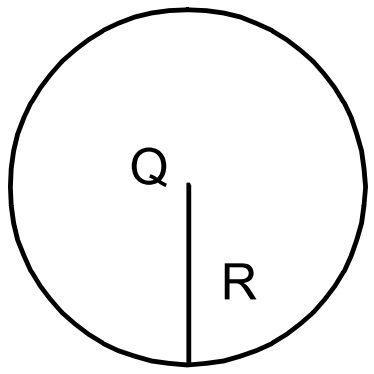
A point charge Q is placed at the origin. Find the electrostatic energy stored outside the sphere of radius R centred at the origin.
Answer

Charge = Q
Radius of sphere = R
$\therefore$ Capacitance of the sphere $=\text{C}=4\pi\in_0\text{R}$
Energy $=\frac{1}{2}\frac{\text{Q}^2}{\text{C}}=\frac{1}{2}\frac{\text{Q}^2}{4\pi\in_0\text{R}}=\frac{\text{Q}^2}{8\pi\in_0\text{R}}$
View full question & answer
Question 42 Marks
A cylindrical capacitor is constructed using two coaxial cylinders of the same length 10cm and of radii 2mm and 4mm:
  1. Calculate the capacitance.
  2. Another capacitor of the same length is constructed with cylinders of radii 4mm and 8mm. Calculate the capacitance.
Answer
  1. $\text{C}=\frac{2\in_0\text{L}}{\text{ln}\big(\frac{\text{R}_2}{\text{R}_1}\big)}=\frac{\text{e}\times3.14\times8.85\times10^{-2}\times10^{-1}}{\text{ln}2}$ $[\text{ln 2}=0.6932]$
$=80.17\times10^{-13}$

$\Rightarrow8\text{PF}$
  1. Same as $\frac{\text{R}_2}{\text{R}_1}$ will be same.
View full question & answer
Question 52 Marks
Two conducting spheres of radii $R_1$ and $R_2$ are kept widely separated from each other. What are their individual capacitances? If the spheres are connected by a metal wire, what will be the capacitance of the combination? Think in terms of series-parallel connections.
Answer
$\text{C}=\frac{\text{q}}{\text{V}},$ Now $\text{V}=\frac{\text{kq}}{\text{R}}$
So, $\text{C}_1=\frac{\text{q}}{\Big(\frac{\text{Kq}}{\text{R}_1}\Big)}=\frac{\text{R}_1}{\text{K}}=4\pi\in_0\text{R}_1$
Similarly, $\text{c}_2=4\pi\in_0\text{R}_2$
The combination is necessarily parallel.
Hence $\text{C}_{\text{eq}}=4\pi\in_0\text{R}_1+4\pi\in_0\text{R}_2=4\pi\in_0(\text{R}_1+\text{R}_2)$
View full question & answer
Question 62 Marks
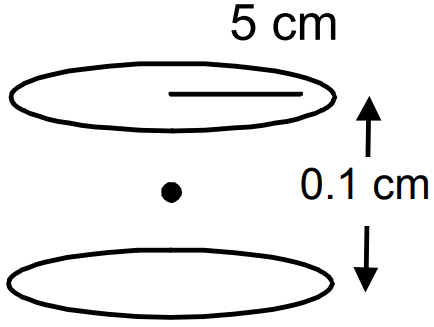
The plates of a parallel-plate capacitor are made of circular discs of radii 5.0cm each. If the separation between the plates is 1.0mm, what is the capacitance?
Answer

$\text{A}=\pi\text{r}^2=25\pi\text{m}^2$
$\text{d}=0.1\text{cm}$
$\text{c}=\frac{\in_0\text{A}}{\text{d}}$
$=\frac{8.854\times10^{-12}\times25\times3.14}{0.1}$
$=6.95\times10^{-5}\mu\text{F}$
View full question & answer