MCQ 3011 Mark
Magnetic flux in a circuit containing a coil of resistance 2Ω changes from 2.0 Wb to 10 Wb in 0.2 sec. The charge passed through the coil in this time is
MCQ 3021 Mark
The coil of area 0.1 $\mathrm{m}^2$ has 500 turns. After placing the coil in a magnetic field of strength $4 \times 10^{-4} \mathrm{wb} / \mathrm{m}^2$, if rotated through $90^{\circ}$ in 0.1 s, the average emf induced in the coil is
View full question & answer→MCQ 3031 Mark
The magnetic flux linked with coil, in weber is given by the equation, $\phi=5 t^2+3 t+16$ The induced emf in the coil in the fourth second is
View full question & answer→MCQ 3041 Mark
If a copper ring is moved quickly towards south pole of a powerful stationary bar magnet, then
- ✓
Current flows through the copper ring
- B
Voltage in the magnet increase
- C
Current flows in the magnet
- D
Copper ring will get magnetised
AnswerCorrect option: A. Current flows through the copper ring
Current flows through the copper ring
View full question & answer→MCQ 3051 Mark
A coil having n turns and resistance R W is connected with a galvanometer of resistance 4RΩ. This combination is moved in time t seconds from a magnetic field $W_1$ weber to $W_2$ weber. The induced current in the circuit is
- A
$-\frac{\mathrm{W_2-W_1}}{5 \mathrm{Rnt}}$
- ✓
$-\frac{n\left(\mathrm{W_2-W_1}\right)}{\mathrm{5 R t}}$
- C
$-\frac{\left(\mathrm{W}_2-\mathrm{W}_{1)}\right)}{\mathrm{Rnt}}$
- D
$-\frac{\mathrm{n}\left(\mathrm{W}_2-\mathrm{W}_1\right)}{\mathrm{Rt}}$
AnswerCorrect option: B. $-\frac{n\left(\mathrm{W_2-W_1}\right)}{\mathrm{5 R t}}$
(b) $-\frac{n\left(\mathrm{W_2-W_1}\right)}{\mathrm{5 R t}}$
View full question & answer→MCQ 3061 Mark
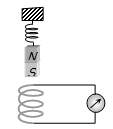
A magnet NS is suspended from a spring and while it oscillates, the magnet moves in and out of the coil C. The coil is connected to a galvanometer G. Then as the magnet oscillates,
- A
G shows deflection to the left and right with constant amplitude
- B
G shows deflection on one side
- C
- ✓
G shows deflection to the left and right but the amplitude steadily decreases.
AnswerCorrect option: D. G shows deflection to the left and right but the amplitude steadily decreases.
(d) G shows deflection to the left and right but the amplitude steadily decreases.
View full question & answer→MCQ 3071 Mark
The magnetic flux linked with a circuit of resistance 100 ohm increases from 10 to 60 webers. The amount of induced charge that flows in the circuit is (in coulomb)
MCQ 3081 Mark
The magnetic flux linked with a vector area $\vec{A}$ in a uniform magnetic field $\vec{B}$ is
- A
$\vec{B} \times \vec{A}$
- B
$A B$
- ✓
$\vec{B} \cdot \vec{A}$
- D
$\frac{B}{A}$
AnswerCorrect option: C. $\vec{B} \cdot \vec{A}$
(c) $\vec{B} \cdot \vec{A}$
View full question & answer→MCQ 3091 Mark
When a bar magnet falls through a long hollow metal cylinder fixed with its axis vertical, the final acceleration of the magnet is
- ✓
- B
- C
- D
Equal to g in to beginning and then more than g
View full question & answer→MCQ 3101 Mark
A coil has 1,000 turns and 500 cm$^2$ as its area. The plane of the coil is placed at right angles to a magnetic induction field of $2 \times 10^{-5} \mathrm{wb} / \mathrm{m}^2$. The coil is rotated through 180° in 0.2 seconds. The average e.m.f. induced in the coil, in milli-volts, is
View full question & answer→MCQ 3111 Mark
The magnetic flux linked with a coil at any instant $‘t’$ is given by $f = 5t^3– 100t + 300,$ the e.m.f. induced in the coil at $t = 2$ second is
- A
$– 40 \ V$
- ✓
$40 \ V$
- C
$140 \ V$
- D
$300 \ V$
AnswerCorrect option: B. $40 \ V$
$40 \ V$
View full question & answer→MCQ 3121 Mark
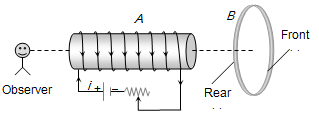
An aluminium ring B faces an electromagnet A. The current I through A can be altered
- A
Whether I increases or decreases, B will not experience any force
- B
If I decrease, A will repel B
- C
If I increases, A will attract B
- ✓
If I increases, A will repel B
AnswerCorrect option: D. If I increases, A will repel B
(d) If I increases, A will repel B
View full question & answer→MCQ 3131 Mark
A magnet is dropped down an infinitely long vertical copper tube
- ✓
The magnet moves with continuously increasing velocity and ultimately acquires a constant terminal velocity
- B
The magnet moves with continuously decreasing velocity and ultimately comes to rest
- C
The magnet moves with continuously increasing velocity but constant acceleration
- D
The magnet moves with continuously increasing velocity and acceleration
AnswerCorrect option: A. The magnet moves with continuously increasing velocity and ultimately acquires a constant terminal velocity
The magnet moves with continuously increasing velocity and ultimately acquires a constant terminal velocity
View full question & answer→MCQ 3141 Mark
The formula for induced e.m.f. in a coil due to change in magnetic flux through the coil is (here A = area of the coil, B = magnetic field)
- A
$\mathrm{e}=-\mathrm{A} \cdot \frac{\mathrm{dB}}{\mathrm{dt}}$
- B
$\mathrm{e}=-\mathrm{B} \cdot \frac{\mathrm{dA}}{\mathrm{dt}}$
- ✓
$\mathrm{e}=-\frac{\mathrm{d}}{\mathrm{dt}}(\mathrm{A} \cdot \mathrm{B})$
- D
$\mathrm{e}=-\frac{\mathrm{d}}{\mathrm{dt}}(\mathrm{A} \times \mathrm{B})$
AnswerCorrect option: C. $\mathrm{e}=-\frac{\mathrm{d}}{\mathrm{dt}}(\mathrm{A} \cdot \mathrm{B})$
(c) $\mathrm{e}=-\frac{\mathrm{d}}{\mathrm{dt}}(\mathrm{A} \cdot \mathrm{B})$
View full question & answer→MCQ 3151 Mark
Magnetic flux ∅ (in weber) linked with a closed circuit of resistance 10 ohm varies with time t (in seconds) as $\varnothing=5 t^2-4 t+1$ The induced electromotive force in the circuit at t = 0.2 sec. is
View full question & answer→MCQ 3161 Mark
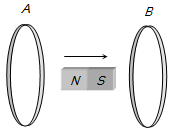
In the diagram shown if a bar magnet is moved along the common axis of two single turn coils A and B in the direction of arrow
- A
Current is induced only in A & not in B
- B
Induced currents in A & B are in the same direction
- C
Current is induced only in B and not in A
- ✓
Induced currents in A & B are in opposite directions
AnswerCorrect option: D. Induced currents in A & B are in opposite directions
(d) Induced currents in A & B are in opposite directions
View full question & answer→MCQ 3171 Mark
A moving conductor coil in a magnetic field produces an induced e.m.f. This is in accordance with
MCQ 3181 Mark
A coil has an area of $0.05 \mathrm{~m}^2$ and it has 800 turns. It is placed perpendicularly in a magnetic field of strength $4 \times 10^{-5} \mathrm{wb} / \mathrm{m}^2$, it is rotated through 90° in 0.1 sec. The average e.m.f. induced in the coil is
View full question & answer→MCQ 3191 Mark
The magnetic flux linked with a coil, in webers, is given by the equations $\phi=3 t^2+4 t+9$. Then the magnitude of induced e.m.f. at t = 2 second will be
View full question & answer→MCQ 3201 Mark
In a coil of area $10 \mathrm{~cm}^2$ and 10 turns with a magnetic field directed perpendicular to the plane and is changing at the rate of $10^8$ gauss/second. The resistance of the coil is 20 ohm. The current in the coil will be
View full question & answer→MCQ 3211 Mark
The total charge induced in a conducting loop when it is moved in magnetic field depends on
- A
The rate of change of magnetic flux
- B
Initial magnetic flux only
- ✓
The total change in magnetic flux
- D
AnswerCorrect option: C. The total change in magnetic flux
The total change in magnetic flux
View full question & answer→MCQ 3221 Mark
A magnetic field of $2 × 10^{-2}$ T acts at right angles to a coil of area $100\ cm^2$ with $50$ turns. The average emf induced in the coil is $0.1 V$, when it is removed from the field in time t. The value of $t$ is
- ✓
$0.1 \sec$
- B
$0.01 \sec$
- C
$1 \sec$
- D
$20 \sec$
AnswerCorrect option: A. $0.1 \sec$
$0.1 \sec$
View full question & answer→MCQ 3231 Mark
Faraday's laws are consequence of conservation of
- ✓
- B
Energy and magnetic field
- C
- D
View full question & answer→MCQ 3241 Mark
A coil of 40 W resistance has 100 turns and radius 6 mm is connected to ammeter of resistance of 160 ohms. Coil is placed perpendicular to the magnetic field. When coil is taken out of the field, 32 m C charge flows through it. The intensity of magnetic field will be
MCQ 3251 Mark
A solenoid is $1.5 m$ long and its inner diameter is $4.0 \ cm. $ It has three layers of windings of $1000$ turns each and carries a current of $2.0$ amperes. The magnetic flux for a cross$-$section of the solenoid is nearly
- A
$2.5 \times 10^{-7}$ weber
- ✓
$6.31 \times 10^{-6}$ weber
- C
$5.2 \times 10^{-5}$ weber
- D
$4.1 \times 10^{-5}$ weber
AnswerCorrect option: B. $6.31 \times 10^{-6}$ weber
$6.31 \times 10^{-6}$ weber
View full question & answer→MCQ 3261 Mark
To induce an e.m.f. in a coil, the linking magnetic flux
- A
- ✓
Can either increase or decrease
- C
- D
AnswerCorrect option: B. Can either increase or decrease
Can either increase or decrease
View full question & answer→MCQ 3271 Mark
The direction of induced current is such that it opposes the very cause that has produced it. This is the law of
MCQ 3281 Mark
In a circuit with a coil of resistance 2 ohms, the magnetic flux changes from 2.0 Wb to 10.0 Wb in 0.2 second. The charge that flows in the coil during this time is
MCQ 3291 Mark
A coil of 100 turns and area 5 square centimetre is placed in a magnetic field B = 0.2 T. The normal to the plane of the coil makes an angle of 60° with the direction of the magnetic field. The magnetic flux linked with the coil is
AnswerCorrect option: A. $5 \times 10^{-3} \mathrm{wb}$
(a) $5 \times 10^{-3} \mathrm{wb}$
View full question & answer→MCQ 3301 Mark
- A
The magnitude of the induced e.m.f.
- ✓
The direction of the induced current
- C
Both the magnitude and direction of the induced current
- D
The magnitude of the induced current
AnswerCorrect option: B. The direction of the induced current
The direction of the induced current
View full question & answer→MCQ 3311 Mark
The dimensions of magnetic flux are
- A
$\mathrm{MLT}^{-2} \mathrm{A}^{-2}$
- B
$\mathrm{ML}^2 \mathrm{T}^{-2} \mathrm{A}^{-2}$
- C
$\mathrm{ML}^2 \mathrm{T}^{-1} \mathrm{A}^{-2}$
- ✓
$\mathrm{ML}^2 \mathrm{T}^{-2} \mathrm{A}^{-1}$
AnswerCorrect option: D. $\mathrm{ML}^2 \mathrm{T}^{-2} \mathrm{A}^{-1}$
(d) $\mathrm{ML}^2 \mathrm{T}^{-2} \mathrm{A}^{-1}$
View full question & answer→MCQ 3321 Mark
The magnetic field in a coil of 100 turns and 40 square cm area is increased from 1 Tesla to 6 Tesla in 2 second. The magnetic field is perpendicular to the coil. The e.m.f. generated in it is
- A
$10^4 \mathrm{~V}$
- B
- ✓
- D
$10^{-2} \mathrm{~V}$
View full question & answer→MCQ 3331 Mark
The north pole of a long horizontal bar magnet is being brought closer to a vertical conducting plane along the perpendicular direction. The direction of the induced current in the conducting plane will be
MCQ 3341 Mark
The unit of magnetic flux is
- A
$\mathrm {weber/m}^2$
- ✓
- C
- D
View full question & answer→MCQ 3351 Mark
According to Faraday's law of electromagnetic induction
- A
The direction of induced current is such that it opposes the cause producing it
- ✓
The magnitude of induced e.m.f. produced in a coil is directly proportional to the rate of change of magnetic flux
- C
The direction of induced e.m.f. is such that it opposes the cause producing it
- D
AnswerCorrect option: B. The magnitude of induced e.m.f. produced in a coil is directly proportional to the rate of change of magnetic flux
The magnitude of induced e.m.f. produced in a coil is directly proportional to the rate of change of magnetic flux
View full question & answer→MCQ 3361 Mark
Two different loops are concentric and lie in the same plane. The current in the outer loop is clockwise and increasing with time. The induced current in the inner loop then, is
- A
- B
- ✓
- D
In a direction that depends on the ratio of the loop radii
View full question & answer→MCQ 3371 Mark
A coil having an area $2$m$^2$is placed in a magnetic field which changes from $1$ wb/m$^2$ to $4$ wb/m$^2$ in a interval of 2 second. The e.m.f. induced in the coil will be
View full question & answer→MCQ 3381 Mark
A 50 turns circular coil has a radius of 3 cm, it is kept in a magnetic field acting normal to the area of the coil. The magnetic field B increased from 0.10 tesla to 0.35 tesla in 2 milliseconds. The average induced e.m.f. in the coil is
MCQ 3391 Mark
A coil of area $100$ cm$^2$ has 500 turns. Magnetic field of $0.1$ weber/metre$^2$ is perpendicular to the coil. The field is reduced to zero in 0.1 second. The induced e.m.f. in the coil is
View full question & answer→MCQ 3401 Mark
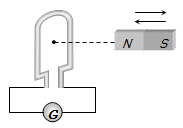
When a magnet is pushed in and out of a circular coil C connected to a very sensitive galvanometer G as shown in the adjoining diagram with a frequency v, then
- A
Constant deflection is observed in the galvanometer
- B
Visible small oscillations will be observed in the galvanometer if v is about 50 Hz
- ✓
Oscillations in the deflection will be observed clearly if v = 1 or 2 Hz
- D
No variation in the deflection will be seen if v = 1 or 2 Hz
AnswerCorrect option: C. Oscillations in the deflection will be observed clearly if v = 1 or 2 Hz
(c) Oscillations in the deflection will be observed clearly if v = 1 or 2 Hz
View full question & answer→MCQ 3411 Mark
The direction of induced e.m.f. during electromagnetic induction is given by
MCQ 3421 Mark
A square coil $10^{-2}$ m$^2$ area is placed perpendicular to a uniform magnetic field of intensity $10^3$ wb/m$^2$. The magnetic flux through the coil is
- ✓
- B
$10^{-5}$ weber
- C
$10^{5}$ weber
- D
View full question & answer→MCQ 3431 Mark
Lenz's law is consequence of the law of conservation of
MCQ 3441 Mark
In electromagnetic induction, the induced charge in a coil is independent of
- A
- ✓
- C
Resistance in the circuit
- D
View full question & answer→MCQ 3451 Mark
The magnetic flux through a circuit of resistance R changes by an amount ∆∅ in time ∆t, Then the total quantity of electric charge Q, which passing during this time through any point of the circuit is given by
- A
$Q=\frac{\Delta \phi}{\Delta {t}}$
- B
$Q=\frac{\Delta \phi}{\Delta {t}}\times R$
- C
$Q=\frac{\Delta \phi}{\Delta {t}}+R$
- ✓
$Q=\frac{\Delta \phi}{R}$
AnswerCorrect option: D. $Q=\frac{\Delta \phi}{R}$
(d) $Q=\frac{\Delta \phi}{R}$
View full question & answer→MCQ 3461 Mark
A cylindrical bar magnet is kept along the axis of a circular coil. If the magnet is rotated about its axis, then
- A
A current will be induced in a coil
- ✓
No current will be induced in a coil
- C
Only an e.m.f. will be induced in the coil
- D
An e.m.f. and a current both will be induced in the coil
AnswerCorrect option: B. No current will be induced in a coil
No current will be induced in a coil
View full question & answer→MCQ 3471 Mark
A coil having an area $A_0$ is placed in a magnetic field which changes from $B_0$ to $4B_0$ in a time interval t. The e.m.f. induced in the coil will be
- ✓
$\frac{3 A_0 B_0}{t}$
- B
$\frac{4 A_0 B_0}{t}$
- C
$\frac{3 B_0}{A_0 t}$
- D
$\frac{4 B_0}{A_0 t}$
AnswerCorrect option: A. $\frac{3 A_0 B_0}{t}$
(a) $\frac{3 A_0 B_0}{t}$
View full question & answer→MCQ 3481 Mark
The magnetic flux linked with a coil is given by an equation ∅ (in webers) = $8 t^2+3 t+5$. The induced e.m.f. in the coil at the fourth second will be
View full question & answer→MCQ 3491 Mark
The current flowing in two coaxial coils in the same direction. On increasing the distance between the two, the electric current will
- ✓
- B
- C
- D
The information is incomplete
View full question & answer→MCQ 3501 Mark
A circular coil of 500 turns of wire has an enclosed area of $0.1 \mathrm{~m}^2$ per turn. It is kept perpendicular to a magnetic field of induction 0.2 T and rotated by 180° about a diameter perpendicular to the field in 0.1 sec. How much charge will pass when the coil is connected to a galvanometer with a combined resistance of 50 ohms
View full question & answer→