Questions

M.C.Q (1 Marks)

Take a timed test

14 questions · auto-graded multiple-choice test.

MCQ 11 Mark
A positively charged particle projected towards east is deflected towards north by a magnetic field. The field may be:
  • Towards west.
  • B
    Towards south.
  • C
    Upward.
  • D
    Downward.
Answer
Correct option: A.
Towards west.
Explanation:
$\text{F}=\text{q}\big(\overrightarrow{\text{V}}\times\overrightarrow{\text{B}}\big)$
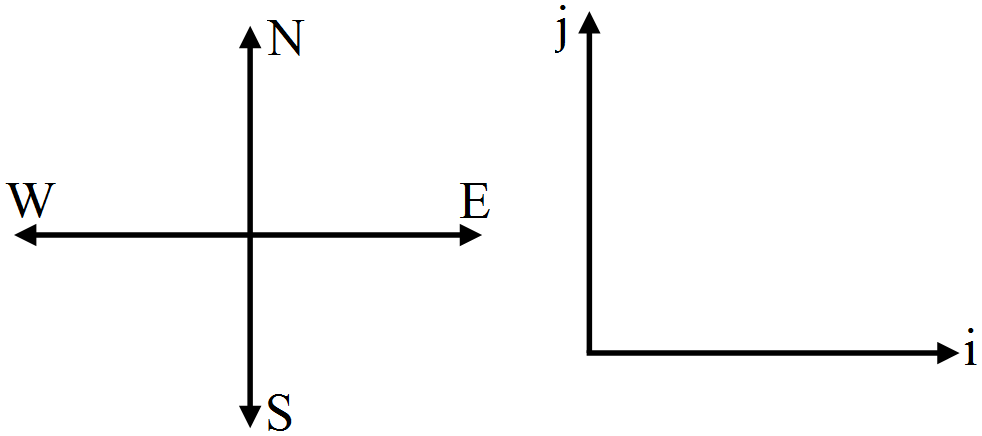
$\text{j}=\text{q}\big(\overrightarrow{\text{i}}\times\overrightarrow{\text{B}}\big)$
$\Rightarrow\text{B}\otimes$
⇒ The magnetic field may be down ward direction.
View full question & answer
MCQ 21 Mark
An electric current i enters and leaves a uniform circular wire of radius a through diametrically opposite points. A charged particle q moving along the axis of the circular wire passes through its centre at speed v. The magnetic force acting on the particle when it passes through the centre has a magnitude:
  • A
    $\text{qv}\frac{\mu_0\text{i}}{2\text{a}}$
  • B
    $\text{qv}\frac{\mu_0\text{i}}{2\pi\text{a}}$
  • C
    $\text{qv}\frac{\mu_0\text{i}}{\text{a}}$
  • $\text{Zero}$
Answer
Correct option: D.
$\text{Zero}$
Explantion:
As the current is entering and exiting from two diametrically opposite points of a circular coil, the currents in the two semicircular sections are in the opposite direction.
The fields due to the two semi-circular sections at the centre is in the opposite direction.
Hence net feild is zero.
View full question & answer
MCQ 31 Mark
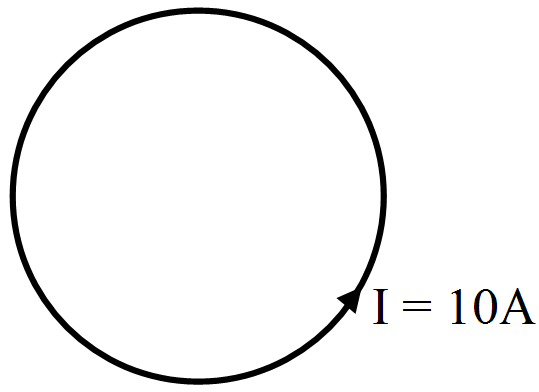
A circular loop of area $1\ cm^2$, carrying a current of $10A,$ is placed in a magnetic field of $0.1T$ perpendicular to the plane of the loop. The torque on the loop due to the magnetic field is:
  • Zero
  • B
    $10^4N-m$
  • C
    $10^2N-m$
  • D
    $1N-m$
Answer
Correct option: A.
Zero

$B = 0.1T$
Area $ = 1\ cm^2$
Net torque on the loop due to the uniform magnetic field is always zero.
View full question & answer
MCQ 41 Mark
Which of the following particles will describe the smallest circle when projected with the same velocity perpendicular to a magnetic field?
  • Electron
  • B
    Proton
  • C
    $He^+$
  • D
    $Li^+$
Answer
Correct option: A.
Electron

$\text{F}=\text{q}\text{VB}=\frac{\text{mv}^2}{\text{r}}$
$\text{r}=\frac{\text{mV}}{\text{qB}}$
charqe electron $=$ charqe of proton $=$ charqe of $He^+=$ charqe of $Li^+$ But mass of electron is Lowest.
$\therefore ($the electron so smallest $+$ circle made by$)$

View full question & answer
MCQ 51 Mark
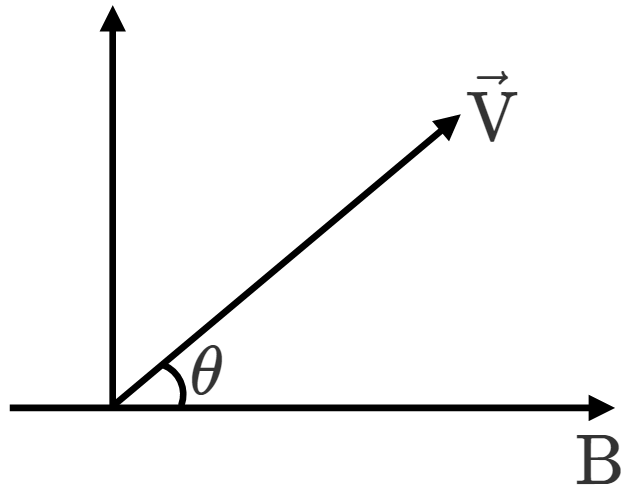
A charged particle moves in a uniform magnetic field. The velocity of the particle at some instant makes an acute angle with the magnetic field. The path of the particle will be:
  • A
    A straight line.
  • B
    A circle.
  • A helix with uniform pitch.
  • D
    A helix with nonuniform pitch.
Answer
Correct option: C.
A helix with uniform pitch.
Explanation:

$\vec{\text{F}}=\text{q}(\vec{\text{V}}\times\vec{\text{B}})=\text{qvB}\sin\theta$
Megnetic force doesn't change the speed of the particle. It change the direction of the velocity of the particle.
V $\cos\theta$ provide the displacement of the particle in Horizontal direction & force is provide the centripetal acceleration of the particle.
So the path of the particle will be a helix with uniform pitch.
View full question & answer
MCQ 61 Mark
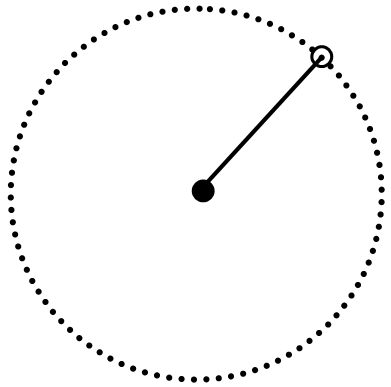
A charged particle is whirled in a horizontal circle on a frictionless table by attaching it to a string fixed at one point. If a magnetic field is switched on in the vertical direction the tension in the string.
  • A
    Will increase.
  • B
    Will decrease.
  • C
    Will remain the same.
  • May increase or decrease.
Answer
Correct option: D.
May increase or decrease.

$B = B_0j$
The tension is the strong may increases or decreases.
View full question & answer
MCQ 71 Mark
A beam consisting of protons and electrons moving at the same speed goes through a thin region in which there is a magnetic field perpendicular to the beam. The protons and the electrons:
  • A
    Will go undeviated.
  • B
    Will be deviated by the same angle and will not separate.
  • Will be deviated by different angles and hence separate.
  • D
    Will be deviated by the same angle but will separate.
Answer
Correct option: C.
Will be deviated by different angles and hence separate.
$\vec{\text{F}}=\text{q}(\text{V}\times\text{B})$
Charge proton is poritive $= e$
$F_p= evB$
Charge of electron is negative $= -e$
$F_e= -evB$
They will be deviated by different angles and Hence separate.
View full question & answer
MCQ 81 Mark
Which of the following particles will experience maximum magnetic force circle when projected with the same velocity perpendicular to a magnetic field?
  • A
    Electron
  • B
    Proton
  • C
    $\mathrm{He}^{+}$
  • $\mathrm{Li}^{++}$
Answer
Correct option: D.
$\mathrm{Li}^{++}$
$|\text{F}|=|\text{qVB}|$
charge of $\mathrm{Li}^{++} > $ charge of $( He^+$, proton, electron$)$
View full question & answer
MCQ 91 Mark
If a charged particle moves unaccelerated in a region containing electric and magnetic fields,
  • A
    $\overrightarrow{\text{E}}$ must be perpendicular to $\overrightarrow{\text{B}}$
  • B
    $\overrightarrow{\text{V}}$ must be perpendicular to $\overrightarrow{\text{E}}$
  • C
    $\overrightarrow{\text{V}}$ must be perpendicular to $\overrightarrow{\text{B}}$
  • Both $A$ and $B$
Answer
Correct option: D.
Both $A$ and $B$
$\Rightarrow\text{E}\perp\overrightarrow{\text{B}}\ \&\ \overrightarrow{\text{V}}\perp\overrightarrow{\text{E}}$
View full question & answer
MCQ 101 Mark
Two ions have equal masses but one is singly$-$ionised and the other is doubly$-$ionised. They are projected from the same place in a uniform magnetic field with the same velocity perpendicular to the field.
  • A
    Both ions will move along circles of equal radii.
  • B
    The circle described by the singly$-$ionised charge will have a radius that is. double that of the other circle.
  • C
    The two circles do not touch each other.
  • Both $B$ and $D$
Answer
Correct option: D.
Both $B$ and $D$
$\text{r}=\frac{\text{mv}}{\text{qB}}$
If charge of singly ionized $= e$
Then charge of doubly ionized $= ze$
The circle described by the singly $-$ ionized charge will have a radius double that of the other circle.
The two circle touch each other because brojected from the same place.
View full question & answer
MCQ 111 Mark
Which of the following particles will have minimum frequency of revolution when projected with the same velocity perpendicular to a magnetic field?
  • A
    Electron
  • B
    Proton
  • C
    $He^+$
  • $Li^+$
Answer
Correct option: D.
$Li^+$
$\text{T}=\frac{2\pi\text{r}}{\text{v}\bot}\ ...(1)$
$\text{r}=\frac{\text{mv}_1}{\text{qB}}$
$\frac{\text{r}}{\text{v}\bot}=\frac{\text{m}}{\text{qB}}\ ...(2)$
from eq. $(1) \ (2)$ we get
$\text{T}=\frac{2\pi\text{m}}{\text{qB}}$
$\text{f}=\frac{1}{\text{T}}=\frac{\text{qB}}{2\pi\text{m}}$
Charge of all these particles are same but mass of $Li^+$ is Highest.
$\therefore\text{ mass}\uparrow,\ \text{f}\downarrow$
View full question & answer
MCQ 121 Mark
If a charged particle at rest experiences no electromagnetic force:
  • A
    The electric field must be zero.
  • B
    The magnetic field must be zero.
  • C
    The magnetic field may or may not be zero.
  • Both $A$ and $D$
Answer
Correct option: D.
Both $A$ and $D$
Force on charged particle in an electric eld, $\text{F} = \text{qE} \ ...(1)$
Force on charged particle in a magnetic eld $\text{F} = \text{q} (\text{v}\times\text{b}) = \text{qvB} \sin\theta \ ...(2) $
Where boldface letter represent vector nature of that quantity, $q$ is charge of the particle, $v$ is the velocity of the particle $($if any$)$, and $\theta$ is the angle between velocity and magnetic eld.
From $(1), F_E= 0$ only when either $q = 0$ or $E = 0.$
Let $q ≠ 0,$ and $F ≠ 0$, then we must have $E ≠ 0$
From (2), if $q ≠ 0, v ≠ 0$ and $B ≠ 0$ even then $F_B$ can be 'zero' because of $θ = 0^\circ$ or $180^\circ$
View full question & answer
MCQ 131 Mark
A charged particle moves along a circle under the action of possible constant electric and magnetic fields. Which of the following are possible?
  • A
    $\text{E}=0,\ \text{B}=0$
  • $\text{E}=0,\ \text{B}\not=0$
  • C
    $\text{E}\not=0,\ \text{B}=0$
  • D
    $\text{E}\not=0,\ \text{B}\not=0$
Answer
Correct option: B.
$\text{E}=0,\ \text{B}\not=0$
Explanation:
A charged particle moves along a circle that mean Magnetic force is provides centripetal force that causes particle is move in a circle.
So, $\text{E}=0,\ \text{B}\not=0$
View full question & answer
MCQ 141 Mark
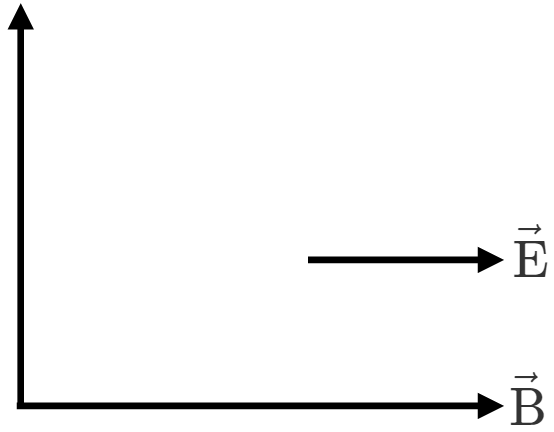
A particle moves in a region having a uniform magnetic field and a parallel, uniform electric field. At some instant, the velocity of the particle is perpendicular to the field direction. The path of the particle will be:
  • A
    A straight line.
  • B
    A circle.
  • C
    A helix with uniform pitch.
  • A helix with nonuniform pitch.
Answer
Correct option: D.
A helix with nonuniform pitch.
Explanation:

$\text{F}=\text{q}\vec{\text{E}}+\text{q}(\vec{\text{V}}\times\vec{\text{B}})$
$\text{F}=\text{q}\vec{\text{E}}$ provides the acceleration in 'x' direction.
$\text{F}_2=\text{}\text{q}(\vec{\text{V}}\times\vec{\text{B}})$ provides the centripetal Force.
The path of the particle will be ahelix with nonuniform pitch.
View full question & answer