MCQ 11 Mark
The greatest number which always divides the product of the predecessor and successor of an odd natural number other than $1$, is:
AnswerLet an odd natural number other than $1$ be $3$.
Then, predecessor of $3 = 3 - 1 = 2$ and successor of $3 = 3 + 1 = 4$
$\therefore$ Their product $= 2 \times 4 = 8$
$LCM$ of predecessor and successor i.e.
$\begin{array}{c|c}2&2,4\\ \hline2&1,2\\ \hline&1,1\end{array}$
$= 2 \times 2= 4$
Hence, the greatest number which always divides the product of predecessor and successor of an odd natural number other than $1$, is $4$.
View full question & answer→MCQ 21 Mark
Which of the following statements is not true?
- A
Both addition and multiplication are associative for whole numbers.
- ✓
Zero is the identity for multiplication of whole numbers.
- C
Addition and multiplication both are commutative for whole numbers.
- D
Multiplication is distributive over addition for whole numbers.
AnswerCorrect option: B. Zero is the identity for multiplication of whole numbers.
We know that, zero is not the identity for multiplication of whole numbers, i.e. $a \times 0 = 0$, where a is any whole number.
View full question & answer→MCQ 31 Mark
- A
$1$ lakh
- ✓
$10$ lakh
- C
$1$ crore
- D
$10$ crore
AnswerCorrect option: B. $10$ lakh
We know that, $1$ million $= 1000000 = 10$ lakh
View full question & answer→MCQ 41 Mark
The product of successor and predecessor of $999$ is:
- A
$999000$
- ✓
$998000$
- C
$989000$
- D
$1998$
AnswerCorrect option: B. $998000$
We know that, the successor of a whole number is the number obtained by adding $1$ to it and the predecessor of a whole number is one less than the given number.
So, the successor of $999 = 999 + 1 = 1000$ and the predecessor of $999 = 999 - 1 = 998$
Product of successor and predecessor of $999 = 1000 \times 998 = 998000$
View full question & answer→MCQ 51 Mark
Which of the following numbers in roman numerals is incorrect?
AnswerWe know that, the symbols $V, L$ and $D$ can never be repeated.
So, $LLX$ is incorrect.
View full question & answer→MCQ 61 Mark
The expanded form of the number $9578$ is:
- A
$9 \times 10000 + 5 \times 1000 + 7 \times 10 + 8 \times 1$
- ✓
$9 \times 1000 + 5 \times 100 + 7 \times 10 + 8 \times 1$
- C
$9 \times 1000 + 57 \times 10 + 8 \times 1$
- D
$9 \times 100 + 5 \times 100 + 7 \times 10 + 8 \times 1$
AnswerCorrect option: B. $9 \times 1000 + 5 \times 100 + 7 \times 10 + 8 \times 1$
Given number is $9578.$
On expanding $9578$, we get $9578 = 9 \times 1000 + 5 \times 100 + 7 \times 10 + 8 \times 1$
[writing each digit as its place value]
View full question & answer→MCQ 71 Mark
Which of the following statements is not true?
- A
$0 + 0 = 0$
- B
$0 - 0 = 0$
- C
$0 \times 0 = 0$
- ✓
$\frac{0}{0}=0$
AnswerCorrect option: D. $\frac{0}{0}=0$
Since, division of zero-by-zero is not defined.
Note If we divide any number by $0$, then it is not defined (infinite).
View full question & answer→MCQ 81 Mark
The smallest $4$-digit number having three different digits is:
- A
$1102$
- B
$1012$
- C
$1020$
- ✓
$1002$
AnswerCorrect option: D. $1002$
For smallest number, we write the digits in ascending order.
So, the smallest $4$-digit number having three different digits is $1002.$
View full question & answer→MCQ 91 Mark
The predecessor of $1$ lakh is:
- A
$99000$
- ✓
$99999$
- C
$999999$
- D
$100001$
AnswerCorrect option: B. $99999$
To get predecessor of a number, we subtract $1$ from the given number.
So, the predecessor of $1$ lakh $= 100000 - 1 = 99999$
View full question & answer→MCQ 101 Mark
In Indian system of numeration, the number $58695376$ is written as:
- A
$58, 69, 53, 76$
- B
$58, 695, 376$
- ✓
$5, 86, 95, 376$
- D
$586, 95, 376$
AnswerCorrect option: C. $5, 86, 95, 376$
According to the Indian system of numeration, the number $58695376$ will be written as
$5, 86, 95, 376$
Note In Indian system of numeration, we use different periods like ones, thousands, lakhs, crores, etc., to read the large number easily. A comma $(,)$ is used to differentiate the periods. There are two places in each period except ‘units’.
View full question & answer→MCQ 111 Mark
Number of even numbers between $58$ and $80$ is:
AnswerSince, even numbers between $58$ and $80$ are $60, 62, 64, 66, 68, 70, 72, 74, 76$ and $78.$
Total even numbers between $58$ and $80 = 10$
View full question & answer→MCQ 121 Mark
The greatest number which on rounding off to nearest thousands gives $5000$, is:
- A
$5001$
- B
$5559$
- C
$5999$
- ✓
$5499$
AnswerCorrect option: D. $5499$
On rounding off the given numbers to nearest thousands,
we get $5001 \rightarrow 5000$ $5559 \rightarrow 6000$ $5999 \rightarrow 6000$ $5499 \rightarrow 5000$
Out of $5001$ and $5499$, the greatest number is $5499$, which gives $5000$ on rounding off to nearest thousands.
View full question & answer→MCQ 131 Mark
The number of common prime factors of $75, 60$ and $105$ is:
AnswerPrime factorization of $75, 60$ and $105$.
$\begin{array}{c|c}3&75 \\\hline5&25 \\\hline5&5 \\\hline&1\end{array}$
$\begin{array}{c|c}2&60 \\\hline2&30 \\\hline3&15 \\\hline5&5 \\\hline&1\end{array}$
$75 = 3 \times 5 \times 5$
$60 = 3 \times 5 \times 2 \times 2$
$105 = 3 \times 5 \times 1 \times 7$
Common factors of $75, 60$ and $105$ are $3$ and $5$.
Hence, the number of common prime factors of $75, 60$ and $105$ is $2$.
View full question & answer→MCQ 141 Mark
Number of whole numbers between $38$ and $68$ is:
AnswerWhole numbers between $38$ and $68$ are $39, 40, 41,42, 43, 44, 45, 46, 47, 48, 49, 50, 51,52, 53, 54, 55, 56, 57, 58, 59, 60, 61, 62, 63,$ $64, 65, 66$ and $67$.Total whole numbers between $38$ and $68 = 29$
Alternate Method
Let $a = 38$ and $b = 68$
Then, number of whole numbers between $a$ and $b = b - a -1$ [when $b > a$]
Number of whole numbers between $38$ and $68 = 68 - 38 - 1 = 29$
View full question & answer→MCQ 151 Mark
A number is divisible by $5$ and $6$. It may not be divisible by:
AnswerAny number divisible by $5$ and $6$ will be either $30$ or multiple of $30$, but $30$ is not divisible by $60$.
View full question & answer→MCQ 161 Mark
Which of the following numbers is divisible by $11$?
- A
$1011011$
- B
$1111111$
- ✓
$22222222$
- D
$3333333$
AnswerCorrect option: C. $22222222$
A number is divisible by $11$, if the difference of the sum of the digits on even places and odd places is either $0$ or divisible by $11.$
From option $(a)$, we get
Sum of the digits at even places $= 1 + 1 + 0 = 2$
Sum of the digits at odd places $= 1 + 0 +1 + 1 = 3$
Difference $= 3 - 2 = 1$
It is not divisible by $11.$
From option $(b)$, we get
Sum of the digits at even places $= 1 + 1 + 1 = 3$
Sum of the digits at odd places $= 1 + 1 + 1 + 1 = 4$
Difference $= 4 - 3 = 1$
It is not divisible by $11.$
From option $(c),$ we get
Sum of the digits at even places $= 2 + 2 + 2 + 2 = 8$
Sum of the digits at odd places $= 2 + 2 + 2 + 2 = 8$
Difference $= 8 - 8 = 0$
It is divisible by $11.$
From option $(d),$ we get
Sum of the digits at even places $= 3 + 3 + 3 = 9$
Sum of the digits at odd places $= 3 + 3 + 3 + 3 = 12$
Difference $= 12 - 9 = 3$
It is not divisible by $11.$
Hence, $22222222$ is divisible by $11.$
View full question & answer→MCQ 171 Mark
The successor of $1$ million is:
- A
$2$ million
- ✓
$1000001$
- C
$100001$
- D
$10001$
AnswerCorrect option: B. $1000001$
To get successor of a number, we add $1$ to the given number.
So, the successor of $1$ million $= 1000000 + 1 = 1000001$
View full question & answer→MCQ 181 Mark
If the number $7254 * 98$ is divisible by $22$, then the digit at $*$ is:
AnswerWe know that, smallest $5$-digit number $= 10000$ Prime factors of $10000$
$\begin{array}{c|c}2&10000\\ \hline2&5000\\ \hline2&2500\\ \hline2&1250\\ \hline5&625\\ \hline5&125\\ \hline5&25\\ \hline5&5\\ \hline&5\end{array}$
i.e. $10000 = 2^4\times 5^4$
Hence, the number of distinct prime factors of the smallest $5$-digit number is $2$.
View full question & answer→MCQ 191 Mark
Keeping the place of $6$ in the number $6350947$ same, the smallest number obtained by rearranging other digits is:
- A
$6975430$
- B
$6043579$
- ✓
$6034579$
- D
$6034759$
AnswerCorrect option: C. $6034579$
The digits in the given number $6350947$ are $6, 3, 5, 0, 9, 4$ and $7$.
Keeping the digit $6$ at ten lakh’s place, the rest of the digits fill other places like lakh, ten thousands, thousand, hundreds, tens and ones place by decreasing order of remaining number, i.e. $0, 3, 4, 5, 7, 9.$
Hence, the required smallest number is $6034579.$
View full question & answer→MCQ 201 Mark
The largest number which always divides the sum of any pair of consecutive odd numbers is:
AnswerThe smallest pair of consecutive odd numbers is $1$ and $3$.
Their sum $= 1 + 3 = 4$, which is divisible by $4$.
View full question & answer→MCQ 211 Mark
If $1$ is added to the greatest $7$-digit number, it will be equal to:
- A
$10$ thousand
- B
$1$ lakh
- C
$10$ lakh
- ✓
$1$ crore
AnswerCorrect option: D. $1$ crore
Greatest $7$-digit number $= 9999999$
On adding $1$ to greatest $7$-digit number,
we get $9999999 + 1 = 10000000 , = 1$ crore
View full question & answer→MCQ 221 Mark
The product of the place values of two $2’s$ in $428721$ is:
- A
$4$
- B
$40000$
- ✓
$400000$
- D
$40000000$
AnswerCorrect option: C. $400000$
The given number is $428721.$
According to the question,
The place value of first $2 = 2 \times 10 = 20$ [it is at ten’s place]
and the place value of second $2 = 2 \times 10000 = 20000$ [it is at ten thousand’s place]
Their product $= 20 \times 20000 = 400000$
Hence, the product of the place values of two $2’s$ in $428721$ is $400000.$
View full question & answer→MCQ 231 Mark
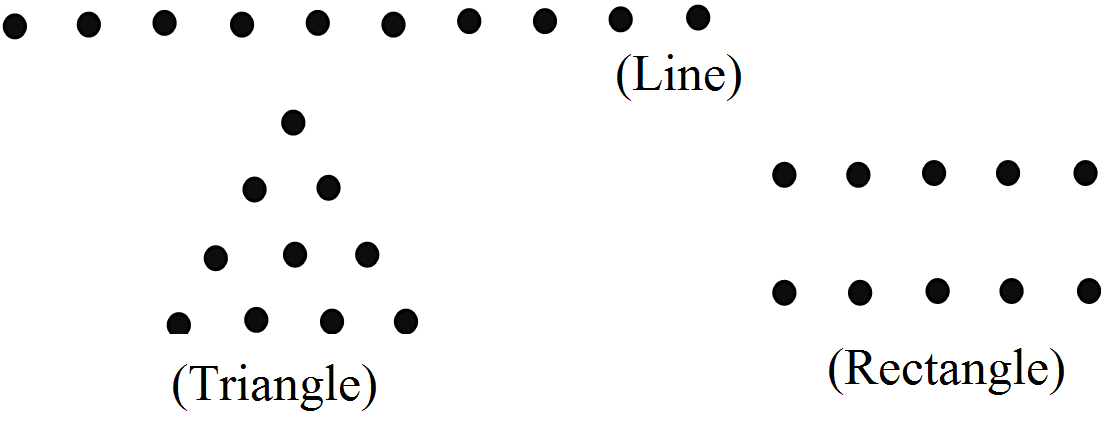
By using dot $(.)$ patterns, which of the following numbers can be arranged in all the three ways, namely a line, a triangle and rectangle?
AnswerBy using $10$ dots, we can make a line, a triangle and a rectangle.
View full question & answer→MCQ 241 Mark
The number of distinct prime factors of the largest $4$-digit number is:
AnswerWe know that, largest $4$-digit number $= 9999$ Prime factors of $9999$
$\begin{array}{c|c}3&9999\\ \hline3&3333\\ \hline11&1111\\ \hline101&101\\ \hline&1\end{array}$
i.e. $9999 = 3^2\times 11 \times 101$
Hence, the number of distinct prime factors of the largest $4$-digit number is $3$.
View full question & answer→MCQ 251 Mark
Which of the following is not true?
- A
$(7 + 8) + 9 = 7 + (8 + 9)$
- B
$(7 \times 8) \times 9 = 7 \times (8 \times 9)$
- ✓
$7 + 8 \times 9 = (7 + 8) \times (7 + 9)$
- D
$7 \times (8 + 9) = (7 \times 8) + (7 \times 9)$
AnswerCorrect option: C. $7 + 8 \times 9 = (7 + 8) \times (7 + 9)$
$a.$ We have, $(7 + 8) + 9 = 7 + (8 + 9)$
$\text{LHS} = (7 + 8) + 9 = 15 + 9 =24$
$\text{RHS} = 7 + (8 + 9) = 7 + 17=24$
$\text{LHS} = \text{RHS}$ So, it is true.
$b.$ We have, $(7 \times 8) \times 9 = 7 \times (8 \times 9)$
$\text{LHS} = (7 \times 8) \times 9= 56 \times 9 = 504$
$\text{RHS} = 7 \times (8 \times 9)= 7 \times 72 = 504$
$\text{LHS} = \text{RHS}$ So, it is true.
$c.$ We have, $7 + 8 \times 9 = (7 + 8) \times (7 + 9)$
$\text{LHS} = 7 + 8 \times 9 = 7 + 72 = 79$
$\text{RHS} = (7 + 8) \times (7 + 9)=15 \times 16 = 240$
$\therefore 79 \neq 240$
$\therefore$ $\text{LHS} \neq \text{RHS}$ So, it is false.
$d.$ We have, $7 \times (8 + 9) = (7 \times 8) + (7 \times 9)$
$\text{LHS} = 7 \times (8 + 9)=7 \times 17 = 119$
$\text{RHS} = (7 \times 8) + (7 \times 9) = 56 + 63=119$
$\therefore \text{LHS} = \text{RHS}$ So, it is true.
View full question & answer→MCQ 261 Mark
The largest $5$-digit number having three different digits is:
- A
$98978$
- B
$99897$
- ✓
$99987$
- D
$98799$
AnswerCorrect option: C. $99987$
For greatest number, we write the digits in descending order.
So, the greatest $5$-digit number having three different digits is $99987.$
View full question & answer→MCQ 271 Mark
$LCM$ of $10, 15$ and $20$ is:
AnswerPrime factorization of $10,15$ and $20$
$\begin{array}{c|c}2&10,15,20\\\hline2&5,15,10\\\hline3&5,15,5\\\hline5&5,5,5\\\hline&1,1,1,\end{array}$
$LCM$ of $10, 15$ and $20 = 22 \times 3 \times 5 = 60$
View full question & answer→MCQ 281 Mark
Which of the following pairs is not coprime?
- ✓
$8, 10$
- B
$11, 12$
- C
$1, 3$
- D
$31, 33$
AnswerCorrect option: A. $8, 10$
We know that, if $HCF$ of a pair of numbers is $1$, then they are called coprimes.
So, $8$ and $10$ are not coprimes.
View full question & answer→MCQ 291 Mark
The largest $4$-digit number, using any one digit twice from digits $5, 9, 2$ and $6$, is:
- A
$9652$
- B
$9562$
- C
$9659$
- ✓
$9965$
AnswerCorrect option: D. $9965$
Given digits are $5, 9, 2$ and $6$.
Descending order of the given digits is $9, 6, 5, 2.$
Since, we can use any one digit twice, so the required largest $4$-digit number is $9965$
View full question & answer→MCQ 301 Mark
$3 \times 10000 + 7 \times 1000 + 9 \times 100 + 0 \times 10 + 4$ is the same a:
- A
$3794$
- B
$37940$
- ✓
$37904$
- D
$379409$
AnswerCorrect option: C. $37904$
We have,
$3 \times 10000 + 7 \times 1000 + 9 \times 100 + 0 \times 10 + 4$ [by simplification]
$= 30000 + 7000 + 900 + 0 + 4 = 37904$
View full question & answer→MCQ 311 Mark
$5$ When rounded off to nearest thousands, the number $85642$ is:
- A
$85600$
- B
$85700$
- C
$85000$
- ✓
$86000$
AnswerCorrect option: D. $86000$
$85642$ rounded off to nearest thousands $= 86000$
View full question & answer→MCQ 321 Mark
Sum of the numbers of primes between $16$ to $80$ and $90$ to $100$ is:
AnswerSince, prime numbers between $16$ to $80$ are $17,19, 23, 29, 31, 37, 41,43, 47, 53, 59, 61,67, 71,73$ and $79$.
Total prime numbers between $16$ to $80 = 16$
And prime numbers between $90$ to $100 = 97$
Total number of prime numbers between $90$ to $100 = 1$
Sum of the numbers of primes between $16$ to $80$ and $90$ to $100 = 16 + 1 = 17$
View full question & answer→MCQ 331 Mark
If the number $7254 * 98$ is divisible by $22$, then the digit at $*$ is:
AnswerWe know that, if a number is divisible by two coprime numbers, then it is divisible by their product also.
If $7254 * 98$ is divisible by $22$, then it must be divisible by $2$ and $11$ both.
Since, the last digit is $8$, so it is divisible by $2$. Now, for divisibility by $11$, the difference of sum of digits on even and odd places must be either zero or divisible by $11$.
Sum of digits at even places $= 9 + 4 + 2 = 15$
Sum of digits at odd places $= 8 + * + 5 + 7 = 20 + *$
Required difference $= (20 + *) - 15 = 5 + *$
For divisibility by 1$1, 5 + * = 11 * = 6$
Hence, the digit at $*$ is $6.$
View full question & answer→MCQ 341 Mark
The product of a non-zero whole number and its successor is always:
AnswerSince, the product of a non-zero whole number and its successor is always an even number, e.g.
$6 \times 7 = 42 13 \times 14 = 182$
View full question & answer→MCQ 351 Mark
$LCM$ of two numbers is $180$. Then, which of the following is not the $HCF$ of the numbers?
Answer$LCM$ must be divisible by $HCF.$
Now, $180$ is not divisible by $75.$
e.g. Let the two numbers be $4$ and $8.$
Then, $HCF$ of $4$ and $8 = 4$ and $LCM$ of $4$ and $8 = 8$
$\therefore$ $LCM + HCF = 8 + 4 = 2$
View full question & answer→MCQ 361 Mark
A whole number is added to $25$ and the same number is subtracted from $25$. The sum of the resulting numbers is:
AnswerLet $x$ be any whole number.
According to the question,
$(x + 25) + (25 - x) = x + 25 + 25 - x = 50$
View full question & answer→