Questions

2 Marks Questions

🎯

Test yourself on this topic

6 questions · timed · auto-graded

Question 12 Marks
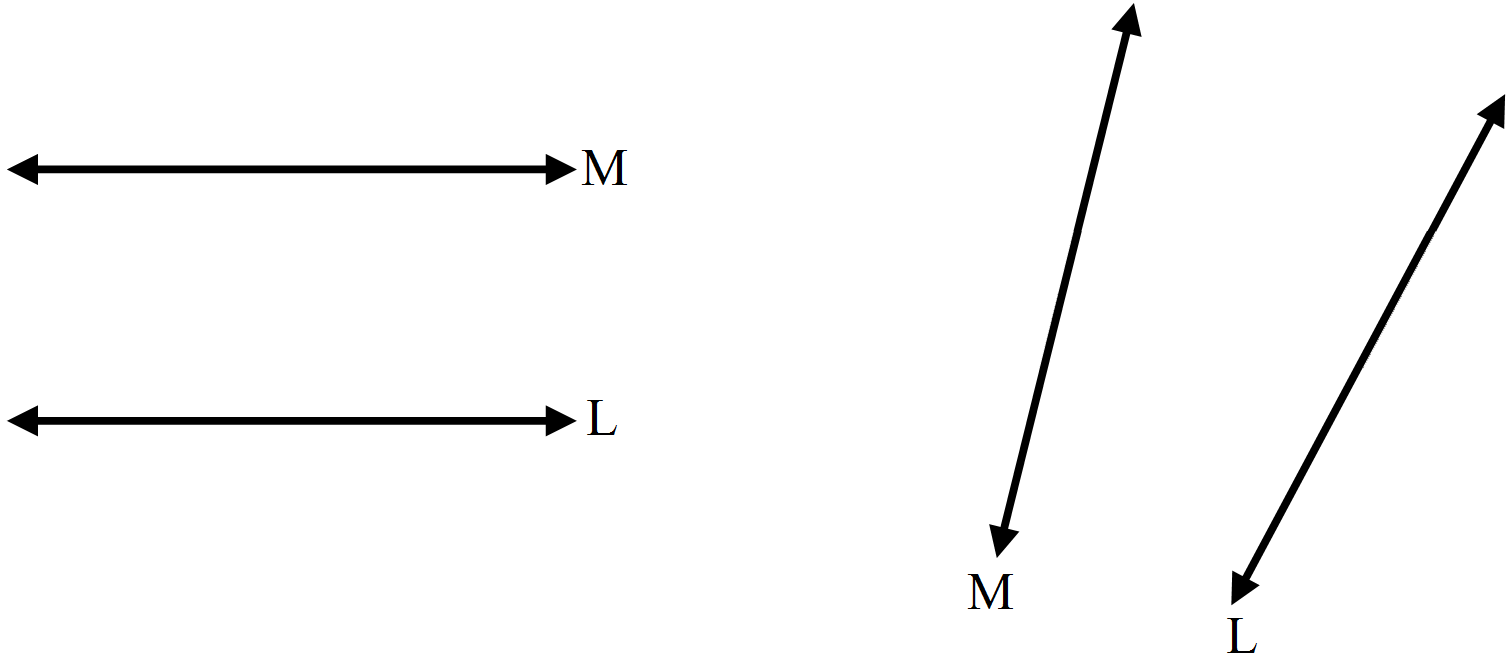
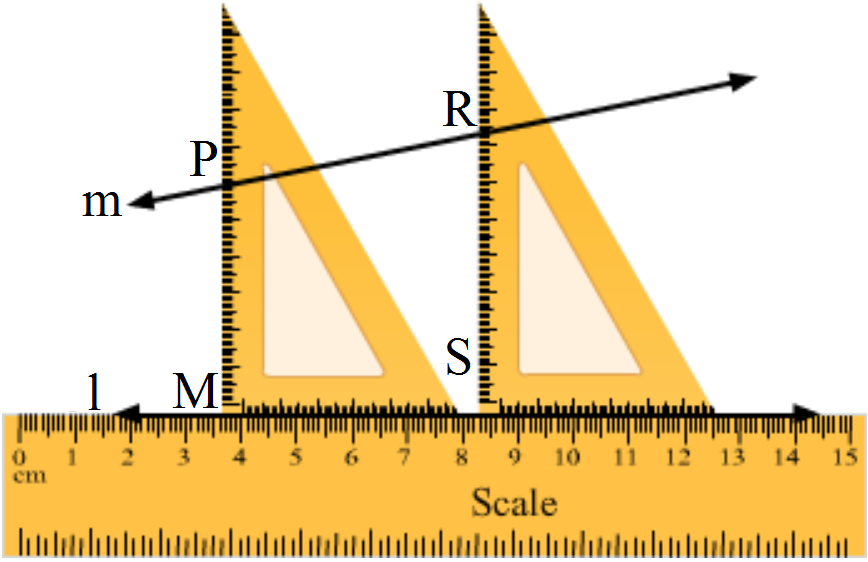
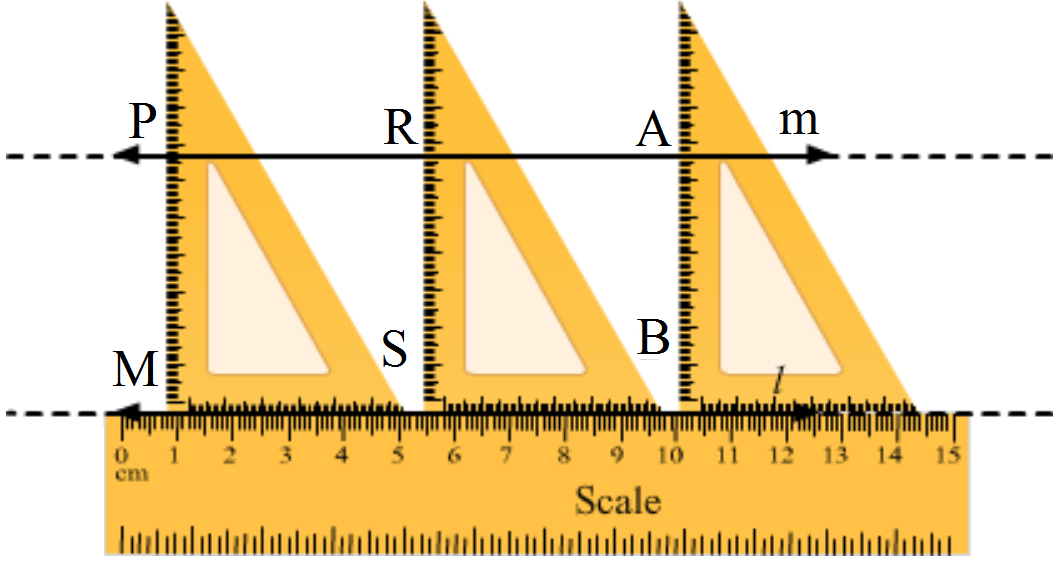
Using a set square and a ruler, test whether $l \| m$ in the following cases:
Answer
Place the ruler so that one of its measuring edges lies along the line $l.$Hold it firmly with one hand.
Now place a set square with one arm of the right angle coinciding with the edge of the ruler.
Draw line segments between $l$ and $m$ (say $PM, RS, AB$) with the set square.
Now, we see that $PM = AB = RS$.
Thus, we can say that $l \| m.$
View full question & answer
Question 22 Marks
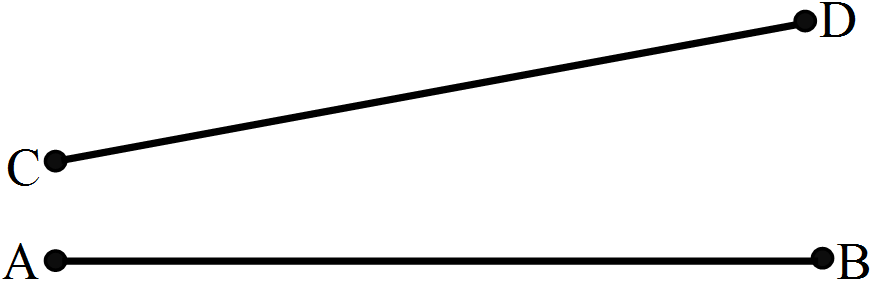
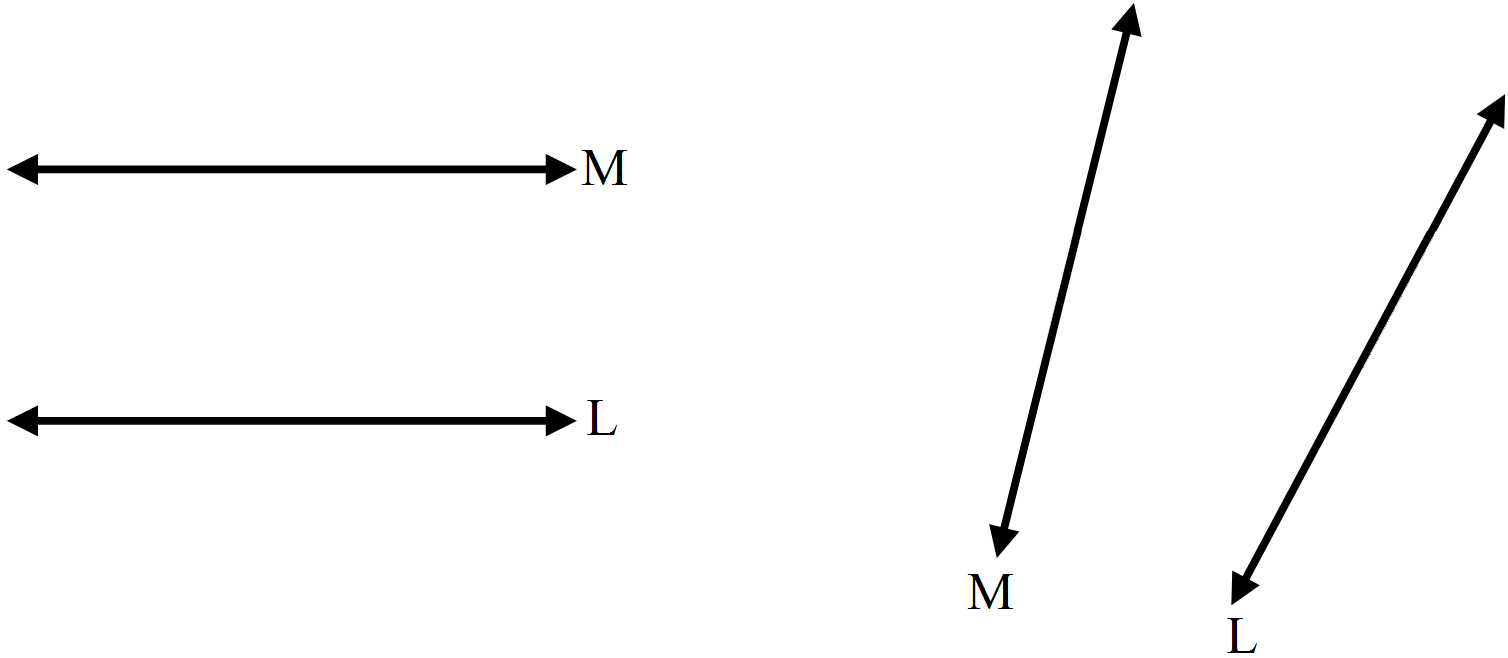
In the figure, do the segments $AB$ and $CD$ intersect? Are they parallel? Give reasons for your answer.
Answer
Line segments $AB$ and $CD$ will intersect if they are produced endlessly towards the ends $A$ and $C$, respectively. Therefore, they are not parallel to each other.
View full question & answer
Question 32 Marks
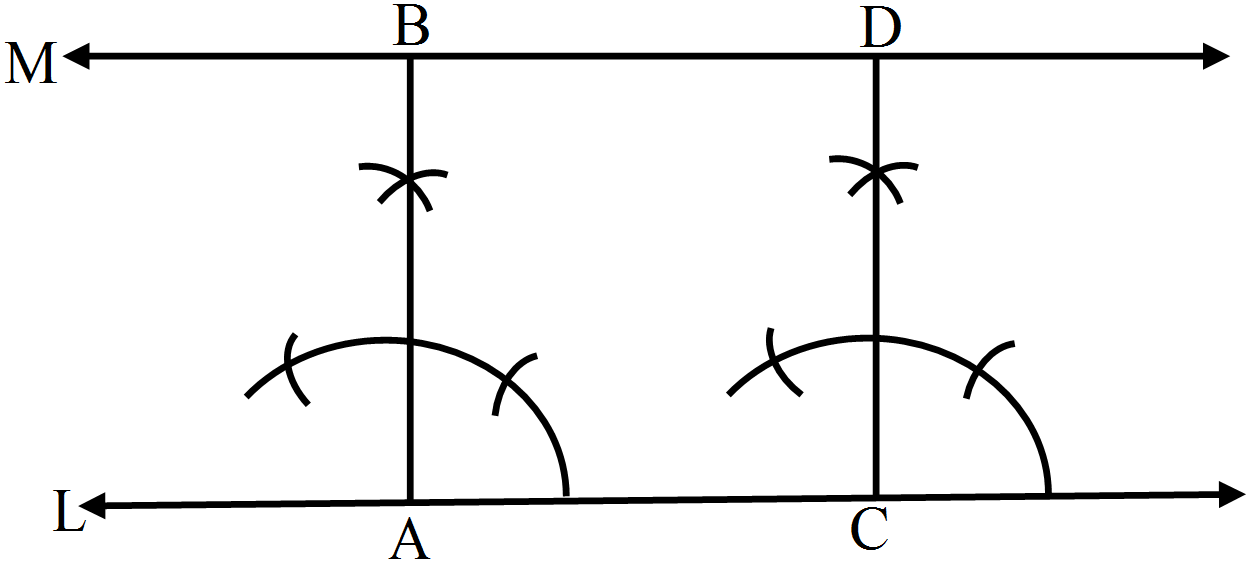
In the figure, $l\ ||\ m$. If $\text{AB}\perp\text{l}$ and $AB = 2.3\ cm$, find $CD.$
Answer
At point $A, AB$ is the perpendicular distance between $l$ and $m$.
At point $C, CD$ is the perpendicular distance between $l$ and $m.$
The perpendicular distance between two parallel lines is same at all points.
Therefore, $CD = AB = 2.3\ cm$
View full question & answer
Question 42 Marks
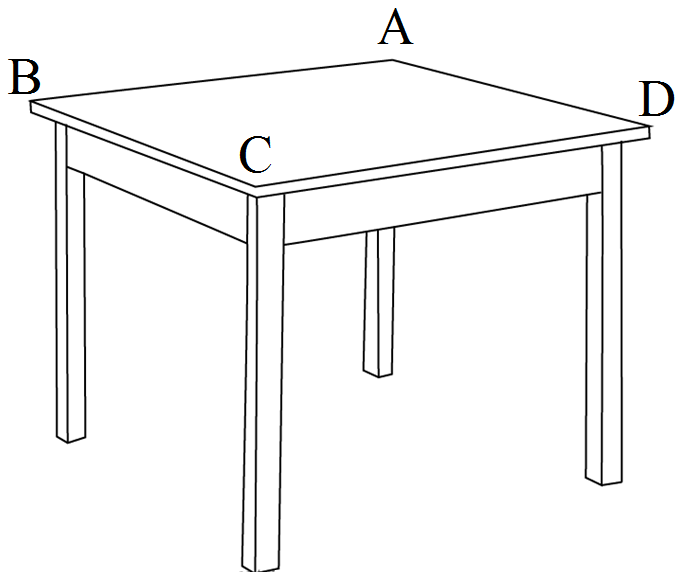
In the figure of a table given below, name the pairs of parallel edges of the top.
Answer
Following are the parallel edges of the top: $AD \| BC$ This is because $AD$ and $BC$ will not intersect even of both these line segments are produced to infinity in both the directions. $AB \| DC$ This is because $AB$ and $DC$ will not intersect even if both these line segments are produced to infinity in both the directions.
View full question & answer
Question 52 Marks
Using a set square and a ruler, test whether $l \| m$ in the following cases:
Answer
In this case, we see that when we draw line segments between l and m, they are unequal, i.e., $PM$ neq $RS$. Therefore, l is not parallel to m.
View full question & answer
Question 62 Marks
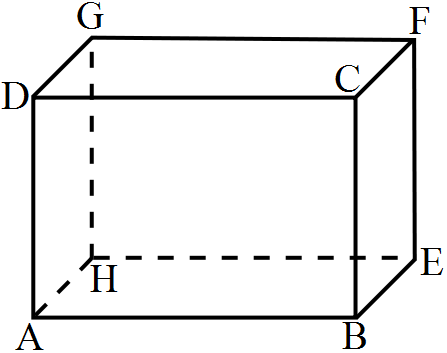
Name the group of all possible parallel edges of the box whose figure is shown below.
Answer
The groups of parallel edges are $(AD \| GH \| BC \| FE), (AB \| DC \| GF \| HE)$ and $(AH \| BE \| CF \| DG).$
The above mentioned groups of edges are parallel because they will not meet each other if produced to infinity to both sides.
View full question & answer
2 Marks Questions - Maths STD 6 Questions - Vidyadip